TL;DR: Vectoron is built for agencies and multi-location businesses that want one platform to plan, execute, and publish content across SEO, PPC, and backlinks all with an approval gate before anything goes live.
Conductor.com is a full enterprise SEO and AEO suite for large organisations that need deep keyword intelligence, AI search performance tracking across nine models and content workflow governance at scale.
Both cover AI visibility, but Conductor tracks it; Vectoron acts on it. If your bottleneck is insight, Conductor wins. If your bottleneck is execution, Vectoron fills that gap.
Vectoron vs Conductor.com: What’s the Difference?
The fundamental difference is what happens after a visibility gap is spotted.
Vectoron is an execution platform. It is built around the idea that knowing your brand is missing from a ChatGPT answer is only half the problem.
You also need someone (or something) to write the content, route it for approval, publish it, and confirm it moved the needle.
Vectoron handles all of that through a Command Center that connects six AI specialist strategists covering content, SEO, PPC, backlinks, social and call intelligence in a single approval-first workflow.
It is priced at $599/month post-trial and is primarily used by agencies, service businesses, and multi-location operators who want to consolidate what was previously a stack of separate tools and freelancers.
Conductor is an enterprise SEO and AEO intelligence platform. It has spent over a decade building one of the most comprehensive keyword research and competitive intelligence databases in the industry.
In recent years, it has added an AI Search Performance module that tracks brand mentions, citations, sentiment, and share of voice across nine AI models including ChatGPT (Auto), ChatGPT (Search), Claude Sonnet, Gemini, Google AI Mode, Google AI Overviews, Grok, Microsoft Copilot, and Perplexity.
Conductor is built for large in-house SEO teams, enterprise brands with multiple websites, and organisations that need deep reporting, governance, and integration with tools like Adobe, Salesforce, and enterprise CMS platforms.
Pricing is not public but it offers a free trial. Third-party reports consistently place contracts between $24,000 and $60,000 per year at the entry level, with enterprise contracts reaching well past $150,000.
The biggest difference: Conductor tells large SEO teams what is happening and what needs to change. Vectoron tells smaller, leaner teams what to do and then does it.
If you need free SEO alternatives, I recommend checking out my roundup on LiteScroll’s free SEO tools.
Vectoron vs Conductor.com at a Glance

| Comparison Criteria | Vectoron | Conductor.com |
|---|---|---|
| Best For | Agencies, multi-location businesses, lean marketing teams | Enterprise SEO teams, Fortune 500 brands, multi-domain organisations |
| Starting Price | $599/month (post 2-week trial) | Approx. $24,000–$60,000/year (not publicly disclosed) |
| Free Plan | No | No |
| Free Trial | 2-week trial; also offers a 7-day execution trial | 3-week free trial (demo required) |
| Main Features | AI strategists for content, SEO, PPC, backlinks, social, call intelligence; Command Center; Brand Intelligence | Keyword research, AI Search Performance, content briefing and generation, 24/7 website monitoring, AEO reporting, ContentKing monitoring |
| SEO Automation | Approval-first execution loop covering content production, internal linking, schema, and CMS publishing | Content briefs, rank tracking, keyword research, technical monitoring via ContentKing acquisition |
| AI Visibility Tracking | Integrated as a signal feeding into execution recommendations; not a standalone tracker | Dedicated AI Search Performance module: 9 AI models tracked across 160+ countries |
| GEO Features | Citation gap analysis feeds into content and backlink recommendations | Full AEO reporting — mentions, citations, sentiment, competitive share of voice, fan-out query analysis |
| Integrations | CMS publishing; call and booking data; API for business signal ingestion | Google Analytics (GA4), Adobe Analytics, Google Search Console, Salesforce, Adobe Experience Manager, Sitecore, WordPress, Jira, Asana, Trello, Slack, Looker Studio, MCP server for Claude, ChatGPT, Copilot |
| Reporting | KPI-linked reports: calls, bookings, cost per lead tracked against published content | Custom dashboards, executive reporting, AEO/SEO performance dashboards, white-label not natively listed |
| Customer Support | Trial-based; “Talk to Our Team” and contact sales pathways available | 24/7 live support, dedicated Customer Success Managers, onboarding for every stakeholder type, phone and chat |
| G2 Rating | Not rated yet | 4.5/5 (832+ reviews as of November 2026) |
| Capterra Rating | Not rated yet | 4.3/5 (2,327+ reviews) |
What Is Vectoron?
Vectoron is an AI-powered marketing execution platform built by Marketing Visionary AI LLC, headquartered in Traverse City, Michigan.
Its pitch is simple: replace the stack of point tools most agencies and marketing teams run.
One for rank tracking, another for content, another for PPC management, another for backlink analysis with a single platform that connects all of those functions and routes every recommendation through a human approval gate before anything goes live.
The platform is structured around six AI specialist strategists:
- Content Strategist: plans, drafts, and schedules written content
- SEO Strategist: covers keyword gaps, on-page recommendations, and schema
- PPC Strategist: manages paid channel recommendations
- Backlink Strategist: identifies link building opportunities and manages outreach
- Social Strategist: handles social publishing and distribution
- Call Intelligence Strategist: ties content and SEO outcomes to calls, bookings, and cost per lead
These strategists operate through a central Command Center, where recommendations are presented, ranked against live business signals (such as booked appointments, inbound call volume, and pipeline data), and queued for review.
Nothing publishes without a named human approver. That is Vectoron’s core governance model.
Its Brand Intelligence layer extracts voice, visual identity, positioning, competitor context, and market data from client websites at setup, so every piece of content the platform generates stays on-brand.
This matters most for agencies managing multiple clients, where brand consistency across dozens of accounts would otherwise require constant manual oversight.
Vectoron is not a traditional SEO platform. It does not have a 20-billion-keyword research database, a 24/7 website crawler, or enterprise compliance features designed for Fortune 500 procurement teams.
What it has is an integrated loop from “we’re missing from this AI search result” to “here is a published article that fills that gap.” That loop is what separates it from most other tools in the AI visibility conversation.
The platform targets agencies, owner-operators, service businesses, and multi-location brands, particularly in sectors like healthcare, home services, and senior living where the same content and SEO challenge needs to be solved across tens or hundreds of locations without proportionally scaling headcount.
What Is Conductor?
Conductor is an enterprise SEO and AEO (Answer Engine Optimisation) platform with over a decade of history in the organic search intelligence market. It is now owned by Conductor, Inc. and serves more than 500 enterprise organisations, including many Fortune 500 brands.
The platform has three major pillars:
Conductor Intelligence covers
- keyword research backed by over 20 billion commercially-focused keywords across 1,000+ location and device combinations
- competitor tracking
- rank tracking with share-of-voice reporting, and since 2025
- a fully rebuilt AI Search Performance module that tracks brand performance across nine AI models in over 160 countries
Conductor Creator handles
- AI-assisted content generation, content briefing
- real-time optimisation scoring for writers
- an AI Topic Map tool that helps teams build topical authority across a site
- content guidance is built into the platform so that SEO-informed recommendations flow directly into the writing environment.
Conductor Monitoring (powered by its 2022 acquisition of ContentKing) provides 24/7 real-time website monitoring. It tracks page changes as they happen, alerts teams when technical SEO elements break, and maintains audit trails for governance.
This is one of the capabilities that sets Conductor apart from most enterprise SEO competitors: monitoring is not a periodic crawl, it is continuous.
Conductor added AI Search Performance in 2025 and rebuilt it substantially in early 2026.
As of now, the module tracks mentions, citations, sentiment, fan-out query behaviour, and competitive share of voice across ChatGPT (Auto), ChatGPT (Search), Claude Sonnet, Gemini, Google AI Mode, Google AI Overviews, Grok (Auto), Microsoft Copilot, and Perplexity.
It supports over 160 countries and includes an API for pulling this data into external workflows.
Conductor was named a Forrester Wave Leader in 2025 for AI-integrated SEO, which is the kind of independent validation enterprise procurement teams take seriously.
The platform is built for large SEO organisations; teams with 5+ dedicated SEO and content practitioners, multi-domain footprints, and budgets that justify a five- to six-figure annual commitment.
It is not designed for freelancers, small agencies, or solo website owners.
Vectoron vs Conductor.com: Feature by Feature Comparison
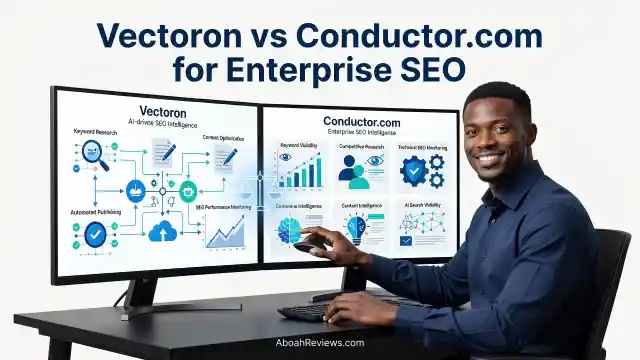
The features that matter most in this comparison are AI visibility tracking, automation depth, ease of use for different team sizes, and what each platform actually does once a gap is identified.
1. Core Features and Capabilities
Vectoron: The platform’s core capability is the approval-first execution loop. Users set up Brand Intelligence by pointing Vectoron at their website and competitors.
The system ingests client context: voice, products, positioning, service areas and uses that to generate and rank content and SEO recommendations. Those recommendations appear in the Command Center queue.
When a recommendation is approved, the relevant specialist AI takes action: a content strategist drafts an article, an SEO strategist generates schema markup, a backlink strategist launches an outreach sequence.
The result feeds into CMS publishing and then tracks back through call and booking data.
The Command Center is the product’s nerve centre. Everything flows through it. The design is intentionally linear: measure the gap, rank the recommendation, approve it, execute, track the result.
Conductor: Conductor’s core is Conductor Intelligence; a research and reporting layer that connects keyword data, competitive analysis, historical rank tracking, content performance, and AI visibility into one dashboard.
Users start by configuring tracked websites, keyword groups, and competitor sets. The system then produces ongoing reports showing rank movements, share-of-voice changes, content gaps, and AI search performance trends.
Content Guidance sits inside this environment.
When a writer opens a brief in Conductor Creator, they see real-time optimisation scores, recommended terms, competitor gap analysis, and AI-surface recommendations alongside the editing interface.
The brief is informed by Intelligence data; the content scores update as the writer works.
Conductor Monitoring adds 24/7 tracking of site changes: if a developer accidentally removes a canonical tag or a migration drops internal links, the alert fires within minutes.
Winner: Tie, different core strengths.
Vectoron wins on execution integration. Conductor wins on intelligence depth and monitoring breadth. The right winner depends entirely on whether your team’s bottleneck is knowing what to do or actually doing it.
2. SEO Automation Capabilities
Vectoron: Automation in Vectoron is channel-wide rather than SEO-specific. The platform automates content planning, drafting, internal linking, schema generation, backlink outreach, and CMS publishing but only after a human approves each step.
It is not a set-and-forget automation system. It is a managed queue of AI-generated recommendations that execute on approval.
What this means in practice: the platform reduces the analyst and coordination hours between identifying a gap and publishing the fix. For a 40-client agency, that compression across all accounts is where the economics make sense.
The SEO automation within Vectoron includes on-page recommendations, internal linking suggestions, structured data, and content updates all informed by business signal data like call volume and conversion rates, not just SERP data.
Conductor: Conductor’s automation is more traditional SEO automation: keyword clustering, automated reporting, rank tracking alerts, website monitoring, and content brief generation.
It introduced AgentStack in 2026, AI agents that run SEO and content workflows inside the platform, which moves Conductor closer to agentic automation rather than just workflow assistance.
Conductor also added an MCP (Model Context Protocol) server in July 2026, allowing users to connect Conductor’s intelligence data into external AI tools like Claude, ChatGPT, Copilot, and orchestration platforms like n8n, Notion, and Replit.
This makes Conductor’s data available inside AI-native workflows for teams that want to build custom automations on top of the platform’s intelligence layer.
Winner: Tie. Vectoron automates execution better. Conductor automates intelligence gathering and monitoring better. If you need a platform that researches at scale and surfaces actionable data, Conductor leads.
If you need one that acts on that data across multiple client accounts without adding headcount, Vectoron is the stronger choice.
3. AI Visibility and GEO Features
Vectoron: AI visibility tracking is integrated into Vectoron’s execution loop rather than available as a standalone monitoring dashboard.
The platform identifies citation gaps across AI surfaces particularly where the brand is absent from ChatGPT, Perplexity, and Google AI Overviews answers and feeds those gaps into the content and backlink recommendation queue.
When a citation gap is confirmed, the platform drafts the asset designed to fill it, routes it for approval, and publishes it upon sign-off.
Vectoron is not a primary tracker for AI visibility. It relies on external trackers to identify what AI engines are doing at a granular, prompt-by-prompt level, and then acts as the production layer once the gap is confirmed.
The company is explicit about this positioning: it is not a replacement for dedicated AI visibility tools like Profound or Peec AI; it is what an agency does next after those tools identify the gap.
For teams that do not have a separate AI visibility tracker and are using Vectoron as their main platform, the Brand Intelligence layer provides enough directional signal to generate relevant recommendations.
However, for enterprise teams needing prompt-level share-of-voice data, Vectoron alone is not sufficient.
Conductor: This is where Conductor has built a genuinely differentiated product in 2026.
The AI Search Performance module, rebuilt from the ground up in early 2026, tracks brand mentions, citations, sentiment, fan-out query behaviour, and competitive share of voice across nine AI models:
- ChatGPT (Auto)
- ChatGPT (Search)
- Claude Sonnet
- Gemini
- Google AI Mode
- Google AI Overviews
- Grok (Auto)
- Microsoft Copilot
- Perplexity
Coverage spans over 160 countries. The module includes prompt tracking, topic-based analysis, intent and persona segmentation, and AI citation data alongside traditional organic data, all in one dashboard.
Users can pull AI Search Performance data via API into their own reporting tools.
It also tracks fan-out queries: when AI search engines like ChatGPT, Gemini, Claude, and Grok break a user’s prompt into multiple research sub-queries, Conductor can compare that behaviour across engines. That is an unusually deep capability for a platform that is primarily an enterprise SEO tool.
G2 reviewers describe the AI visibility module as genuinely useful, though some note it still lacks the depth of output needed for every decision.
One enterprise user reported six months of configuration before seeing full value, and several G2 reviewers note the AI visibility layer is “work in progress” compared to Conductor’s more mature SEO capabilities.
Winner: Conductor for teams that need dedicated, granular AI visibility tracking with 9-engine coverage and deep analytics. Vectoron for teams that have already identified the gap and need an execution layer to act on it.
4. Ease of Use and User Experience
Vectoron: The platform is built for a relatively lean user base; a marketing director, an agency account manager, or an owner-operator reviewing and approving recommendations rather than configuring complex enterprise workflows.
The Command Center model means most users are spending time reviewing queued recommendations, approving or declining them and tracking results, not configuring a 60,000-keyword research infrastructure.
Setup involves connecting the client website and competitors to train the Brand Intelligence layer, then defining the approval routing. The two-week free trial is intended to demonstrate results with a live site rather than just features in a sandbox.
There is limited third-party review data available for Vectoron since it is a newer platform, but the product design philosophy; approval queues rather than research dashboards suggests it is intentionally simpler to operate day-to-day for the target audience.
Conductor: Conductor is an enterprise platform with an enterprise learning curve. G2 reviewers consistently describe it as powerful but complex, with onboarding times that can extend to weeks for large implementations.
One G2 enterprise user reported six months of configuration before full value was apparent.
Conductor addresses this with a dedicated Customer Success organisation. The company’s customer success page describes onboarding built for every stakeholder type, from content writers to technical SEO leads to executive reporting.
G2 quality-of-support scores are near 9.4, which is high for enterprise software. Capterra rates customer service at 4.8 out of 5 from over 112 reviews.
The platform itself is feature-dense. For experienced SEO teams, that density is the point: they need access to competitor tracking on up to 75+ rivals, 60,000+ tracked keywords, and granular AI visibility data.
For smaller teams or those without a dedicated SEO lead, the complexity can feel excessive.
Winner: Vectoron for smaller teams, agencies, and operators who need a manageable daily workflow. Conductor for enterprise SEO teams with the resources and expertise to configure and use a full-featured intelligence platform.
5. Integrations and Compatibility
Vectoron: Vectoron integrates with CMS platforms for direct publishing, and ingests live business signals; calls, bookings, cost per lead, pipeline data to rank recommendations based on real revenue impact.
The platform’s API accepts data inputs from business signal sources.
Specific named integrations are not extensively documented in public-facing material, but the platform is designed around direct CMS publishing and business signal ingestion rather than enterprise data warehouse connectivity.
Conductor: Conductor has one of the more comprehensive integration libraries in the enterprise SEO space:
- Analytics: Google Analytics (GA4), Adobe Analytics, IBM Digital Analytics (advanced plans)
- Search data: Google Search Console
- CMS: WordPress, Adobe Experience Manager, Sitecore, Drupal, and other enterprise CMS platforms via API
- Project management: Jira, Asana, Trello, Jira Integration+
- Communication: Slack
- CRM/enterprise: Salesforce, Lumen by Talkwalker, Yext
- Reporting: Looker Studio, custom BI tools via the Reporting API
- AI tools: An official MCP server connects Conductor to Claude, ChatGPT (Auto and Search), Microsoft Copilot, and orchestration platforms including n8n, Notion, Replit, Abacus, LibreChat, and Lovable
Google Analytics is available on all subscription plans. Adobe Analytics and advanced analytics integrations are limited to higher tiers.
Winner: Conductor by a significant margin. Its integration library covers the full enterprise stack, and the MCP server adds a genuinely useful layer for teams building AI-native workflows on top of Conductor’s data.
6. Reporting and Analytics
Vectoron: Reporting in Vectoron is linked to business outcomes rather than purely SEO metrics.
The platform tracks KPI impact, how published content and backlinks move calls, bookings, cost per lead, and pipeline alongside standard visibility metrics.
Recommendations in the Command Center include strategic reasoning, so users understand why a particular action was prioritised.
Vectoron does not appear to offer white-label reporting or the kind of executive dashboard infrastructure that enterprise CMOs typically need for quarterly business reviews.
Conductor: Conductor’s reporting is a core enterprise capability. Users get custom dashboards connecting rank, traffic, and conversion data for executive reporting. The platform supports:
- Organic performance dashboards with historical data
- AI Search Performance dashboards showing trends across 9 engines
- Share-of-voice and competitive intelligence reporting
- Change tracking and audit trails via ContentKing monitoring
- Content performance analytics via Creator
- API access to pull data into Looker Studio, BI tools, or custom reporting systems
- Unlimited seats, so reporting access does not need to be rationed
The Reporting API is a meaningful differentiator for enterprise teams that need Conductor data inside a central data warehouse or custom dashboard environment.
Winner: Conductor for enterprise reporting, executive dashboards, and data export capabilities.
7. Customer Support and Documentation
Vectoron: Vectoron offers a “Talk to Our Team” pathway and contact sales options on its website. It is a newer, smaller platform, and third-party review data for support quality is limited.
The 2-week trial is designed to let users evaluate the product through live execution rather than a guided demo, which suggests a more self-serve discovery model.
Conductor: Conductor’s customer support is consistently one of its most praised features across G2, Capterra, and TrustRadius reviews:
- 24/7 live representative support
- Email/help desk, FAQs, knowledge base, chat, and phone
- Dedicated Customer Success Managers for enterprise contracts
- Structured onboarding for every stakeholder type (content, technical, executive)
- G2 quality-of-support score near 9.4
Capterra rates customer service at 4.8/5. TrustRadius reviewers frequently cite the support team and Customer Success Managers as a primary reason for renewal.
The documentation library is extensive, covering integration guides, API references, and release notes that are updated frequently.
The June–July 2026 release notes alone include new fan-out tracking features, MCP server launch, page group filtering, and keyword group logic updates.
Winner: Conductor on documented support quality and enterprise onboarding infrastructure.
Vectoron vs Conductor Pricing Comparison
Pricing is where these two platforms diverge most sharply, and it matters more than a feature list for most buying decisions.
Vectoron Pricing
| Plan | Price | Key Details | Best For |
|---|---|---|---|
| Trial | Free for 7–14 days | Full platform access; run on a live site | Evaluation before committing |
| Core Platform | $599/month (post-trial) | Includes all six AI strategists, Command Center, Brand Intelligence | Agencies, multi-location businesses, lean marketing teams |
| Multi-location / enterprise | Contact sales | Per-workspace pricing may differ for large location counts | DSOs, home services franchises, large multi-site operators |
Vectoron publishes its $599/month post-trial price openly, which is relatively rare in this category. It offers both a 7-day execution trial and a 2-week free trial depending on context. There are no reported credit limits or per-user seat fees for the core plan based on current public information.
Best value plan: The core $599/month tier is the main offering and is priced to compete directly against agency retainer costs rather than other software tools.
Conductor Pricing
Conductor does not publish fixed pricing on its website. All tiers require a sales conversation. Third-party reporting from multiple sources in 2026 places the ranges as follows:
| Plan | Approximate Annual Cost | Key Limits | Best For |
|---|---|---|---|
| Essentials | $24,000–$35,000/year | Entry-level keyword and website limits; basic analytics integration | Small enterprise teams with one primary domain |
| Growth | $35,000–$75,000/year | 2,500+ AI Search Credits, 60,000+ keywords, 75+ competitors tracked | Mid-size enterprise teams with multiple sites |
| Enterprise | $75,000–$500,000+/year | Full platform suite, 10+ websites, 125,000+ pages analysed, dedicated CSM, white-glove implementation | Multi-domain global enterprises |
Additional costs to factor in: advanced analytics integrations (Adobe Analytics, IBM Digital Analytics) are restricted to higher plans.
AI Search Credits used to power the AI Search Performance module increase by tier. Some enterprise features require the Enterprise tier.
Best value plan: Conductor’s Growth tier offers the most complete balance of AI visibility tracking (2,500+ AI Search Credits), competitive depth, and content workflow access for teams that do not yet need the full Enterprise suite.
Which Tool Offers Better Value for Money?
This comparison requires separating two very different use cases.
At $599/month, Vectoron offers execution across six marketing channels plus AI visibility signal routing through a human-approved workflow.
Compared to running a content writer ($3,000–$6,000/month), a PPC freelancer, a backlink agency, and a rank tracking tool separately, the consolidation case is real.
At $24,000–$500,000+/year, Conductor offers the intelligence infrastructure, AEO tracking depth, and enterprise governance that large organisations need to run SEO at scale.
The investment is justified when the platform replaces four or five separate enterprise point tools including a dedicated website monitor, a keyword research platform, a content workflow system, and an AI visibility tracker.
Pricing winner: Vectoron for small to mid-size teams with limited budgets. Conductor for enterprise organisations where the per-year investment is a fraction of the organic marketing budget it supports.
My Experience Testing Vectoron and Conductor
I have not personally trialled both platforms under equivalent conditions.
Rather than manufacture hands-on results, I have based this comparison on verified documentation, third-party review data from G2 and Capterra, official product documentation from both companies, and extensive coverage from independent SEO industry sources.
Where I draw on live reviewer feedback, I note it as such. The observations below reflect patterns I identified across multiple independent reviews and documented product capabilities.
What Conductor users consistently report
G2 reviewers frequently highlight Conductor’s keyword research depth, content guidance features, and customer support quality.
The most common criticism is cost and complexity. Several reviewers describe the platform as overwhelming without a dedicated SEO lead.
G2’s AI visibility section notes that some enterprise users initially found the AI Search Performance module lacking depth for confident action, though Conductor substantially rebuilt this module in early 2026 and reviewer sentiment appears to have improved.
What Vectoron users and observers report
Vectoron is a newer platform with less third-party review data.
The consistent picture from industry analysis including coverage from AI visibility tool roundups and agency efficiency guides describes it as a consolidation play for teams that have identified what needs doing but lack the production capacity to do it.
The approval-first model is noted as a genuine differentiator for agencies concerned about brand consistency and quality control at scale.
Vectoron Pros and Cons
Pros:
- Transparent, fixed pricing at $599/month makes budget planning straightforward
- Approval-first model ensures human oversight for every published asset; important for agencies managing client brands
- Covers six marketing channels (content, SEO, PPC, backlinks, social, call intelligence) in one platform, reducing tool fragmentation
- Ties content and SEO recommendations to live business signals like calls, bookings, and cost per lead rather than just SERP metrics
- Two-week free trial runs on a live site rather than a demo environment, letting users see real results before committing
- Well-suited to multi-location businesses where the same execution loop needs to run across tens or hundreds of locations at a fixed cost
Cons:
- Not a primary AI visibility tracker. Teams needing prompt-level, granular brand monitoring across nine models will need a separate tool like Profound or Peec AI
- Limited third-party review data makes independent support quality and reliability harder to verify
- Enterprise-scale integrations (Adobe Analytics, IBM, Salesforce, enterprise CMS) are not part of the documented offering
- No white-label reporting, which limits its appeal for agencies that deliver branded executive reports
- Keyword research is not a core capability. Teams that run intensive competitor gap analysis and deep keyword research at scale will find it limited compared to Conductor or Semrush
Conductor Pros and Cons
Pros:
- 9-engine AI Search Performance tracking across 160+ countries, with mention, citation, sentiment, and fan-out query analysis
- One of the deepest keyword research databases in enterprise SEO: 20+ billion keywords across 1,000+ location and device combinations
- 24/7 website monitoring via ContentKing acquisition catches technical SEO issues in real time
- Extensive integration library: GA4, Adobe Analytics, Google Search Console, Salesforce, Adobe Experience Manager, Sitecore, Jira, Slack, and more
- MCP server enables Conductor data inside Claude, ChatGPT, Copilot, and AI orchestration platforms
- 4.5/5 on G2 (832+ reviews) and 4.3/5 on Capterra (2,327+ reviews) indicate sustained user satisfaction across a large enterprise customer base
- Unlimited seats on most plans; reporting access does not need to be rationed across teams
- Named a Forrester Wave Leader in 2025 for AI-integrated SEO
Cons:
- No public pricing. Every tier requires a sales conversation, which makes it difficult to compare actual costs against competitors during evaluation
- Entry-level contracts start at approximately $24,000/year, putting it out of reach for smaller teams, freelancers, and most agencies
- Steep learning curve. G2 reviewers consistently note that the platform takes significant time to configure and derive full value from
- Some G2 users report the AI visibility layer still lacks depth for confident action on certain decisions, particularly compared to dedicated GEO-only tools
- Content workflow produces briefs and scoring guidance but actual writing and publishing remain external processes. Conductor does not close the execution loop the way Vectoron does
- Annual contracts minimum. There is no month-to-month option reported
Who Should Use Vectoron?
Choose Vectoron if you:
- Run an SEO or marketing agency managing multiple clients and want to consolidate content, SEO, PPC, backlinks, and social into one approval workflow
- Operate a multi-location business; a healthcare group, a home services franchise, a dental group where the same content and SEO challenge needs to be solved at scale without proportionally scaling team size
- Have a budget in the $600–$1,500/month range and want a consolidated execution platform rather than assembling a stack of separate tools
- Need a platform that connects content and SEO outcomes to real business signals like calls, booked appointments, and cost per lead
- Want approval-first governance. Nothing publishes automatically, every recommendation goes through a named human reviewer
- Are an owner-operator or small marketing team where hiring dedicated SEO analysts, content writers, and PPC managers is not feasible
The platform does not require a background in enterprise SEO. It is designed for people who need marketing results, not people who want to build a data infrastructure.
Who Should Use Conductor?
Pick Conductor if you:
- Lead an enterprise SEO or content team at a large organisation and need a platform that can handle 60,000+ tracked keywords, 75+ competitors, and 10+ websites from one dashboard
- Need AI Search Performance tracking across ChatGPT, Gemini, Claude, Grok, Copilot, Perplexity, Google AI Mode, and Google AI Overviews in a single reporting view alongside your traditional organic data
- Have a minimum SEO software budget of $20,000–$24,000 per year and need vendor-led onboarding, dedicated Customer Success management, and enterprise governance
- Manage compliance, audit trails, and change tracking for a website that cannot afford unmonitored technical SEO changes. 24/7 ContentKing monitoring is a core requirement
- Operate in an enterprise stack with Adobe, Salesforce, or enterprise CMS platforms that need native integration
- Need to report AI search visibility and organic performance to executive leadership in one unified dashboard
- Want the depth of AEO intelligence: mention, citation, sentiment, fan-out query behaviour, and competitive share of voice without switching to a GEO-only tool
Conductor requires a dedicated SEO team. It is not designed for solo operators, small agencies, or teams that want to minimise configuration time.
Which Tool Is Better for Different SEO Professionals?
| User Type | Recommended Tool | Reason |
|---|---|---|
| Freelance SEO consultant | Vectoron | $599/month is accessible; covers execution across multiple client accounts without enterprise overhead |
| Small SEO agency (1–10 clients) | Vectoron | Consolidation across SEO, content, and backlinks for multiple clients at a fixed cost; approval workflow works well for client review |
| Mid-size SEO agency (10+ clients) | Vectoron or a hybrid stack | Vectoron handles execution; a dedicated AI tracker like Peec AI or Profound can fill the monitoring gap |
| In-house enterprise SEO team | Conductor | The intelligence depth, 24/7 monitoring, and AEO reporting capabilities match large-team needs |
| Multi-location business operator | Vectoron | The per-workspace pricing and location-agnostic execution loop are built for this use case |
| SaaS company (content and SEO) | Conductor | AI Search Performance tracking across nine models is valuable for SaaS brands competing in AI-generated answer contexts |
| Digital marketing agency needing white-label reports | Neither clearly — explore alternatives | Vectoron lacks white-label reporting; Conductor’s pricing may be prohibitive for agencies |
Alternatives to Vectoron and Conductor
If neither platform fits your budget, team size, or workflow, three alternatives are worth considering:
Semrush (with AI Visibility Toolkit)
Semrush offers a broad SEO, PPC, and content marketing platform starting at around $139.95/month.
For teams already using Semrush for keyword research and backlink analysis, the AI visibility module adds Google AI Overviews and ChatGPT tracking without switching platforms.
It lacks the AI-first tracking depth of Conductor and the execution loop of Vectoron, but for mid-market teams it represents a solid starting point.
SE Ranking
SE Ranking is a mid-market SEO platform starting at around $103/month. It includes AI visibility tracking with AI Overview detection and is well-suited to agencies and mid-sized teams that want an accessible SEO suite.
It recently introduced GEO tracking features alongside its traditional rank tracking and site audit capabilities.
SE Ranking is a reasonable middle ground for teams who cannot justify Conductor pricing but need more than Vectoron’s execution focus.
Otterly AI
Otterly AI is a dedicated AI visibility tracker starting at $29/month for basic monitoring.
It tracks brand mentions across ChatGPT, Perplexity, and Google AI surfaces at a prompt level and is well-suited for content creators, bloggers, and smaller marketing teams that want to know where they appear in AI search without an enterprise budget.
It has no execution layer, so it pairs naturally with Vectoron as a tracking-plus-execution combination.
Vectoron vs Conductor.com: Which One Should You Choose?
Start with this question: does your team know what needs to change, or does your team know what needs to change but cannot produce it fast enough?
If the answer is “we need better data and intelligence first,” Conductor is the right platform. It has ten-plus years of organic search data, one of the most comprehensive AI visibility tracking systems available to enterprise teams, and the customer success infrastructure to get a large organisation operating effectively on a complex SEO platform.
If the answer is “we know the gaps and need someone to fill them,” Vectoron is the right platform. It converts identified gaps into approved, published content across multiple channels, links outcomes to real business metrics, and does this at a price point accessible to agencies and lean marketing teams.
Choose Vectoron if:
- Your budget is under $2,000/month
- You run an agency, a multi-location business, or a lean in-house marketing team
- You need an execution layer that closes the loop from recommendation to published content
- You want approval-first governance without enterprise configuration complexity
Select Conductor if:
- Your annual SEO budget is $24,000+
- You lead a large in-house SEO team at an enterprise brand
- You need AI Search Performance tracking across 9 models with mention, citation, sentiment, and fan-out query analysis
- You manage multiple websites with 24/7 technical monitoring requirements
- Your stack includes Adobe, Salesforce, or enterprise CMS platforms that require native integration
Overall Winner: It Depends on your situation
For enterprise SEO teams with the budget, team size, and complexity that justifies it, Conductor is the stronger platform: deeper data, more AI engines tracked, better integration with enterprise stacks, and a track record verified by 800+ G2 reviews.
For agencies, multi-location operators, and lean marketing teams, Vectoron addresses a different problem: not what to research but what to do next. At $599/month with a 2-week live trial, the barrier to evaluation is low enough to test against a real site.
Final recommendation:
If you are evaluating both platforms, start with Vectoron’s free trial on a live client or your own website, then compare the execution output against what you currently ship without it.
If you are an enterprise brand with a dedicated SEO team and an existing AEO budget, request a Conductor demo with specific AI Search Performance questions about your industry’s key prompts; their answer to those questions will tell you more than the feature list or start with the free trial.
Frequently Asked Questions
1. Is Vectoron better than Conductor.com?
They serve different purposes. Vectoron is better for lean marketing teams, agencies, and multi-location businesses that need a platform to execute content, SEO, and backlink work across channels without adding headcount. Conductor.com is better for large enterprise SEO teams that need deep keyword intelligence, 9-engine AI visibility tracking, and 24/7 technical monitoring at scale.
2. Which is cheaper, Vectoron or Conductor.com?
Vectoron is significantly more affordable. It publishes its pricing at $599/month after a 2-week trial. Conductor.com does not publish pricing; third-party reporting places entry-level annual contracts at $24,000–$35,000, with enterprise contracts reaching $150,000 or more per year.
3. Which tool is better for beginners?
Vectoron is more accessible for teams without dedicated SEO specialists. Its Command Center is designed for reviewing and approving recommendations rather than configuring a complex research infrastructure. Conductor has a steep learning curve and is built for experienced SEO professionals managing enterprise programs.
4. Can I use Vectoron and Conductor.com together?
Technically yes, but the overlap is limited. Conductor would supply the intelligence and AI visibility tracking layer. Vectoron would handle content production and execution. For enterprise teams, this combination would be expensive. A more practical pairing for most teams is Vectoron plus a dedicated AI tracker like Profound, Peec AI, or Otterly.AI for monitoring.
5. Which tool is better for SEO agencies?
Vectoron is better suited for most agencies. The $599/month price works at agency margins, the approval-first workflow maps naturally to client review cycles, and the multi-channel coverage (content, SEO, PPC, backlinks, social) consolidates what agencies usually spread across several tools and freelancers. Conductor’s pricing is designed for enterprise brands, not agency delivery models.
6. Does Vectoron support AI visibility tracking?
Yes, but as an integrated signal rather than a standalone tracking module. Vectoron identifies citation gaps in AI surfaces and routes them into its content and backlink recommendation queue. It is not a primary AI visibility tracker. Teams needing prompt-level brand monitoring across multiple models should use a dedicated tracker alongside Vectoron.
7. Is Conductor.com worth it in 2026?
For organisations that need it, yes. Conductor’s AI Search Performance module tracks 9 AI engines across 160+ countries, the ContentKing integration provides 24/7 monitoring, and the keyword research database covers 20+ billion keywords. The investment is justified when the platform replaces multiple enterprise point tools and when an in-house SEO team can derive value from its full feature set.

- Vectoron vs Conductor.com: Which Is Better for Enterprise SEO and AI Visibility Tracking in 2026? - November 25, 2026
- Google Ads for Doctors SEO Outline: Complete Breakdown for 2026 - November 24, 2026
- LiteScroll.com Free SEO Tools: Features, Pros, Cons and Alternatives for 2026 - November 20, 2026