
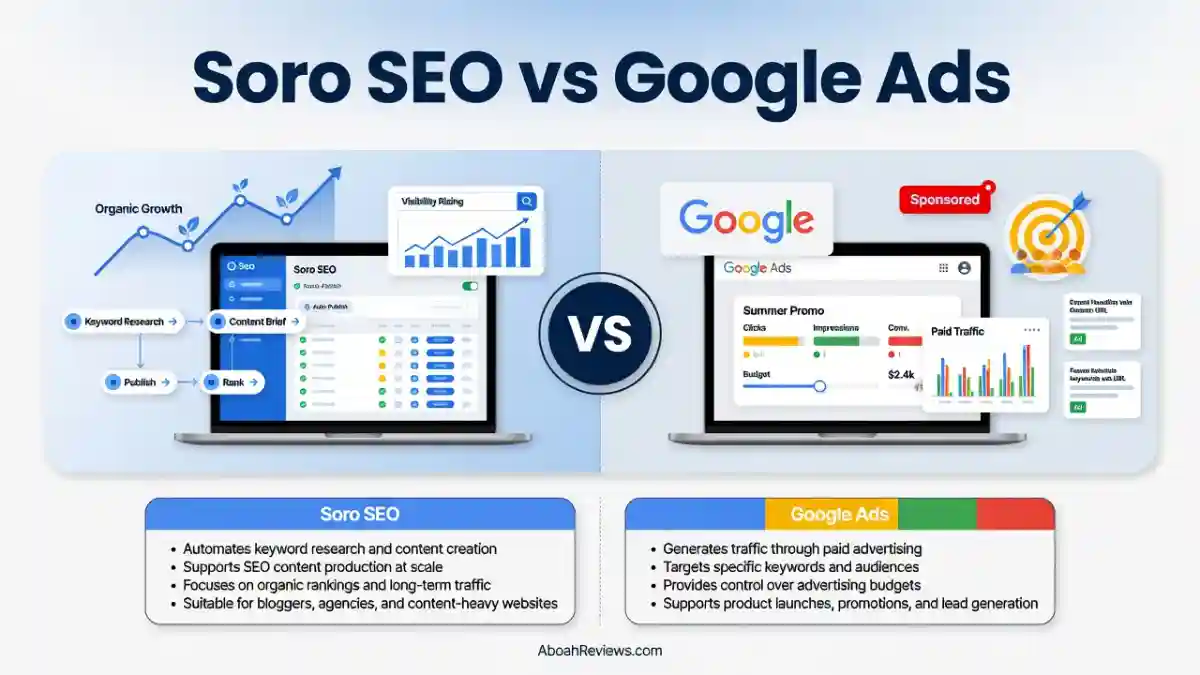
TL;DR: Soro SEO builds free, long-term organic traffic through automated content publishing, while Google Ads buys immediate, paid placement at the top of search results. This guide compares Soro SEO vs Google Ads on cost, speed, control and long-term value so you can pick the right channel (or use both) based on your budget and timeline. Best for marketers, small business owners and agencies deciding where to spend their next dollar.
Introduction
People want to know if a $39/month AI content tool can replace a Google Ads budget or if paying for clicks is just a faster shortcut to the same result.
Short answer: they’re not competing for the same job. Soro SEO is a content automation tool that helps you rank organically over time and Google Ads is a paid auction system that puts your ad above organic results the moment your campaign goes live.
In this article I’ll walk through how each one actually works, what they cost in real numbers and which one makes sense for your specific situation in 2026.
Comparison Table: Soro SEO vs Google Ads
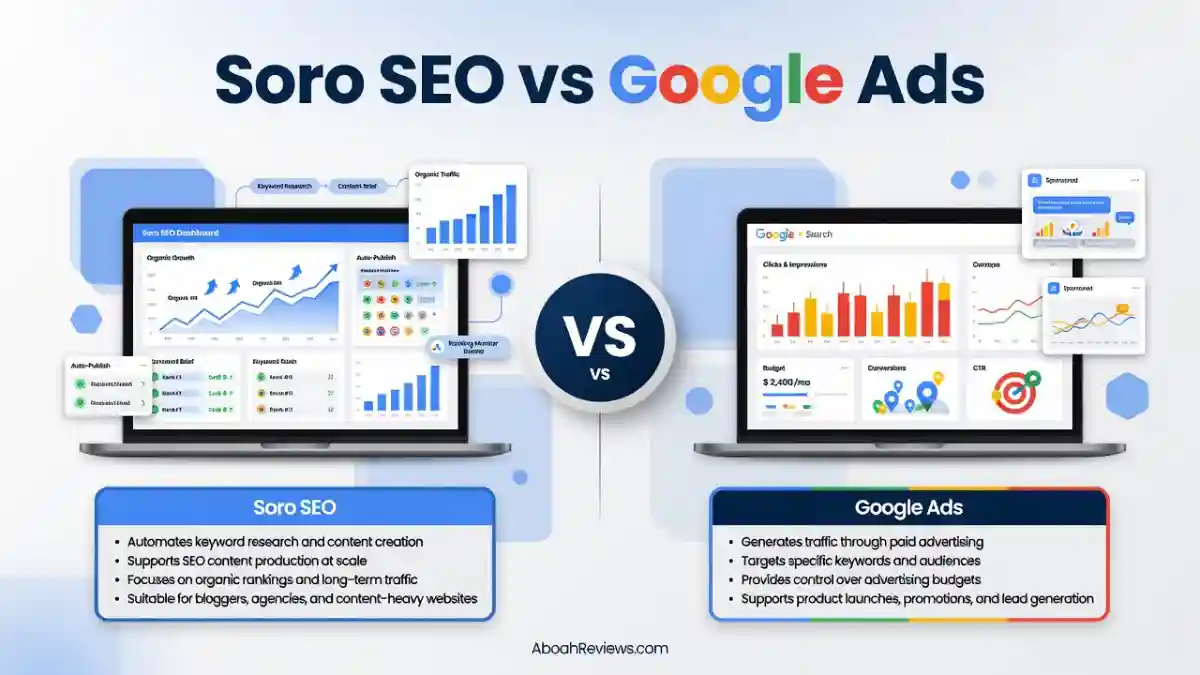
Here’s the side-by-side breakdown I wish someone had shown me before I started splitting budget between content tools and ad campaigns.
| Factor | Soro SEO | Google Ads |
|---|---|---|
| Marketing channel | Organic search | Paid search |
| Traffic source | Search engines (unpaid clicks) | Paid advertisements |
| Initial results | Usually longer-term (weeks to months) | Potentially immediate (once approved) |
| Ongoing cost | $39–$99/month software + editing time | Ad spend, typically $1,000–$10,000/month |
| Cost per click | No direct CPC | $1–$5 average CPC, higher in competitive niches |
| Long-term traffic potential | Yes, content keeps ranking | Stops when campaigns stop |
| Control over placement | Limited (algorithm decides ranking) | High (bid and budget control) |
| Keyword targeting | Content strategy and on-page SEO | Direct ad targeting and match types |
| Best suited for | Sustainable organic visibility | Immediate targeted traffic |
| Main challenge | Time and ranking uncertainty | Ongoing ad costs |
What is the difference between Soro SEO and Google Ads?
Soro SEO is a content automation platform that researches keywords and publishes SEO articles to grow organic traffic without paying per click.
Google Ads is a pay-per-click advertising platform where you bid for ad placement above organic results. One builds a long-term asset, the other rents visibility for as long as you keep paying.
What Is Soro SEO and How Does It Work?

Soro SEO is an AI content automation tool that researches keywords, drafts SEO articles, and publishes them directly to your website on a schedule. I’ve tested it against a handful of other autoblogging tools, and the workflow is fairly simple to follow.
- Keyword and topic targeting: Soro scans your niche for keyword opportunities it thinks will bring in buyers, not just traffic.
- Content planning: It builds out a content calendar based on those keywords automatically.
- Content creation: It writes full articles, including images, in your brand voice.
- Internal linking: Soro researches the keywords it thinks will bring you buyers, writes SEO-optimized articles with images, handles the technical bits like meta tags and internal links, and publishes to your CMS daily, in your brand voice and in 50+ languages.
- Search optimization: Meta tags, headers, and on-page elements get filled in automatically.
- Auto-publishing: Content goes live on your CMS without you touching a keyboard, or you can review drafts first.
- Organic traffic acquisition: Over time, published articles start ranking and pulling in free clicks from search engines.
If you want the deeper mechanics of how the publishing pipeline actually functions, I broke it down step by step in how does Soro SEO work.
Soro SEO Pricing
Soro SEO starts at $39/month for the entry plan, which covers roughly 30 articles.
Soro SEO cost $39/month (or $18/month with the annual payment), making it one of the more accessible AI SEO tools in its category. At that rate, the per-article cost works out to about $1.30 per post at the entry tier, well below what you would pay a freelance writer for an SEO-optimized article.
Compared to hiring out content production, the math is pretty stark. Soro starts at $39/month compared with $2,000–$10,000/month for similar content production volume from SEO agencies. There’s no free trial, but there’s a 14-day money-back window if it’s not a fit.
For the full tier breakdown and what higher plans unlock, I’d check Soro SEO’s pricing page directly since higher tiers weren’t clearly published at the time I tested it.
What Types of Businesses Can Use Soro SEO?
Soro SEO works best for teams that need consistent content output without hiring a full-time writer. Based on my testing and the use cases I’ve seen work:
- SaaS companies: Need ongoing blog content to support product and feature pages.
- Affiliate websites: Soro is well-suited for scaling informational keyword coverage across affiliate sites, handling the research-to-draft stage automatically.
- Publishers: Benefit from daily publishing cadence without expanding editorial headcount.
- Small businesses: Small businesses that cannot afford an agency or a full-time writer get a workable entry point at $39/month.
- Agencies: Agencies can use Soro to increase content production capacity for lower-budget clients.
- E-commerce businesses: Use it to cover product-adjacent informational queries.
- Content-driven websites: Rely on volume to cover broad topical ground quickly.
What Are the Potential Benefits of Soro SEO?
Soro SEO’s main benefit is that it builds an accumulating content asset instead of a recurring bill. Here’s what stood out to me after using it in production:
- Builds organic visibility that doesn’t disappear when you stop paying.
- Can target both informational and commercial search queries.
- Creates a growing library of published content that keeps earning impressions.
- Reduces the manual workload of keyword research, drafting, and formatting.
- Supports broader topical coverage across a niche without hiring more writers.
Limitations of Soro SEO
Soro SEO’s biggest limitation is that it doesn’t shortcut the fundamentals of SEO, it just automates the production step. A few things I’ve learned the hard way:
- SEO takes time. Rankings don’t show up overnight, no matter how fast you publish.
- Rankings aren’t guaranteed. Google’s algorithm decides who ranks, not the tool.
- Content quality still matters. Teams that need a full SEO toolkit should be aware: Soro does not do backlinks, site audits, rank tracking or AI-visibility tracking.
- Competitive keywords are still hard to rank for, automation or not.
- Algorithm updates can shift organic visibility regardless of how much content you publish.
- Automation doesn’t remove the need for strategy and editorial review.
If you want a full list of what to watch for, I documented the common patterns in common autoblogging mistakes to avoid.
What Is Google Ads and How Does It Work?
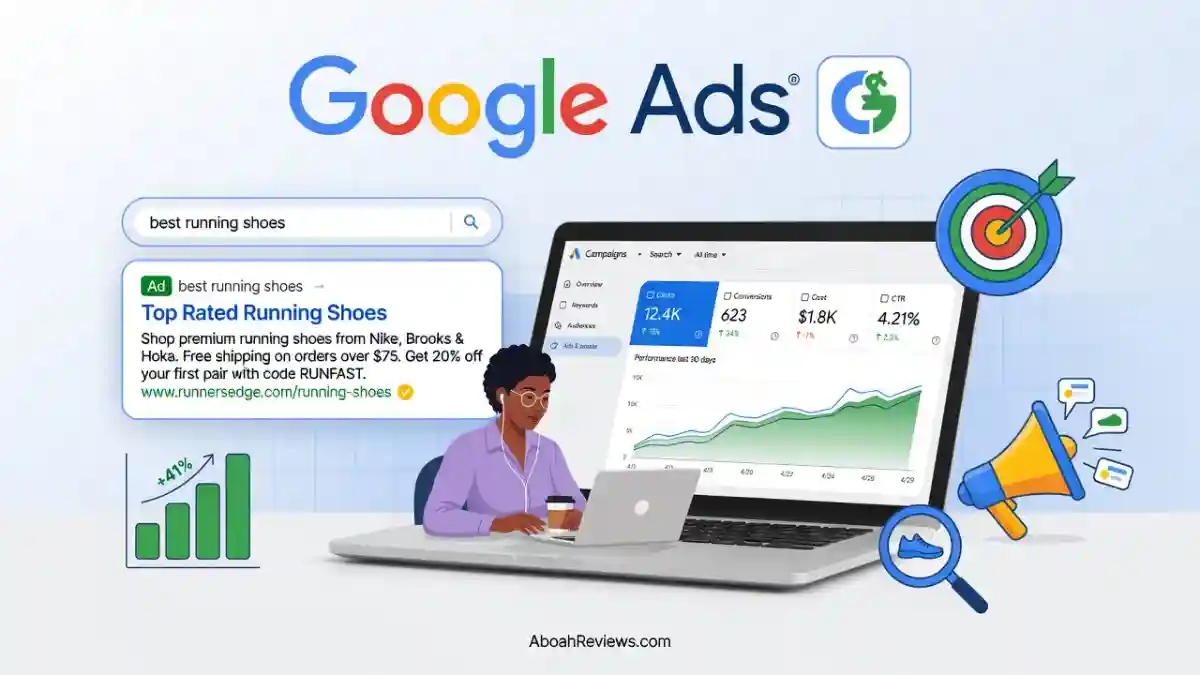
Google Ads is a pay-per-click advertising platform where advertisers bid on keywords to show ads above organic search results. Here’s the basic mechanics:
- Search campaigns: You create ad groups targeting specific search queries.
- Keywords: You choose which terms trigger your ad, using match types like exact, phrase, or broad.
- Ad auctions: Every time someone searches a targeted keyword, Google runs an auction among advertisers.
- Bidding: You set a maximum bid you’re willing to pay per click.
- CPC (cost per click): You’re charged only when someone clicks your ad, not for impressions.
- Ad relevance: Google scores your ad’s relevance and expected click-through rate.
- Landing pages: Your ad sends traffic to a page designed to convert that specific search intent.
- Conversion tracking: You set up tracking to see which clicks turn into leads or sales.
How Much Does Google Ads Cost?
Google Ads typically costs businesses between $1,000 and $10,000 per month, with an average cost-per-click of $1 to $5 depending on industry.
Google Ads costs vary widely with no fixed price, but businesses typically spend $1,000 to $10,000 per month, with an average cost-per-click ranging from $1 to $5 depending on industry and competition levels. That range swings hard depending on your niche.
Highly competitive industries like legal services ($71.64 average CPC) and insurance ($67.73 average CPC) pay significantly more per click than less competitive sectors like fitness/health ($5.03 average CPC) or real estate ($5.38 average CPC).
The good news is there’s no entry barrier. There’s no minimum budget for Google Ads, and campaigns can run on as little as a few dollars a day. That flexibility is part of why small businesses use it to test offers before committing bigger budgets.
What Are the Benefits of Google Ads?
Google Ads’ main benefit is speed. You can be showing up for high-intent searches the same day your campaign gets approved. Beyond that:
- Fast access to paid search visibility, no waiting on rankings.
- Precise campaign targeting by location, device, demographics, and time of day.
- Budget controls that let you cap daily or monthly spend exactly.
- Conversion tracking built directly into the platform.
- Ability to test keywords and offers quickly before scaling.
- Especially useful for high-intent, bottom-of-funnel searches.
Limitations of Google Ads
Google Ads’ biggest limitation is that visibility disappears the moment you stop paying. A few other things to watch for:
- Requires ongoing advertising expenditure, there’s no “set it and forget it.”
- Competitive keywords can get expensive fast, as the legal and insurance CPC numbers above show.
- Performance depends heavily on campaign setup, not just budget size.
- Poor landing pages waste ad spend even with a well-built campaign.
- Traffic generally drops to zero once campaigns are paused.
Key Differences Between Soro SEO and Google Ads
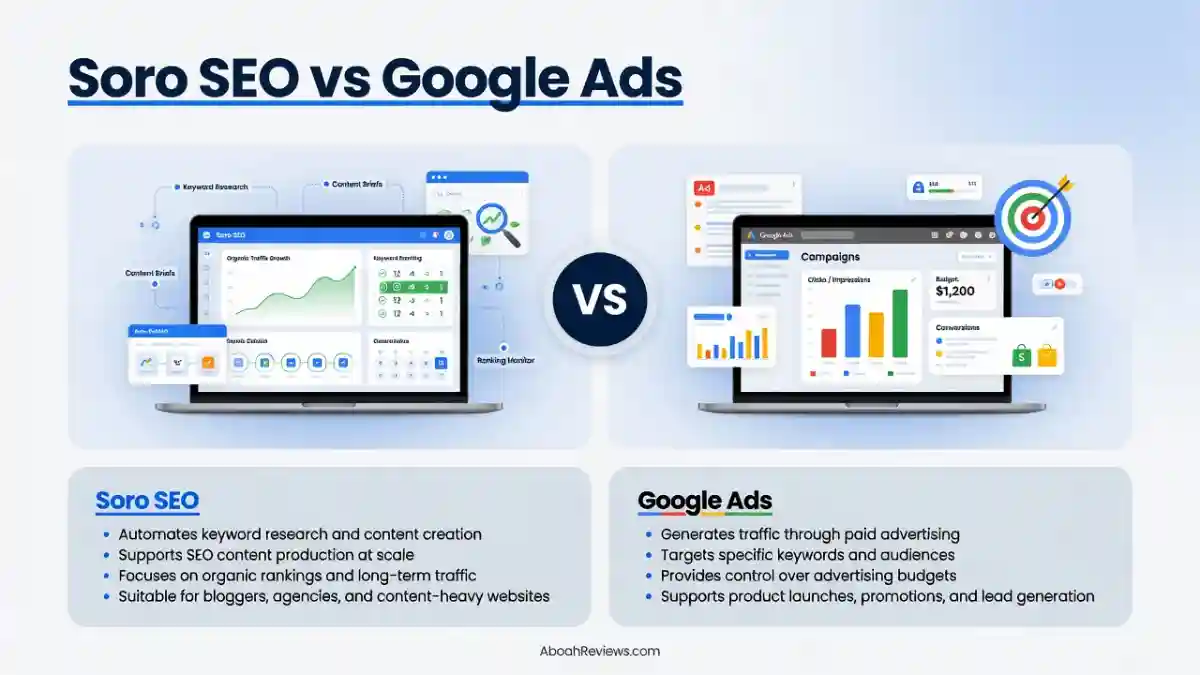
SEO vs PPC
The fundamental split is simple: organic search is earned through ranking, paid search is bought through bidding. Paid search campaigns deliver faster results and allow you to target users based on specific criteria, such as demographics, location, and search behavior, but these campaigns can be costly, especially in competitive markets. Organic search, by contrast, takes longer to build but keeps working once it’s ranking.
Speed of Results
Google Ads is faster, Soro SEO is slower but compounds over time. Content published through Soro needs to be discovered, indexed, and gradually ranked before it produces meaningful traffic. SEO takes 6-12 months to show results but offers sustainable traffic and higher long-term ROI (minimum 500%).
Google Ads, on the other hand, can start generating paid traffic almost immediately once your campaign is approved and running, though actual performance still depends on your budget, targeting, and how competitive the auction is for your keywords.
Cost
Soro SEO’s cost is mostly fixed software and editing time, while Google Ads’ cost scales directly with clicks. On the Soro side, you’re paying $39–$99/month plus whatever time you spend reviewing drafts before they go live. On the Google Ads side, you’re paying per click, and that adds up fast in competitive niches, plus whatever it costs to build and maintain landing pages that actually convert.
Long-term, SEO content keeps producing traffic without additional spend, while every dollar you stop putting into ads stops producing clicks the same day.
Long-Term Value
Soro SEO builds an asset you keep, Google Ads rents traffic you lose access to. Every article that ranks organically keeps earning impressions and clicks for months or years without additional spend.
Every ad campaign only produces traffic while it’s actively funded, so the moment the budget runs out, so does the visibility.
Traffic Control
Google Ads gives you far more direct control over who sees your message and when. You can dial in keywords, geography, audience segments, budget caps, ad messaging, and landing pages with precision.
Soro SEO gives you control over your content strategy and on-page optimization, but the actual ranking and placement decisions are made by Google’s algorithm, not you.
Scalability
Google Ads scales by increasing budget, Soro SEO scales by increasing content volume and quality. Ad scaling runs into diminishing returns as CPCs rise with increased competition for the same keywords.
Content scaling runs into a different wall: more articles only help if each one is genuinely useful, since publishing volume without quality control is exactly how common mistakes hurt a site’s rankings instead of growing them.
Soro SEO vs Google Ads: Which Is Faster?
Google Ads is faster for generating visible traffic, since campaigns can start showing ads almost as soon as they’re approved. Soro SEO requires time for content to get discovered, indexed, and ranked, and that process depends on competition, domain authority, and how good the content actually is.
- Short-term traffic need: Google Ads.
- Long-term organic acquisition: Soro SEO.
I wouldn’t put a specific number of days or weeks on either timeline since it varies too much by niche and competition. But directionally, if you need traffic this week, paid search wins. If you’re building for the next two years, organic content wins.
Soro SEO vs Google Ads: Which Is More Cost-Effective?
There’s no universal winner here, it depends entirely on your business model and timeline.
When SEO Can Be More Cost-Effective
SEO tends to pay off better for businesses with steady, recurring search demand. This works well if you have:
- Consistent search demand for your core topics year-round.
- The ability to produce genuinely authoritative content, not just volume.
- Longer customer lifecycles where repeat organic visits add up.
- A goal of building recurring traffic instead of one-time clicks.
When Google Ads Can Be More Cost-Effective
Google Ads tends to win when speed and precision matter more than long-term compounding. This applies if you’re dealing with:
- High-value conversions where one sale covers a lot of ad spend.
- Time-sensitive campaigns tied to a specific window.
- Product launches that need visibility immediately.
- Local services competing for nearby, high-intent searchers.
- Searches with strong commercial or transactional intent.
Metrics You Should Compare
The real comparison isn’t “SEO vs Ads” in the abstract, it’s your actual numbers side by side. Track these for both channels:
- CAC (customer acquisition cost)
- CPA (cost per action)
- CPC (cost per click)
- Conversion rate
- ROAS (return on ad spend)
- Organic traffic volume
- Revenue per visitor
- Customer lifetime value
For context on conversion performance, SEO advertising converts at a rate of 2.4%, nearly double that of PPC, which converts at 1.3%, though these numbers shift by industry and should be checked against your own funnel, not treated as universal.
Soro SEO vs Google Ads for Different Business Goals
| Goal | Relevant strategy |
|---|---|
| Generate traffic quickly | Google Ads |
| Build organic visibility | Soro SEO |
| Test commercial keywords | Google Ads |
| Build topical authority | Soro SEO |
| Promote a limited-time offer | Google Ads |
| Build long-term search traffic | Soro SEO |
| Capture both paid and organic demand | Both |
Soro SEO vs Google Ads for Small Businesses
Small businesses usually face the same tension: limited budget, limited time, and pressure to see results fast.
Local search competition adds another layer, since a plumber or dentist competing for high-intent local keywords needs a different approach than a national e-commerce brand.
Your available marketing time also matters, since Soro SEO still needs someone reviewing drafts, and Google Ads still needs someone watching spend and conversions.
When a Small Business May Consider Soro SEO
A small business should lean toward Soro SEO when the goal is building long-term visibility without an ongoing ad budget.
If you have some patience, a defined niche, and can commit to reviewing content before it publishes, the $39/month entry point is hard to beat against hiring a writer.
This works especially well for local service businesses that want to slowly own informational search terms in their area, which I cover in more depth in local SEO automation.
When a Small Business May Consider Google Ads
A small business should lean toward Google Ads when they need customers now and have a clear, trackable conversion path.
If you’re launching, running a promotion, or competing in a local market where organic ranking would take months, paid search fills that gap immediately. The tradeoff is that visibility stops the day the budget does.
Can You Use Soro SEO and Google Ads Together?
Yes and honestly, this is how I’d recommend most businesses actually run things. The two channels solve different problems, and running them together lets you get traffic now while building traffic for later.
Use Google Ads for Immediate Visibility
Google Ads fills the gap while your organic content is still ranking. Since Soro SEO’s published articles can take months to gain traction, running ads in parallel means you’re not sitting without traffic during that ramp-up period.
Use SEO to Build Organic Visibility
SEO content keeps producing traffic long after you stop actively working on it. While your ad campaigns are running,
Soro SEO can be quietly publishing and indexing content in the background, so that by the time you’re ready to pull back ad spend, there’s already organic traffic in place to soften the drop.
Use Paid Search Data to Inform SEO
Your Google Ads account is actually a goldmine of keyword data you can feed straight into your content strategy. Identify which PPC keywords drive the most traffic, and add these and related keywords to your SEO strategy.
A workflow that’s worked well for me looks like this: Google Ads generates keyword and conversion data, that data informs which topics Soro SEO should target next, the resulting organic content reduces dependence on paid traffic over time.
I want to be clear that this is a strategy framework, not a guaranteed outcome, since results still depend on execution and competition in your niche.
Soro SEO vs Google Ads: Which Should You Choose?
Choose Soro SEO if you:
- Want to develop organic search visibility over time.
- Have a longer-term acquisition strategy in mind.
- Want to build a growing SEO content portfolio.
- Are willing to wait for organic rankings to build.
Select Google Ads if you:
- Need immediate paid search exposure.
- Have a defined advertising budget you can commit to.
- Need highly controllable targeting by location, audience, or device.
- Want to test offers or commercial keywords quickly.
Consider Both if you:
- Want immediate traffic and long-term organic visibility at the same time.
- Have enough resources to run both channels without shortchanging either.
- Want to use paid-search data to sharpen your SEO keyword research.
Final Verdict: Soro SEO vs Google Ads
Soro SEO is built for organic search visibility that compounds over time, while Google Ads buys paid search visibility that stops the moment you stop funding it.
Neither one is universally “better,” the right choice depends on your business objective, time horizon, budget, how competitive your search space is, your customer acquisition economics, what a conversion is actually worth to you, and how much organic authority your site already has.
If I had to boil it down to one line after years of testing both: use Google Ads when you need customers this month, and use Soro SEO when you’re building something that still brings in traffic two years from now.
Frequently Asked Questions About Soro SEO vs Google Ads
Is Soro SEO better than Google Ads?
Neither is universally better, it depends on your timeline and budget. Soro SEO is better if you’re building long-term organic traffic and can wait for rankings to develop, while Google Ads is better if you need immediate, controllable traffic right now. Many businesses get the best results running both at once.
Is SEO more effective than Google Ads?
SEO tends to produce a higher share of overall clicks and often converts better long-term, but it takes longer to show results. According to a study by Seomator, 75% of clicks on search results pages are for organic results, while only 25% are for paid results. That said, “effective” depends on your timeline, since Google Ads still wins when you need traffic immediately.
Is $500 a month enough for Google Ads?
$500/month can work for a small, tightly targeted local campaign, but it won’t go far in competitive industries. Given that average CPCs range from about $1 to $5 and climb much higher in sectors like legal or insurance, $500 might only buy 100 to 500 clicks depending on your niche. It’s enough to test a campaign, but not enough to compete at scale in expensive verticals.
Is SEO still worth it in 2026?
Yes, SEO is still worth it in 2026, especially as AI Overviews pull more citations from pages already ranking organically. Organic search remains one of the largest sources of website traffic, and building content that ranks continues to pay off over the long run even as the search results page changes shape. It just requires patience and a willingness to keep content updated as algorithms shift.
What is more effective than Google Ads?
There’s no single channel that’s universally more effective, it depends on the goal. For long-term, compounding traffic without ongoing spend, SEO content (including tools like Soro SEO) tends to outperform ads over a multi-year horizon, while for immediate, trackable conversions, few channels beat Google Ads’ speed and targeting precision.
Is $10 a day enough for Google Ads?
$10 a day can work for testing a narrow, low-competition keyword set, but it won’t sustain a competitive campaign. At an average CPC of $1 to $5, that budget buys somewhere between 2 and 10 clicks daily, which is enough for early testing but too thin for meaningful volume in competitive industries.
Who are the main competitors of Google Ads?
The main competitors of Google Ads include Microsoft Advertising (Bing Ads), Meta Ads (Facebook and Instagram), Amazon Ads, LinkedIn Ads, and TikTok Ads. Each platform targets different audience behaviors, so the “competitor” that makes sense depends on where your customers actually search and browse.

- SEO Instant Appear HighSoftware99.com: Full Breakdown - October 18, 2026
- SEO by HighSoftware99.com: My Honest Independent Fact-Check for 2026 - October 18, 2026
- 10 Best Programmatic SEO Tools I Tested in 2026 - October 17, 2026