TL;DR: Is Generative Engine Optimization a thing? Yes, generative engine optimization is a real, research-backed and growing digital marketing strategy.
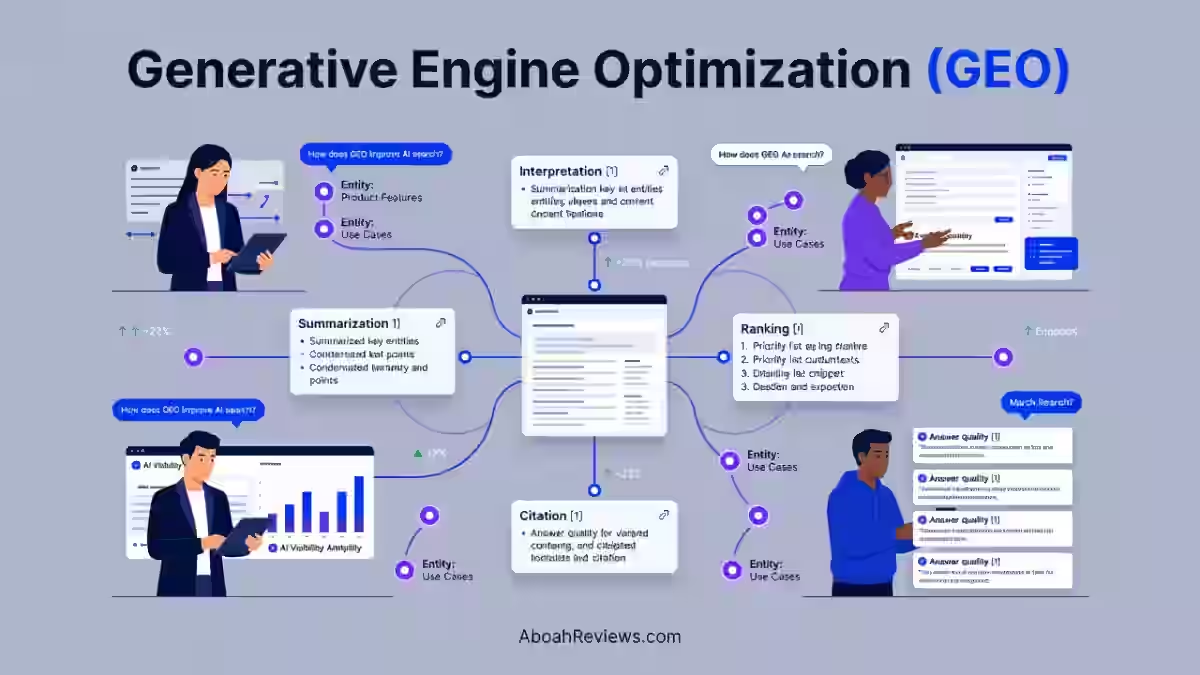
It focuses on structuring and refining online content so that AI-powered search engines and chatbots such as ChatGPT, Perplexity, Claude, Microsoft Copilot and Google’s AI Overviews can cite, summarize and recommend your brand in their direct text answers.
How GEO Differs from SEO
- The Goal: SEO focuses on winning clicks and high rankings in a list of links. GEO focuses on being chosen as a trusted source, quote, or recommendation inside an AI-generated answer.
- The Strategy: SEO relies heavily on keywords, metadata, and backlinks. GEO relies on clear structure, factual accuracy, direct conversational answers, and being mentioned across trusted third-party forums or news sites.
- The Connection: GEO does not replace standard search optimization. Because AI tools pull from the live web or core search indexes (using techniques like retrieval-augmented generation), strong technical and content SEO forms the foundation for GEO.
Core Tactics for AI Visibility
- Answer direct questions clearly in the first few sentences of an article.
- Use structured data like schema markup so AI crawlers can easily parse facts, prices, and reviews.
- Build a strong presence on platforms that large language models frequently reference, such as Reddit, YouTube, Quora and Wikipedia.
I covered the full guide to generative engine optimization in my previous post.
Introduction
So, is generative engine optimization a thing or is it just another piece of industry jargon that will fade in years to come?
I spent a good chunk of the last year asking that exact question. I tested tools, read the original research, watched my content get cited in AI answers for some topics.
And completely ignored for others and worked through what any of it means for the sites I manage. The honest answer is: yes, GEO is real, but not in the way most marketing posts describe it.
GEO is not a replacement for traditional SEO and it’s definitely not something you need a brand new strategy or a $200/month tool to “get started with.”
What it is, is a real shift in how information gets surfaced in AI-generated search experiences and understanding that shift helps you think more clearly about where your content shows up and why.
Quick Answer: Is Generative Engine Optimization a Thing?
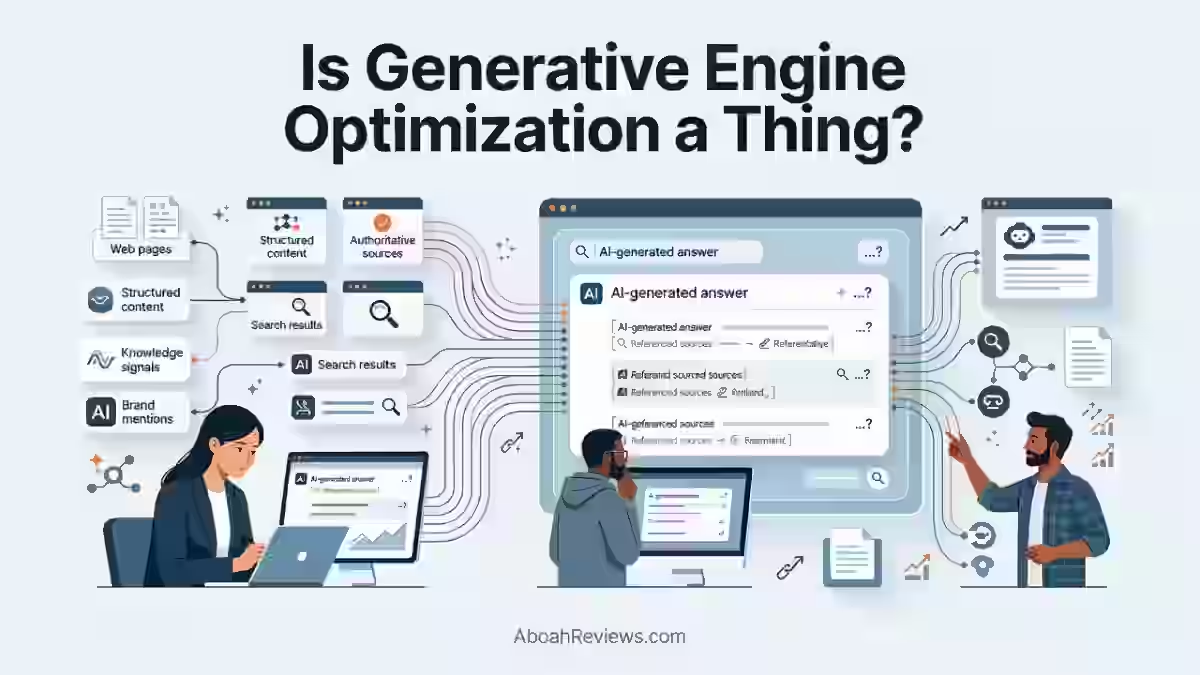
Generative engine optimization is the practice of structuring and improving content so that AI-powered search systems like Google AI Overviews, ChatGPT search, Perplexity, and Gemini are more likely to extract, cite or reference that content in their generated answers.
Here’s what GEO attempts to do:
- Get content surfaced inside AI-generated answers, not just ranked on page one
- Earn citations or source references when AI systems synthesize information
- Increase how often a brand or source appears across multiple AI platforms
- Improve the probability that AI systems treat a source as reliable and worth referencing
- Build visibility that exists independently of traditional SERP click-through rates
Generative engine optimization is the original term, from a 2024 academic paper, and GEO is its abbreviation.
The terminology and methodologies are still evolving, and there’s no universal GEO “algorithm” to reverse-engineer the same way SEOs have studied Google’s ranking signals for years.
That’s both the challenge and the opportunity. You’re not optimizing for a fixed set of ranking rules. You’re making your content easier for AI systems to trust, parse, and use.
Instead of optimizing a page to rank at position one, you’re optimizing it to be the kind of source an AI would quote.
Content must be optimized at the passage level, not just the page level, since LLMs extract and use small text chunks. That’s a meaningful shift if you’re used to thinking about pages as the unit of optimization.
Why Is GEO Becoming Important?
The way people search is changing, and the numbers back this up.
Seer Interactive’s research shows that organic CTR for informational queries with Google AI Overviews dropped 61% (from 1.76% to 0.61%). Paid CTR on those same queries fell 68% (from 19.7% to 6.34%). The study examined 3,119 queries and millions of impressions between June 2024 and September 2025.
That’s a structural shift in how search traffic flows.
AI Overviews appear on 48% of all Google search queries as of March 2026, up from 34.5% in December 2025.
And it’s not just Google. ChatGPT’s web search, Perplexity, Gemini, and Microsoft Copilot are all now actively pulling from web sources to generate answers in real time.
Your brand can rank on page one of Google and still be completely absent from the AI-generated answer a user actually reads. That’s the visibility gap GEO addresses.
Where Did the Term Generative Engine Optimization Come From?
GEO didn’t come from a marketing agency or a software vendor; it came from academic research.
On November 16, 2023, a team of researchers from Princeton and Georgia Tech published a technical paper on arXiv, laying the foundation for a new discipline.
Titled “GEO: Generative Engine Optimization,” it went beyond observing AI responses, proposing the first scientific methodology to influence generative engines.
The origins of the term trace back to late 2023, specifically within a seminal research paper titled “GEO: Generative Engine Optimization,” a collaborative effort involving researchers from Princeton University, Georgia Tech, IIT Delhi, and Niloy Ganguly.
The paper introduced GEO as the first novel paradigm to aid content creators in improving their content visibility in generative engine responses through a flexible black-box optimization framework.
The research also introduced GEO-bench, a benchmark system for evaluating optimization strategies across different content types.
Through rigorous evaluation, the researchers demonstrated that GEO can boost visibility by up to 40% in generative engine responses.
That’s a meaningful number from a peer-reviewed study, not a marketing claim.
Is GEO an Established SEO Discipline?
GEO is not yet a standardized industry discipline with agreed-upon methods, tools, or benchmarks.
Right now, GEO exists as three distinct things at once:
- An academic and research concept with a peer-reviewed paper, benchmark datasets, and measurable optimization strategies
- An emerging marketing practice with agencies and tools building services around AI visibility
- A loose framework that many SEO professionals are folding into existing content strategy work
There’s no GEO certification, no authoritative GEO guide from Google, and no universally accepted playbook. What you’ll find online is a mix of solid research, reasonable practice, and some hype.
Is GEO Just a Marketing Buzzword?
Honestly? It depends on who’s using it and how.
The term itself has real, academic roots. The problem GEO addresses: how to be visible in AI-generated answers is also very real, as the CTR data above shows.
But some uses of the term “GEO” in the wild are really just rebadged content marketing advice with a new label.
GEO tactics overlap heavily with SEO fundamentals.
So is GEO a buzzword? Partially. Is the underlying problem it describes real? Yes. Keep that distinction in mind when you evaluate anything branded as a “GEO service.”
How Does Generative Engine Optimization Work?
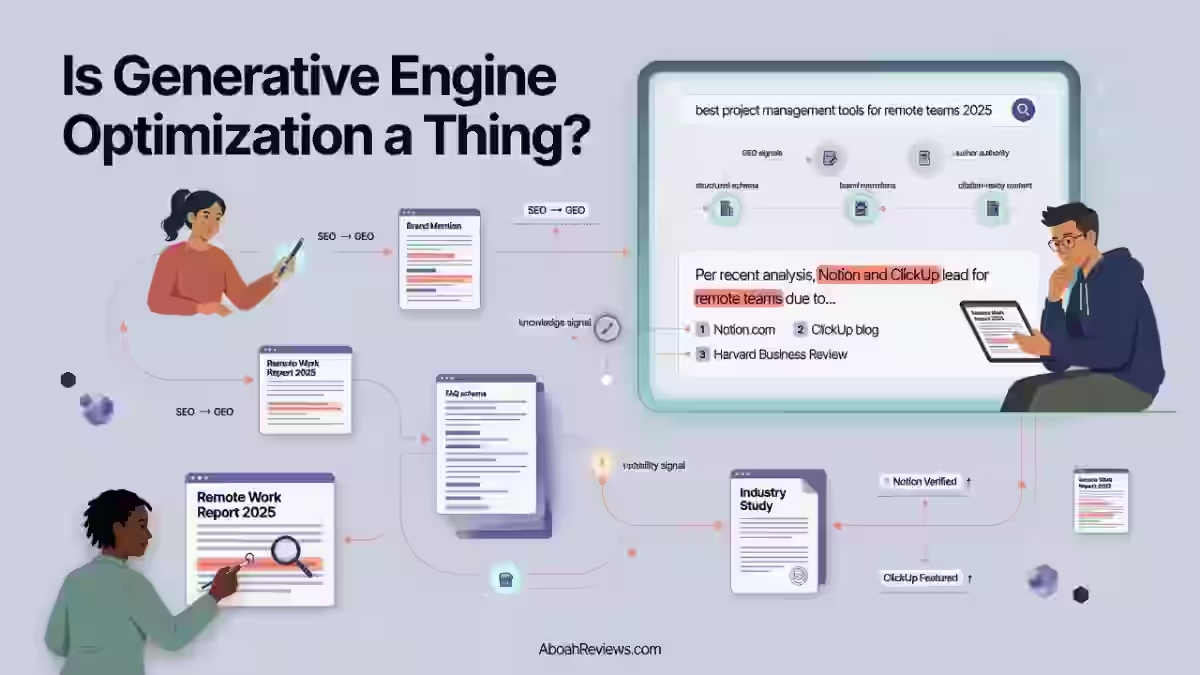
Here’s the basic process that happens when someone searches in an AI system:
- The user submits a query in natural language
- The generative system interprets the query and determines intent
- It retrieves relevant information – either from a trained model’s knowledge or live web retrieval
- Retrieved sources are evaluated for relevance, credibility, and usefulness
- The AI generates a synthesized answer using selected source material
- Some sources receive citations or mentions in the response; others don’t
Your content can influence steps 3 through 6. That’s where GEO practice lives.
What Factors Can Influence AI Visibility?
No single factor guarantees inclusion in an AI-generated answer. But the research and practical testing both point to several consistent signals:
- Relevance to the query: Does your content directly answer the question being asked?
- Topical authority: Do you cover a subject comprehensively across multiple related pages?
- Source credibility: Is your content cited, referenced, or linked from trusted sources?
- Information completeness: Does your content cover the topic with sufficient depth and specificity?
- Clear factual statements: Are claims direct, accurate, and easy to extract?
- Content structure: Are headings, lists, and tables used to make information scannable?
- Entity relationships: Are key concepts, people, brands, and topics named explicitly?
- Brand and author authority: Is there a clear expert or organization behind the content?
- Third-party mentions: Are you referenced in relevant directories, publications, or forums?
- Crawlability: Can AI systems actually access and read your pages?
The most effective GEO strategies involve adding statistics, citations, and credible references to content.
The original GEO research paper tested multiple strategies: authoritative tone, adding statistics, citations, quotations, simplified language and found that citation-rich, statistic-backed content consistently performed better.
Does GEO Mean Optimizing Content Specifically for ChatGPT?
GEO is broader than any single platform. Optimizing for ChatGPT alone misses most of the opportunity.
Generative engine optimization ensures your content is structured in a way that AI search engines like ChatGPT, Google Gemini, Perplexity, and others can easily understand, retrieve, and present as part of their response.
Each platform uses different retrieval mechanisms, different training data, and different methods for deciding which sources to cite.
The practical implication: optimize for clarity, credibility, and structure and you improve your odds across all AI platforms simultaneously.
GEO vs SEO: What’s the Difference?
This is the question a lot has been asking most. The short answer is that they address different visibility problems in the same search ecosystem.
Dimension | Traditional SEO | Generative Engine Optimization (GEO) |
|---|---|---|
Primary goal | Rank in search engine results pages | Be cited or referenced in AI-generated answers |
Key outcome | Clicks and organic traffic | Brand mentions, citations, AI visibility |
Target platform | Google, Bing SERP rankings | ChatGPT, Gemini, Perplexity, AI Overviews, Copilot |
Main signals | Keywords, backlinks, technical signals | Relevance, topical authority, content structure, entity clarity |
Measurement | Rankings, CTR, sessions | Citation frequency, AI referral traffic, brand mention share |
Content unit | Full page | Passage or section level |
Established methodology | Yes – well-documented | Emerging – still developing |
Replaces the other? | No | No |
Unlike traditional search engines that rank web pages, AI models analyze and synthesize vast amounts of data to deliver direct answers.
That’s the fundamental structural difference between the two optimization challenges.
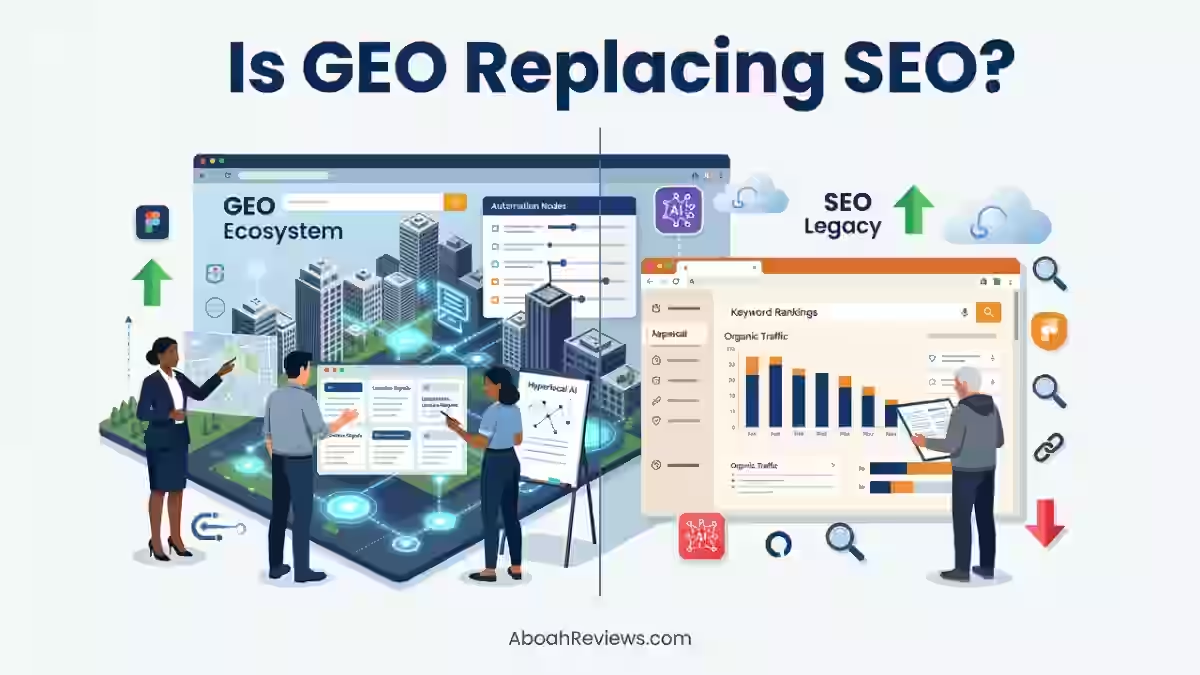
Does GEO Replace SEO?
No. GEO does not replace SEO, and you should be skeptical of anyone who says it does.
- Technical SEO such as crawlability, indexing, page speed, structured data, internal linking still matters enormously.
- Backlinks still matter.
- Content quality still matters.
- In fact, most GEO best practices are downstream of good SEO
- If Google can’t crawl your page, no AI system is going to cite it either.
Start with SEO fundamentals. Well-structured content, clear entity identification, and authoritative sourcing form the foundation for both traditional and AI search visibility.
GEO is not a shortcut around SEO. It’s an additional layer you build on top of a solid SEO foundation. If you’re skipping basic technical SEO and thinking GEO will compensate, it won’t.
Want to understand how SEO automation fits into this picture? That’s worth reading alongside this.
SEO + GEO: Why Businesses Need Both
The most practical framing is this: SEO and GEO address different parts of the same search journey.
For most brands, the highest-visibility strategy combines both: SEO drives organic clicks, while GEO secures your brand’s presence in the AI-generated responses that increasingly sit above traditional search results.
Think about what happens when a user searches for a product category. They might get an AI Overview at the top, click through to a traditional result or they might ask ChatGPT separately.
Without both SEO and GEO working together, you’re leaving part of that discovery journey uncovered.
GEO vs AEO vs LLM Optimization
The terminology in this space is genuinely confusing, and a lot of vendors make it worse by using these terms interchangeably.
Generative Engine Optimization vs Answer Engine Optimization
Answer engine optimization (AEO) refers to optimizing content to appear in direct answer features. Things like Google’s featured snippets, People Also Ask boxes, and voice search responses. AEO predates GEO by several years.
GEO specifically focuses on AI-generated answers produced by large language models. The overlap is significant: both care about clear, direct answers, structured content, and authoritative sources.
But GEO extends into AI retrieval behavior, entity relationships, and multi-platform AI visibility in ways that traditional AEO didn’t address.
AEO and LLM SEO are adjacent terms that mostly overlap with GEO; the distinctions drawn between them tend to be vendor marketing rather than differences in the actual work.
You can read more about whether GEO is replacing SEO for a deeper look at how these terms interact in practice.
Generative Engine Optimization vs LLM Optimization
LLM optimization is broader than GEO. It can refer to anything from fine-tuning a model’s behavior to optimizing prompts in internal tools.
GEO specifically focuses on external content visibility, making your website or brand more likely to be cited when an LLM generates a search response.
Are GEO, AEO, and AI SEO the Same Thing?
They’re not the same, but they overlap heavily. Here’s a quick way to think about it:
- AEO: Optimizing for direct answer features in traditional search (featured snippets, PAA)
- GEO: Optimizing for AI-generated search responses (ChatGPT, Gemini, AI Overviews)
- LLM SEO / AI SEO: Loose terms often used to describe both of the above
The practical work involved in each is increasingly similar. Don’t let the terminology differences slow you down.
How Do You Do Generative Engine Optimization?
Let me be upfront: there’s no guaranteed formula for getting cited in AI-generated answers.
What follows are the practices that are consistently supported by the original GEO research, real-world testing, and the broader SEO community.
Create Direct, Answer-Focused Content
Every section of your content should answer its question immediately.
Don’t build up to the answer; state it in the first sentence, then support it. AI systems extract passages, not pages. If the answer is buried in paragraph five, the AI may never get to it.
The first sentence under every heading should be self-contained and quotable. That’s the single biggest structural change most content teams need to make.
Build Topical Authority
Topical authority means covering a subject comprehensively, not just writing one good post, but building out an interconnected set of content that covers a topic from multiple angles.
Volume alone doesn’t build topical authority. Coverage quality and internal linking structure both matter.
Use Clear Content Structure
AI systems parse structured content more reliably than dense prose. Practically, this means:
- Descriptive H2 and H3 headings that state what the section covers
- Short paragraphs (3 sentences or fewer works well)
- Lists and tables for comparisons, steps, and definitions
- Explicit question-and-answer sections
- Clear definitions when introducing technical terms
Support Claims With Reliable Sources
The Princeton GEO study found that adding statistics, citations and quotations to content boosts visibility by up to 40%.
That’s not a coincidence. AI systems are trained to favor content that mirrors the patterns of trustworthy, well-sourced writing.
Link to original research, first-party data, government sources, and recognized industry publications.
Vague claims with no evidence get deprioritized by both human readers and AI systems.
Strengthen Brand and Entity Signals
AI systems build an understanding of entities: brands, people, concepts, organizations.
The more consistently your brand appears across credible sources, the more clearly it gets “understood” by AI systems.
This means:
- Consistent NAP (name, address, phone) information across directories
- Clear author bios and expertise signals
- About pages that accurately describe your organization
- Mentions in relevant publications and third-party sites
- Active presence on platforms AI systems frequently cite – including Reddit and YouTube
AI engines frequently cite Reddit, YouTube, and category-specific forums. Think about where your target audience already gathers and whether your brand has a visible presence there.
Make Content Easy for Search Systems to Understand
Crawlability is the foundation everything else sits on. If AI crawlers can’t access your content, nothing else matters.
Use semantic HTML5 tags correctly (article, section, header). Ensure pages load fast. Write descriptive title tags and meta descriptions.
Use structured data where it makes sense for your content type. And check that your robots.txt isn’t accidentally blocking AI crawlers; a mistake I’ve seen on more sites than I’d like to admit.
Does GEO Actually Work?
The original research says yes with caveats. Through rigorous evaluation, researchers demonstrated that GEO can boost visibility by up to 40% in generative engine responses.
They also showed that the efficacy of these strategies varies across domains, underscoring the need for domain-specific optimization.
Real-world results are harder to isolate. Unlike traditional SEO where you can track rank changes over time, AI citation patterns are much harder to monitor consistently.
How Can You Measure GEO Performance?
Measuring GEO performance is genuinely difficult right now, but here are the metrics worth tracking:
Metric | What It Measures | How to Track |
|---|---|---|
AI citation frequency | How often your brand appears in AI answers | Manual query sampling; tools like Profound, Semrush |
Brand mention share | Brand visibility across AI platforms | Social listening + AI monitoring tools |
AI referral traffic | Traffic arriving from ChatGPT, Perplexity, Gemini | GA4 referral source analysis |
Share of AI answers | How often your domain appears for target topics | AI visibility tracking platforms |
Citation position | Where your source appears in AI responses | Manual testing |
Assisted conversions | Whether AI-referred visitors convert | GA4 conversion paths |
Brands cited in AI Overviews earn 35% more organic clicks and 91% more paid clicks. That’s a meaningful commercial signal, even if the measurement infrastructure isn’t fully mature yet.
Why GEO Measurement Is Still Difficult
Here’s the honest problem with measuring GEO: there’s no universal metric, and AI responses are not consistent.
Given the black-box and fast-moving nature of generative engines, content creators have little to no control over when and how their content is displayed.
Two users searching the same query at the same time may get different answers. Results change as models update. There’s no “GEO rank tracker” the way there are keyword rank trackers for SEO.
This makes it hard to know definitively whether a content change improved your AI visibility, or whether the change you’re seeing is just natural variation.
What Are the Benefits of Generative Engine Optimization?
Increased Visibility in AI Search
AI Overviews now appear on 48% of all Google search queries as of early 2026.
If your content isn’t structured to appear in those results, you’re invisible in nearly half of all Google searches.
More Brand Mentions
Every time an AI cites your brand as a source, it contributes to your overall brand awareness.
This is even when the user doesn’t click through. Think of it as earned media inside an AI response.
More Opportunities to Earn Citations
Structured, authoritative content gets cited. Citations signal credibility to both AI systems and human readers.
Over time, consistently getting cited builds a positive feedback loop around your brand’s perceived authority.
Greater Visibility Beyond Traditional SERPs
SEO and GEO are responses to two different retrieval systems, and both retrieval systems now matter to your business.
GEO extends your visibility into ChatGPT, Perplexity, Copilot, and Gemini – platforms where traditional SEO has no direct influence.
Potential Competitive Advantage
Most small businesses and content teams haven’t structured their content with GEO in mind.
Getting ahead of that curve now, while the space is still developing is a genuine first-mover opportunity.
What Are the Limitations of GEO?
This section matters. Anyone selling you a guaranteed GEO outcome is overselling.
There Is No Guaranteed Way to Get Cited
You can do everything right: clear structure, authoritative sources, strong entity signals and still not be cited by a given AI system for a given query. There’s no direct equivalent of “ranking in position one” in GEO.
AI Search Algorithms Are Not Fully Transparent
GEO acts as a black-box optimization process because the internal ranking logic of generative engines is unknown.
You can observe outcomes, but you can’t audit the process the way you can with traditional SEO ranking factors.
AI Responses Can Change Frequently
A source that gets cited today may not get cited after a model update, a change in retrieval strategy, or a shift in how the platform weights different signals. GEO is not “set it and forget it.”
GEO Has No Universal Ranking Formula
There’s no agreed-upon set of GEO ranking factors from any AI platform. What works on Perplexity may not work the same way on Gemini.
Domain-specific factors also vary, as the original Princeton research pointed out.
Some GEO Tactics Overlap Heavily With Traditional SEO
This is actually a feature, not a limitation but it’s worth being clear about. If you already do strong SEO, you’re already doing a lot of what GEO recommends.
Be skeptical of any “GEO service” that charges a premium for advice that’s really just good content strategy repackaged with a new label.
Is GEO the Future of SEO?
The evidence is clear: search is not what it was three years ago.
Traditional blue-link SERPs still exist, but they’re increasingly accompanied by and sometimes replaced by AI-generated summaries.
Ahrefs’ analysis of 300,000 keywords comparing December 2023 to December 2025 data found that AI Overviews reduce the click-through rate for the top-ranking page by up to 58% from 7.3% to 1.6% on AI Overview keywords.
Users are also searching differently. Conversational queries. Multi-turn questions. Search journeys that start in ChatGPT and never reach a traditional search engine.
The search session that ends without a single click to any website is now the norm for many query types.
Zero-click searches in the USA have crossed 60%, which means users are increasingly getting answers without clicking through.
Will SEO and GEO Eventually Become One Discipline?
Probably, yes but not yet.
Right now, GEO has enough distinct characteristics (passage-level optimization, entity signals, multi-platform AI visibility) to warrant thinking about separately.
But the foundational work is the same: create trustworthy, well-structured, well-sourced content.
Understanding the difference between these two disciplines, and knowing how to apply both, is now a core competency for any marketing team that wants durable visibility.
For a detailed look at AI SEO automation and how it intersects with these trends, that’s a useful next read.
Frequently Asked Questions About Generative Engine Optimization
Is GEO a Legitimate Marketing Strategy?
Yes, GEO is a legitimate strategy, grounded in peer-reviewed academic research and increasingly supported by real-world data on AI search behavior. It’s not a silver bullet, but structuring content for AI visibility is a rational response to measurable changes in how search traffic flows. Treat it as a layer on top of existing SEO, not a replacement.
Is GEO Replacing SEO?
No, GEO is not replacing SEO. Traditional search rankings still drive the majority of organic web traffic globally, and technical SEO remains foundational for any content to be discoverable by AI systems in the first place. Google’s traditional search results still drive the majority of organic web traffic globally. The two disciplines work together.
What Is an Example of GEO?
A practical GEO example: rewriting a blog post so that each section opens with a direct, one-sentence answer to its heading question – rather than a paragraph of context-setting. AI systems extract passages. If your answer is in sentence one, it’s far more likely to be used. Adding a cited statistic and a named source in the same paragraph strengthens it further.
How Do You Optimize for Generative AI?
Optimizing for generative AI means writing content that is direct, clearly structured, and credibly sourced. Answer the main question immediately. Use headings that state what each section covers. Add specific data points with named sources. Build topical authority by covering related subtopics comprehensively. And make sure your pages are crawlable by AI systems.
How Do I Get My Website Cited by ChatGPT?
There’s no guaranteed method, but several practices improve your odds. The most effective GEO strategies involve adding statistics, citations, and credible references to content. Make sure your pages are publicly crawlable. Write content that directly answers specific questions. Build consistent brand presence across third-party sites. And produce content at the passage level with clear, quotable statements.
Does Google Use GEO?
Google doesn’t use the term “GEO” internally, but Google’s AI Overviews operate using the same core principles GEO research describes – retrieving sources, evaluating their authority and relevance, and generating synthesized answers that cite selected content. Ranking in AI Overviews depends on many of the same signals that matter for AI search more broadly: clear, well-structured answers near the top of the page, credible sourcing, and content that directly resolves search intent.
What Is the Difference Between GEO and SEO?
SEO optimizes content for traditional search engine rankings. GEO optimizes content to appear in AI-generated answers. SEO focuses on clicks and rankings. GEO focuses on citations, brand mentions, and AI source inclusion. Both rely on high-quality content, but GEO adds passage-level clarity, entity signals, and multi-platform AI visibility as additional considerations.
Is GEO a Ranking Factor?
GEO is not a ranking factor in the traditional sense – there’s no AI platform that publishes a list of GEO signals the way Google has historically published guidance on ranking factors. Think of GEO as influencing “retrieval likelihood” rather than rank position. GEO focuses on increasing visibility in AI-generated responses rather than standard search results. Unlike SEO’s click-through rates, GEO prioritizes citation frequency and semantic relevance.
Can AI-Generated Content Rank in AI Search?
AI-generated content can appear in AI-generated search answers, but quality and credibility signals still matter. Thin, generic AI content – the kind produced by fully automated tools with no editorial review – is less likely to be cited than well-structured, specific, human-reviewed content.