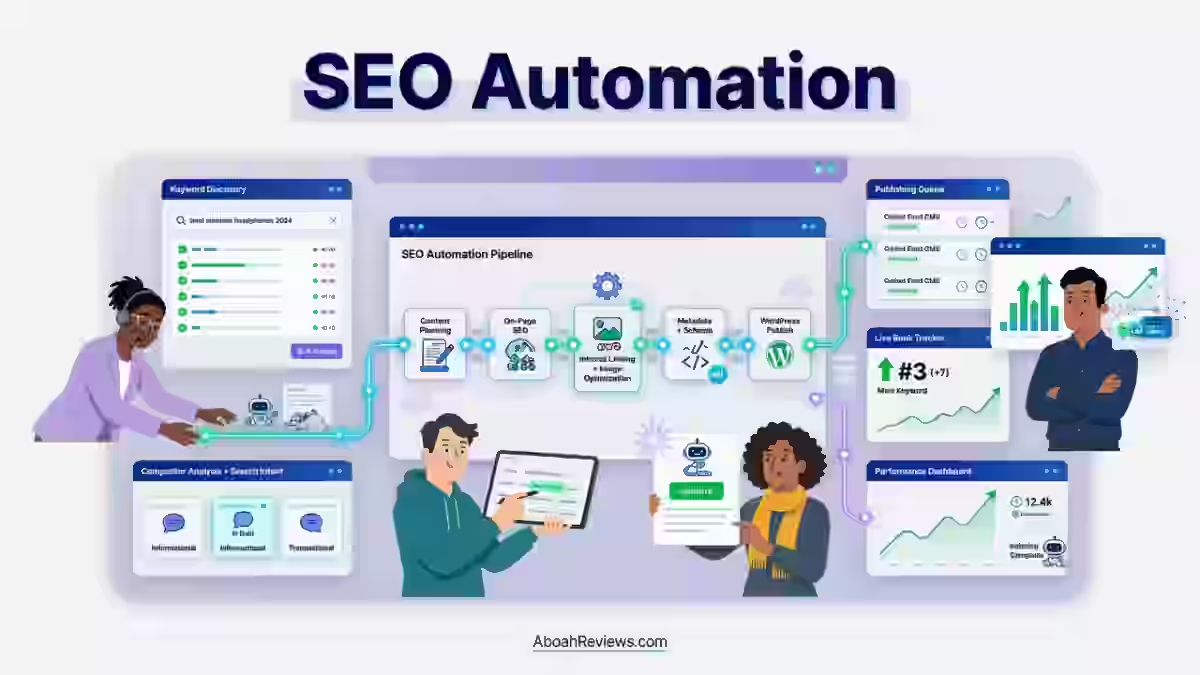
TL;DR: SEO automation uses software, APIs and workflows to handle repetitive search optimization tasks like keyword research, rank tracking, technical audits, reporting and content generation. It allows teams to scale organic visibility without manual effort.
Core Automated SEO Tasks:
- Keyword & Competitor Research: Pulling search volumes, tracking ranking shifts and identifying content gaps.
- Technical Audits & Schema: Crawling site architecture, fixing broken links and generating structured data markup.
- Content Generation: Drafting SEO-optimized briefs, writing bulk metadata and publishing automated news or blog updates to your CMS.
- Reporting: Aggregating metrics from Google Search Console or analytics tools into live dashboards and automated Slack updates.
Recommended SEO Automation Tools:
- Technical & Crawling: Screaming Frog for site structure, broken links and technical diagnostics.
- Execution & AI Agents: Search Atlas (OTTO SEO) for hands-off execution of technical, on-page and content updates.
- Workflows & Integration: Gumloop or Make for building custom cross-platform automation chains linking data sources, AI models and your CMS.
The short answer: automate the busywork, keep humans in charge of judgment calls.
Introduction to Automated SEO
If you have run SEO on a site with more than 50 pages, you already know the problem:
- Keyword tracking
- Website audits
- Internal linking
- Reporting
- Content updates…
The list of repetitive tasks never actually ends; it just grows. And the moment you add a second website or a second client, everything multiplies.
That is exactly the problem SEO automation is designed to solve. SEO automation helps marketers streamline repetitive optimization tasks, allowing them to focus more on strategy, content quality, and growth.
It does not replace your thinking. It just stops you from wasting 3 hours every Monday manually pulling rank data that a tool could deliver in seconds.
In this guide, I am going to explain what SEO automation actually is, how it works in practice, which tasks you can safely hand off to software and which ones still need a human being making the call.
I will also walk you through the best SEO automation tools available in 2026 with real pricing, strengths and honest limitations.
What Is SEO Automation?
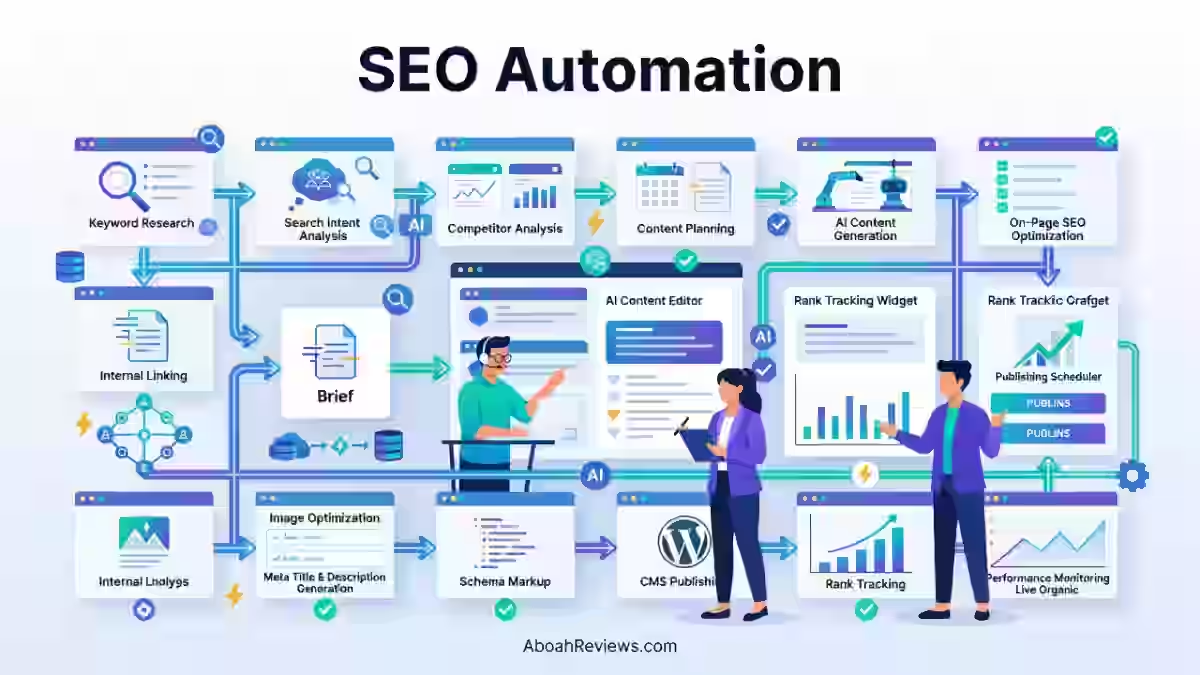
SEO automation is the use of software, scripts, and pre-built workflows to automatically complete SEO-related tasks that would otherwise require manual effort.
Instead of checking rankings by hand, running audits manually, or pulling reports from five different tabs, automation handles those recurring jobs on a schedule, sends you the output and flags anything that needs attention.
Effective SEO automation deploys intelligent software to handle repetitive tasks, such as keyword research, technical scans, and content optimizations.
The difference between manual SEO and automated SEO is not really about the tasks themselves. It is about how often you can realistically do them.
A manual audit might happen once a month if you are lucky. An automated audit can run weekly, daily or whenever you push new content.
Here is the simplest way to think about it:
- Manual SEO = you do the task every time
- Automated SEO = software does the task on a schedule, you review the output
Common examples of tasks that automated SEO tools handle:
- Monitoring keyword rankings
- Crawling websites to find technical errors
- Tracking backlinks (new, lost, and competitor links)
- Generating performance reports
- Surfacing content gap analysis opportunities
- Flagging pages with content decay
What automation does not do is tell you what to do about the data. That still requires a person.
How Does SEO Automation Work?
1. Data Collection
Automated tools collect SEO data continuously from multiple sources.
They pull from search engine APIs, Google Search Console, website crawlers, Google Analytics, and competitor research databases.
These tools pull data directly from your analytics and CMS, creating a smooth-running SEO workflow that shifts your team’s focus from manual labor to strategic growth.
The result is a constant stream of data that would take a human analyst days to assemble by hand.
2. Analysis and Identification
Once the data is collected, the system analyzes it automatically.
It spots ranking changes that dropped more than a set threshold, flags broken links that appeared after a new deploy.
It identifies pages that were indexed yesterday but have gone missing today, and surfaces keywords that competitors rank for but you do not.
Proper automation functions through a specialized SEO tool that automatically collects informational data, analyzes the results, and presents them in a readable, intuitive, and user-friendly format.
3. Automated Actions
Depending on the platform, the system then takes action or queues recommendations.
Lower-tier tools send you email alerts when something changes.
More advanced SEO automation platforms generate full reports, update dashboards in real time, create automated content briefs, and push workflow tasks to your team.
This approach allows an SEO team to identify issues as quickly as possible and make decisions on how to resolve them without manual or additional verification.
SEO Tasks You Can Automate
1. Keyword Rank Tracking
Automated rank tracking is where most teams start, and rightfully so.
You set up your tracked keywords once, and the tool monitors your positions daily across target locations and devices, flags ranking drops, and shows you trend lines without you lifting a finger.
Automation cuts down time spent on traditional tasks like rank tracking by 83%. That is not a trivial saving. For an agency managing 10 clients, that alone is worth the tool cost.
What you still review: why a page dropped, what changed on the SERP, and whether a competitor is outranking you with a better piece of content.
The tool tells you the ranking changed. You decide what to do about it.
2. Website SEO Audits
Automated SEO audits can detect broken links, missing or duplicate meta tags, slow-loading pages, indexing issues, and crawl errors.
Ahrefs automatically assesses the health of your website and provides specific recommendations on how to fix issues.
Screaming Frog does this at scale with scheduled crawls you can run via command line, without opening the interface.
Lengthy manual SEO reviews are condensed into quick automated SEO audits, freeing up hundreds of hours yearly, time teams reinvest into gaining a competitive advantage.
For a site with 500+ pages, a manual audit is not realistic on a weekly basis. An automated one is.
3. Automated SEO Reporting
If you work with clients or manage multiple sites, reporting is one of the most time-consuming tasks that adds zero creative value.
Automated reporting pulls from Google Analytics, Google Search Console, and rank tracking tools, assembles the data, and delivers it on a schedule.
Automating SEO reports saves time and provides consistent, data-driven insights.
You can set up customizable templates for different stakeholders, schedule weekly or monthly delivery, and add anomaly detection that highlights meaningful changes rather than noise.
Agencies in particular benefit here. You stop building reports manually and start reviewing them.
4. Internal Linking
Automated internal linking tools scan your content library, identify related pages, surface orphaned pages, and suggest linking opportunities based on topical relevance.
Automated internal linking tools increase time-spent-on-site by improving user navigation, lowering bounce rates and seamlessly connecting related content.
One critical point here: do not implement suggestions blindly. I lost an affiliate site’s rankings after publishing 42 auto-generated posts without internal linking or keyword filtering. The content cannibalized itself.
That experience taught me that internal linking automation is only useful when you filter suggestions through editorial judgment before publishing.
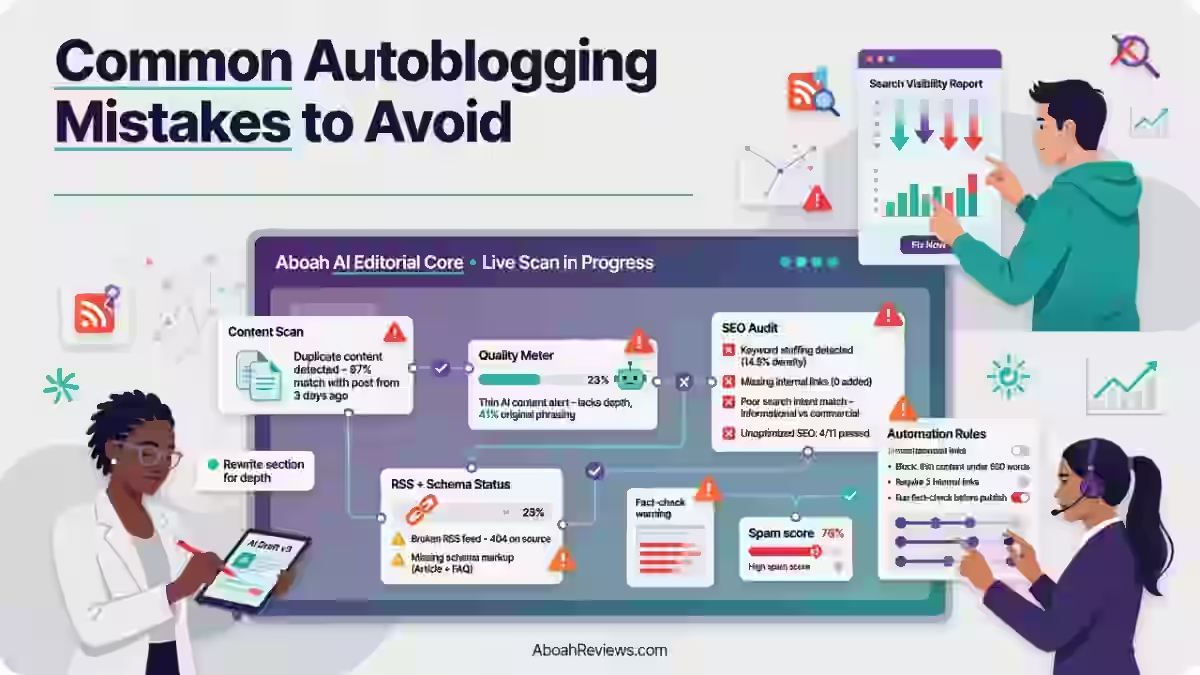
If you want to understand how common autoblogging mistakes connect to internal linking failures, that is a pattern I see consistently across automated content setups.
5. Backlink Monitoring
Backlink monitoring is one of the cleanest automation wins in SEO.
Tools like Ahrefs and Semrush track new backlinks pointing to your site, flag lost links, and monitor competitor link building, all without you needing to check manually.
Ahrefs’ key differentiation, 15 to 30 minute backlink data refresh, remains unmatched by competitors for near-real-time link monitoring.
That matters when you are running an active link building campaign and need to confirm that new links are actually indexed and live.
6. Content Optimization
Content optimization platforms like Surfer SEO scan top-ranking pages, identify keyword gaps, suggest structural improvements, and score your content against SERP competitors.
Automation tools scan top-ranking pages, extract their structural elements, and build detailed content briefs with clear specifications that boost SEO performance metrics.
This is where AI writing assistants and content optimization platforms intersect with SEO data analysis.
They speed up the process of understanding what a page needs. They do not write the page for you, at least not without editing.
Many marketers automate on-page content optimization for existing blog posts. The key word there is “existing.”
Updating older content with automated recommendations is a legitimate use case. Publishing raw AI output without review is a different thing entirely.
SEO Tasks That Still Need Humans
Automation covers the operational layer of SEO. Strategy is a different category entirely. Here is what should stay in human hands:
- Editorial judgment and content approval — Does this draft actually help someone? Does it answer the right question? Software cannot tell you that.
- Strategic keyword selection — Automated keyword research tools surface volume data. A human decides which keywords actually match business goals.
- Link relationship building — Automated link building tools can find prospects, but real link acquisition requires human outreach, relationship, and context.
- Brand voice decisions — An AI writing assistant can produce on-topic text. It cannot sound like your brand without significant editing.
- Search intent analysis — Tools can categorize intent broadly, but matching a specific page to exactly what a user needs at each stage of their journey still requires a content strategist.
- AI Overviews tracking response — Knowing that your brand appears in an AI overview is automated. Deciding how to respond to what is being cited requires a person.
An SEO tool will by no means replace human expertise and the strategic thinking of a marketing expert, but will only complement the assumptions and ideas of an SEO specialist.
Benefits of SEO Automation
1. Saves Time
Businesses save an average of 9 hours per month on manual meta-tag editing with plugins like Yoast alone.
Scale that across rank tracking, audits, reporting, and content scoring, and a small team can recover 20 to 40+ hours per month. Those hours go back into strategy, client work, or content creation.
2. Improves Efficiency
Automated SEO tools help improve organic traffic by 20 to 30% on average. Part of that is because issues get caught and fixed faster.
Part of it is because the data is always current, so decisions are based on reality rather than a snapshot from last month.
3. Reduces Human Error
Humans forget to check things. An automated audit does not. Enterprise sites decreased SEO project lag time using BrightEdge Autopilot.
Fewer delays and missed checks translate directly to fewer ranking problems that compound over time.
4. Helps Scale SEO Operations
72% of marketers say automation helps them scale content production by targeting the right audience and keeping messages consistent across channels.
For agencies managing multiple client sites or businesses with large site footprints, automation is the only realistic path to consistent monitoring and optimization at scale.
5. Provides Better Data Visibility
Real-time dashboards, automated rank tracking reports, content decay detection, and search visibility tracking give teams a current picture of performance.
67% of businesses use automation for SEO tasks like keyword tracking and reporting. Those businesses are making decisions based on live data.
The ones doing it manually are making decisions based on last month’s numbers.
SEO Automation vs. Traditional SEO
Automation does not replace SEO professionals. It changes what they spend their time doing.
Here is how the two approaches compare across key workflows:
Feature | Manual SEO | SEO Automation |
|---|---|---|
Keyword tracking | Manually checked on a set schedule | Automatically monitored daily |
Reporting | Built manually by pulling data from multiple sources | Generated automatically on a schedule |
Audits | Run periodically when someone remembers to | Scheduled scans on a daily or weekly basis |
Internal linking | Manual research across the content library | Automated suggestions reviewed by editor |
Content decay detection | Not typically done systematically | Flagged automatically when traffic drops |
Scalability | Limited by team capacity | Scales with the platform, not headcount |
Error detection speed | Depends on audit frequency | Near real-time on premium platforms |
The honest answer is that manual SEO at scale is a losing game. You will always miss something. Automation does not miss things. It just cannot decide what to do about what it finds.
For more on how automated approaches compare to traditional methods, see my breakdown of autoblogging vs. traditional blogging.
SEO Automation vs. AI SEO Automation
These two terms get used interchangeably, but they describe different things.
Standard SEO automation follows rules you set. AI SEO automation uses machine learning to interpret data, identify patterns, and generate recommendations that go beyond what a static rule set would catch.
Feature | SEO Automation | AI SEO Automation |
|---|---|---|
Workflow logic | Rule-based triggers and schedules | AI-driven pattern recognition |
Decision-making | Predefined conditions | Data interpretation across signals |
Content creation | Limited to templates and scoring | AI-assisted drafts and content briefs |
Optimization approach | Surfaces issues and suggestions | Generates automated SEO recommendations |
Learning over time | Static rules | Improves with more data |
Best for | Operational SEO tasks at scale | Strategic content and predictive SEO |
The practical difference is this: standard automation tells you a page dropped 5 positions.
AI SEO automation might tell you the page dropped because it no longer matches current search intent, and here is what the top-ranking pages are doing differently.
Neither replaces your judgment. AI SEO automation just gives you a more complete picture to work from.
Best SEO Automation Tools in 2026
I will organize these by use case rather than giving you a flat list, because the “best” tool depends entirely on what you are trying to automate.
SEO Analytics, Rank Tracking and Reporting Tools
Semrush
Semrush is the widest platform in this category. In 2026 the five tiers cover a limited Free plan, Pro at $139.95/month, Guru at $249.95/month, Business at $499.95/month, and custom Enterprise pricing.
For most SEO professionals and small marketing teams, the Pro plan covers core needs including keyword research, site audits, position tracking for 500 keywords, and the free Semrush Copilot AI assistant.
Semrush counters Ahrefs with broader coverage: PPC data, content marketing tools, social media tracking, and AI search visibility, features Ahrefs does not include at any tier.
Best for: teams running keyword research, rank tracking, competitor research, and content marketing from one platform.
Ahrefs
Ahrefs is the stronger choice if backlink monitoring is your primary concern. Ahrefs’ 15 to 30 minute backlink data refresh rate remains unmatched by competitors for near-real-time link monitoring.
Ahrefs Standard at $249/month competes directly with Semrush Guru at $249.95/month and Moz Pro’s Medium plan at $179/month.
Best for: agencies and SEO professionals who do heavy link analysis and competitor backlink research.
Ahrefs now shows if your brand is mentioned in AI Overviews and across major LLMs like ChatGPT, Perplexity, Gemini, and Copilot.
This makes it one of the only tools actively built for AI Overviews tracking as a core feature.
SE Ranking
It sits between budget and mid-range. Essential starts at $65/month, Pro at $119/month, and Business at $259/month.
SE Ranking delivers all-in-one SEO automation at price points that undercut most competitors while maintaining feature depth.
It is ideal for small to mid-sized agencies and in-house marketing teams that need enterprise-level automation features without the enterprise price tag.
Technical SEO Automation Tools
- Screaming Frog SEO Spider is the standard for automated technical audits. Screaming Frog SEO Spider costs £199 per year ($279 USD) per user, a flat annual fee that unlocks unlimited crawls with no monthly subscription or per-crawl credits. The free version includes core crawling functionality with a 500-URL limit per crawl.
You can schedule crawls to run automatically. Instead of manually re-running audits after a crawl, the exports can be automatically exported for further analysis.
Best for: technical SEO specialists and agencies who need deep, scheduled crawl data without paying monthly SaaS rates.
- Google Search Console (free) is underused as an automation tool. Combined with Looker Studio, you can build fully automated reporting dashboards that refresh without any manual intervention. Once connected, dashboards update automatically whenever the data source updates. Best for: any team that wants automated performance visibility at no cost.
Content Optimization and Content Brief Generation Tools
- Surfer SEO focuses specifically on content scoring and on-page optimization. Surfer SEO delivers strong value at $119/month, with a focus on content optimization automation.
Best for: content marketers and writers who need data-driven guidance on keyword placement, structure and topical coverage for every article they produce.
- MarketMuse goes deeper on content gap analysis and content brief generation. MarketMuse processes millions of search queries, spotting gaps your competitors missed and tracking intent shifts that manual research would never catch.
Best for: content-heavy sites that need systematic, data-backed briefs at scale.
Automated content scoring tools are used by 55% of B2B content teams.
If your team produces content regularly, running it through a content optimization platform before publishing is one of the highest-ROI uses of SEO automation.
All-in-One SEO Automation Platforms
For enterprise SEO automation, BrightEdge and Conductor operate at a different scale entirely.
Botify is an enterprise technical SEO platform that combines log file analysis, crawl data, and search analytics into automated workflows for large-scale website optimization.
These platforms are built for large organizations managing complex multi-domain content programs. Custom enterprise pricing only with no public rates available is standard at this tier.
For a broader look at how individual tools compare, see my detailed autoblogging AI alternatives guide.
Quick Tool Comparison
Tool | Monthly Price | Best Use Case | Free Plan |
|---|---|---|---|
Semrush Pro | $139.95/mo | Keyword research, rank tracking, reporting | Limited free tier |
Ahrefs Standard | $249/mo | Backlink monitoring, AI visibility tracking | No |
SE Ranking Essential | $65/mo | All-in-one for small/mid agencies | Limited |
Screaming Frog | $279/yr flat | Scheduled technical audits | Yes (500 URLs) |
Surfer SEO Essential | $89/mo | Content scoring, on-page optimization | No |
Google Search Console | Free | Search visibility tracking, indexing | Yes (fully free) |
SEO Automation Best Practices
1. Automate Repetitive Tasks First
Start with the tasks you do on a fixed schedule: reporting, rank tracking, and technical audits.
These are the areas where automation delivers the most immediate time savings with the least risk of something going wrong.
Do not start by automating content creation. Start by automating your monitoring, then work toward content optimization with human review in the loop.
2. Keep Human Oversight on Everything That Touches the Reader
Any output that gets published should pass through a human editor.
This applies to automated content briefs, AI-generated drafts, and SEO recommendations that get implemented on live pages.
Automation tells you what the data shows. A human editor decides whether the action makes sense for your audience.
44% of companies struggle with a lack of skilled personnel to manage automation tools.
The risk is not that you automate too much. It is that you automate without understanding what the tool is actually doing.
3. Avoid Over-Automating Content
This is the lesson I keep seeing repeated.
I tested three autoblogging tools side by side over 90 days: Emplibot, Junia AI, and RightBlogger.
The semi-automated approach (AI draft plus human editing) outperformed fully automated posts by roughly 3x in organic traffic after 6 months.
Fully automated content with no editorial review consistently underperforms because it cannot account for search intent, tone or the specific nuances of what a user actually wants to read.
Google’s Search Quality Rater Guidelines make clear that helpful, people-first content is the standard.
Automation does not know what “helpful” feels like to your specific reader.
4. Combine Automation With SEO Strategy
Effective SEO automation deploys intelligent software to handle repetitive tasks.
These tools pull data directly from your analytics and CMS, creating a smooth-running SEO workflow that shifts your team’s focus from manual labor to strategic growth.
The data tells you what happened. Your strategy determines what you do next. Treat automated tools as inputs to your decision-making process, not as decision-makers themselves.
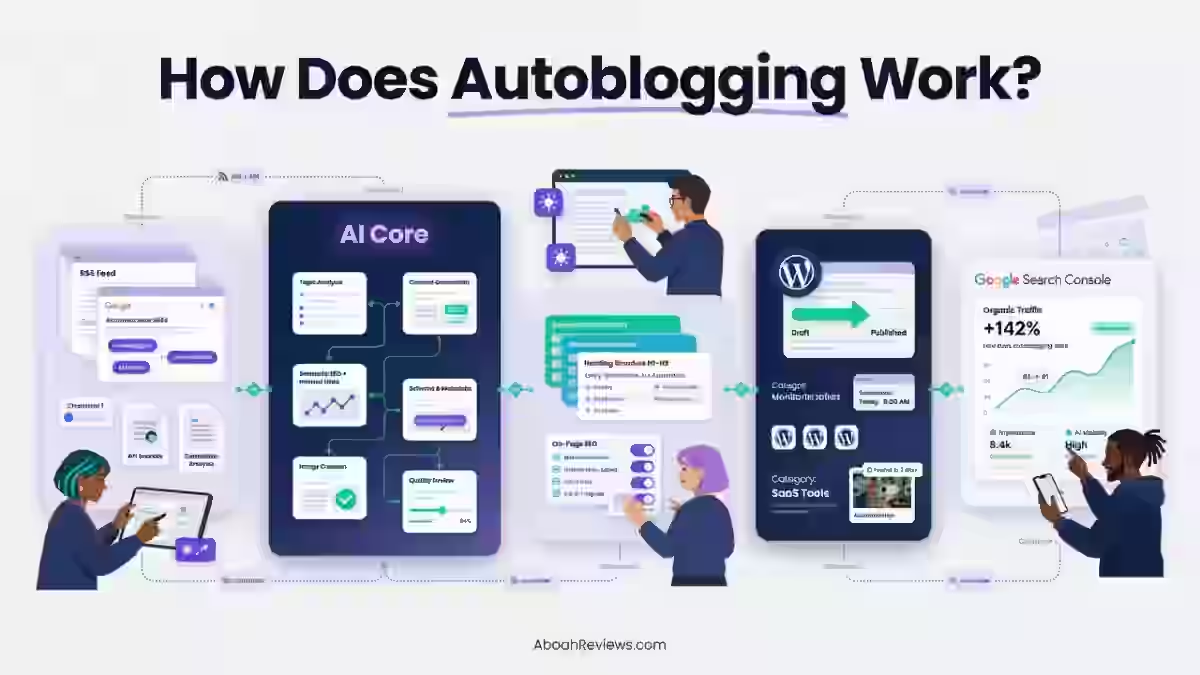
For a clearer picture of how this fits into a full workflow, my how autoblogging work guide breaks down the mechanics in more detail.
Limitations of SEO Automation
Every automation tool has a ceiling. Here is where they consistently fall short:
- Cannot understand audience psychology: A tool can tell you that a page has low time-on-page. It cannot tell you that the writing feels cold, or that the introduction buries the answer users came for.
- May produce inaccurate recommendations: Automated SEO recommendations are based on pattern matching. If your site has unusual architecture or operates in a niche with thin SERP data, recommendations can be wrong.
- Requires proper configuration: A poorly configured automated audit will miss issues or flag things that are not problems. Setup matters.
- Does not replace expertise: Proper, well-thought-out, and clearly planned SEO automation can not only save time but also reduce the number of errors in operational processes. It also accelerates decision-making during the promotion of a business project. But it requires someone who understands SEO to configure it correctly and interpret the output accurately.
One of the most common mistake teams make is treating automated audit findings as a to-do list rather than a prioritized set of signals that still require human triage.
Is SEO Automation Worth It?
The answer depends on your situation.
- For bloggers: Automation is worth it for rank tracking and content optimization scoring. Tools like Semrush Pro ($139.95/month) or SE Ranking Essential ($65/month) give you enough coverage to monitor your site and spot opportunities without overspending. You probably do not need an enterprise SEO automation platform.
- For agencies: Automation is worth it at almost every level. For agencies, the savings come from reporting time, audit time, and the ability to manage more clients per team member. Tools with white-label reporting (SE Ranking, Semrush Business) are specifically built for this.
- For small businesses: In many ways, small businesses benefit more because they need to maximize the impact of every hour and dollar. You do not need the entire suite of enterprise tools. Start with one or two affordable tools that solve your biggest pain point. Google Search Console (free) plus Screaming Frog ($279/year) covers the basics without a large monthly commitment.
For context on the cost-versus-benefit calculation for different team sizes, see free vs. paid autoblogging tools as a reference framework that applies directly here.
Future of SEO Automation
The direction is clear even if the exact timeline is not. Here is what is already happening and where things are heading:
- AI Overviews tracking will become a standard feature: Tools like Ahrefs already show brand mentions in ChatGPT, Perplexity, and Google AI Overviews. Within 12 months, this will likely be table stakes across mid-range tools.
- Search visibility tracking will expand beyond traditional SERPs: Automated monitoring will increasingly cover AI-generated answer surfaces, not just blue-link rankings.
- Automated content briefs will become more precise: As search intent analysis improves, brief generation tools will move from keyword lists to fully structured editorial briefs with entity recommendations and source suggestions.
- Content decay detection will be built into more platforms: Content freshness scoring and automated update recommendations are the next logical step.
- Predictive SEO analysis will go mainstream: Rather than reporting on what happened, platforms will increasingly flag what is likely to happen based on trend data and algorithm pattern recognition.
Teams that will benefit most from these changes are those who use automation for operational tasks now, because they will already have the workflow discipline to add AI layers without losing quality control.
If you want to go deeper on where this category is heading, the future of autoblogging piece covers the longer arc of AI-driven content and SEO workflows.
Final Thoughts On Automated SEO
SEO automation is not a shortcut. It is a workflow improvement. The teams that use it well are not trying to remove humans from the process.
They are trying to make sure their humans are spending time on things that actually require human thinking.
The starting point for most teams should be rank tracking and reporting automation. Both deliver immediate time savings with near-zero risk.
From there, automated audits and content optimization scoring are the logical next steps. Content generation with AI assistance belongs further down the chain, once you have editorial processes in place to review and improve the output.
As search continues to evolve and AI Overviews take up more SERP real estate, the importance of automated search visibility tracking and content freshness monitoring will only increase.
The tools are already there. What changes is how central they become to a standard SEO workflow.
Start by automating repetitive tasks while keeping strategy, creativity, and quality under human control. That is the version of SEO automation that actually produces results.
If you have questions about which tools fit your specific situation or if you have had a different experience with automated keyword research or link building workflows, drop a comment below.
Frequently Asked Questions
1. What is automation in SEO?
SEO automation is the use of software and scripted workflows to automatically handle repetitive SEO tasks such as rank tracking, technical audits, backlink monitoring, reporting, and content optimization. The goal is to reduce manual effort on recurring tasks so that SEO teams can focus time on strategy and content quality. Automation handles the data collection and flagging; humans handle the decisions.
2. How do I learn SEO as a beginner?
Start with Google’s own Search Central documentation, which covers how Google crawls and indexes content. From there, free tools like Google Search Console and Google Analytics give you hands-on data to practice with before investing in paid platforms. The best way to learn SEO is to run a real site, make real mistakes, and track what actually changes in rankings.
3. Will SEO be replaced by AI?
SEO will not be replaced by AI, but the nature of SEO work is shifting. AI handles more of the data analysis and content generation, but search intent analysis, editorial judgment, link relationship building, and strategy still require human expertise. The professionals who adapt will use AI tools to work more efficiently, not disappear.
4. Can ChatGPT do SEO?
ChatGPT can assist with SEO tasks like drafting content, generating meta descriptions, brainstorming keyword ideas, and creating content briefs. It is not a replacement for dedicated automated SEO tools because it cannot crawl your site, pull live ranking data, monitor backlinks, or generate automated reports. It works best as an AI writing assistant inside a broader SEO workflow.
5. Is SEO dead or evolving in 2026?
SEO is evolving, not dying. The rise of Google AI Overviews, ChatGPT search, and Perplexity has changed where clicks go and what kind of content gets cited, but organic search remains a primary traffic channel for most businesses. Automated SEO tools help improve organic traffic by 20 to 30% on average, which tells you that investing in optimization still produces measurable returns.
6. Will SEO exist in 5 years?
SEO will exist in 5 years in a recognizable form, though the tactics will continue shifting. As long as search engines and AI platforms use content to answer user queries, there will be a need to optimize that content for discoverability and relevance. The job of an SEO professional will increasingly include optimizing for AI citation and AI Overviews tracking alongside traditional SERP rankings.
7. Is SEO automation safe?
SEO automation is safe when applied to operational tasks like rank tracking, audits, and reporting. The risk comes from automating content publishing without editorial review, which can produce thin content, keyword cannibalization, and ranking drops. Used correctly, it is a legitimate and effective approach. Used without oversight, it produces the same problems manual spam always has.
8. Does SEO automation replace SEO experts?
SEO automation does not replace SEO experts. It replaces the parts of the job that do not require expertise: pulling reports, checking rankings, running crawls, and formatting data. An SEO tool will by no means replace human expertise and the strategic thinking of a marketing expert, but will only complement the assumptions and ideas of an SEO specialist. An experienced SEO professional using automation gets more done and makes better decisions than one working manually.
9. Can SEO automation improve rankings?
Yes, indirectly. SEO automation improves rankings by helping teams identify and fix issues faster, maintain content freshness, monitor search visibility tracking continuously, and scale optimization across large site footprints. The automation itself does not create the improvement. It enables faster, more consistent execution of the actions that do.
10. What is the difference between SEO automation and AI SEO automation?
Standard SEO automation follows rules you define: send an alert when rankings drop, run an audit every Monday, generate a report on the first of the month. AI SEO automation uses machine learning to interpret data beyond static rules, identify content opportunities, generate automated content briefs, and produce contextual recommendations based on patterns across large datasets.

- Generative Engine Optimization (GEO): The Complete Guide to Winning AI Search in 2026 - August 14, 2026
- 10 Best AI Autoblogging Tools I Tested for 2026 - August 12, 2026
- How to Automate Blog Content Posting to Social Media With RSS Feeds (2026) - August 11, 2026