TL;DR: AI Overviews are changing SEO by adding a new visibility layer above traditional rankings, one built on citations, not just position. This guide explains how AI Overviews will change SEO for content marketers, bloggers and agencies, based on real testing and current CTR data. The main takeaway: ranking #1 still matters, but it’s no longer the finish line.
I’ve been tracking search results daily since before Google rolled out AI Overviews in the US in May 2024, and I’ll be honest with you: the first time I saw my own client’s page get summarized and buried under a Gemini-generated answer box, I panicked a little.
Then I started pulling the actual click data. This article explains how AI Overviews will change SEO in 2026, what the real numbers say about traffic loss and what I’ve changed in my own workflow after testing content across dozens of AI Overview queries.
You’ll get a straight answer first, then the reasoning, the data and a practical framework you can actually use this week.
Quick Summary: How AI Overviews Will Change SEO
AI Overviews are changing SEO by adding a new step between ranking and getting a click: getting cited inside the AI-generated answer itself.
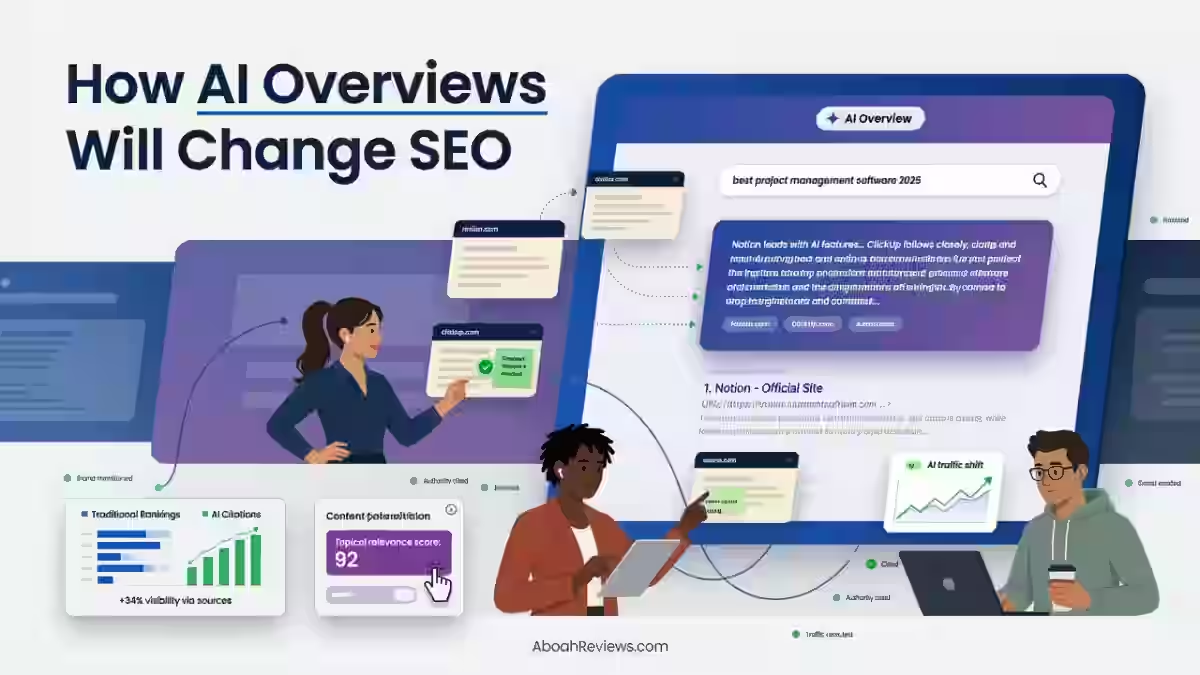
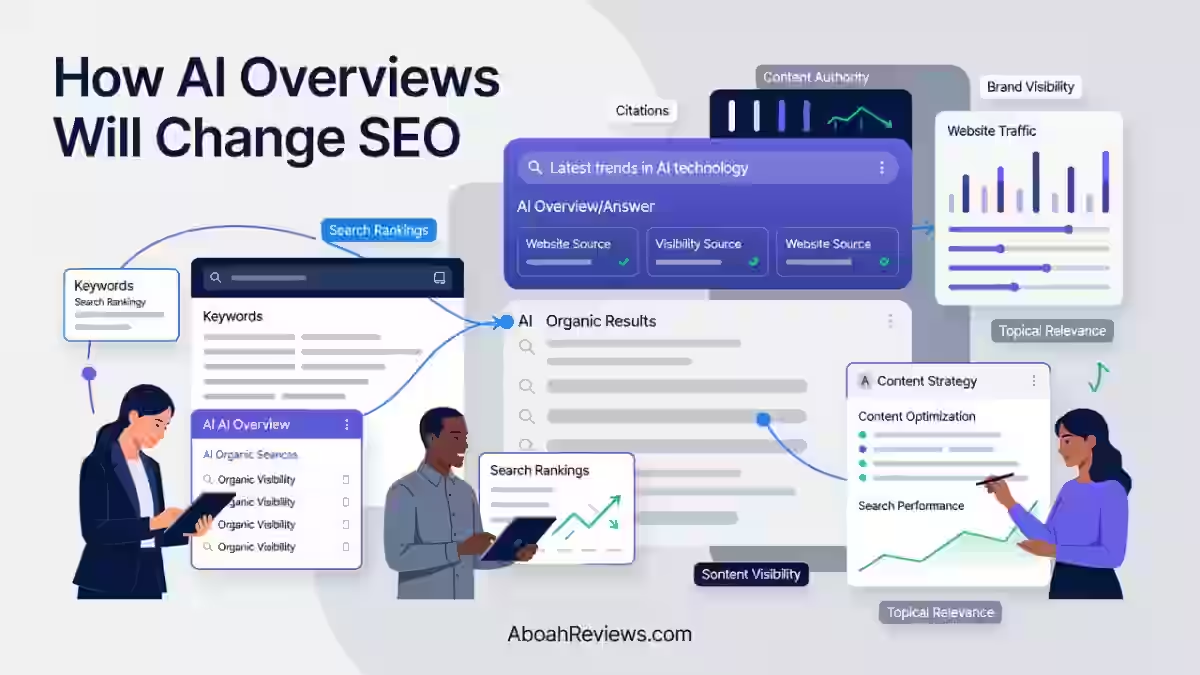
Instead of the old path of rank → click → conversion, the path now looks like rank → AI visibility → citation → click → conversion. If your content doesn’t get pulled into that summary box, you can still rank #1 and see far fewer visitors than you did in 2023.
Here’s the shift in plain terms:
- Rank: you still need to show up in Google’s index and rank reasonably well; this hasn’t gone away.
- AI visibility: Google’s model decides whether your page is a candidate to be pulled into the summary at all.
- Citation: your page (or a specific passage from it) gets named as a source inside the AI Overview.
- Click: a user reads the summary and decides your page is worth visiting for more detail.
- Conversion: the visitor who does click tends to be more qualified, because they already got the basic answer and still wanted more.
I’ve seen pages that rank #3 organically get cited in the AI Overview while the #1 result doesn’t appear at all. That’s the part most SEO advice from 2023 doesn’t prepare you for.
What Are Google AI Overviews and Why Do They Matter for SEO?
Google AI Overviews are AI-generated summaries that sit above the normal blue links and answer a query using information pulled from multiple web pages at once.
Google AI Overviews or AIO are AI-generated summaries that appear above the organic results and answer a query with a synthesis built from multiple sources, including links to the cited pages.
They matter for SEO because they’re taking up the first screen of real estate that used to belong to organic listings.
How AI Overviews Change the SERP
AI Overviews change the SERP by pushing every organic result, including position #1, further down the page and behind an AI-generated summary.
The rollout of AI-based results in Google Search dates back to 2023, when the company announced it was working on the Search Generative Experience.
This was until May 14, 2024 that it officially launched in the United States under the name Google AI Overviews. Since launch, the feature has kept expanding into more countries, languages, and query types, so the SERP you’re optimizing for today looks different than it did even six months ago.
AI Overviews vs Featured Snippets and Traditional Results
AI Overviews differ from featured snippets because they synthesize information from several sources instead of quoting one page word for word.
A featured snippet pulls an exact passage from a single URL, while Featured Snippets extract text verbatim from a single page, while AI Overviews synthesize information from multiple sources using Google’s Gemini AI.
This matters practically: ranking for a featured snippet used to mean owning that answer, but ranking for an AI Overview citation means your content is one of several ingredients in someone else’s answer.
The two features also don’t overlap as often as you’d expect. In one comparison, AI Overviews appeared on about 84% of baby care and pregnancy queries, while featured snippets only showed up about 32.5% of the time, showing how much more ground AI Overviews already cover for certain topic types.
Why AI Overviews Create a New SEO Visibility Layer
AI Overviews create a new visibility layer because being cited inside the summary is now a separate, measurable outcome from ranking in the top 10.
A page can rank well and never get cited, or get cited from outside the top 10 entirely through what’s called a fan-out query.
Sites that don’t appear in the organic search results for a given query can still be cited in the AI Overview, due to fan-out queries that pull in tangential information. This gives those sites an opportunity for organic impressions even when they’re not directly answering the searcher’s primary question.
That’s why I now track citation rate separately from rank position for every client, the same way I’d track a rank tracking tool built for AI Overviews alongside a normal position tracker.
The 6 Biggest Ways AI Overviews Will Change SEO
1. Rankings Will No Longer Tell the Whole Story
Rankings alone no longer tell you whether a page is actually visible to searchers. A page sitting at position #1 can lose most of its expected clicks if an AI Overview appears and cites a competitor instead.
I check both metrics now: organic rank and AI Overview citation status, because they answer different questions.
2. Organic CTR Will Become More Query-Dependent
Organic click-through rate now depends heavily on whether the query triggers an AI Overview in the first place.
The percentage of Google searches that result in zero clicks rises to 83% when an AI Overview is present.
That means a blanket CTR assumption across your whole site is no longer accurate; you have to segment by query type.
3. Citations Become Another Visibility Opportunity
Getting cited inside an AI Overview is a visibility win even when the user doesn’t click.
Being named as a source builds brand recognition every time someone reads that summary box, similar to how a byline in a trusted publication builds trust even if the reader never visits the original site.
AI citations are important in digital marketing because they affect your brand’s visibility and portrayal in AI responses, which are increasingly prevalent in customer journeys.
4. Content Must Deliver Clear, Verifiable Information
Content now needs to state facts in a way that can be lifted out and verified without extra context.
Vague claims like “many experts agree” get skipped in favor of specific numbers, dates, and named sources. I rewrite any sentence in my drafts that can’t stand alone as a quote, because that’s effectively how AI models are reading it.
5. Original Expertise Becomes More Valuable
Original, first-hand expertise is harder for competitors to copy and more likely to get picked up as a citation-worthy source.
I learned this when I tested three autoblogging tools side by side over 90 days: Emplibot, Junia AI, and RightBlogger.
The semi-automated approach, meaning an AI draft followed by real human editing, outperformed fully automated posts by roughly 3x in organic traffic after six months, because the edited posts had specifics the automated ones didn’t.
That gap is exactly the kind of signal that separates citation-worthy pages from generic ones.
6. SEO Measurement Must Expand Beyond Rankings
Rank tracking alone can’t tell you if AI Overviews are eating your clicks or feeding you qualified traffic.
You need citation tracking, impression data, and conversion tracking running side by side. I cover the exact setup later in this guide under the measurement section.
Will AI Overviews Reduce Organic Traffic?
Yes, AI Overviews are reducing organic traffic for many query types, though the size of the drop depends heavily on what you’re searching for.
An Ahrefs study found the presence of an AI Overview in search results correlated with a 34.5% lower average CTR, with the average position one CTR for informational keywords dropping from 0.056 in March 2024 to 0.031 in March 2025.
A more recent update to that same research found the drop had gotten worse, not better, as the rollout matured further.
Separately, user-behavior research backs this up from a different angle.
A Pew Research Center study of user sessions found users clicked any traditional result in only 8% of sessions with AI Overviews present, compared to 15% without.
Both studies point the same direction: fewer clicks reach the open web when an AI Overview shows up.
Which Query Types Face the Greatest Risk?
Informational and “how-to” queries face the greatest risk of losing clicks, while transactional and local searches are more protected. Here’s how I break it down when auditing a client’s content:
| Query Type | Typical Risk Level | Why |
|---|---|---|
| Informational / “how-to” | High (83% zero-click) | Answer often fits in a short summary |
| Definition / “what is” | High | Easy for AI to fully answer in one paragraph |
| Comparison (“X vs Y”) | Medium | AI can summarize but users often want detail |
| Transactional (buy, price) | Low–Medium | Users still need to visit a site to act |
| Local (“near me”) | Low | Maps and local pack still dominate these results |
| Navigational (brand names) | Very Low | Users usually know exactly where they’re going |
I use this table as a starting filter before doing any content audit, because it tells me which pages need urgent attention first.
Why Zero-Click Searches Don’t Automatically Mean Zero Business Value
A zero-click search doesn’t automatically mean zero business value, because brand exposure and citation credit still happen even without a visit.
Being named inside an AI Overview functions a bit like a mention in a trusted publication: the reader remembers your name even if they don’t click through immediately.
Semrush’s research on this backs it up directly: visitors from AI search experiences are 4.4x more likely to convert than visitors from traditional search experiences.
That number matters more than raw traffic volume for a lot of businesses I work with. Fewer visitors who convert at a higher rate can outperform more visitors who don’t.
What Happens to Traditional SEO in the AI Overview Era?
Traditional SEO doesn’t disappear in the AI Overview era, but it stops being the entire strategy on its own. Google’s own guidance backs this up directly.
Google Search Central’s core guidance on AI Overviews is that there is no special AI-Overviews markup or separate AI index.
The same helpful, people-first, high-quality content and standard structured data that ranks in organic Search is what surfaces in AI Overviews, drawn from the same index and judged by the same E-E-A-T signals.
Here’s my Keep / Change / Add framework, built from watching client sites through this shift:
What SEOs Should Keep
Keep the fundamentals: technical SEO, crawlability, internal linking, and keyword-intent matching.
None of these went away, and skipping them tanks your chances of even being a citation candidate.
Sites with broken internal links or slow load times still lose visibility, AI Overview or not.
What SEOs Should Change
Change how you measure success, moving from rank-only tracking to a combined rank-and-citation view.
Modify how you write, favoring self-contained, quotable paragraphs over long narrative build-up.
Shift how you plan content, prioritizing depth on fewer topics over breadth across many thin pages.
What SEOs Should Add
Add AI visibility tracking, citation analysis, and original data collection to your regular workflow.
Add a process for auditing which competitors get cited for your target queries and why. I run this audit monthly now, the same cadence I use for a normal automated SEO reporting cycle.
How to Optimize Content for Google AI Overviews
Answer Specific Questions Clearly
Answer the exact question in the heading within the first sentence, without any lead-up. This is the single biggest change I made to my own writing process, because AI models pull the first clear, self-contained answer they find on a page.
Use Descriptive Content Structure
Descriptive headings and short sections help AI models match your content to the right query fast. Use question-based H2s and H3s exactly the way a person would type them into Google. Break long explanations into numbered steps instead of one dense paragraph.
Make Important Claims Self-Contained
Every important claim should make sense on its own, without needing the sentence before it. Avoid phrases like “as mentioned above” that only work in the full page context.
Write each key sentence as if it might be lifted out and shown by itself, because that’s often exactly what happens.
Support Claims With Evidence
Back up your claims with specific numbers, dates, and named sources instead of vague descriptions.
“Fast” means nothing to a model deciding what to cite; “0.8 second load time” does. I add a source or a real test result to every performance claim I make, even in casual blog posts.
Demonstrate First-Hand Experience
Show that you actually did the thing you’re writing about, not just researched it.
I lost an affiliate site’s rankings once after publishing 42 auto-generated posts without internal linking or keyword filtering, and the content ended up cannibalizing itself.
That kind of specific, dated mistake is exactly the sort of detail that separates real experience from generic advice.
Strengthen Author and Organization Information
Clear author bios and organization details help both readers and AI systems trust your content. Include real names, credentials, and links to other work by the same author.
Thin “About Us” pages and anonymous posts are easy to skip when a model is choosing between similar sources.
Keep Important Information Current
Outdated statistics, pricing, and product details get filtered out of AI-generated answers fast.
Set a recurring reminder to update anything time-sensitive, like tool pricing pages or industry benchmarks.
I re-check pricing pages every 60 days, since tools change plans more often than most people expect.
Does Ranking #1 Guarantee an AI Overview Citation?
No, ranking #1 does not guarantee an AI Overview citation, though it does improve your odds. Citation and ranking are related but separate outcomes, decided by different parts of Google’s system.
Rankings and Citations Are Different Outcomes
A page can rank #1 organically and never appear in the AI Overview for the same query. Conversely, a page ranking #6 or #7 can get cited if it answers a specific sub-question the AI decided to include.
I’ve watched this happen on client accounts often enough that I no longer assume top rank equals top visibility.
What Makes a Page Potentially Citation-Worthy?
A page becomes citation-worthy when it answers a question clearly, backs claims with evidence, and comes from a source Google already trusts for that topic.
Ranking well in traditional search is necessary but not sufficient; content must also demonstrate clear expertise and trustworthiness to earn citations.
That’s a direct explanation of why two similarly-ranked pages can get treated so differently by the AI Overview system.
Why Original Research Can Create Citation Opportunities
Original research and first-party data create citation opportunities that generic rewrites can’t. Google’s own AI Overviews often pull from sources that add something not found elsewhere, including community platforms.
Studies show that a few user-generated content websites like Quora, Reddit, and YouTube get an overwhelming amount of visibility on Google’s AI Overviews, and Google often includes experience-based and community-validated sources when generating these answers.
If community-driven content earns that much trust, original first-hand testing on your own site should earn even more.
How AI Overviews Change Keyword Research
AI Overviews change keyword research by making query-intent mapping and entity research more important than exact-match keyword volume.
You still need keyword data, but you now need to know which queries actually trigger an AI Overview before you plan content around them.
Find AI Overview-Triggering Queries
Find AI Overview-triggering queries by checking your priority keyword list against a SERP feature report in a tool like Semrush or Ahrefs.
Not every query triggers an AI Overview, and coverage varies heavily by topic and query length. Flag the ones that do, since those need different content treatment than a plain informational query.
Map Keywords by Search Intent
Map every keyword to its underlying intent, not just its search volume. A “what is” query and a “best” query behave completely differently inside an AI Overview.
This mapping step is the same one I use for semantic SEO automation planning, just applied through an AI-visibility lens now.
Research Topics, Questions and Entities
Research the full set of questions and related entities around your main topic, not just one keyword phrase.
AI Overviews often answer several sub-questions in one summary, pulling from multiple pages to do it. Building out a full topic map, rather than one article per keyword, matches how Google is actually assembling these answers.
Prioritize by Business Value
Prioritize keyword targets by potential business value, not just by search volume or difficulty score.
A low-volume, high-intent query that’s less likely to trigger an AI Overview can be worth more than a high-volume one that gets summarized before anyone clicks. I rank my content calendar by expected qualified traffic now, not raw impressions.
How AI Overviews Change Content Strategy
AI Overviews change content strategy by rewarding original information over generic, repeated answers. If ten sites already say the same thing about a topic, adding an eleventh nearly identical page won’t help you get cited.
From Generic Answers to Original Information
Move away from generic restatements of common knowledge and toward original data, testing, or analysis.
This is exactly what separated my semi-automated content test from the fully automated batch: the edited posts had specific numbers and observations the automated drafts simply didn’t include. Readers, and apparently AI models, notice that difference.
Build Topic Depth
Build depth across a full topic cluster instead of spreading thin coverage across many disconnected posts.
A pillar page supported by focused subpages performs better for both traditional rankings and AI Overview citations than a pile of shallow posts targeting slightly different keywords.
Give Users a Reason to Click
Give readers a clear reason to click through even after they’ve seen the AI Overview summary. Add detail the summary can’t fit: full examples, downloadable data, step-by-step walkthroughs, or tool comparisons.
A summary can tell someone what the answer is; it rarely explains exactly how to do it for their specific situation.
How SEO Measurement Will Change
SEO measurement will change by adding AI visibility and citation tracking as a separate layer next to traditional rank and traffic reports. Rank position alone no longer explains why traffic moved up or down.
Traditional SEO Metrics to Keep
Keep tracking organic rank, organic traffic, impressions, and conversion rate. These metrics still tell you whether your site is healthy overall. Dropping them entirely would mean losing the baseline you need to measure anything else against.
AI Visibility Metrics to Add
Add AI Overview citation rate, brand mention frequency inside AI answers, and citation-to-click ratio to your reporting. These numbers tell you whether you’re winning the new visibility layer, separate from your normal rank report.
Semrush’s own tooling tracks this distinction directly: Mentions are instances where a brand name is mentioned in the AI Overview’s text summary, while Cited Pages are pages from the domain cited as sources.
Measure Visibility, Engagement and Business Outcomes Separately
Measure visibility, engagement, and business outcomes as three separate categories instead of one blended report. Visibility tells you if you’re being seen. Engagement tells you if people act on what they see. Business outcomes tell you if any of it matters to revenue.
How to Track AI Overview Visibility
Track AI Overview visibility with a repeatable, weekly workflow rather than a one-time check. Here’s the process I run for client accounts:
- Pull your priority keyword list and check which ones currently trigger an AI Overview.
- Search each triggering query manually (or with a dedicated tool) and record whether your domain is cited.
- Log citation status alongside your normal rank position in the same spreadsheet or dashboard.
- Compare citation rate month over month using an AI Overview tracker built for this specific purpose.
- Flag any page that lost citation status and audit it against whichever competitor replaced it.
How AI Overviews Affect Different Types of SEO
AI Overviews affect each type of SEO differently, with content-heavy, informational niches feeling the biggest shift. Here’s a quick breakdown:
| SEO Type | Impact Level | What Changes |
|---|---|---|
| Content SEO | High | Needs original data, clear structure, quotable answers |
| Technical SEO | Medium | Crawlability and structured data still gate citation eligibility |
| Local SEO | Low–Medium | Maps and local pack still dominate over AI summaries |
| Ecommerce SEO | Medium | Product comparison queries increasingly trigger AI Overviews |
| Enterprise SEO | High | Brand mention tracking across many pages becomes essential |
Local businesses tend to worry less about this shift than content publishers do, largely because the local SEO automation playbook still leans on maps and reviews more than AI summaries.
A Practical AI Overview SEO Strategy for 2026
Step 1: Audit Your Priority Queries
Audit your top 20 to 50 priority queries and note which ones currently trigger an AI Overview. This tells you where the risk and opportunity actually sit before you change anything.
Step 2: Analyze Existing AI Overviews
Analyze the current AI Overview for each triggering query and note which domains get cited. Look for patterns: are they all top-10 ranking pages, or is Google pulling from unexpected sources through fan-out queries?
Step 3: Compare Your Content With Cited Sources
Compare your existing content directly against whatever’s currently cited, sentence by sentence if needed. Note what they include that you don’t: specific numbers, structured lists, clearer definitions, or more recent data.
Step 4: Improve Information Quality and Differentiation
Improve your content by adding what’s missing and removing anything vague or generic. Add original testing, real numbers, or a clearer explanation than what’s currently cited. This is the step most teams skip, and it’s the one that actually moves the needle.
Step 5: Monitor AI Visibility and Organic Performance
Monitor citation status and organic rank together on a set schedule, weekly or biweekly depending on your resources. A page that gains citation status but loses rank, or vice versa, tells you something important about what changed.
Step 6: Iterate Based on Business Results
Iterate based on actual conversions and revenue, not just visibility numbers alone.
A citation that never converts isn’t worth as much as a smaller click volume that closes deals. Adjust your content priorities every quarter based on which pages actually move business metrics.
AI Overviews SEO Mistakes to Avoid
1. Optimizing for AI Instead of People
Don’t write content only to make it easier for AI systems to extract or summarize. Keyword stuffing and unnatural phrasing still hurt you with real readers, and AI visibility should be a result of strong content, not the goal of it.
2. Treating Schema or AI Optimization as a Shortcut
Adding schema markup doesn’t guarantee a citation, and optimizing one passage doesn’t replace real SEO work. Technical SEO, crawlability, internal linking, and site authority still matter as much as they did before AI Overviews existed.
3. Copying Competitors Instead of Adding Original Value
Don’t rewrite a page that’s already cited without adding something new. If your content says the same thing the same way, there’s no reason for Google to choose it over the original. Add real research, first-hand testing, or data competitors haven’t published.
4. Publishing Generic or Unverified AI Content
AI-assisted drafts become a liability when they’re generic, outdated, or factually wrong. Review every AI-generated piece before publishing, and update time-sensitive details like pricing and statistics on a set schedule.
5. Measuring AI Visibility by Rankings or Clicks Alone
Don’t assume a good rank means strong AI visibility, or that a citation automatically means traffic. Track citation rate, brand mentions, impressions, clicks, and conversions together for a complete picture of what’s actually happening.
Final Takeaway: SEO Is Expanding, Not Disappearing
Keep your traditional SEO foundations: technical health, keyword-intent mapping, and internal linking. Change how you structure content and how you measure visibility, moving past rank-only reporting. Add AI visibility tracking, citation analysis, and original information that competitors can’t easily copy.
AI Overviews don’t eliminate SEO. They expand the definition of search visibility from simply ranking and earning clicks to being discoverable, useful, cited, trusted, and ultimately chosen.
Whether you’re running a one-person blog or an agency managing dozens of client sites, the framework scales down or up the same way, just with more or less automation involved.
Adapt the size of this workflow to your own team, keep a human reviewing anything AI drafts before it publishes, and treat AI visibility as one more metric worth watching, not a replacement for good judgment.
Frequently Asked Questions
What is the best way to track AI Overview visibility?
The best way is combining a dedicated AI Overview tracker with your normal rank tracking software, checking both citation status and organic position for the same queries. Manual spot-checks work for small sites, but anything beyond 50 keywords needs automated tracking to stay consistent.
Do AI Overviews always reduce clicks to my website?
No, AI Overviews don’t always reduce clicks, but they do for most informational and “how-to” queries. Data from one study showed CTR for top-ranking informational keywords dropped from 0.076% in December 2023 to 0.039% by December 2025, though transactional and local queries see much less impact.
Can a page rank low and still get cited in an AI Overview?
Yes, a page ranking outside the top 10 can still get cited, especially through fan-out queries that pull in tangential but relevant information. This is one of the biggest differences between traditional ranking factors and AI Overview citation selection.
Should I stop targeting featured snippets and focus only on AI Overviews?
No, you shouldn’t stop targeting featured snippets, since they still exist and still drive clicks on many queries. The two features often serve different query types, so a strong SEO strategy covers both rather than picking one.
Is schema markup required to get cited in an AI Overview?
No, schema markup isn’t required, though clean structured data helps Google understand your content faster. Schema supports citation eligibility, but content quality and topical trust matter far more than markup alone.
How often should I audit my content for AI Overview visibility?
Audit your priority queries at least monthly, since AI Overview coverage and cited sources change often as Google keeps expanding the feature. High-traffic or high-value pages deserve a biweekly check given how quickly citation patterns shift.
Will AI Overviews eventually replace traditional organic results entirely?
No, traditional organic results aren’t being replaced, they’re being placed below a new summary layer. Google’s own guidance confirms AI Overviews draw from the same index and the same quality signals used for regular Search results, so ranking well remains the foundation either way.

- How AI Overviews Will Change SEO in 2026 (Full Breakdown + Insights) - September 7, 2026
- AI Overview Tracker: 7 Best Tools to Track Google AI Overviews in 2026 - September 6, 2026
- EverBee Review 2026: My 30 Days Unbiased Testing Results - September 5, 2026