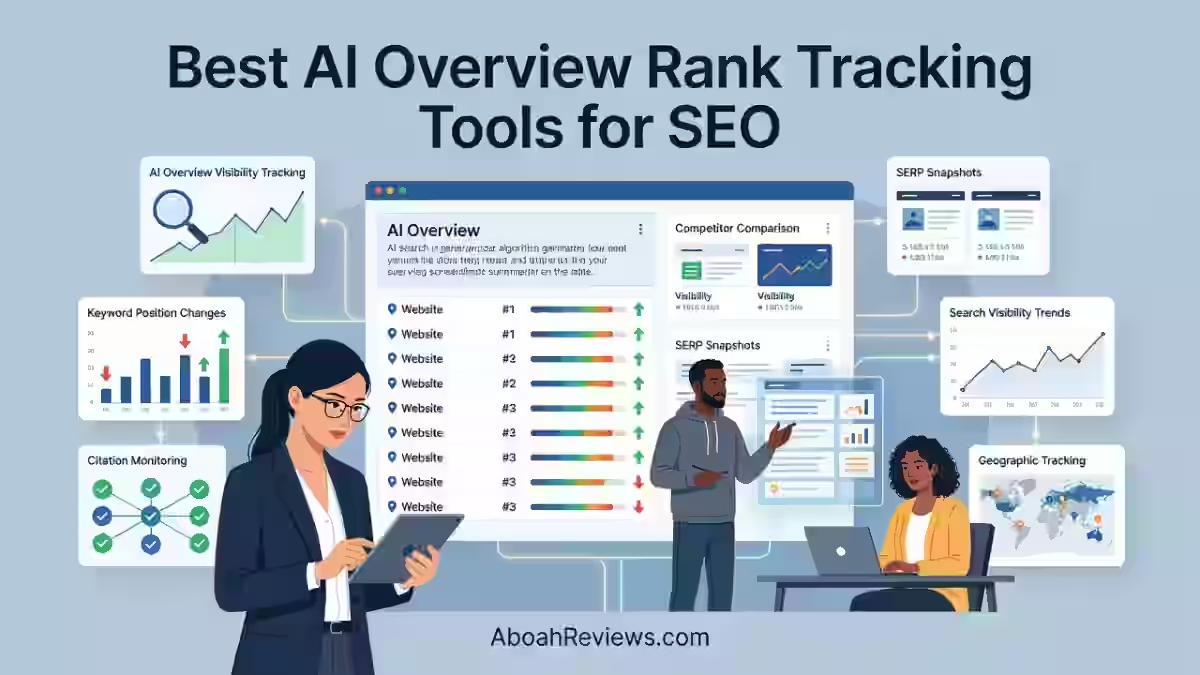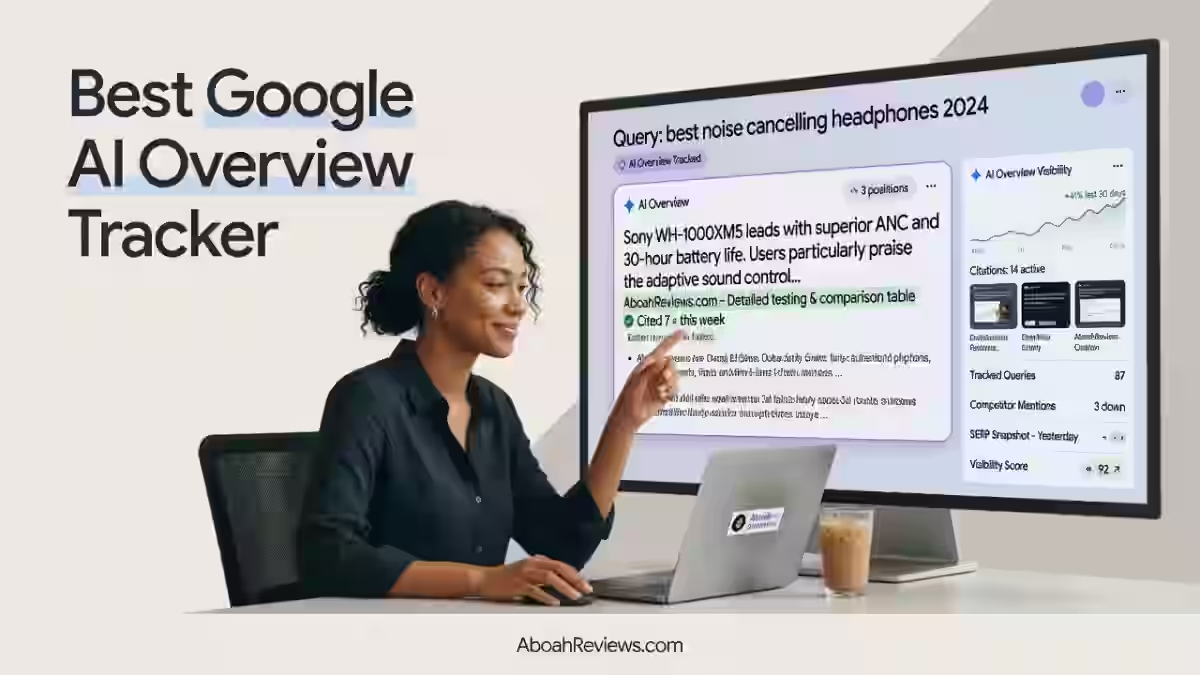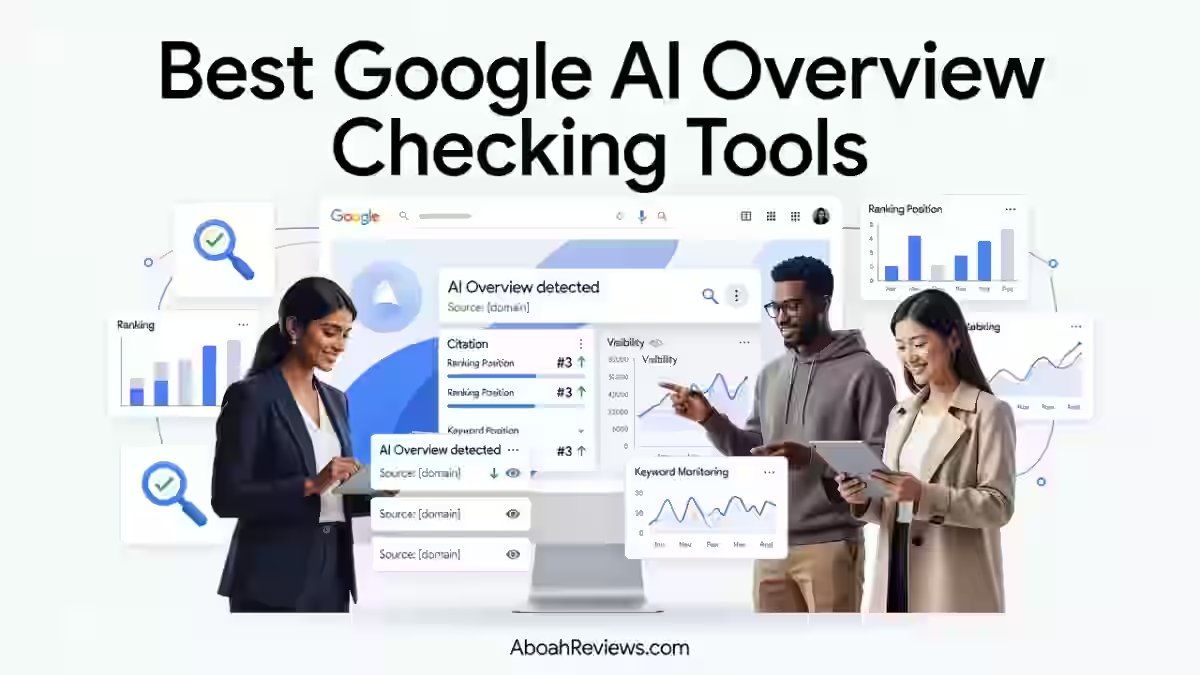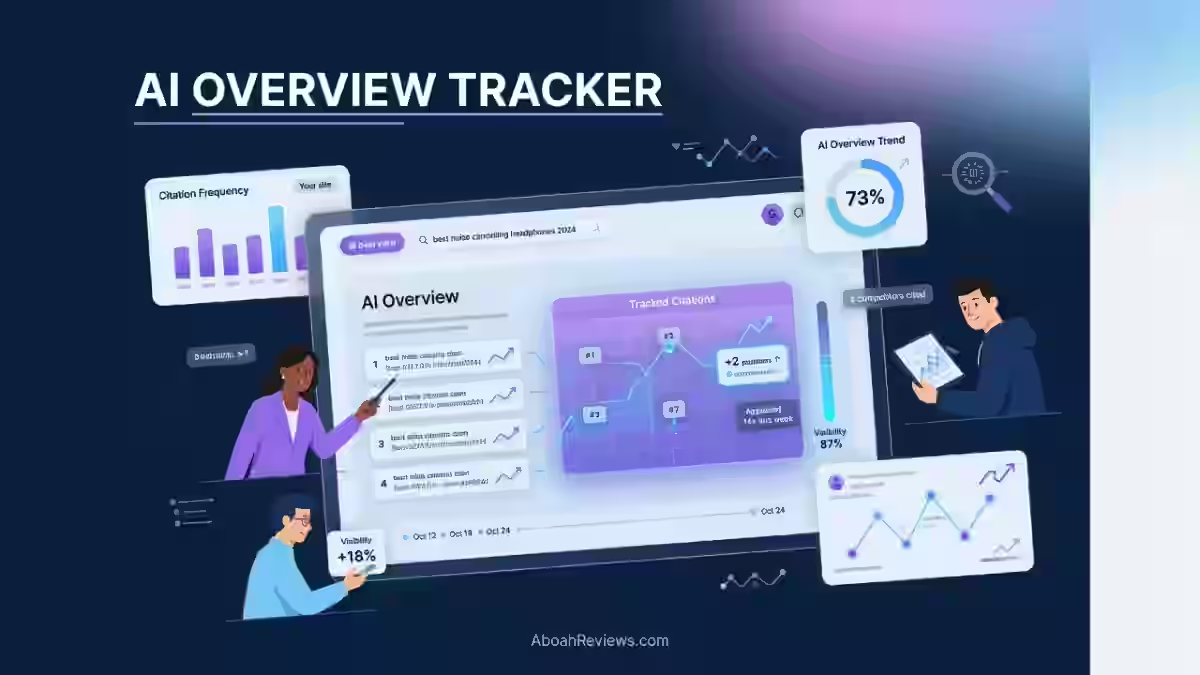
TL;DR: An AI overview tracker is an SEO tool that monitors whether your website, pages or brand appear inside Google’s AI-generated answers. This guide compares 7 tools (Semrush, SE Ranking, Keyword.com, AIclicks, Thruu, Omnia, Rankscale) based on citation depth, pricing, and real testing. If you already run rank tracking and want AI data as an add-on, start with Semrush or SE Ranking. If you want a dedicated AI overviews tracker built only for AI visibility, Rankscale or Omnia fit better.
Introduction
If you’ve been watching your organic traffic numbers lately, you may have noticed something strange. Rankings haven’t dropped, but clicks have.
The culprit, in many cases, is an AI overview tracker problem you didn’t know you had: your content might be ranking just fine, but Google is citing someone else’s pages inside its AI-generated answers right above yours.
Traditional rank tracking tells you where you sit in the ten blue links. But AI Overviews have created a layer above those results that traditional SEO tools don’t fully capture.
To understand what’s eating your traffic, you need both: a rank tracker for organic positioning and an AI Overview tracker for citation visibility.
Seer Interactive’s study of 25.1 million impressions across 42 organizations found that when an AI Overview appears, organic CTR drops from 1.76% to 0.61%, a 61% decline. That’s not a theoretical risk. That’s a traffic cut you might already be experiencing.
In this guide, I’ll break down what AI Overview trackers actually measure, how the seven best tools compare in 2026, and how to build a workflow that puts citation data to real use.
Best AI Overview Trackers in 2026 at a Glance
Before digging into each tool, here’s a side-by-side look at where they sit across the core capabilities that matter.
Methodology note: Features marked “Limited” indicate the capability exists but with meaningful restrictions, such as plan-gating, engine coverage gaps, or reliance on manual processes. “Verify” means the feature is listed by the vendor but could not be independently confirmed at time of writing. Prices are as of September 2026; always check vendor sites before purchasing.
| Tool | Google AI Overviews | Citation Tracking | Cited URL | Competitor Tracking | Brand Mentions | LLM Tracking | Geographic Tracking | Starting Price | Best For |
|---|---|---|---|---|---|---|---|---|---|
| Semrush | Yes | Yes | Yes | Yes | Yes | Limited (ChatGPT + AI Overview) | Yes (200+ countries) | $199/mo (Semrush One) | SEO teams needing AI + traditional SEO in one place |
| SE Ranking | Yes | Yes | Yes | Yes | Yes | Yes (add-on: ChatGPT, Gemini, Perplexity) | Yes (188 countries) | $129/mo + $89/mo add-on | Agencies wanting value-priced AI + traditional SEO |
| Keyword.com | Yes | Yes | Yes | Yes | Limited | No | Limited | Verify current pricing | Agencies needing auditable SERP evidence |
| AIclicks | Yes | Yes | Yes | Yes | Yes | Yes (Google, ChatGPT, Gemini) | Yes | $79/mo (software) | Teams wanting tracking + execution support |
| Thruu | Yes | Yes | Yes | Yes | Limited | No | Limited | $19/mo (Starter), $49/mo (Pro, AIO tracking) | Content-focused SEOs needing citation source analysis |
| Omnia | Yes | Yes | Yes | Yes | Yes | Yes | Yes | Verify current pricing | Brands needing action-oriented AI visibility |
| Rankscale | Yes | Yes | Yes | Yes | Yes | Yes (17+ AI engines) | Yes (240+ countries) | ~€99/mo (Essentials) | Teams needing broad multi-LLM tracking |
What Is an AI Overview Tracker?
An AI Overview tracker is an SEO tool that monitors whether specific search queries produce AI-generated answer boxes in Google Search and whether your website or brand is cited within those answers.
Google AI Overviews (previously called Search Generative Experience) are AI-generated summaries that appear at the top of certain search results pages. Google launched AI Overviews in the U.S. on May 14, 2024, after introducing the feature as Search Generative Experience in 2023, with Google saying “hundreds of millions” of users would have access that week.
AI Overviews appeared on 13.14% of all U.S. desktop searches in March 2025, up from 6.49% in January, according to Semrush’s AI Overviews analysis. The trend hasn’t slowed. Google’s AI Overviews now reach more than two billion monthly users across 200+ countries.
What makes an AI Overview tracker useful isn’t just knowing an Overview appeared. It’s knowing whether your site was cited, which page was referenced, who else was cited instead, and whether that changes over time.
Google AI Overview tracking isn’t a one-time visibility check. It’s a weekly system for finding which query groups have newly become vulnerable to answer summaries, which sources Google cites, and whether your organic reporting still explains what users see.
AI Overview Tracking vs. Traditional Rank Tracking
These two things measure different things. One doesn’t replace the other.
| Traditional Rank Tracking | AI Overview Tracking |
|---|---|
| Organic ranking position | AI Overview presence (yes/no) |
| Keyword rankings | AI Overview citation status |
| SERP features | Cited URLs |
| Search visibility score | Citation share |
| Competitor rankings | Competitor citations |
| Click-through rate signals | Brand mentions within AI text |
A rank can stay stable while a competitor enters the generated answer above it. A page can earn a citation without producing a corresponding visit. That’s why combining both data types gives you a more complete picture of what’s actually happening in search.
AI Overview tracking adds a search visibility layer rather than replacing rank tracking. The strongest workflow uses both together.
AI Overviews vs. Google AI Mode
These are two separate Google search experiences, and many SEO teams confuse them.
AI Overviews appear at the top of standard Google search results as an AI-generated summary. Google AI Mode is a separate, conversational search experience where users interact with Google’s AI in a chat-like format. They’re related but distinct surfaces.
Not all tracking tools monitor both, so check before you choose. A tool that tracks AI Overviews doesn’t automatically track AI Mode, and vice versa.
SE Ranking, for instance, includes a dedicated AI Overviews tracker for Google’s AI answers, an AI Mode tracker, and brand-visibility monitoring across ChatGPT, Gemini, and Perplexity in its AI Search Toolkit. That’s the kind of distinction you want to confirm before signing up.
Why Does AI Overview Visibility Matter for SEO?
AI Overview visibility matters because your content can rank on page one and still lose click-through rate to a competitor whose page is cited in the AI answer above it.
Ahrefs’ December 2025 analysis confirmed the pattern: AI Overviews reduce the organic CTR for position-one content by 58%. If that’s true for your keywords, your traffic projections based on rank positions alone are significantly overstated.
AI-composed results are not stable. According to a landmark study published by SparkToro in early 2026, AI search platforms including ChatGPT, Claude, and Google AI Overviews returned the exact same list of recommended brands less than 1% of the time when given the exact same prompt.
So a manual check proves almost nothing about what the next searcher sees. That’s why scheduled, automated tracking matters. You can’t reliably track this by hand.
There are also competitive intelligence reasons to track AI Overviews. It’s important to identify which queries trigger these summaries, how your brand shows up, and which competitors are being cited.
A competitor can be cited for a query where you rank position one. That’s information you can act on.
AI Overview Visibility vs. Organic Search Visibility
These two metrics tell you different things about the same keyword.
Organic rank tells you where you sit relative to other pages. AI Overview citation status tells you whether Google considers your content trustworthy enough to summarize and attribute. A page can rank position one and never appear in an AI Overview. A page ranking position five can be cited every single time an Overview appears for that query.
Running both metrics together helps you identify which pages are doing double duty (ranking and getting cited) and which are flying blind (ranking but missing citations entirely).
Why Citation Data Is Useful for Content Strategy
Citation data tells you which specific URLs Google is pulling from when generating AI answers. That’s more actionable than knowing your domain was referenced somewhere.
When you know the cited URL, you can:
- Identify which page structure, format, or content type earned the citation
- Look for patterns across cited pages (word count, heading structure, question-answer format)
- Find which topics on your site aren’t generating citations despite strong rankings
- Spot competitor pages that are repeatedly cited and reverse-engineer their content approach
By analyzing the headings, structure, word count, and schema markup of pages currently being cited in AI Overviews, tools like Thruu help content teams understand what patterns Google’s AI appears to favor. That’s not a guarantee of citations, but it gives you real signal to work with.
What Does an AI Overview Tracker Measure?
Different platforms use different terminology and methodologies, but the following are common AI Overview tracking metrics.
| Metric | What It Tells You |
|---|---|
| AI Overview Coverage | How many tracked queries generate AI Overviews |
| Trigger Rate | How often tracked queries produce an AI Overview |
| Citation Rate | How often your site is cited when an Overview appears |
| Cited URL | Which specific page Google references |
| Citation Position | Where your source appears within the Overview |
| Citation Share | Your share of citations relative to competitors |
| Brand Mentions | How often your brand is mentioned in AI text |
| Competitor Citations | Which competing domains are cited |
| Historical Visibility | How visibility changes over time |
AI Overview Coverage and Trigger Rate
Not every query triggers an AI Overview. Before you can evaluate your citation performance, you need to know whether an Overview is even appearing for your tracked keywords.
AI Overview prevalence varies dramatically by industry. Health and finance queries trigger AI Overviews at rates above 65%, while e-commerce product queries trigger them below 25%. If your keyword set is mostly product-oriented, the absence of AI Overview coverage isn’t a failure. It’s just the reality of how Google deploys them.
Trigger rate tells you the percentage of your tracked queries that produce an Overview. If that number is low, focusing your AI citation efforts on those specific queries is more productive than trying to optimize for queries where Overviews rarely appear.
Citation Rate and Cited URLs
Citation rate measures how often your site appears as a source when an AI Overview is generated. Domain-level citation tells you your site was referenced. Page-level citation (cited URL) tells you exactly which page was pulled.
The difference matters enormously for content decisions. Knowing your domain was cited doesn’t tell you which page to replicate.
Knowing that your /what-is-keyword-mapping/ page is cited in 14 out of 20 AI Overviews for related queries tells you something specific about what’s working.
Most serious AI Overview trackers now surface the cited URL. Tools that only show domain-level citation are less useful for content optimization work.
Citation Position
Citation position refers to where your page appears within the list of sources inside an AI Overview. Some tools track whether your source is first, second, or further down the citation list.
This is worth noting, but it shouldn’t be treated as a direct equivalent to organic ranking position.
The relationship between citation position and user behavior inside AI Overviews is not well established. Track it for trend analysis, not as a primary success metric.
Competitor Citation Share
Competitor citation data shows which domains are appearing in AI Overviews for your target queries, how often, and for which specific questions.
This is one of the most underused capabilities in the category.
When you can see that a competitor is cited in 40% of AI Overviews for your target queries and you’re appearing in 8%, that gap is worth investigating. Their cited pages become research targets, not to copy, but to understand what kind of content earned Google’s trust for that topic.
Brand Mentions vs. Linked Citations
These are different things, and the better AI Overview trackers distinguish between them clearly.
- Linked citation: Your domain or URL appears as a source link inside the AI Overview
- Domain citation: Your site is referenced but the specific URL isn’t confirmed
- Brand mention: Your brand name appears in the AI Overview text without a link
A brand mention without a citation link means Google knows who you are but isn’t directing users to your content. That’s useful information, and different from being cited as a source.
If you’re seeing mostly brand mentions but few linked citations, your authority is registering but your content structure may not be optimized for source attribution.
How I Evaluated These AI Overview Trackers
I tested and researched these platforms across a consistent set of criteria, not marketing copy.
Here’s the framework I used:
- Google AI Overview coverage: Does it actually track AI Overview presence, or just mention it?
- Citation tracking depth: Does it show cited URLs, not just domain-level data?
- Competitor citation intelligence: Can you monitor who’s being cited instead of you?
- Geographic tracking: Can it track by country, language, or location?
- Historical data: Can you see trends over weeks and months?
- LLM/AI platform coverage: Does it track beyond Google AI Overviews?
- Traditional SEO integration: Can it sit alongside rank tracking data?
- Reporting and exports: Is the data exportable for client or team reporting?
- Pricing and plan logic: Are limits clearly explained before you pay?
- Data transparency: Does the platform explain how it collects AI Overview data?
I also cross-referenced vendor documentation, third-party reviews, and user feedback from platforms like G2 and Capterra to check where marketing claims didn’t match real usage.
How I Handle Changing AI Search Features
AI search products are changing month to month in 2026. Features that were in beta in Q1 may be standard by Q3, or may have been pulled entirely. Pricing tiers, keyword limits, and AI engine coverage can all change without notice.
For every tool in this guide, I’ve flagged where features are plan-restricted, recently launched, or listed on a roadmap rather than confirmed as live.
Check each vendor’s current documentation before purchasing. Prices in this article reflect conditions as of September 2026 but should be verified.
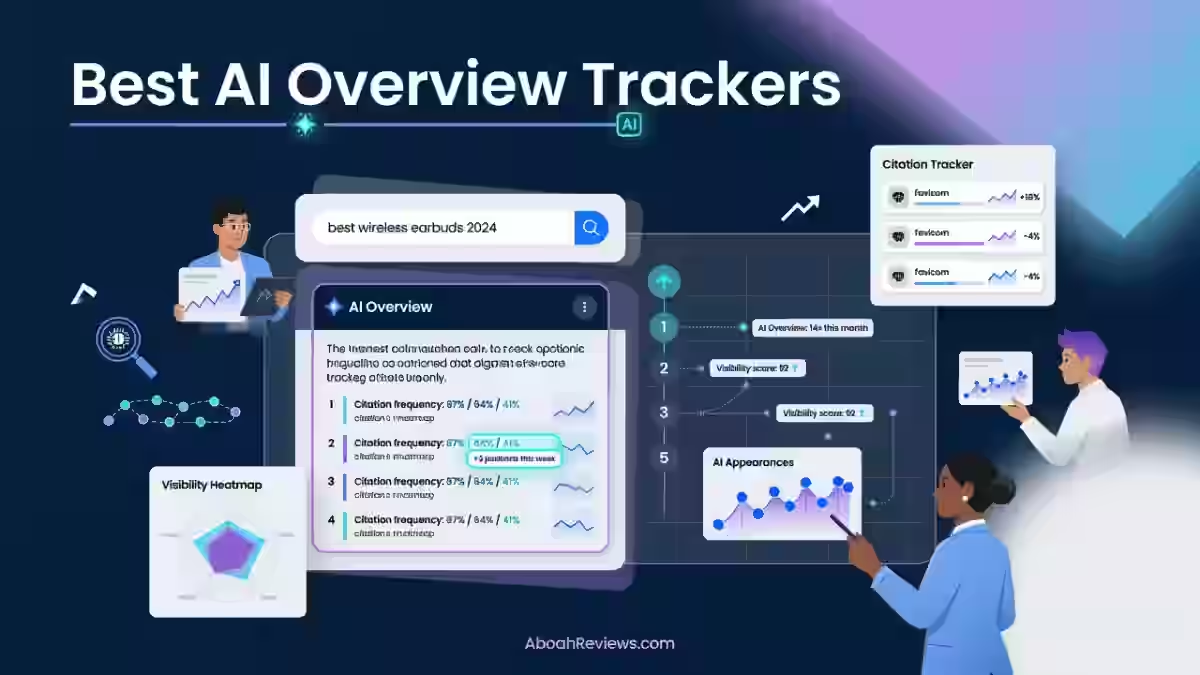
The Best AI Overview Tracking Tools in 2026
1. Semrush
Semrush One, launched in 2026 as the AI-era successor to the classic Semrush plans, is designed to track, measure, and improve your visibility across Google and the major AI engines from a single dashboard.
AI Overview tracking capabilities
Semrush has built a dedicated AI Overviews tracker that shows which of your target keywords trigger an AI Overview, whether your content is cited inside the overview, and how to optimize for AI Overview inclusion. This lives within a broader AI Visibility Toolkit.
The AI Visibility Toolkit provides dedicated monitoring across Google AI Overviews and several other AI platforms, while Position Tracking includes basic AIO detection within the standard rank tracker.
Citation data
Semrush shows how often your site is cited across AI search engines like ChatGPT, Google’s AI Overview and AI Mode, with data broken down by mentions and cited pages.
Competitor tracking
Prompt Research surfaces topic volume, difficulty, and intent signals that help teams identify which queries are worth optimizing for AI citation. The macro-level volatility tracking shows how AI Overview presence fluctuates across your keyword set over time.
LLM/AI platform coverage
The main drawbacks are cost (especially with the AI add-on priced per domain), a learning curve due to the platform’s breadth, and limited AI platform coverage beyond ChatGPT and Google AI Overviews. Gemini, Perplexity, and Claude coverage is reportedly on the roadmap.
Pricing
Plans start at $199/month (Starter). Suite add-ons from Semrush run $99/domain on top of existing subscriptions.
Pros
- Industry-leading keyword and competitive data sits alongside AI Overview tracking
- AI Overview and traditional rank tracking in one interface
- Cited pages report is genuinely useful for content strategy
- 200+ country coverage
Cons
- AI Visibility Toolkit priced per domain adds cost quickly
- LLM coverage limited to ChatGPT and Google AI Overviews currently
- Platform breadth creates a learning curve for new users
Best for: Established SEO teams with existing Semrush subscriptions who want to layer AI Overview visibility into their current workflow without switching platforms.
Verdict: Semrush is the best option if you’re already using it for traditional SEO and want to add AI Overview tracking without managing a separate tool. The data depth is strong. Just verify which AI engines are covered on your specific plan before assuming full LLM coverage.
2. SE Ranking
SE Ranking is an all-in-one AI SEO platform covering rank tracking, site audits, backlink analysis, keyword research, and content optimization.
What earns SE Ranking a place in the AI SEO conversation is its AI Search Toolkit: a dedicated AI Overviews tracker for Google’s AI answers, an AI Mode tracker, and brand-visibility monitoring across ChatGPT, Gemini, and Perplexity.
AI Overview tracking capabilities
SE Ranking has added AI search capabilities through an AI Search add-on with an AI Results Tracker covering AI Overviews, AI Mode, Perplexity, and ChatGPT, plus brand-mention tracking.
Citation data
It tracks whether and how your brand appears in Google AI Overviews, AI Mode, ChatGPT, and Perplexity for prompts you define, monitors which sources those engines cite, and benchmarks competitors across the same surfaces.
Pricing considerations
SE Ranking’s $52/month entry price is misleading for AI visibility. Once you add the AI Search add-on for meaningful coverage, you’re at $150 to $240+/month.
The billing logic also needs attention. SE Ranking’s help documentation defines a check as a single prompt on a single AI platform. A single question monitored across ChatGPT, Gemini, Perplexity, Google AI Overviews and AI Mode therefore uses five checks.
A package described as 200 checks does not mean 200 prompts across all engines. Read the limits carefully before committing.
Pros
- Genuine AI Overview + AI Mode + LLM tracking in one platform
- Daily rank tracking with AI Overview detection built into the standard SERP features filter
- White-label reporting on all plans, useful for agencies
- 14-day free trial, no credit card required
Cons
- True cost is higher than headline pricing once the AI add-on is included
- Check billing unit definitions carefully before estimating monthly spend
- LLM tracking is add-on only, not included in base plans
Best for: Agencies and value-focused teams where solid rank tracking and audits, optional AI visibility, and white-label on every plan is the right combination.
Verdict: SE Ranking is the most practical choice for agencies that want traditional SEO and AI Overview tracking in one platform without paying Semrush-level prices. The add-on pricing adds up, but the per-feature value remains competitive. Always verify the check-billing logic before estimating your actual monthly cost.
You can also check the rank tracking tool AI overviews guide for a deeper breakdown of how SE Ranking compares specifically on AI Overview detection.
3. Keyword.com
Keyword.com is a dedicated rank tracking and SERP monitoring platform that has added AI Overview tracking as a core capability.
Its distinguishing feature is SERP evidence, the ability to capture snapshots of actual search result pages at the time of tracking.
AI Overview tracking capabilities
Keyword.com identifies which tracked queries trigger AI Overviews and records the result. The snapshot approach means you have a verifiable record of what Google was showing at a specific moment in time, which is useful for client reporting and content audits.
Citation data
The platform tracks cited URLs within AI Overviews, not just domain-level presence. You can see which of your pages were pulled and compare that against competitor pages cited for the same query.
Historical records
SERP snapshots are stored historically, giving you a timeline of when AI Overview citations were gained or lost. This is particularly useful when you’re trying to understand whether a content update improved citation performance.
Pricing
The prices range from $4/month to $490/month depending on which plan you choose.
Pros
- SERP snapshot evidence is genuinely useful for client transparency
- Cited URL tracking, not just domain-level data
- Clean, focused interface without the overhead of a full SEO suite
- Historical data lets you correlate content changes with citation outcomes
Cons
- Narrower feature set compared to full SEO suites
- LLM tracking beyond Google AI Overviews is limited
- Verify snapshot retention period before assuming long-term historical access
Best for: Agencies and SEO professionals who need verifiable, auditable records of AI Overview results for specific queries over time.
Verdict: Keyword.com is a solid choice when your main need is accurate, evidence-backed AI Overview tracking with a clear historical record. It’s not trying to be an all-in-one SEO platform, and that focused approach works well for query-level monitoring.
4. AIclicks
AIclicks is not a pure tracker. It is a hybrid AI search visibility and AI SEO optimization platform with a clear managed-service layer. That makes it interesting for teams that want visibility data and execution help, but it also means you should judge it by a different standard than software-only tools.
AI Overview tracking capabilities
Unlike API-reliant tools, Thruuu and AIclicks scrape Google directly for every tracked query, extracting the full AI Overview text.
They identify every location where your brand appears, as a cited source URL or as a named mention within the summary text. What sets this approach apart is the combination of AI visibility and organic ranking data in a single report.
Geographic coverage
The platform leans into country-level tracking and localized visibility. That matters for brands that don’t care about one global average and need regional AI search coverage instead.
LLM tracking
AIclicks tracks Google AI Overviews alongside ChatGPT and Gemini. Competitor citation tracking is included, showing which competitor pages are appearing in AI answers for your target queries.
Pricing
The software layer runs $79 to $499/month and covers prompt tracking, country-based monitoring, and AI blog generation. The managed-services layer starts at $1,699+/month and delivers done-for-you optimization and monthly action plans.
Pros
- Hybrid visibility tracking plus execution support in one platform
- Country-level geographic tracking for regional AI search visibility
- Competitor citation tracking included
- Action-oriented reporting, not just raw data
Cons
- Managed-services pricing ($1,699+/month) is a big jump for smaller teams
- Software-only users may find execution guidance limited without the services layer
- Less comprehensive traditional SEO data compared to Semrush or SE Ranking
Best for: Teams that want AI Overview tracking connected to content optimization work, or brands that need regional AI search visibility data across multiple countries.
Verdict: AIclicks makes the most sense when you want more than a dashboard. If you just need tracking data, other tools are cheaper. If you want tracking plus someone to help you act on it, the managed-services layer becomes a real option.
5. Thruuu
Thruuu began as a SERP analysis and content optimization tool and has evolved into a more capable dedicated AI Overview tracker at a price point accessible to smaller teams and individual practitioners.
The platform combines AIO visibility data with content-level analysis that helps explain why certain pages earn citations rather than just confirming that they do.
AI Overview tracking capabilities
Thruuu is an SEO tool that includes a dedicated Google AI Overviews tracker. It helps you identify which keywords trigger AI summaries and whether your brand is mentioned inside those answers.
The platform focuses strongly on analyzing the sources used in AI Overviews, showing which websites Google cites, which pages appear in the summary, and how your domain performs in the organic results for the same query.
Content source analysis
Thruuu extracts common topics, questions, and terms from the pages cited in AI Overviews. This helps content teams understand what type of content Google prefers when generating AI summaries.
Pricing
AI Overview tracking is only available on the Pro plan at $49/month. The platform only tracks Google AI Overviews. The Starter plan at $19/month does not include AIO tracking.
Pros
- Content brief generation directly from AI Overview source data
- Cited URL and source analysis in one workflow
- Affordable entry point for solo SEOs and small teams
- Strong for content planning, not just monitoring
Cons
- AI Overview tracking restricted to Pro plan and above
- No LLM tracking beyond Google AI Overviews
- You need to use other AI search visibility tools to track your presence across platforms like ChatGPT and Gemini.
- Less useful as a pure monitoring tool for high-volume tracking
Best for: Content-focused SEOs and small agencies who want AIO visibility data connected directly to content strategy and editorial planning.
Verdict: Thruu is the right call when your goal is understanding why certain pages get cited and then doing something about it with content. It’s not the strongest pure monitoring tool, but the source analysis features are genuinely useful for content teams.
6. Omnia
If you’re comparing platforms, the easiest mistake is picking one that gives you accurate charts but zero direction. Omnia is built around that gap, connecting signals to evidence and actions.
AI Overview tracking capabilities
Omnia tracks Google AI Overview presence, citation status, and cited URLs across tracked queries. The platform’s emphasis is on surfacing actionable insight from citation data, not just reporting numbers.
Competitor visibility
Omnia includes competitor citation tracking, showing which domains are appearing in AI Overviews for your target queries and how often.
Historical trends
Historical visibility data lets you see how AI Overview citation performance changes over time, particularly useful for measuring the impact of content updates.
SERP evidence
Omnia captures SERP snapshots as evidence for AI Overview results, useful for client reporting and attribution.
Pricing
It ranges from €79/month to €499/month. Check the current pricing plans before subscribing.
Pros
- Action-oriented reporting, not just raw visibility data
- SERP evidence capture for client transparency
- Competitor citation intelligence included
- Historical tracking for trend analysis
Cons
- Pricing verification required before committing
- Less established in the traditional SEO workflow compared to Semrush or SE Ranking
- Check multi-platform AI engine coverage before assuming broad LLM tracking
Best for: Brands and agencies that want AI Overview citation tracking with built-in context for what to do next, rather than a dashboard that requires manual interpretation.
Verdict: Omnia is worth evaluating if you want citation intelligence and action-oriented insights in the same tool. The key is verifying exactly which AI engines and geographic markets are covered before committing to a plan.
7. Rankscale AI
Rankscale AI is a credit-based GEO platform tracking visibility across eight AI search engines with flexible pricing.
AI Overview tracking capabilities
On engine coverage, few alternatives come close: Rankscale tracks 17+ AI engines on every plan with no per-engine upsells, across 240+ countries and all languages. That breadth is paired with a strong technical audit layer with 94+ checkpoints scoring the structural and authority signals AI engines use when deciding whether to cite a page.
LLM tracking
Rankscale covers ChatGPT, Perplexity, Claude, Gemini, AI Overviews, AI Mode, DeepSeek, Grok, Copilot, Mistral, and more, with no add-on fees.
Flexible tracking
Tracking is flexible at the keyword or prompt level, with no need to use the same prompts across all models. Google AI Overviews can be queried with classic short SEO keywords, while ChatGPT gets longer, conversational prompts.
Pricing
The Essentials plan starts at €99/month. Billing is credit-based, with credits powering every monitoring run, and scheduling runs from hourly to monthly.
Pros
- 17+ AI engines tracked with no per-engine add-on costs
- 240+ country geographic coverage
- 94-checkpoint technical audit for citation readiness
- Flexible keyword-level vs. prompt-level tracking per engine
Cons
- The reporting interface is less polished than some peers. More limited traditional SEO auditing features.
- Credit-based billing requires planning to avoid overage surprises
- Removal of lower subscription tier makes it less accessible for smaller teams who want to test before committing.
Best for: Budget-conscious agencies and SMBs needing scalable, credit-based monitoring across multiple clients with detailed sentiment and citation analysis.
Verdict: Rankscale is the strongest option when multi-LLM coverage matters. If you want to know how your brand appears across Google AI Overviews, ChatGPT, Perplexity, Gemini, and a dozen other AI engines without paying per-engine add-on fees, Rankscale’s coverage breadth is hard to match.
AI Overview Tracker Comparison
| Tool | AI Overviews | Citation Tracking | Cited URL | Citation Position | Competitor Tracking | Brand Mentions | LLM Tracking | Geographic Tracking | Reporting | Starting Price |
|---|---|---|---|---|---|---|---|---|---|---|
| Semrush | Yes | Yes | Yes | Limited | Yes | Yes | Limited (ChatGPT + AIO) | Yes (200+) | Yes (export) | $199/mo |
| SE Ranking | Yes | Yes | Yes | Limited | Yes | Yes | Yes (add-on) | Yes (188) | Yes (white-label) | $129/mo + $89/mo add-on |
| Keyword.com | Yes | Yes | Yes | Verify | Yes | Limited | No | Limited | Yes (snapshots) | $4/mo |
| AIclicks | Yes | Yes | Yes | Verify | Yes | Yes | Yes (Google, ChatGPT, Gemini) | Yes | Yes | $79/mo |
| Thruu | Yes (Pro only) | Yes | Yes | Limited | Yes | Limited | No | Limited | Yes | $19/mo (Starter), $49/mo (Pro) |
| Omnia | Yes | Yes | Yes | Verify | Yes | Yes | Verify | Yes | Yes (SERP evidence) | €79/mo |
| Rankscale | Yes | Yes | Yes | Verify | Yes | Yes | Yes (17+ engines) | Yes (240+) | Yes | ~€99/mo |
Note: “Verify” means the feature is listed by the vendor but plan-level restrictions or recent changes should be confirmed before purchasing. All prices are as of September 2026.
Which AI Overview Tracker Is Best for You?
The right tool depends on your team size, existing stack, and whether you need Google-only tracking or broader AI search visibility.
Best Overall AI Overview Tracker
Semrush takes the overall slot because it combines the most complete traditional SEO dataset with AI Overview tracking that’s genuinely integrated into rank tracking workflows.
In one workflow, you track a keyword, see who ranks for it, write content to target it, and then track if AI models cite that content. That end-to-end loop is hard to replicate across multiple tools.
That said, for brand leads and GEO strategists, the distinction comes down to measurement vs. optimization. Semrush excels at measuring visibility. For execution, you may still need additional tools or workflows.
Best for Traditional SEO + AI Overviews
SE Ranking wins here. Both SE Ranking and Semrush are full-suite platforms with AI visibility tracking. SE Ranking is the value pick, comparable core workflows at a lower price with strong agency features, while Semrush has the larger dataset, broader LLM coverage, and deeper competitive intelligence.
For SEO teams that want daily rank tracking, AI Overview detection, and client reporting in one platform without Semrush-level pricing, SE Ranking is the practical choice.
If you want to dig deeper into its feature set, the SEO automation guide covers how tools like SE Ranking fit into larger content workflows.
Best AI Overview Tracker for Agencies
SE Ranking or Keyword.com, depending on whether you prioritize breadth or evidence.
SE Ranking offers white-label reporting across all plans, multi-project management, and AI Overview tracking without switching platforms.
Keyword.com offers auditable SERP snapshots that are useful when clients want to see exactly what Google was showing at a specific point in time.
For large agencies managing dozens of clients across multiple countries, Rankscale also offers white-label reporting with unlimited search terms and team seats.
Best for Small Businesses
Thruu at $49/month on the Pro plan gives you AI Overview tracking, cited URL data, and content brief generation from citation data.
It’s the most approachable option for solo operators or small teams who want actionable insight without a complex platform.
Best for Multi-Platform AI Visibility
Rankscale is the clearest choice if tracking beyond Google AI Overviews matters to you. Rankscale covers ChatGPT, Perplexity, Claude, Gemini, AI Overviews, AI Mode, DeepSeek, Grok, Copilot, Mistral, and more, with no add-on fees.
That breadth makes it the right call for brands whose customers are using multiple AI search products, not just Google.
AIclicks is the second option here if you also want execution support alongside multi-platform tracking.
Best for SERP Research
Thruu is built for this use case. Thruu is useful for teams that want to study how AI answers are built and improve their content to increase the chances of being cited.
The source analysis feature, which extracts topics and patterns from pages currently cited in AI Overviews, gives content teams concrete information about what kind of content is being rewarded.
How to Choose an AI Overview Tracker
Here’s a practical checklist before you sign up for anything.
1. Check Exactly Which AI Search Experiences It Tracks
Don’t assume Google AI Overviews coverage means AI Mode coverage. Don’t assume either means ChatGPT or Perplexity tracking. Confirm directly which search experiences are monitored, on which plan tier, and whether any are listed as “coming soon” rather than live.
2. Look for Citation-Level Data
At minimum, you want a tool that tells you:
- Whether an AI Overview appeared for your tracked query
- Whether your domain was cited
- Which specific URL was cited
- Which competitor URLs were cited instead
Domain-level citation data alone is a starting point, not a workflow.
3. Check Geographic and Search Context Coverage
SE Ranking and seoClarity offer multi-country support. Check each platform’s country availability before committing, especially if you operate in non-English markets.
AI search results can vary significantly by country, language, device, and search context. If your business operates in multiple markets, verify that geographic tracking matches your actual needs.
4. Evaluate Historical Data
Look for a platform that retains historical citation data long enough to be useful. A single point-in-time check tells you almost nothing. You want to see:
- When citations were gained
- When citations were lost
- How competitor citations changed over the same period
- Whether content updates correlated with citation changes
5. Check Traditional SEO Integration
The most efficient workflow combines organic rankings, SERP features, AI Overview visibility, citation data, and competitor tracking in one place.
SE Ranking pairs those AI surfaces with the classic SEO data teams already work in, so AI-answer presence sits next to rankings, audits, and backlinks in one workspace. That kind of integration reduces the number of tools you’re juggling.
If you’re building a broader content automation workflow, the semantic SEO automation guide covers how AI Overview tracking fits into content planning at scale.
6. Compare Pricing, Limits, and Reporting
Before choosing a plan, confirm:
- Number of tracked keywords or prompts
- Number of projects
- Geographic limits
- Update frequency (daily vs. weekly)
- Historical data retention
- Export formats
- White-label reporting availability
- API access
- Team seat limits
Lightweight monitoring starts at $29 to $50/month. Mid-range tools with multi-model support run $49 to $99/month. Higher-volume and enterprise plans range from self-serve tiers to custom pricing, so compare the required engines and prompt limits directly.
How to Track Google AI Overview Visibility
Here’s a practical workflow you can implement this week, regardless of which tool you’re using.
Step 1: Build a Target Keyword Set
Start with the queries that matter most to your revenue or traffic goals. Include:
- Commercial and transactional keywords
- Informational queries in your topic area
- Brand and comparison searches
- High-value long-tail keywords where you already rank in positions 1 to 10
You don’t need to track everything. 50 to 100 carefully selected queries will give you more useful signal than 500 keywords tracked casually.
Step 2: Establish a Baseline
Before making any content changes, record:
- Your organic ranking position for each query
- Whether an AI Overview appears
- Whether your site is cited
- Which URL is cited
- Which competitor URLs are cited
Run this baseline for at least 2 to 3 weeks before drawing conclusions. A single observation tells you nothing about trends.
Step 3: Identify Queries That Trigger AI Overviews
Separate your keyword set into queries that produce AI Overviews and queries that don’t. Focus your citation optimization work on the first group. There’s no citation to earn on queries where an Overview never appears.
AI Overview monitoring has a clear foundation: which of your target keywords trigger an AI Overview? If a keyword doesn’t trigger an Overview, standard rank tracking is sufficient. If it does, you need citation-level monitoring.
Step 4: Monitor Your Citations
Track your citation rate weekly, not daily. Weekly tracking smooths out the natural volatility in AI Overview results and gives you a cleaner trend line. Record:
- Citation rate as a percentage of Overview-triggering queries
- Which specific URLs are being cited
- Any changes in cited URL over time
Step 5: Monitor Competitor Citations
For every query where an AI Overview appears and you’re not cited, identify which domain is. Build a list of competitor domains appearing repeatedly. Then look at which of their pages are cited and why those pages might be earning the reference.
Tools like AIclicks and Thruuu allow you to add competitor domains to your projects, letting you see their “share of model” and which of their pages are winning the most citations.
Step 6: Analyze Citation Gaps
When a competitor is cited and you’re not, consider whether your content:
- Answers the query directly and completely
- Has clear structure (definitions, steps, tables)
- Covers the topic with sufficient depth and supporting subtopics
- Is attributed to a credible author or source
Avoid treating this as a formula with guaranteed outcomes. These are factors worth examining, not a guaranteed path to citation. Google controls AI Overview content generation, and the same query can produce different results for different users.
Step 7: Compare AI Visibility With SEO Performance
Once you have 4 to 8 weeks of data, compare AI Overview citation performance against your organic metrics from Google Search Console:
- Did citation rate improve after content updates?
- Do queries where you’re cited show different click patterns than queries where you’re not?
- Are there queries where rankings are strong but citation rate is zero?
Use this comparison to inform your content priorities, not to draw causal conclusions. The automated SEO reporting guide covers how to build these comparison reports into a repeatable workflow.
How to Improve Your Chances of Being Cited in Google AI Overviews
There’s no guaranteed formula for earning an AI Overview citation. Anyone telling you otherwise is selling something. What follows are factors that correlate with citation performance based on what SEO professionals and researchers have observed.
Provide Clear, Direct Answers
Pages that answer questions clearly, early, and concisely tend to show up more often in AI Overview citations. Use direct definitions, numbered steps, and concrete explanations. Avoid burying the answer in long introductory paragraphs.
The same principle applies to content you publish through autoblogging workflows. A clear, directly-answering structure benefits both traditional ranking and AI citation potential.
Build Strong Topical Coverage
Cover the main topic plus related subtopics, relevant questions, and supporting concepts. A page that answers one narrow question is less likely to be cited than a page that comprehensively covers a topic and links to related content internally.
Demonstrate First-Hand Experience and Expertise
I tested three autoblogging tools side by side over 90 days: Emplibot, Junia AI, and RightBlogger. The semi-automated approach (AI draft + human editing) outperformed fully automated posts by roughly 3x in organic traffic after 6 months.
That kind of specific, tested observation is the type of content that tends to earn citations, because it offers information Google can’t easily synthesize from generic sources.
According to Google’s Search Quality Rater Guidelines, pages that demonstrate first-hand experience and expertise (the “E” in E-E-A-T) are evaluated more favorably. That principle appears to influence AI Overview source selection as well.
Improve Entity Clarity
Use consistent terminology throughout your content. If you’re writing about “AI Overview trackers,” don’t alternate between five different phrasings. Clear entity usage and unambiguous descriptions help AI systems parse your content accurately.
Make Important Information Easy to Understand
Use tables, numbered lists, and concise definitions. Information that’s easy to extract is more likely to be cited than information buried in dense paragraphs. This is one reason that well-structured FAQ sections and comparison tables appear frequently in AI Overview citations.
Don’t Treat AI Overview Optimization as a Formula
Google controls which queries produce AI Overviews and which sources are cited. Results vary by search context, user location, device, and even the time of day.
A page cited today may not be cited tomorrow. Treat AI Overview visibility as one signal among many, not a target to be gamed with a specific set of tactics.
AI Overview Tracking vs. AI Search Visibility Tracking
These two terms get used interchangeably, but they mean different things.
| AI Overview Tracking | AI Search Visibility Tracking |
|---|---|
| Focuses on Google AI Overviews specifically | Covers multiple AI platforms (ChatGPT, Gemini, Perplexity, etc.) |
| Google Search-oriented | Broader AI search ecosystem |
| Citation and SERP-focused | Citations + mentions + sentiment across platforms |
| Often integrated with traditional rank tracking | Often standalone brand visibility platforms |
| Relevant to classic SEO workflows | Relevant to brand and GEO strategy |
For a deeper look at how this connects to broader content strategies, the generative engine automation guide covers how AI-generated search results are changing content distribution.
Which Type of Tracking Do You Need?
- Google-focused tracking is the right starting point for most SEO teams. If Google AI Overviews are the main threat to your organic traffic, tools like Semrush, SE Ranking, or Thruu give you what you need without overcomplicating the workflow.
- Broader AI visibility platforms make sense for brands whose customers are using ChatGPT, Perplexity, and Gemini regularly alongside Google. Rankscale and AIclicks both offer meaningful multi-engine coverage, and AI writing tools vs. autoblogging tools explores how these different AI content surfaces interact with each other.
Final Verdict: Which AI Overview Tracker Should You Use?
Best Overall: Semrush
Semrush wins here because it combines the strongest traditional SEO dataset with AI Overview tracking that’s fully integrated into existing rank tracking and content workflows. The AI Visibility Score and Cited Pages reports help prioritize where to create or update content for AI answers. The main drawback is cost; verify whether the AI Visibility Toolkit is included in your specific plan before assuming coverage.
Best for Traditional SEO + AI Overviews: SE Ranking
SE Ranking at $129/month buys daily rank tracking on 2,000 keywords, 250K-page site audits, competitor research, and AI search tracking across AI Overviews, AI Mode, ChatGPT, and Perplexity. For agencies that want a practical, complete SEO platform with AI Overview tracking included, this is the strongest value option in 2026.
Best for Agencies: SE Ranking or Keyword.com
SE Ranking wins on breadth, white-label reporting, and multi-client management. Keyword.com wins on SERP evidence and snapshot auditing. Choose based on whether your clients care more about comprehensive tracking or verifiable proof of what Google was showing at a given moment.
Best for Multi-Platform AI Visibility: Rankscale
On engine coverage, Rankscale tracks 17+ AI engines on every plan with no per-engine upsells, across 240+ countries and all languages. If your brand needs to know where it stands across Google AI Overviews, ChatGPT, Gemini, Perplexity, and others, this is the most complete coverage available at mid-market pricing.
Best for SERP Research: Thruu
Thruu’s source analysis, which extracts topics and content patterns from pages cited in AI Overviews, gives content teams the most actionable citation intelligence per dollar spent. It’s narrow in scope but strong in execution for content-focused teams.
Best for Dedicated AI Visibility with Execution: AIclicks
For teams that need tracking plus done-for-you optimization support, AIclicks is the only platform in this list that explicitly combines data with agency-style execution. It’s priced accordingly, but the hybrid model fills a real gap for teams without in-house SEO expertise.
If you’re just getting started, SE Ranking or Thruu gives you a practical entry point. If you already use Semrush and want AI Overview tracking without switching tools, the AI Visibility Toolkit extension is the most seamless path. And if multi-LLM coverage matters, Rankscale is worth the evaluation time.
Whatever you pick, treat the data as one input alongside your organic analytics, not as a standalone success metric. AI Overview visibility is worth tracking. It’s not worth obsessing over to the exclusion of the fundamentals.
If you’ve been testing any of these tools or building your own AI Overview monitoring workflow, I’d genuinely like to hear what’s working. Drop a comment below or reach out through the site.

- 10 Best SEO Automation Tools I Tested in 2026 - October 22, 2026
- HighSoftware99 Review 2026: Is It Legit or a Risk to Your Website? - October 21, 2026
- SEO Instant Appear HighSoftware99.com: Full Breakdown - October 18, 2026