TL;DR: AI overviews rank tracking tools monitor whether Google cite your brand, which pages they cite, how often and how you compare to competitors. This guide is for SEO professionals, content marketers and agencies who need to prove AI visibility with real data instead of guesswork. My take after testing several of these: pick the tool that matches your prompt volume and reporting needs, not the one with the longest engine list.
Introduction
If you’ve been doing SEO longer than 18 months, you’ve noticed something odd. You check your keyword rankings, everything looks fine, but your traffic is dropping.
The reason, in many cases, is Google AI Overviews. Those AI-generated summaries at the top of the SERP are answering questions that used to drive clicks to your site. And they’re not citing you.
That’s the core problem AI overviews rank tracking tools are built to solve. These tools tell you whether an AI Overview appeared for a given query, whether your site was cited, where you appeared among the cited sources, and how that changes over time.
In this guide, I’m going to walk you through exactly what these tools measure, how I evaluated them, and which ones are worth paying for depending on your team size and use case.
Best AI Overviews Rank Tracking Tools at a Glance
Here’s a high-level overview of every tool in this guide before we go deeper. Pricing and features shift quickly in this category, so verify on each vendor’s pricing page before buying.
| Tool | Best For | Starting Price | AI Overviews | AI Mode | Other AI Engines | Citation Tracking | Refresh | Free Option |
|---|---|---|---|---|---|---|---|---|
| AIclicks | Dedicated Google AI Overview citation tracking | $59/mo | Yes | Yes | 10+ engines incl. ChatGPT, Gemini, Claude, Grok | Yes (exact URLs) | Daily | No, custom demo |
| Rankability | Combining traditional SEO + AI visibility | $199/mo | Yes | Plan-dependent | ChatGPT, Perplexity, Gemini | Yes | Plan-dependent | No, trial only |
| Peec AI | AI visibility + citation intelligence | $89–95/mo | Yes | Yes | ChatGPT, Gemini, Claude, Perplexity, Copilot | Yes | Daily | 7-day trial |
| Otterly AI | Budget-friendly AI search tracking | $29/mo | Yes | Add-on ($9+/mo) | ChatGPT, Perplexity, Copilot | Yes | Daily | No, trial only |
| SE Visible (SE Ranking) | Agencies tracking multiple brands | ~$49–99/mo | Yes | Yes | Multiple LLMs | Yes | Weekly-leaning | 14-day trial |
| Semrush AI Visibility | Existing Semrush users | $99/mo | Yes | Plan-dependent | ChatGPT, Gemini, Perplexity | Yes | Daily | No, trial only |
| Ahrefs Brand Radar | Advanced SEO teams on Ahrefs | $129/mo base + $199–699 add-on | Yes | Yes | ChatGPT, Gemini, Perplexity, Copilot | Yes | Snapshot-based | No, Ahrefs trial |
| Rankscale | Multi-engine AI visibility | $20/mo | Yes | Yes | 17+ engines | Yes | Plan-dependent | Low-cost entry tier |
| Omnia | Turning AI visibility into action | Varies, check site | Yes | Yes | ChatGPT, Perplexity | Yes | Daily | Trial available |
| Profound | Enterprise AI search intelligence | $99–399/mo self-serve, $2,000+/mo enterprise | Yes | Yes | ChatGPT, Claude, Gemini, Grok, DeepSeek | Yes | Daily | No, demo required |
| Thruuu | Content and SERP analysis | Varies, check site | Yes | Limited | Limited | Yes (source pages) | Plan-dependent | Trial likely |
What Is an AI Overview Rank Tracking Tool?
A rank tracker for AI overviews monitors your brand and website’s presence inside AI-generated responses, specifically Google’s AI Overviews, Google AI Mode, and major LLMs like ChatGPT, Gemini, Perplexity, and Claude.
Traditional rank tracking tells you: keyword → position → URL. That’s clean, numerical, and well-understood.
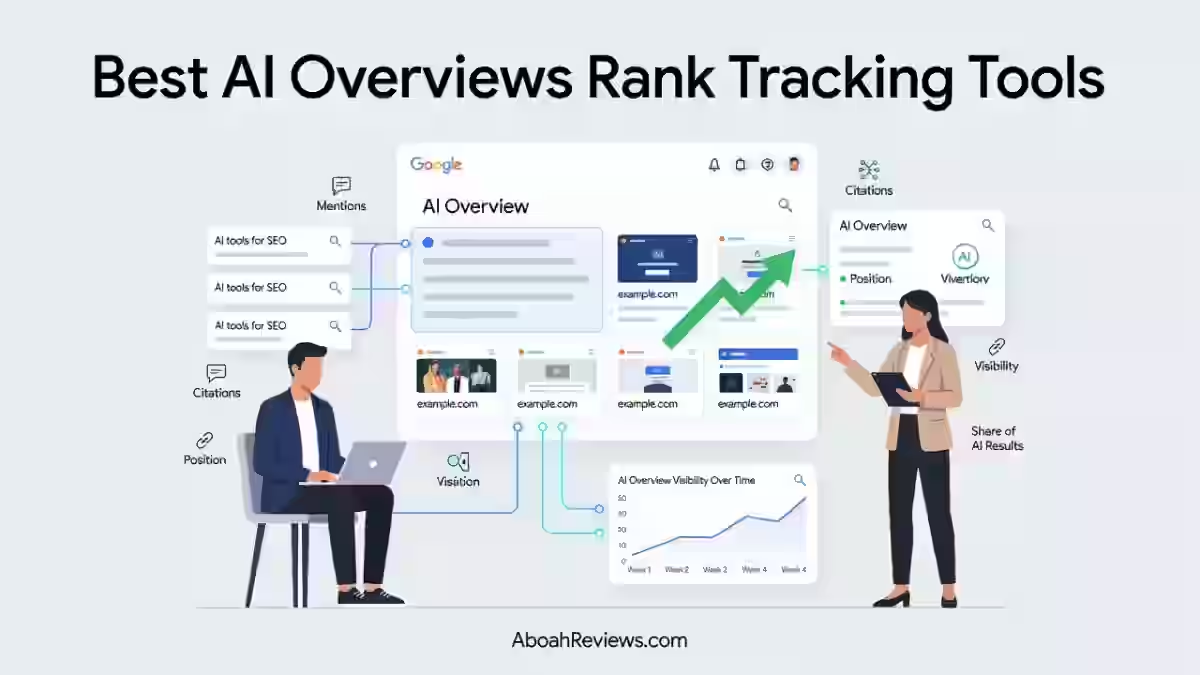
AI Overview tracking is different. The data chain looks more like this: prompt → AI response → brand mention → citation → source URL → competitor comparison → change over time.
There’s no single “position 1” anymore. Instead, there’s a citation or there isn’t. Your brand is mentioned or it isn’t. You’re compared favorably to a competitor or you’re not in the response at all.
A brand can rank #1 on Google for a keyword but appear nowhere in ChatGPT’s response to the same query. That gap is exactly what this category of tools was built to surface.
A good AI overviews tracker monitors these key signals:
- AI Overview presence: does the query trigger an AI Overview at all?
- Citation presence: is your site linked or referenced inside the response?
- Citation URL: which specific page on your site is being cited?
- Citation position: where does your source appear among all cited sources?
- Brand mention: does the AI mention your brand even without linking to you?
- Competitor citations: who else is being cited, and for which queries?
- Share of voice: how often does your brand appear relative to competitors?
- Historical trends: is your visibility growing, flat or declining?
Understanding these signals is the first step. Knowing which tool measures them accurately is the second.
AI Overview Tracking vs. Traditional Google Rank Tracking
Traditional SEO rank tracking gives you a clean number. You track a keyword, you see a URL at position 3, you get a green or red arrow showing movement. It’s simple to act on.
AI Overview tracking doesn’t work that way. You track a prompt, not just a keyword. The response changes based on location, device, query phrasing, and time of day. Your “ranking” isn’t a number. It’s whether you were cited, how prominently, and alongside which competitors.
The two signals are separate and serve different purposes. You need both to get a full picture of your search visibility in 2026.
Why an AI Overview Citation Is Not the Same as Ranking #1
Being cited in an AI Overview is not the same as holding the #1 organic ranking for a keyword. They’re measured differently, they serve different user intents, and they can move independently of each other.
I’ve seen pages cited consistently in AI Overviews that sit at position 8 in traditional organic results. I’ve also seen pages ranking at position 1 that never appear in AI Overviews for the same query. These are separate signals, and conflating them leads to the wrong decisions.
What Should an AI Overview Rank Tracker Measure?
Before you compare any tool’s pricing or feature list, you need a clear framework for what actually matters. Here’s what a useful AI Overview tracker should give you.
AI Overview Presence
The tracker should tell you whether a given prompt actually triggered an AI Overview. If no AI Overview appeared, there’s nothing to track.
This sounds obvious, but some tools count queries where no Overview appeared, which inflates your “coverage” numbers in a misleading way.
Citation Rate
Citation rate is the percentage of your tracked prompts where your site was cited in the AI response. If you’re tracking 100 prompts and cited in 23 of them, your citation rate is 23%. This is a more meaningful metric than raw mention counts.
Citation Position
Not all citations carry equal weight. Appearing as the first listed source in an AI Overview is different from being the sixth. Some tools surface this positional data. Others only confirm presence or absence.
Share of Voice
Share of voice measures how often your brand appears relative to all brands mentioned across your tracked prompts. This is most useful for competitive analysis. If a competitor appears in 65% of your target prompts and you appear in 22%, you have a clear gap to work on.
Brand Mentions
Some AI responses reference your brand by name without linking to your site. These “unlinked mentions” still carry brand value and may influence how AI systems perceive your authority. Your tracker should separate URL citations from unlinked brand mentions.
Citation URLs
A good tracker shows you the exact pages Google or another AI engine is citing. This lets you identify which content is earning citations and which pages might need improvement to become citation-worthy.
Competitor Citation Gaps
This is one of the most actionable features in the category. A competitor citation gap report shows you which queries cite your competitors’ pages but not yours. Those are the gaps to close first, because they represent existing AI-visible demand you’re not capturing.
Historical Trends
Snapshot data alone isn’t useful. You need to see whether your citation rate improved from last month, whether a competitor gained share, or whether a specific page stopped being cited after you updated it. Historical tracking turns a metric into a learning loop.
Geographic and Device Variation
AI Overviews vary by location, language, and device. If you run a multilingual site or operate in multiple markets, your UK AI Overview results may look completely different from your German or US results. The best tools let you run prompts in specific countries and on specific device types.
How I Evaluated the Best Rank Tracking Tools for AI Overviews
I approached this evaluation the same way I’d approach any tool purchase for a client: by focusing on what the data actually does for your SEO workflow, not on how many features are listed on the pricing page.
I spent time across several of these tools running real prompts against live sites in the UK, US, and European markets. I looked at how each tool handled discrepancies, how citation data lined up with what I saw manually in Google, and how their pricing structures actually translate to usable prompt volume.
Here’s the framework I used.
AI Overview Tracking Capability
I tested whether each platform tracks genuine Google AI Overviews specifically, versus just broader “AI visibility” that buckets everything together.
Some tools claim to track AI Overviews but actually track Google AI Mode or generalized LLM responses. They’re related, but they’re not the same signal. The distinction matters for how you interpret the data.
Citation Intelligence
I looked at whether each tool surfaces the exact cited URLs, not just a domain-level “you were mentioned.” URL-level citation data tells you which page earned the reference, which matters when you’re deciding what to optimize or update next.
Prompt Tracking
I evaluated prompt-level controls: can you set custom prompts, import keywords from GSC, discover relevant prompts, cluster similar queries, and track enough prompt volume to be statistically meaningful? Prompt design quality directly affects the value of the data you get back.
AI Engine Coverage
I separated tools by which engines they genuinely track versus which they claim to track. The list that matters most in 2026 includes:
- Google AI Overviews
- Google AI Mode
- ChatGPT
- Gemini
- Perplexity
- Claude
- Microsoft Copilot
One honest note here: a tool tracking three engines extremely well is often more useful than a tool claiming 17 engines where the data depth per engine is thin. Don’t treat engine count as a standalone quality indicator.
Accuracy and Data Methodology
I looked at refresh frequency, whether the tool runs actual browser-based queries or API simulations, geographic execution methods, device settings, and how the tool handles response variance.
AI Overviews don’t return identical results every time the same prompt is run. How a tool samples and averages those results affects how reliable your trend data is.
Reporting and Integrations
For agencies and larger teams, I checked for CSV export, API access, Google Analytics integration, Google Search Console connection, Looker Studio connectors, and white-label reporting options. These features separate tools you can run a client program on from tools that only work for personal monitoring.
Pricing and Value
I looked at what you actually get for the entry price, not the headline number. Some tools advertise a $20/mo entry point that doesn’t include any usable credits.
Others bill annually only, which means you’re committing significant budget without a monthly exit option.
The Best Tools for Monitoring AI Overviews
1. AIclicks — Best for Multi-Engine AI Visibility with an Action Layer
- Best for: Growing brands and agencies wanting AI search visibility across multiple LLMs with built-in content recommendations
- Starting price: $59/month
- Google AI Overviews: Yes
- Google AI Mode: Yes
- Other AI engines: ChatGPT, Gemini, Perplexity, Claude, Copilot, Grok, DeepSeek, Mistral (varies by plan tier)
- Refresh frequency: Daily
- Citation tracking: Yes (URL-level)
- Free plan/trial: 3-day trial only
What it does:
AIclicks offers LLM monitoring, competitor benchmarking, source intelligence, and AI-assisted content recommendations, showing marketers which prompts they surface for, why certain sources are cited, and how to publish the right content to win more mentions and clicks.
The number of simultaneous LLMs you can track depends on your plan: Starter allows 3, Pro allows 4, and Business allows 6.
You can choose which models to monitor from AIclicks’ full pool, including ChatGPT, Gemini, Perplexity, Google AI Overviews, Claude, Microsoft Copilot, Google AI Mode, Grok, Meta, DeepSeek, and Mistral across all paid tiers.
Best features:
- Prompt-level citation tracking with exact cited URLs
- Competitor share of voice reporting
- AI-generated content recommendations tied to citation gaps
- Country-level tracking for regional markets
- Google Analytics integration for connecting citation visibility to traffic data
Strengths:
The cleanest way to describe AIclicks is as an AI search visibility tool with a built-in optimization service model. That combination is useful for teams that don’t want to stitch together a tracker and a content workflow manually.
Limitations:
AIclicks tracks AI mentions, not backlinks or keyword rankings, so it complements a tool like Semrush or Ahrefs rather than replacing one. There’s no free plan, only a 3-day trial, which isn’t long enough to see meaningful movement in a visibility score before you’re billed.
Best use case: Brands and agencies running active GEO programs who want to connect citation data to a content production queue.
Verdict: AIclicks is one of the more complete tools in this category for multi-engine tracking with an action layer. The $59/mo entry point is steeper than Otterly or Rankscale, but you get more engines and more actionable data per prompt. Not ideal for solo bloggers or one-off visibility checks.
2. Rankability — Best for Combining Traditional SEO and AI Visibility
- Best for: SEO agencies that want keyword research, content optimization, and AI tracking in a single platform
- Starting price: $99/month
- Google AI Overviews: Yes
- Google AI Mode: Yes
- Other AI engines: ChatGPT, Perplexity, Gemini, Claude
- Refresh frequency: Daily
- Citation tracking: Yes
- Free plan/trial: No
What it does:
Rankability combines content optimization with AI content generation, keyword research, rank tracking, and AI search visibility monitoring. This means you can track how your content performs not just in traditional Google search, but also in ChatGPT and Google AI Overviews.
Best features:
Rankability offers AI Accessibility Audit, AI Mention Tracking, AI Visibility Score, and Citation Intelligence for monitoring AI search presence. It also includes SEO Audit, Keyword Research Tools, Keyword Rank Tracking, Competitive Benchmarking, Content Gap Analysis, GEO Optimization, Schema Guidance, and Reporting/Analytics across multiple brands and platforms.
Strengths:
Rankability maintains strong user satisfaction ratings. The tool is particularly popular among agencies managing multiple clients who need centralized dashboards and team collaboration features.
Limitations:
Rankability combines traditional SEO optimization with AI search tracking across platforms like ChatGPT and Google Gemini. The tool delivers solid results but requires a significant investment starting at $199 per month for the Core plan.
The plans are defined by content output and workspace limits rather than tracked prompt volume, which makes it harder to compare directly against prompt-based tools.
Best use case: Mid-sized SEO agencies that want to replace multiple tools (rank tracker, content optimizer, AI visibility) with a single platform.
Verdict: If you’re an agency already spending on separate tools for rank tracking, content briefs, and AI visibility, Rankability’s integrated approach makes financial sense. If you only need AI Overview tracking, it’s more than you need.
3. Peec AI — Best for AI Visibility and Citation Intelligence
- Best for: Mid-market teams wanting clean share-of-voice analytics and multi-market tracking
- Starting price: From ~$95/month (50 prompts, 3 models)
- Google AI Overviews: Yes
- Google AI Mode: Enterprise add-on
- Other AI engines: ChatGPT, Gemini (add-on), Perplexity, Claude
- Refresh frequency: Daily
- Citation tracking: Yes (URL-level)
- Free plan/trial: No
What it does:
Peec AI has become the default mid-market pick at €89/month for 25 tracked prompts, rising to €199/month Pro with 100 prompts. It raised $29M and reached $4M+ ARR within ten months. Strengths are clean share-of-voice analytics and competitor benchmarking.
Best features:
- Citation analysis with source URL extraction
- Competitor gap reporting (who’s cited where you’re not)
- Unlimited countries and languages at every pricing tier
- Sentiment tracking per AI engine
- Prompt-level share of voice reporting
Strengths:
The praise for Peec AI is consistent: clean UI, fast setup, and a focused feature set. On G2, Peec holds a 4.9 average, though the review base is still small.
Limitations:
Watch-out: Peec AI’s pricing scales with both prompt volume and geographic coverage, so multi-country programs should model costs before committing. Gemini and Google AI Mode are enterprise-tier add-ons, which matters if those engines are priorities for your audience.
Best use case: European or multi-market brands that need multilingual AI visibility tracking with solid citation intelligence. Also a good fit for teams that want a purpose-built tracker without the broader SEO suite overhead.
Verdict: Peec AI is one of the cleaner analytics platforms in this category. The cost scales up faster than it looks when you add geographic coverage, so run the numbers before signing up.
4. Otterly AI — Best Budget-Friendly AI Search Tracker
- Best for: Small businesses, freelancers, and smaller SEO teams getting started with AI visibility tracking
- Starting price: $29/month (15 prompts, 4 AI engines)
- Google AI Overviews: Yes
- Google AI Mode: Paid add-on
- Other AI engines: ChatGPT, Perplexity, Copilot (Gemini is a paid add-on)
- Refresh frequency: Daily
- Citation tracking: Yes (URL-level)
- Free plan/trial: Trial available
What it does:
You select the questions and countries to track, and Otterly reruns them daily across its included AI engines. It reports Brand Coverage, Share of Voice, Average Brand Position, sentiment, Domain Coverage, and citations.
Otterly’s citation reporting is a standout feature. It shows the domains, URLs, and prompts behind cited answers, along with whether your brand appears in the response, on the cited page, or alongside competitors.
Best features:
- $29/mo Lite plan with 15 prompts across 4 AI engines
- URL-level citation reporting at entry price
- Daily monitoring without a premium tier requirement
- Raw data exports
- Looker Studio integration on Standard plan and above
Strengths:
At $29/mo, Otterly AI is the most accessible entry point for teams that want basic AI Overview monitoring without committing to an enterprise platform.
Limitations:
Prompts are entered one at a time, which doesn’t scale to hundreds of tracked queries. Gemini and Google AI Mode are paid add-ons at $9–$149/mo, so if those engines matter to you, the real monthly cost is higher than the headline price.
Best use case: Small businesses or freelancers running their first AI visibility program with a limited budget. Also useful as a secondary monitor for agencies that need a lightweight client-facing tracker.
Verdict: Otterly AI is the best entry-level tool in this list. At $29/mo you get real citation-level data, daily tracking, and 4 AI engines. The prompt entry flow doesn’t scale well for large programs, but for under 50 prompts it does the job cleanly.
5. SE Visible — Best for Agencies Tracking Multiple Brands
- Best for: Agencies managing several clients across multiple AI platforms who need consolidated reporting
- Starting price: Custom (contact for pricing)
- Google AI Overviews: Yes
- Google AI Mode: Yes
- Other AI engines: Multiple LLMs (ChatGPT, Gemini, Perplexity, Copilot)
- Refresh frequency: Weekly (less frequent than daily competitors)
- Citation tracking: Yes
- Free plan/trial: No
What it does:
SE Visible is the AI visibility arm of the SE Ranking ecosystem, built specifically for agencies running multi-client AI monitoring programs. It tracks prompt-level AI visibility across Google AI Overviews, AI Mode, and major LLMs, with a Visibility Score metric and sentiment analysis per response.
SE Visible covers 7 countries with real-time scraping. That geographic scope is useful for agencies with clients in multiple markets, though it’s narrower than some alternatives for truly global programs.
Best features:
- Multi-project setup for agency client management
- AI Visibility Score across tracked prompts
- Competitor sentiment comparison
- Citation analysis with domain-level tracking
- Integrated reporting within the SE Ranking ecosystem
Strengths:
If you’re already inside SE Ranking for traditional rank tracking, SE Visible adds AI Overview monitoring without requiring a new vendor relationship. That reduces tool switching costs and keeps reporting consolidated.
Limitations:
The weekly refresh cycle is a real limitation compared to tools like Otterly, Peec AI, and AIclicks, which all run daily. If you need to spot citation changes quickly or monitor volatile queries, a weekly snapshot can leave you behind by days before you notice a problem.
Best use case: SE Ranking agencies who want to add AI visibility tracking without switching platforms. Not ideal for teams who need daily citation monitoring or deep URL-level citation intelligence.
Verdict: A reasonable addition if you’re already on SE Ranking. As a standalone AI visibility platform, the weekly refresh cycle puts it behind daily competitors at comparable price points.
6. Semrush — Best for Existing Semrush Users
- Best for: Teams already on Semrush who want AI visibility tracking without adding another vendor
- Starting price: $99/month per domain (AI Visibility Toolkit, billed annually)
- Google AI Overviews: Yes
- Google AI Mode: Yes
- Other AI engines: ChatGPT, Gemini, Perplexity
- Refresh frequency: Daily
- Citation tracking: Partial (domain-level, some URL-level)
- Free plan/trial: 7-day free trial (main Semrush platform)
What it does:
The Semrush AI Visibility Toolkit measures your mentions, citations, and share of voice in AI-generated responses across platforms like ChatGPT, Google AI Mode, Google AI Overview, and Gemini.
Prompt Tracking lets you follow a custom set of prompts with daily visibility updates in ChatGPT and Google AI Mode.
The $99/month per domain plan includes AI visibility reports for any domain, 25 custom prompts (daily AI rankings), 1 domain for Brand Performance analysis, mentions from ChatGPT, Google AI, Gemini, and Perplexity, AI competitor analysis and prompt research, and a site audit for AI readiness.
Best features:
- AI visibility integrated with traditional rank tracking
- Competitor AI performance comparison
- Prompt research tool to discover citation opportunities
- Domain-level AI readiness audit
- Direct connection to Semrush’s keyword and backlink databases
Strengths:
Semrush’s AI Visibility Toolkit is more practical for SEOs who need to track performance on specific prompts in AI search results. If you already use Semrush daily, the workflow integration alone saves you meaningful time.
Limitations:
A team with two domains, two users, and 75 prompts is already at $357 a month once you stack the AI Visibility Toolkit on top of the base SEO plan. The $99/mo add-on sounds reasonable until you do the full-cost calculation. Also note: AI visibility is behind a paywall. The $139 SEO plan has no AI-search tools.
Best use case: SEO professionals already paying for Semrush who want to extend their current reporting to cover AI Overview citations without managing a separate tool.
Verdict: The right tool if you’re already in the Semrush ecosystem. The wrong tool if you’re choosing between Semrush and a dedicated AI tracker, because the total cost stacks up fast.
7. Ahrefs — Best for Advanced SEO Teams
- Best for: Advanced SEO teams focused on backlink authority who want AI visibility as a secondary data point
- Starting price: $129/month (base plan); Brand Radar (AI visibility) from $199/month add-on
- Google AI Overviews: Yes
- Google AI Mode: Limited
- Other AI engines: ChatGPT, Gemini, Perplexity
- Refresh frequency: Variable by plan
- Citation tracking: Partial (brand-level and domain-level)
- Free plan/trial: No
What it does:
Ahrefs’ Brand Radar is better for brand managers who want a high-level view of their brand’s AI share of voice. It’s less granular on prompt-level citation data compared to dedicated AI trackers, but it connects directly to Ahrefs’ backlink and organic research tools.
Best features:
- Brand Radar for AI share of voice tracking
- Integration with Ahrefs’ organic keyword and backlink data
- Competitor AI visibility comparison
- Site audit features for technical SEO
- Historical data depth for organic performance
Strengths:
As of July 2026, Ahrefs bundles LLM visibility tracking at $129/mo, while Semrush gates it at $199/mo. That makes Ahrefs the more cost-efficient option if you’re comparing both platforms purely on AI visibility pricing, though the depth of citation data differs.
Limitations:
Many of Ahrefs’ add-ons are quite expensive. For example, it’s $199/month for Brand Radar. Against Profound, the comparison is mostly about buyer type: Profound sells a sales-led enterprise deployment with the widest surface coverage and Fortune 500 references, at prices reported in the thousands per month.
Ahrefs is not a dedicated AI visibility tool, and if that’s your primary need, purpose-built options like Peec AI or AIclicks will give you more granular citation data.
Best use case: SEO teams already on Ahrefs who want AI visibility as a supplementary metric alongside traditional backlink and ranking data.
Verdict: A logical add-on for existing Ahrefs users. As a standalone AI overview tracker, the citation depth isn’t as strong as dedicated platforms. Worth it if you need both organic SEO data and AI visibility in one place.
8. Rankscale — Best for Multi-Engine AI Visibility
- Best for: Brands and agencies wanting broad AI engine coverage at a competitive entry price
- Starting price: $20/month (limited credits); working entry ~$99/month (Pro)
- Google AI Overviews: Yes
- Google AI Mode: Yes
- Other AI engines: ChatGPT, Claude, Gemini, Perplexity, Copilot, Grok, DeepSeek, Mistral
- Refresh frequency: Daily or hourly (plan dependent)
- Citation tracking: Yes
- Free plan/trial: 7-day free trial on Pro plan
What it does:
Rankscale is an Austrian AI visibility tracker that names ten engines on every plan, including its cheapest, and bills for answers rather than for prompts.
Engines named on every plan: ChatGPT, Perplexity, Google AI Mode, Google AI Overviews, Gemini, Claude, Copilot, Grok, DeepSeek and Mistral.
Best features:
- 10 named AI engines across all plans (no engine gating by tier)
- Credit-based model with rollover credits
- White-label dashboards on agency tier
- API access for custom integrations
- Looker Studio connector
- Geographic tracking across multiple markets
Strengths:
Rankscale tracks brand visibility across 17+ generative engines for AI search optimization. The engine breadth at the entry price is genuinely unusual. Most competitors gate engine access by pricing tier. Rankscale doesn’t.
Limitations:
Rankscale does sell a $20 plan, but that plan ships with zero credits and cannot run a single prompt, so the working entry is the $99 Pro tier. There is no content generation, no publishing pipeline, and no classic Google rank tracking, so a full program still requires a second product.
Best use case: Agencies or brands that need broad AI engine coverage across many markets and want to handle content strategy separately. Also well-suited for teams that need API access to pull citation data into custom dashboards.
Verdict: Rankscale has the broadest engine coverage at the lowest working entry price in this list. The credit model adds complexity, but the engine breadth is a real differentiator. Just be honest about the $99 working entry cost when comparing sticker prices.
9. Omnia — Best for Turning AI Visibility Data Into Actions
- Best for: Content-focused teams who want citation data connected directly to a content brief and publishing workflow
- Starting price: From ~€63/month
- Google AI Overviews: Yes
- Google AI Mode: Yes
- Other AI engines: ChatGPT, Perplexity (Claude, Gemini, Copilot as add-ons)
- Refresh frequency: Daily
- Citation tracking: Yes (URL-level)
- Free plan/trial: Free AI Visibility Checker (no signup required)
What it does:
Omnia’s geo-first monitoring executes prompts via real browsers in actual geographic locations (not API-simulated), capturing country-specific citation patterns across unlimited countries without per-market surcharges.
When Omnia identifies that you’re invisible for a specific prompt or losing share of voice to a competitor, it generates content suggestions: what to write, what to optimize, which pages to prioritize.
Best features:
- Browser-based prompt execution (not API simulation)
- Daily tracking across core AI engines
- URL-level citation history
- AI-generated content briefs based on citation gaps
- Unlimited geographic coverage with no per-market charges
- Free AI Visibility Checker for initial testing
Strengths:
Omnia offers a free AI Visibility Checker that shows where your brand appears across ChatGPT, Perplexity, and Google AI Overviews without requiring signup, making it the best affordable entry point for basic monitoring.
The browser-based execution methodology is also more representative of real user conditions than API-only sampling.
Limitations:
Omnia’s own content ranks itself as the best tool in the category. That’s a vendor claim, not an independent one. I’d treat any tool’s self-assessment with appropriate skepticism and test their free checker against a few real queries before committing.
The core engine set (4 engines) is narrower than Rankscale’s 10 named platforms, though Omnia argues those 4 drive the majority of real brand discovery decisions.
Best use case: Teams that want visibility data to flow directly into a content calendar. If you’re already identifying citation gaps manually and then writing content briefs separately, Omnia tries to connect those two steps.
Verdict: Promising combination of monitoring and execution. The free checker is genuinely useful for a first look. Vendor’s self-ranking as #1 should be evaluated against your own testing, not taken at face value.
10. Profound — Best for Enterprise AI Search Intelligence
- Best for: Large organizations with dedicated AI search programs, budget, and technical resources
- Starting price: $99/month billed annually (1 engine, ChatGPT only); multi-engine from $399/month
- Google AI Overviews: Yes
- Google AI Mode: Yes
- Other AI engines: ChatGPT, Gemini, Perplexity, Claude, Copilot (varies by tier)
- Refresh frequency: Daily
- Citation tracking: Yes (URL-level, deep historical)
- Free plan/trial: No
What it does:
Profound is built for large brands that need deep AI visibility tracking, large-scale prompt monitoring, citation intelligence, conversation demand analysis, and enterprise reporting.
Profound has also raised significant funding, including a $96M Series C announced in 2026, which has pushed it further into the enterprise category.
Best features:
- Deep historical data with compliance-grade audit trails
- Multi-dimensional analytics across 10 AI engines
- Prompt discovery for identifying untapped citation opportunities
- Enterprise integrations and white-glove onboarding
- Sentiment tracking per engine and per query
Strengths:
Profound delivers white-glove support, historical data tracking, and multi-dimensional analytics across 10 engines, making it the choice for Fortune 500 brands with dedicated technical resources.
Limitations:
Profound’s $99 looks like the same shelf as everyone else until you notice it is billed as $1,188 a year, for one engine. Profound has historically offered entry pricing around $499/month for multi-engine coverage.
Profound is best for enterprise brands, large in-house teams, and well-funded organizations. Profound may be overkill for smaller agencies and SMBs.
Best use case: Large brands and enterprise marketing teams running AI search programs at scale, with budget and technical staff to implement and interpret deep analytics data.
Verdict: The category leader for enterprise use cases. If you’re a smaller agency, the price and complexity aren’t justified. But for a large organization where AI search visibility has board-level attention, Profound has the data depth and support infrastructure to match.
11. Thruuu — Best for Content and SERP Analysis
- Best for: Content teams that want to connect AI Overview citation sources directly to content research and brief creation
- Starting price: Freemium available; paid plans on request
- Google AI Overviews: Yes (SERP-level tracking)
- Google AI Mode: No
- Other AI engines: NoRefresh frequency: On-demand / variable
- Citation tracking: Partial (source-page analysis)
- Free plan/trial: Yes (limited)
What it does:
Thruuu started as a SERP analysis tool and has added AI Overview tracking to its content research workflow. Rather than monitoring citations on an ongoing basis, it helps content teams understand which pages Google cites in AI Overviews for specific queries, then uses that data to inform content briefs.
Best features:
- AI Overview source extraction per query
- Content brief generation from cited source analysis
- SERP structure analysis alongside AI Overview data
- Useful for understanding what kind of content earns AI citations
- Accessible entry price for content-focused teams
Strengths:
If your primary question is “what should I write to get cited in AI Overviews?” rather than “track my citation rate daily across 50 prompts,” Thruuu’s content-first approach may be more useful than a full-stack monitoring platform. It connects the research to the output.
Limitations:
Thruuu doesn’t provide ongoing citation monitoring in the same way as Otterly, Peec AI, or AIclicks. It’s better described as a research tool than a rank tracker.
No Google AI Mode coverage, no LLM coverage beyond Google, and no competitor share-of-voice reporting at the depth you’d get from dedicated monitors.
Best use case: Content strategists and writers who want to reverse-engineer what’s being cited in AI Overviews before writing a piece, not ongoing citation monitoring at scale.
Verdict: A strong content research companion, but not a replacement for a dedicated AI overview rank tracker. Use it alongside a monitoring tool, not instead of one.
AI Overview Rank Tracking Tools Compared by Feature
Here’s a direct feature matrix for all 11 tools. “Plan-dependent” means the feature exists but only on specific pricing tiers.
| Tool | AIO | AI Mode | ChatGPT | Gemini | Claude | Perplexity | Citation URLs | Competitor Tracking | API | Geo | Daily Tracking |
|---|---|---|---|---|---|---|---|---|---|---|---|
| AIclicks | Yes | Yes | Yes | Yes | Yes | Yes | Yes | Yes | Yes | Yes | Yes |
| Rankability | Yes | Yes | Yes | Yes | Yes | Yes | Yes | Yes | Yes | Yes | Yes |
| Peec AI | Yes | Add-on | Yes | Add-on | Yes | Yes | Yes | Yes | No | Yes (unlimited) | Yes |
| Otterly AI | Yes | Add-on | Yes | Add-on | No | Yes | Yes | Yes | No | Yes (50+ countries) | Yes |
| SE Visible | Yes | Yes | Yes | Yes | Yes | Yes | Partial | Yes | No | Yes (7 countries) | No (Weekly) |
| Semrush | Yes | Yes | Yes | Yes | No | Yes | Partial | Yes | Plan-dependent | Yes | Yes |
| Ahrefs | Yes | Limited | Yes | Yes | No | Yes | Partial | Yes | Yes | Yes | Variable |
| Rankscale | Yes | Yes | Yes | Yes | Yes | Yes | Yes | Yes | Yes | Yes | Yes |
| Omnia | Yes | Yes | Yes | Add-on | Add-on | Yes | Yes | Yes | No | Yes (unlimited) | Yes |
| Profound | Yes | Yes | Yes | Yes | Yes | Yes | Yes | Yes | Yes | Yes | Yes |
| Thruuu | Yes | No | No | No | No | No | Partial | No | No | Limited | No |
Best AI Overview Tracker for Each Use Case
Best AI Overview Tracker Overall
Peec AI and AIclicks are the strongest all-round performers for teams with active AI visibility programs. Peec AI wins on analytics depth and multilingual coverage. AIclicks wins on action recommendations and service support for smaller teams.
Best Free AI Overview Tracker
Omnia offers a free AI Visibility Checker that shows where your brand appears across ChatGPT, Perplexity, and Google AI Overviews without requiring signup, making it the best accessible entry point for basic monitoring. Thruuu also has a limited free tier for SERP and AIO source analysis.
Best Affordable AI Overview Tracker
Otterly AI at $29/month is the most accessible paid option with real citation-level data and daily tracking. Rankscale offers lower sticker pricing, but the working entry for usable credits is closer to $99/month.
Best AI Overview Tracker for Agencies
Rankability and SE Visible both serve agency workflows well. Rankability wins if you want SEO + AI in one platform. SE Visible is the right call if you’re already inside the SE Ranking ecosystem and need multi-client management.
Best AI Overview Tracker for SaaS Companies
Peec AI and AIclicks both perform well for SaaS teams. Peec AI’s clean share-of-voice and competitor benchmarking makes it easy to present AI visibility data in a SaaS context where comparison prompts (“best tool for X”) are common.
Best Enterprise AI Overview Tracker
Profound is best for enterprise brands, large in-house teams, and well-funded organizations that want deep AI search intelligence.
Best Tracker for Citation Analysis
Peec AI and AIclicks both excel here. Peec AI’s citation intelligence is particularly clean with URL-level source extraction and competitor citation gap reports.
Best Tracker for Competitor Research
AIclicks and Rankability both offer strong competitor citation tracking. For share-of-voice benchmarking specifically, Peec AI’s analytics interface is one of the cleaner experiences in the category.
Best Tracker for Multiple Countries
Peec AI (unlimited countries on all plans) and Omnia (unlimited geographic coverage via real browser execution) are the strongest choices for multi-market programs.
Best Tracker for Google AI Overviews Only
Otterly AI or Thruuu. If you only care about Google AI Overviews and have no need for ChatGPT or Perplexity tracking, both offer a more focused and affordable path than broader multi-engine platforms.
Best Multi-LLM AI Visibility Platform
Rankscale starts at $20 and names ten engines on every plan. That’s the widest engine coverage available at entry price. For teams that genuinely need to track across ChatGPT, Gemini, Claude, Perplexity, Copilot, Grok, DeepSeek, and Mistral simultaneously, Rankscale is the most practical option.
Best AI Overview Tracker with Content Recommendations
Omnia and AIclicks both connect visibility data to content action plans. Omnia’s approach is more structured, with content briefs tied directly to citation gap data. AIclicks offers blog generation integrated into the platform.
Google Search Console vs. AI Overview Tracking Tools
This is a comparison worth making honestly, because not every team needs paid software.
Google Search Console’s Generative AI Features
Google Search Console now includes some AI Overview performance data.
You can filter by “AI Overviews” in the Search Type dropdown to see impressions and clicks from AI Overview appearances. That’s real data, it’s free, and it comes directly from Google.
What it tells you: which of your existing pages appeared in AI Overviews and generated impressions or clicks. That’s genuinely useful.
What Dedicated Trackers Add
Here’s where the gap opens up. Google Search Console doesn’t tell you:
- Whether an AI Overview appeared for a given query (only that it appeared and you were cited)
- Competitor citation data for any query
- Which prompts you’re missing but should be targeting
- Your share of voice compared to competitors
- Citation data for ChatGPT, Perplexity, Gemini, or Claude
- Historical citation trends by prompt
- URL-level citation analysis with recommendation context
Dedicated tools fill those gaps.
GSC vs. dedicated trackers: a direct comparison:
| Feature | Google Search Console | Dedicated Tracker |
|---|---|---|
| Your citation data | Yes | Yes |
| Competitor citations | No | Yes |
| Prompt-level insight | Limited | Yes |
| Share of voice | No | Yes |
| Multi-engine coverage | Google only | Google + LLMs |
| Geo controls | Limited | Yes |
| Historical snapshots | Limited | Yes |
| Price | Free | $29–$499+/mo |
When Google Search Console Is Enough
If you run a small site, track fewer than 20 priority queries, and only care about Google AI Overviews, GSC may be all you need. Use the free Omnia checker or Thruuu for occasional supplemental checks.
If you’re running client programs, tracking hundreds of prompts across multiple markets, or need competitor data, GSC alone won’t cut it.
Can You Track Google AI Overviews for Free?
Yes, to a limited degree. Here are your realistic free options:
- Manual Google searches: Run your target queries in Google (logged out, in a clean browser, from your target location), screenshot the AI Overviews, and log citations in a spreadsheet. This works for 10 or fewer priority queries. It doesn’t scale.
- Google Search Console: Free, connected to your own domain, shows AI Overview clicks and impressions for pages Google has already cited. Doesn’t show competitor data or prompts where you’re absent.
- Omnia’s free checker: Omnia offers a free AI Visibility Checker that shows where your brand appears across ChatGPT, Perplexity, and Google AI Overviews without requiring signup. Useful for a first-pass brand audit.
- Thruuu free tier: Limited SERP and AI Overview source analysis for content research.
When Manual Tracking Makes Sense
Manual tracking is fine if you have fewer than 20 priority queries, you’re doing a one-off audit rather than ongoing monitoring, and you don’t need competitor data.
Set up a simple Google Sheet, log which queries trigger an AI Overview, whether your site is cited, and which URL is cited. Check it weekly.
When You Need Dedicated Software
You need a paid tool when you’re tracking more than 50 prompts, when you need competitor citation data, when you have clients to report to, when you operate in multiple markets, or when you want to act on citation gaps with a structured workflow.
The time cost of manual tracking at scale quickly exceeds the monthly tool cost.
How to Choose the Right AI Overview Rank Tracker
Start with Your Primary Search Ecosystem
Before comparing tools, ask yourself what you actually need to track:
- Google AI Overviews only → Otterly AI, Thruuu, or GSC
- Google + AI Mode → Omnia, Rankability, AIclicks
- Google + major LLMs → Peec AI, AIclicks, Omnia
- Full multi-engine GEO monitoring → Rankscale, Profound, AIclicks
Determine How Many Prompts You Need
Prompt volume drives real cost more than engine count. A plan with 15 prompts across 10 engines gives you shallower data than a plan with 100 prompts across 4 engines, in most practical SEO programs.
Calculate how many queries you actually need to track before comparing sticker prices.
If you want context on how content automation connects to AI visibility strategy, the guide on SEO automation for agencies is worth reading alongside this one.
Check Citation-Level Visibility
Prioritize platforms that surface exact cited URLs rather than only domain-level brand mentions. URL-level data tells you which pages are working and which aren’t.
Domain-level data only confirms that someone on your site was cited, which is far less useful for optimization decisions.
Evaluate Geographic Coverage
For local SEO, multilingual sites, and regional brands, geographic prompt execution matters a great deal.
Omnia’s geo-first monitoring executes prompts via real browsers in actual geographic locations (not API-simulated), capturing country-specific citation patterns across unlimited countries without per-market surcharges.
Check whether your tool of choice executes prompts in the actual target country or simulates geographic variation via API settings, as results can differ substantially between those two approaches.
For local-specific SEO programs where AI visibility intersects with map rankings and GBP signals, the guide on local SEO automation tools with AI content optimization covers that intersection well.
Consider Reporting Requirements
Agencies and enterprise teams often need:
- API access for pulling data into custom dashboards
- Looker Studio connectors for client reporting
- White-label reports for agency presentations
- CSV exports for offline analysis
- Scheduled email reports for stakeholder updates
Check which of these exist at your target pricing tier, not just the enterprise tier.
Check the Real Cost
The cleanest way to compare prices across this category is:
Monthly price ÷ usable tracked prompts = cost per prompt
A $29/mo tool with 15 prompts costs $1.93 per prompt. A $99/mo tool with 100 prompts costs $0.99 per prompt. At scale, the “more expensive” tool often gives you better value per data point. Don’t compare sticker prices alone.
How to Use AI Overview Tracking Data to Improve Your SEO
Getting citation data is the easy part. Doing something useful with it is where most teams stall.
Find Competitor Citation Gaps
Pull a list of queries where competitors are cited and you aren’t. These are your highest-priority targets.
A competitor’s citation presence confirms that AI systems consider the topic relevant and that there are sources to cite. You just need to become a better source than the ones already being referenced.
This type of analysis connects directly to semantic SEO automation workflows where content gap identification feeds into a structured content calendar.
Analyze the Pages Google Cites
When you find a query where a competitor is cited, go read the page being cited. Look at:
- Content depth — is the answer more complete than yours?
- Structure — are there clear headings, bullet points, direct answers?
- Entities — are they mentioning relevant people, brands, statistics?
- First-hand evidence — case studies, original data, author expertise?
- Internal links — are they linking to topically related content?
- External references — are they citing studies, Google documentation, or authoritative third-party sources?
Improve Existing Pages Before Creating New Ones
If you have a page that’s already being cited in some AI Overviews, that page is your highest-leverage asset. Improve it before building something new.
Add more specific data, answer adjacent questions within the same piece, tighten the structure, and add author context where it’s missing.
Build Content Around Recurring Prompt Clusters
Rather than optimizing for one exact keyword, group similar prompts together.
If five variations of “best AI visibility tracking tool” all trigger similar AI Overviews citing similar sources, those five prompts are one content opportunity.
This cluster approach also improves statistical reliability; you’re less likely to be misled by single-prompt variance.
For teams running automated SEO reporting, feeding prompt cluster data into your reporting workflow gives you a cleaner picture of AI visibility trends than tracking individual prompts in isolation.
Pursue Third-Party Citation Sources
Improving your AI overview visibility isn’t always about fixing your own pages. Sometimes the fastest way to get cited is to be referenced by pages that are already being cited.
Useful third-party citation sources include:
- Industry publications (Search Engine Journal, Backlinko, Search Engine Watch)
- Review platforms (G2, Capterra, Trustpilot)
- Community forums (Reddit, niche Slack groups)
- Expert roundups where your team contributes quotes
- Research publications that cite your original data
- YouTube where AI systems now reference video content
Why AI Overview Rankings Are Volatile
One of the most common mistakes I see is teams treating a single day’s AI Overview citation data as a firm verdict. It isn’t.
AI Overviews are dynamically generated. The same prompt run twice, from the same location, on the same device, five minutes apart, can return a different set of cited sources. This is not a bug in your tracking tool. It’s how these systems work.
Variables that influence which AI Overview appears (or doesn’t):
- Query phrasing — minor variation in wording can change the response
- Location — city-level variation is common in local queries
- Device — mobile and desktop responses differ
- Account state — logged-in vs. logged-out sessions behave differently
- Time — Google updates AI Overview responses as its index changes
- Personalization — user history may influence what appears
Don’t Overreact to One Day’s Result
If your citation rate drops by 15% on a single day, don’t panic-rewrite your content.
Look at the 7-day and 30-day trend before drawing any conclusions. A single-day drop may represent normal response variance, not an algorithmic signal change.
Track Trends, Not Isolated Rankings
Your citation rate over 30 days is far more meaningful than any single day’s result. Build your reporting around trend lines, not point-in-time snapshots.
Most of the better tools in this list (Peec AI, AIclicks, Profound, Rankscale) include trend visualizations for exactly this reason.
Use Prompt Clusters to Improve Statistical Reliability
If you track 10 semantic variations of the same core query, the average citation rate across those 10 prompts is far more reliable than the result from any single prompt.
This is one reason prompt clustering matters beyond content strategy. It also improves the statistical quality of your tracking data.
Here’s an important editorial note worth flagging: a tool that reports a dramatic visibility change isn’t necessarily showing you a dramatic SEO change. It may be showing normal response-level variance.
The methodology behind sampling and aggregation matters as much as the raw number. Ask your tool vendor how they handle response variance before trusting trend data at face value.
What Is the Difference Between AI Overview Rank, Citation Rank and Share of Voice?
This is one of the most common points of confusion in this category, and it’s worth a clean, direct table.
| Metric | What It Means |
|---|---|
| Organic rank | Your position in traditional Google search results (1–100+) |
| AI Overview presence | Whether an AI Overview appeared at all for a given query |
| Citation presence | Whether your page was referenced inside the AI Overview |
| Citation position | Where your source appeared among all cited sources (1st, 2nd, 3rd, etc.) |
| Brand mention | Whether your brand name appeared in the AI response, with or without a link |
| Share of voice | How often your brand is cited across all tracked prompts relative to competitors |
These metrics are independent of each other. You can have a strong organic rank with no AI Overview citation. You can have a citation without a brand mention.
You also can have a high share of voice in AI responses while ranking poorly in organic results. Track them separately. Don’t conflate them in your reports.
For a broader look at how generative engine optimization differs from traditional SEO, that guide covers the strategic context behind these metrics in more detail.
Final Verdict: Which AI Overview Rank Tracking Tool Should You Use?
There’s no universal winner here. The right tool depends on your budget, team size, prompt volume, engine requirements, and what you plan to do with the data.
| If you need… | Consider… |
|---|---|
| Dedicated Google AI Overview tracking on a budget | Otterly AI ($29/mo) |
| SEO + AI tracking in one platform | Rankability ($99/mo+) |
| Multi-engine AI visibility with action layer | AIclicks ($59/mo+) |
| Clean citation intelligence and multi-market coverage | Peec AI (~$95/mo+) |
| Broadest engine coverage at lowest entry | Rankscale ($99/mo working entry) |
| Visibility data connected to content briefs | Omnia (~€63/mo+) |
| Enterprise AI search program | Profound ($399/mo+, multi-engine) |
| Existing Semrush users | Semrush AI Visibility Toolkit ($99/mo add-on) |
| Existing Ahrefs users | Ahrefs Brand Radar ($199/mo add-on) |
| Agency multi-brand tracking | SE Visible or Rankability |
| Content and SERP research only | Thruuu |
Final Takeaway
AI overviews rank tracking tools went from a niche experiment to a mainstream SEO workflow item in less than 18 months. If you’re running content programs and not measuring your citation presence, you’re flying without instruments.
That said, the tools are only as useful as the decisions they drive. Tracking your citation rate without improving the underlying content, fixing your internal linking, or building third-party references isn’t going to move anything. The data is the starting point, not the finish line.
If you’re a solo blogger or freelancer, start with Otterly AI or the free Omnia checker. If you’re an agency with multiple clients, Rankability or Rankscale will serve you better. If you’re enterprise, Profound is worth the conversation. And if you’re an existing Semrush or Ahrefs user, check what AI visibility features your current plan already includes before adding another tool to your stack.
The goal isn’t to monitor your AI visibility. The goal is to use that monitoring to produce content that earns citations, build the kind of topical authority that AI systems trust, and measure whether your efforts are working over time.
Frequently Asked Questions About AI Overviews
What is an AI overview rank tracking tool?
An AI overview rank tracking tool monitors whether your website is cited inside AI-generated responses on platforms like Google AI Overviews, ChatGPT, Perplexity, and Gemini. It tracks citation presence, citation position, share of voice, and competitor mentions across tracked prompts.
Which AI overview rank tracking tool is best for beginners?
Otterly AI is the best starting point for most beginners, with a $29/month plan that includes 15 prompts, daily tracking, and URL-level citation data across four AI engines. For a completely free first look, Omnia’s free AI Visibility Checker requires no signup and covers the core engines.
Is Google Search Console enough for AI Overview tracking?
Google Search Console shows you impressions and clicks from AI Overview appearances for your own domain, but it doesn’t show competitor citations, prompts where you’re absent, share of voice, or data from ChatGPT, Perplexity, or Gemini. For small sites with fewer than 20 target queries, GSC is a reasonable starting point. For agencies or teams running active AI visibility programs, dedicated tools add significant value GSC can’t provide.
How often should I check AI overview citation data?
Weekly trend reviews are sufficient for most programs. Daily data is useful for spotting sudden changes, but AI Overview responses are volatile enough that single-day results shouldn’t trigger immediate content decisions. Focus on 7-day and 30-day trends rather than daily snapshots.
How is AI overview tracking different from traditional keyword rank tracking?
Traditional rank tracking gives you a position number for a keyword. AI overview tracking tells you whether your brand or page was cited in an AI-generated response, how often, at what position, and how that compares to competitors. The two signals are independent and should be tracked separately.
Can AI overview tracking improve my content strategy?
Yes, directly. Citation gap reports show you which queries cite competitors but not your site, giving you a prioritized list of content opportunities. Analyzing the pages being cited tells you what structure, depth, and specificity AI systems are responding to.
What is share of voice in AI overview tracking?
Share of voice is how often your brand or site is cited across all tracked prompts relative to competitors. If you track 100 prompts and appear in 30 while Competitor A appears in 55, your share of voice is 30% and theirs is 55%. It’s one of the most useful competitive metrics in this category because it shows relative visibility, not just absolute citation counts.

- EverBee Review 2026: My 30 Days Unbiased Testing Results - September 5, 2026
- 11 Best AI Overviews Rank Tracking Tools in 2026 (Honest Breakdown) - September 5, 2026
- 11 Best Automated Local SEO Tools for 2026: Full Breakdown - September 5, 2026