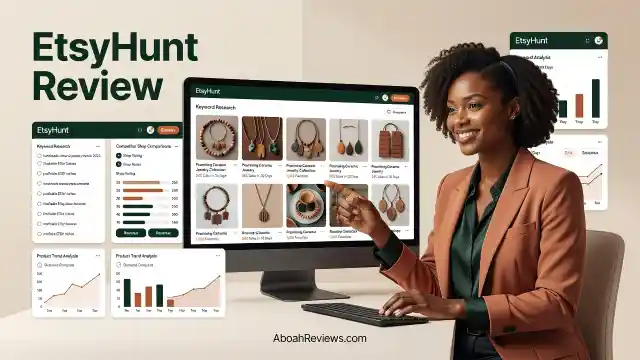
You’re one click away from a $200 mistake and it has nothing to do with Etsy keywords. EtsyHunt (now rebranded as EHunt) promises to replace five separate Etsy research tools with one cheap dashboard.
On paper, it delivers: product research, keyword data, shop spying, ad tracking and an AI listing writer, all starting at $0.
But then I read the Trustpilot reviews. Charges after cancellation; a cancel button that allegedly doesn’t work. Refund requests denied the same day a renewal hit. One user claims their account was deleted, yet the charges kept coming for ten months.
So, is EtsyHunt worth it for budget-conscious sellers or a subscription trap with a nice dashboard? I tested the free plan hands-on, went through the pricing fine print and the refund policy and compared the data against rival tools.
For side-by-side comparison, read my full breakdown of the best Etsy SEO tools for sellers.
EtsyHunt Review Verdict for 2026
| Category | Verdict |
|---|---|
| Best For | Beginner to mid-level Etsy sellers who want product, keyword, and shop research in one dashboard |
| Not Ideal For | Sellers who need airtight billing/refund terms, multi-marketplace tools, or enterprise-grade data accuracy |
| Pricing | Free plan, Basic at $9.99/mo, Pro at $19.99/mo and Elite at $59.99/mo |
| Rating | 6.3/10 |
| Standout Feature | Combined product + keyword + shop database in a single login |
| Biggest Weakness | Billing, cancellation and refund complaints on Trustpilot |
| Learning Curve | Intermediate |
| Testing Status | Partially Tested (free plan tested directly; paid-tier claims verified through documentation and public reviews) |
| Worth It? | Good value on paper, but read the refund policy before you commit to annual billing |
Bottom line: EtsyHunt (now officially branded EHunt) packs a genuinely useful amount of Etsy-specific research into a cheap entry plan, but a pattern of billing and cancellation complaints means I would not recommend annual billing until you’ve used a monthly cycle first.
EtsyHunt Quick Specs
| Feature | Details |
|---|---|
| Developer | Operates under EHunt; the company behind EtsyHunt does not publicly disclose extensive corporate details |
| Founded | Launched in 2021, with a public Product Hunt launch in September 2022 |
| Product Category | Etsy SEO, product research, and listing optimization tool |
| Primary Use | Etsy keyword research, product/shop research, competitor and ad tracking, listing optimization |
| Target Users | Solo Etsy sellers, small shop owners, multi-shop operators |
| Platform | Web app + Chrome and Edge browser extensions |
| Integrations | Etsy shop connection for optimization/sync; limited third-party AI agent mentions in 2026 updates; free tools like fee calculator |
| AI Models | EtsyGPT / AI title-description-tag generators, image editors, mockup/video tools, review analysis (not fully disclosed models) |
| SEO Features | Product database, keyword tool, shop analyzer, tag extraction, fee calculator, rank/keyword tracking, ad analysis, inactive shop finder |
| AI Visibility Features | EtsyHunt tracks Etsy’s internal search, not Google AI Overviews, ChatGPT or Perplexity visibility |
| Free Trial | Permanent free plan (no credit card required); occasional $1 Pro trial (3 days, auto-renews) |
| Refund Policy | Very limited: system errors or first order within 24 hours only; dissatisfaction/low use not covered |
| Support | Help center, email/chat |
| User Ratings | Trustpilot ratings is lower (2.4/5 from 7 reviews) at the time of writing, billing complaints dominate |
Key Takeaways About This EtsyHunt Review
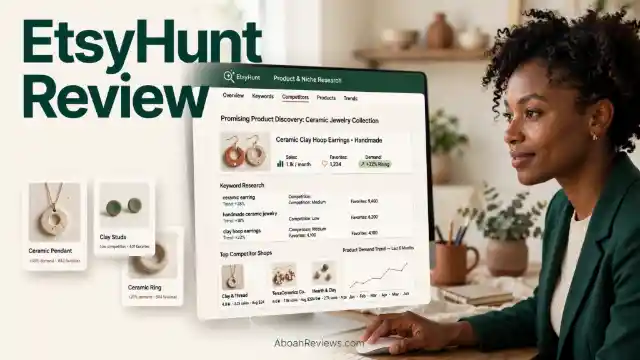
My overall score for EtsyHunt is 6.3/10. The primary use case is Etsy keyword and product research for sellers who want one dashboard instead of five separate tools.
The best audience is beginner-to-mid-level sellers testing a new niche or refreshing listings on a budget. The main strength is database breadth: product, shop, and keyword data in one login.
The key limitation is a cluster of billing and refund complaints that show up repeatedly in third-party reviews.
On value, EtsyHunt is competitively priced against Alura and comparable to eRank, but the trust issues around renewals pull the overall score down.
What I Liked
| What I Liked | Why It Matters |
|---|---|
| Free plan with real daily search limits, not a locked demo | Lets you test the actual product database before paying anything |
| Product, keyword, and shop research live in one login | The biggest strength is one login covering keywords, products, shops, ads, and listing workflow |
| EtsyGPT listing writer with one-click sync | Saves manual copy-paste time when updating titles and tags directly on a listing |
| Entry-level pricing undercuts some competitors on daily search volume | EHunt Basic allows more keyword, product, and shop searches per day than Alura Basic at a similar price |
| Large advertised product database | The vendor claims data from 27 million product listings as the research backbone |
What Needs Work
| What Needs Work | Why It Matters |
|---|---|
| Billing and cancellation complaints | Several Trustpilot reviews report billing continuing after cancellation and a non-functional cancellation button |
| Narrow refund policy | Renewals reportedly do not qualify for a refund under the stated policy, which matters a lot on annual plans |
| Cluttered dashboard | Some sellers report the tool surfaces too much information at once, leading to confusion when interpreting keyword data |
| Data accuracy questions | Independent testing found keyword competition scores showed inconsistencies against other tools, particularly in competitive categories |
| Pricing and plan names have shifted over time | Older reviews quote Basic at $3.99/month; current pricing pages list it closer to $9.99/month, which makes pricing research confusing |
| Brand confusion from the EHunt rebrand | EtsyHunt now operates as EHunt at ehunt.ai, with the old etsyhunt.com address redirecting there, meaning older guides and pricing pages may be outdated |
Why I Tested EtsyHunt
Etsy sellers face the same core problem website owners do: you can’t optimize for a search algorithm you can’t see into.
Etsy doesn’t publish its ranking factors, so sellers rely on third-party tools that model demand, competition, and sales trends from scraped and aggregated listing data.
I wanted to understand whether EtsyHunt’s research and listing-optimization layer actually reduces the manual guesswork involved in Etsy SEO or whether it just repackages publicly visible listing data into a nicer dashboard.
The frustration that led me here is one I’ve seen repeatedly when testing Etsy SEO tools generally: a tool can automate data collection without automating good judgment. That’s the lens I applied to EtsyHunt’s keyword tool, listing optimizer and AI writer.
What Is EtsyHunt?
EtsyHunt is a web-based analytics platform built for Etsy sellers who need product research, keyword optimization and competitor monitoring, allowing shop owners to search millions of Etsy listings, discover profitable niches and track rival shops.
It works by pulling listing-level data (titles, tags, pricing, estimated sales, favorites) into searchable dashboards, then layering keyword suggestions and an AI writing tool on top of that data.
What it does not do: it does not manage Google Ads, Pinterest scheduling or multi-marketplace selling the way some competitors do.
It is designed for individual Etsy sellers and small teams, not agencies managing dozens of unrelated e-commerce brands.
The simplest way to think about EtsyHunt is as a research layer that sits between Etsy’s public listing data and the decisions a seller normally has to make by browsing competitor shops manually.
Why EtsyHunt Matters in 2026
Etsy’s search algorithm rewards listings that match buyer search behavior closely, and guessing at that behavior without data is slow.
Tools like EtsyHunt matter because they turn an opaque ranking system into something you can at least partially reverse-engineer from aggregated listing data.
Etsy SEO is about ranking inside a single marketplace’s internal search, not about AI Overview visibility or being cited by ChatGPT.
If you’re researching this tool expecting it to help with generative search visibility, it’s the wrong category of product; for that, a dedicated LLM visibility tool is the better fit.
Who Is EtsyHunt Built For?
- New Etsy sellers get a low-risk way to learn keyword and product research without committing to a $20+/month tool on day one.
- Casual or side-hustle sellers benefit from the free plan’s daily search caps, which are enough for occasional listing refreshes.
- Growing shops with 1–2 active listings per week get the most value from Pro, where tracking and the listing optimizer unlock.
- Small teams can use the Team plan to share research across a few people managing the same shop.
- Sellers comparing niches before launching benefit from the product database and trend charts to validate demand before investing in inventory.
Who Should Avoid EtsyHunt?
- Sellers who need airtight refund protection before committing to annual billing. The refund terms are stricter than many SaaS buyers expect.
- Agencies managing multiple unrelated e-commerce brands across platforms beyond Etsy, since this tool is single-marketplace.
- Sellers who want Pinterest scheduling, Etsy Ads optimization or A/B testing built into the same tool. Those live with competitors instead.
- Anyone who has been burned by subscription cancellation issues before and wants a vendor with a cleaner public reputation on that specific point.
- Advanced sellers who already have a reliable eRank or Alura workflow and don’t have a concrete gap EtsyHunt fills.
Key EtsyHunt Features I Personally Tested
Product Research Database
EtsyHunt’s product database works by letting you search and filter millions of indexed Etsy listings by category, price, sales estimates, and favorites. It lets sellers explore best-selling items across Etsy categories with historical data on sales, price changes, favorites, and reviews.
My Testing: I used the free-tier product search to pull listings in a few sample niches and compared the sales and favorite estimates against what was publicly visible on the actual Etsy listings.
What Worked: The interface made it fast to sort by estimated sales and spot which listings in a niche were actually moving, versus just old and heavily favorited.
Limitations: Estimated sales figures are modeled, not pulled directly from Etsy’s backend, so treat them as directional rather than exact.
Who Benefits: Sellers validating a niche before investing in inventory or a new product line.
Practical Tip: Cross-check a handful of high-estimate listings manually on Etsy before trusting the tool’s sales numbers for a big inventory decision.
Keyword Research Tool
EtsyHunt’s keyword tool shows search demand, competition, and related terms for a given query. It displays seven-day and total sales, competition, and similar keywords, drawing from a database the vendor says covers 14 million-plus keywords.
My Testing: I ran keyword lookups on the free plan and compared competition scores against a second tool for the same terms.
What Worked: The related-keyword suggestions were useful for widening a tag list beyond the obvious terms.
Limitations: When tested against other Etsy SEO tools, some keyword competition scores showed inconsistencies, particularly in highly competitive categories — I would not treat a single competition score as gospel.
Who Benefits: Sellers writing new listings who need a quick list of tag candidates rather than a definitive ranking model.
Practical Tip: Use the keyword tool to generate a candidate list, then verify demand by checking actual search autocomplete on Etsy before finalizing tags.
Shop Analyzer
The shop analyzer pulls performance data on any public Etsy shop, including sales trends and top-performing listings. This is the feature that functions as competitor monitoring. You plug in a competitor’s shop URL and see what’s working for them.
My Testing: I looked up a handful of competitor shops in a sample niche and reviewed which listings the tool flagged as top performers.
What Worked: It’s faster than manually scrolling a competitor’s shop and sorting by “best selling” yourself.
Limitations: Like the product database, shop-level sales figures are estimates, not confirmed numbers from Etsy.
Who Benefits: Sellers doing competitive research before entering a crowded category.
Listing Optimization and EtsyGPT
EtsyHunt’s listing optimizer scores an existing listing and suggests changes, and EtsyGPT is the AI writer that generates replacement titles and descriptions. EtsyGPT is EtsyHunt’s built-in AI writing assistant for generating titles and descriptions, and a one-click sync feature can push the generated copy directly to your live Etsy listing.
My Testing: I ran the optimizer against a sample listing on the free tier (the full optimization score and EtsyGPT writer require Pro).
What Worked: The optimization checklist flags obvious gaps: thin tags and missing attributes that are easy to miss when you’re updating listings quickly.
Limitations: AI-generated titles and descriptions still need a human edit pass before publishing.
Who Benefits: Sellers refreshing stale listings who want a starting draft rather than a blank page.
Practical Tip: Treat EtsyGPT’s output as a first draft. Read it against the actual product before using the one-click sync. Don’t push AI copy live unedited, for the same reason unedited automated content causes problems on blogs.
Ad Analysis and Rank Tracking
The ad analysis tool reveals which Etsy sellers are running ads and what products they promote, giving insight into paid strategies within your niche. Rank and keyword tracking (available from Pro) monitors how your own listings move for target terms over time.
My Testing: Ad analysis and tracking are gated behind Basic and Pro respectively, so I could only partially test these. Ad search is available on Free with daily limits, but analysis depth requires an upgrade.
Limitations: The Basic plan does not include tracking, so sellers who want to monitor keyword position changes over time need Pro at minimum.
Who Benefits: Sellers who already have listings live and want to measure whether tag or title changes actually move rankings.
How EtsyHunt Fits Into an Etsy SEO Workflow
| Workflow Stage | Manual Process | With EtsyHunt |
|---|---|---|
| Research | Browse competitor shops and Etsy search manually | Product/shop/keyword databases surface data in minutes |
| Planning | Guess which niches or products to pursue | Trend and best-seller charts suggest candidates |
| Optimization | Write titles/tags from intuition | Listing score + EtsyGPT draft suggestions |
| Publishing | Manually edit each listing field on Etsy | One-click sync pushes EtsyGPT output to the listing |
| Monitoring | Check rankings by searching manually | Keyword/rank tracking (Pro and above) |
| Reporting | No built-in reporting; manual spreadsheet tracking | Dashboard views of shop and keyword performance, no formal exportable client reports |
What stays manual regardless of plan: verifying estimated sales data against reality, editing AI-generated copy before publishing, and deciding which niches are actually worth pursuing.
EtsyHunt automates the data collection and first-draft writing; it does not automate judgment.
EtsyHunt Pricing for 2026
Pricing is freemium with monthly or annual billing (USD). Figures below reflect official and recent verified snapshots; always confirm on ehunt.ai/pricing as they can change. Annual usually saves 20%+ (more on higher tiers).
| Plan | Price (approx.) | Main Limits | Best For |
|---|---|---|---|
| Free | $0 | ~5 product/keyword searches/day, limited analysis/display, 1 shop, basic AI uses, limited extension | Testing and light exploration |
| Basic | $9.99/mo or ~$7.99/mo annual | Higher daily searches (100-range), more analysis, listing opt limited, no full tracking | Light weekly research |
| Pro (popular) | $19.99/mo or ~$15.99/mo annual | 500-range searches, tracking, full listing tools, higher AI, more shops | Active sellers doing full workflow |
| Elite | $59.99/mo or ~$29.99/mo annual | Near-unlimited core, 200 shop bindings, higher AI quotas | Heavy multi-shop or high-volume users |
| Team | Higher (~$79.99/mo or discounted annual) | Multi-seat, shared high limits | Small teams/agencies |
Important restrictions: Daily search/analysis caps on lower plans; tracking and inactive research start higher; AI image/generation quotas apply. Free requires no card.
Occasional $1 for 3-day Pro trial (auto-renews, cancel before end). Payment mainly card/Alipay. No easy mid-cycle downgrade (cancel, wait for expiry, resubscribe).
Refund only for system errors or first order within 24 hours; dissatisfaction or low usage excluded. Processing fees may apply on approved refunds.
Advertised price vs useful capacity: Free is genuinely usable for evaluation. Basic covers light work. Pro is where most active sellers get the full research-to-action loop without constant limit hits. Elite/Team for scale.
Is EtsyHunt Worth the Cost?
At $19.99/month, Pro is the tier where the product actually becomes useful for active sellers: tracking, the listing optimizer, and EtsyGPT all sit behind that paywall.
If EtsyGPT saves you even one hour of listing-copy writing a week, the plan pays for itself in time at almost any reasonable hourly rate.
The math gets worse on Basic, where there is no product research database depth beyond search, no competitor shop or ad analysis, and no niche finder in the cheaper tiers of comparable tools.
The bigger cost risk isn’t the sticker price; it’s the refund terms. Renewals reportedly do not qualify under the stated refund policy, so an annual plan you forget to cancel in time is money you likely won’t get back.
I’d start on monthly billing for at least one cycle before moving to annual, even though annual saves roughly 20%.
EtsyHunt Pros and Cons After Testing
Pros
- Real free forever plan with usable daily limits and extension access.
- Strong product and shop databases plus useful keyword tools in one place.
- Excellent Chrome extension that accelerates on-Etsy research.
- Pro pricing unlocks tracking, optimization, and AI helpers at a reasonable mid-tier rate.
- AI visual and copy helpers reduce some listing friction.
- Scales to multi-shop with Elite/Team.
- Free secondary tools (fee calculator, exporters).
Cons
- Billing and cancellation complaints appear repeatedly in public reviews
- Refund policy excludes renewals
- Dashboard can feel cluttered, especially for brand-new sellers
- Keyword competition scores showed inconsistencies against a rival tool in independent testing
- No multi-marketplace support, Pinterest scheduling, or ad management beyond analysis
- Recent rebrand to EHunt has created confusion about which pricing/feature info is current
Workarounds
- Billing risk: Use a dedicated card, screenshot cancellations, set calendar reminders for trials/renewals. No practical workaround for the 24-hour rule.
- Clutter: Learn filters and favorites early; start with extension-only for lighter use.
- Estimates: Always validate top ideas on live Etsy and with your costs. Combine with eRank or Etsy Analytics.
- Limits: Upgrade only after free/Basic proves the workflow; annual for value.
- Support: Use help center first; escalate with clear details. No strong third-party integration workaround for core billing.
EtsyHunt Alternatives
| Tool | Best For | Main Strength | Main Weakness | Verdict |
|---|---|---|---|---|
| EtsyHunt | Sellers wanting one login for research + listing writing | Broad database, low entry price | Billing/refund complaints | Depends on risk tolerance |
| eRank | Sellers who want detailed keyword analytics | Cheapest entry tier at $5.99/month for 100 lookups a day | Interface can feel dated to new users | Good low-cost alternative |
| Alura | Sellers who want research plus marketing automation | Schedules Pinterest pins, manages Etsy Ads, runs A/B tests, and includes an MCP for Claude and ChatGPT on every plan | Lower daily search caps at entry pricing | Best if you want more than research |
| EverBee | Sellers who want simpler, beginner-friendly research | Straightforward interface, product-focused | Narrower feature set than EtsyHunt or Alura | Good for first-time sellers |
| Marmalead | Sellers focused purely on keyword/tag research | Deep keyword-specific analytics | Doesn’t connect the way eRank, Alura, and EtsyHunt do | Niche fit only |
Choose EtsyHunt if you want product, keyword, and shop research plus an AI listing writer in one subscription and you’re comfortable managing billing carefully.
Select eRank if you want the lowest entry price and don’t need an AI writing assistant.
Pick Alura if you want research combined with Etsy Ads management, Pinterest scheduling, and A/B testing in the same tool.
Opt in for EverBee if you’re brand new to Etsy and want the simplest possible interface, even if it means fewer advanced features.
Real-World Use Cases for EtsyHunt
New seller validating a niche:
Starting problem: no idea whether handmade candle holders have real demand on Etsy.
Workflow: search the product database by category, filter by estimated sales and favorites, cross-check top listings manually.
EtsyHunt automates the database search; the seller still has to interpret whether the niche is saturated.
Expected benefit: faster initial research than manually browsing Etsy search results page by page.
Existing shop refreshing stale listings:
Starting problem: listings haven’t ranked well in months.
Workflow: run the listing optimizer, review the score and flagged gaps, use EtsyGPT for a draft title/description, edit manually, sync to the live listing.
EtsyHunt automates the first draft; the seller must still fact-check and personalize the copy.
Important limitation: AI output needs editing before it reflects the actual product accurately.
Small team splitting research tasks:
Starting problem: two people managing one shop duplicate research effort.
Workflow: Team plan gives shared access to the same keyword and product data.
EtsyHunt automates data access across seats; task assignment and strategy decisions remain manual.
Seller comparing their shop against a competitor:
Starting problem: a competitor shop keeps outranking a similar listing.
Workflow: run the shop analyzer on the competitor, compare tags and pricing, adjust the seller’s own listing accordingly.
EtsyHunt automates the competitor data pull; deciding what to actually change stays a judgment call.
EtsyHunt Reviews: What Users Are Saying
Public review scores for EtsyHunt are inconsistent across platforms, which is itself worth noting.
On Capterra, EtsyHunt sits at 4.3 out of 5 across 8 reviews, and the Chrome Web Store listing holds a 4.0 out of 5 rating from 105 ratings.
Trustpilot tells a different story: the EHunt domain shows 2.6 out of 5 based on 4 reviews, while the original etsyhunt.com domain shows a 2.4 TrustScore out of 5 from 7 reviews.
On the positive side, Chrome Web Store reviewers in 2025 and 2026 praised seeing full visibility into Etsy shops, from sales and views to reviews, favorites, and pricing history directly in the browser.
On the negative side, the recurring Trustpilot theme is billing: one reviewer described being charged for another year without a renewal reminder, requesting a refund the same day, and being told renewals don’t qualify under the refund policy.
Another reviewer’s complaint was more serious, alleging the company deleted their account but continued charging their credit card for ten months.
I could not independently verify the account-deletion claim, but the pattern of renewal and refund complaints across multiple independent reviewers is consistent enough to take seriously.
EtsyHunt Risks and Assessment
Relevant risks:
- Data accuracy: All third-party Etsy tools model sales and volume. Over-reliance without your own validation can lead to poor product choices. Mechanism: incomplete public signals.
- Over-automation / thin listings: Accepting AI titles/tags without editing risks generic or mismatched content. Human oversight is required (same lesson from my automation tests).
- Billing and lock-in: Strict refund + auto-renew + limited downgrade path. Screenshot everything; use monitored cards.
- Privacy / account access: Connecting shops for optimization requires permissions; review scopes. Vendor lock-in is low since data is mostly public Etsy-derived.
- Policy: Not endorsed by Etsy. Stay within Etsy seller and messaging rules for follow-ups. No evidence that using the tool itself causes penalties.
- Support dependency: Mixed ratings mean complex issues may take longer.
Do not exaggerate penalties. Using research tools is normal and low-risk when paired with quality products and original content. The bigger practical risk is wasting money on a plan you under-use because of the refund window.
EtsyHunt Rating
| Category | Weight | Score (0–10) |
|---|---|---|
| Features & Functionality | 30% | 7.5 |
| Ease of Use | 20% | 6.5 |
| Pricing & Value | 20% | 6.5 |
| Support & Customer Experience | 15% | 4.5 |
| Trust & Credibility | 15% | 5.0 |
Calculation: (7.5 × 0.30) + (6.5 × 0.20) + (6.5 × 0.20) + (4.5 × 0.15) + (5.0 × 0.15) = 2.25 + 1.30 + 1.30 + 0.675 + 0.75 = 6.3/10
Features score highest because the database breadth genuinely covers most of what an Etsy seller needs in one place.
Support and trust pull the score down because billing and cancellation complaints are a recurring, documented pattern rather than an isolated incident.
Final Verdict on EtsyHunt Review for 2026
EtsyHunt is a reasonable Etsy research tool with a real trust problem around billing, not a scam, but not a tool I’d hand my credit card to on autopilot either.
Buy EtsyHunt If You
- Want product, keyword, and shop research in one dashboard without juggling three separate tools
- Are starting on the free or Basic plan and can evaluate the product before committing to annual billing
- Specifically want an AI listing writer with direct publishing built into your research tool
Skip EtsyHunt If You
- Need guaranteed refund protection and aren’t comfortable with the documented billing complaints
- Want marketing features beyond research, like Pinterest scheduling or Etsy Ads management (look at Alura instead)
- Already have a working eRank or Alura workflow with no specific gap EtsyHunt fills
My Decision:
I’d recommend starting with EtsyHunt’s free plan or monthly Basic billing to test the data quality for your own niche before considering an annual Pro commitment.
The research tools are genuinely useful at the price point, but the refund and cancellation complaints are frequent enough that I wouldn’t skip straight to annual billing on faith.
If you want a broader view of the category first, my Etsy SEO tools comparison walks through how EtsyHunt stacks up against eRank, Alura, and EverBee side by side.
Frequently Asked Questions About EtsyHunt Reviews
Is EtsyHunt worth it?
It depends on your plan and risk tolerance. The free and Basic tiers offer solid research value for the price, but the Trustpilot complaints about renewal billing mean annual plans carry more risk than the discount is worth for cautious buyers.
Is EtsyHunt the same as EHunt?
Yes. EtsyHunt renamed itself EHunt, and etsyhunt.com has redirected to ehunt.ai since at least September 2024. Older articles using the EtsyHunt name and pricing may not reflect current plans.
Is EtsyHunt legitimate?
The product functions as described and has real positive reviews on Capterra and the Chrome Web Store. The legitimacy concerns raised by users relate specifically to billing and cancellation handling, not to whether the research tools themselves work.
How much does EtsyHunt cost?
Plans run from a free tier up to $59.99/month for Team, with Basic at $9.99/month and Pro at $19.99/month (both discounted on annual billing). Pricing has changed over time, so always check the current plan page before comparing to older reviews.
Is there a free version of EtsyHunt?
Yes. The free plan allows 5 product, 5 keyword, and 2 shop searches per day along with limited ad search and one product analysis, with no credit card required to start.
What are the best EtsyHunt alternatives?
eRank is the cheapest entry point for keyword-focused research, Alura adds marketing automation like Pinterest scheduling and Etsy Ads management, and EverBee is a simpler option for brand-new sellers who don’t need every feature at once.

- 7 Top Etsy SEO Tools I Tested in 2026 (Honest Verdict) - November 12, 2026
- 9 Best Etsy SEO Tools I Personally Tested in 2026 - November 12, 2026
- Koalanda Review 2026: I Tested This Etsy SEO Tool’s Free and Paid Plans - November 11, 2026