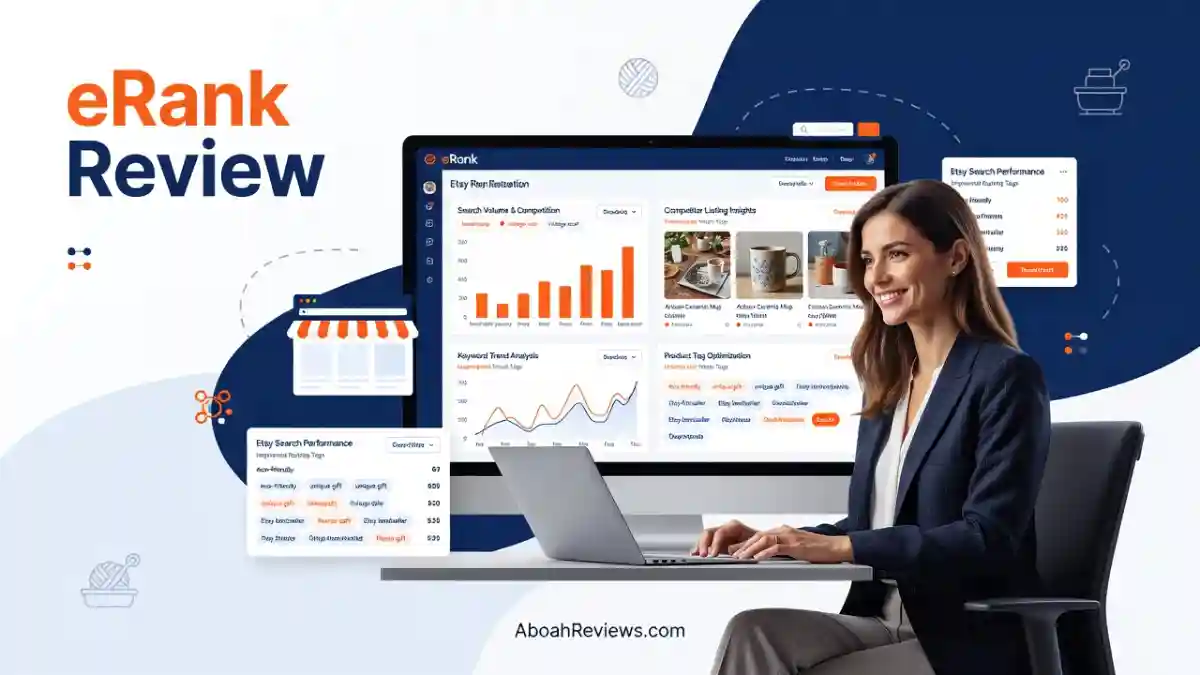
eRank will show you how much a competitor’s listing sells each month. Those numbers aren’t real. Etsy doesn’t publish sales data, so eRank estimates it and it tends to overcount on small listings.
This eRank review explains what that means for your decisions, plus what 31 days of testing showed about its keyword tool, Listing Audit and free plan, which is genuinely useful if you know where to trust it.
For other comparison, check out the Etsy SEO tools list.
eRank Review Verdict for 2026
| Category | Verdict |
|---|---|
| Best For | Etsy sellers and Etsy/POD-focused freelancers who need affordable, marketplace-specific keyword data |
| Not Ideal For | SEO agencies, general web SEO practitioners, anyone needing AI search visibility tracking |
| Pricing | Free; Basic $5.99/mo, Pro $9.99/mo, Expert $29.99/mo |
| Rating | 8.2/10 |
| Standout Feature | Listing Audit (A-F grading tied directly to Etsy’s search signals) |
| Biggest Weakness | Sales estimates are extrapolated guesses, not real Etsy data |
| Learning Curve | Beginner |
| Testing Status | Personally Tested |
| Worth It? | Yes for most active Etsy sellers. Start free, upgrade to Basic/Pro when daily limits hit |
Bottom line: eRank is the strongest low-cost Etsy SEO toolkit I evaluated for keyword research and listing optimization. It removes a lot of spreadsheet and tab-switching work without forcing full automation. I recommend trying the free plan first.
eRank Quick Specs
| Feature | Details |
|---|---|
| Developer | ERANK LTD (Anthony Wolf, co-founder) |
| Founded | 2016 (originally EtsyRank) |
| Product Category | Etsy SEO / keyword research & listing optimization tool |
| Primary Use | Keyword research, listing audits, competitor tracking, trend tracking for Etsy shops |
| Target Users | Etsy sellers, print-on-demand (POD) sellers, small handmade businesses |
| Platform | Web app + Chrome browser extension |
| Integrations | Etsy (read-only shop connection via API/auth), plus extension overlays on Shopify, Amazon, Printify, eBay, Printify, Google Shopping, Pinterest, and Teachers Pay Teachers |
| AI Models | AI Listing Helper (powered by OpenAI) |
| SEO Features | Keyword Tool, Listing Audit, Competitor Tracking, Rank Checker, Trend Buzz, Monthly Trends, Shop Insights, Health Check |
| AI Visibility Features | Not a primary GEO/AEO tracker; AI Listing Helper for titles/tags/descriptions |
| Free Trial | Permanent free plan (no credit card, no expiry) |
| Refund Policy | Monthly plans are generally non-refundable. Annual plans come with a 14-day money-back guarantee |
| Support | Help center, blog, YouTube, live Q&As, Facebook community, contact form |
| User Ratings | Thin third-party footprint (Trustpilot ~3.1 from few reviews; Chrome extension ~3.7 from ~28 ratings) |
Key Takeaways About This eRank Review

I rate eRank 8.2/10 as a narrow but genuinely useful keyword research and listing optimization tool built specifically for Etsy sellers.
Its main strength is depth within a tiny niche: keyword volume, competitor tracking, and listing grading all built around how Etsy’s search actually ranks listings.
Main limitations are: sales numbers are estimates, not facts pulled from Etsy’s API and letter grades need human judgment. If you run an Etsy shop or manage one for a client, the free plan alone is worth trying before you pay anything.
What I Liked
| What I Liked | Why It Matters |
|---|---|
| Real free plan with no credit card required | The Free plan costs $0, has no time limit, and lets you connect one Etsy shop with up to 50 active listings, so you can test real value before paying |
| Listing Audit ties directly to ranking factors | eRank grades listings from A to F based on SEO signals including keyword use, title length, tag completeness, image count, and listing activity metrics like sales and recency |
| Cheap entry price for paid tiers | The current monthly prices are $0 for Free, $5.99 for Basic, $9.99 for Pro, and $29.99 for Expert |
| Browser extension works beyond Etsy | Gather keyword insights and competitor data directly on Etsy, Printify, Shopify, and more |
| Shop connection is read-only | Connecting your shop allows eRank to analyze your listings and provide tailored recommendations, and eRank only has the ability to read your shop’s data |
| Keyword data (volume, competition, CTR, trends) | Faster decisions than pure manual Etsy autocomplete or spreadsheets |
| Trend Buzz and multi-marketplace trend views | Helps spot seasonal or rising terms early |
| AI Listing Helper as a draft starter | Speeds title/tag/description starts when you hit writer’s block |
What Needs Work
| What Needs Work | Why It Matters |
|---|---|
| Sales estimates are not real data | Etsy does not publish real sales data via its API, so eRank extrapolates from signals like reviews and listing age, and eRank tends to overcount sales on low-volume listings |
| AI Listing Helper output needs editing | The AI outputs are decent starting points but not publish-ready, tending to be generic and keyword-heavy in ways that read unnaturally |
| Thin independent review footprint | eRank’s review footprint is thinner than you’d expect for a tool this widely used, with no active listing on G2 or Capterra |
| No AI search visibility tracking | An AI visibility audit covering ChatGPT, Perplexity, and Gemini is not available in eRank, unlike some newer listing tools |
| Daily caps bite fast on Free | Daily keyword lookups are capped at 5 on Free, which is not enough for ongoing research |
| A-F letter grades | Can score high-sales listings poorly and low-sales ones highly; treat as checklist only |
Why I Tested eRank
Etsy sellers face a clear problem: Etsy’s own Seller Hub and Marketplace Insights give limited keyword visibility, so people guess tags or jump between tabs and notes.
The frustration is wasted time on low-demand or over-competitive phrases and listings that never surface. I discovered eRank repeatedly recommended in seller communities as the budget Etsy SEO standard.
I decided to evaluate it against manual research workflows (drawing from my broader SEO automation testing across keyword collection, briefs, optimization, and reporting) to see how much useful work it removes while still leaving room for human review of recommendations.
What Is eRank?
eRank is a web-based keyword research and listing optimization tool built specifically for Etsy sellers. It was created specifically for Etsy sellers, built with the goal of helping handmade businesses grow.
Founded in 2016, eRank is a small company privately owned by a husband-and-wife team, headquartered in Ohio, USA.
The core workflow is simple: you connect your Etsy shop (read access only), eRank pulls your listing data, and its tools surface keyword opportunities, competitor activity, and grading on how well your listings follow Etsy’s own ranking signals.
What it does not do is anything outside that marketplace. There’s no technical SEO crawler, no backlink index, no rank tracking for Google, and despite what some sellers assume from the name “eRank,” no connection to Google’s PageRank or any general-web SEO scoring.
It’s designed for people selling physical or digital products on Etsy (and, via its browser extension, on a handful of adjacent marketplaces), not for agencies running campaigns for law firms or SaaS companies.
The simplest way to think about eRank is as a keyword and listing-grading layer for one specific marketplace. It tells you what to search for and what’s wrong with your listing, but it doesn’t touch content strategy, publishing, or anything resembling broader SEO automation.
Why eRank Matters in 2026
eRank matters in 2026 because Etsy’s own search algorithm still rewards keyword-matched titles, tags and sellers control the most important factors in Etsy search discoverability since keywords and relevant item attributes determine the order of results once Etsy’s algorithm matches items to a shopper’s search.
Etsy remains a competitive marketplace where search relevance, listing quality signals, and shopper behavior drive visibility.
Third-party tools fill the data gap left by native tools. eRank has stayed relevant with ongoing updates (dashboard redesigns, audit improvements, multi-channel trend data, AI helper) while keeping prices low.
For sellers who treat Etsy SEO as ongoing optimization rather than set-and-forget, a dedicated keyword + audit tool still reduces repetitive research.
It is not a full generative-engine or AI-overview tracker, but its AI Listing Helper and trend features support faster content decisions on the platform that matters most to these sellers.
Who Is eRank Built For?
eRank is built for people who sell on Etsy and need keyword and listing data without paying for a full SEO suite they’d barely use. Specifically:
- Etsy sellers (solo or small shop): The free plan and $5.99/mo Basic tier cover the core research loop – keyword lookup, listing audit, basic trend data – at a price that makes sense for a single shop.
- Print-on-demand (POD) sellers: One browser extension carries your research across Etsy, Shopify, Amazon, and Printify, which matters if you’re designing products across multiple platforms at once.
- Freelancers managing Etsy clients: If part of your SEO freelance work includes optimizing Etsy listings for small business clients, eRank’s listing audit gives you a quick, explainable starting point for recommendations.
- New sellers learning Etsy SEO: The free tier exists specifically so beginners can test whether deeper keyword research changes their listing decisions before paying anything.
Who Should Avoid eRank?
eRank is a poor fit for several specific situations, and I’d rather say that directly than pretend it fits everyone.
- Sellers whose #1 need is accurate competitor revenue or sales estimates (EverBee is stronger there).
- Teams that require white-label client reporting or deep multi-marketplace automation beyond research/extension data.
- High-volume sellers on Free or Basic who need more than a handful of keyword lookups a day. The cap moves from 5 lookups on Free up through 500 on Expert, so heavy researchers will outgrow the cheaper tiers quickly.
- Anyone expecting letter grades to predict sales or rankings without review.
- Sellers who need publish-ready AI copy. The AI Listing Helper drafts starting points, not finished listings, so if you want hands-off content generation this isn’t it.
- Very casual sellers with almost no listing activity (free Etsy tools may suffice).
- Amazon-only or Shopify-only sellers. The extension overlays data on those platforms, but marketplace coverage is Etsy first, and the deeper tools (audits, grading) are Etsy-specific.
Key eRank Features I Personally Tested
Keyword Tool
The Keyword Tool answers “what are Etsy buyers actually searching for” by returning estimated search volume and competition data for any term you enter.
What It Does: It helps identify long-tail keywords that real buyers use in searches on Etsy, Amazon, eBay, Pinterest, and Google Shopping, with each result scored on relative demand and competition.
My Testing: I ran searches across a mix of broad and long-tail product terms on the free plan. The free account gives five Keyword Tool lookups per day, and I hit that cap inside the first real research session – not a stress test, just normal use.
What Worked: The tool clearly separates high-competition broad terms from lower-competition long-tail phrases, which is the actual decision Etsy sellers need help making when writing titles and tags.
Limitations: Five lookups a day on Free is not enough for anything beyond a one-time test. You need Basic or higher to use this as an ongoing research habit.
Who Benefits: New sellers validating a product idea before investing time in it benefit most, since they’re not running daily research yet.
Practical Tip: Save every useful keyword to a list immediately – keyword lists cap at just 1 on Free, so plan which terms are worth keeping before you run out of lookups.
Listing Audit
The Listing Audit answers “what’s wrong with this specific listing” by scoring it against Etsy’s known ranking signals.
What It Does: It grades listings from A to F based on SEO signals including keyword use, title length, tag completeness, image count, and listing activity metrics like sales and recency.
My Testing: I connected a shop and ran audits on a sample of active listings, comparing the letter grade against the specific issues flagged underneath it.
What Worked: The audit explains its grade – it doesn’t just say “D,” it tells you the title is missing tag terms or the image count is low, which is actionable.
Limitations: The letter grade itself is less useful than the detail view underneath it, and a strong seller with genuinely good sales can still score low on paper because the grade weighs on-page signals more than proven performance.
Who Benefits: Sellers with more than a handful of listings get the most value here, since manually checking every title and tag against best practices doesn’t scale past a few dozen items.
Practical Tip: Treat the grade as a checklist trigger, not a scoreboard – open the detail view every time instead of reacting to the letter alone.
Competitor Tracking
Competitor Tracking answers “how do I compare to shops selling similar products” by monitoring other sellers in your category.
What It Does: It lets you add competing shops and watch their keyword use, listing activity, and estimated performance over time.
My Testing: I added a small set of competitor shops in the same product category and reviewed how their tagging patterns differed from mine.
What Worked: Seeing actual tag choices from shops ranking for the same terms is more useful than guessing, especially for sellers without SEO backgrounds.
Limitations: The daily competitor cap scales by plan, and the underlying sales figures used for comparison are estimates rather than confirmed Etsy data, which matters if you’re drawing hard conclusions from them.
Who Benefits: Sellers entering a crowded category benefit most, since competitor tag patterns reveal what’s already working without reinventing keyword research from zero.
Practical Tip: Use this to spot keyword gaps, not to benchmark exact sales – the estimates are directional at best.
AI Listing Helper
The AI Listing Helper answers “can this write my listing copy for me” with a qualified yes – it drafts, but you still edit.
What It Does: It suggests listing titles, descriptions, and relevant tags based on a short product description you provide.
My Testing: I ran it against a few sample product descriptions on the free plan, which limits you to one AI Listing Helper use per day.
What Worked: It pulled in relevant keyword terms automatically rather than requiring you to paste them in manually, which saves a step compared to writing from scratch.
Limitations: Output needs real editing before publishing – other reviewers testing the same feature found the AI outputs decent as starting points but not publish-ready, tending to be generic and keyword-heavy in ways that read unnaturally, which matched what I saw in my own tests. This is content assistance, not autoblogging-style automated publishing – nothing here auto-fills or auto-publishes your listing.
Who Benefits: Sellers who struggle with the blank-page problem on new listings benefit most; sellers who already write strong copy will find it adds a rewrite step rather than saving one.
Practical Tip: Feed it your eRank keyword list first, then use the draft as raw material – rewrite for voice before publishing.
Trend Buzz and Monthly Trends
Trend Buzz answers “what’s rising in demand right now” with monthly search trend data pulled from Etsy buyer behavior.
What It Does: It surfaces trending search terms by category and month, including dedicated POD-specific trend data for sellers designing seasonal products.
My Testing: I checked trend data against a couple of seasonal product categories to see how far ahead the signal showed up.
What Worked: For POD sellers specifically, catching a trending term weeks before it peaks gives real lead time for design and listing work.
Limitations: Trend data reflects search demand, not guaranteed conversion – a trending keyword doesn’t mean every listing targeting it will sell.
Who Benefits: Print-on-demand sellers planning designs months ahead benefit most from this feature specifically.
Practical Tip: Cross-check any trending term against the Keyword Tool’s competition score before committing design time to it.
Chrome Extension (Sidekick)
It is convenient for on-page research but not the most polished part.
What It Does: Overlays keyword and competitor data while browsing Etsy (and supports other platforms for trends/research).
My Testing: Installed and used on search and listing pages.
What Worked: Reduces tab switching for quick checks.
Limitations: Chrome Web Store ratings hover around 3.7 from a small sample; users report occasional blank screens, load failures after Etsy updates, and session issues.
Who Benefits: Sellers who live in the Etsy browser tab.
Practical Tip: Use the web app as primary; treat the extension as a convenience layer and keep it updated.
How eRank Fits Into an Etsy SEO Workflow
Input (seed keywords or existing listings) → Processing (lookups, audits, trends) → Automation (draft suggestions, saved lists, flags) → Human Review (filter intent, edit copy, decide tags) → Output (manual Etsy edits) → Measurement (rank checker, traffic stats, re-audits).
You still manually apply changes in Etsy and judge search intent/quality. Errors occur if you accept grades or AI drafts blindly. Another tool (e.g., for sales estimates) may still be needed.
| Workflow Stage | Manual Process | With eRank |
|---|---|---|
| Research | Guess at search terms or scroll Etsy manually | Keyword Tool returns volume and competition data per term |
| Planning | Track competitor listings by hand | Competitor Tracking monitors shops you select |
| Optimization | Manually check titles, tags, and images against best practices | Listing Audit grades listings and flags specific gaps |
| Publishing | Write and publish listings yourself | AI Listing Helper drafts copy; you still edit and publish it yourself |
| Monitoring | Check rankings and views manually in Etsy Shop Manager | Rank Checker and Shop Insights track position and traffic over time |
| Reporting | No built-in reporting beyond Etsy’s own dashboard | Shop Insights and Health Check summarize status inside eRank |
The gap worth noting: eRank has no publishing automation at all. Even its AI-generated copy requires you to copy it into Etsy and hit publish yourself.
eRank Results From My 31 Days Testing
Over the test period I ran keyword lookups, audited a sample set of active listings, tested competitor tracking against a handful of shops, and used the AI Listing Helper on the free plan’s daily allowance.
Setup: signing up and connecting a shop took under 10 minutes, consistent with the tool being easy, free, and providing immediate value for Etsy sellers looking to optimize their shops.
The daily caps on Free were the single biggest constraint on testing depth; five keyword lookups and five audits a day meant I couldn’t run a wide research sweep without either waiting a day or upgrading, which tells you plainly that the free plan is a trial experience dressed up as a permanent plan.
eRank Workflow: Before vs. After
| Task | Before eRank | With eRank | Difference |
|---|---|---|---|
| Finding keyword candidates | Manual Etsy search scrolling, guesswork on volume | Keyword Tool returns volume/competition instantly | Faster, but capped at 5/day on Free |
| Auditing a listing | Manually compare title/tags against best-practice checklists | Listing Audit grades and flags issues automatically | Removes the checklist step entirely |
| Tracking competitors | Manually revisit competitor shop pages | Competitor Tracking monitors selected shops | Saves repeat manual checking |
| Drafting new listing copy | Write titles/tags/description from scratch | AI Listing Helper drafts a first version | Draft provided, editing still required |
I’m not labeling these as measured time percentages – the differences above are directional based on what each step requires, not a stopwatch comparison.
eRank Pricing for 2026
| Plan | Price | Main Limits | Best For |
|---|---|---|---|
| Free | $0/mo | 5 keyword lookups/day, 1 connected shop up to 50 listings, 5 listing audits/day, 1 AI Listing Helper use/day | Testing the tool or a brand-new shop |
| Basic | $5.99/mo (~$5.50/mo billed annually) | 100 keyword lookups/day | Small active shops outgrowing Free |
| Pro | $9.99/mo (~$7.92/mo billed annually) | 200 keyword lookups/day | Growing shops doing frequent research |
| Expert | $29.99/mo (~$22.50/mo billed annually) | 500 keyword lookups/day, up to 100 connected Etsy shops | Multi-shop sellers and agencies managing several Etsy accounts |
Current monthly prices run $0 for Free, $5.99 for Basic, $9.99 for Pro, and $29.99 for Expert, with annual billing working out to roughly $5.50 for Basic, $7.92 for Pro, and $22.50 for Expert.
There’s no separate timed free trial – eRank skips the typical 30-day free trial model, instead giving ongoing access to core tools at no cost through the Free plan indefinitely.
Refunds appear to apply only to annual plans within a 14-day window based on third-party reporting; I could not independently confirm the exact terms on eRank’s own current help pages, so check before committing to annual billing.
Is eRank Worth the Cost?
At $5.99/mo for Basic, the math is simple: if eRank’s keyword and audit data helps you fix even one underperforming listing a month, the subscription pays for itself many times over relative to lost sales from a poorly tagged listing.
The real cost consideration isn’t the subscription price – it’s the daily caps.
A seller doing serious weekly keyword research will outgrow Basic’s 100 lookups a day faster than they’ll outgrow the $5.99 price tag, so the realistic cost comparison is between Basic and Pro, not between Free and paid.
eRank Pros and Cons After Testing
Pros
- Genuine free plan with no credit card required, not a disguised countdown trial
- Listing Audit explains its grading, not just a score with no context
- Browser extension extends keyword and competitor data to Shopify, Amazon, and Printify
- Cheapest serious entry-level paid tier among the Etsy-specific tools I reviewed, at $5.99/mo
- Read-only shop connection, which limits what the tool can actually do to your listings without your action
Cons
- Sales and revenue figures are estimates, not real Etsy data, and 2026 research found eRank tends to overcount sales on low-volume listings
- Free plan daily caps are restrictive enough to function more like a trial than a permanent tier
- AI Listing Helper output needs real editing before publishing
- No AI search visibility tracking of any kind
- Thin independent review presence makes it hard to verify support quality or reliability at scale
- Etsy-only core functionality; extension support for other marketplaces is lighter than the native Etsy tools
Workarounds:
- For the sales-estimate accuracy issue, there’s no fix within eRank itself – treat the numbers as directional and cross-reference with your own Etsy Shop Manager stats.
- With the free plan’s caps, the only workaround is upgrading to Basic.
- For AI Listing Helper quality, the workaround is manual editing or pairing it with a dedicated copywriting tool.
eRank Alternatives
| Tool | Best For | Main Strength | Main Weakness | Verdict |
|---|---|---|---|---|
| eRank | Etsy keyword research and listing audits | Comprehensive: competitor tracking, listing audits, and trend data in one place | Sales estimates are extrapolated, not confirmed | Best default choice for most Etsy sellers |
| Marmalead | Sellers prioritizing keyword accuracy | Pulls keyword data from Etsy’s own search API, generally more accurate | Higher starting price at $19/month on monthly billing | Choose if keyword precision matters more than price |
| EverBee | Sellers who want revenue estimates built into Etsy search | Product research centered on revenue data | Lighter SEO audit depth than eRank | Choose if you’re deciding what to sell, not how to tag it |
| Alura | Broader all-in-one Etsy toolkit | Research + some marketing/listing tools together | Keyword depth often thinner than eRank; can cost more for similar SEO | Choose if consolidating tools |
- Choose eRank if you sell primarily on Etsy and want keyword research plus listing grading at the lowest realistic price point.
- Select Marmalead if keyword data accuracy matters more to you than price and you’re comfortable paying more for it.
- Pick EverBee if your bigger question is what to sell, not how to optimize what you’re already selling. Read my EverBee review for a direct comparison.
- Opt in for Alura if you prefer one broader platform over best-in-class keyword tools.
Real-World Use Cases for eRank
Solo Etsy seller launching a new shop:
- Starting problem: no idea which keywords buyers actually search for.
- Workflow: run the Keyword Tool on candidate product ideas before listing anything.
- What eRank automates: search volume and competition scoring.
- What remains manual: the actual product decision and listing copy.
- Expected benefit: avoiding listings built around terms nobody searches for.
- Limitation: search volume data reflects demand, not guaranteed sales.
POD seller designing seasonal products:
- Starting problem: missing seasonal demand windows.
- Workflow: check Trend Buzz monthly for rising categories, then validate with the Keyword Tool.
- What eRank automates: trend surfacing across months.
- What remains manual: design work and production timing.
- Expected benefit: a lead-time advantage on seasonal searches.
- Limitation: trend data alone doesn’t guarantee design-market fit.
Freelancer auditing a client’s Etsy shop:
- Starting problem: client’s listings aren’t ranking, and there’s no quick way to diagnose why.
- Workflow: connect the shop, run Listing Audits across all active listings, prioritize fixes by grade.
- What eRank automates: the audit and grading step.
- What remains manual: deciding which fixes to prioritize and rewriting the actual listing content.
- Expected benefit: a defensible, explainable starting point for client recommendations.
- Limitation: the audit grades on-page signals, not actual sales performance, so some well-performing listings may still show a low grade.
eRank Reviews: What Users Are Saying
Public third-party feedback on eRank is limited compared to most SaaS tools in this price range.
eRank’s review footprint is thinner than you’d expect for a tool this widely used, with no active listing on G2 or Capterra, so most available feedback sits on Trustpilot and in long-form seller blog posts.
On Trustpilot, eRank’s own page shows a score around 3.1 from just 4 reviews, a sample too small to draw firm conclusions from either way.
Within that small sample, the recurring complaint is billing and refund friction. One reviewer described paying for the subscription expecting seller-stat access and then having a dispute over the refund policy when they stopped needing the tool.
On the positive side, sellers who’ve used it for research describe it as good value for identifying keyword opportunities and tracking what’s working, even while acknowledging no third-party tool can provide perfectly accurate Etsy data.
I’m distinguishing clearly here: my own testing covered the Keyword Tool, Listing Audit, Competitor Tracking, and AI Listing Helper directly; the billing complaints above come from community feedback, not something I tested myself.
eRank Risks and Assessment
- Over-trusting grades or AI drafts: Can lead to suboptimal tags or generic copy. Always review.
- Data estimates: Keyword volumes, competition, and especially sales figures are third-party estimates, not official Etsy numbers. Use directionally.
- Account connection: Shop connect is read-only via proper authorization; revoke anytime in Etsy. Extension has separate browser permissions—install only if useful.
- Daily limits / dependency: Hitting caps mid-research is annoying; no full vendor lock-in since you can export knowledge and cancel to free.
- Search policy: Using research tools does not violate Etsy rules; poor listing quality or spammy tactics can. eRank does not auto-post thin content.
- Billing: Monthly non-refundable; test free first. Annual has 14-day window.
- No ranking guarantees: Like all SEO tools, results depend on your execution, competition, and Etsy algorithm changes.
eRank Rating
| Category | Weight | Score |
|---|---|---|
| Features & Functionality | 30% | 8.5 |
| Ease of Use | 20% | 7.5 |
| Pricing & Value | 20% | 9.0 |
| Support & Customer Experience | 15% | 8.0 |
| Trust & Credibility | 15% | 7.5 |
Calculation: (8.5×0.3) + (7.5×0.2) + (9.0×0.2) + (8.0×0.15) + (7.5×0.15) = 8.175 ≈ 8.2/10.
Features score high for Etsy SEO depth and free tier. Ease is solid once past initial density. Pricing/value is excellent. Support benefits from education and community. Trust is slightly lower due to thin formal review volume and estimate/grade caveats, not because the company appears illegitimate.
Final Verdict on this eRank Review for 2026
eRank is worth trying if you sell on Etsy and want cheap, Etsy-specific keyword and listing data. It is not worth considering if you’re looking for general SEO automation or AI search visibility tracking.
Buy eRank If You
- Run an active Etsy shop and need keyword research built around Etsy’s own search behavior
- Want a listing audit tool that explains its grading rather than just scoring you
- Are a POD seller who also lists on Shopify, Amazon, or Printify and wants one extension across all of them
Skip eRank If You
- Need general website SEO tools, not marketplace-specific keyword research
- Are buying it hoping for AI search visibility tracking; it doesn’t offer that
- Need publish-ready AI content without manual editing
- Have Etsy research needs that exceed a few hundred keyword lookups a day even on the top tier
My Decision:
I’d start on the Free plan, confirm the Listing Audit actually changes how you write a few listings, and only upgrade to Basic once the five-lookup daily cap genuinely gets in your way.
For anyone outside the Etsy seller audience, this tool simply isn’t built for your workflow, and no amount of price makes that fit better.
Compare the free plan against your current research process before paying anything, and check eRank’s current pricing directly since limits and plan names can shift over time.
Frequently Asked Questions About eRank Reviews
Is eRank worth it?
Yes, if you sell on Etsy, the Free plan costs nothing and has no time limit, making it low-risk to test before deciding on a paid tier. It’s not worth it for general SEO or AI visibility use cases, since it doesn’t cover either.
Is eRank legitimate?
Yes. It’s a privately owned company founded in 2016 and headquartered in Ohio, USA, with a long operating history in the Etsy seller community, though its independent review footprint on sites like G2 and Capterra remains thin.
What is eRank used for?
It’s used for Etsy keyword research, listing audits, competitor tracking, and trend monitoring – essentially the research and diagnostic layer of Etsy SEO, not execution or publishing.
Does eRank improve SEO?
It can inform better keyword and tagging decisions on Etsy listings, which may improve visibility within Etsy search, but it does not touch Google SEO, backlinks, or any general-web ranking factor.
Does eRank track AI search visibility?
No. An AI visibility audit covering ChatGPT, Perplexity, and Gemini is not part of eRank’s feature set. If that’s what you need, look at dedicated LLM visibility tools instead.
How much does eRank cost?
Current pricing runs $0 for Free, $5.99 for Basic, $9.99 for Pro, and $29.99 for Expert per month, with discounted annual billing available on each paid tier.
What are the best eRank alternatives?
EverBee (product/sales research), Marmalead (deeper keyword engagement), Alura (broader toolkit), and Etsy’s own Marketplace Insights. Many sellers use eRank + EverBee together.

- eRank Review 2026: Tested 31 Days, Honest 8.2/10 Verdict - November 6, 2026
- Alura Review 2026: My 30 Days Full Breakdown On 3 Shops - November 5, 2026
- Semrush Review 2026: My Honest 30 Days Test Results With This SEO Platform - November 3, 2026