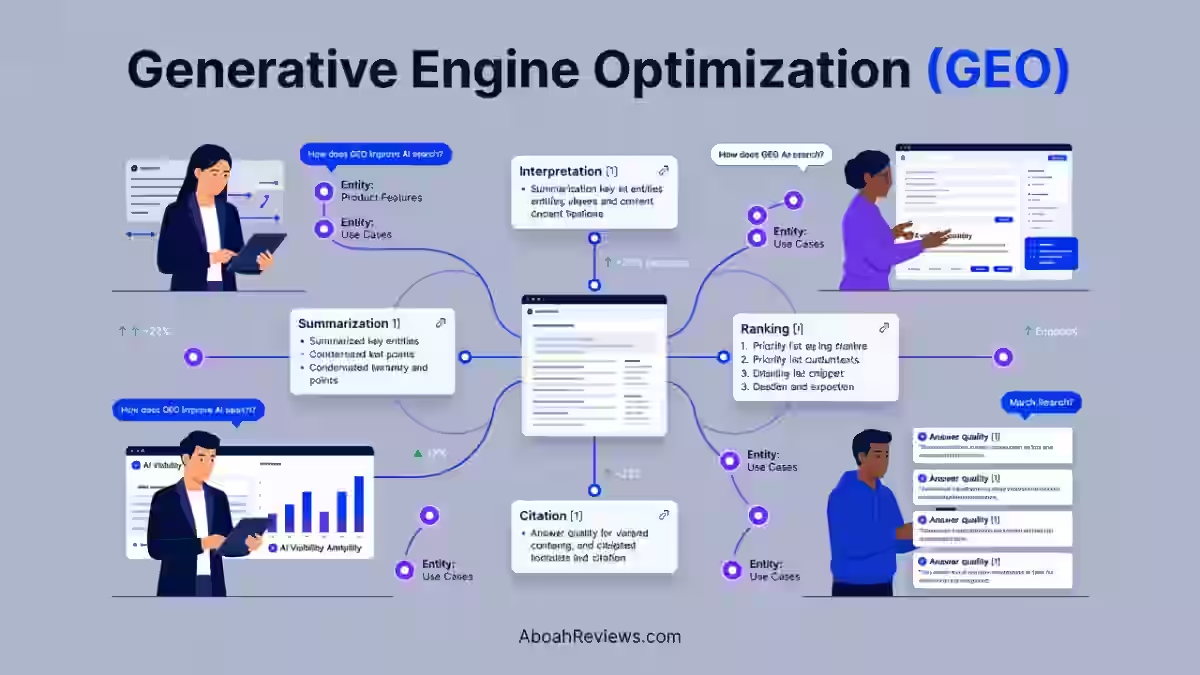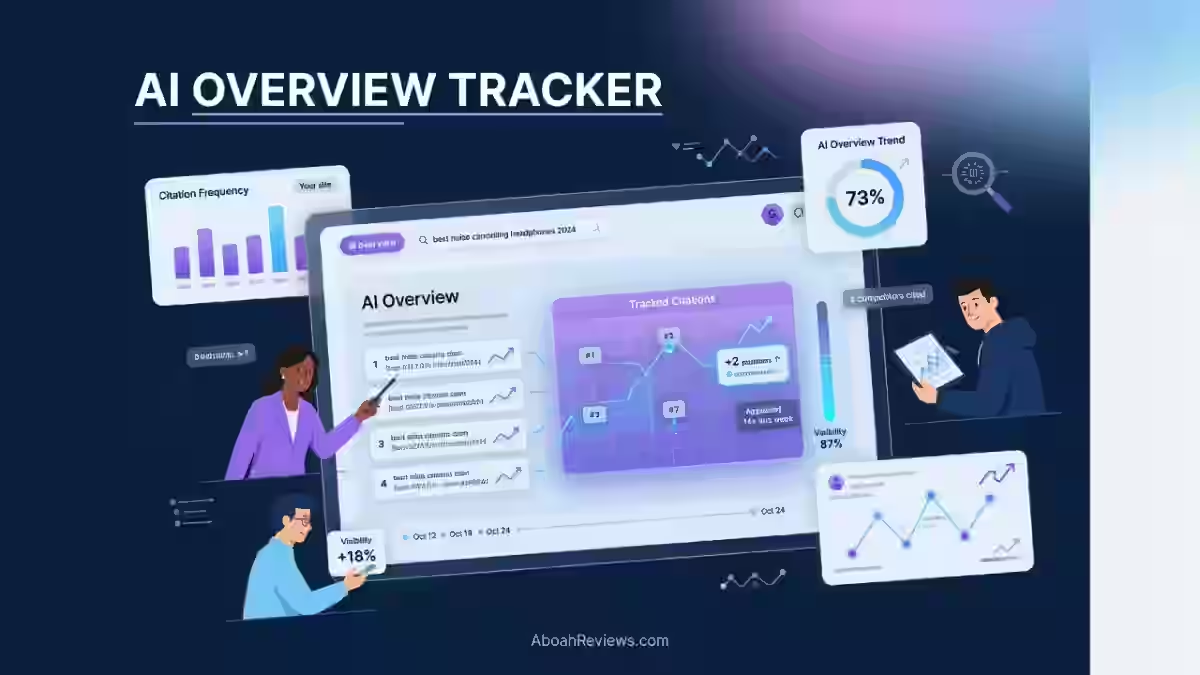
TL;DR: This guide reviews and ranks 13 of the best Google AI Overview checking tools in 2026 for SEOs, content marketers, agencies, and brands. Traditional rank tracking no longer tells the complete story. You need tools that monitor AI Overview appearances, cited URLs, brand visibility, and competitor presence. The right tool depends on your team size, budget and how much AI search data you actually need.
Introduction
If you’ve been running SEO campaigns for a while, you know the old rhythm: check rankings, tweak metadata, wait for Google to notice. That worked well enough in 2022. But right now, in 2026, Google AI Overviews are sitting at the top of a significant chunk of searches, and they don’t care about your position 3 ranking the same way a blue link did.
Google’s AI Overviews now sit at the top of roughly a third of US searches, and they pull citations from a narrow set of sources. If your page gets cited, you get visibility before a single link is clicked. If it doesn’t, that traffic quietly goes to whoever Google chose to quote instead.
That’s exactly why the best Google AI overview checking tools have become something I now consider a non-negotiable part of any serious SEO workflow. Traditional rank trackers tell you where you sit in the blue links. They don’t tell you whether Google is summarising a competitor instead of you, which URLs are being cited in AI answers, or whether your brand is even mentioned in AI-generated results.
In this guide, I’ve reviewed 13 tools across their AI Overview detection, citation tracking, brand visibility, competitor monitoring, pricing, and traditional SEO integration. Some of these I’ve tested hands-on. For others, I’ve verified product documentation and cross-referenced multiple independent sources. I’ll tell you which is which as we go.
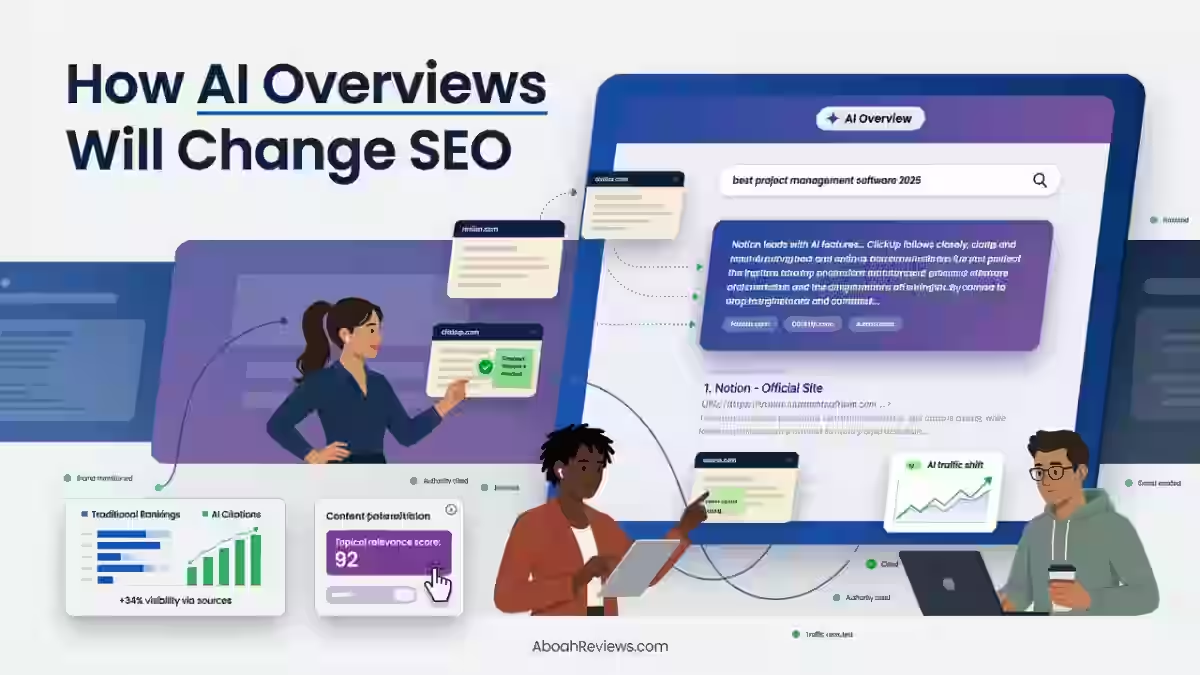
If you want a broader look at how AI search is reshaping SEO, my piece on how AI Overviews will change SEO covers the strategic picture. This guide is about the tools you need to measure it.
Best Google AI Overview Checking Tools at a Glance
Here’s a snapshot of all 13 tools before we get into the details. Pricing is verified against current documentation as of September 2026. Check vendor sites before purchasing, as this category is still moving fast.
| Tool | Best For | AI Overviews | Citations | AI Visibility | Traditional SEO | Starting Price |
|---|---|---|---|---|---|---|
| LLM Pulse | Best overall | Yes | Yes | Yes | No | €49/mo |
| Omnia | AI Overview tracking | Yes | Yes | Yes | No | €79/mo |
| Semrush | All-in-one SEO | Yes | Yes | Yes | Yes | $139.95/mo |
| SE Ranking | Agencies | Yes | Yes | Yes | Yes | $129/mo + $89 AI add-on |
| Ahrefs | SEO data + citations | Yes | Yes | Yes | Yes | $129/mo + Brand Radar from $199/mo |
| Ziptie | AI visibility monitoring | Yes | Yes | Yes | No | $69/mo |
| Profound | Enterprise AI intelligence | Yes | Yes | Yes | No | $399/mo (Growth) |
| BrightEdge | Enterprise SEO | Yes | Yes | Yes | Yes | Contact for details |
| Otterly AI | Dedicated AI monitoring | Yes | Yes | Yes | No | $29/mo |
| Peec AI | AI visibility analysis | Yes | Yes | Yes | No | $95+/month |
| seoClarity | Enterprise SEO + AI | Yes | Yes | Yes | Yes | $2,500/mo+ |
| Rankscale AI | AI visibility tracking | Yes | Yes | Yes | No | $99/mo (Pro) |
| Keyword.com | Traditional rank tracking | Partial | Partial | Yes | Yes | $9.80+/mo |
Always confirm pricing with vendor before purchasing.
What Are the Best Google AI Overview Checking Tools?
Not all of these tools do the same thing. Some are built specifically to track Google AI Overviews and nothing else. Others combine AI search monitoring with traditional SEO data inside a platform you might already be paying for.
A few are enterprise-only tools that cost more per month than most agencies charge in retainer fees.
The right tool is the one that fits your actual workflow, not the one with the most features on a comparison page. Let me walk through each of them.
1. LLM Pulse — Best Overall Google AI Overview Checker
LLM Pulse is an AI search visibility tracker designed to monitor brand mentions and performance across AI chatbots and search platforms. It helps users understand how their brand appears in AI-generated responses from platforms such as ChatGPT, Google AI Mode, Perplexity, and Google AI Overviews.
The company started in 2025, launched in July 2025, and is bootstrapped and profitable since day one. That matters. A product built for actual usage tends to be more practical than one built to attract VC funding.
Google AI Overview Tracking
Every LLM Pulse plan tracks ChatGPT, Perplexity, Gemini, Google AI Mode, and AI Overviews. There’s a 14-day free trial. The tool includes prompt tracking capabilities, allowing users to monitor prompts over time and organize them with tags for analysis. Tracking frequency defaults to weekly, with daily tracking available as an add-on on any tier.
Citation and Brand Monitoring
Visibility scores measure brand presence across AI models, while citation analysis examines how AI systems source and reference brand information. Sentiment analysis evaluates whether AI responses portray brands positively, neutrally, or negatively.
AI Search Coverage
LLM Pulse starts at €49/month for the Starter plan, which includes Google AI Mode and the other four standard AI models. The Growth plan at €99/month adds more prompts, competitors, and projects.
The Scale plan at €299/month adds higher limits and more projects, while white-label reporting is arranged separately for agencies and enterprises.
Competitor Tracking
Features include AI prompt suggestions based on user behavior, competitive landscape comparisons, and detailed response analysis with LLM answers. Competitor mentions and citation shares are available across all paid tiers.
Pricing
LLM Pulse starts at €49 per month for the Starter plan for 1 team member, with a free trial available. Growth costs €99 per month and Scale costs €299 per month. Starter includes 1 project and 40 tracked prompts.
LLM Pulse includes unlimited seats across all paid plans, which matters for agency teams sharing dashboards.
One important caveat: the REST API unlocks on the €299 Scale tier. If you specifically need the API and nothing else, that is a steep entry point.
Pros
- Broad multi-model AI coverage from the cheapest plan
- Unlimited seats on all tiers
- 14-day free trial with no credit card required on most sources (verify current trial terms)
- Sentiment analysis included
Cons
- No traditional SEO data (backlinks, organic rankings, keyword research)
- Weekly refresh by default; daily tracking costs extra
- API access requires the €299/month plan
- Prompt limits cap relatively quickly on lower tiers
Best For: Marketing teams, SEO professionals, and agencies that want comprehensive AI visibility tracking across all major AI models at an accessible price.
Verdict: The best starting point for most teams moving into AI search monitoring. The multi-model coverage and unlimited seats make it the strongest value proposition in the category for teams that don’t need traditional SEO data in the same platform.
2. Omnia — Best for Google AI Overview Rank Tracking
Omnia is an AI visibility platform built for SEO and product teams who need to understand not just if they’re visible in Google AI Mode, but why competitors are cited and what actions will shift AI answers in their favor.
What sets Omnia apart from most monitoring tools is what happens after the data arrives. Omnia monitors your AI search visibility by tracking inclusion, mentions, citations, and answer share. Then, it turns those gaps into content recommendations you can act on.
Unlike passive monitoring tools that show you charts and leave execution entirely to your team, Omnia tells you exactly what content to create, how to structure it, and where to publish it.
Google AI Overview Tracking
Per Omnia’s site, it mimics real user behavior to run prompts on a 24-hour schedule across major AI engines, analyzes citation data to identify why AI favors one brand over another, and generates a weekly action plan prioritizing the highest-impact work. Default engines: ChatGPT, Google AI Overviews, Google AI Mode, and Perplexity. Claude, Microsoft Copilot, and Gemini are enabled on request.
Citation and Visibility Analysis
Omnia is the only platform that combines comprehensive AI engine tracking (ChatGPT, Google AI Overviews, Google AI Mode, Perplexity) with an agentic layer that turns monitoring data into prioritized actions. This dual capability of tracking plus execution sets it apart from competitors that only offer dashboards.
Competitor Tracking
Omnia ships an MCP server you add to Claude, ChatGPT, or Cursor in about a minute. Once connected, you can ask your AI assistant to pull your share of voice, analyze citations, or generate recommendations using your live Omnia data. It removes the need to switch between the dashboard and your AI tools.
Pricing
Per Omnia’s site: Growth €79/month or €63/month (annual); Pro €279/month or €223/month (annual); Enterprise from €499/month or €399/month (annual).
Omnia offers a 14-day free trial on the Growth plan. No credit card required.
One thing to note: Omnia is built primarily for teams managing one brand. If you’re an agency managing 10 client accounts, the project limits and pricing structure need careful evaluation.
Pros
- Daily tracking with real browser simulation
- Action-oriented recommendations, not just dashboards
- MCP server integration for AI workflow users
- 14-day free trial, no credit card required
Cons
- Primarily single-brand focused; not ideal for multi-client agencies
- No traditional SEO features (backlinks, rankings)
- Pricing in EUR may require conversion math for non-European billing teams
Best For: In-house marketing and growth teams that want AI visibility tracking tied directly to content action plans.
Verdict: The strongest dedicated AI Overview platform for teams that want to move from “we know there’s a gap” to “here’s what to publish next.” If your primary question is why competitors get cited and how to fix that, Omnia answers it more directly than most tools on this list.
3. Semrush — Best All-in-One SEO Platform
In October 2025, Semrush launched Semrush One, which merges the classic SEO toolkit with the AI Visibility toolkit. You can measure and grow visibility in traditional search and in AI answers (Google AI Overviews, ChatGPT, Gemini, Perplexity).
Semrush now sells its plans as SEO, Starter, Pro+, and Advanced. Every Semrush tier now bundles AI search visibility tracking directly into the price. That’s a meaningful change from the old model where AI features required expensive add-ons.
Traditional SEO + AI in One Place
The platform is organized into toolkits: Traffic and Market, SEO, Local, Content, AI Visibility, Social, and Advertising. That makes Semrush one of the few platforms in 2026 that combines deep SEO data with systematic AI visibility tracking in a single subscription.
Semrush is better if you want deeper analysis of how AI platforms portray your brand: its AI visibility tools include brand perception and sentiment analysis.
Keyword Research and Position Tracking
Semrush remains one of the most comprehensive keyword research tools available. Semrush holds a 3.7 billion US keyword database, the largest US-specific database of the two major players. Position Tracking is built into all plans and goes down to city level for local SEO.
Reporting
Rich integrations with GA, GSC, Google Ads, Sheets, Looker Studio, GBP, Gmail, and API (on higher plans) support centralized reporting and automation.
Pricing
Semrush restructured its plans in 2026 into SEO, Starter, Pro+, and Advanced, starting at $117.33 a month billed annually, with AI search visibility features bundled into every tier.
The entry-level plan is $139.95/month billed monthly.
Pros
- AI visibility bundled into every plan tier in 2026
- Largest all-in-one SEO dataset available to most mid-market teams
- Integrated keyword research, backlinks, site audits, and AI tracking
- GA, GSC, and Looker Studio native integrations
Cons
- 45+ tools and multiple toolkits can feel overwhelming at first; it takes time to learn where to start and which modules matter for your role.
- For pure link-building and content discovery, Ahrefs is often preferred; Semrush leads on breadth and integration.
- Higher cost than single-purpose AI tracking tools
Best For: SEO and content teams who want AI Overview monitoring inside the same platform they use for keyword research, technical audits, and competitive analysis.
Verdict: If you’re already on Semrush, the AI visibility features bundled into the 2026 plans remove the need for a separate AI checker for most use cases. If you’re evaluating from scratch and need both traditional and AI search measurement, this is the platform that covers the widest ground.
4. SE Ranking — Best for Agencies and Consultants
SE Ranking is a strong mid-market option. SE Ranking covers five AI platforms daily, and AWR goes deep on Google AI Overviews specifically.
SE Ranking’s AI Results Tracker (AI Overviews, AI Mode, Perplexity, ChatGPT) is part of an AI Search add-on at $89/mo ($71.20/mo billed annually) layered onto a Core or Growth base plan (from $129/mo, or $103.20/mo annually). That’s an important number: the headline price doesn’t include AI tracking.
Agency and Client Reporting
SE Ranking is one of the most popular tools among agencies managing multiple clients because of its white-label reporting, project-based structure, and per-user pricing. You can set up separate projects per client and control what each client can see.
Brand Mentions vs. Citations
The platform distinguishes between brand mentions (your brand name appearing in the AI response) and citations (your URL being linked or referenced as a source). Both are tracked at the keyword level across daily snapshots.
Competitor Tracking
Competitors can be tracked alongside your own brand visibility, with share-of-voice style comparisons showing how your presence compares across AI results.
Pricing
The AI Search add-on at $89/month is on top of a base plan starting at $129/month. Budget approximately $218/month to get full AI tracking plus traditional SEO at the entry level.
Pros
- White-label reporting included
- Project-based structure works well for multi-client agencies
- Daily AI tracking across 5 platforms
- Traditional SEO included (rankings, audits, backlinks)
Cons
- AI features are a paid add-on, not bundled into the base plan
- Combined cost ($218+/month) higher than standalone AI tools for smaller teams
- Reporting customization takes time to set up correctly
Best For: Agencies managing multiple client accounts who need both AI search tracking and traditional SEO in one tool with white-label reporting.
Verdict: The strongest pick for agency workflows, provided you budget for the AI add-on. The project structure and white-label features make it genuinely useful for consultant teams billing multiple clients.
5. Ahrefs — Best for SEO Data and Citation Analysis
Ahrefs added its own AI prompt tracking through a separate tool called Brand Radar. Ahrefs has an advantage in platform coverage, however, tracking visibility across ChatGPT, Google AI Overviews, Gemini, Perplexity, Grok, and Copilot.
The key distinction: AI visibility is a separate product at Ahrefs. Ahrefs kept its Lite, Standard, and Advanced structure, starting at $108 a month, and sells AI prompt tracking as a separate Brand Radar add-on starting at $199 a month.
Organic Search Data and Backlink Depth
Where Ahrefs shines is organic data. Semrush vs Ahrefs is breadth versus depth. Semrush is an all-in-one marketing suite; Ahrefs is a link-and-research specialist with the larger referring-domain index.
Ahrefs live in backlink data daily with the freshest link discovery, updating every 15 minutes vs Semrush’s 2-4 weeks. If backlinks are a core part of your workflow, this gap matters.
Citation and Content Analysis
Ahrefs is particularly strong for understanding which pages earn citations from AI systems when combined with their Brand Radar data. You can cross-reference which content assets perform well in organic search with which ones appear in AI answers, which is a powerful workflow for prioritising content investment.
Pricing
Ahrefs ($129–$449/mo) wins on backlink data freshness and pure link-building workflows. Add Brand Radar at $199/month for full AI search monitoring.
Pros
- Best backlink index freshness in the market (15-minute updates)
- Wide AI platform coverage through Brand Radar (6 platforms including Grok and Copilot)
- Ahrefs lets you track an unlimited number of verified domains and offers unlimited reporting on its more expensive plans.
- Clean, fast interface
Cons
- AI visibility requires a separate $199/month add-on
- No PPC or social media data
- No free trial
Best For: SEOs whose primary work involves link building and competitor research, who also want AI search visibility data without switching platforms.
Verdict: The right pick if SEO research is your core workflow and you need AI visibility as a secondary data layer. If your job is 80% link building and competitor backlink forensics, pick Ahrefs.
6. Ziptie — Best for AI Search Visibility Monitoring
Built by the Onely technical SEO team, Ziptie ($69–$159/month) captures results with real browsers rather than APIs, and its content optimization module produces page-specific improvement briefs, the clearest bridge from “monitoring” to “what do I change on this page.”
ZipTie tracks 3 platforms with real user behavior simulation. That narrower focus on real browser rendering (rather than API calls) means the data reflects what actual users see, not what an API scrape returns.
Citation Monitoring
Ziptie surfaces which URLs are cited in AI Overviews, along with historical citation changes over time. For technical SEOs who want to understand rendering and crawlability alongside AI visibility, the Onely background of the team shows through in the depth of technical detail.
Keyword and Query Tracking
Ziptie and LLM Pulse both offer robust APIs for custom integrations. The API access means Ziptie works well for teams that want to pull AI visibility data into custom dashboards or BI tools.
Pricing
Basic monitoring starts at $20–$30/month for Rankscale AI, Keyword.com, and ZipTie at entry level. Full feature tiers from Ziptie run $69–$159/month based on public documentation.
Pros
- Real browser simulation for accurate AI response capture
- Content optimization briefs included (not just monitoring)
- API available for custom integrations
- Technical SEO pedigree from the Onely team
Cons
- Covers only 3 AI platforms (narrower than most rivals)
- No traditional organic rank tracking
- Smaller prompt volume limits compared to enterprise tools
Best For: Hands-on SEOs and agencies tracking Google AI Overviews alongside ChatGPT and Perplexity.
Verdict: The best pick when you want AI Overview data combined with practical content recommendations and technical SEO insight. Narrower platform coverage than LLM Pulse or Omnia, but the real browser approach produces more reliable data.
7. Profound — Best for Enterprise AI Search Intelligence
Profound raised $58.5 million in total funding and is positioned as an enterprise-grade GEO platform for Fortune 500 brands.
Profound is deeper: source-level citation intelligence, SOC 2 compliance, and enterprise scale. The SOC 2 compliance alone makes it the default choice for enterprise procurement teams with security review requirements.
Brand Visibility and Citation Tracking
Profound tracks AI answer presence, cited sources, brand mention sentiment, and competitor visibility across multiple AI platforms at scale. It’s designed for teams tracking hundreds or thousands of queries, not dozens.
Profound tracks up to 10 platforms on the Enterprise plan.
Enterprise Reporting
Profound includes audit trails, compliance documentation, and structured reporting suitable for enterprise stakeholders who need to report AI search visibility alongside traditional SEO metrics.
Pricing
Growth plan starts at $399/month with 3 AI engines; enterprise tier at $2,000–$5,000+/month covers 10+ AI platforms.
Profound now starts at $99/month for 50 prompts on ChatGPT. Its $399 Growth plan covers 100 prompts across ChatGPT, Perplexity, and Google AI Overviews, while Enterprise pricing is custom.
Pros
- SOC 2 compliant, suitable for enterprise security review
- Source-level citation intelligence (not just presence detection)
- Highest platform coverage at enterprise tier (10+ AI engines)
- Funded and stable for long-term enterprise contracts
Cons
- Expensive relative to SMB and agency budgets
- Annual-only billing on some tiers
- Overkill for teams tracking fewer than 100 queries per month
Best For: Enterprise brands and large agencies that need AI visibility intelligence at scale, with compliance documentation and deep competitive intelligence.
Verdict: Choose Profound for enterprise programs. If you’re a mid-market team or smaller agency, the pricing pushes you toward tools like LLM Pulse, Omnia, or Otterly AI instead.
8. BrightEdge — Best for Enterprise SEO and AI Search
BrightEdge has invested heavily in AEO through its AI Catalyst product, which monitors AI Overview appearances and provides recommendations for improving AI citation rates.
Core BrightEdge capabilities include keyword research and market intelligence, competitive analysis and share-of-voice tracking, real-time trend monitoring, large-scale technical site auditing, on-page SEO recommendations, AI-assisted content creation and optimization, local and mobile SEO, AI Catalyst for AI search visibility, and extensive reporting and dashboards.
Traditional SEO Integration
BrightEdge is one of the oldest enterprise SEO platforms and integrates AI visibility alongside a deep traditional SEO feature set.
The platform also offers integrations with analytics tools like Google Analytics, Adobe Analytics, and Google Search Console plus a REST-based Connect API.
Enterprise Pricing
Enterprise SEO platforms typically range from $3,000 to $15,000+ per month depending on the number of keywords tracked, domains monitored, and seats required. BrightEdge, Conductor, and seoClarity use custom enterprise pricing.
BrightEdge sells enterprise-first with no public pricing. There’s no self-serve option. You need to go through a sales process.
Pros
- AI Catalyst for AI Overview monitoring built into the enterprise platform
- Deep traditional SEO data at enterprise scale
- Google Analytics, Adobe Analytics, and GSC integrations
- Competitive share-of-voice reporting
Cons
- No public pricing; requires sales engagement to get a number
- Annual contracts are standard; limited flexibility
- Overkill and cost-prohibitive for teams under enterprise scale
Best For: Large enterprise SEO teams with complex web properties, multiple stakeholders, and existing BrightEdge contracts or procurement processes already in motion.
Verdict: BrightEdge and seoClarity have the most mature AI visibility features among enterprise platforms. If you’re already inside the BrightEdge ecosystem, AI Catalyst is a logical extension. If you’re not, the cost and sales-led process creates high friction.
9. Otterly AI — Best Dedicated AI Search Monitoring Tool
Otterly AI is a lightweight, budget-friendly tool that tracks your brand’s presence in AI Overviews, ChatGPT, and Perplexity without the complexity of a full SEO suite. At $29/mo, Otterly AI is the most accessible entry point for teams that want basic AI Overview monitoring without committing to an enterprise platform.
Citation and Brand Mentions
ChatGPT and Perplexity monitoring are included. Otterly has a simple dashboard with trend charts and email alerts for citation changes.
Otterly’s 25-factor GEO audit per prompt gives real diagnostic value, not just mention counts. That’s more depth than the entry price suggests.
Competitor Tracking
Otterly includes competitor monitoring at the prompt level, so you can compare your citation rate against named competitors for each tracked query.
Historical Data
Trend charts track visibility over time. Email alerts notify you when citation status changes, which matters if a competitor starts appearing where you previously did.
Pricing
Lite $29, Standard $189, Premium $489 monthly; $25, $160, $422 annual; Enterprise from $1,000.
The limitation: prompts are entered one at a time, which doesn’t scale to hundreds of tracked queries.
Pros
- Cheapest serious AI visibility tool in the market ($29/month)
- 25-factor GEO audit per prompt
- Email alerts for citation changes
- Simple, low-learning-curve dashboard
Cons
- Limited keyword capacity on lower plans. No sentiment analysis or deep competitive intelligence.
- Manual prompt entry doesn’t scale well for large query volumes
- Platform coverage narrower than dedicated enterprise tools
Best For: Small businesses and freelancers starting their first AI visibility program.
Otterly AI Verdict: The best first tool for anyone just getting started with AI Overview monitoring. Don’t expect it to replace a full SEO platform. Do expect it to tell you clearly whether you’re getting cited across AI search. At $29/month, the risk of trying it is low.
10. Peec AI — Best for AI Search Visibility Analysis
Peec AI tracks 6 platforms. Peec AI specialises in multi-market, multi-language tracking. If your brand operates across multiple countries and languages, that’s a material advantage over tools with narrower geographic coverage.
Visibility Measurement
Peec AI covers the analytics most brands actually use at roughly a fifth of the price of Profound. The platform focuses on brand visibility metrics, competitor comparisons, citation analysis, and query tracking across AI search engines.
Pricing
Peec AI visibility tracking pricing begins at $95 per month ($80 per month billed annually) for the Starter plan, scaling up to $245 per month for the Pro plan and $495 per month for the Advanced plan. All tiers include unlimited team seats and daily tracking with varying limits on prompts and projects.
Pros
- Multi-language and multi-market tracking
- 6-platform AI search coverage
- Strong analytics depth relative to price
- Good fit for international brands
Cons
- No public pricing; requires sales contact
- Annual billing only on most tiers
- Less transparent than tools with published pricing pages
Best For: Mid-market brands with international audiences tracking AI visibility across multiple languages and markets.
Verdict: Peec AI covers the analytics most brands actually use at roughly a fifth of the price of Profound. Choose Peec for everything below enterprise scale. The lack of public pricing is frustrating, but the multi-language coverage fills a real gap that most other tools in this category don’t address.
11. seoClarity — Best for Enterprise SEO and AI Visibility
seoClarity has a strong focus on AI search with Clarity ArcAI and the Sia assistant, helping brands understand and influence visibility in AI Overviews and conversational AI results.
seoClarity offers a free trial, tiered pricing, and a hybrid motion targeting agencies and mid-market alongside enterprise, with Clarity ArcAI for AI search tracking. That makes it slightly more accessible than BrightEdge, which is entirely sales-led.
Enterprise Rank Tracking
seoClarity provides a keyword index of over 32 billion terms across 90+ countries with unlimited rank tracking and AI content optimization in 16 languages.
Content Optimization and Reporting
Key features include daily rank tracking, Research Grid keyword database, Content Fusion AI content optimization, enterprise technical site audits, ClarityAutomate no-code SEO execution and split testing, Clarity ArcAI for AI search visibility, and a suite of SEO data APIs.
Pricing
Enterprise suites range from $2,500–$4,500/month. ArcAI is the dedicated AI tracking add-on that sits on top of the core platform. Plans start at $2,500/month for the Research and Content tier, with the ArcAI add-on available at custom pricing.
Pros
- Free trial available (unlike BrightEdge)
- 32-billion-term keyword index across 90+ countries
- No-code SEO execution tools (ClarityAutomate)
- Unlimited rank tracking on enterprise plans
Cons
- AI tracking is an add-on, not included in base pricing
- Minimum $2,500/month for base platform
- Complex onboarding for teams new to enterprise SEO platforms
Best For: Enterprise SEO teams at large organizations managing thousands of URLs across multiple domains or countries who need AI visibility alongside deep traditional SEO data.
seoClarity Verdict: seoClarity’s Sia engine surfaces AI-related insights, while the platform leads in AI visibility tracking for enterprises alongside BrightEdge, offering monitoring of AI Overview appearances and generative search citations. Strong platform if you’re already at enterprise scale. Too heavy and expensive for everyone else.
12. Rankscale AI — Best for AI Visibility Tracking
Rankscale has broad platform coverage (ChatGPT, Perplexity, AI Overviews, Copilot, with Gemini and AI Mode as add-ons). Rankscale uses a credit-based pricing model that gives users flexibility in how they allocate monitoring activity.
Rankscale tracks 4 engines on core plans, with Gemini and AI Mode available as additional coverage.
Brand Mentions and Citation Tracking
Rankscale tracks brand mentions and domain citations across tracked AI platforms, with historical visibility trends and competitor comparisons built into the reporting dashboard.
Pricing
Essentials “from $20/mo” with 0 credits; Pro $99/mo; Growth $385; Enterprise $780. Note: the Essentials plan at $20/month includes no credits, which means you can’t actually track anything on that plan. The functional entry point is the $99/month Pro plan.
Pros
- Credit-based model gives flexibility in how you allocate monitoring
- Lower entry price than most dedicated AI visibility tools
- Solid basic AI tracking across 4 platforms
Cons
- The sticker trap is Rankscale’s $20 plan with no credits. Functional plan starts at $99/month
- Narrower platform coverage than LLM Pulse or Omnia
- Less competitive intelligence depth than Profound or seoClarity
Best For: Small teams and individual SEOs who want a flexible credit-based AI monitoring tool without committing to a monthly prompt volume they might not use.
Verdict: A solid choice for teams that want AI visibility monitoring without the rigidity of a fixed prompt-per-month plan. Be aware that the $20/month entry tier is effectively unusable. Budget for the $99/month Pro plan from the start.
13. Keyword.com — Best for Traditional Rank Tracking With AI Search Capabilities
Keyword.com is primarily a keyword rank tracker. It handles Google rank tracking across desktop and mobile, local and national searches, with clean reporting and competitive tracking built in.
AI Search Capabilities
Keyword.com uses a credit-based model that may suit teams with check-limited rather than prompt-limited requirements. AI Overview detection is available but not as deeply developed as dedicated AI tracking platforms.
Competitor Tracking and Reporting
Keyword.com has strong competitor tracking for traditional organic rankings and a clean, agency-friendly reporting interface. It handles local and national tracking well and supports multiple locations per project.
Pricing
Keyword.com offers three main tiers: the Search Visibility plan at $4 per month for 50 keywords focused on Google SERP tracking, the AI Visibility plan at $9.80 per month for 20 credits tracking AI engines, and the comprehensive 360° Visibility plan at $33 per month for 1,000 keywords and 15 credits.
Additionally, a tailored Custom Plan starts at $490 per month for unlimited keywords and scaling features.
Pros
- Clean traditional rank tracking as the primary feature
- Local and national tracking on the same plan
- Agency-friendly reporting
- AI Overview capability available via credit-based model
Cons
- AI search monitoring is not a core feature; limited depth compared to dedicated tools
- Credit-based AI tracking doesn’t suit teams with continuous monitoring needs
- Not designed primarily for AI search visibility
Best For: Agencies and freelancers who primarily track traditional Google rankings and want occasional AI Overview checking without committing to a dedicated AI tracking platform.
Verdict: The right tool if organic rank tracking is your primary workflow and you need AI Overview checking as an occasional supplement. Not the right choice if AI search visibility is a core reporting requirement.
How I Tested the Best Google AI Overview Checking Tools
Before I tell you which tools to buy, here’s how I evaluated them. Some of these tools I tested hands-on.
For others, I cross-referenced multiple independent third-party sources, product documentation, and user reviews from G2, Capterra, and community discussions.
AI Overview Detection
The first thing I looked at was whether a tool actually detects when a Google AI Overview appears for a given query. Some tools track query-level AI Overview presence accurately and consistently.
Others report presence or absence inconsistently depending on how they query the SERP.
The distinction between API-based querying and real browser simulation matters here.
The critical differentiator most buyers miss: whether a tool tracks real user-facing AI responses or just queries APIs, a distinction that determines whether your visibility data reflects what customers actually see.
Citation Tracking
Citation tracking measures which URLs and domains are referenced inside an AI Overview answer. Not all tools track citation position, domain authority of cited sources, or historical citation changes.
I prioritised tools that distinguish between a brand mention (your name appears in the text) and a citation (your URL is directly linked or sourced).
Brand and Domain Visibility
I looked for tools that track share of voice across AI search results: how often your domain appears across all tracked queries compared to competitors. This is the AI-search equivalent of SERP share of voice in traditional SEO.
Competitor Monitoring
I tested how tools handle competitor comparisons. The best tools let you benchmark your citation rate, mention frequency, and AI answer inclusion against specific named competitors, not just your own brand.
Google AI Overview and AI Mode Coverage
One thing I was strict about: Google AI Overviews and Google AI Mode are not the same thing. AI Overviews appear on standard Google SERPs in response to informational queries.
AI Mode is a separate conversational experience. Tools that conflate these two give you misleading data. If you want to understand more about how Google’s generative results work, see my guide on generative engine automation.
Keyword, Location, Language and Device Coverage
I evaluated how many queries each tool can track, which countries and languages are supported, and whether desktop and mobile results are tracked separately. Multi-language support is often an afterthought on lower-tier plans.
Historical Data and Reporting
Trend data matters more than snapshots. I looked for tools that store historical AI visibility and citation data, support scheduled exports, and offer white-label reporting for agencies.
Traditional SEO Integration
Most dedicated AI tools do not include traditional SEO data. That’s fine if you have a separate rank tracker. It becomes a problem when teams want a single view of both traditional and AI search performance without paying for two separate platforms.
Pricing and Value
Dedicated AI visibility platforms with content workflows run $99 to $599/month, while pay-as-you-go checkers start around $0.03 per check. I compared tools at comparable usage levels, not just headline pricing. A $20/month plan with no functional credits is not actually a $20/month plan.
How I Scored the Tools
Here’s the weighting I used to produce my rankings. This isn’t arbitrary. It reflects what matters most in a practical SEO workflow where AI search monitoring is the primary goal.
| Evaluation Area | Weight |
|---|---|
| AI Overview tracking | 20% |
| Citation tracking | 15% |
| AI visibility and mentions | 15% |
| Competitor monitoring | 10% |
| Keyword/location coverage | 10% |
| Historical data and reporting | 10% |
| Traditional SEO integration | 10% |
| Ease of use | 5% |
| Pricing and value | 5% |
AI Overview tracking carries the highest weight because it’s the core function these tools exist to perform. I docked points for tools that can’t distinguish between a brand mention and a URL citation, tools with no historical data, and tools where AI tracking was clearly an afterthought on top of a traditional SEO platform.
Google AI Overview Checker vs. Traditional Rank Tracker
This distinction trips up a lot of teams when they’re shopping for tools. Let me make it clean.
What Traditional Rank Trackers Measure
- Keyword positions in organic Google results (positions 1–100)
- SERP feature presence (featured snippets, People Also Ask, local packs)
- Desktop and mobile ranking differences
- Local rankings by city, region, or postcode
- Historical ranking trends and keyword movements
What Google AI Overview Checkers Measure
- Whether an AI Overview appears for a given query
- Which URLs are cited inside that AI Overview
- Whether your brand is mentioned in the AI response
- Your domain’s share of citations across tracked queries
- Competitor citation frequency and visibility trends
- Changes in AI answer composition over time
Why You May Need Both
Traditional SEO tools track Google rankings, but only 14% of AI Mode citations come from top-10 Google results. AI visibility is a different metric that requires different tracking.
That number is important. Ranking in position 1 doesn’t guarantee you’ll be cited in an AI Overview. The correlation between traditional rankings and AI citations is weaker than most SEOs assume. AI Overview citations do not simply mirror the classic rankings, and the relationship is worth understanding.
If you’re curious about how AI ranking tools compare more broadly, the AI Overview rank tracking tools guide on the site covers this in more depth.
What Should a Google AI Overview Checking Tool Track?
A good tool should ideally track the following metrics. Here’s what each one means and why it matters:
- AI Overview trigger rate — What percentage of your tracked queries produce an AI Overview at all? Not every query triggers one.
- Citation rate — How often is your domain cited when an AI Overview does appear?
- Citation position — Where in the AI response does your citation appear? First-cited sources typically receive more attention.
- Brand mention rate — Is your brand name mentioned in the AI response, even if your URL isn’t directly cited?
- Domain visibility — What’s your overall presence across all AI Overview results for tracked queries?
- Competitor citations — How often are named competitors cited instead of you?
- AI share of voice — Your citations as a percentage of total citations across all tracked queries.
- Historical visibility changes — How has your citation rate changed over time, especially after content updates or Google model changes?
- Keyword-level results — Which specific queries produce AI Overviews where you appear vs. where you’re absent?
- Location and device differences — Do results differ between desktop and mobile, or between countries?
How to Choose the Best Google AI Overview Checking Tool
Choose LLM Pulse If You Want a Dedicated AI Visibility Platform
LLM Pulse covers the broadest AI platform range at the most transparent pricing of any self-serve tool in the category.
If you are looking for a single platform to monitor Google AI Mode alongside ChatGPT, Perplexity, and Gemini without enterprise-level pricing, LLM Pulse is the strongest option available.
Start here if you’re new to AI search monitoring and want to cover multiple platforms without overcomplicating things.
Choose Omnia If Google AI Overview Tracking Is Your Priority
Omnia is the best fit when you want to know not just whether you’re cited, but why competitors are cited instead of you.
Omnia is a strong fit for marketing and growth teams that want AI visibility tracking with a clear path to improving it, not just a dashboard, but a system that tells you what to do next.
Choose Semrush If You Want AI Tracking Plus Full SEO
If you want Google AI Overview monitoring sitting inside the same platform where you do keyword research, technical audits, and competitive analysis, Semrush is the pick.
In 2026, having AI Visibility (Google AI Overviews, ChatGPT, Gemini, Perplexity) in the same platform as classic SEO is a clear differentiator for teams focused on “every search.”
Choose SE Ranking If You Manage Multiple Clients
The project-based structure, white-label reporting, and daily AI tracking make SE Ranking the strongest agency tool on this list. Budget for the base plan plus AI add-on: approximately $218/month at the entry level.
Choose Ahrefs If SEO Research Is Your Priority
If your job is 80% link building and competitor backlink forensics, pick Ahrefs. Then add Brand Radar for AI visibility as a secondary data layer.
Choose Profound, BrightEdge or seoClarity for Enterprise Needs
BrightEdge, seoClarity, or AccuRanker handle scale for enterprises with thousands of keywords. Add Profound if you need SOC 2 compliance and source-level citation intelligence.
Choose Otterly AI, Ziptie, Peec AI or Rankscale AI for Dedicated AI Monitoring
If you want focused AI search monitoring without paying for a full SEO platform, these four tools cover different needs: Otterly AI for budget entry, Ziptie for technical depth and real browser capture, Peec AI for multi-language international tracking, and Rankscale AI for credit-based flexibility.
Choose Keyword.com If Traditional Rank Tracking Comes First
If keyword position tracking is your primary job and AI Overview checking is an occasional need, Keyword.com handles the traditional side well with AI capabilities added on a credit basis.
For a deeper look at options in the AI tracker category specifically, the best AI Overview rank tracking tools guide covers more options across pricing bands.
Best Google AI Overview Checking Tools by Use Case
| Use Case | Recommended Tool |
|---|---|
| Best overall | LLM Pulse |
| AI Overview-focused tracking | Omnia |
| All-in-one SEO | Semrush |
| SEO agencies | SE Ranking |
| SEO research | Ahrefs |
| Dedicated AI monitoring | Otterly AI |
| AI visibility (technical depth) | Ziptie |
| Enterprise AI intelligence | Profound |
| Enterprise SEO | BrightEdge |
| Enterprise SEO + AI | seoClarity |
| AI visibility analysis (multilingual) | Peec AI |
| AI visibility tracking (flexible credits) | Rankscale AI |
| Traditional rank tracking | Keyword.com |
Final Verdict: Which Google AI Overview Checking Tool Is Best?
The honest answer: there’s no single best tool for everyone. Here’s how to decide quickly.
Want dedicated AI Overview monitoring at the lowest cost? Start with Otterly AI at $29/month. You’ll understand the basics without overspending.
Want broad multi-model AI visibility at transparent pricing? LLM Pulse at €49/month is the strongest value proposition in the category for small to mid-size teams.
Want AI tracking plus traditional SEO in one platform? Semrush is the default choice, especially now that AI visibility is bundled into every 2026 plan.
Running an agency with multiple clients? SE Ranking handles the project structure, white-label reporting, and daily AI tracking that agency workflows need. Budget $218+/month for the full stack.
Need deep SEO research alongside AI search visibility? Ahrefs with Brand Radar covers both, with the freshest backlink data in the market.
At enterprise scale? Profound for AI-first intelligence, BrightEdge or seoClarity if you need AI tracking inside a full enterprise SEO platform.
On a tight budget and just getting started? Otterly AI at $29/month. Run it for 90 days, understand what the data tells you, and then decide whether you need to upgrade.
Final Buying Advice
- Want dedicated AI Overview monitoring? Choose a specialized platform like LLM Pulse or Omnia.
- Want AI search + traditional SEO? Choose a hybrid SEO platform like Semrush or SE Ranking.
- Need agency reporting? Prioritize project, user, and reporting limits. SE Ranking wins here.
- Need enterprise intelligence? Prioritize scale, integrations, and compliance. Profound and seoClarity are the shortlist.
- Only need traditional rankings with some AI capabilities? Choose a conventional rank tracker like Keyword.com with AI support as a credit add-on.
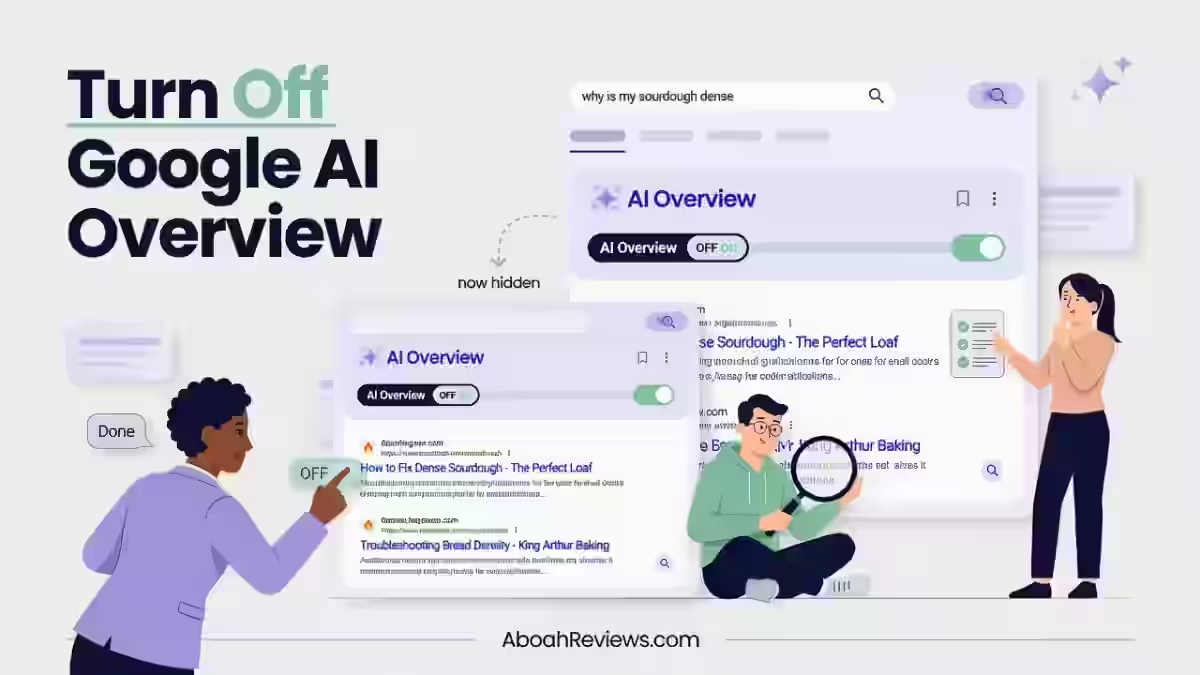
If you want to know whether you can opt out of AI search features entirely, the guide on how to turn off Google AI Overview is a useful context.
If you’re already using one of these tools, or have questions about how they compare in your specific setup, share them in the comments.
Frequently Asked Questions
What are the top 10 Google AI tools?
The most widely used AI tools related to Google include Google AI Overviews, Google AI Mode, Gemini, NotebookLM, Google Lens, Google Bard (now Gemini), Google Translate AI, Google Search Generative Experience, Google AI Studio, and YouTube AI summaries. These are distinct from AI Overview checking tools, which are third-party platforms used to monitor how brands appear inside AI-generated Google search results.
Are Google’s AI Overviews accurate?
Google AI Overviews are generally accurate for well-documented topics but are known to produce errors on niche, technical, or rapidly changing subjects. According to Google’s own guidelines, quality raters are instructed to evaluate AI-generated content against the same E-E-A-T standards applied to organic results. Independent analyses have documented factual errors in AI Overviews, particularly on medical and legal topics. Human verification remains necessary before acting on AI Overview content.
What are the 5 most popular AI tools right now?
As of 2026, the five most widely used AI tools globally are ChatGPT (OpenAI), Gemini (Google), Copilot (Microsoft), Claude (Anthropic), and Perplexity. Each has a different approach to AI search and content generation. For AI visibility monitoring purposes, the key question is which of these surfaces your brand and domain in their answers.
Which AI tracker is the best?
The best AI tracker depends on your use case. LLM Pulse is the best overall self-serve option for most teams, covering 5 AI platforms from €49/month with unlimited seats. Omnia is the strongest for action-oriented AI Overview tracking. Semrush is the best choice if you want AI tracking inside a full SEO platform. Profound is the strongest at enterprise scale.
Which AI tool is better than ChatGPT?
No single AI tool is objectively better than ChatGPT across all tasks. Claude (Anthropic) is generally preferred for long-document analysis and nuanced writing. Perplexity is preferred for real-time web research with citations. Gemini integrates more deeply with Google’s data and services. Each tool has genuine strengths in different workflows, and most professionals use more than one depending on the task.
What are the top 3 AI search engines right now?
The top three AI search platforms in terms of user volume in 2026 are Google AI Overviews (largest reach, integrated into standard Google Search), Perplexity AI (fastest-growing dedicated AI search engine), and Microsoft Copilot (integrated into Bing and Microsoft 365). ChatGPT Search is growing rapidly but remains behind these three in organic search volume.
Which AI does Elon Musk use?
Elon Musk founded xAI and built Grok, the AI assistant integrated into X (formerly Twitter). Grok uses xAI’s own large language models. Musk left OpenAI’s board in 2018 and has been publicly critical of ChatGPT and OpenAI since then. Grok is positioned as an alternative to ChatGPT and is available to X Premium subscribers.

- 13 Best WordPress Autoblogging Plugins I Tested & Ranked for 2026 - September 13, 2026
- 13 Best Google AI Overview Checking Tools in 2026 (Tested & Ranked) - September 9, 2026
- 10 Best Google AI Overview Trackers in 2026 - September 8, 2026