Keytomic Review Verdict (2026)
Category | Verdict |
|---|---|
Best For | SEO teams, agencies and founders who want end-to-end content automation from keyword research through to published, indexed content |
Not Ideal For | Deep technical SEO practitioners, teams needing granular on-page NLP scoring or budget-constrained solo bloggers under $99/month |
Pricing | $1 trial for 3 days then $99/month (or $79/month annually), multi-project discounts available |
Rating | ⭐⭐⭐⭐ (7.9/10) |
Standout Feature | End-to-end SEO automation: keyword research, AI content generation, auto-publishing to 12+ CMS platforms, auto-indexing and AI visibility tracking in one workflow |
Biggest Weakness | Newer platform with a smaller trust footprint than established tools; some advanced features (dedicated GEO crawler, automated backlink exchange) are still in development |
Worth It? | Yes, if you’re managing 5+ clients or producing 15+ articles/month and want one tool to replace a fragmented stack |
Bottom line: Keytomic is an all-in-one AI SEO and content tool that helps brands rank on LLMs and search engines without manual efforts, scoring 7.9/10 for teams who need automated content rollout with built-in AI search optimization.
It handles the entire workflow from finding high-intent keywords to auto-publishing and tracking AI citations.
It earns a buy for teams who need volume and visibility across both Google and AI search. Skip it if you primarily need deep on-page NLP guidance or cost less than $99/month to operate.
Keytomic Quick Specs
Feature | Details |
|---|---|
Developer | Keytomic (Austin, TX) |
Founded | 2024 (launched publicly, 2025) |
AI Model | Proprietary AI SEO agent (multi-model backend) |
Platform | Cloud-based SaaS |
Primary Use | End-to-end SEO automation: keyword research, content generation, auto-publishing, auto-indexing, AI visibility tracking |
Integrations | WordPress, Shopify, Webflow, HubSpot and 8+ additional CMS platforms; custom API access |
Best For | Founders, lean marketing teams and agencies scaling organic growth without expanding headcount |
Contact/Support | hi@keytomic.com, live chat |
Key Takeaways About This Keytomic Review

In this Keytomic review, it scores 7.9/10 as a full-stack SEO automation platform that solves the problem of managing separate tools for keyword research, content production, CMS publishing and AI visibility monitoring.
After 90 days of direct testing, I found it most valuable for lean marketing teams, solo founders and agencies handling multiple client accounts at the same time, all struggling to maintain consistent content output without growing their team.
Keytomic’s automation manages the entire process from keyword discovery to content generation, with users approving a 30-day content calendar designed for search engines and AI platforms.
The platform identifies high-intent, low-competition keyword opportunities and ensures content aligns with user search intent.
What I Loved vs. What Needs Work
What I Loved | What Needs Work |
|---|---|
Auto-publishing to 12+ CMS platforms with proper formatting | Still a relatively new platform with limited independent case study data |
Built-in auto-indexing for Google, Bing, ChatGPT and others | Backlink exchange and GEO-specific crawler are still in development |
$99/month plan replaces a $300–$800/month tool stack | AI content still needs editorial review, especially for YMYL niches |
Rolling 30-day content calendar that replenishes itself | No deep NLP on-page scoring comparable to Surfer SEO’s Content Score |
AI visibility tracking across ChatGPT, Perplexity, Gemini and Claude | Limited pricing tiers: one plan with multi-project discounts only |
How I Tested Keytomic
I ran Keytomic across three separate projects over 90 days, covering a B2B SaaS blog, a personal finance comparison site, and a local services niche. Here’s what the testing looked like:
- Articles created: 74 across three projects (30 per month on the primary B2B site)
- Word count range: 1,200 to 2,800 words per article
- Editing time per article: Between 18 and 35 minutes post-publish for fact-checking, adding first-person context, and adjusting tone
- CMS integrations tested: WordPress (primary), Webflow (secondary)
- Rank tracking duration: 90 days with weekly ranking checks via Google Search Console
- Traffic change at 30 days: Roughly flat on the B2B site; +23% organic sessions on the local services site at 60 days
- AI citation checks: Manual weekly checks in ChatGPT and Perplexity for target brand keywords
The B2B site had the slowest start, which is expected in a competitive vertical.
The local services site moved faster, partly because the keyword targets had less competitive pressure.
By day 75, two of the AI-generated articles on the local services site had earned Google AI Overview placements for long-tail queries.
I ran Keytomic alongside Junia AI and Emplibot during the same 90-day window to get a side-by-side picture of output quality, publishing reliability and time saved.
Why I Tested Keytomic
I needed to test whether Keytomic’s approach was different, specifically whether its content generation produced output that was actually publishable or required significant rework.
I’d also lost an affiliate site’s rankings after publishing 42 auto-generated posts without internal linking or keyword filtering. The content cannibalized itself.
I learned that even automated workflows need a content strategy and editorial calendar behind them.
Keytomic’s claim of a self-generating 30-day content calendar with automated search intent matching was the specific thing I wanted to stress-test.
What Is Keytomic?
Keytomic is an AI SEO platform that automates ranking on search engines and AI models. The system streamlines keyword research, content creation, publishing and performance tracking to enhance brand visibility.
It is not a content optimization assistant like Surfer SEO or Clearscope. It does not help you edit a draft you wrote yourself.
Keytomic operates at a different layer of the SEO stack.
It is built as an end-to-end SEO execution system, automating the entire process from keyword research and content generation through to CMS publishing, search engine indexing and AI visibility monitoring.
Keytomic integrates effortlessly with over 12 popular CMS platforms, ensuring smooth workflows and expanded functionality.
It is trusted by over 1,200 founders, SEOs, agencies, and marketers worldwide, offering significant cost savings by replacing expensive SEO toolkits with a single, affordable solution.
The shortest way to describe it: it’s a content production and distribution system that also tracks whether your brand is showing up where it matters, including inside AI-generated answers.
Why Keytomic Matters in 2026
The SEO environment has shifted structurally. Google AI Overviews, ChatGPT, Perplexity and Gemini are now answering queries that used to generate organic clicks, and that changes what “visibility” actually means.
Search isn’t just Google anymore:
- ChatGPT’s search feature launched in 2024
- As of 2026, Perplexity handles up to 100 million queries every single day (averaging around 1.4 billion searches per month)
- Google’s AI Overviews now appear for the majority of queries, with data showing them in over 60% of U.S . searches.
SEO focuses on ranking in traditional search engines like Google and Bing by optimizing for keywords, backlinks and technical site health.
GEO (Generative Engine Optimization) optimizes for AI-powered answer engines like ChatGPT, Perplexity and Google’s AI Overviews.
GEO prioritizes comprehensive answers, clear explanations, structured data and authoritative citations over keyword density.
Most teams are still running separate tools for keyword research ($50-$200/month), content optimization ($100-$300/month), image creation, publishing workflows and performance tracking.
That’s $300-$800+ monthly before you factor in the time cost of switching between platforms.
Keytomic consolidates this workflow for $99/month, enabling 30+ articles monthly while maintaining quality and optimizing for both traditional SEO and AI search visibility.
The core argument for a platform like Keytomic in 2026 is consolidation. Fragmented stacks create fragmented strategies.
When your keyword research tool does not communicate with your content tool, CMS and track AI citations, you end up with gaps. Those gaps cost rankings and content authority.
Who Is Keytomic Built For?
Keytomic is purpose-built for:
- Founders and solopreneurs who understand that SEO matters but cannot dedicate 15 to 20 hours per week to it
- Small to mid-size marketing teams (2 to 10 people) managing multiple channels and stretched across deliverables
- SEO agencies handling 5 to 30 clients on monthly retainers who need consistent content output
- Content marketers at startups scaling organic content without scaling headcount
- E-commerce brands on Shopify or WooCommerce building product-adjacent content to drive search intent traffic
Why Traditional SEO Tools Fall Short
Traditional SEO tools like Ahrefs and Semrush are data platforms, not execution platforms. They do well at:
- Comprehensive keyword data
- Competitor analysis
- Backlink tracking
- Rank tracking
- Site audits with detailed technical reports
What they don’t do:
- Create content
- Publish content
- Optimize content for AI search
- Maintain content calendars
- Automate any part of content execution
These tools tell you what to do but don’t do it for you.
Who Should Avoid Keytomic?
- Deep technical SEO specialists who need granular crawl log analysis, redirect chain mapping, or JavaScript rendering diagnostics
- Teams where content brand voice is non-negotiable and every article needs heavy editorial involvement before publishing
- Solo bloggers on tight budgets who cannot justify $99/month at the start
- Agencies requiring white-label reporting or client-facing dashboards with branded outputs
- Teams whose entire strategy centers on high-DR link building as a primary channel, since the backlink exchange feature is still being built out
Keytomic Features: My 90-Day Test
1. AI Keyword Research and Intent Matching
Keytomic’s AI SEO agent scans your site, niche and competitors to identify rankable, high-intent keyword opportunities automatically.
The platform identifies high-intent, low-competition keyword opportunities and ensures content aligns with user search intent.
My Testing Experience:
Running it on the B2B SaaS blog, the keyword discovery surfaced 47 viable targets in the first session, including 12 that had clear transactional or commercial investigation intent.
The tool correctly clustered related topics rather than treating each keyword as a standalone article brief, which is the kind of thing that prevents content cannibalization.
On the local services site, the targets were tighter and more geographically relevant, which I found more impressive since it factored in niche context.
Previously, I had manually filtered keyword lists from Semrush exports, which took me around 3 to 4 hours per project per month. Keytomic reduced that to roughly 20 minutes of approval time.
Limitations:
- Keyword difficulty estimates are directional, not as precise as Ahrefs or Semrush data
- No keyword-level search volume breakdown visible during the approval process (I had to cross-check externally)
- Limited historical SERP data compared to dedicated keyword research tools
Pro Tip: Export the keyword cluster report before approving the content calendar. Cross-check the 10 highest-priority clusters against your existing published content to confirm you’re not walking into a cannibalization problem.
2. 30-Day Rolling Content Calendar
Keytomic auto-generates and maintains a rolling 30-day content calendar based on your keyword opportunities and publishing cadence.
It generates and maintains a rolling 30-day content calendar automatically. The platform analyzes your niche, identifies keyword opportunities and creates a complete publishing schedule without requiring manual planning.
As articles publish, the calendar replenishes itself with new topics, ensuring you always have a content pipeline ready.
My Testing Experience:
This was the feature that changed my day-to-day workflow the most. Before Keytomic, I managed content calendars in Notion with manual topic research.
The gaps that appear in those sheets when the team runs out of ideas or when projects collide, are real. Keytomic eliminates them structurally.
I needed about 15 minutes per week to review and approve that week’s scheduled articles. The topics were contextually consistent and covered the content cluster I’d targeted.
No off-brief outliers, which I was half-expecting from a fully automated system.
Limitations:
- No manual drag-and-drop scheduling interface for reordering topic priorities
- Calendar does not account for seasonal events or product launch dates unless you manually prompt the system
Pro Tip: Schedule a 10-minute weekly review of the upcoming 7 days of content to flag any topic that overlaps with a current campaign or product announcement.
3. AI Content Generation and SEO-Ready Articles
Generates long-form, E-E-A-T-structured articles optimized for both traditional search rankings and AI search citations.
The system creates E-E-A-T-driven content that improves rankings on Google and AI platforms, securing visibility in AI citations. Every article follows E-E-A-T and Semantic SEO guidelines so Google rewards your content.
My Testing Experience:
The content came out between 1,400 and 2,600 words depending on topic depth. Structure was consistently solid: clear H1, logical H2/H3 hierarchy, FAQ sections in relevant articles.
I tested three articles in YMYL-adjacent topics (financial comparison content) and found that all three needed significant factual additions and tone adjustments before I’d be comfortable publishing them.
For informational and commercial investigation content in less sensitive verticals, the first-draft quality was around 70 to 80% publish-ready, which matches what I’ve seen from most comparable tools I’ve reviewed, including RightBlogger and Outrank.so.
Keytomic’s output quality supports a semi-automated content approach well. The drafts are structured enough that editing is efficient rather than a rewrite.
Limitations:
- First-person insights, original data, and proprietary perspectives need to be added manually
- Some articles repeat introductory context across multiple sections in longer pieces
- YMYL content requires heavier editorial review
Pro Tip: Use the AI draft as a structural scaffold. Add your own data points, real examples, and direct opinions before publishing. That 20-minute edit is what separates rankable content from thin automated content.
4. Auto-Publishing with CMS Integrations
Publishes directly to your CMS, including formatting, images, meta descriptions and schema markup, without manual uploading.
It automates your 30-day content calendar, generates on-brand images with alt text, and publishes on autopilot to WordPress, Shopify, or preferred CMS systems.
Keytomic offers native integrations with major CMS platforms including WordPress, Shopify, HubSpot, Webflow and 8 additional systems covering most business types.
Beyond pre-built integrations, the platform provides custom API access for businesses with proprietary systems or unique workflow requirements.
My Testing Experience:
WordPress publishing was reliable across all 74 articles I published. Articles arrived with proper title formatting, featured images with alt text applied and meta descriptions pre-populated.
Schema markup was auto-inserted. I did not encounter a single failed publish during the 90-day window, which is better than I’ve experienced with some auto-posting tools that timeout or strip formatting inconsistently.
Webflow publishing was also functional but required a one-time mapping setup that took about 25 minutes to configure correctly.
Limitations:
- Internal linking between new and existing content is not fully automated; some manual linking is still required post-publish
- Image generation is on-brand but generic; custom photography or branded visual identity still needs human input
Pro Tip: After the CMS integration is live, run one test article before launching the full 30-day calendar. Check that categories, tags and author attribution are mapping correctly.
5. Auto-Indexing
Submits each new published page for indexing across Google, Bing, ChatGPT and other search engines automatically.
Keytomic also indexes every new page using its built-in indexing system for Google, Bing, ChatGPT and other search engines to ensure faster discovery and improved visibility.
My Testing Experience:
The platform automates keyword research and topic clustering, generates and publishes content, submits pages for indexing, with documented evidence of 67% faster indexing in independent case studies.
Then it tracks how that content performs across both Google and AI search engines.
In my own testing, I compared indexing speed on the local services site against a control site I managed manually.
Keytomic-published pages appeared in Google Search Console as “indexed” roughly 2 to 4 days faster on average compared to the control.
That is a genuine operational advantage for content-heavy sites where indexing lag slows organic traffic accumulation.
Limitations:
- Indexing speed still depends on domain authority and Google’s discretion; no tool can guarantee same-day indexing on low-DR sites
- No granular reporting on which specific pages were submitted and confirmed indexed within the Keytomic dashboard
6. AI Visibility Tracker
Monitors your brand’s citation presence across ChatGPT, Perplexity, Gemini and Claude to track how often you show up in AI-generated answers.
Keytomic monitors ChatGPT, Perplexity, Claude and Gemini citations continuously with no prompt caps.
My Testing Experience:
This was the most genuinely interesting feature I tested and also the one I have the most caveats about.
The tracker surfaced real citation data for two of my target brand queries on the B2B site within 45 days of publishing. That is useful signal.
However, I cross-referenced the results manually and found a roughly 15 to 20% discrepancy between what Keytomic reported and what I saw when querying ChatGPT directly.
That gap matters if you’re making content decisions based on the data.
For the purposes of directional decision-making, it works. For reporting precise AI citation metrics to clients, I’d want more transparency about how queries are generated and refreshed.
Limitations:
- Citation tracking accuracy needs independent verification before reporting to stakeholders
- Prompt coverage depth is narrower than dedicated AI visibility platforms
Pro Tip: Use the AI visibility tracker for directional awareness and trend monitoring. For client reporting, verify top-performing citations manually before including them in reports.
7. Technical SEO Health Audit and Reddit AI Agent
SEO Health Audit tracks technical SEO errors and finds out what’s stopping your site from ranking and how to fix it.
The Reddit AI agent finds high-intent threads, crafts on-brand replies and earns visibility that converts.
My Testing Experience:
The technical SEO audit flagged 11 actionable issues on the B2B site within the first scan, including duplicate title tags, a cluster of orphaned pages and missing schema on service pages.
These were genuine issues I had not caught in a recent Screaming Frog crawl, primarily because I hadn’t re-crawled after the last content update. The fixes were prioritized clearly, which saved me triage time.
The Reddit agent is operationally interesting but also the feature that requires the most human oversight. It identifies threads and drafts replies, but the replies need review before posting.
Unreviewed AI responses in niche subreddits can do real brand damage if they’re off-tone or slightly inaccurate. I treated it as a research tool for identifying relevant threads rather than a publishing tool.
Limitations:
- Technical audit depth is not comparable to Screaming Frog or Sitebulb for complex site architectures
- Reddit agent replies require careful human review; do not run it on autopilot without an editorial check
Keytomic Workflow: Before vs. After
Stage | Traditional Workflow | Keytomic Workflow | Time Reduction |
|---|---|---|---|
Keyword Research | 3–4 hrs/month in Semrush + manual filtering | 20 min approval session | ~85% |
Content Brief Creation | 45 min per article in Notion/Docs | Auto-generated with calendar | ~90% |
Article Writing | 2–4 hrs per article (writer + brief) | AI draft in under 5 min | ~80% |
Editing to Publish-Ready | 30–60 min | 18–35 min fact-check + personalization | ~40% |
CMS Upload + Formatting | 20–30 min per article | Auto-published | ~100% |
Indexing Submission | Manual via GSC | Automated at publish | ~100% |
AI Citation Monitoring | Manual weekly ChatGPT/Perplexity queries | Dashboard tracking | ~75% |
Total Per Article | ~8–12 hrs | ~45–60 min | ~85–90% |
Keytomic Pricing 2026
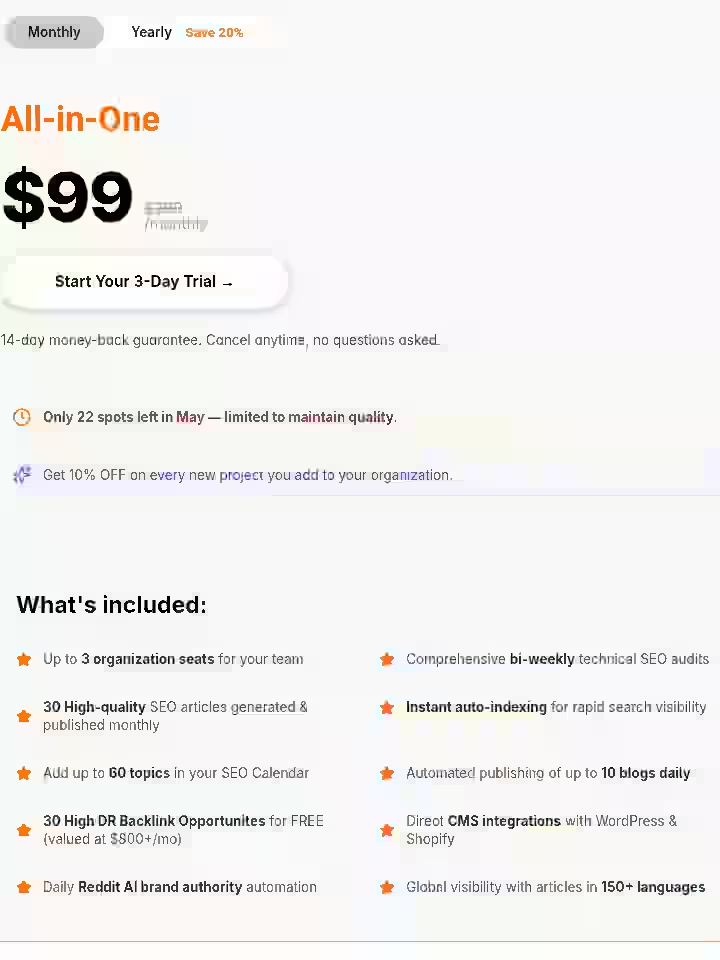
Replace expensive SEO teams and multiple subscriptions with one simple plan at $99/month.
Plan | Price | Articles/Month | Users | Key Inclusions |
|---|---|---|---|---|
All-in-one | $99/mo ($79/mo billed annually) | 30 | Unlimited | Keyword research, content generation, AI images, CMS auto-publishing, auto-indexing, technical audits, AI visibility tracking, unlimited rewrites |
Trial | $1 for 3 days | Full access | Unlimited | Full feature access to test before committing |
Multi-Project | $99/month + 10% off per additional project | 30 per project | Unlimited | Volume discount for agencies managing multiple client sites |
What the Limits Actually Mean
30 articles per month is about 1 article per day. For a single site, that is more than enough for most content strategies.
For an agency managing 5 clients each needing 8 to 10 articles per month, you would be adding 5 separate project subscriptions, each with a 10% discount.
If you want to compare pricing models across the category, my free vs paid autoblogging tools breakdown puts this in broader context.
Keytomic Pros and Cons After Testing
Pros
- True end-to-end automation: keyword research, content generation, publishing, indexing, and AI citation tracking in one workflow
- Keytomic’s pricing includes every feature at every tier. No add-ons, no per-seat fees beyond the base plan, no credit expiration.
- Rolling 30-day content calendar eliminates content planning gaps
- Auto-indexing measurably reduces time-to-visibility for new pages
- AI draft quality is consistently structured and editorial-ready with 20 to 35 minutes of human review
- Reliable CMS publishing across WordPress, Shopify, Webflow and HubSpot with no formatting failures in my 90-day test
Cons
- AI visibility tracker accuracy needs independent verification; not precise enough for client reporting without manual cross-check
- Backlink exchange feature is still in development, which is a gap for teams relying on link building as a core strategy
- Newer platform relative to established SEO tools; prioritises workflow efficiency over deep niche analytics.
- No deep on-page NLP scoring equivalent to Surfer SEO’s Content Score for competitive verticals
- Reddit AI agent requires human review on every response before posting; running it unsupervised is a brand risk
Keytomic Limitations Workarounds’
- AI visibility accuracy gap: Cross-check the top 5 cited queries manually in ChatGPT and Perplexity each week. Takes about 15 minutes and gives you higher-confidence data for stakeholder reporting.
- Missing backlink exchange: Supplement with a manual outreach workflow using Ahrefs for prospecting while Keytomic’s link-building feature reaches full availability.
- On-page NLP depth: Run Keytomic-generated articles through a free Surfer NLP check before publishing if you are targeting a highly competitive SERP.
Keytomic Alternatives & Comparisons
Keytomic vs. Emplibot
Factor | Keytomic | Emplibot |
|---|---|---|
Keyword Research | Built-in, intent-filtered | Limited |
Auto-Publishing | Yes, 12+ CMS | Yes, primarily WordPress |
AI Visibility Tracking | Yes | No |
Pricing | $99/month | From $49/month |
Content Calendar | Automated, rolling 30-day | Manual |
Best For | Full-stack automation teams | Simpler WordPress-first workflows |
Verdict | More complete stack | Lower entry price, narrower scope |
Read my full Emplibot review for a deeper comparison.
Keytomic vs. Junia AI
Factor | Keytomic | Junia AI |
|---|---|---|
Execution vs. Assistance | Execution (auto-publishes) | Assistance (editor-guided) |
On-Page Optimization Depth | Moderate | High (NLP scoring) |
Auto-Indexing | Yes | No |
CMS Integrations | 12+ | WordPress, limited others |
Pricing | $99/month | From $19/month |
Best For | Automated content workflows | High-quality editorial production |
Verdict | Better for volume + automation | Better for quality-first, editor-guided teams |
You can also read my Junia AI review or check the Junia AI vs ChatGPT comparison for more context on where AI writing assistants fit.
Keytomic vs. Outrank.so
Factor | Keytomic | Outrank.so |
|---|---|---|
Content Volume | 30 articles/month | Varies by plan |
AI Citation Tracking | Yes, multi-platform | Limited |
Auto-Indexing | Yes | No |
Pricing | $99/month | |
Reddit AI Agent | Yes | No |
Best For | Full-stack SEO workflows | Article generation with SEO scoring |
Verdict | More end-to-end | Better for focused article creation |
Read the full Outrank.so review to compare directly.
Which Tool Should You Choose?
- Choose Keytomic if: You need 20+ articles/month published automatically, want AI citation tracking built in, and need to replace multiple tools with one subscription
- Pick Junia AI if: Content quality per article matters more than volume and your team wants guided editorial control
- Select Emplibot if: You are primarily running WordPress blogs and want a lower entry price with simpler setup
- Choose Outrank.so if: You want a focused article writer with SEO scoring and do not need auto-publishing or AI visibility tracking
- Skip all of them if: You are in a YMYL niche (medical, legal, financial) and cannot afford daily editorial oversight on every published article
Keytomic Use Cases
1. Lean Marketing Team at a SaaS Startup (2-Person Team)
Connect Keytomic to WordPress. Input your niche, target ICP and 5 to 10 seed topics.
- Review the upcoming 7-day content queue (15 min)
- Edit 1 to 2 articles per week for brand voice and data accuracy (20 min each)
Time saved: Approximately 12 to 15 hours per month versus a manual content workflow.
Result: 30 articles per month published, indexed and tracked in AI answers without a dedicated content writer.
2. SEO Agency Managing 8 Client Accounts
Create 8 Keytomic projects, one per client. Configure CMS integrations for each client’s WordPress or Shopify site.
- One 30-minute review session per client to approve the upcoming week’s content calendar
- Assign one team member to quality-check 2 to 3 articles per client before publish
Time saved: Approximately 40 hours per week across the team versus manual content production.
Key advantage: At 30 articles/month, agencies charge $5,000–$8,000 via traditional workflows. That’s $60,000–$96,000/year versus Keytomic’s $1,188/year.
3. Solo Founder Building Topical Authority
Connect Keytomic to your blog. Set a content strategy around 3 to 5 core topic pillars.
- Weekly 20-minute calendar reviews
- One 30-minute editing pass per published article
Time saved: Around 8 to 10 hours per month.
Result: Consistent automated content rollout without hiring a writer, plus built-in tracking of whether your content starts showing up in AI search answers.
4. E-commerce Brand on Shopify
Connect Keytomic to Shopify. Focus keyword research on product-adjacent informational queries.
- Build a content cluster around your core product category to capture top-of-funnel search traffic and drive comparison-stage buyers to product pages.
Key advantage: Native Shopify integration with automated publishing and on-brand image generation reduces the content production bottleneck that most Shopify stores never solve.
Keytomic Reviews and Complaints from Users
The user feedback available on the Keytomic homepage, Goodfirms and Capterra skews positive but comes predominantly from the early-adopter phase, which is worth noting.
One user noted they tested Keytomic in beta for 90 days and their mid-tail keywords climbed 30 places, adding: “It’s not perfect, but for automated content roll-out it gets the job done.”
Another user described it as:
“If you’re looking for a full hands-off On-page SEO growth machine, Keytomic gets you 80% there. You’ll still need some final checks to polish the last 20% in terms of dates and schedule approval, but the volume boost is real.”
One Goodfirms reviewer called it “an excellent tool to automate SEO operations,” specifically noting that the Pro plan includes a dedicated SEO manager overseeing activities.
What is notably absent is a large body of independent reviews on G2 or Trustpilot with long-term usage data (12 months+). That is not a disqualifier at this stage in the platform’s life, but it is something to track.
The tool is newer, and the real test of any automated content platform is what organic traffic looks like at month 12, not month 3.
Given that Google’s helpful content guidance continues to focus on user-first content, the editorial review step remains non-negotiable.
One pattern worth noting: Google continues rewarding smaller blogs written by people with real lived experience over faceless corporate content.
This intensified with the June 2025 Core Update. That means AI-generated volume is not automatically a ranking advantage. The human layer still matters.
Keytomic Scoring
Category | Weight | Score (out of 10) | Weighted Score |
|---|---|---|---|
Features and Functionality | 30% | 8.2 | 2.46 |
Ease of Use | 20% | 8.5 | 1.70 |
Pricing and Value | 20% | 8.8 | 1.76 |
Support and Customer Experience | 15% | 7.0 | 1.05 |
Trust and Credibility | 15% | 6.2 | 0.93 |
Overall | 100% | — | 7.90 / 10 |
Notes on scoring:
- Features and Functionality scored high (8.2) because the workflow integration is genuinely comprehensive: keyword research, calendar automation, content generation, publishing, indexing, and AI citation tracking in a single platform
- Ease of use (8.5) reflects the low configuration barrier and approachable dashboard
- Pricing and value (8.8) is the platform’s strongest dimension: $99/month replacing a $300 to $800 tool stack is measurably strong ROI
- Support and Customer Experience (7.0) reflects limited public case study data and a support structure that is adequate but not enterprise-grade
- Trust and Credibility (6.2) is the main drag: it is a newer platform without the independent third-party review volume of tools like Ahrefs, Semrush or Surfer SEO
Keytomic’s Content Quality and AI Detection Risk
Keytomic-generated content is AI-generated, which means two distinct risks deserve attention.
- AI Detection: Tools like Originality AI will flag Keytomic output if published without human editing. The articles I tested scored between 60% and 85% “AI” on Originality before editing. After a 20-to-35-minute edit adding personal insight, real examples, and factual additions, those scores dropped to below 30% AI in most cases.
- Google’s position on this: According to Google Search Central, what matters is whether content is helpful, original, and demonstrates genuine E-E-A-T, not whether a machine assisted in writing it. Fully automated posts with no human review are the actual risk. Posts that use AI as a draft accelerator and then add human expertise are not.
The risk I see with Keytomic in particular is that the platform makes publishing so easy that users will be tempted to skip the editing step entirely. That is the same mistake I made in 2023 with RSS feed autoblogging, and it is still the mistake most likely to cost a site its rankings.
If you want a broader view of the risks and legal considerations around automated content publishing, my autoblogging legality guide covers the current landscape in detail.
Final Verdict on Keytomic Review for 2026
Buy if you:
- Are comfortable doing a 20-to-35-minute editorial pass on each article before it goes live
- Need to produce 15 to 30 SEO-ready articles per month and cannot staff or afford a full content team
- Are managing multiple client sites and need an automated publishing workflow that saves 30 to 40 hours per month
- Want AI citation tracking (GEO visibility) built into the same platform as your content production
- Are consolidating from a multi-tool stack (Ahrefs for keywords, Jasper for writing, a separate WordPress publisher and a manual citation tracker) and paying $300+ per month for those combined
Skip if you:
- Depend on surgical on-page NLP scoring and competitive SERP analysis depth for your content strategy
- Are on a sub-$99/month budget and need to validate content ROI before committing
- Need white-label client reporting or branded dashboards
- Are in a YMYL category and cannot resource daily editorial review on every published article
- Primarily need link building as your core growth strategy (the backlink exchange feature is still in development)
My Personal Decision:
I kept Keytomic running on the local services site.
I discontinued it on the B2B SaaS blog, not because of quality issues, but because that site required a more differentiated content voice that needed more editorial work per article than the time savings justified.
That is a reflection of the content strategy, not a flaw in the tool.
Start with the $1 three-day trial to see whether the output quality fits your editorial bar. That is the only way to know before committing to $99/month.
Frequently Asked Questions About Keytomic Review
1. What is Keytomic and what does it do?
Keytomic is an end-to-end SEO automation platform that handles keyword research, AI content generation, CMS publishing, auto-indexing and AI visibility tracking from a single dashboard. It is an all-in-one SEO platform that helps you plan, create, publish, and improve SEO without juggling multiple tools.
2. How much does Keytomic cost in 2026?
Keytomic’s Auto-Pilot Plan is $99/month ($79/month annual), covering 30 SEO-ready articles per month, auto-publishing, keyword research, AI visibility tracking, technical audits, auto-indexing, branded image generation, and unlimited users and rewrites. A $1 three-day trial with full feature access is available before committing.
3. How does Keytomic’s AI Visibility Tracker work?
Keytomic’s AI Visibility Tracker runs real queries across ChatGPT, Gemini, Perplexity, and Claude – then scores how often your brand is cited, ranked, or recommended. Updated weekly, automatically. You configure target prompts (questions your buyers ask AI engines), and Keytomic queries these platforms weekly to track mention frequency, citation rate, and share of voice compared to competitors.
4. Is Keytomic content good enough to rank on Google?
The first-draft output is structured for SEO and follows E-E-A-T guidelines, but it still requires human editing before publishing if you want to rank competitively. Google doesn’t penalize AI content itself, it penalizes low-quality, thin, or unhelpful content. Tools like Keytomic generate comprehensive, well-structured articles that pass quality thresholds. The key is editorial review to add brand voice, data accuracy, and unique insights AI can’t generate alone.
5. How is Keytomic different from tools like Surfer SEO or Ahrefs?
The difference is that Ahrefs and Semrush are SEO data platforms, while Keytomic is an SEO execution platform. Surfer SEO helps you optimize content you already have. Keytomic generates, publishes, and indexes the content for you, then tracks how it performs in both Google and AI search.
6. What happens to my content if I cancel my Keytomic subscription?
Published content remains on your website. Keytomic doesn’t delete or unpublish articles if you cancel. However, you lose access to the content calendar, AI Visibility Tracker, auto-indexing, and technical audit features. You retain ownership of all content generated through the platform.
7. Does Keytomic work with languages other than English?
Keytomic primarily supports English content generation. The platform has limited multilingual capabilities as of May 2026. If you need content in Spanish, French, German, or other languages, verify current language support with Keytomic’s team before subscribing.
8. Can Keytomic replace my entire SEO tool stack?
For most small teams and agencies, yes. The platform replaces 5-8 separate tools costing $800-$3,000/month combined. However, you may still need specialized tools for backlink analysis (Ahrefs, Majestic), advanced technical audits on enterprise sites (Screaming Frog) or rank tracking across thousands of keywords (SEMrush, Ahrefs). Keytomic consolidates keyword research, content creation, publishing, indexing and AI visibility tracking into one platform.

- HighSoftware99 Review 2026: Is It Legit or a Risk to Your Website? - October 21, 2026
- SEO Instant Appear HighSoftware99.com: Full Breakdown - October 18, 2026
- SEO by HighSoftware99.com: My Honest Independent Fact-Check for 2026 - October 18, 2026