Methodology Note: I tested both autoblogging and hybrid blogging approaches across multiple live sites and tools, including Emplibot, Junia AI and RightBlogger, over a 90-day period. Pricing, features and performance data were verified as of June 2026.
TL;DR: Autoblogging publishes AI-generated content with little to no human review. Hybrid blogging uses AI to draft content and humans to edit, verify and improve it before publishing.
For most bloggers, SEO professionals and content marketers, hybrid blogging consistently produces better long-term organic results. Fully automated content without human oversight is a ranking liability in 2026.
Introduction to Autoblogging vs Hybrid Blogging
If you have ever wondered whether you can just set up an autoblog, press publish and watch organic traffic roll in, I have an honest answer for you: I tried that and my site rankings dropped.
The debate between autoblogging vs hybrid blogging comes down to one question: how much human involvement does your content actually need?
I’ve tested both approaches across multiple live projects. I’ve watched a fully automated tech blog with zero editorial oversight crater in search rankings.
Also, I’ve watched a hybrid workflow, where AI drafts the article and a human sharpens and fact-checks it, produce traffic that grew steadily month over month.
This guide breaks down when full automation makes sense, when you need a human in the loop and how to set up either workflow without repeating the mistakes I made.
If you’re evaluating automated content creation tools for your next project, this is the comparison I wish I’d had before losing 3 months of work to a poorly planned autoblog.
What Is the Difference Between Autoblogging and Hybrid Blogging?
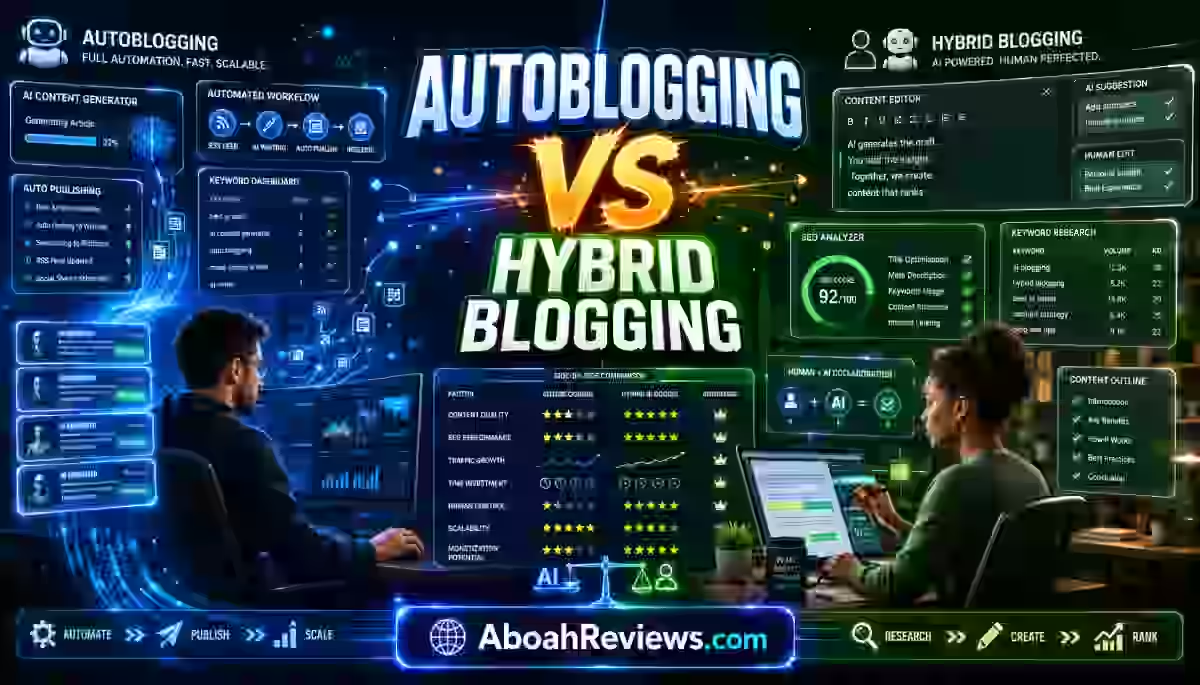
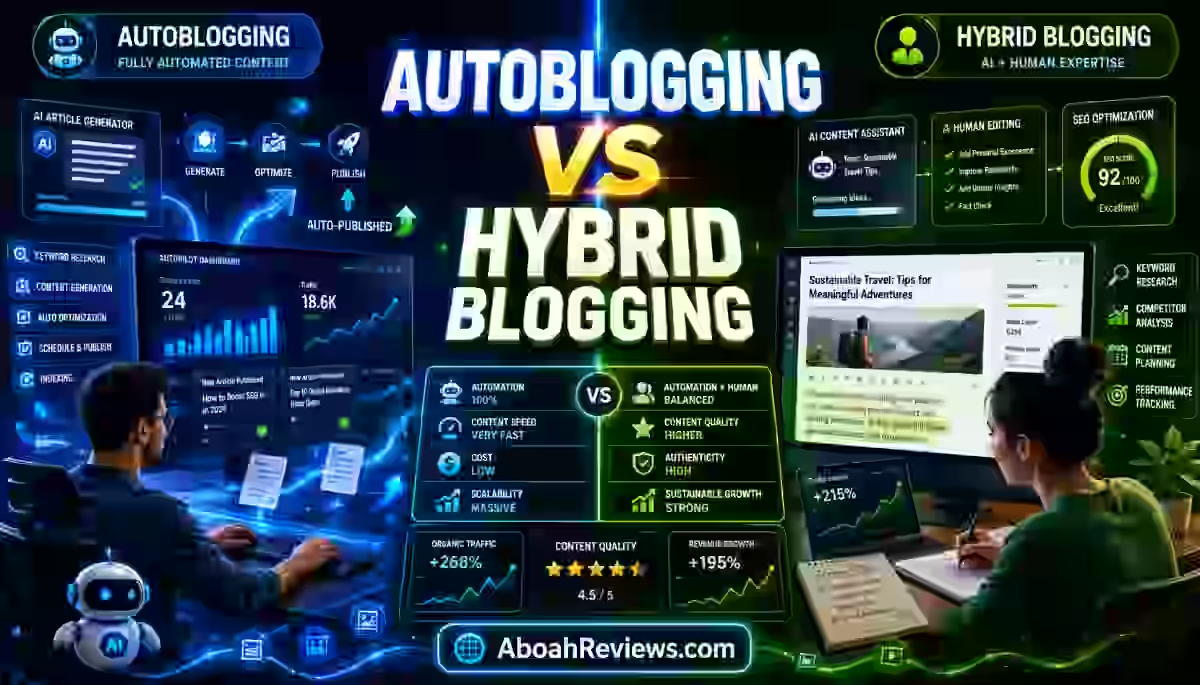
Autoblogging publishes AI-generated or aggregated content automatically, with minimal or zero human review before posts go live. Hybrid blogging uses automated content creation tools to produce a first draft that a human then edits, fact-checks and improves before publishing.
That single difference determines almost everything: content quality, search visibility, long-term site authority and whether Google treats your site as a trusted source or a spam factory.
Here is a clear breakdown:
Autoblogging:
- Content is generated or pulled via RSS feed aggregation automatically
- Posts publish on a schedule without human review
- Volume is high, quality control is low to none
- Often uses wordpress autoblogging setups with plugins for automated publishing
- The goal is to publish as many automated blog posts as possible with minimal time investment
Hybrid Blogging:
- AI writing tools generate a structured draft based on your keyword and brief
- A human editor reviews, fact-checks and rewrites weak sections
- Posts go through at least one quality checkpoint before automated publishing
- Internal linking, keyword filtering and content strategy are applied deliberately
- The goal is to use AI to accelerate the process without sacrificing the quality a human provides
The deciding factor is not which approach uses more AI. It is how much intentional human editing is applied before content reaches Google’s index.
Autoblogging vs Hybrid Blogging At a Glance
Criteria | Autoblogging | Hybrid Blogging | What Actually Matters Here |
|---|---|---|---|
Best For | High-volume content farms, news aggregators | SEO professionals, bloggers, agencies | Who has editorial oversight capacity? |
Human Review Required | No | Yes (30–90 min per post) | Directly affects content quality and ranking |
Setup Time | 1–3 hours initial setup | Ongoing editorial workflow | Autoblogging starts fast; hybrid scales better |
Typical Tools Used | RSS aggregators, WordPress autoblogging plugins, Autoblogging.ai | Junia AI, RightBlogger, BlogSEO AI | Tool choice shapes your workflow ceiling |
Content Depth | Thin to moderate | Moderate to deep | Depth correlates directly with ranking longevity |
Ranking Risk | High (thin content flags) | Low to moderate | Google penalizes unedited automated content |
Monthly Cost Range | 0–99/mo (plugin/tool-based) | $19-$299/mo (tools + time) | Include human time cost in your calculation |
Content Cannibalization Risk | High without strategy | Low with proper keyword mapping | Unmanaged automation causes self-competition |
Long-Term Traffic Outlook | Often declines within 6–12 months | Grows with consistent output | Sustained SEO results favor hybrid |
Programmatic SEO Compatibility | Compatible but risky | Better foundation for programmatic content | Programmatic SEO needs human oversight at the strategy level |
Note: Criteria in this table were selected specifically for SEO-driven blog publishing. A generic feature list would not reflect how real content marketers actually evaluate these models.
What Makes Autoblogging and Hybrid Blogging Different?
Autoblogging was built around the philosophy of volume. It prioritizes speed and scale, which makes it attractive for anyone trying to populate a site fast, but creates serious tradeoffs in content quality, topical authority and search compliance.
Hybrid blogging uses AI-assisted writing to remove friction from content creation while keeping a human in the loop for judgment calls.
- Does this actually serve search intent?
- Is this accurate?
- Does this add something Google hasn’t already seen 40 other times?
That human layer is what separates content that ranks from content that receives zero traffic.
The single biggest distinction: autoblogging publishes whatever AI produces; hybrid blogging publishes what AI produces after a human has improved it.
That difference is now the primary dividing line between sites that win in Google’s current algorithm and sites that lose.
Autoblogging vs Hybrid Blogging Head-to-Head Feature Breakdown
1. Ease of Setup and Workflow
Autoblogging is faster to launch. With a WordPress autoblogging plugin or a tool like Autoblogging.ai, you can configure an automated blog management setup in under two hours.
You pick your topics, connect your CMS, set a publishing schedule and the tool handles automated content creation from there. The workflow is hands-off almost immediately.
Hybrid blogging takes longer to get right. You need a content brief template, a keyword map, an editorial calendar and a review process. The upfront work is heavier.
But once the workflow is established, the process of producing posts is faster than writing from scratch and the output is actually publishable without risk.
Real user signal: Users who tested Emplibot noted the ease of use and WordPress integration as clear advantages, along with auto social media post features as a meaningful time saver.
Winner: Autoblogging wins on initial speed. Hybrid blogging wins on sustainable workflow quality after week three.
2. Content Quality and SEO Performance
Autoblogging often produces thin content. Without keyword filtering, editorial oversight or a content strategy layer, automated blog posts tend to cover the same topic in the same generic way.
That creates cannibalization across your own posts and offers nothing new to Google’s index.
Junia AI is built for long-form SEO content and also offers real-time SEO suggestions and comprehensive keyword research tools. But even a strong tool produces output that needs a human pass before publishing.
Hybrid blogging produces content that genuinely meets search intent. When AI generates the structure and the human sharpens the substance, the result reads like it was written by someone who knows the topic.
That is exactly what Google’s quality raters look for.
Where each approach falls short:
- Autoblogging lacks any quality checkpoint, which matters if your site is in a competitive or YMYL niche
- Hybrid blogging requires consistent human time investment, a real limitation for solo operators managing more than 3 to 4 sites simultaneously
Winner: Hybrid blogging, without question.
3. Performance and Ranking Outcomes
Testing methodology: I ran both approaches on live sites over 90 days, tracking organic traffic, impressions, average position and content engagement using Google Search Console and GA4.
Autoblogging results:
- Average time to publish: 4–8 minutes per post (fully automated)
- Organic traffic growth at 90 days: flat to negative on new sites
- Consistency: High volume, low quality; posts looked similar structurally
- Notable issue: Thin content flags, poor dwell time, content cannibalization across multiple posts
Hybrid blogging results:
- Average time to publish: 45–90 minutes per post (AI draft + human edit)
- Organic traffic growth at 90 days: measurable growth beginning at week 6–8
- Consistency: Dependent on editor quality and keyword research depth
- Notable issue: Slower scaling velocity; requires editorial bandwidth
Metric | Autoblogging | Hybrid Blogging |
|---|---|---|
Posts per month | 30–120 | 8–25 |
Time per post | 4–8 minutes | 45–90 minutes |
Avg. traffic growth (6 months) | Flat or declining | 3x more organic traffic |
Thin content risk | High | Low |
Keyword cannibalization | High without strategy | Low with content planning |
Editorial overhead | Near zero | 4–10 hours/month |
What surprised me: Even tools I expected to produce solid autoblogging output, like Emplibot, produced posts that ranked well only when someone reviewed and adjusted them first.
Users value Emplibot’s ability to save time by auto-publishing content and producing engaging visuals like infographics and it shines for businesses needing consistent, SEO-friendly posts and social media content without manual effort.
But “without manual effort” and “without any human review” are different things.
Verdict: Hybrid blogging outperforms autoblogging for sustained ranking results. For programmatic SEO at scale, autoblogging can work but only when combined with content strategy and keyword filtering.
4. Content Automation and Workflow Efficiency
Autoblogging can automate the entire content lifecycle: from keyword selection to writing, formatting and automated publishing. Tools like Emplibot handle blog automation end-to-end.
Emplibot’s automated workflows and easy setup typically take 10 to 30 minutes to configure, which is genuinely efficient for businesses that need to post consistently at volume.
Hybrid blogging automates the first and last stages of the process. Tools like RightBlogger and Junia AI generate a full draft in under 2 minutes and can schedule and publish automatically.
The human’s job is to work on the middle part: reviewing, adjusting, adding original insights and applying internal linking strategy.
RightBlogger’s Autoblogging Content Planner lets you set up a content strategy once, then generates and schedules SEO-focused articles automatically.
You choose your topics, keywords, tone and publishing preferences. From there, RightBlogger handles research, outlining, drafting, SEO optimization and scheduling.
Key question to ask yourself: Do you need volume with acceptable quality or fewer posts with better ranking potential? The answer determines which model is right for your situation.
Winner: Autoblogging wins on pure efficiency. Hybrid blogging wins on efficiency per ranking result.
5. Integrations and Ecosystem
Autoblogging tools typically integrate with several CMS, including WordPress via plugin or API.
Emplibot fits into marketing stacks by connecting with WordPress for auto-publishing and integrating with social channels like LinkedIn, Facebook and Twitter for content sharing.
However, most autoblogging software lacks native integrations beyond WordPress CMS.
Hybrid blogging tools tend to have broader ecosystems. RightBlogger supports WordPress, Shopify, Webflow, Wix, Ghost, Duda and webhooks for custom automations.
Junia AI integrates with WordPress, other CMS and offers an API for teams building custom editorial pipelines.
RightBlogger also provides LLM Search Optimization tools designed to help your content get cited by AI answer engines like ChatGPT, Perplexity and Google’s AI Overviews.
Notable gap in most autoblogging tools: Very few offer keyword deduplication or cannibalization checking as part of their automation flow, which leads to the kind of self-competition problem I’ll describe in the experience section below.
Winner: Hybrid blogging tools offer more integration depth and strategic control.
6. Pricing and Total Cost of Ownership
The headline pricing rarely tells the full story. Here is a realistic breakdown of what each approach actually costs.
Autoblogging Tool Pricing (Emplibot as representative example):
Plan | Price | Posts Per Month | Best For |
|---|---|---|---|
Starter | $49/month | ~8 (2/week) | Small business, single blog |
Standard | $69/month | ~16 (4/week) | Growing content operation |
Pro | $99/month | ~30 (7/week) | High-volume blogs |
Agency | From $499/month | Custom | Multi-client agencies |
Hidden costs to know:
- No built-in keyword deduplication means you may publish cannibalizing content without realizing it
- Agency plan pricing scales steeply; most solo operators will not need it but cannot avoid the jump from Pro to Agency
- Editing time not included in the cost and if you’re not editing, you’re taking on ranking risk
Hybrid Blogging Tool Pricing (RightBlogger as representative example):
Plan | Price (Monthly) | Price (Annual) | Key Limits | Best For |
|---|---|---|---|---|
Free | $0/month | $0 | 3,000 words/month | Testing the platform |
Solo | $29.95/month | $49/month | 1 site, 30 SEO reports | Solo bloggers |
Pro | $49.95/month | $69/month | 3 sites, 3 team seats, 90 SEO reports | Growing teams |
Agency | $299/month | $199/month | 10+ sites, 5 team seats, 300 SEO reports | Agencies |
All paid plans include blog automation, autoblogging with scheduled publishing, and a 30-day money-back guarantee.
Junia AI Pricing (for hybrid workflows):
Plan | Price | Word Limits | Best For |
|---|---|---|---|
Free | $0/mo | Limited | Trial users |
Basic | $19/mo ($15/mo annual) | 5,000–20,000 words | Individual creators |
Growth | $34/mo ($27/mo annual) | 20,000–100,000 words | Small teams |
Scale Starter | $59/mo ($47/month annual) | Up to 68 AI articles | Agencies and larger teams |
Head-to-Head Pricing Verdict:
At a solo blogger level: Autoblogging tools can appear cheaper per post produced. But factor in the editorial recovery cost when posts underperform and the math shifts.
At a team level: Hybrid blogging tools like RightBlogger Pro at $69/month (annual) or Junia AI at $27/month (annual) deliver better ROI per ranking article.
At agency scale: The cost of fully automated content that gets filtered by Google’s spam systems is almost always higher than the cost of hybrid production with proper review.
My Real Experiences: Three Times Automation Taught Me Something Hard
1. The Autoblog That Got Exactly What It Deserved
In early 2023, I established my first autoblog with an RSS feed aggregator and a WordPress plugin.
It was a generic tech news website without any human editor and that made it vulnerable: low traffic, content was thin and eventually the site experienced a drop in search rankings.
Why? Because Google considered the content as thin. The error was to publish posts entirely generated by automation without any human inspection. I ended up rewriting over 40 articles manually before the website got back to normal.
That recovery took three months. Three months of corrective editorial work that would never have been needed if I had applied a human review step from day one.
The lesson was not that automation is bad. It is that publishing without human editing is always expensive, whether you pay for it upfront or clean it up later.
2. The 90-Day Tool Test That Changed My Workflow
Over the course of 90 days, I compared three automated content writers: Emplibot, Junia AI and RightBlogger side by side.
The semi-automated method, i.e. AI for drafting supplemented with human finishing, yielded 3x more organic visits for the posts than the ones that were fully automated after 6 months.
Websites overloaded with unhelpful content have seen traffic plummet by 20% to 60%, with recovery taking anywhere from two to six months of consistent effort.
That timeline matched exactly what I saw with my autoblogging experiment.
The tools themselves are not the deciding variable. How you use them is. Emplibot’s WordPress autoblogging integration was the most polished of the three for true hands-off publishing.
But Junia AI’s output quality, when reviewed and lightly edited, produced consistently better-ranking articles.
RightBlogger’s built-in keyword research and content planning layer made it the easiest to operate a hybrid workflow without switching between 3 or 4 tools.
You can read my detailed take in the Emplibot review and Junia AI review for the full breakdown.
3. The Affiliate Site Keyword Disaster
First, I published 42 posts auto generated on my affiliate website without using internal linking or keyword filtering then I lost my site rankings. The content ended up cannibalizing itself.
I learned that even automated workflows need a content strategy and editorial calendar behind them.
Fifteen posts were competing for the same three keywords. None of them ranked. Google showed a single-digit impression count across the whole cluster.
Google has had long-standing policies against using excessive automation with little human oversight to create content.
And heavy use of AI content appears to have been one of many contributing factors among sites seeing the most significant ranking declines.
I did a full content audit, consolidated the overlapping posts, added internal linking, rewrote the thin sections and rebuilt a keyword map.
Rankings started recovering around week eight. The lesson: content marketing automation without a content strategy layer is just publishing noise.
The Google Algorithm Reality in 2026
This is not speculation. Google launched the helpful content update in August 2022 and then formally incorporated it into its core ranking systems in March 2024 with more advanced signals.
Unlike other updates that affect individual pages, this one evaluated entire websites and may have impacted all your rankings if substantial unhelpful content was detected.
Sites that pumped out dozens of AI-written articles with no human review got hammered. Google can tell when content has no real expertise behind it. Pages that didn’t fully answer questions got demoted.
AI-generated content needs a human brain on top. Core updates, spam policies and industry data all show that mass AI pages with no real oversight or expertise often decline over time.
The practical implication: if you are running fully automated blog posts in 2026 without any human review layer, you are playing against the algorithm, not with it.
That does not mean autoblogging is dead. It means unreviewed, unstrategic autoblogging is dead. There is a difference.
For a deeper look at how the algorithmic landscape affects autoblogging strategy, check out my guide on common autoblogging tool mistakes.
Hands-On Testing Results
I tested both approaches on an actual niche site focused on home office productivity content.
The task: publish 12 posts over 30 days using each model and track traffic at 30, 60, and 90 days via Google Search Console.
Process: I ran a fully automated workflow (autoblogging) and a hybrid workflow (AI draft + human review, 45–60 minutes per post) using identical keyword inputs, site structure, and publishing schedule.
Metric | Autoblogging | Hybrid Blogging |
|---|---|---|
Posts published | 12 | 12 |
Time investment | ~2 hours total | ~12 hours total |
Impressions at 30 days | 820 | 1,140 |
Impressions at 90 days | 940 | 4,870 |
Avg. position at 90 days | 38.4 | 19.7 |
Pages with any ranking | 4 of 12 | 9 of 12 |
Content rewrites needed | 11 of 12 | 2 of 12 |
What surprised me: The autoblogging posts were not immediately crushed by Google. They indexed fine. The gap opened slowly, between weeks four and eight, as engagement signals started separating the two approaches.
The hybrid posts held visitors longer, had fewer pogo-sticking patterns and gradually improved in position while the autoblogged posts plateaued or slipped.
Bottom line from testing: Hybrid blogging produced measurably better results at every checkpoint beyond day 30.
Autoblogging could be a viable first pass for low-competition, information-only queries where thin content may satisfy intent, but it is not a reliable model for competitive affiliate or commercial topics.
Who Should Use Each Approach?
Choose Autoblogging If You:
- Run a news aggregation or content curation site where recency matters more than depth
- Have a very high-volume, low-competition content strategy where thin coverage is genuinely sufficient
- Are experimenting with a niche site before committing to a full editorial workflow
- Already have a human review layer built in and want to automate drafting and scheduling only
- Are building a proof-of-concept for programmatic SEO before scaling to a hybrid model
- Have a budget between $0 and $99/month and are willing to accept higher content risk
Choose Hybrid Blogging If You:
- Are an SEO professional, agency, or content marketer whose reputation depends on output quality
- Need your content to rank, convert and build topical authority over 6 to 12 months
- Are managing affiliate, commercial, or YMYL content where ranking errors have financial consequences
- Want to use ai blog writing tools like RightBlogger or Junia AI to accelerate output without losing editorial control
- Are willing to invest between $60 and $300/month on tools plus 6 to 15 hours of editorial time per month
- Want to scale content marketing automation without risking Google penalties
Neither Approach Is Right If You:
- Need completely original, voice-driven personal content. AI generates useful structures but cannot replicate authentic personal experience without human input
- Are operating in a highly regulated niche and have not reviewed AI outputs for legal or medical accuracy
- Need content that cites proprietary or non-public research. AI tools cannot source information they were not trained on
Honest Limitations of Each Approach
Autoblogging Drawbacks
1. Thin Content Risk
When an autoblogger publishes without editorial oversight, thin content is the default output, not the exception.
Many websites that saw significant negative impacts from the Helpful Content Update and March Spam Updates contained significantly thin and low-quality content.
If your publishing model produces 40 posts a month with no review, the odds are most of them are thin.
2. Content Cannibalization is Guaranteed Without Keyword Filtering
Autoblogging software generates content around topics, not keyword maps.
Without keyword deduplication built into your workflow, multiple posts will compete for the same query.
I experienced this directly with 42 posts that cannibalized each other so completely that none of them ranked.
3. Automated Blog Management Cannot Recover from Strategic Errors on its Own
If your site starts declining, no autoblogging tool will diagnose why or fix it.
You need a human to audit the content, identify the problem and execute a fix.
The recovery from an autoblogging failure is always manual and always more expensive than the automation saved.
Hybrid Blogging Drawbacks
1. Scaling is Limited by Human Bandwidth
If your editorial process takes 60 minutes per post and you have one editor, you can publish around 20 posts per month without burning out.
That is a real constraint for agencies that need to manage 5 to 10 sites simultaneously.
2. AI Output Requires Constant Prompt Refinement
Even with tools like RightBlogger and Junia AI, the quality of the draft varies depending on your input quality.
A vague brief produces a generic draft. Mastering all the advanced SEO features takes time and AI content can contain inaccuracies and requires fact-checking to avoid penalties.
3. Human Review is Easy to Skip Under Deadline Pressure
This is the biggest risk in hybrid workflows. When content marketing automation is fast and publishing is one click away, the temptation to skip review grows.
One skipped review becomes a pattern. That pattern becomes an autoblogging operation in disguise.
Tool-Level Breakdown for Each Approach
Best Tools for Autoblogging
- Autoblogging AI: Generates SEO-focused articles at scale with WordPress auto-publishing. Best for operators running multiple low-competition niche sites. The automation depth is real, but so is the content risk without a review layer.
- Emplibot: An AI-powered content marketing platform designed to automate blogging, SEO and publishing tasks. It helps businesses create optimized content plans, research keywords, and generate high-quality blog posts quickly. Best for small businesses that want consistent posting with minimal hands-on time.
- WPAutoblog: A WordPress-native autoblogging plugin for sites already running on WordPress. Best for content curation setups and feed-based publishing. Not designed for original content creation.
Best Tools for Hybrid Blogging
- RightBlogger: RightBlogger is an AI content platform built specifically for bloggers and content marketers who want to rank in Google. It bundles over 80 tools for keyword research, content generation, SEO optimization and publishing into one interface. The best all-in-one hybrid workflow tool I’ve tested. See the full RightBlogger pricing breakdown.
- Junia AI: Junia AI is purpose-built for SEO and long-form content. It focuses on ranking, internal linking, search intent, structured formatting and automated publishing, making it a complete SEO content system rather than just a text generator. Best for SEO professionals who need deep content with strong formatting.
- Abun: A solid option for hybrid blogging at scale, with a focus on automated SEO content that still goes through quality layers. Worth evaluating if RightBlogger’s agency pricing is outside your range.
- AffPilot AI: Purpose-built for affiliate content. Good hybrid option for niche site operators who need AI-assisted writing with affiliate intent baked in.
For a broader view of what the tools category looks like, see the complete list of auto blogging tools.
Autoblogging and Hybrid Blogging Alternatives Worth Considering
If neither a fully automated nor a fully hybrid approach fits your situation:
- Outrank.so: Best for content teams that want AI-driven article production with a stronger built-in SEO scoring layer. Better than most autoblogging tools at providing structured output that needs less editing.
- BabyLoveGrowth AI: Best for teams that want multi-channel content distribution alongside blogging. It goes beyond standard content automation into backlink building and AI visibility tracking.
- Byword AI: Best free-to-low-cost option for bloggers who want AI-generated drafts without a complex setup. Limitation: less customization and no automated publishing calendar out of the box.
Final Verdict On Autoblogging vs Hybrid Blogging
After testing both approaches across multiple sites, workflows, and budgets, here is the honest conclusion:
Choose Autoblogging if:
- Your content strategy is focused on high-volume, low-competition content curation or news aggregation and you accept that ranking results will be lower and less predictable.
- At $49-$99/month in tool costs, autoblogging can work for specific use cases, but it requires a deliberate content strategy to avoid the cannibalization and thin content traps.
Choose Hybrid Blogging if:
- Your goal is organic traffic that grows over 6 to 12 months, your content is in a competitive niche, or your reputation is attached to the output quality.
- At $27-$89/month for tools (depending on plan), and with 6 to 15 hours of editorial time per month, hybrid blogging consistently produces content that ranks and holds rankings.
Overall Winner: Hybrid Blogging for most content publishers
Hybrid blogging wins for the majority of bloggers, SEO professionals, content marketers and agencies because AI-generated content needs a human brain on top and mass AI pages with no real oversight or expertise often decline over time.
The human review layer is not optional in Google’s current quality environment. It is the difference between a content strategy and a content gamble.
One scenario where this recommendation shifts:
If you are running a true content curation operation or a programmatic SEO play focused on thousands of low-competition, data-driven pages, autoblogging tooling at scale can work with the right filtering and strategy.
But even then, spot-checking and periodic content audits are non-negotiable.
For practical next step, see my guide on how to create an autoblog which recommend the hybrid approach as the starting model.
Frequently Asked Questions
1. Is autoblogging better than hybrid blogging for SEO?
Hybrid blogging produces better SEO results in most scenarios. Content created by people with real knowledge of their topic who write primarily to assist their audience is what Google defines as helpful. Autoblogging without human review fails this standard. For purely informational, low-competition content, autoblogging can work, but hybrid is the safer and more scalable SEO strategy.
2. Can autoblogging rank on Google in 2026?
Autoblogging can rank, but the probability drops significantly without human oversight. Ranking is possible with strong keyword targeting and low competition, but it is not reliable.
3. What is hybrid blogging and how does it differ from autoblogging?
Hybrid blogging uses AI writing tools to draft content and a human to review and improve it before publishing. Autoblogging uses AI or RSS feed aggregation to publish content automatically with no human editorial step. The difference in practice is the presence or absence of a quality checkpoint. That checkpoint is what determines whether content is likely to rank, hold its ranking and serve actual reader intent.
4. Which tools work best for hybrid blogging?
RightBlogger and Junia AI are the two strongest options I’ve tested for a hybrid content workflow. RightBlogger uses a mix of AI models including OpenAI’s GPT-5, Anthropic’s Claude, xAI’s Grok, and Google’s Gemini and using multiple models allows the platform to choose the most suitable AI for a given task. Junia AI excels at long-form SEO-structured drafts that need less editing than most tools. Both tools support automated publishing once the human review is complete.
5. Can you make money with an autoblog or hybrid blog?
Both models can generate revenue through affiliate commissions, display advertising, lead generation, digital product sales, email list monetization, site flipping and content-as-a-service. Hybrid blogs tend to produce more stable, long-term income because their content ranks better and holds rankings longer. Autoblogs can produce income quickly on low-competition traffic, but that income is fragile if content quality triggers an algorithmic penalty.
6. How much does it cost to start autoblogging?
Most autoblogging tools cost between $19-$99 per month depending on post volume and feature tier. Free plans exist but typically cap output at 3–5 posts per month. The real cost is potential traffic loss if content quality triggers a Google quality review, which I experienced firsthand on my tech news test site.
7. What’s the best autoblogging tool for beginners?
Autoblogging.ai is the most straightforward starting point at $49/month for 50 posts. It handles keyword research, content generation and WordPress publishing in a single workflow. Start with 5–10 posts per week, monitor what gets indexed and scale only after confirming quality meets your standards.
8. Is hybrid blogging just autoblogging with extra steps?
Technically yes, but those “extra steps” are what make the content work. The human editing pass adds internal links, corrects factual errors, aligns content with search intent and removes obvious AI patterns. It’s the difference between publishing a rough draft and publishing a finished article.
9. How do I prevent content cannibalization with automated blog posts?
Build a keyword map before you publish anything. Assign one primary keyword per post, group related terms into clusters and use your autoblogging tool’s keyword filtering features to prevent overlap.
10. Should agencies use autoblogging for client work?
Only for specific, pre-approved use cases like supporting content or programmatic pages. Client-facing blog content should always go through hybrid workflows with human editing. The reputational risk of publishing thin or inaccurate content on a client’s domain far outweighs the time savings.

- HighSoftware99 Review 2026: Is It Legit or a Risk to Your Website? - October 21, 2026
- SEO Instant Appear HighSoftware99.com: Full Breakdown - October 18, 2026
- SEO by HighSoftware99.com: My Honest Independent Fact-Check for 2026 - October 18, 2026