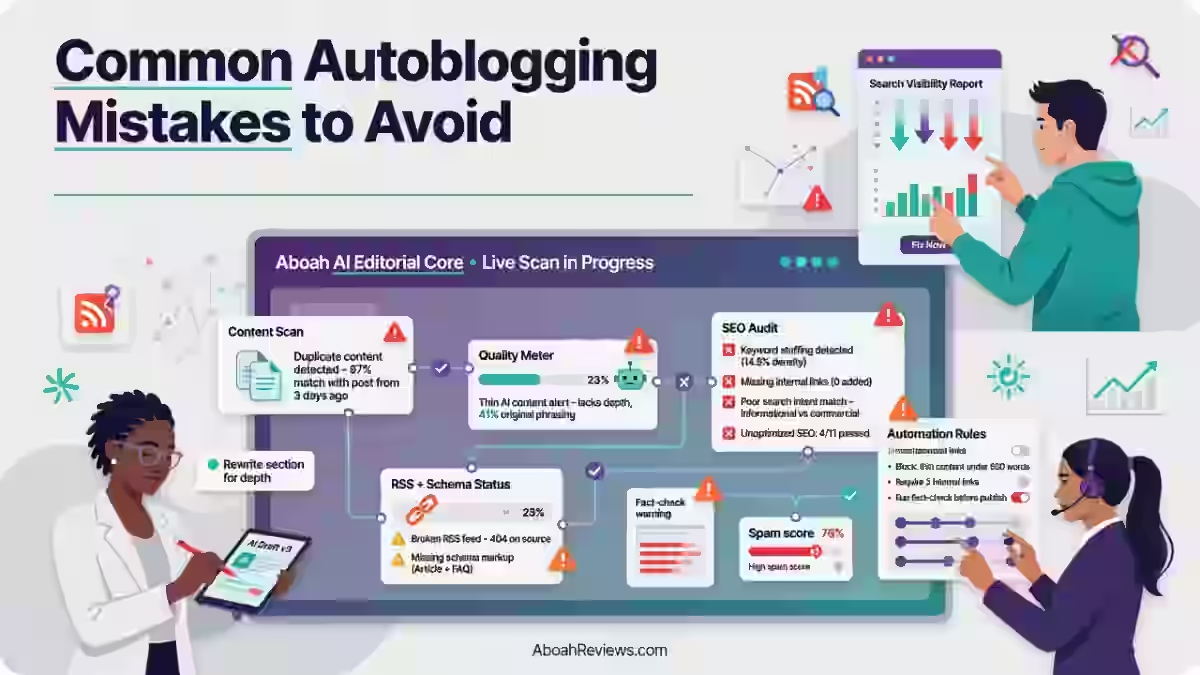
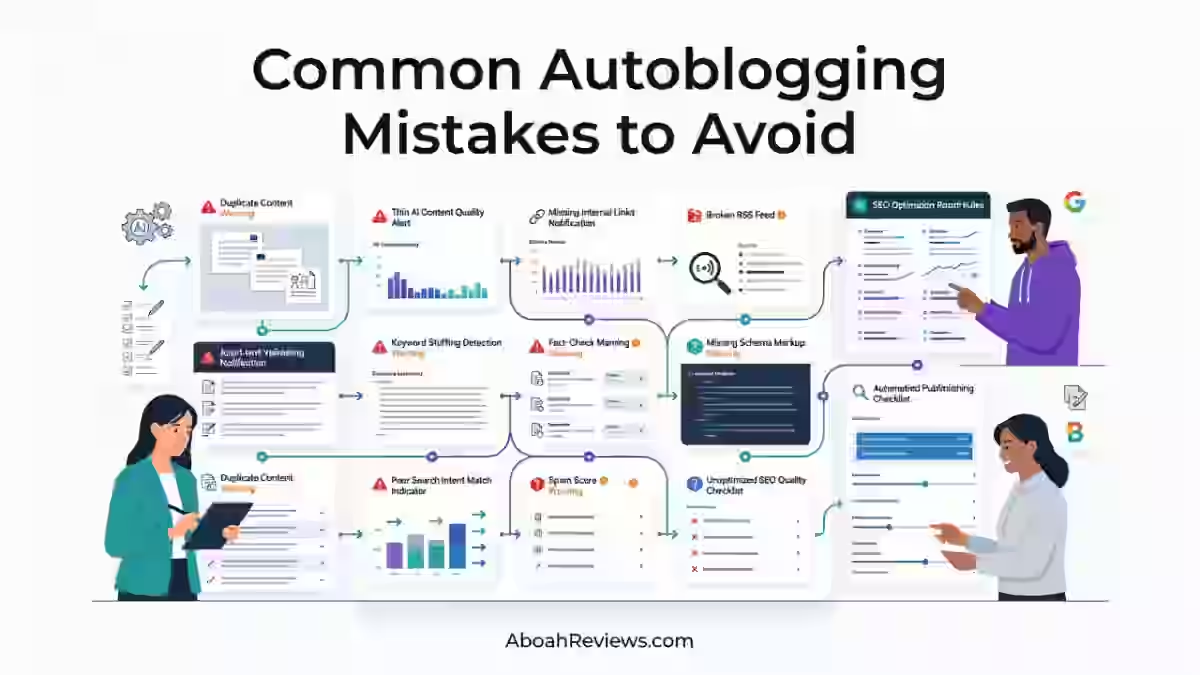
TL;DR: The biggest autoblogging mistakes are publishing raw, unedited AI or scraped content in bulk. This leads to thin content penalties, factual errors and algorithmic drops within a few months. Success requires strategic human oversight, proper search intent and structural planning.
Content & Quality Mistakes
- No human editing: Publishing raw tool outputs lets factual errors, hallucinations, and robotic phrasing go live.
- Ignoring search intent: Generating text for a keyword without matching what users actually want to read kills engagement.
- Bulk mass posting: Dumping dozens of automated posts a day strains crawl budgets and triggers spam flags.
- Zero original insight: Relying purely on the combination of existing web facts fails to add unique value.
SEO & Strategy Mistakes
- Skipping keyword research: Guessing topics instead of targeting low-competition, specific queries wastes effort.
- Content cannibalization: Generating overlapping posts on similar topics causes your own pages to compete against each other.
- Neglecting internal links: Leaving site architecture completely to automated plugins without manual adjustments weakens topical authority.
- Forgetting old updates: Assuming automated posts never need maintenance means your site accumulates outdated information.
Technical & Legal Mistakes
- Hotlinking images: Stealing images directly via source URLs rather than hosting them locally breaks media over time.
- Feed instability: Relying on RSS feeds that change structure or block crawlers breaks the auto-posting pipeline.
- Ignoring compliance: Failing to disclose affiliate links or properly attribute external data violates legal and platform guidelines.
If you are just getting started and want a foundation before reading about mistakes, the complete autoblogging guide covers how the whole system works from the ground up.
Introduction to Autoblogging Mistakes to Avoid
If you’re searching for common autoblogging mistakes to avoid, you’ve probably already made one or you’re about to launch a site and don’t want to repeat what everyone else gets wrong.
I’ve been on both sides of that line.
Successful autoblogging isn’t about hitting “publish” on AI-generated articles and walking away. It’s a mix of AI writing tools, real SEO strategy, editorial review, automation workflows, and technical upkeep.
However, if any one of those pieces is missing, the whole thing falls apart faster than most people expect.
Modern autoblogging tools can research keywords, draft content, and even handle internal linking automatically.
But I’ve watched sites with expensive software behind them lose lots of their traffic within a few months, while smaller, slower-moving autoblogs with tighter editorial oversight kept climbing.
The difference was never the tool; it was the process around the tool.
This guide walks through the content, SEO, business and technical mistakes that actually sink autoblogs, based on what I’ve tested and what I’ve had to fix.
What Is Autoblogging and Why Do Many Autoblogs Fail?
Autoblogging is the practice of using software to automate parts of the content publishing process, from topic selection to drafting to posting on a CMS like WordPress.
Most autoblogs fail because they treat automation as a replacement for strategy rather than a support system for it.
When publishing speed outruns content quality and technical maintenance, search engines eventually notice and rankings drop.
Understanding Modern Autoblogging
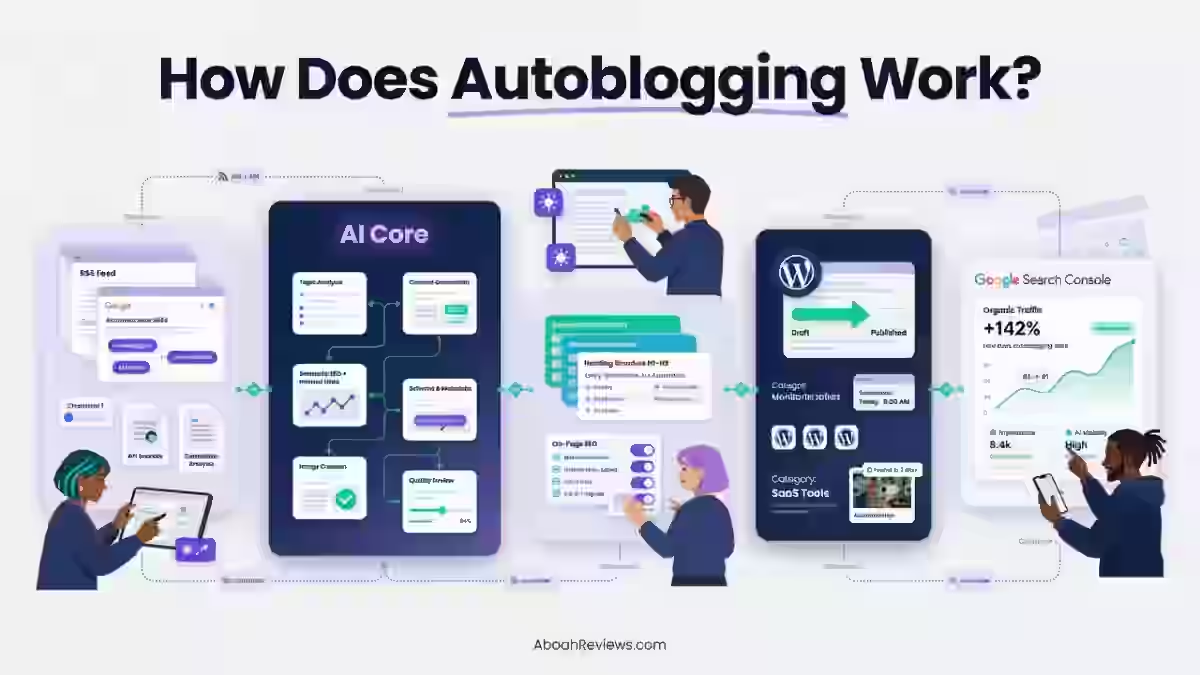
Modern autoblogging combines several distinct processes, not just “AI writes, site publishes.” Here’s what a real workflow looks like today:
- AI-assisted content creation: large language models draft sections based on a brief, not the whole article from a single prompt
- Automated keyword research: tools pull search volume, difficulty, and related terms before a topic is chosen
- Content optimization: on-page SEO elements like headers, meta descriptions, and internal links get applied during or after drafting
- Internal linking automation: some platforms auto-suggest links between related posts to build content hubs
- WordPress publishing workflows: drafts move from tool to CMS through APIs or plugins, often with scheduling
- Content monitoring and updates: performance is tracked through Google Search Console so underperforming pages get revised, not ignored
If you want a deeper breakdown of how these pieces connect, I’ve covered the mechanics in detail in how autoblogging actually works behind the scenes.
The Difference Between Smart Autoblogging and Content Automation Spam
The old autoblogging approach was RSS scraping content from other sites, running it through a spinner, and auto-publishing without anyone reading it first.
That model relied on duplicate content, zero editorial review, and volume over value, and it stopped working years ago once Google’s detection systems improved.
Modern autoblogging looks different.
It uses AI for research and first drafts, but a human edits for accuracy and voice, matches content to actual search intent, adds original insight the AI couldn’t generate on its own, and revisits older posts to keep them current.
The gap between these two approaches is the difference between a site that survives a core update and one that doesn’t.
Content Quality Mistakes That Hurt Autoblogs
1. Publishing Low-Quality AI-Generated Content
Publishing AI drafts without improvement is the single biggest reason autoblogs get flagged for thin content.
AI-generated text can be generic, factually shaky, or shallow on a topic when it’s published exactly as generated, and search engines are built to spot that pattern at scale.
Google’s Search Quality Rater Guidelines describe helpfulness partly through whether content demonstrates real depth and first-hand knowledge rather than surface-level summarization.
Helpful content clearly demonstrates first-hand expertise and a depth of knowledge, and the site as a whole needs a primary purpose someone reading it will leave satisfied that their needs were met.
I remember my first autoblog in early 2023 using RSS feed aggregation, a WordPress plugin and a zero editorial oversight.
Guess what happened? Poor traffic, thin content and eventually a drop in search rankings. Google flagged the site for thin content.
The mistake was publishing unedited, fully automated posts with no human review.
To avoid this:
- Improve AI drafts with human expertise before publishing
- Add real examples, screenshots, or workflow details the AI can’t invent
- Expand sections that read as generic or repetitive
- Verify every statistic, date, and claim manually
2. Skipping Human Editing and Quality Control
Fully automated publishing without human review consistently produces factual errors, awkward phrasing, and claims that don’t hold up.
That combination erodes reader trust and gives search engines a reason to discount the page, even when the topic itself is relevant.
An editorial review checklist doesn’t need to be complicated. Before anything goes live, I check for:
- Fact accuracy against a primary source
- Tone and flow that match the site’s actual brand voice
- At least one piece of expert commentary or lived experience
- Unnecessary filler sections that add word count but no value
- Basic on-page SEO: title tag, meta description, header structure
3. Publishing Duplicate or Repurposed Content
Copying or lightly rewriting content from RSS feeds, competitors, or other sites adds almost no value and creates a plagiarism risk that can affect both rankings and reputation.
Search engines are explicitly built to favor pages that say something new rather than restate what’s already ranking.
The better approach is to treat outside sources as research material, not raw content.
Use them to understand what’s already been said, then write your own explanation, add a comparison table or include a case study that no other page on page one currently has.
4. Creating Content With Zero Original Insight
AI tools are good at summarizing what already exists online, but they can’t replace a person who has actually used a product or run a test.
That’s exactly where the E-E-A-T framework comes in, and it’s become harder to fake, not easier, as more sites lean on AI content.
Google’s own guidance on this is direct: E-E-A-T is now part of the updated search rater guidelines, with clearer signals underscoring the importance of content created to be original and helpful for people.
And it specifically looks at whether content demonstrates it was produced with some degree of experience, such as actual use of a product or having actually visited a place.
Ways to add original value that AI can’t generate on its own:
- Product testing with your own screenshots
- Short case studies from real campaigns
- Data pulled from your own analytics or rank tracking
- Descriptions of your actual workflow, including what didn’t work
SEO Strategy Mistakes That Prevent Autoblogs From Ranking
5. Ignoring Search Intent
Targeting a keyword without matching what the searcher actually wants is one of the fastest ways to waste a publishing slot.
A page can be well-written and still fail to rank if it answers the wrong kind of question for that query.
Search intent generally falls into three buckets:
Intent Type | What the Reader Wants | Example Content Format |
|---|---|---|
Informational | How something works or how to do it | Guides, tutorials, explainers |
Commercial Investigation | Which option is best before buying | Reviews, comparisons, alternatives |
Transactional | Ready to act or purchase | Product pages, buying guides |
Mismatching these is common in autoblogging because AI tools will happily generate a “best tools” listicle for a keyword that actually needs a step-by-step tutorial.
Check the current top 10 results before assigning a content type, not after.
6. Skipping Keyword Research and Topic Planning
Publishing without keyword research produces a pile of disconnected articles that never build topical authority.
A content brief built from real search data prevents this by mapping what to write, why, and how it connects to everything else on the site.
Before assigning any topic, I check:
- Keyword difficulty and realistic ranking potential for the site’s current authority
- Monthly search volume against competition level
- What competitors are already covering (and where the gaps are)
- Keyword clusters that group related queries into one stronger page
- Content gaps competitors haven’t addressed yet
Ahrefs, Semrush, and Google Keyword Planner all handle this differently, and I use them for different jobs:
- Semrush for competitor gap analysis
- Ahrefs for keyword difficulty and backlink context
- Google Keyword Planner as a sanity check on volume estimates.
7. Neglecting Internal Linking
Internal links tell search engines how your pages relate to each other, and without them, even good content sits isolated with no way to pass authority around the site.
This is one of the most overlooked pieces of on-page SEO in automated workflows because AI tools don’t naturally know your site structure.
Internal linking best practices that actually move the needle:
- Build pillar pages surrounded by supporting content clusters
- Link supporting articles back to the relevant pillar page
- Use descriptive, keyword-rich anchor text instead of “click here”
- Revisit old posts periodically to add links to newer, relevant articles
If you’re structuring a site from scratch, it’s worth reading through how to build an autoblog that supports internal linking from day one before you publish your first batch of posts.
8. Creating Content Cannibalization Problems
Publishing multiple articles that target the same keyword makes those pages compete against each other instead of one page winning clearly.
This is one of the most common consequences of unchecked automated content production, since AI tools will generate similar topics repeatedly if no one is tracking what’s already been covered.
I lost an affiliate site’s rankings after publishing 42 auto-generated posts without internal linking or keyword filtering.
The content cannibalized itself, with multiple pages splitting ranking signals for the same terms instead of one authoritative page capturing them.
To prevent this:
- Map keywords before publishing anything new
- Assign one primary keyword per page, no exceptions
- Merge or redirect similar articles once you spot overlap
- Organize related content into clusters instead of a flat list of posts
Business Mistakes That Limit Autoblogging Success
9. Choosing the Wrong Niche
Picking a niche based on how easy it is to automate, rather than its search demand and monetization potential, is a common early mistake.
Some niches are simply too competitive for a new site, lack real ways to earn revenue, or require expertise that automated content can’t fake convincingly.
Before committing, evaluate a niche against:
- Search demand relative to your realistic timeline
- Competition level from established, high-authority sites
- Monetization potential (affiliate programs, ads, products)
- How much content depth the topic genuinely requires
- Whether you or your team have any real expertise in it
Understanding your actual reader persona matters here too.
A finance autoblog aimed at beginners needs different content than one aimed at day traders, and automated tools won’t make that distinction for you.
10. Choosing the Wrong Autoblogging Software
Different autoblogging tools are built for different jobs, and picking one based on marketing claims instead of actual output leads to wasted budget.
Some platforms focus purely on AI content generation, while others handle SEO automation, publishing, and optimization end to end.
I tested three autoblogging tools side by side over 90 days: Emplibot, Junia AI and RightBlogger.
The semi-automated approach, AI draft plus human editing, outperformed fully automated posts by roughly 3x in organic traffic after 6 months.
Factor | Emplibot | Junia AI | RightBlogger |
|---|---|---|---|
Core strength | End-to-end WordPress automation | SEO-focused long-form content | Multi-format content toolkit |
Human editing required | Recommended | Recommended | Recommended |
Best for | Hands-off publishing at scale | SEO-first content teams | Bloggers needing varied formats |
Before choosing a tool, run it through this checklist:
- AI content quality on a sample article, not just the demo
- SEO features (keyword research, on-page checks, schema)
- Internal linking automation, if any
- CMS integrations (WordPress, Webflow, etc.)
- Pricing tiers against your actual publishing volume
- Support responsiveness when something breaks
For a side-by-side breakdown of specific platforms, I’d point you to detailed comparisons between top autoblogging tools rather than relying on any single vendor’s pricing page.
11. Publishing too Much Content too Quickly
High publishing volume doesn’t guarantee rankings, and in a lot of cases it actively works against a new or smaller site.
Large batches of low-quality content published quickly can drag down the perceived quality of the entire domain, not just the individual pages.
Google formally incorporated the helpful content signal into its core ranking systems in March 2024, and unlike updates that affect individual pages, this one evaluates entire websites.
That means one bad batch of 50 posts can hurt pages that were already ranking well. The better strategy is prioritizing quality over quantity.
Build topical authority gradually, and reviewing every batch before it goes live, not after traffic drops.
12. Failing to Update Published Content
Content that isn’t revisited eventually falls behind competitors, changing search results, and shifting user expectations, and that decline shows up as a slow traffic bleed rather than a sudden drop.
A content maintenance workflow needs to be built into the process from the start, not treated as an afterthought.
A basic update workflow looks like:
- Monitor rankings monthly through Google Search Console
- Flag pages with declining impressions or clicks
- Update outdated statistics, screenshots, and examples
- Add new sections that address gaps competitors have filled
- Refresh publish dates only when the content actually changed meaningfully
Technical and Legal Autoblogging Mistakes to Avoid
13. Hotlinking Images Instead of Hosting Them Locally
Hotlinking means displaying an image directly from another site’s server instead of uploading it to your own media library.
It’s a mistake that causes broken images, slower load times, and potential copyright issues all at once.
If the source site removes or moves the image, your page ends up with a blank space where content used to be.
Better practice:
- Use licensed or properly attributed images only
- Upload images to your own WordPress media library
- Compress and resize images to protect Core Web Vitals scores
- Add attribution where the license requires it
14. Relying on Unstable RSS Feeds
RSS-based automation breaks the moment a feed changes structure, gets shut down, or starts blocking automated crawlers, and that failure often goes unnoticed until traffic has already dropped.
I’ve seen entire autoblogs go quiet for weeks because a single feed source disappeared and no one was monitoring it.
To prevent this:
- Monitor feed availability on a regular schedule
- Diversify across multiple reliable content sources
- Build a backup workflow that doesn’t depend on any single feed
- Treat RSS as a research input, not a publishing source
15. Ignoring Affiliate Disclosure and Content Compliance
Autoblogs that use affiliate links, external data, or third-party content are legally required to disclose those relationships clearly.
Skipping this step creates real legal and platform risk, not just an SEO one.
This applies whether the content was written by a person or generated through an AI SEO tool.
A basic compliance checklist:
- Disclose affiliate relationships clearly and near the links themselves
- Attribute external sources and data properly
- Follow image licensing rules without exception
- Avoid claims about results or earnings you can’t back up
- Keep disclosure language visible, not buried in a footer
How to Build a Successful Autoblogging Workflow
Step 1: Start With SEO Research
Every reliable autoblogging workflow starts with keyword mapping and search intent analysis before a single ChatGPT prompt gets written.
Competitor research and a documented content brief for each topic keep the entire pipeline organized instead of reactive.
Step 2: Use AI for Efficiency, Not Replacement
AI tools are genuinely useful for research, outlines, first drafts, and on-page optimization suggestions.
Strategy, lived experience, factual accuracy, and final editing decisions still need a person behind them.
That division of labor is what separates sites that survive algorithm updates from ones that don’t.
AI can support high-performing content, but the content that consistently stands out is still shaped by strong human input, often trading some speed for better judgment and deeper expertise.
That lines up with what I’ve seen across every autoblog I’ve managed: the tool speeds up production, but the human still decides what’s worth publishing.
Step 3: Add Quality Control Before Publishing
A content QA pass before publishing should check for factual accuracy, on-page SEO basics, original insight, and compliance items like affiliate disclosures.
This step takes minutes per article and prevents the kind of thin-content pileup that triggers site-wide ranking drops.
Step 4: Monitor, Update and Improve Content
Track rankings, organic traffic, click-through rate, engagement, and conversions on a recurring schedule, not just after something goes wrong.
Google Search Console and Google Analytics 4 handle the free tracking layer, while Ahrefs and Semrush add competitive context and keyword-level detail.
Autoblogging Mistakes Checklist
Use this before every publishing sprint:
- Validate every keyword against search volume and keyword difficulty before generating content.
- Write a content brief before generating any AI draft.
- Match content format to search intent, not just keyword topic.
- Edit every AI draft before publishing. No exceptions.
- Fact-check all claims against named primary sources.
- Add at least one original insight, example, or experience to every post.
- Build internal links from new posts to relevant cluster and pillar pages.
- Assign one primary keyword per page. Map it in your keyword tracking sheet.
- Include affiliate disclosures on every commercially oriented post.
- Host all images locally. Compress to under 150KB. Add alt text.
- Monitor RSS feed availability weekly if feeds are part of your input pipeline.
- Review rankings monthly and flag declining pages for content updates.
- Test page speed with Google PageSpeed Insights after publishing. Address core web vitals issues before moving on.
- Apply Article schema markup and, where relevant, FAQPage structured data to support rich snippets.
Frequently Asked Questions About Autoblogging Mistakes to Avoid
1. Is autoblogging bad for SEO?
Autoblogging isn’t inherently bad for SEO, but unedited, fully automated publishing consistently is. The risk comes from thin content, duplicate posts, and missing editorial oversight, not from using automation tools themselves.
2. Can AI-generated autoblogs rank on Google?
Yes, AI-generated content can rank, but execution determines whether it does. Semrush’s research shows AI content is already competing in search, but performance still comes down to execution, and AI supports SEO performance when it’s used to improve workflows and content quality rather than replace strategy.
3. What is the biggest autoblogging mistake beginners make?
The biggest mistake is publishing AI drafts without any human review or fact-checking. This single habit is behind most of the thin-content penalties and ranking drops I’ve seen on new autoblogs.
4. How often should an autoblog publish new content?
There’s no fixed number that works for every site, but consistency and quality matter more than volume. A smaller site publishing 2-3 well-edited posts weekly typically outperforms one publishing 20 unreviewed posts in the same period.
5.Should I edit AI-generated articles before publishing?
Yes, every AI-generated article should go through human editing before it publishes. Editing catches factual errors, improves tone to match your brand voice, and adds the original insight that separates ranking content from generic summaries.
6. Are RSS-based autoblogs still effective?
RSS-based autoblogs work best as a research input rather than the entire publishing engine. Feeds can change structure or disappear without warning, so relying on them as a sole content source creates ongoing reliability risk.
7. What tools help avoid common autoblogging mistakes?
Tools like Ahrefs and Semrush help with keyword research and content gap analysis, while platforms like RightBlogger and Junia AI combine drafting with basic SEO optimization. None of them remove the need for editorial review before publishing.

- #1 Best Plugin for Automatic Blog Posting in WordPress (2026) - September 13, 2026
- 13 Best WordPress Autoblogging Plugins I Tested & Ranked for 2026 - September 13, 2026
- 13 Best Google AI Overview Checking Tools in 2026 (Tested & Ranked) - September 9, 2026