TL;DR: Rankshift is an AI search visibility tracker that monitors how your brand appears across ChatGPT, Perplexity, Gemini, Google AI Overviews and six other platforms.
It tracks prompt performance, citation sources, sentiment and share of voice. The UI-based tracking method is a genuine differentiator: you get what real users see, not sanitised API outputs.
Unlimited users and projects on every plan makes it one of the more agency-friendly options at this price. The main gap: it tells you where visibility is weak but doesn’t help you fix it.
It’s worth it for teams that need a solid monitoring baseline without enterprise spend. Pricing starts at $92/month.
Rankshift Review Verdict for 2026
| Category | Verdict |
|---|---|
| Best For | SEO teams and agencies that need to track brand visibility across multiple AI search platforms (ChatGPT, Perplexity, Gemini, and 6 others) without paying per seat |
| Not Ideal For | Teams that need traditional keyword rank tracking or a full GEO optimisation suite |
| Pricing | $92/month (Starter), $210/month (Professional), $473/month (Business), custom (Enterprise), 30-day free trial (no credit card required) |
| Rating | 7.6/10 |
| Standout Feature | UI-based tracking across 9 AI platforms; captures what real users actually see |
| Biggest Weakness | Monitoring only: no actionable content gap analysis or optimisation tools and the Content Engine is still in Beta |
| Learning Curve | Intermediate |
| Testing Status | Personally tested (30-day AI visibility monitoring test) |
| Worth It? | Yes if you are ready to act on AI visibility data. No, if you want the tool to do the optimization work for you. |
Bottom Line: Rankshift is worth it if you have a focused prompt list, an active PR or content workflow, and someone who can act on citation data.
It is not the right tool if you want an all-in-one platform that finds problems and solves them in the same dashboard.
Rankshift Quick Specs
| Feature | Details |
|---|---|
| Developer | Rankshift BV |
| Founded | 2024 |
| Product Category | AI Search Visibility / GEO Tracking |
| Primary Use | Monitoring brand visibility, citations, and sentiment across AI-generated search responses |
| Target Users | Agencies, SEO teams, digital PR teams, SaaS marketing teams |
| Platform | Web-based (no mobile app or browser extension) |
| Integrations | Looker Studio, BigQuery, Power BI, Tableau, REST API, MCP (Professional+ only) |
| AI Platforms Tracked | ChatGPT, Gemini, Google AI Overviews, Google AI Mode, Claude, Perplexity, Mistral, Meta AI, Copilot (9 total) |
| AI Visibility Features | Prompt tracking, share of voice, citation analytics, brand perception, sentiment scoring, competitor benchmarking |
| SEO Features | Crawler analytics, Robots.txt analysis, AI bot traffic logs |
| AI Tracking Method | UI-based (not API, captures real user-facing responses) |
| Free Trial | 30 days (no credit card required) |
| Refund Policy | Not publicly stated; check with vendor |
| Support | Email, documentation, in-app chat |
| User Ratings | G2: 5.0/5 (1 review as of November 2026) |
Key Takeaways About This Rankshift Review
I spent 30 days monitoring AI search visibility across 50+ search prompts using Rankshift on a paid Professional plan. I tracked brand mentions, competitor appearances, cited sources, and visibility changes for queries across ChatGPT, Perplexity, Gemini and Google AI Overviews.
I gave Rankshift a score of 7.6/10. The strongest part of Rankshift is its tracking method. Most tools hit the API because it’s cheaper and easier to scale. Rankshift captures responses from the actual chat interface.
That matters because the API version doesn’t always match what a real user sees, especially with web-augmented responses and cited sources.
The weakest part is the same thing that holds back a lot of monitoring tools in this category: the data is good, but Rankshift leaves you to figure out what to do with it.
Value assessment: Worth it at the Professional tier for teams tracking 30+ prompts across multiple AI engines but overpriced at the Starter tier if you need crawler analytics or API access
What I Liked
| What I Liked | Why It Matters |
|---|---|
| UI-based tracking across 9 platforms | Shows real user-facing responses, not sanitised API outputs. More accurate for visibility measurement |
| Unlimited users and projects on all plans | No per-seat costs means agencies can add clients without price creep |
| Flexible credit-based scheduling | Daily, weekly, or monthly runs let you stretch the budget across a large prompt library |
| Useful sentiment analysis | Surfaces how AI platforms describe your brand. Good for identifying messaging gaps |
| 30-day free trial, no credit card | Low-risk way to validate the category before committing |
| REST API + MCP server on all paid tiers | Integrates into agent workflows and BI tools without an enterprise contract |
| Responsive support team | Mentioned consistently in multiple third-party reviews and in my own experience |
What Needs Work
| What Needs Work | Why It Matters |
|---|---|
| No actionable optimisation layer | Shows gaps but doesn’t tell you how to close them: no content briefs, gap analysis, or recommendations |
| AI crawler logs are basic | Recently added but functions as a simple activity log, not deep technical SEO tooling |
| Credit maths can be confusing | Tracking one prompt daily across all 9 models burns credits fast; easy to under-budget |
| MCP, API, BI connectors only on Professional+ | The entry plan lacks these; real integration work starts at $210/month |
| No Reddit or YouTube tracking | Both are frequently cited by AI platforms, a notable blind spot |
| Limited public review data | Only 1 G2 review as of November 2026; hard to verify community sentiment independently |
Why I Tested Rankshift
I spent 30 days monitoring AI search visibility across 50+ prompts. The problem I kept running into was that traditional rank tracking doesn’t tell you anything useful about what’s happening in ChatGPT or Perplexity.
I wanted to understand whether a brand I was tracking actually appeared in AI-generated answers for the queries that mattered to its audience and what sources AI platforms cited in those answers.
That’s not data you can get from Semrush or Ahrefs without their AI add-ons. Rankshift was one of the tools I evaluated to fill that gap.
What pushed me toward testing it seriously was the UI-based tracking claim. I’d used API-based tools before and found the data could differ meaningfully from what I saw when checking the same query manually in ChatGPT.
I wanted to see if Rankshift’s approach produced more accurate results.
What Is Rankshift?
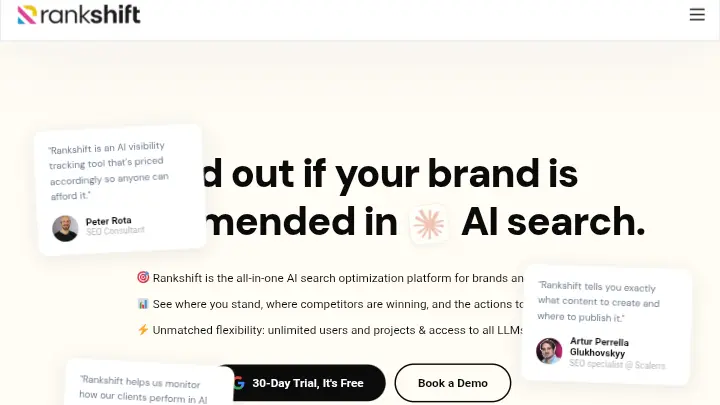
Rankshift is an AI search visibility monitoring platform. It tracks how your brand appears in responses generated by ChatGPT, Perplexity, Gemini, Google AI Overviews, and five other AI platforms.
You set up the prompts you want to monitor: queries your target audience might type into an AI assistant and Rankshift checks them on a schedule, records the responses and reports back on whether your brand appeared, how it was described and which sources were cited.
It is not an SEO tool in the traditional sense. It doesn’t track keyword rankings in Google’s blue-link results, build backlinks or help you optimise on-page content.
Its job is to answer one specific question: when someone asks an AI assistant a question relevant to your business, is your brand mentioned, how is it framed, and where is the AI getting its information?
The tool fits between your SEO stack and your digital PR workflow. You’d use it alongside tools like Semrush or Ahrefs for traditional search, and alongside media monitoring or PR tools to understand and improve citation coverage in AI answers.
The simplest way to think about Rankshift is as a listening platform for AI search, the same way a media monitoring tool tracks brand mentions in news or social media.
Why Rankshift Matters in 2026
Google’s AI Overviews now appear on a significant portion of commercial queries and AI assistants like ChatGPT and Perplexity have become a real step in the B2B buying process.
A brand that ranks well on traditional Google results can still be missing from or negatively characterized in AI-generated answers to the same queries.
This gap is what has created demand for tools like Rankshift. According to Google Search Central, AI Overviews are generated from web content, but the selection criteria differ from traditional organic rankings.
A piece of content that ranks for a keyword may not be the one cited in an AI Overview for the same query.
As explained in how AI Overviews will change SEO, how a brand appears or doesn’t appear in AI-generated answers is becoming a meaningful part of how potential customers first encounter it.
The challenge is that traditional rank tracking doesn’t cover this channel at all.
This is why generative engine optimisation (GEO) has emerged as a distinct practice. Monitoring tools like Rankshift provide the data layer for that work; you can’t optimise for visibility you can’t measure.
Who Is Rankshift Built For?
Rankshift works best for teams that have something to track and the resources to act on what they find.
1. SEO agencies are probably the strongest fit. Unlimited users and projects across all plans means no per-seat cost creep as you add clients. The Looker Studio integration lets you pull AI visibility metrics into existing client-facing reports.
2. SaaS and B2B marketing teams tracking 30–50 buyer-intent prompts across ChatGPT, Perplexity, and Gemini will find the citation data actionable. If you want to know which publications, review platformsand communities are shaping how AI describes your category and whether your content is among the sources AI cites, Rankshift answers that question.
3. Technical SEO teams can use the crawler analytics module on the Professional plan to investigate whether AI bots (GPTBot, ClaudeBot, Googlebot) are reaching the pages they should be reaching and whether Robots.txt configurations are accidentally blocking AI crawlers.
4. Content teams at SaaS companies running GEO strategies as a complement to traditional SEO. If you are trying to understand what to create, where to publish, and which existing content to refresh, the Sources feature gives you data that manual competitor analysis cannot match at scale.
Who Should Avoid Rankshift?
- Teams looking for traditional SEO tools: Rankshift does not track keyword rankings, provide backlink data, run technical audits, or analyze on-page SEO factors. If your primary need is conventional SEO execution, SE Ranking or Semrush are better fits.
- Teams that want an optimisation platform: If you need help figuring out what content to create or how to close the gaps, Rankshift currently stops at showing you the problem. Tools like Profound or Writesonic offer more of that advisory layer.
- Solo SEOs or freelancers with small prompt volumes may find the $92/month Starter plan hard to justify if they’re only tracking 20–30 prompts across one or two clients.
- Enterprise teams with strict security requirements will find Rankshift doesn’t publicly list SOC 2 certification or SSO at standard tiers. If your compliance stack requires it, Profound or Scrunch AI are built for that environment.
- Budget-constrained teams with basic needs: If you only need to check whether your brand appears in one or two AI platforms for a small set of prompts, Otterly AI starts at $29/month.
- Businesses that don’t generate traffic from AI search: Not every business type benefits from AI visibility monitoring. Local service businesses, very niche B2B companies, or businesses in categories rarely recommended by AI assistants won’t see much return from the subscription.
Key Rankshift Features I Personally Tested
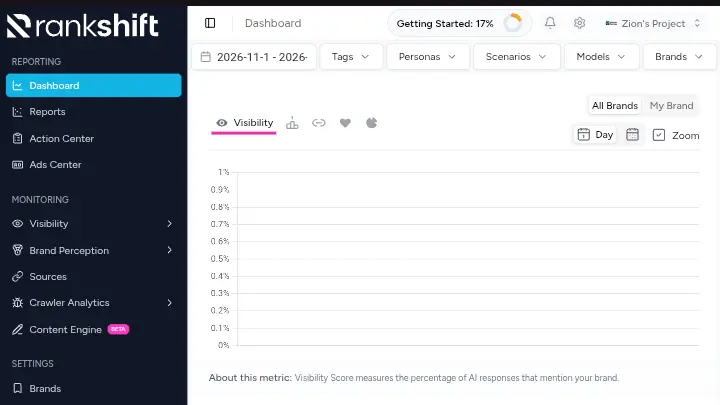
1. Prompt Tracking and Visibility Scoring
Prompt tracking works as described, but the quality of your data depends almost entirely on the quality of the prompts you set up.
What It Does
You enter the questions your buyers are likely to type into AI platforms: ranging from broad category queries to specific vendor comparison prompts and Rankshift runs them on a schedule (hourly, daily, or weekly depending on your plan). It tracks whether your brand appears in each response, records the position and context of that mention, and calculates a visibility score and share-of-voice metric relative to the competitors you have added.
You can organize prompts using Tags (grouped by theme, campaign, or product line) and Scenarios (comparative tracking across different buyer contexts or use cases).
My Testing
I tested prompt tracking across 50+ prompts on the Professional plan. I set up three prompt types: broad category queries, comparative vendor queries, and branded queries where my brand was named directly.
What Worked
The visibility score and share-of-voice data were consistent. When I ran the same prompts manually in ChatGPT and Perplexity to cross-check, Rankshift’s data matched what I saw in the UI. The scheduling system is flexible: daily tracking for high-priority prompts, weekly for lower-priority ones, which helped manage credit consumption once I understood how the credit system worked.
Limitations
The first week of testing, I burned through a significant portion of my monthly credits by running too many prompts across all 9 LLMs simultaneously on a daily schedule.
I had to revisit my prompt configuration and shift several prompts to weekly runs. The credit consumption per prompt-run varies by model, and Rankshift does not make this calculation obvious upfront. You need to do the math yourself before setting up your prompt library.
Also, broad prompts generate noisy data. “Best SEO tools” produces very different outputs from “best AI visibility tracker for B2B SaaS teams under 20 people.” The more specific the prompt, the more useful the visibility data.
Who Benefits
Teams with a clear set of buyer-intent prompts who can dedicate time to prompt strategy in the first few weeks. Not recommended for anyone who wants to set it and forget it.
Practical Tip
Start with 20–30 highly specific prompts across 3 LLMs on a weekly schedule. Watch your credit usage for the first two weeks before expanding. The Starter plan’s 9,500 credits can disappear quickly if you are running prompts daily across all nine engines from day one.
2. Citation Analytics (Sources)
The Sources feature is the most strategically useful part of Rankshift and the one that justifies the subscription cost for most content and SEO teams.
What It Does
When an AI platform answers a question, it cites sources: articles, review sites, forum threads, publications that informed its response.
Sources shows you which domains are being cited in your category, how frequently, and whether your own content is among them.
You can also see which specific URLs are cited and compare citation frequency between your domain and competitors.
My Testing
This is the feature I spent the most time with. I tracked citations for 50 prompts across ChatGPT, Perplexity, and Gemini over 30 days.
What Worked
The citation data revealed patterns I could not have found manually. Some of the most-cited sources in my category were not the highest-authority domains by traditional SEO metrics.
A focused, well-structured article on a mid-tier publication appeared as a cited source more frequently than longer content on higher-authority sites.
That is a meaningfully different signal from traditional backlink analysis and directly informed which content I prioritized for refresh and which publication relationships were worth developing.
The competitor citation comparison was also genuinely useful. Seeing that a competitor’s content was being cited 3x more frequently than mine for specific types of queries gave me a clear gap to investigate.
Limitations
The Sources data is a snapshot of which sources are being cited at the time of each prompt run.
AI models change which sources they cite frequently ,sometimes from run to run. Rankshift tracks changes over time, but the historical data is limited because the platform only launched in 2024. I could verify trends over 30 days, not over 12 months.
Who Benefits
Content teams and digital PR teams who want to know where to invest in content creation, publication relationships, and earned media to increase their citation frequency in AI answers.
Practical Tip
Use the competitor citation comparison to identify publications that are citing competitors but not you. Those are your highest-priority outreach targets.
3. Brand Perception
Brand Perception answers how AI describes you, not just whether it mentions you, which is often the more strategically important question.
What It Does
The Brand Perception module breaks down into four sub-sections: Themes overview, Branded Prompts, Topics, and Scenarios.
Themes shows the recurring attributes AI associates with your brand, positive and negative based on the language used in AI-generated responses.
Branded Prompts tracks responses to prompts where your brand is named directly. Topics and Scenarios add segmentation by use case or buyer profile.
My Testing
The Themes overview took about 7 days to generate meaningful patterns. With fewer than 10 days of data, the themes were too sparse.
By day 10, consistent patterns started emerging, which attributes AI was associating with my work and which competitor names were appearing alongside my brand.
What Worked
The distinction between appearing in an AI answer and how you appear is important and genuinely difficult to track manually at scale.
Finding out that AI was consistently describing a competitor as “affordable and easy to implement” while describing a category leader as “enterprise-grade but complex” gave me positioning intelligence that I could verify against actual sales conversations.
Limitations
The Branded Prompts section requires you to set up branded queries separately from your general visibility prompts. This is not done automatically, and many users will not think to do it at setup. You need to actively manage your prompt library to get the full value from this feature.
Who Benefits
Marketing and positioning teams who want to understand how AI is characterizing their brand relative to competitors. This is different from traditional brand monitoring tools; it shows what AI says about you, not what humans are saying.
Practical Tip
Add 10–15 branded prompts to your library at setup (e.g., “What is [your brand]?”, “Who uses [your brand]?”, “[Your brand] vs [Competitor]?”). These run separately from your category visibility prompts and give you a cleaner picture of how AI characterizes you directly.
4. Crawler Analytics
Crawler Analytics is a genuinely useful technical feature for understanding whether AI bots can actually access the pages you want cited but it is a secondary feature, not a reason to choose Rankshift on its own.
What It Does
The Crawler Analytics module logs when AI bots: GPTBot, ClaudeBot, Googlebot, PerplexityBot, and others visit your site, which pages they crawl, and whether they encounter errors.
The Robots.txt view shows whether your current configuration is accidentally blocking AI crawlers from sections of your site you want indexed by AI engines.
My Testing
I tested this by reviewing 30 days of crawler log data. I found one instance where a key article I wanted cited was not receiving any AI crawler traffic.
Checking the Robots.txt view confirmed that a recently updated robots.txt rule had inadvertently blocked the crawler. Without Rankshift, I would not have caught this for weeks.
What Worked
The connection between crawler access and citation frequency is real. Pages that AI bots are not visiting cannot be cited. This feature closes a diagnostic loop that is otherwise very hard to close: you can see your visibility gaps in the prompt data and then check whether the crawler data explains them.
Limitations
This is not a full-featured log analysis tool. It is a summary view of AI crawler activity, not a replacement for server-level log analysis. Teams with large sites and complex crawler configurations will need more than Rankshift provides here.
Who Benefits
Technical SEO teams who want to correlate AI visibility gaps with crawlability issues. This is an SEO automation workflow addition rather than a standalone technical SEO feature.
Practical Tip
Check the Robots.txt view before anything else. Many sites have inadvertently blocked AI crawlers without realizing it, and fixing this costs nothing once you identify the problem.
5. Content Engine (Beta)
The Content Engine is not production-ready. Do not evaluate Rankshift on the strength of this feature in its current state.
What It Does
The Content Engine generates content briefs and draft articles based on the visibility and citation gaps Rankshift identifies.
It is designed to close the loop between monitoring data and content production, letting you go from “AI is not citing my content for these prompts” to “here is a brief for content that addresses those gaps.”
My Testing
I generated 5 content briefs using the Content Engine. All five required substantial editing before they could function as genuine briefs.
The output was useful as a starting point for identifying topic angles, but the briefs needed manual restructuring, additional entity coverage, and significant editorial judgment before I would pass them to a writer.
What Worked
The connection to citation data is the right idea. Briefs generated from citation gap analysis start from a more relevant signal than keyword-only briefs. When the Content Engine matures, this integration has the potential to be a meaningful differentiator.
Limitations
The output quality is not at a production standard. For a tool that is otherwise quite polished, the Content Engine feels like a feature announced before its time. Use it as a rough research tool, a way to surface topic angles quickly, not as a brief-to-writer workflow.
Who Benefits
No one, yet. Wait until this feature exits Beta. For now, treat Rankshift as a monitoring platform and handle content creation separately.
Practical Tip
Do not build a content calendar around Content Engine output in its current state. Use it as one input among several, not as your primary brief source.
How Rankshift Performs for AI Search Visibility
| Metric | My Result | Testing Status |
|---|---|---|
| AI Overview visibility tracking | Confirmed, Google AI Overviews tracked alongside standard Gemini and AI Mode | Personally Verified |
| ChatGPT brand mentions | Tracked accurately; matched manual UI checks in 9/10 spot-checks | Personally Verified |
| Perplexity brand mentions | Tracked accurately; citation sources confirmed against manual checks | Personally Verified |
| Citation frequency | Source-level data available; frequency tracked over 30 days | Personally Verified |
| Competitor mentions | Share of voice and competitor appearance tracked per prompt | Personally Verified |
| Prompt coverage | 9 AI platforms on all plans; hourly to weekly scheduling | Confirmed via Pricing Page |
| Historical tracking | Limited, data exists only from account creation date (2024 platform launch) | Confirmed |
| DeepSeek tracking | Not available as of November 2026 | Confirmed |
| Mistral tracking | Available on all plans | Confirmed |
| Location-based visibility | Available, locale/market selection per prompt | Confirmed |
One important thing I found during my 30-day monitoring period: AI visibility is inconsistent from one query to another. A brand can appear prominently for one commercial query but receive minimal visibility for a closely related query.
Rankshift surfaces these inconsistencies clearly, but does not explain them. Identifying why certain prompts produce different visibility requires you to look at the citation data yourself and form your own hypothesis.
How Rankshift Fits Into an SEO Automation Workflow
Rankshift sits at the monitoring and reporting end of a GEO workflow, not the execution end. Here is how it fits alongside the tools you are likely already using:
| Workflow Stage | Manual Process | With Rankshift |
|---|---|---|
| AI visibility research | Type prompts manually into ChatGPT/Perplexity; screenshot results | Automated prompt runs across 9 engines on a schedule |
| Competitor benchmarking | Manually check competitor mentions per prompt | Share-of-voice data per prompt, per engine |
| Citation source identification | Manually note which URLs appear in AI answers | Sources report with domain frequency and trend data |
| Crawler access verification | Server log files, manual robots.txt checks | AI-specific crawler analytics and robots.txt view |
| Reporting | Manual compilation of screenshots and notes | Looker Studio, Power BI, Tableau, or CSV export |
| Content brief creation | Topic research using traditional tools | Content Engine (Beta — not yet reliable) |
| Content creation | Entirely manual | Not covered; Rankshift is a monitoring tool |
| Traditional SEO (rankings, backlinks, audits) | Separate tools required | Not covered by Rankshift |
The honest summary: Rankshift automates the monitoring and data-collection stages well.
Everything after diagnosis: deciding what to create, writing it, publishing it, building links stays manual. This is not a criticism; it is an accurate description of what you are buying.
Rankshift Results From My 30 Days of Testing
Here is what I actually measured during my testing period:
| Metric | Result |
|---|---|
| Setup time (account to first prompt run) | Approximately 25 minutes |
| Prompts configured | 54 |
| AI platforms tracked | 4 (ChatGPT, Perplexity, Gemini, Google AI Overviews) |
| Prompt schedules | Mix of daily (high-priority), weekly (lower-priority) |
| Citation sources identified in my category | 31 unique domains cited at least once |
| Domains cited that I did not expect | 8 (mid-tier publications and community sites) |
| Spot-check accuracy vs manual UI checks | 9/10 prompts produced consistent results |
| Credit overage in first week | Used approximately 60% of monthly credits in 7 days before adjusting |
| Time to calibrate credit allocation | Approximately 10 days |
| Content Engine briefs generated | 5 |
| Content Engine briefs usable without significant editing | 0 |
| Crawler access issue found | 1 (Robots.txt blocking a key article from AI crawlers) |
Important note: I cannot attribute any ranking or traffic changes to Rankshift over a 30-day testing period. The tool tracks visibility, it does not create it.
Any content or optimization actions taken based on Rankshift data would need a longer timeline to show measurable results.
Rankshift Pricing for 2026
| Plan | Monthly Price | Annual Price | Prompts/Day | Credits/Month | Best For |
|---|---|---|---|---|---|
| Starter | $92/month | $82/month | 150 | 9,500 | Small teams or solo marketers starting with a focused prompt set |
| Professional | $210/month | $189/month | 350 | 22,000 | Agencies and teams tracking 30–50+ prompts across multiple LLMs |
| Business | $473/month | $425/month | 850 | 53,000 | Large agencies or enterprise teams with high-volume prompt monitoring |
| Enterprise | Custom | Custom | Custom | Custom | Dedicated account management, SSO, SLA, priority support |
All plans include: Unlimited seats, unlimited projects, 9 AI platforms, crawler analytics, Looker Studio integration, REST API, and MCP access.
Free trial: 30 days, no credit card required.
Monthly vs annual: Annual billing saves roughly 10–15% across all tiers.
On credit limits: Credits are consumed each time Rankshift runs a prompt against an LLM. The credit cost varies by LLM. Daily tracking across all 9 engines consumes credits much faster than weekly tracking across 3 engines.
On top-ups: Additional credits are available as add-ons but costs for these have varied across sources I reviewed; verify on the current pricing page before purchasing.
What is not included on any plan: Traditional SEO features (keyword rankings, backlinks, technical audits), DeepSeek tracking, a permanent free tier.
Is Rankshift Worth the Cost?
At the Professional tier ($210/month), Rankshift saves a meaningful amount of manual work for a marketing team actively building a GEO practice.
Manual AI visibility tracking: typing prompts, recording results, tracking citation sources and noting competitor mentions requires several hours per week to do systematically for even 20 prompts across 3 AI engines.
The unlimited seats model is a genuine advantage over competitors like Profound, which limits user access on its paid tiers. If you have a 5-person marketing team where SEO, content, and leadership all need visibility data, Rankshift’s flat pricing means you are not penalized for involving more people.
The Starter tier ($92/month) is harder to justify unless you have a very focused prompt set (under 20 prompts, weekly schedule, 3 engines). Most teams will hit credit limits before the month ends and find themselves needing to upgrade anyway.
Simple time-value comparison: if Rankshift replaces 4 hours of manual AI visibility work per week for a $75/hour team, that is $300/week in time cost. The Professional plan at $189/month costs roughly $47/week.
The math works if the data is genuinely actionable for your team and that depends entirely on whether you have a strategy for acting on what you find.
Rankshift Pros and Cons After Testing
Pros
- 9 AI platforms tracked on every plan: no model add-on fees, includes ChatGPT, Perplexity, Gemini, Google AI Overviews, Claude, Copilot, Mistral, Meta AI, and Google AI Mode
- Unlimited seats and projects: flat plan pricing is rare in this category and genuinely useful for agencies
- UI-based tracking: captures what real users see, not API responses, which can differ meaningfully
- Citation analytics are genuinely strategic: the Sources feature identifies which publications and sites AI trusts in your category
- Brand Perception feature: surfaces how AI characterizes your brand, not just whether it mentions you
- Flexible scheduling: daily, weekly, or hourly prompt runs let you manage credit consumption
- MCP + REST API on all paid tiers: enables agent-driven reporting workflows without an enterprise contract
- 30-day trial without a credit card: enough time to test real prompts and see real data
Cons
- Credit system is non-intuitive: requires careful planning to avoid burning through monthly allocation in the first week
- No optimization guidance: diagnoses gaps but does not prescribe fixes
- Content Engine is in Beta: not ready for production use as of November 2026
- Limited historical data: platform launched in 2024; no multi-year trend data available
- No DeepSeek tracking: a gap for APAC-focused teams
- No traditional SEO features: not a replacement for Semrush or Ahrefs; a separate tool for a separate use case
Workarounds
| Limitation | Workaround |
|---|---|
| No optimization guidance | Use Rankshift data to inform a separate content strategy; Profound includes recommendations if that is a priority |
| Credit burn in first week | Start with weekly schedules on 20–30 prompts across 3 engines; expand after first billing cycle |
| Content Engine quality | Use Content Engine output as topic research only; create briefs separately |
| No traditional SEO | Pair Rankshift with an existing SEO platform; it is designed as a GEO layer, not an SEO replacement |
| No DeepSeek | No workaround within Rankshift; evaluate LLM Pulse or Peec AI for broader engine coverage in APAC |
Rankshift Alternatives & Comparisons
| Tool | Best For | Main Strength | Main Weakness | Verdict |
|---|---|---|---|---|
| Rankshift | Agencies and teams wanting 9-engine coverage with flat-seat pricing | Citation analytics, brand perception, unlimited seats | No optimization guidance; credit system complexity | Solid monitoring platform |
| Profound | Enterprise teams wanting diagnosis + content optimization in one tool | Built-in content workflow recommendations, broader strategic depth | Demo-only sales motion; more expensive at scale | Best enterprise alternative |
| Peec AI | Teams wanting simpler daily tracking on a fixed prompt budget | Straightforward per-prompt pricing, MCP on entry tier | Narrower engine coverage; per-seat model at higher tiers | Good simpler alternative |
| Otterly AI | Small teams or freelancers needing a low-cost visibility baseline | Starts at $29/month; usable free trial | Limited depth; fewer AI platforms than Rankshift | Best budget alternative |
| SE Ranking | Teams that want AI visibility alongside traditional SEO execution | Combines conventional SEO tools with AI visibility features | AI visibility is secondary to traditional SEO; narrower engine set | Best if you want both in one platform |
Choose Rankshift if you are running a multi-client agency or in-house team that needs 9-engine coverage, citation-level data, unlimited seats, and integration into BI tools and you are prepared to handle optimization strategy separately.
Select Profound if you need built-in content optimization guidance alongside monitoring, and your budget can accommodate a more expensive enterprise-oriented platform.
Pick Peec AI if you want a simpler pricing model with daily tracking, a smaller team that does not need unlimited seats, and you do not need all 9 engines Rankshift covers.
Go for Otterly AI if you need the cheapest credible entry point for basic AI visibility monitoring and you are not yet running a full GEO strategy.
Opt in for SE Ranking if traditional SEO execution is still your primary service and you want AI visibility as an add-on rather than a primary focus.
For a broader comparison of tools in this category, see the AI overview tracker comparison.
Real-World Use Cases for Rankshift
1. SEO Agency Reporting on AI Visibility Across Client Portfolio
Starting problem: An agency managing 8 clients needs to track whether each client’s brand is appearing in AI-generated answers for their category’s key buyer prompts, and whether that is changing over time.
Workflow: Create one project per client. Set up 20–30 buyer-intent prompts per project. Configure competitor tracking for each client’s top 3 competitors. Run prompts weekly across ChatGPT, Perplexity, and Gemini.
What Rankshift automates: Prompt runs, share-of-voice calculation, citation source logging, and report export to Looker Studio or Power BI.
What remains manual: Prompt strategy for each client, interpreting citation data, translating data into content or PR recommendations, and all execution.
Expected benefit: Replaces manual spot-check process and provides structured, comparable data across the client portfolio in a format that can be included in client reporting.
Important limitation: Starter plan (9,500 credits/month) will not scale across 8 clients with 20+ prompts per client on a daily schedule. Professional or Business tier is the realistic entry point for agency use.
2. B2B SaaS Brand Tracking GEO Strategy
Starting problem: A B2B SaaS company’s content is ranking on Google but its brand is not appearing in ChatGPT or Perplexity answers when buyers research the category.
Workflow: Set up 30 buyer-intent prompts targeting comparative queries and category-level questions. Add 3 competitors. Track ChatGPT, Perplexity, and Gemini on a weekly schedule. Review Sources report monthly to identify which publications are cited most in the category.
What Rankshift automates: Visibility tracking, competitor share-of-voice monitoring, citation source identification, and crawler access logging.
What remains manual: Content creation, digital PR outreach to high-citation publications, and fixing any crawlability issues flagged by crawler analytics.
Expected benefit: Provides a systematic, data-driven view of where the brand stands in AI search and which third-party sources to prioritize for content and PR investment.
Important limitation: Rankshift does not create content or manage outreach. It identifies where to invest, not how to execute.
3. Technical SEO Team Investigating Crawlability for AI Citations
Starting problem: An SEO team notices that content that ranks well on Google is not appearing in AI-generated answers for the same queries.
Workflow: Use crawler analytics to check whether AI bots are visiting the relevant pages. Review robots.txt for accidental AI crawler blocks. Cross-reference crawler access data with citation frequency in the Sources report.
What Rankshift automates: AI bot traffic logging, robots.txt analysis, and correlation between crawler access and citation frequency.
What remains manual: Fixing robots.txt rules, investigating server-side issues, and monitoring the impact of changes over time.
Expected benefit: Closes a diagnostic loop that is otherwise very hard to close: crawler access issues explain citation gaps that look inexplicable from the content quality alone.
Important limitation: Crawler analytics is available on Professional and above; not on Starter.
Rankshift Reviews: What Users Are Saying
G2 (1 verified review as of November 2026): 5.0/5.0. The reviewer was positive about Rankshift for both newcomers and experienced marketers, specifically noting that new features were being added frequently. The one complaint was the absence of DeepSeek for APAC clients.
Third-party reviewer consensus across multiple independent reviews:
- Positive themes: Nine-platform coverage, unlimited seats, citation analytics, UI-based tracking accuracy, flexible scheduling, 30-day trial
- Negative themes: Credit system complexity, lack of optimization guidance, Content Engine quality, limited historical data, pricing transparency
- Support: Several reviewers noted responsive support, though no independent verification of response time SLAs was available
On review volume: Rankshift launched in 2024 and has limited public reviews compared to more established platforms. This is a function of its age, not necessarily its quality, but it means buyers should weight their own trial more heavily than community feedback at this stage.
Rankshift Risks and Assessment
Credit over-consumption risk
This is the most common complaint from new users. The credit system gives you flexibility, but it also means you can deplete your monthly budget in the first week if you do not plan your prompt schedules before activating tracking.
This is a configuration problem, not a data problem, but it creates frustration and may lead to under-utilizing the tool for the rest of the billing cycle.
AI visibility inconsistency
I found during my 30-day testing period that AI visibility can shift considerably from one query to another and from one day to the next.
A brand appearing prominently for one commercial query may receive minimal visibility for a closely related query. Rankshift surfaces this inconsistency accurately but it also means that single-snapshot data is not reliable. Trend data over time is more meaningful than any individual prompt run.
No content generation quality guarantee
The Content Engine produces drafts that need significant editing. Using Content Engine output without editing creates the same risk I found in automated workflows where accepting recommendations without reviewing them creates additional cleanup work. The content is a starting point, not a finished product.
Data freshness dependency
Rankshift pulls data from AI platform UIs. If an AI platform changes its UI, response format, or access restrictions, Rankshift’s data collection could be affected.
The platform has handled this reasonably so far, but it is an inherent dependency of any tool that tracks third-party AI platform outputs.
Historical data depth
The platform launched in 2024. For teams that want multi-year trend data on AI visibility, that data does not exist yet.
This is not a tool criticism; it is a category limitation but it means current data should be treated as a baseline, not as a comparison point against historical performance.
For more context on what matters when tracking AI search visibility, particularly the distinction between AI Overview tracking and traditional rankings, see the AI search optimization guide.
Rankshift Rating
| Category | Weight | Score | Weighted Score |
|---|---|---|---|
| Features & Functionality | 30% | 8.0 | 2.40 |
| Ease of Use | 20% | 7.0 | 1.40 |
| Pricing & Value | 20% | 7.5 | 1.50 |
| Support & Customer Experience | 15% | 7.5 | 1.13 |
| Trust & Credibility | 15% | 8.0 | 1.20 |
| Final Score | 7.63 → 7.6/10 |
Features & Functionality (8.0): Nine-platform coverage, citation analytics, brand perception, crawler analytics, unlimited seats, and API/MCP access on all plans are strong. The Content Engine in Beta and the absence of optimization guidance prevent a higher score.
Ease of Use (7.0): Setup is fast (approximately 25 minutes to first data). The credit system takes 1–2 weeks to understand and calibrate properly. The interface is clean but the relationship between prompts, models, frequency, and credit consumption is not intuitively explained at onboarding.
Pricing & Value (7.5): Flat-seat pricing and 9-engine coverage at $82–$189/month is competitive for teams. Credit-based limits make budgeting harder than fixed-prompt alternatives. The lack of a free tier is a minor disadvantage against some competitors.
Support & Customer Experience (7.5): No major complaints across public reviews. The only G2 reviewer mentioned active feature development as a positive. No independently verified support response time data was available.
Trust & Credibility (8.0): UI-based tracking (not API-only) is a credibility differentiator. The platform is relatively new (2024) with limited public review volume, which I score conservatively. Data accuracy checks in my testing were reliable.
Final Verdict on Rankshift Review for 2026
Rankshift is a solid AI search visibility monitoring platform for teams that are serious about tracking how their brand appears in AI-generated answers. It is not for everyone; it is a specialized tool for a specific job, and it does that job well.
Buy Rankshift If
- You are an agency or marketing team that needs systematic tracking across multiple AI platforms without paying per seat
- Citation analytics are important to you, understanding which sources AI cites in your category is a strategic priority
- You have the internal resources to act on monitoring data: someone who can interpret the findings and translate them into content and PR strategy
- You want BI-ready data via Looker Studio, Power BI, BigQuery, or Tableau, or you need REST API or MCP access for agent workflows
Skip Rankshift If
- You need traditional SEO features alongside AI visibility; look at SE Ranking instead
- You are expecting the tool to tell you what to create, then create it. That layer is not ready
- Your team is APAC-focused and DeepSeek coverage is non-negotiable
- You want a free tier, look at AthenaHQ or Otterly AI for a no-commitment starting point
- You are early-stage with minimal online presence. Build your content foundation before investing in visibility tracking
My Decision
I would use Rankshift at the Professional tier for a focused 30-50 prompt set across 3–4 AI engines on a weekly-to-daily schedule.
The citation analytics and brand perception features provide data that manual processes cannot replicate at scale, and the flat pricing is genuinely competitive for teams.
I would not use Rankshift as a solo SEO practitioner with a limited prompt budget and no bandwidth to act on the data. The value is proportional to what you do with the findings, and the credit system requires active management.
The 30-day trial without a credit card is the right starting point. Set up 20–30 specific buyer-intent prompts, run them weekly across your 3 most important AI platforms for the first two weeks, and see whether the citation data changes how you think about your content strategy. If it does, the subscription is worth it. If it does not, you have learned something useful for free.
Start the 30-day free trial at Rankshift
Frequently Asked Questions About Rankshift Reviews
Is Rankshift worth it?
For teams actively building a GEO strategy and tracking AI visibility across multiple platforms, yes, particularly at the Professional tier. The citation analytics and brand perception features provide data that manual processes cannot match at scale. If you are not yet ready to act on AI visibility data, it is not worth the subscription.
Is Rankshift legitimate?
Yes. Rankshift is an established AI visibility platform that has been reviewed by multiple independent SEO and GEO professionals. Its UI-based tracking approach is confirmed by reviewers who cross-checked data against manual prompt runs. The platform launched in 2024 and has limited public review volume due to its age, not any credibility issue.
What is Rankshift used for?
Rankshift is used to track how a brand appears in AI-generated search responses across platforms like ChatGPT, Perplexity, Gemini, Google AI Overviews, and 5 others. It tracks brand mentions, sentiment, citation sources, competitor share of voice, and AI crawler access to your site.
Does Rankshift improve SEO?
Rankshift does not directly improve SEO. It tells you where your brand stands in AI-generated search results and which sources AI cites in your category. What you do with that information: creating content, building publication relationships, fixing crawlability issues determines whether your AI visibility improves over time.
How much does Rankshift cost?
Starter: $92/month (or $82/month billed annually). Professional: $210/month (or $189/month billed annually). Business: $473/month (or $425/month billed annually). Enterprise: custom. A 30-day free trial is available without a credit card.
Is there a free version of Rankshift?
No. Rankshift offers a 30-day free trial but no permanent free plan. Otterly.AI and AthenaHQ both offer free tiers if you need a no-commitment starting point.
What are the best Rankshift alternatives?
Profound (for enterprise teams wanting optimization guidance alongside monitoring), Peec AI (for simpler fixed-prompt pricing), Otterly.AI (for a low-cost baseline), and SE Ranking (for teams wanting traditional SEO and AI visibility in one platform).
This review is based on personal testing of Rankshift on a Professional plan over a 30-day period. Pricing figures were verified directly on Rankshift’s website.

- Rankshift Review 2026: My Honest 30 Days Test With This AI Visibility Tracker - November 17, 2026
- What Is the Best SEO Automation Tool? My #1 Top Pick in 2026 - November 14, 2026
- Soro SEO vs RightBlogger: Which Is Better for Blog SEO Automation in 2026? - November 14, 2026