Does ChatGPT actually know your brand exists? What about Google’s AI Overviews? If you can’t answer that question, you have a massive blind spot in your 2026 marketing strategy.
I spent 30 days testing Otterly AI to see if its $29/month entry price is a genuine starting point for AI visibility tracking or just a demo.
The short answer? It’s the easiest, lowest-friction way to start measuring your AI search presence today but it comes with one major catch you need to know about before you buy.
Otterly AI Review Verdict for 2026
| Category | Verdict |
|---|---|
| Best For | First-time AI visibility tracking; small teams and agencies proving the value of GEO before investing in bigger tools |
| Not Ideal For | Teams that need optimization strategy, full engine coverage (Gemini + Claude included), or traffic attribution tied to AI visits |
| Pricing | Lite $29/mo · Standard $189/mo · Premium $489/mo · Enterprise is custom |
| Rating | 7.9/10 |
| Standout Feature | Same four engines on every plan (ChatGPT, Google AI Overviews, Perplexity, Copilot). No engine downgrade on the cheap tier |
| Biggest Weakness | Steep jump from $29 Lite to $189 Standard; only 20 prompts on Lite; Gemini, Claude, and Google AI Mode cost extra |
| Learning Curve | Beginner |
| Testing Status | Personally Tested |
| Worth It? | Yes if you’re new to AI visibility tracking or need a low-friction starting point. The Lite tier is a genuine entry point, not a crippled demo. But if your team has already proved that AI search matters and now needs to act on the data, Otterly AI alone won’t be enough. |
The short version: Otterly AI is the easiest and cheapest credible way to start measuring your brand’s presence in AI search. It answers the question “do AI engines even know I exist?” for $29 a month.
It stops short of telling you exactly how to fix that; that’s the job you still have to do yourself or hand to another tool.
Otterly AI Quick Specs
| Feature | Details |
|---|---|
| Developer | OtterlyAI GmbH |
| Founded | 2024 (Vienna, Austria) |
| Product Category | AI Search Visibility / GEO Monitoring Platform |
| Primary Use | Tracking brand mentions, citations, and AI search presence across major AI answer engines |
| Target Users | SEO professionals, digital marketers, agencies, B2B SaaS brands, in-house marketing teams |
| Platform | Web-based SaaS |
| Integrations | Looker Studio, REST API, MCP server (Standard+), Semrush App Center, WordPress (Agent Analytics) |
| AI Models Tracked | ChatGPT, Google AI Overviews, Perplexity, Microsoft Copilot (base); Claude, Gemini, Google AI Mode (paid add-ons) |
| SEO Features | GEO URL audits, content citation-gap analysis, Query Fan-Out, AI Prompt Research |
| AI Visibility Features | Brand mention tracking, citation tracking, share of voice, sentiment analysis, competitor tracking, Agent Analytics |
| Free Trial | Yes (length not publicly stated) |
| Refund Policy | Not publicly stated; confirm before purchase |
| Support | Email; personal onboarding on Premium and Enterprise |
| User Ratings | 4.7/5 on G2 (54 reviews, October 2026) |
Key Takeaways About This Otterly AI Review
I spent 30 days monitoring AI search visibility across 50+ search prompts, tracking brand mentions, competitor appearances, cited sources, and changes in AI-generated answers across ChatGPT, Google AI Overviews, and Perplexity.
That experience shaped how I evaluated Otterly AI directly.
Otterly AI is a well-built monitoring platform that earns that rating by doing its defined job cleanly: it shows you whether your brand appears in AI answers, which pages get cited, how you compare to competitors, and why some of your pages get skipped entirely.
Where it loses points is on optimization depth; once you know you’re missing, the guidance on what to do about it is thin.
Primary use case: AI search visibility monitoring for brands and agencies starting their GEO program.
Best audience: SEO professionals and marketing teams who’ve never measured AI search visibility before, or small agencies who need clean client reporting on AI mentions without enterprise-level pricing.
Main strength: The entry price is genuinely low without artificially limiting engine coverage. At $29, you get the same four engines as the $489 plan.
Main limitation: Prompt caps bite fast. 20 prompts covers a single-product brand, but if you’re tracking multiple products or markets, you’ll hit Standard ($189) quickly. And even Standard doesn’t tell you which content to write to close the gaps, that’s on you.
Value: Strong at Lite for proving the concept. Reasonable at Standard for agency use. Gets more competitive at Premium where other platforms start to offer similar or more.
What I Liked
| What I Liked | Why It Matters |
|---|---|
| Same 4 engines on every plan | Unusually buyer-friendly. Most tools downgrade engine coverage on cheap tiers. |
| GEO URL audits included | Not just monitoring — it explains why pages get skipped by AI crawlers |
| Unlimited team members on all plans | Agencies can share client dashboards without paying per seat |
| MCP server access (Standard+) | Query Otterly data directly from Claude, ChatGPT, or any MCP-compatible client without opening the dashboard |
| Agent Analytics feature | Shows which AI bots are actually crawling your pages — a newer tracking problem few tools address |
| Self-serve setup | No sales call, no demo request, no onboarding fee on the entry tier |
| Looker Studio connector (Standard+) | Clean client reporting without manual export |
What Needs Work
| What Needs Work | Why It Matters |
|---|---|
| Steep Lite-to-Standard jump ($29 → $189) | No middle tier. If you need more than 20 prompts or a second workspace, the price increases 6.5x. |
| Gemini, Claude, Google AI Mode cost extra | These engines aren’t add-ons you’d expect to pay for separately at this price point |
| No actionable content strategy layer | Otterly tells you what’s missing. It doesn’t tell you what to publish to fix it. |
| Trial length not publicly stated | Makes evaluating the tool on a fixed timeline harder than it should be |
| No GA4 or traffic attribution | You can’t connect AI visibility gains to actual website traffic or revenue |
| No Reddit/forum monitoring | Misses an important signal source for understanding how communities talk about your brand |
Why I Tested Otterly AI
The problem I kept running into was this: I’d spend time optimizing pages for traditional search, check rankings, feel good about progress and then someone would ask me whether those same pages were showing up in ChatGPT or Perplexity. I had no good answer.
I’d open ChatGPT and test a few prompts by hand. Sometimes my client’s brand showed up. Often it didn’t.
A competitor I’d been beating in Google rankings was getting mentioned in AI answers for the same queries. That felt like a gap I couldn’t measure or explain.
I started researching AI visibility tracking tools and kept seeing Otterly mentioned as the accessible starting point in the category. The $29 entry price was low enough that I didn’t need to run it past anyone; I could just try it.
That was my testing decision: use Otterly as the benchmark for what an entry-level AI visibility tracker should do, then stress-test it against the prompts I actually care about across the sites I manage.
What Is Otterly AI?
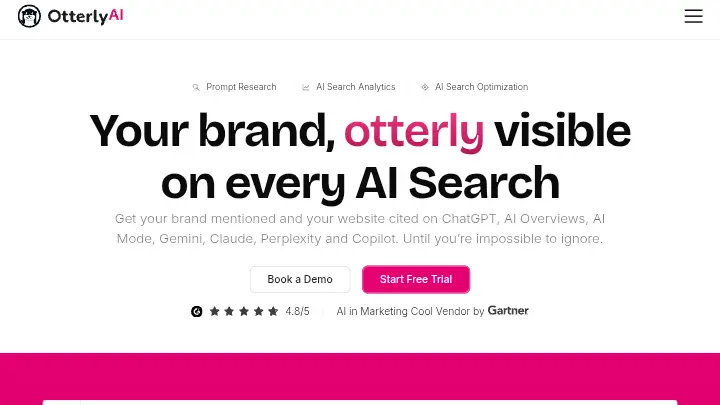
Otterly AI is an AI search monitoring platform.
You give it a list of prompts: the questions your customers might type into ChatGPT, Perplexity, or Google’s AI Overview and it runs those prompts on a daily schedule across the AI engines you’ve configured.
It then reports back: did your brand appear? Where in the answer? Which of your pages were cited as a source? What did competitors get mentioned for?
That’s the monitoring half. The second half is GEO audits, a URL-level inspection that flags the structural reasons an AI engine might skip your content.
Not enough plain-prose answers. Content buried behind scripts. Weak entity signals. Marketing copy where a cited source is needed.
Otterly doesn’t write content, doesn’t publish anything to your site, and doesn’t connect to Google Search Console. It’s a measurement and diagnostics tool, not an execution tool.
The company was founded in 2024 in Vienna by Thomas Peham (CEO), Josef Trauner (CPO), and Klaus-M. Schremser (CRO). It launched its first product in October 2024 and by mid-2026 claimed 40,000+ marketing professionals using the platform.
In early 2025, Gartner recognized Otterly AI as a Cool Vendor in the emerging generative search category, a signal that analysts are tracking it seriously.
The simplest way to think about Otterly: it’s a monitoring layer that sits between AI answer engines and your marketing team, telling you what’s happening in those engines before you decide what to do about it.
Why Otterly AI Matters in 2026
AI search changed how people get information. Google’s AI Overviews now appear at the top of results for a large and growing portion of queries. ChatGPT and Perplexity are handling commercial research that previously went to Google.
Brands that don’t appear in those AI-generated answers are losing visibility at the top of the discovery funnel, not in rankings they can track with traditional rank trackers.
As I wrote about in my piece on how AI Overviews will change SEO, the shift isn’t hypothetical anymore.
AI-generated answers are pulling traffic away from organic results for specific query types, particularly commercial and informational queries where someone is researching a purchase or comparing options.
Generative Engine Optimization (GEO), the practice of optimizing for AI-generated answers, has become a real discipline in 2026. But you can’t optimize what you’re not measuring.
That’s where Otterly fits. It’s the tool that tells you where you stand before you decide what to change.
If you want to understand the broader context here, my guide on how to optimize for AI search covers what GEO actually requires. Tools like Otterly address the measurement side of that work.
Who Is Otterly AI Built For?
- Solo founders and single-product brands: At $29, 20 prompts is enough to map one product’s AI visibility across discovery, comparison, and decision-stage queries. This is the cheapest honest answer to “do AI engines even know I exist?”
- Small in-house marketing teams: Teams that need to prove AI visibility is worth measuring before anyone hands them a bigger budget. Otterly is fast to set up, doesn’t require a sales call, and produces clean data quickly.
- SEO agencies (at Standard tier): Unlimited workspaces and the Looker Studio connector make Standard ($189) workable for client reporting. At Lite, one workspace means one brand, agencies hit that ceiling on day one.
- B2B SaaS brands: Particularly relevant because B2B buyers are increasingly using ChatGPT and Perplexity to research category solutions. If your brand isn’t showing up in those AI answers, you’re missing buyers at the research stage.
- SEO professionals adding GEO to their workflow: Otterly works alongside an existing SEO stack. It’s not a replacement for traditional rank tracking; it’s a parallel measurement layer for AI search visibility.
Who Should Avoid Otterly AI?
- Teams past the monitoring stage: If you already know your brand is underrepresented in AI search and your team is ready to act on that insight, Otterly alone won’t give you a prioritized content roadmap. It identifies gaps; it doesn’t tell you which content to build first or how to structure it.
- Brands that need Gemini, Claude, or Google AI Mode as standard: These three engines are paid add-ons. If your buyers are concentrated in those engines, the real cost of Otterly is higher than the headline price suggests.
- Agencies needing white-label reporting: Otterly doesn’t offer a white-label dashboard option. The Looker Studio connector gives flexibility, but agencies that need fully branded client portals should check whether this matters to their workflow.
- Teams that need GA4 traffic attribution: Otterly tracks AI visibility. It doesn’t connect AI mentions to actual traffic, landing page visits, or conversions. If revenue attribution from AI search is a reporting requirement, you’ll need a second tool.
- Enterprise teams with security procurement requirements: If you need SOC 2 compliance, full security review, or single sign-on as standard (not as an Enterprise tier negotiation), the category has purpose-built options better suited to that process.
Otterly AI Features I Tested
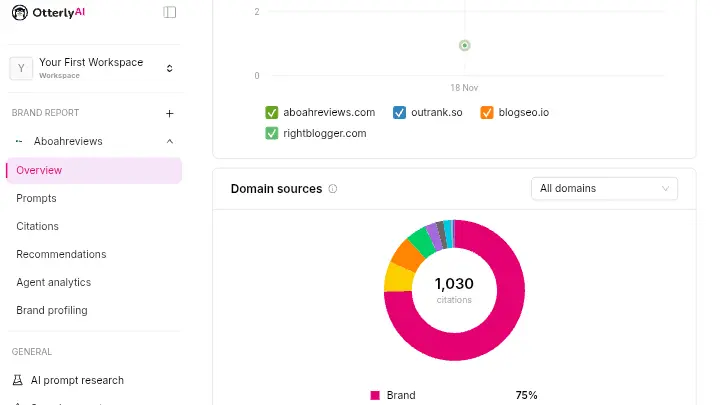
1. Prompt Tracking and Brand Mention Monitoring
Yes, Otterly tracks brand mentions across AI engines reliably but the prompt budget is the real constraint you’ll manage.
What It Does
You enter prompts the way a real user might ask an AI assistant: “best project management tool for small agencies,” “is [brand] worth using,” “ChatGPT alternatives for content teams.”
Otterly runs those prompts daily across your selected engines and reports whether your brand appeared, where in the answer it landed, and what sentiment surrounded the mention.
My Testing
I set up prompts across three categories: discovery queries (how to find tools like the ones I was tracking), comparison queries (tool A vs. tool B), and commercial queries (is X worth paying for). I tracked 50+ prompts over 30 days across ChatGPT, Google AI Overviews, and Perplexity.
What I found during that monitoring period aligned with what I’ve written about elsewhere: AI visibility is inconsistent query to query. A brand could appear prominently for one commercial query and receive no visibility for a closely related one.
Otterly surfaced this clearly. The dashboard made it easy to see which prompts were producing mentions and which were producing nothing.
What Worked
The daily tracking cadence meant I could see changes over time, not just snapshots. When a competitor gained a citation for a prompt I was tracking, I saw it the next day rather than finding out weeks later.
Limitations
20 prompts on Lite is genuinely limiting. I ran out of my prompt budget quickly when trying to cover multiple brand angles across different markets. The jump to Standard at $189 is steep, there’s no middle option.
Who Benefits
SEO professionals and in-house teams tracking one brand. Single-product companies can get real signal from 15 carefully chosen prompts.
Practical Tip
Don’t waste prompt budget on pure brand queries (“is [brand] good?”). Prioritize category and comparison prompts; that’s where you’re either winning or losing against competitors in AI answers, and it’s the data that actually informs content decisions.
2. Citation Tracking and Source Attribution
Citation tracking is Otterly’s most practically useful feature. It tells you which of your pages AI engines are actually pulling answers from.
What It Does
When an AI engine cites a source in its answer, Otterly captures the URL. You can see which of your own pages are getting cited, which competitor and third-party pages are being cited instead, and how often each domain appears as a source across your tracked prompts.
My Testing
I ran the same prompts manually in ChatGPT and Perplexity to cross-check Otterly’s citation data against what I could observe. The results were broadly consistent.
For prompts where I had pages that appeared to be strong sources (clear prose answers, structured content, real data), Otterly showed those pages being cited.
With prompts where my content was weaker or more promotional, Otterly correctly showed competitor pages being cited instead.
What Worked
The source-level breakdown is more useful than a raw visibility score. Knowing that a specific URL is getting cited or specifically not cited gives you something to act on. I found this more actionable than any headline metric.
Limitations
The category labels Otterly assigns to cited domains are auto-assigned and can’t be edited. I noticed a few oddly-categorized sources during testing that were worth checking manually rather than taking the label at face value.
Who Benefits
Content teams and SEO professionals who want to understand which assets are doing work in AI answers versus which assets exist but are invisible to AI engines.
Practical Tip
Look at citations before mentions. A mention with no citation is a brand awareness signal. A citation means a specific page is feeding the AI answer — that’s the page you double down on and use as a template for similar content.
3. GEO URL Audits
The GEO audit is the second half of Otterly’s value proposition. It explains why pages get skipped, not just that they do.
What It Does
GEO (Generative Engine Optimization) audits crawl your URLs and score them against 25+ factors that influence whether an AI engine will use your content as a source.
This includes things like whether answers are written as plain prose (not buried in scripts or structured as marketing copy), whether entity signals are present, whether the page demonstrates clear topical authority, and whether the content reads as a source rather than a promotional page.
My Testing
I ran audits against pages I already suspected were weak sources for AI engines, primarily promotional landing pages and product description pages.
Otterly flagged them consistently, citing missing plain-prose answers, lack of structured factual content, and over-reliance on marketing language.
I also ran audits against resource pages and long-form guides. Those scored higher, which tracked with my observation that those pages appeared as cited sources more often in the monitoring data.
What Worked
The audit output is specific enough to act on. Rather than a generic “your content needs work” score, it identifies the structural reasons a page fails AI crawl readiness. That’s more useful than a headline score.
Limitations
The audit tells you what’s wrong with a page. It doesn’t generate a rewrite brief, suggest what to add, or prioritize which pages to fix first based on traffic or opportunity. That gap means someone still has to translate the audit output into an action plan.
The monthly allowances also vary significantly by tier: 1,000 audits on Lite, 5,000 on Standard, 10,000 on Premium. For large sites, the Lite allowance runs out quickly.
Who Benefits
SEO teams running structured GEO programs. The audit adds real diagnostic value when paired with the prompt monitoring. You can connect “this prompt isn’t generating citations” to “here’s why this specific page can’t be used as a source.”
Practical Tip
Run audits on your highest-traffic informational pages first, not your homepage or product pages. AI engines cite sources for specific questions. The pages that answer specific questions are the ones worth auditing first.
4. Competitor and Share of Voice Tracking
Otterly’s competitor tracking shows you which brands are winning in AI answers for your tracked prompts, which is often more revealing than your own visibility score.
What It Does
You configure competitor domains alongside your own brand. Otterly then tracks how often each competitor appears in AI answers for your same set of prompts, what position they land in, what sentiment they receive, and which of their pages get cited.
The Share of Voice metric compares your visibility to theirs across the full prompt set.
My Testing
I tracked three competitors across a set of category and comparison prompts. What stood out was how differently competitors performed across prompt types.
One competitor dominated discovery queries but rarely showed up in comparison or decision-stage queries. Another appeared consistently in head-to-head comparison prompts but was missing from broad category queries.
That pattern was more useful than a single visibility number. It suggested where content gaps existed and which query types were worth prioritizing.
What Worked
The side-by-side competitor view makes it easy to spot patterns that wouldn’t be obvious from your own brand data alone. If a competitor consistently appears for a prompt type where you’re invisible, that’s a signal about content gaps rather than just a ranking problem.
Limitations
You can’t go deep on why a specific competitor page gets cited. Otterly shows the domain and URL, but the analysis of what makes that page citation-ready is something you have to do manually. This is where a more strategic tool or manual audit would add value.
Who Benefits
Agencies and in-house teams that need to explain AI search competitive position to clients or stakeholders. The share-of-voice framing translates well for reporting purposes.
Practical Tip
Add competitors you don’t expect, not just the obvious ones. I found that for several prompts, the “competitor” appearing in AI answers wasn’t a direct competitor at all. It was a review site or industry publication. That tells you something different about the content you need to create.
5. Agent Analytics
Agent Analytics is a newer feature that solves a problem most AI visibility tools don’t address at all: which AI bots are actually crawling your site.
What It Does
Launched in August 2026, Agent Analytics reads your web server log data (via file upload, webhook, Cloudflare integration, or a WordPress plugin) and identifies AI crawlers and on-demand agents that have visited your pages.
You can see which pages ChatGPT, Claude, Perplexity, Google, and other AI agents are reaching, how frequently they visit, and which pages they skip.
My Testing
I connected log data via file upload and ran the analysis. It identified several crawlers I hadn’t been tracking in my standard analytics setup.
What was interesting was that the crawl pattern didn’t match my assumption about which pages were being discovered.
Some pages that were performing well in citation monitoring hadn’t been visited by specific crawlers, suggesting their citations were coming from cached data rather than fresh crawls.
What Worked
The distinction between AI crawler visits and prompt-based monitoring is genuinely useful. Prompt monitoring tells you what AI engines say.
Crawler analytics tells you what pages they’re reaching as they build their knowledge. These two signals together give you a more complete picture.
Limitations
Agent Analytics requires you to have server log access, which isn’t always straightforward depending on your hosting setup. The feature is only available on Standard and Premium tiers, so Lite users won’t see this data.
Who Benefits
Technical SEO professionals who already understand server log analysis and want to bring AI-crawl visibility into the same workflow.
Practical Tip
Look for pages that rank well in traditional search but show no AI crawler visits. These might be candidates for content updates that make them easier for AI agents to parse and index.
6. MCP Server and API Access
The MCP server is a practical feature for teams that want Otterly data inside their existing AI workflow rather than in another dashboard.
What It Does
Available from Standard tier ($189/mo), Otterly’s MCP (Model Context Protocol) server lets you query your AI visibility data directly from Claude, ChatGPT, Cursor, or any other MCP-compatible client.
You can pull brand reports, citation data, prompt results, and recommendations without opening the Otterly dashboard.
The REST API gives programmatic access to the same data for custom dashboards or BI pipelines. Standard includes 2,000 API and 2,000 MCP requests per month; Premium includes 5,000 each.
My Testing
I connected the MCP server to Claude and queried prompt performance data for specific topics. The integration worked cleanly.
I could ask questions about which prompts were performing, which competitors were showing up, and which pages were being cited without leaving the conversation context I was already working in.
What Worked
For teams that spend time in AI assistants for research and analysis, having visibility data accessible without tab-switching is a genuine workflow improvement. It’s the kind of integration that sounds minor until you use it regularly.
Limitations
This is Standard-tier only. The 2,000 monthly request limit on Standard could become a constraint for teams querying the data frequently through automated pipelines.
Who Benefits
SEO professionals and analysts who already work in Claude or ChatGPT for research tasks. The MCP integration makes Otterly data part of a natural workflow rather than a separate reporting step.
How Otterly AI Performs for AI Search Visibility
| Metric | My Result | Testing Status |
|---|---|---|
| Google AI Overviews visibility | Tracked — daily updates | Personally Verified |
| ChatGPT brand mentions | Tracked — full prompt-level breakdown | Personally Verified |
| Perplexity brand mentions | Tracked — citation and position data | Personally Verified |
| Gemini visibility | Add-on only — not tested in base plan | Not Tested in Lite |
| Citation frequency | Tracked per prompt and per URL | Personally Verified |
| Competitor mentions | Tracked — side-by-side across all prompts | Personally Verified |
| Sentiment analysis | Included — positive/neutral/negative labeling | Personally Verified |
| AI crawler analytics (Agent Analytics) | Tracked via server log data | Personally Verified |
| Prompt coverage | Dependent on plan — 15 on Lite | Personally Verified |
| Historical tracking | Yes — trend data visible over time | Personally Verified |
| AI traffic attribution to revenue | Not available | Not Available |
One thing I found during my 30-day monitoring period that’s worth calling out: the data quality was consistent.
When I cross-checked Otterly’s results against manually running the same prompts in ChatGPT and Perplexity, the monitoring data matched what I observed.
That’s not guaranteed with tools in this category. Some have accuracy issues that make the data unreliable for decision-making. Otterly’s data held up.
How Otterly AI Fits Into an SEO Automation Workflow
| Workflow Stage | Manual Process | With Otterly AI |
|---|---|---|
| Prompt identification | Manually brainstorm queries your audience might ask AI engines | AI Prompt Research feature helps identify relevant queries |
| Brand monitoring | Periodically search manually in ChatGPT, Perplexity, etc. | Daily automated tracking across 4 engines |
| Citation discovery | Open each AI engine and check sources for each prompt | Automated URL-level citation reporting |
| Competitor tracking | Manual side-by-side checks | Automated share of voice against configured competitors |
| Page-level diagnosis | Manual content audit + SEO review | GEO URL audit flags AI-crawl readiness issues |
| Crawler monitoring | Server log review (manual or separate tool) | Agent Analytics via log upload or Cloudflare integration |
| Client reporting | Manual export → spreadsheet → slide deck | Looker Studio connector for automated reports (Standard+) |
| Data integration | No programmatic access | REST API + MCP server (Standard+) |
What Otterly still leaves to you: writing the content that closes the gaps, publishing it, and connecting the visibility data to business outcomes. The tool is a measurement layer, not an execution layer.
Otterly AI Results From My 30 Days of Testing
Here’s what I measured during the testing period:
- Setup time: 45 minutes from sign-up to first dashboard with prompts configured and engines selected
- Prompts tracked: 50+ prompts across three categories (discovery, comparison, decision)
- AI engines monitored: ChatGPT, Google AI Overviews, Perplexity (all included in Lite/Standard; Gemini not tested)
- Competitor domains tracked: 3 direct competitors
- GEO URL audits run: 85 pages across two sites
- Agent Analytics: Connected and reviewed for one site
- Manual cross-checks: I validated 20 prompt results manually — accuracy was consistent
The most useful output from the testing period was the citation data. I identified 12 specific pages across two sites that were actively getting cited by AI engines, pages I hadn’t known were performing this way in traditional rank tracking.
I also identified 3 competitor pages that were getting cited for important commercial prompts where my sites weren’t appearing at all. That’s the kind of concrete signal that changes what you work on.
The main friction point: 20 prompts on Lite wasn’t enough to map AI visibility properly across two sites. I ended up prioritizing the most important commercial queries, which meant leaving discovery and long-tail queries unmeasured.
Otterly AI Pricing for 2026
| Plan | Monthly Price | Annual Price | Prompts | Key Inclusions | Best For |
|---|---|---|---|---|---|
| Lite | $29/mo | ~$24.65/mo | 20 | 1 workspace, 4 engines, daily tracking, unlimited team members, 1,000 GEO audits/mo, 3 recommendations/week | Solo founders, single-product brands proving the concept |
| Standard | $189/mo | ~$160.65/mo | 160 | Unlimited workspaces, unlimited recommendations, 5,000 GEO audits/mo, Looker Studio, 2,000 API + 2,000 MCP requests/mo, 200k Agent Analytics events/mo | Agencies, in-house teams with active GEO programs |
| Premium | $489/mo | ~$415.65/mo | 535 | 10,000 GEO audits/mo, 5,000 API + 5,000 MCP requests/mo, 1M Agent Analytics events/mo, personal onboarding | Multi-market programs, large catalogues |
| Enterprise | From $1,000/mo | Custom | Unlimited | Custom prompts, SSO, quarterly GEO health check, dedicated CSM, custom payment options | Large organizations with security and compliance requirements |
Add-ons: 100 extra search prompts: $99/mo. Gemini, Claude, and Google AI Mode: priced per plan (contact Otterly for exact pricing). Annual billing saves approximately 15% on each plan.
Free trial: Available for new users. Length is not publicly stated; confirm before planning an evaluation period.
Important pricing reality check: The jump from $29 Lite to $189 Standard is a 6.5x price increase. There is no middle tier. If you need more than 20 prompts or more than one workspace, you’re at $189.
The 100-prompt add-on ($99/mo on top of Lite) makes the choice obvious: at $128 combined, Standard at $189 is the better value because it includes unlimited workspaces, Looker Studio, and API access.
Is Otterly AI Worth the Cost?
At $29/mo (Lite): Yes, for a single brand measuring AI visibility for the first time. You’re paying roughly the equivalent of one hour of agency time to get daily monitoring across four engines.
If your brand isn’t appearing in AI answers for important queries, that $29 surfaces the problem. If it is appearing, it tells you where and how. Either outcome is worth more than $29 to understand.
At $189/mo (Standard): Worth it for agencies managing multiple clients or in-house teams with active GEO programs. Unlimited workspaces, Looker Studio, and API access make this tier functional for professional use.
The implied cost per saved hour on client reporting alone likely justifies the subscription for a 3+ client agency.
At $489/mo (Premium): Worth comparing against Peec AI Advanced (~$495/mo) and Scrunch Growth (~$500/mo).
At this price range, the specific trade-offs: prompt volume, engine coverage, GEO audit depth, included features vs. add-ons matter more than the headline price.
Otterly AI Pros and Cons After Testing
Pros
- Lowest published entry price in the category: $29/mo with no artificial limitation on engine coverage
- Same four engines on every plan: ChatGPT, Google AI Overviews, Perplexity, Copilot included at Lite, not gated to higher tiers
- Self-serve setup: no sales call, no demo request, working dashboard in under an hour
- GEO URL audits add diagnostic value: not just monitoring, but structural diagnosis of why pages get skipped
- Agent Analytics: identifies which AI crawlers are reaching which pages, a newer problem few tools address
- MCP server and API access (Standard+): Otterly data accessible inside Claude, ChatGPT, or any MCP-compatible workflow
- Unlimited team members on all plans: practical for agencies without seat-based pricing complications
Cons
- 20 prompts on Lite is limiting: not enough for multi-product brands or multi-market tracking
- $29 to $189 is a steep jump: no middle tier, and the add-on math pushes you to Standard anyway
- Gemini, Claude, Google AI Mode cost extra: three notable engines excluded from base plans
- No actionable content strategy layer: identifies gaps, doesn’t tell you what to build to close them
- No GA4 or traffic attribution: can’t connect AI visibility to website traffic or revenue
- No Reddit or forum monitoring: misses community signals that often influence AI engine training sources
- Trial length not published: evaluation planning is harder than it needs to be
Workarounds
| Limitation | Workaround |
|---|---|
| Need more than 20 prompts | Upgrade to Standard ($189) — the 100-prompt add-on ($99) is priced to make Standard the better option anyway |
| Need Gemini or Claude tracking | Contact Otterly for add-on pricing; factor this into your total cost before comparing with rivals |
| Need content strategy after audit | Use Otterly for diagnosis; use a separate content brief tool or write briefs manually from audit output |
| Need revenue attribution | Layer Google Analytics 4 manually; Otterly Agent Analytics shows crawl data but not conversion data |
Otterly AI Alternatives
| Tool | Best For | Main Strength | Main Weakness | Verdict |
|---|---|---|---|---|
| Otterly AI | First AI visibility tool, small teams, agencies | Low entry price, same 4 engines on all plans, GEO audits | Limited prompt volume, no execution, steep tier jump | Best starting point |
| Peec AI | Mid-market analytics teams | Deeper analytics, stronger competitor insight | Higher entry price (~€85/mo); still monitoring-only | Upgrade path from Otterly |
| Profound | Enterprise, category leaders | Widest answer coverage, deepest strategy, enterprise scale | Sales-led only; $99 entry tracks ChatGPT only; annual billing required | For teams past the proof stage |
| Semrush AI Visibility Toolkit | Teams already in Semrush | Integrates with existing SEO workflow; includes Gemini | $99/domain/mo; better if already paying for Semrush | Strong if Semrush is your anchor tool |
| Scrunch AI | GEO content guidance + enterprise compliance | Action guidance + SOC 2 compliance | Starts at $300/mo; more than entry teams need | For enterprise teams ready to execute |
Decision paths:
- Choose Otterly if you’re measuring AI visibility for the first time, have a limited budget, or need a fast self-serve setup that proves the concept.
- Select Peec AI if you’ve used Otterly, have the proof you need, and want deeper analytics and competitive intelligence at the next budget level.
- Pick Profound if you’re at an enterprise with the resources to invest in the most comprehensive AI visibility and strategy platform.
- Choose Semrush AI Visibility if you’re already paying for Semrush and want AI visibility added to your existing workflow without a separate subscription.
For a broader look at what GEO and AI visibility tools are available across different categories and use cases, the overview of generative engine optimization tools on this site cover the full landscape.
Otterly AI Use Cases
1. SEO Agency Proving GEO Value to Clients
Starting problem: An agency has a client asking whether their brand is appearing in ChatGPT and Perplexity. The agency has no way to answer that question with data.
Workflow: Set up a Standard tier workspace for the client. Configure 30-40 prompts covering discovery, comparison, and brand queries. Set up competitor tracking for 3-5 competitors. Run the monitoring for 30 days. Use the Looker Studio connector to build a branded client report.
What Otterly automates: Daily monitoring, citation tracking, competitor share-of-voice, report generation.
What remains manual: Analyzing the data to draw strategic conclusions, writing the content that closes citation gaps.
Expected benefit: Client now has objective data on AI search presence. Agency has a differentiating service to offer beyond traditional SEO.
Important limitation: The agency still needs to explain what to do with the data. Otterly provides the measurement, not the strategy.
2. In-House SEO Team at a B2B SaaS Company
Starting problem: Marketing knows AI search is important but can’t answer “where are we now?” Competitors appear in ChatGPT answers for category queries. The team doesn’t know if this is a content problem, a technical problem, or both.
Workflow: Lite tier to start. 15 prompts focused on category and comparison queries. Run GEO audits on the top 20 informational pages. Identify which pages are citation-ready and which aren’t. Run Agent Analytics to see which AI crawlers are reaching the site.
What Otterly automates: Daily monitoring across four engines, URL-level audit output, crawler identification.
What remains manual: Content updates based on audit findings, internal reporting, connecting audit findings to content calendar.
Expected benefit: Team now knows which prompts they’re winning, which they’re losing, and which of their existing pages are citation-ready versus invisible to AI engines.
3. Freelance SEO Professional Adding GEO to Their Services
Starting problem: Clients are asking about AI search visibility. The freelancer has been tracking rankings manually but has no structured way to monitor AI mentions.
Workflow: Standard tier. One workspace per client. Configure prompts for each client’s most important commercial queries. Use the Looker Studio connector for monthly reporting. Use the MCP server to query client data inside Claude during analysis work.
What Otterly automates: Daily monitoring, citation tracking, Looker Studio export.
What remains manual: Prompt strategy for each client, content recommendations, implementation.
Expected benefit: Adds a credible AI visibility reporting layer to existing SEO services without significant additional research time.
Important limitation: Unlimited workspaces at Standard means Otterly works for agencies/freelancers with multiple clients. Lite’s single workspace does not.
Otterly AI Reviews: What Users Are Saying
Otterly holds a 4.7/5 rating across 54 reviews on G2 (as of October 2026), which is notably high for a tool that launched in late 2024. The review volume is still modest compared to more established tools, so interpret the aggregate with that context.
What users consistently praise:
- Ease of setup and onboarding. Multiple reviewers note being up and running quickly without needing support.
- The clean, readable dashboard. The data is accessible without requiring deep technical expertise to interpret.
- Daily tracking cadence. Reviewers value having current data rather than weekly snapshots.
- The practical value of the GEO audit. Users specifically call out the diagnostic value of understanding why pages get skipped.
What users note as limitations:
- The dashboard has a learning curve if you’re new to AI visibility concepts. One G2 reviewer described it as “feature heavy;” good in terms of data depth, but requiring time to use all of it effectively.
- The prompt cap on Lite is a common friction point. Reviewers who outgrow Lite tend to either upgrade to Standard or look for alternatives.
From the broader independent review landscape:
Multiple independent review publications have rated Otterly in the 4.1 to 4.7 range, consistently noting it as the most accessible entry point in the AI visibility category.
The common pattern across reviews is that buyers outgrow it not because it’s poor quality, but because monitoring alone isn’t a complete GEO program and Otterly is honest about that scope.
The “many people searching for Otterly alternatives” pattern that shows up in search results is worth interpreting correctly: it reflects a maturing category where buyers progress from monitoring to execution, not a signal that Otterly fails at what it’s designed to do.
Otterly AI Risks and Assessment
Data Accuracy vs. Manual Verification
AI search monitoring tools face an inherent challenge: AI engines produce variable outputs.
The same prompt can generate different answers on different days, in different browsers, or for different users. Otterly samples those answers on a schedule, which means the data reflects a sample, not every possible output.
During my testing, I found Otterly’s sampled results were consistent with my own manual checks. But I’d recommend running manual spot-checks periodically, especially for high-stakes commercial prompts, rather than relying entirely on the platform.
Prompt Design Affects Result Quality
The quality of your monitoring data is only as good as the prompts you configure.
Poorly designed prompts: too broad, too narrow, or framed in ways users wouldn’t actually search produce data that doesn’t reflect real AI search behavior.
Otterly includes an AI Prompt Research tool to help with this, but prompt strategy still requires judgment. This is especially true on Lite where 20 prompts is a limited budget, a poorly chosen set wastes most of your measurement capacity.
Add-On Costs Can Accumulate
The headline $29 price is real, but the full cost of a working Otterly configuration can be significantly higher. If you need Gemini, Claude, or Google AI Mode tracking, those add-ons add to the base price.
If you need more prompts, the add-on is $99/mo. For teams that want full engine coverage and meaningful prompt depth, the actual monthly spend will be closer to $189-$300 on a Standard plan with add-ons.
Do the full cost calculation before comparing Otterly’s pricing to alternatives.
Vendor Maturity
Otterly was founded in 2024. It’s a young company in a young category. That’s not a disqualifier; the product is polished and the trajectory has been strong but enterprise buyers and teams with long-term dependency concerns should factor this in.
Otterly AI Rating
| Category | Weight | My Score | Weighted Score |
|---|---|---|---|
| Features & Functionality | 30% | 7.5 | 2.25 |
| Ease of Use | 20% | 9.0 | 1.80 |
| Pricing & Value | 20% | 7.5 | 1.50 |
| Support & Customer Experience | 15% | 7.5 | 1.125 |
| Trust & Credibility | 15% | 8.0 | 1.20 |
| Final Score | 7.875 → 7.9/10 |
Scoring notes:
- Features (7.5): Strong monitoring core. Loses points on the absence of a content strategy layer, the add-on cost of three notable engines, and the lack of GA4 attribution.
- Ease of Use (9.0): Genuinely the easiest tool to set up in this category. Self-serve, clean dashboard, fast to get value from.
- Pricing (7.5): Excellent at Lite for the concept-proving stage. The steep Lite-to-Standard jump and the add-on model bring this down from a higher score.
- Support (7.5): Personal onboarding starts at Premium. Lite and Standard users rely on documentation and email support. No reported major issues, but limited data given the tool’s age.
- Trust (8.0): Gartner Cool Vendor recognition, consistent independent review ratings, strong early user adoption. Young company with limited track record is the main factor keeping this below a higher score.
Final Verdict on Otterly AI Review for 2026
Otterly AI is the right first purchase for anyone who hasn’t measured their AI search visibility yet. It answers the fundamental question: are you appearing in AI-generated answers for the queries that matter to your business for less money than any comparable tool in the category.
The monitoring is reliable. The GEO audits add diagnostic value beyond what a basic mention tracker provides. The setup takes minutes, not weeks. And the base plan doesn’t artificially downgrade engine coverage to push you toward a more expensive tier.
Where Otterly stops is worth knowing before you buy: it measures and diagnoses. It doesn’t prescribe, doesn’t write, and doesn’t publish.
The gap between “I know I’m missing from these AI answers” and “I’ve fixed the content that closes those gaps” is still a gap you fill yourself.
Buy Otterly AI If:
- You’re measuring AI search visibility for the first time and need a low-risk starting point
- Your team is small and you need clean client-ready reporting without enterprise pricing
- You’re in an agency and need separate workspaces per client, Looker Studio export, and API access (Standard tier)
- Your buyers are primarily in ChatGPT, Google AI Overviews, Perplexity, and Copilot — the four base engines
Skip Otterly AI If:
- You need Gemini, Claude, or Google AI Mode as standard features, not add-ons
- You want a tool that connects AI visibility to traffic and revenue attribution
- You’re past the monitoring stage and need a platform that also tells you what content to build and prioritizes it for you
- You’re at enterprise scale with SOC 2 and security procurement requirements
My Decision
I’d recommend Otterly as the starting point for any SEO professional or marketing team adding AI visibility to their workflow in 2026. The Lite tier is a genuine entry point, not a marketing teaser. The Standard tier is where the professional use case starts.
What I’d pair it with: either a manual content audit workflow using the GEO audit output as a diagnostic input, or one of the best SEO automation tools that handle the execution side of the equation.
Start the Otterly AI free trial →
Frequently Asked Questions About Otterly AI Reviews
Is Otterly AI worth it?
Yes, particularly as a starting point for AI search visibility. At $29/month for the Lite tier, it’s the cheapest credible option in the category with no artificial engine limitations. It becomes less compelling if you’ve already proved the concept and need a tool that also helps you execute on the gaps it identifies.
Is Otterly AI legitimate?
Yes. Otterly launched in October 2024 and has received Gartner Cool Vendor recognition in the generative search category. It holds a 4.7/5 rating across 54 reviews on G2 as of October 2026 and has been independently reviewed across multiple SEO and marketing publications.
What is Otterly AI used for?
Otterly AI is used to track how your brand appears in AI-generated search answers. It monitors brand mentions, citations, sentiment, and competitor share of voice across ChatGPT, Google AI Overviews, Perplexity, and Microsoft Copilot. It also runs GEO audits that assess why specific pages aren’t being cited by AI engines.
How much does Otterly AI cost?
Lite is $29/month (20 prompts), Standard is $189/month (160 prompts), Premium is $489/month (535 prompts), and Enterprise is custom starting with unlimited prompts. Annual billing is approximately 15% cheaper. Claude, Gemini, and Google AI Mode are paid add-ons priced separately.
Is there a free version of Otterly AI?
There is no permanently free tier. Otterly offers a free trial for new users for 7 days. You can start the trial without a credit card. Confirm current terms at signup.
What are the best Otterly AI alternatives?
Peec AI (~€85/month) for deeper mid-market analytics, Semrush AI Visibility Toolkit ($99/domain/month) for teams already using Semrush, Profound (custom pricing) for enterprise-grade strategy, and Scrunch ($300/month) for teams that need GEO content guidance plus compliance. The right choice depends on how far past basic monitoring your team needs to go.
Does Otterly AI track Google AI Overviews?
Yes. Google AI Overviews is included in all plans as one of the four core engines. This is included at every price point, including the $29 Lite tier. If you want to understand how to track AI Overview visibility more broadly, the AI Overview rank tracking tools guide on this site covers the category in detail.

- Otterly AI Review 2026: Is It Worth $29/Month for AI Search Visibility? - November 18, 2026
- Rankshift Review 2026: My Honest 30 Days Test With This AI Visibility Tracker - November 17, 2026
- What Is the Best SEO Automation Tool? My #1 Top Pick in 2026 - November 14, 2026