Last Updated: August 31, 2026
TL;DR: This page explains my testing methodology for reviewing autoblogging and AI SEO tools on Aboah Reviews. I cover how I research, test, score and update reviews using real workflows on live websites. If you want to understand why I recommend what I recommend and how those scores are calculated, this is the right place to start.
What This Page Covers
Picking the right SEO tool is harder than it looks. New tools, including AI blogging platforms and content automation software, launch almost every month. Most of them promise to rank your content on Google, save you hours of time, and replace your writing team entirely.
In practice, a lot of those tools fall short once you actually use them on a real website.
I built Aboah Reviews because I got tired of reading reviews that were either written by people who had never used the tool or clearly shaped by whatever affiliate commission was on the table.
My testing methodology exists so you know exactly where every score and recommendation on this site comes from.
What Is My Testing Methodology?
My testing methodology is a structured process where I install a tool on a real, live WordPress site, publish content the way an actual user would and track rankings, traffic, and editing time for at least 30 to 90 days before assigning a score. It’s not a five-minute demo click-through.
Here is the short version of how every review on this site works:
- Research the product before touching it (documentation, pricing, public roadmap)
- Register as a normal paying customer whenever possible
- Test it on real WordPress websites across typical content workflows
- Evaluate content quality using a checklist, not gut feel
- Measure automation value by tracking time saved versus editing required
- Compare against at least one other tool doing the same task, so I’m not scoring in a vacuum.
- Check SEO features against recognized best practices
- Score it using a weighted score across five categories
- Update the review when pricing, features, or performance changes
No tool gets a pass for being popular or gets a higher score because they offer a generous commission rate.
The Mistake That Built This Methodology
I didn’t start with a strict process. I set up my first autoblog in early 2023 using RSS feed aggregation and a WordPress plugin.
It was a general tech news site with zero editorial oversight. The site produced thin, low-value content and eventually lost search visibility.
The mistake was publishing unedited, fully automated posts with no human review, and I had to manually rewrite over 40 posts before the site recovered.
That single failure is the reason I now test RSS feed aggregation setups very differently than I did back then. I no longer judge a tool by how fast it publishes. I judge it by how much cleanup is required after publishing, and whether the content is still quality three months later.
My Review Philosophy
Every review on this website follows one clear principle: the review exists to help you choose the right tool, not to help a software company sell subscriptions.
That might sound obvious, but it is rare in practice. Most review sites in the SEO and content automation space are monetized almost entirely through affiliate partnerships, which creates a direct financial reason to avoid saying anything negative about a tool.
I do not operate that way.
I Test Before I Recommend
I create an account, subscribe to a plan, or use an available free trial before writing anything. I do not rely on promotional videos, vendor-supplied screenshots, or feature lists copied from a company’s website.
If I cannot fully test a tool because of pricing, access limits, or region restrictions, I say so clearly in the review and explain what I was and was not able to evaluate.
Affiliate Relationships Are Disclosed, Not Hidden
Some articles on this site contain affiliate links. If you buy through those links, I earn a commission at no extra cost to you. That commission does not change any score, change any recommendation or prevent me from recommending a better alternative.
If a tool performs poorly, I say so. If a competitor offers better value for a specific use case, I recommend that instead. You can see this in practice throughout my autoblogging tools comparisons where I have been direct about which tools fall short.
Every Tool Has Strengths and Limits
No SEO software does everything well. Some tools generate solid long-form drafts but have no native WordPress publishing.
Others publish automatically but require 30 to 60 minutes of editing per post before the article is usable.
My goal is always to explain both sides clearly so you can decide whether a tool fits your actual workflow.
What My Reviews Do Not Claim
My testing cannot predict exactly how a tool will perform on every website.
Search rankings depend on factors outside the software itself, including competition, site authority, content quality, links, technical SEO and changes to search algorithms.
I also do not treat a short-term ranking increase as proof that a tool caused the improvement.
Where SEO performance is discussed, I distinguish between what I directly observed and what I can reasonably attribute to the software.
A score represents my testing experience under the conditions described in the review. It is not a universal rating for every user or website.
How I Test SEO Tools: The 11-Step Process
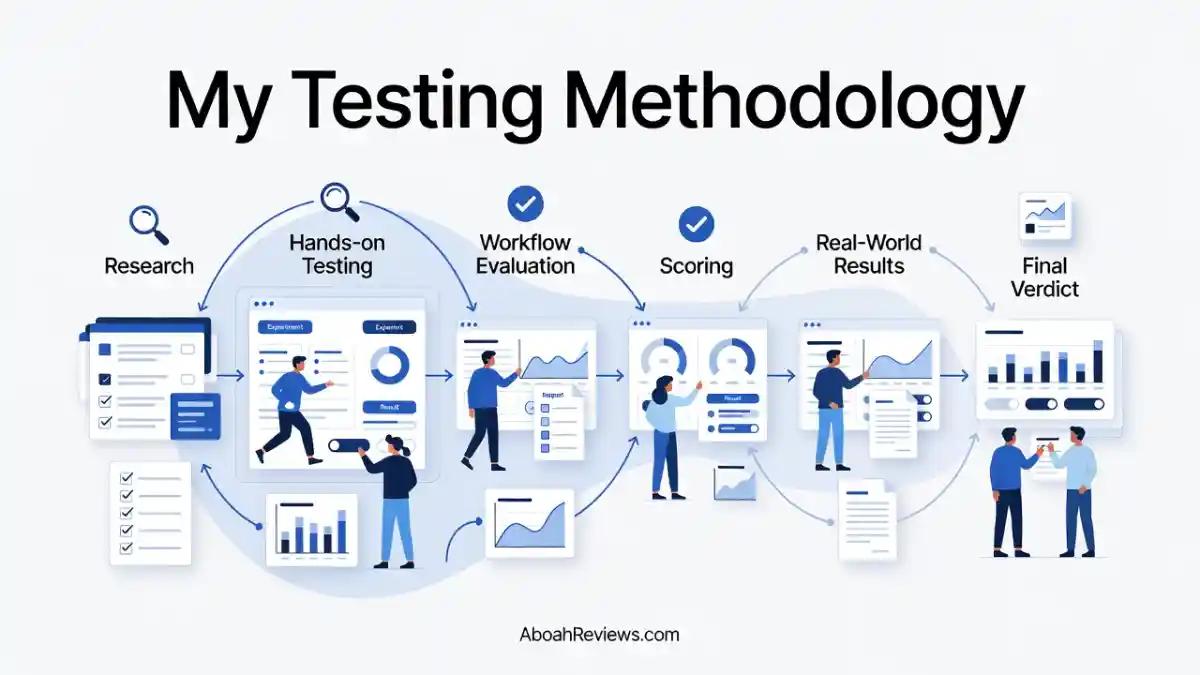
Every review on this site follows the same structured process. Using the same steps each time means I can compare tools fairly across reviews published months apart.
Step 1: Research the Product First
Before I log in to anything, I spend time understanding what the software is actually built to do.
This includes reading the official documentation, studying the pricing tiers, reviewing the feature list, checking the public changelog or roadmap when available, and reading through any published FAQs.
I also compare the tool against similar products I have already reviewed to understand where it fits in the broader market.
This step matters more than most people think. Some tools are clearly built for agencies managing 50+ sites. Others are designed for solo bloggers publishing 4 posts a month.
Reviewing both with the same expectations produces useless results.
Step 2: Register as a Normal Customer
I sign up the same way you would. If a free trial is available, I start there. If the software requires a paid subscription to access the features worth testing, I subscribe.
I do not use vendor-provided premium access unless I clearly disclose that in the review.
Receiving free access can create subtle pressure to be more positive than the tool deserves, so I avoid it whenever practical.
Step 3: Test Real Blogging Workflows
I test every tool on real WordPress websites, not sandbox environments.
Typical tasks I run through include:
- Creating blog articles from a target keyword
- Generating and reviewing full article outlines
- Writing long-form content (1,000 to 3,000+ words)
- Creating titles and meta descriptions
- Adding internal links
- Generating featured images when the tool supports it
- Publishing directly to WordPress
- Scheduling posts
- Reviewing in-tool SEO recommendations
- Tracking how much manual editing each output requires
Testing in a real environment surfaces problems that clean demos never show: slow generation times, broken publishing integrations, inconsistent formatting, and AI outputs that look fine in a preview but fall apart once they go live.
Step 4: I Keep Tool Tests Comparable
When I compare multiple AI SEO or autoblogging tools, I try to keep the testing conditions as consistent as possible.
I use comparable keywords, search intent, article lengths and publishing environments wherever the tools allow it.
When a platform requires a different workflow, I document that difference rather than forcing every tool into an identical process. For content-generation tests, I record:
- Target keyword
- Search intent
- Target article length
- Time required to generate the article
- Number of revisions required
- Manual editing time
- Fact-checking requirements
- Internal linking work
- Publishing time
- Final article length
- Content quality issues identified
For SEO performance tests, I record relevant Search Console and analytics data where available.
I treat ranking and traffic changes as observations rather than proof that a particular tool caused the change, because search performance is affected by many variables outside the software itself.
Step 5: Evaluate Content Quality
Content quality is the most heavily weighted part of my scoring system.
I review whether articles are accurate, readable, logically organized, and actually useful to a reader who found the post through search. I also check for common problems that make AI-generated content easy to spot and hard to rank:
- Repetitive sentences or ideas within the same section
- Generic or vague introductions that say nothing useful
- Claims presented without any supporting sources
- Outdated information presented as current
- Poor heading structure and paragraph formatting
- Missing internal or external citations
- Weak or absent conclusions
- Obvious AI writing patterns (padding, excessive hedging, filler transitions)
The less editing a piece needs before it is usable, the higher it scores. A tool that produces a 90% ready draft is worth far more in practice than one that requires a full rewrite.
Step 6: Evaluate Automation Features
Good SEO software should reduce repetitive, time-consuming work.
I check how well each tool handles:
- Keyword research and topic generation
- Content drafting and scheduling
- Direct publishing to WordPress or other CMS platforms
- Automated internal linking
- Image generation or sourcing
- Content refresh workflows
- Multi-site management
- Workflow customization
I also track whether the automation actually saves net time once you account for editing, reformatting, and fact-checking.
Some tools that bill themselves as “fully automated” end up creating more work than they save because every post needs significant cleanup before it is ready to publish.
If you want to understand what separates useful automation from noisy automation, my guide on how autoblogging works covers the full breakdown.
Step 7: Evaluate SEO Features
Most tools claim to create “SEO-optimized content.” During testing, I check whether those claims are backed by real features inside the platform.
Areas I look at:
- Title tag generation and customization
- Heading hierarchy (H1, H2, H3 structure)
- Meta description generation
- Internal linking suggestions or automation
- Keyword density and placement
- Schema markup support
- Image alt text generation
- Content organization against search intent
- Indexing recommendations
I use Google’s Search guidance and Search Quality Rater Guidelines as reference points when evaluating whether a tool’s output demonstrates qualities such as originality, usefulness, expertise and first-hand experience.
They are benchmarks for my editorial evaluation, not a guarantee that content will rank.
I do not guarantee search rankings in any review. No software can honestly promise that, and any tool that does is overstating what it can control.
Step 8: Evaluate Ease of Use
A tool with excellent output is still a bad tool if it takes 3 hours to figure out and has no documentation to help you.
I look at:
- Account setup time and complexity
- Dashboard organization and clarity
- Navigation between core features
- Learning curve for first-time users
- Quality of help documentation and tutorials
- Overall user experience for both beginners and experienced users
A well-designed tool should let someone publish their first article within 20 to 30 minutes of signing up. If it takes longer than that without a clear tutorial, that counts against the ease-of-use score.
Step 9: Compare Pricing Against the Market
Price alone does not determine value, but value always includes price.
I compare each plan against competing tools at the same price point and ask: does what this plan includes justify what it costs? I also check:
- Monthly post or article limits
- Word count caps per article
- Credit-based pricing structures and how quickly credits deplete
- Hidden fees for features listed as “add-ons”
- Restrictions between plan tiers
- Refund and cancellation policies
For example, a tool charging $49/month with a cap of 10 posts/month and no WordPress integration scores differently than one charging the same price with 50 posts/month and direct CMS publishing included.
Step 10: Evaluate Customer Support
Support quality becomes important fast when something breaks, a post does not publish correctly, or a billing issue appears.
I check:
- Average response time for email or ticket support
- Live chat availability and quality
- Knowledge base depth and accuracy
- Whether support resolves issues or just redirects to documentation
Reliable, responsive support contributes to the final score. A tool with weak support is a real operational risk, especially for agencies or freelancers managing multiple client sites.
Step 11: Publish the Final Verdict
After completing all testing, I answer a fixed set of questions before writing the final verdict:
- Who should use this tool?
- Who should avoid it?
- Is the price justified?
- What does it do better than competitors?
- What are its biggest weaknesses?
Every published review then receives an overall score based on the weighted rubric below.
My Scoring System
Every tool reviewed on this site receives a score out of 10. The score reflects the overall testing experience, not just one standout feature. Here is how the scoring breaks down:
Category | Weight | What I Evaluate |
|---|---|---|
Content Quality | 30% | Accuracy, readability, editing required, AI patterns |
Automation Features | 25% | Publishing, scheduling, linking, workflow efficiency |
Ease of Use | 15% | Setup time, dashboard UX, documentation quality |
Pricing and Value | 15% | Cost vs. output vs. competitor pricing at same tier |
Customer Support | 15% | Response time, issue resolution, knowledge base depth |
For example:
Overall Score = (Content Quality × 0.30) + (Automation × 0.25) + (Ease of Use × 0.15) + (Pricing & Value × 0.15) + (Support × 0.15)
If a tool scores:
- Content Quality: 8.5
- Automation: 9
- Ease of Use: 8
- Pricing: 7
- Support: 6
then:
8.5 × .30 + 9 × .25 + 8 × .15 + 7 × .15 + 6 × .15 = 8.0/10
A tool scoring 8.5/10 on content quality but 4/10 on support will not receive a misleadingly high overall score. The weighting reflects what actually matters when you use these tools in a real workflow every week.
How I Handle Content Quality Failures
Not everything goes smoothly. Some tools that looked strong in early testing have failed in ways I did not expect.
One pattern I have seen repeatedly is content cannibalization.
Without proper keyword filtering and internal linking strategy, AI tools can generate posts that compete directly against each other in the same site, splitting ranking signals instead of building them.
This is one of the most common autoblogging mistakes I have documented across my testing.
When a tool produces output that consistently causes these kinds of structural problems, I document that in the review. I do not bury it in a footnote.
Google’s guidelines emphasize that experience must be demonstrable and relevant, and raters are instructed to look for content creators who have actually performed the task they are writing about.
That is why my reviews describe specific outcomes from specific tests, not general impressions.
How Often I Update Reviews
Software changes faster than most people realize. Pricing adjusts, AI models improve, features get added or removed, and tools that were solid 12 months ago can become unreliable today.
I update reviews when any of the following happen:
- A major feature is added or removed
- Pricing changes by more than 10%
- The AI model or content generation engine is updated
- Significant bugs or reliability issues are identified
- The user experience changes substantially
- A competitor closes a gap that previously made one tool a clear winner
Every updated review displays the most recent revision date at the top of the page. If a tool was scored 12 months ago and nothing has changed, the review notes that explicitly.
Tool Comparison Standards
When I compare two or more tools within a single article or review, I follow a specific set of rules to keep the comparison honest.
State Who Each Option Is Best For
I do not pick one winner and dismiss everything else. A tool that is wrong for an agency managing 200 posts/month might be the right tool for a solo blogger publishing 6 posts/month. Both readers deserve an honest answer.
Acknowledge Competitor Strengths
If a competing tool does something better than the one I am reviewing, I say so. If you need native social publishing, Tool B is a stronger choice.
If you need long-form SEO content with deep customization, Tool A is built for that. You can see this in practice in my autoblogging vs hybrid blogging breakdown.
I Use Numbers, Not Adjectives
“Affordable” and “fast” mean different things to different people. I use specific numbers: $29/month, 40 posts/month, 1.2 seconds average generation time, 15-minute setup. Vague descriptors do not help you make decisions.
Who These Reviews Are For
My reviews are written for people who want honest, practical information before spending money on SEO software or AI content tools.
That includes:
- Bloggers publishing between 4 and 20 posts per month
- Affiliate marketers managing content-heavy niche sites
- SEO professionals evaluating tools for client campaigns
- Agencies looking for scalable content workflows
- Content teams assessing tools for editorial pipelines
- Small businesses trying to grow organic traffic without hiring a full writing team
- Freelancers looking to increase output without sacrificing quality
Whether you publish one article a week or manage 500 posts across multiple domains, the goal is the same: help you choose a tool that actually fits your workflow and your budget.
The difference between a good review and a bad one is whether it came from someone who actually tested the software in a real environment, or someone who read the feature page and called it a day.
For more on the broader category of tools covered on this site, my best autoblogging tools tested list is a good starting point if you are still figuring out which direction to go.
My Editorial Standards
I follow the same rules for every review I publish:
- Write based on my own testing, not vendor materials
- Disclose affiliate relationships clearly
- Never sell a score or recommendation
- Correct factual errors when I find them
- Update outdated information promptly
- Explain both the strengths and the weaknesses of every product
- Separate what I know from testing versus what I believe based on limited access
Google evolved its framework from E-A-T to E-E-A-T (Experience, Expertise, Authoritativeness, Trustworthiness) with the addition of Experience as a distinctive parameter for authoritative content.
Every review I publish is written with that framework in mind: I am not just an expert in the topic, I have hands-on experience with the specific tools I am evaluating.
Final Takeaway
If you have read this far, you now know exactly how every review on this site is produced. That transparency is intentional.
My testing methodology is not just a process. It is a way of saying: I have used these tools, I have made mistakes with them, and I will tell you what I found, including the parts the vendor would prefer I leave out.
The goal is not to send you toward the highest-paying affiliate link. The goal is to help you make a better decision than you would have made without this information.
If something in a review seems off, if you have used a tool and experienced something different from what I described, or if you want to suggest a tool for testing, reach out through the contact page. Getting that feedback directly helps me keep everything accurate and useful.
Frequently Asked Questions
Do you accept payment for positive reviews?
No. Companies cannot pay to receive a higher rating or a recommendation on this site. Every score is calculated using the same weighted score, applied based on actual testing. No amount of promotional budget changes that.
Do affiliate commissions influence your scores?
No. Affiliate commissions help cover the cost of running this site, including paid subscriptions to the tools I test. They do not affect the scores I assign. If a tool performs poorly, the review says so, even when that tool has a high commission rate.
Do you test every tool yourself?
Whenever possible, yes. I create an account, subscribe to a plan, and use the tool on real websites before writing anything. If testing is limited for any reason, such as regional restrictions or pricing barriers, I say so clearly in the review and explain what that limitation means for the score.
Why do review scores change over time?
Software evolves. A tool that improves its AI model, adds a feature that was previously a major weakness, or significantly adjusts pricing may receive a higher score on a second evaluation. A tool that removes features, raises prices without adding value, or declines in output quality may receive a lower one. The revision date on every review reflects when the score was last verified against the current version of the product.
How do you decide which tools to review next?
I prioritize tools based on reader requests, search demand, competitive gaps in my existing coverage, and whether the tool represents something genuinely different from what I have already tested. If you have a suggestion, the contact page is the right place for that. I genuinely do look at what comes in.
Can I trust a review if you have an affiliate link to that tool?
Yes, because the affiliate relationship is disclosed, and the score is calculated using a rubric that does not change based on who links where. The clearest proof is that several tools with affiliate programs available on this site have scored below 6.5/10 in my reviews. The link does not buy a better score.
How is your review methodology different from other SEO review sites?
Most SEO review sites test tools in demo environments, pull information from vendor pages, and write reviews optimized for affiliate clicks rather than useful information. My testing methodology uses real WordPress websites, paid subscriptions, and structured evaluation across 10 steps. I also document failures and limitations, not just what a tool does well.