Affiliate Disclosure: Some of the links in this article are affiliate links. If you click through and make a purchase, I earn a small commission at no extra cost to you.
I only recommend products, tools and services that I have personally tested, thoroughly researched or genuinely believe will add value to my readers
Quick Answer: What are the best AI autoblogging tools in 2026?
- Keytomic: Best overall for end-to-end AI autoblogging, including SEO, publishing, backlinks building, auto-indexing and AI search visibility.
- BabyLoveGrowth AI: Best for SEO automation, backlink building and AI search visibility tracking.
- WordRocket AI: Best for affordable, high-volume AI content production using a BYOK model.
- Outrank.so: Best for SEO-focused, SERP-driven content automation and multi-CMS publishing.
- Distribb: Best for combining AI content creation with content distribution and backlink building.
- BlogSEO.io: Best for semantic SEO, schema markup, and automated blogging.
- RankPill: Best for daily automated SEO content publishing across multiple CMS platforms.
- Byword AI: Best for programmatic SEO and large-scale keyword-to-article generation.
- RightBlogger: Best for bloggers and small content teams that want an easy-to-use all-in-one toolkit.
- Frizerly: Best for simple automated blogging workflows and local SEO content.
Overall winner: Keytomic is the strongest choice for full-pipeline AI autoblogging, while WordRocket AI is the better budget option and Byword AI is better suited to large-scale programmatic SEO.
What Are AI Autoblogging Tools?
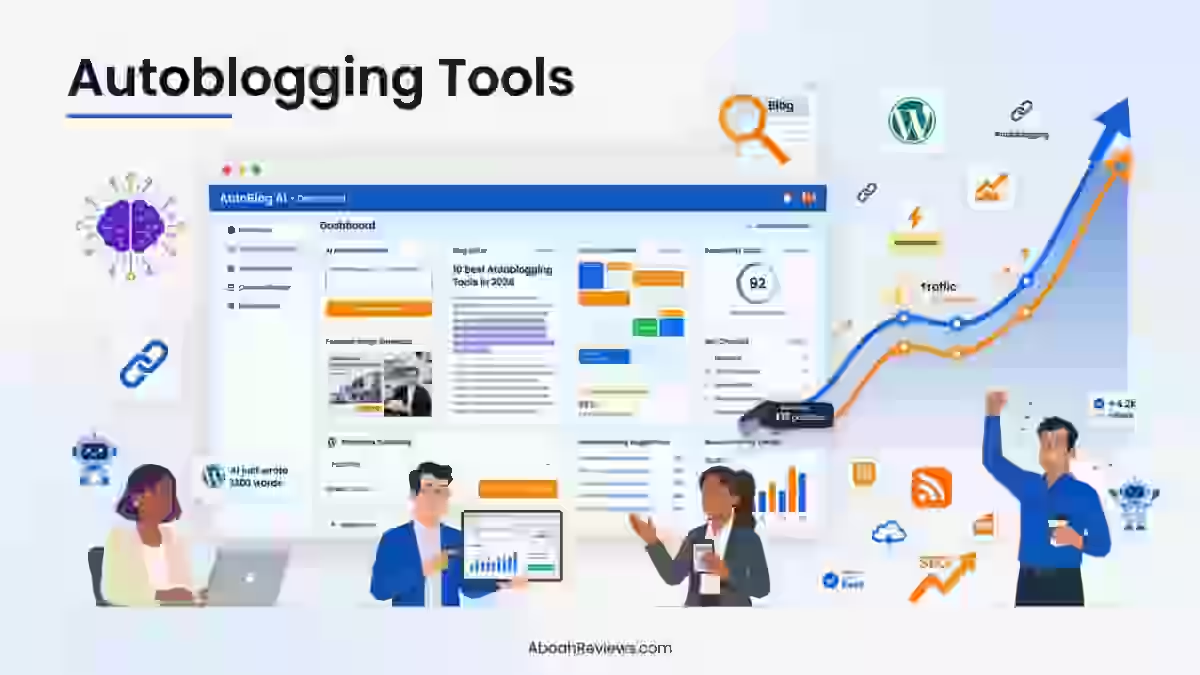
AI autoblogging tools are software platforms that automate part or all of the blog content production workflow. The better ones handle multiple tasks in a single pipeline:
- Keyword research and topic discovery
- Content generation from AI drafts to finished articles
- SEO optimization including on-page elements, schema, and semantic coverage
- Internal linking across published posts
- Image generation and media formatting
- Post formatting with proper heading structure
- Publishing directly to WordPress, Shopify, Webflow, or other CMS platforms
- Content scheduling on automated calendars
- Content updates for refreshing older posts
- Auto-indexing for faster discovery by search engines
The key distinction worth clarifying upfront: AI writing tools like ChatGPT or Claude help you write. AI autoblogging tools handle the publishing pipeline from research through to live page.
The two categories overlap but they are not the same thing. If you want a deeper look at how they compare, this breakdown of AI writing tools vs. autoblogging tools explains the difference clearly.
One thing I want to be clear about from the start: automation does not eliminate the need for human review.
Quick Verdict Table
Tool | Best For | SEO Automation | Auto-Publishing | Starting Pricing | Rating |
|---|---|---|---|---|---|
Overall AI autoblogging | Full pipeline incl. indexing + AIO tracking | Yes (WordPress, Shopify, Webflow, HubSpot) | $99/mo | 9.4/10 | |
SEO + AI search visibility | Content + backlinks + GEO tracking | Yes | $99/mo | 9.2/10 | |
Automated content production | Content generation + WordPress publishing | Yes (WordPress) | $10/mo | 8.4/10 | |
SEO-focused content automation | Keyword research + content + publishing | Yes (WordPress, Shopify, Webflow, Wix) | $99/mo | 8.6/10 | |
Content distribution + automation | Content + backlinks + distribution | Yes | $97/mo | 8.1/10 | |
Automated SEO blogging | Semantic SEO + schema + publishing | Yes | $97/mo | 7.9/10 | |
Automated SEO content | Daily publishing + keyword research | Yes (multi-CMS) | $49.5/mo | 7.7/10 | |
Programmatic SEO content | Bulk keyword-to-article generation | Yes (WordPress) | $5/article or $99/mo (25 articles) | 8.0/10 | |
Bloggers and content teams | 90+ tools + Site Agent + WordPress | Yes (WordPress) | $59/mo | 8.3/10 | |
Automated blogging workflows | Article generation + scheduling | Yes | $49/mo | 7.5/10 |
How I Chose the Best AI Autoblogging Tools for 2026

These tools were evaluated based on real-world testing, vendor documentation review, user feedback from Trustpilot, G2, Capterra and direct comparison across live SEO workflows.
I want to be transparent about the methodology: some tools I tested hands-on across production websites.
Others I evaluated through free trials, platform walkthroughs, community feedback and documented case studies.
AI Content Quality
The first thing I check is whether the output is actually usable. That means:
- Originality: Does the content read as unique, or does it feel templated?
- Factual accuracy: Are claims verifiable, or does the tool hallucinate?
- Readability: Would a real person want to read this?
- Search intent alignment: Does the content match what someone searching that keyword actually wants?
- Depth: Is there enough substance for a competitive keyword, or is it surface-level filler?
- Human editing requirements: How much cleanup does a published draft need?
SEO Capabilities
A tool that writes well but ignores SEO is just a word processor. I evaluated:
- Keyword research and topical clustering
- SERP analysis before content generation
- Semantic optimization and entity coverage
- On-page SEO elements (titles, meta, headings, schema)
- Internal linking automation
- Content gap identification
Automation and Publishing
This is where autoblogging tools separate from general AI writers. I looked at:
- WordPress and multi-CMS integration reliability
- Automatic publishing without manual copy-paste
- Scheduling and content calendar management
- Bulk content creation capabilities
- RSS and content workflow options
- AI-generated images and formatting quality
Pricing and Value
I ran cost-per-article calculations across each tool to compare real value:
- Monthly and annual pricing
- Article and word limits per plan
- Number of websites supported
- Agency-level capabilities
- Hidden costs (API keys, add-ons, overages)
Hands-On Testing
Where I tested directly, I documented articles generated, niches tested, editing time per article, publishing workflow, and early search performance.
For tools I did not test in production, I clearly note that and rely on verified user reviews and platform documentation.
The 10 Best AI Autoblogging Tools in 2026
1. Keytomic: Best Overall AI Autoblogging Tool
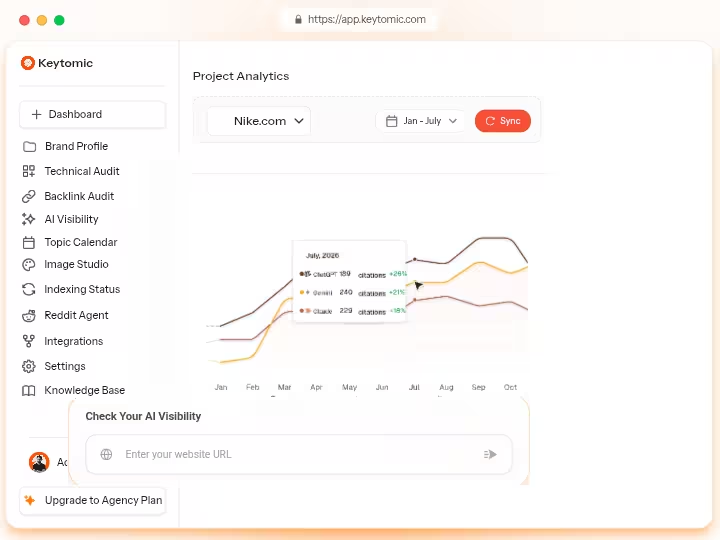
Keytomic is an AI SEO platform that automates ranking on search engines and AI models. It is the most complete end-to-end autoblogging platform I have come across.
It handles the full content pipeline from keyword discovery through publishing and indexing, without requiring five separate tools to fill the gaps.
Keytomic Features
- Automated 30-day content calendar with user approval before publishing
- Keyword research and SERP analysis built into the workflow
- AI-generated on-brand images with alt text
- Auto-publishing to WordPress, Shopify, Webflow, and HubSpot
- Built-in auto-indexing across Google, Bing, and AI platforms
- AI visibility tracking for citations in Google AI Overviews, ChatGPT, and Perplexity
- 30 high-DR backlink opportunities (valued at $800+/month per vendor claims)
- Reddit AI agent for brand authority building
- Internal linking automation
- Schema markup automation
- Technical SEO audits
- Content in 150+ languages (verify current language availability with their team before subscribing)
For a detailed look at what Keytomic delivers in practice, read the full Keytomic review.
Pricing
Plan | Price (Monthly) | Key Features Included |
|---|---|---|
3-Day Trial | $1 | Full, unrestricted access to all core platform features for 3 days. |
Auto-Pilot / Core Plan | $99/mo ($79/mo annual) | • 30 SEO-ready AI articles generated & published monthly. |
Done-For-You Agency Plan | $999/mo | A completely hands-off model where Keytomic’s internal team manages the overall strategy, content execution, and performance reporting. |
Pros and Cons
Pros | Cons |
|---|---|
Full pipeline: research, content, publishing, indexing, AIO tracking | Higher price point compared to single-feature tools |
Auto-indexing across Google, Bing, ChatGPT | Multilingual support being expanded, verify before subscribing |
Dedicated SEO manager included on pro plans | Requires 20–35 minutes of human review per article |
No credit expiration or hidden usage caps | Not the right tool if you only need one-off content |
Reddit AI agent for brand authority | Limited public pricing transparency for higher tiers |
Who Should Use Keytomic?
Keytomic is best for small-to-medium teams and agencies that want a single platform to replace a fragmented stack.
It’s built for teams wanting predictable, scalable content production and SEO execution without operational overhead.
If you are running multiple client websites, building topical authority in a competitive niche, or trying to appear in AI-generated search results, Keytomic is structured for that goal.
Verdict
Keytomic is the most complete AI autoblogging platform I have reviewed.
The combination of auto-indexing, AI search visibility tracking, Reddit brand authority automation and a dedicated SEO manager at the pro tier is genuinely unusual.
2. Babylovegrowth AI: Best for SEO Automation and AI Search Visibility
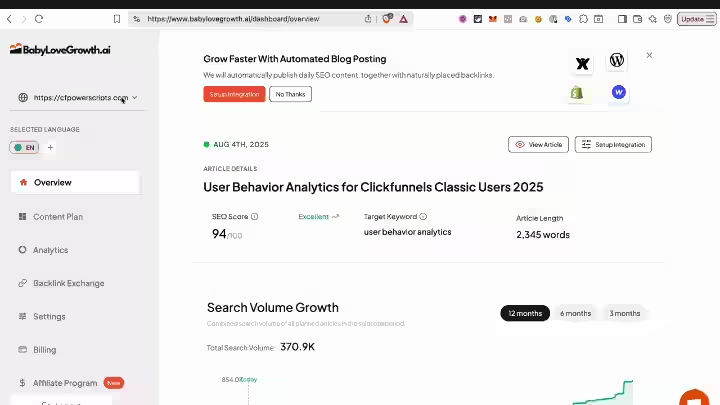
BabyLoveGrowth AI is an SEO automation platform that handles daily content publishing, backlink building and AI search visibility tracking.
It is a SaaS-based platform founded in 2024 by Tilen Savnik that runs the full content workflow autonomously.
Babylovegrowth AI Features
- 30 SEO-optimized articles per month, auto-published to your CMS
- Citations, internal linking, and branded infographics included per article
- 30-day content plan with LLM-optimized article types
- Automated backlink building bundled into the core plan
- Brand citation tracking across ChatGPT, Perplexity, and Gemini
- GEO (Generative Engine Optimization) audit
- JSON-LD schema markup
- Technical SEO audits
- Multilingual support across 20+ languages
- 90-day money-back guarantee if organic traffic does not increase
For a deeper look at how it performs, the Babylovegrowth AI review covers output quality and real results in detail.
Pricing
Plan | Price | Key Features Included |
|---|---|---|
3-Day Trial | Free / $1–$3 | Full access to explore the onboarding, initial SEO calendar generation, and test articles. |
Grow Plan (All-in-One) | $99/mo (Regular $247) | • 30 auto-published SEO & LLM optimized articles monthly. |
Scale Plan | $299/mo | Includes all Grow features, plus: |
Reseller / Agency | Custom Pricing | Designed for agencies looking to offer automated SEO to clients with sub-branding capabilities and full or dashboard-only visibility controls. |
For a full breakdown of what each plan includes, see the Babylovegrowth AI pricing guide.
Pros and Cons
Pros | Cons |
|---|---|
Backlink building bundled into $99/month | Credit card required for 3-day trial |
GEO tracking across ChatGPT, Perplexity, Gemini | Monthly spot limits; not always immediately accessible |
90-day money-back guarantee | Agency plan pricing not publicly listed |
Infographics included in article output | Relatively new platform (founded 2024) |
$3.30 cost-per-article at full utilization | Backlink quality varies. Audit links during trial |
Who Should Use Babylovegrowth AI?
Babylovegrowth AI is best for businesses that want to appear in AI-generated answers, not just traditional search results.
If tracking whether your brand is cited in ChatGPT or Perplexity matters to your strategy, few tools at this price point offer that monitoring capability.
Compare it to alternatives in the Babylovegrowth AI alternatives guide.
Verdict
- Babylovegrowth AI is the strongest option for AI search visibility tracking and automated backlink building at the $99/month price point
- The bundled approach: content, links, GEO audit reduces the number of tools you need to maintain.
Audit the backlinks you receive during the trial before fully committing, and use the 3-day trial to verify that article tone and quality match your brand standards.
3. WordRocket AI: Best for Automated AI Content Production
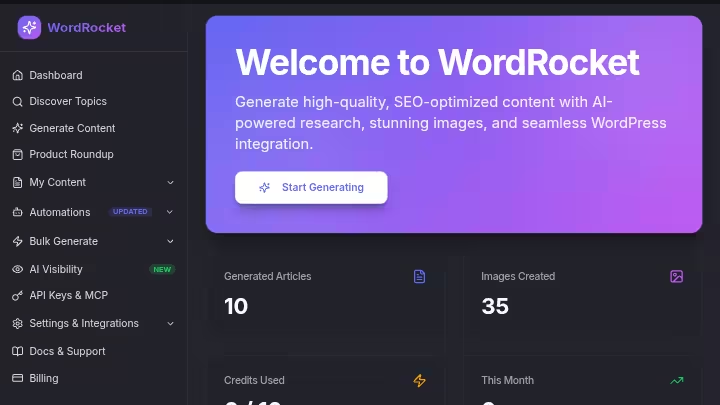
WordRocket AI is a content generation platform that uses a Bring Your Own Key (BYOK) model, meaning you supply your own API key from OpenAI, Anthropic, or another provider.
This gives you full control over your AI costs and which model generates your content. It scored 8.1/10 in my testing.
Features
- Keyword targeting and content briefs
- Bulk article generation from keyword lists
- Content customization for tone and structure
- WordPress auto-publishing with scheduling
- SEO-focused templates for different content formats
- Strong SERP analysis
- Lifetime deal option that eliminates recurring costs
For a detailed breakdown, read the WordRocket AI review.
Pricing
Free plan ($0/month), Starter plan ($10/month), Pro ($20/month), Premium ($49.99/month).
A lifetime deal is available; see the WordRocket lifetime deal for current pricing.
See WordRocket AI pricing for the full breakdown.
Pros and Cons
Pros | Cons |
|---|---|
$0.18–$0.31 cost-per-article (lowest tested) | Keyword research isn’t deep compared to competitors |
Lifetime deal option eliminates recurring costs | API setup not beginner-friendly |
Multi-model access (OpenAI, Anthropic, etc.) | Image generation is basic quality |
Maintains coherence on posts 3,000+ words | No team collaboration or workflow management |
Direct WordPress publishing | No built-in SEO scoring |
Who Should Use WordRocket AI?
Pick WordRocket AI if you need high-volume long-form content, want control over AI costs and are comfortable with API setup.
It is best for solo operators and small teams running multiple niche sites at volume.
Verdict
- WordRocket AI is the most cost-efficient tool in this list on a per-article basis.
- The BYOK model gives you real flexibility. The trade-off is setup complexity.
- If you have your content strategy mapped and you want to run volume content affordably, WordRocket AI is the right call.
4. Outrank.so: Best for SEO-Focused Content Automation

Outrank.so is an automated SEO content platform.
The product idea is straightforward: connect a CMS, choose your keywords and the system generates, optimizes, publishes articles on a schedule while building backlinks on the side.
Features
- SERP analysis before each article is drafted
- AI content generation with on-page SEO optimization
- Automated internal linking
- Auto-publishing with customizable scheduling
- Source citations included in articles
- Opt-in Backlink Exchange with partner sites
- Content gap identification
- Publishing cadence control (daily, 3x/week, etc.)
Outrank.so is best for research-first content with source citations, competitor analysis and content gap identification built in.
If ranking on page one is the primary goal and you want to be able to defend every claim in your content, Outrank.so is built for that.
Read the full Outrank.so review for 30 days of hands-on testing results.
Pricing
$1 three-day trial, a $99/month Standard plan with 30 auto-published articles and a custom Enterprise plan for agencies.
See the Outrank.so pricing guide for a complete plan breakdown.
Pros and Cons
Pros | Cons |
|---|---|
SERP analysis included before each article | Backlink Exchange introduces link-scheme risk if misused |
Broadest CMS compatibility tested (WordPress, Shopify, Notion, Wix, Framer) | Standard plan caps at 30 articles/month |
$1 three-day trial with full platform access | Webflow integration still in beta |
Month-to-month billing — no annual lock-in | Reporting is basic; no deep rank tracking |
Research-backed content with citations | Requires 15–30 minutes setup per keyword profile |
Who Should Use Outrank.so?
Outrank.so is best for high-quality, research-backed content with editorial review before publishing.
It fits SEO professionals who want automated content that can withstand scrutiny on competitive keywords, without manually prompting each article.
If you are running an agency across multiple client CMS platforms, the broad integration support reduces setup friction.
Verdict
Outrank.so is one of the most polished content-to-publishing pipelines in this list.
The SERP-first generation approach means articles are structured around what is actually ranking, not just what the AI guesses should be there.
The backlink exchange is useful for newer sites but evaluate each link carefully before opting in.
5. Distribb: Best for Automated Content Distribution

Distribb (formerly Rebelgrowth) is a content automation platform that combines article generation with backlink building, making it a practical option for anyone who needs more than just daily content.
It’s particularly useful for content marketers who want distribution and link-building handled in the same workflow.
Features
- AI article generation with SEO optimization
- Automated content distribution across the web
- Backlink building through content placement
- Publishing workflow automation
- CMS integrations for direct publishing
- Content scheduling and calendar management
- Social and content distribution capabilities
If organic search visibility depends on both content and links, Distribb gives you both under one subscription. That bundled approach is Distribb’s main differentiator from tools that only write.
For an output quality test, read my Distribb review.
Pricing
$1 3-day trial is available.
Paid plans start from $97/month and scale to $495/month.
Pros and Cons
Pros | Cons |
|---|---|
Content generation + backlink building in one subscription | $97–$495/month pricing range is wide |
$1 3-day trial | Higher price floor than standalone content tools |
Distribution workflow reduces reliance on separate link-building tools | Less editorial control than human-reviewed tools |
Useful for content marketers at scale | Fewer public reviews and case studies than established competitors |
Automated publishing saves operational time | Distribution quality varies by niche and partner network |
Who Should Use Distribb?
Content marketers and bloggers who want backlink building plus article generation without paying for two separate tools are the core use case.
If your current workflow involves paying one tool for content and another for link building, Distribb consolidates that.
It is less suitable for bloggers who prioritize editorial voice over publishing volume.
Verdict
Distribb.io fills a real gap for content marketers who need both content production and link building without managing two separate subscriptions.
The pricing range is broad, so verify what each tier includes before signing up.
The $1 three-day trial gives you enough time to evaluate content quality and distribution reach for your niche.
6. BlogSEO.io: Best for Automated SEO Blogging
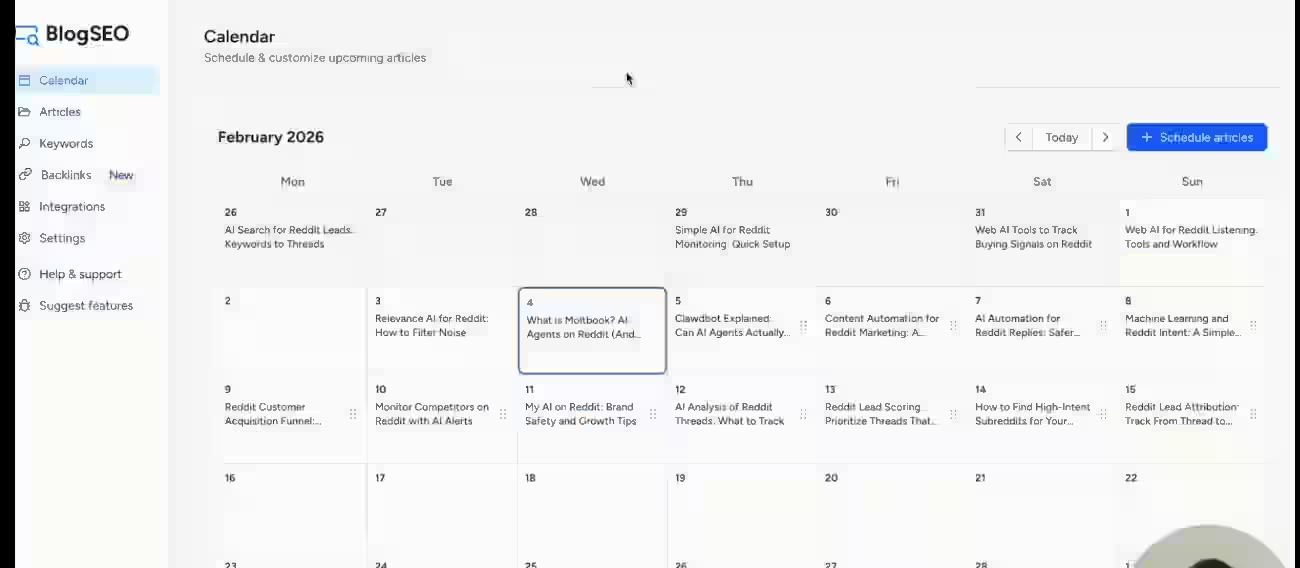
BlogSEO.io is best for semantic SEO content, schema markup, and structured data optimization. It targets bloggers and content teams who want automated publishing with stronger SEO-structural foundations built into every article.
Features
- AI article generation with keyword research built in
- Semantic SEO optimization for topical depth
- Schema markup and structured data included
- Automated publishing to connected CMS platforms
- Internal linking automation
- AI-generated images for each article
- Backlink exchange network
- Content scheduling and calendar management
- Keyword difficulty assessment before writing
BlogSEO has a strong focus on semantic SEO and keyword difficulty assessment before writing. That pre-writing SERP research step improves content relevance before a word is generated.
Check out the BlogSEO.io review for a full feature walkthrough.
Pricing
$1 for three-day trial then $97 per month, covering 30 articles, AI-generated images, frontier model support (like GPT and Claude), and built-in backlink exchange credits.
Pros and Cons
Pros | Cons |
|---|---|
Semantic SEO built into content generation | $97/month pricing requires careful tier comparison |
Schema and structured data included automatically | Only 15 backlinks per month |
Keyword difficulty assessment before writing | Reporting and analytics are basic |
AI-generated images included | Less established than some competitors |
Content scheduling and calendar management | Output may require editing for highly competitive keywords |
Who Should Use BlogSEO.io?
BlogSEO.io works best for bloggers and small content teams who want automated SEO blogging with schema markup handled automatically.
If you are building topical authority in a structured niche and want structured data built into every post without configuring it manually, BlogSEO.io removes that friction.
Teams focused purely on content volume without SEO depth may find simpler tools sufficient.
Verdict
BlogSEO.io is a solid mid-tier autoblogging tool with stronger semantic and structured data foundations than most tools at this price.
The $1 three-day trial entry point makes it accessible. The $97 ceiling is justified if you are publishing at scale with advanced SEO requirements.
7. RankPill: Best for Automated SEO Content Workflows
RankPill is best for daily publishing across multiple CMS platforms with built-in keyword research.
It targets content teams and SEO professionals who want a consistent daily publishing rhythm without managing each article manually.
Features
- AI content generation with built-in keyword research
- Daily publishing automation across multiple CMS platforms
- On-page SEO optimization for each article
- Internal linking automation
- Built-in backlinks building
- Content calendar and scheduling management
- Keyword targeting and content planning tools
- Publishing workflow management
Read the full RankPill review for a feature-by-feature breakdown.
Pricing
RankPill starts at $49.5 for first 2 months then $99/month
Pros and Cons
Pros | Cons |
|---|---|
Multi-CMS publishing built in | Backlink building needs verification |
Built-in keyword research reduces reliance on external tools | Less brand awareness than established competitors |
Daily publishing automation for consistent content velocity | Fewer third-party integrations than Outrank.so or Keytomic |
Internal linking handled automatically | Limited public case studies |
Content calendar keeps publishing organized | May require editorial review for competitive niches |
Who Should Use RankPill?
RankPill is a practical option for content teams and SEO professionals running daily publishing across multiple websites.
If consistent content velocity across several CMS platforms is the primary goal and you want keyword research folded into the same tool, RankPill removes the need for additional software.
Smaller teams publishing to a single site may find it more than they need.
Verdict
RankPill offers a focused automated SEO content workflow with multi-CMS support.
The daily publishing automation is genuinely useful for teams that need consistent output.
8. Byword AI: Best for Programmatic SEO and Large-Scale Content
Byword is the volume play. You feed it a keyword (or a list of keywords), and it generates a full article per keyword, with optional direct WordPress publishing.
Features
- Keyword-to-article generation at bulk scale
- Programmatic SEO scheduling
- Affiliate content templates (product reviews, comparisons)
- CSV keyword upload for batch processing
- WordPress auto-publishing
- API access for automation workflows
- Scalable content production (50+ articles/month)
For a full performance assessment, read the Byword AI review.
Pricing
- Free Tier: $0 / month. New accounts receive a signup bonus of 5 free article credits to test the platform.
- Starter Plan: $99 / month (or $83/month billed annually). Includes 25 articles per month (~$3.96/article) and supports up to 5 domains for solo use. Extra articles cost $3.50 each.
- Standard Plan: $299 / month (or $249/month billed annually). Includes 80 articles per month (~$3.74/article), 3 team seats, API access, whitelabeling, and unlimited domains. Extra articles cost $3.00 each.
- Scale Plan: $999 / month (or $833/month billed annually). Includes 300 articles per month (~$3.33/article), 10 team seats, and priority support. Extra articles cost $2.50 each.
- Unlimited Plan: $1,999 to $2,499 / month. Unlocks unlimited articles, a dedicated server, and exclusive beta features.
Pros and Cons
Pros | Cons |
|---|---|
$5/article or $99/mo for 25 articles, clear pricing | Generic output without heavy editing |
Bulk keyword-to-article generation | Fewer customization options for tone and structure |
Programmatic scheduling for large content builds | Less suitable for brand-voice-driven publishing |
Affiliate content templates save setup time | No built-in backlink building |
API access for custom automation workflows | Limited semantic depth vs. research-backed tools |
Who Should Use Byword AI?
Byword AI is best for publishers running programmatic SEO plays or large-scale niche sites where the priority is throughput, not perfectionism.
Skip it if you care about brand voice or hand-shaped editorial work.
Byword has fewer customization knobs for tone, structure, and writing style than most alternatives, and the drafts will sound generic without heavy editing.
Verdict
Byword AI is the go-to option for programmatic SEO and affiliate content at volume.
The pricing is transparent, the bulk generation is reliable, and the affiliate templates reduce setup time per article.
Do not expect polished, brand-voice content out of the box. Plan for editing time, especially on competitive affiliate keywords.
9. RightBlogger: Best for Bloggers and Small Content Teams
RightBlogger’s clean interface, 90+ tools, and strong documentation make it the most accessible starting point for new bloggers.
RightBlogger has a clean interface, strong documentation, and a toolkit that grows with you.
Features
- 90+ AI blogging and SEO tools in one dashboard
- One-click article generation from keyword
- Site Agent for ongoing SEO maintenance and content updates
- Keyword research built in
- WordPress direct publishing with formatting
- Unlimited article generation on all plans
- Bulk content creation
- Blog management and content calendar tools
- Content audit and refresh capabilities
For my full 30-day breakdown, read the RightBlogger review.
Pricing
- Free Plan: $0 / month. Offers limited access to its catalog of 90+ tools with a cap of 2,000 words per month to test the platform.
- Solo Plan: $59 / month (or $49/month billed annually). Designed for single creators, it includes 1 connected site, weekly site agent audits, a backlink exchange, and 30 SEO reports per month.
- Pro Plan: $89 / month (or $69/month billed annually). Built for scaling bloggers, it supports 3 connected sites, 3 team seats, 90 SEO reports per month, full social integrations, and premium blogging courses.
- Agency Plan: $299 / month (or $199/month billed annually). Tailored for businesses, unlocking 10+ connected sites, 5 team seats, 300 SEO reports per month, and dedicated onboarding/strategy calls
Pros and Cons
Pros | Cons |
|---|---|
90+ tools in one subscription | Built-in backlink building is new and needs verification |
Unlimited article generation from $59/month | Less suited for large agency multi-site management |
Site Agent for ongoing SEO maintenance | Fewer programmatic SEO features than Byword |
Most user-friendly interface tested | Output still needs editing for competitive keywords |
WordPress direct publishing | No GEO or AI citation tracking |
Who Should Use RightBlogger?
RightBlogger is the most user-friendly interface for bloggers just getting started.
It fits solo bloggers, content teams of 2–4 people, and freelancers managing a handful of client sites.
The Site Agent is particularly useful for content audits and keeping older posts updated, which matters for SEO performance over time.
Verdict
RightBlogger is the most complete toolkit for bloggers at the $59/month entry price point.
The 90+ tools cover everything from keyword research through WordPress publishing, and the Site Agent adds a content maintenance layer that most tools at this price skip entirely.
Unlimited article generation removes the anxiety of hitting monthly caps mid-sprint.
10. Frizerly: Best for Automated Blogging Workflows
Frizerly is best for small businesses and local SEO content. It focuses on simple, automated blogging workflows with minimal setup friction, making it one of the more accessible entry points into AI autoblogging.
Features
- AI article generation with keyword targeting
- SEO features for on-page optimization
- Publishing automation to connected CMS platforms
- Content scheduling and automated calendar
- Keyword workflow management
- Website integrations for auto-publishing
- Simple onboarding designed for non-technical users
Both Frizerly and Soro have simple onboarding, minimal configuration, and clear use cases. Frizerly edges it for local business users.
For a hands-on breakdown, see the Frizerly review.
Pricing
- Standard Plan: Costs $49 per month (or $29/month billed annually)
- Pro Plan: Costs $149 per month (or $99/month billed annually)
- Pro SEO + Social Plan: Costs $199 per month (or $149/month billed annually)
Pros and Cons
Pros | Cons |
|---|---|
Simple onboarding; minimal technical setup | Less feature-depth than Keytomic or Babylovegrowth AI |
Freemium option to test before paying | Less suited for high-volume or agency publishing |
Good fit for local SEO content | Limited advanced SEO automation |
Automated publishing and scheduling | Fewer CMS integrations than Outrank.so |
Clean workflow for non-technical users | No backlink building or GEO tracking |
Who Should Use Frizerly?
Frizerly is a practical starting point for small business owners, local service businesses, and bloggers who want automated content publishing without a steep learning curve.
Frizerly is best for small businesses and local SEO content. If you need enterprise-level SEO automation, Keytomic or Babylovegrowth AI are better investments.
Verdict
Frizerly does what it promises: simple, automated blogging with minimal friction. The freemium entry point reduces financial risk for testing.
For small businesses that need consistent blog content without hiring a writer, it delivers.
For SEO professionals who need advanced automation, it will feel too lightweight.
Best AI Autoblogging Software Compared
Tool | Best For | Content Automation | SEO | Publishing | Bulk Content | Ease of Use | Overall Score |
|---|---|---|---|---|---|---|---|
Keytomic | Overall | Full pipeline | 9.5/10 | WordPress, Shopify, Webflow, HubSpot | Yes | Medium | 9.4/10 |
Babylovegrowth AI | SEO/AIO | Content + backlinks | 9.2/10 | Auto-publish to CMS | 30/mo | Medium | 9.2/10 |
WordRocket AI | Content production | BYOK generation | 7.5/10 | WordPress | High volume via API | Medium-High | 8.4/10 |
Outrank.so | SEO | SERP-first drafts | 8.8/10 | WordPress, Shopify, Notion, Wix, Framer | 30–90/mo | Medium | 8.6/10 |
Distribb | Distribution | Content + distribution | 7.8/10 | Multi-platform | Volume plans | Medium | 8.1/10 |
BlogSEO | SEO blogging | Semantic + schema | 8.2/10 | Connected CMS | Yes | Easy-Medium | 7.9/10 |
RankPill | SEO automation | Daily publishing | 7.9/10 | Multi-CMS | Daily cadence | Medium | 7.7/10 |
Byword AI | Programmatic SEO | Bulk keyword-to-article | 7.2/10 | WordPress | Unlimited (volume pricing) | Easy | 8.0/10 |
RightBlogger | Bloggers | 90+ tools | 7.8/10 | WordPress | Unlimited | Easy | 8.3/10 |
Frizerly | Blogging automation | Simple workflows | 7.0/10 | Connected CMS | Limited | Very Easy | 7.5/10 |
How to Choose the Best AI Autoblogging Tool
This is a practical buying framework based on what I check before committing to any tool.
Content Quality
Generate 3–5 test articles on your actual target keywords before subscribing.
Evaluate the output for factual accuracy, readability, and search intent alignment. Do not judge quality on a generic test prompt.
SEO Automation
Check whether the tool does SERP analysis before generating content, handles internal linking automatically, and includes schema markup.
These three features have measurable SEO impact. A tool that only writes is not an autoblogging tool.
CMS Integrations
Confirm the tool publishes directly to your CMS without copy-pasting.
Test the formatting output: heading hierarchy, image placement, and category tagging.
Broken or messy publishing workflows create cleanup work that erases time savings.
Publishing Limits
Match the tool’s monthly article output to your actual publishing schedule.
A tool capped at 10 articles/month does not scale for a daily publishing target. Overpaying for unlimited articles you will not use is equally wasteful.
Compare Article and Word Limits
Some tools charge by article count, others by word count, and others by credit system. Calculate the real cost-per-published-article across each plan before comparing prices.
A $29/month tool that produces 5 articles costs $5.80/article. A $99/month tool producing 30 articles costs $3.30/article.
Calculate the Cost per Published Article
Use this formula: Monthly plan price ÷ articles published per month = cost per article.
Factor in editing time at your hourly rate. A “cheaper” tool that requires 2 hours of editing per article may cost more than a “pricier” tool that needs 20 minutes.
Check Human Editing Requirements
Without those guardrails, autoblogging software is one of the fastest ways to get a site flagged for thin content.
Every tool in this list benefits from at least light editorial review. Ask vendors directly how much editing time their typical customer spends per article.
Test Before Scaling
Use every available trial period. Publish 5 articles in your actual niche before scaling to 30.
If the quality does not meet your standard at 5 articles, it will not improve at 30.
See the free vs. paid autoblogging tools comparison for a breakdown of trial options across the category.
Final Verdict: What Is the Best AI Autoblogging Tool in 2026?
Here is where each tool earns its recommendation based on tested performance, not marketing claims:
- Best Overall: Keytomic for full pipeline automation (research, content, publishing, indexing, AIO tracking) in one subscription, with a dedicated SEO manager on pro plans
- Best for SEO/AI Search: Babylovegrowth AI for GEO tracking, bundled backlink building, and AI citation monitoring at $99/month
- Best Budget Option: WordRocket AI at $0.18–$0.31 cost-per-article with BYOK flexibility and a lifetime deal option
- Best for Programmatic SEO: Byword AI for bulk keyword-to-article generation at $5/article or $99/month for 25 articles
- Best for Bloggers: RightBlogger, offers 90+ tools, unlimited articles, and a Site Agent from $59/month
- Best for SEO-Focused Workflows: Outrank.so for SERP-first content generation with the broadest CMS compatibility tested
- Best for Automated SEO Blogging: BlogSEO.io for Semantic SEO, schema markup, and automated publishing from $97/month
If you are still mapping out the right approach for your team, how to do autoblogging is a good starting point for building a workflow before selecting a tool.
Frequently Asked Questions About AI Autoblogging Tools
What is the best AI autoblogging tool?
Keytomic is the best AI autoblogging tool in 2026 based on end-to-end workflow coverage. Keytomic consolidates keyword research, content creation, publishing, indexing and AI visibility tracking into one platform. The selection criteria were: automation depth, SEO capability, CMS integrations, content quality, and value per dollar.
What is the best AI tool for automated blogging?
The best AI tool for automated blogging depends on your publishing volume and SEO goals. Keytomic is best for full-pipeline automation. RightBlogger is best for bloggers who want unlimited article generation with a simple interface. Byword AI is best for high-volume programmatic publishing. Compare their outputs on your own keywords before deciding.
Can AI autoblogging tools automatically publish to WordPress?
Yes, most AI autoblogging tools can automatically publish to WordPress. Keytomic, Outrank.so, RightBlogger, Byword AI, WordRocket AI, and Babylovegrowth AI all offer direct WordPress integration. Publishing includes formatting, heading structure, categories, tags, and featured images depending on the tool. Test the publishing integration during any trial period; formatting failures are common on first setup.
Can AI autoblogging tools rank on Google?
Yes, AI autoblogging tools can produce content that ranks on Google, but not without the right conditions. Content needs proper keyword targeting, search intent alignment, factual accuracy, internal linking, and at least light human editing. Fully automated content published without review ranks poorly and risks thin content penalties.
Is AI autoblogging good for SEO?
AI autoblogging is good for SEO when used as a production accelerator, not a replacement for strategy. It speeds up content output and handles formatting, schema, and publishing. It does not replace keyword research, content strategy, internal linking architecture, or editorial review.
Are AI autoblogs allowed by Google?
Yes, AI autoblogs are allowed by Google, provided the content meets quality standards. Quality is acceptable for niche-site standards; less polished than human-edited content, more polished than most prompt-and-pray AI tools. Google’s Search Central guidelines evaluate content on helpfulness and quality, not on whether it was AI-generated. Mass-produced, thin, or spammy AI content violates Google’s spam policies regardless of how it was created.
Can AI-generated blog posts rank on Google?
AI-generated blog posts can and do rank on Google when they are properly optimized, factually accurate, and editorially reviewed before publishing. Content that is entirely auto-generated without human input, fact-checking, or editorial oversight tends to rank poorly or trigger quality filters. The semi-automated approach (AI draft + human editing) consistently outperforms full automation in organic search performance.
What is the difference between autoblogging and AI blogging?
Autoblogging refers to the automated publishing pipeline using tools to generate, format, and publish content at scale with minimal human involvement. AI blogging refers to using AI to assist in writing, where a human is still driving the research, editing, and publishing process. Unlike standalone AI writing tools that require you to prompt, edit and publish manually, true autoblogging platforms run the full content workflow autonomously.
How much do AI autoblogging tools cost?
Most AI autoblogging tools cost between $49 and $199/month depending on article volume and feature tier. Keytomic and Babylovegrowth AI both sit at $99/month for full-pipeline automation. RightBlogger starts at $59/month for unlimited articles. Byword AI charges $5/article or $99/month for 25 articles.
Is AI autoblogging worth it?
AI autoblogging is worth it when it replaces manual publishing effort at scale, reduces cost-per-article, and maintains acceptable content quality with editorial review. It is not worth it when used as a set-and-forget system with no human oversight. That approach produces thin content, ranking drops, and cleanup work that costs more than the time saved.
What is the best AI autoblogging tool for affiliate marketing?
Byword AI is the best AI autoblogging tool for affiliate marketing due to its bulk keyword-to-article generation, affiliate content templates, and programmatic scheduling. Byword AI’s bulk generation, affiliate content templates, and programmatic scheduling make it the best fit for affiliate marketers who need product review and comparison content at scale with low per-article cost.
What is the best AI autoblogging tool for WordPress?
Keytomic, Outrank.so, and RightBlogger are the strongest WordPress options. Keytomic and Outrank.so offer full auto-publishing with formatting, images, and scheduling. RightBlogger is the most user-friendly WordPress publishing experience for individual bloggers. WordRocket AI and Byword AI also publish directly to WordPress, making them solid choices for volume-focused publishers.

- #1 Best Plugin for Automatic Blog Posting in WordPress (2026) - September 13, 2026
- 13 Best WordPress Autoblogging Plugins I Tested & Ranked for 2026 - September 13, 2026
- 13 Best Google AI Overview Checking Tools in 2026 (Tested & Ranked) - September 9, 2026