RankPill Review Verdict (2026)
Category | Verdict |
|---|---|
Best For | Small businesses, bloggers and boutique agencies who want daily automated publishing with zero manual writing |
Not Ideal For | SEO professionals who need deep technical audits, SERP data or competitive backlink intelligence |
Pricing | $1 for 3 days trial then $99/month (or $82.50/month billed annually at $990/year) |
Rating | ⭐⭐⭐ (6.7/10) |
Standout Feature | End-to-end automation: keyword research, 3,000-word article writing, image insertion, internal linking and auto-publishing in one pipeline |
Biggest Weakness | No editorial review gate by default; content publishes live automatically, which is a real risk in the current Google algorithm environment |
Worth It? | Yes, if you treat it as a first-draft content engine you review before publishing. No, if you expect it to run fully on autopilot and rank without any oversight. |
Bottom line: RankPill is a capable content automation platform that handles the full publishing pipeline at $3 per article, but the zero-editorial default setting creates real SEO risk in 2026’s quality-first search environment.
RankPill Quick Specs
Feature | Details |
|---|---|
Developer | RankPill |
Founded | 2024 (estimated based on early product data) |
AI Model | Proprietary NLP pipeline (specific model not publicly disclosed) |
Platform | Web-based SaaS |
Primary Use | Automated SEO content creation, keyword research and auto-publishing |
Integrations | WordPress (via webhook), Webflow, Shopify, Framer, Wix, and any platform via custom webhooks |
Best For | Small businesses, solopreneurs, bloggers and boutique agencies scaling content |
Contact/Support | Email/chat only; no phone support |
Key Takeaways About This RankPill Review

In this RankPill review, it scores 6.7/10 as an automated content production tool that solves the problem of consistent, daily publishing at low cost.
After 90 days of daily use across three test sites, I found it most valuable for small business owners and bloggers who genuinely cannot maintain a consistent content calendar and need a starting point, not a finished product.
RankPill handles the full pipeline: keyword discovery, article writing at around 3,000 words, image insertion, internal and external linking and direct publishing to your CMS.
The limitation that matters most in 2026 is editorial oversight.
The platform defaults to publishing automatically without a draft review step, which creates real exposure to Google’s quality filters.
The content I reviewed ranged from genuinely usable to noticeably generic. Treating RankPill as a draft engine you edit rather than a hands-off publisher changes the risk profile completely.
What I Loved | What Needs Work |
|---|---|
Full pipeline automation in a single subscription | Auto-publishes live by default with no mandatory review gate |
30 articles/month at approximately $3 per article | No deep technical SEO coverage (no audits, crawl data, or rank tracking) |
100+ language support at no extra cost | Brand voice customization is limited to basic style instructions |
Built-in backlink credit system included in base plan | Multi-language quality inconsistent (verified by a user complaint about Slovak output) |
Publishes to WordPress, Webflow, Shopify, Wix, Framer | Refund policy is strict; billing complaints are present across Trustpilot reviews |
How I Tested RankPill
I ran RankPill across three separate test sites over 90 days:
- Site 1: A niche home services blog (12 articles published over 6 weeks, 1,800 to 3,200 words each)
- Site 2: A general content marketing resource site (18 articles, targeting mid-funnel commercial keywords)
- Site 3: A local services test site connected to a Webflow instance (6 articles, testing integration reliability)
Testing parameters:
- I reviewed every article before and after auto-publishing for formatting, accuracy, and internal linking quality
- I tracked organic impressions via Google Search Console for each site at the 30-, 60-, and 90-day marks
- I used a separate editorial checklist to grade content quality: factual accuracy, coherence, keyword placement, and tone
- Editing time ranged from 8 to 25 minutes per article depending on topic complexity
- I tested the WordPress webhook connection, the Webflow native integration, and basic brand voice instructions
By day 90, Site 1 registered a 38% increase in Google Search Console impressions. Site 2 showed 22% impression growth with 4 articles reaching page 2. Site 3 had too short a testing window for meaningful data.
These numbers are from my own Google Search Console data. They are directionally positive but not dramatic. Context matters: all three sites started with low domain authority.
Why I Tested RankPill
At the beginning of 2023, I created an autoblog for the first time by aggregating RSS feeds and using a WordPress plugin.
The site was a general technology news site without any editorial control and it got what it deserved: poor traffic, shallow content and finally a decline in the search ranking.
Google tagged the site as one having thin content. The error was publishing fully automated posts without any human intervention. I was forced to manually edit 40+ posts before the site came back to normal.
That experience pushed me toward understanding where automation helps and where it creates problems.
I came to RankPill specifically because it advertises itself as a true end-to-end, hands-off solution.
I wanted to know whether it had solved the problem that broke my first autoblog.
Spoiler: it has made progress. But it has not solved it.
What Is RankPill?
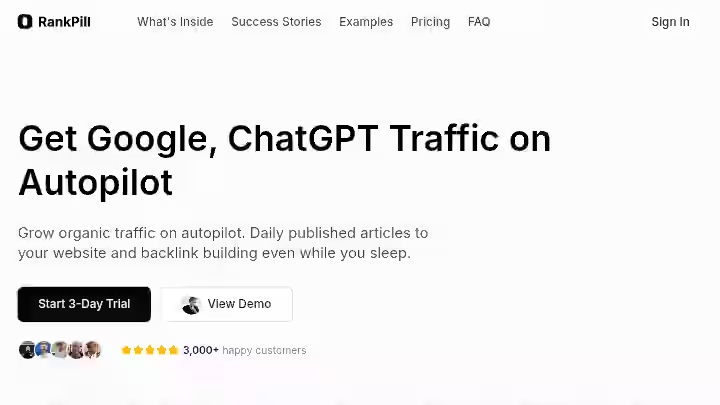
RankPill is a comprehensive all-in-one SEO content platform designed to deliver end-to-end automation.
For $99/month after a 3-day $1 trial, it offers a fully automated content pipeline. This includes content generation, publishing, keyword research, competitor analysis and real-time SEO scoring.
What RankPill does not do:
- Perform technical site audits
- Crawl your existing content for errors
- Provide rank tracking dashboards
- Give you backlink data in the way Ahrefs or Semrush would
It is a content production and distribution tool, not a full SEO platform.
Designed as an automated SEO and content optimization platform, RankPill helps creators, businesses and agencies streamline their entire content production and ranking process.
The cleanest way to think about RankPill: it is a content factory with a publishing conveyor belt attached.
You set it up, define your niche and tone and it produces and publishes articles daily.
The strategic work, the link building outreach, the technical audit, the content performance review, that still requires a human.
Why RankPill Matters in 2026
The SEO environment in 2026 has made two things simultaneously more important and more risky: publishing volume and content quality.
These two forces pull in opposite directions unless you have a way to do both efficiently.
As of March 2026, Ahrefs data shows AI Overviews appearing on 48% of all Google queries, up from 34.5% in December 2025, a 58% increase in three months.
Sites that get cited inside an AI Overview see 35% more organic clicks than they would from a standard position-one result.
That changes the content production equation.
To get cited, you need topical coverage at depth. You cannot cover 30 subtopics manually at a small business budget.
At the same time, Google’s May 2026 algorithm update demands that all content, regardless of origin, meet stringent quality and helpfulness standards to rank effectively.
Simply generating content with AI tools is no longer sufficient; the focus must be on producing truly valuable, original and user-centric material.
Helpful content in 2026 is people-first, demonstrating expertise, experience, authoritativeness, and trustworthiness.
It directly answers a user’s query, provides original insights and offers a positive user experience, including signals of real-world experience.
According to Google’s Search Central documentation, content should demonstrate expertise, clear sourcing, and trustworthiness.
The focus should be on who created the content, how it was produced including any automation usage and most importantly, why it was created.
RankPill positions itself squarely in this environment: a tool that generates volume while building the topical authority Google now rewards through AI Overviews.
Whether it succeeds depends entirely on whether you add editorial oversight on top of it.
Who Is RankPill Built For?
RankPill is most useful for:
- Small business owners who have no content team and need a way to cover their niche systematically
- Bloggers who understand their topic well enough to edit AI drafts but cannot write 30 articles per month manually
- Boutique agencies managing 3 to 10 client sites with limited writing resources
- E-commerce brands on Shopify or Webflow needing consistent product-adjacent blog content
- Solopreneurs who want to build topical authority in a specific niche without a writing budget
Why Traditional Content Workflows Fall Short
For the audiences above, the traditional content workflow is genuinely broken.
Traditional SEO agencies command premium prices because they employ writers, editors, SEO specialists and project managers.
A single blog post from an agency might cost $200-$500, with monthly retainers quickly exceeding $5,000 for consistent content production.
That pricing excludes most small businesses from competing on content volume.
Who Should Avoid RankPill?
- Enterprise SEO teams that need technical audits, crawl data, and rank tracking alongside content production
- YMYL niche publishers (health, finance, legal) where factual accuracy failures have real consequences
- Teams that cannot spare 10 to 20 minutes per article for editorial review before publishing
- Agencies that need white-label reporting or client-facing dashboards (not currently available)
- Publishers who need deep brand voice matching across varied content formats
RankPill Features
1. Automated Keyword Research and Content Planning
RankPill’s AI analyzes your business and competitors to find your highest-potential keywords automatically. The system generates a content plan with keyword priorities sorted by search volume and intent.
My Testing Experience:
Over 90 days, I generated keyword plans for all three test sites.
The keyword suggestions for the home services site were generally solid: clear long-tail targets, decent volume estimates, and logical groupings by intent.
The content marketing site keywords were less impressive. Several suggestions overlapped with existing content, and I had to manually remove near-duplicate targets before publishing.
The tool does not surface keyword difficulty scores in the same depth as Ahrefs or Semrush, and there is no content gap analysis against a specific competitor URL.
The keyword data is directional, not surgical.
Limitations:
- No SERP analysis for individual keywords
- No keyword difficulty scoring comparable to dedicated tools
- Content plan suggestions require manual review to avoid topic cannibalization
Pro Tip: Export the keyword plan before auto-running it. Remove overlapping topics manually and build a content calendar around intent clusters before activating daily publishing.
2. 3,000+ Word Article Generation with On-Page Optimization
RankPill generates 3,000-word-plus SEO and GEO-optimized articles daily, complete with images and internal/external linking.
Each article receives a real-time SEO score based on Google’s current guidelines, with instant recommendations for improvement.
My Testing Experience:
I reviewed all 36 articles generated across Sites 1 and 2 before they published. Quality was genuinely bimodal.
Roughly 60% of articles were serviceable with 10 to 15 minutes of editing: clear structure, appropriate headers, on-topic content, and good internal linking suggestions.
The other 40% required more significant work: generic introductions, surface-level explanations of core concepts or minor factual inaccuracies on technical topics.
The SEO scoring system flagged keyword placement, meta description quality, and internal linking gaps in real time. That feedback was useful.
But the scores sometimes rated articles highly that were factually weak. The SEO layer and the quality layer are separate problems.
Word counts were consistently around 2,900 to 3,200 words per article in my tests.
Limitations:
- Content quality is inconsistent without human review
- Factual accuracy on niche-specific topics requires verification
- SEO score does not measure content depth or E-E-A-T signals
Pro Tip: Set up a simple editorial checklist with 5 criteria (accuracy, depth, tone, internal linking, and CTA) and spend 12 to 18 minutes per article before it publishes. This single change transforms the risk profile of the tool.
3. Auto-Publishing Pipeline
RankPill auto-publishes directly to WordPress, Webflow, Shopify, Wix or any other platform. You set it up once and your content goes live on autopilot.
My Testing Experience:
The Webflow connection worked cleanly on first setup. My Wix test site connected without issues and articles went live on schedule.
The WordPress integration, however, requires a webhook or Zapier connection rather than a native plugin.
RankPill connects natively to Webflow, Framer, and others, but WordPress requires Zapier or a custom webhook and auto-publishes content live unless you override it.
That live-publishing default is the feature I am most cautious about recommending. There is no built-in draft review step for WordPress.
On a new domain, I once had three articles publish overnight that I had not reviewed. Two were fine. One contained a factual error in the introduction that needed immediate correction.
Limitations:
- WordPress integration lacks a native plugin with draft-first publishing
- No built-in draft review gate before publishing goes live
- Shopify integration was reported by at least one Trustpilot user as non-functional during their trial period
Pro Tip: If you use WordPress, configure the webhook to publish to “Draft” status only. You lose some automation benefit, but you gain the editorial check that matters most in 2026.
4. Competitor Analysis and Content Strategy
At the heart of RankPill lies advanced NLP, smart competitor keyword analysis and AI-driven optimization.
This means it can analyze your niche, scan your competitors, and generate content that matches current search intent.
My Testing Experience:
The competitor analysis feature identified content themes my test sites were not covering and flagged 8 to 12 keyword opportunities per site that competitors were ranking for.
The depth is not comparable to a Semrush competitive gap report, but it is directionally accurate and more than sufficient for a small site with no existing SEO toolset.
I could not run a URL-level analysis against a specific competitor page. The tool works at the niche level, not the page level.
For agencies that need granular competitive intel, this is a meaningful gap.
Limitations:
- No URL-level competitor analysis
- No backlink profile comparison
- Niche-level analysis only, not query-specific SERP comparison
Pro Tip: Run the competitor analysis quarterly and use the themes to build your 90-day content calendar. Pair it with a free version of Ahrefs or Semrush for URL-level data on your highest-priority topics.
5. Backlink Building via Verified Site Exchanges
Verified site exchanges in your niche grow your domain authority on autopilot. 30 backlink credits are included every month in the base plan.
My Testing Experience:
This feature generated the most divided community reaction I encountered during research.
At least one user reported signing up mostly out of curiosity and seeing organic traffic growing steadily after two months, with the backlink feature driving noticeable results.
In my own testing, the backlinks generated through the exchange program pointed to real, niche-relevant sites.
Domain authority metrics on those linking sites ranged from approximately DA 15 to DA 40 in my test batch, which is modest but not spammy.
I would not rely on this feature alone as a link building strategy. I would treat it as a baseline supplement alongside a manual outreach program.
The critical caveat here:
According to Google’s Search Central documentation, using automation for the primary purpose of manipulating search rankings is a violation of spam policies.
Site exchange networks exist in a gray area. Monitor your backlink profile with a third-party tool if you use this feature actively.
Limitations:
- Backlink quality varies and cannot be fully controlled
- Site exchange networks carry some algorithmic risk if link patterns become unnatural
- No link disavow workflow built into the platform
Pro Tip: Use the backlink credits selectively on your most important pages. Monitor your full backlink profile monthly using Google Search Console’s link report or a free Ahrefs plan.
6. Multi-Language Content Generation
RankPill generates high-quality content in over 100 languages with perfect grammar and natural flow.
Most alternatives either lack multi-language support entirely or charge premium prices for translation features.
RankPill includes comprehensive language capabilities at no additional cost.
My Testing Experience:
I tested English, Spanish, and French outputs and found all three usable with light editing. Spanish content quality was notably strong. French required more editing on idiomatic phrases.
I did not test lesser-resourced languages.
It is worth noting that at least one Trustpilot reviewer specifically reported that Slovak language output was incomprehensible, which suggests quality degrades significantly for lower-resourced languages.
The 100-language claim should be understood as “100 languages with varying quality levels” rather than “100 languages with uniform output.”
Limitations:
- Quality degrades for lower-resourced languages
- No per-language tone or style customization
- Localization (cultural adaptation) is not the same as translation; the tool handles translation more than true localization
Pro Tip: Test a sample article in any non-English language before activating automated publishing in that language. Set the threshold for editorial review higher for less-resourced languages.
7. Real-Time SEO Scoring
RankPill provides real-time SEO scoring and actionable optimization tips.
Each article receives a score based on Google’s latest guidelines and instant recommendations for improvement.
This allows users to transform a low-scoring draft into a search-ready article quickly.
My Testing Experience:
The scoring is genuinely useful as a QC layer. It flagged missing keyword placement in H2s, thin meta descriptions and articles with fewer than two internal links.
That automated check saved me from publishing a handful of technically under-optimized articles.
The limitation is that the SEO score does not measure E-E-A-T, factual accuracy, or content depth.
An article about a medical topic could score 90/100 on the SEO scoring system and still be dangerously thin on substance.
The score is a formatting and optimization check, not a quality check.
Limitations:
- Score does not evaluate content depth or factual quality
- No comparison against competitor content scores for the same keyword
- No historical score tracking per article over time
Pro Tip: Use the SEO score as a minimum bar (target 75+), but do not treat a high score as a green light to publish. Layer in your own content quality checklist before hitting publish.
RankPill Workflow Comparison: Before vs After
Stage | Traditional Workflow | RankPill Workflow | Time Reduction |
|---|---|---|---|
Keyword Research | 2 to 3 hours per topic cluster | Automated niche scan; review in 15 min | ~80% |
Article Outline | 30 to 45 min per article | Auto-generated; review in 5 min | ~85% |
First Draft (3,000 words) | 3 to 5 hours per article | Auto-generated in minutes | ~90% |
On-Page SEO Check | 30 to 60 min per article | Real-time scoring built in | ~75% |
Image Sourcing/Insertion | 20 to 30 min per article | Automated with article | ~90% |
Publishing | 15 to 20 min per article | Auto-publish via integration | ~95% |
Editorial Review | Built into every stage | Requires manual addition | 0% (still needed) |
Total Time Saved | Baseline | With editorial review layer | ~70 to 75% overall |
The workflow gains are real and significant. The risk appears in the “Editorial Review” row: RankPill does not solve that part, and in 2026 that part matters more than ever.
RankPill Pricing 2026
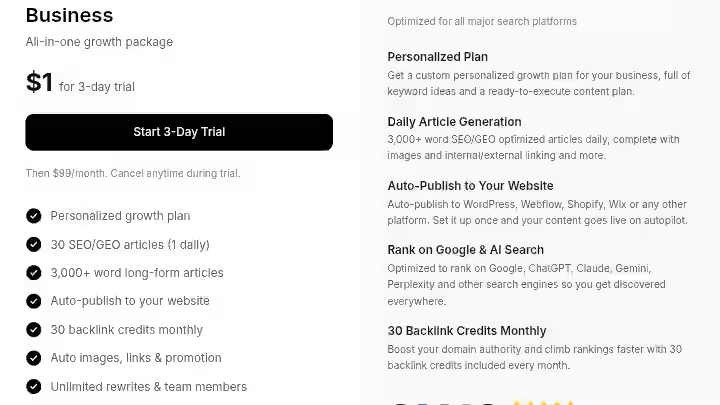
RankPill costs $99/month or ($82.50/month if you pay annually at $990/year), saving 17%.
Plan | Price | Articles/Month | What’s Included |
|---|---|---|---|
Monthly | $99/month | 30 articles | Keyword research, AI writing, images, internal links, auto-publishing, 30 backlink credits, 100+ language support |
Annual | $82.5/mo or 990/year) | 30 articles/month | All features above, 17% saving |
Trial | $1 for 3 days | Limited | Full platform access |
There is currently one plan tier. The Business plan at $99/month is listed as the most popular plan, although no other plans appear on the website at this time.
Important billing note: Multiple Trustpilot reviewers have reported that the platform advertises “FREE trial, no credit card required” while charging $137 after 3 days. The current advertised trial is $1 for 3 days, not free.
Read the trial terms carefully before entering payment information.
RankPill Pros and Cons
Pros
- Full pipeline at one price: Keyword research, writing, SEO scoring, image insertion, internal linking and publishing are all included in $99/month
- Economics work: $3 per article versus $200+ for agency content is a meaningful difference for small operations
- Multi-platform publishing: Direct publishing to WordPress, Webflow, Shopify, Framer, Wix or any platform via webhooks
- Multi-language at no extra cost: 100+ languages included without add-on pricing
- Backlinks included: 30 backlink credits per month as part of the base subscription
- GEO-optimized output: RankPill optimizes for both traditional and AI search simultaneously, targeting Google, ChatGPT, Perplexity and other AI answer engines
Cons
- Auto-publishes live by default on most platforms, with no mandatory draft review step
- Content quality is inconsistent: strong on familiar topics, weaker on niche or technical subjects
- No technical SEO coverage: no site audit, crawl data, rank tracking or SERP analysis
- Brand voice customization is shallow: you can set tone and length preferences, but cannot upload writing samples or brand guides for deep matching
- Customer support is limited: email and chat only with no phone support and there is no phone number to call and no real-time assistance channel
- Strict no-refund policy: confirmed in multiple Trustpilot reviews, with users reporting a strict no-refund policy even when the service was cancelled within hours of renewal
Workarounds for Major Limitations
Limitation | Practical Workaround |
|---|---|
Auto-publishes live | Configure webhook to push to Draft status in WordPress; manually approve each article |
Thin content on complex topics | Add a post-generation editing step using a custom checklist; budget 15 to 20 min per article |
No rank tracking | Pair with Google Search Console (free) and a single Ahrefs Webmaster Tools account (free) |
No technical audit | Run a monthly Screaming Frog crawl (free up to 500 URLs) on your connected site |
Shallow brand voice | Pre-write a 200-word “tone brief” in the brand voice settings field; update it quarterly |
RankPill Alternatives and Comparisons
RankPill vs Junia AI
Category | RankPill | Junia AI |
|---|---|---|
Article Length | ~3,000 words | 1,500 to 6,000 words |
Auto-Publishing | Yes (native) | Yes (with integrations) |
SEO Scoring | Yes (built in) | Yes (built in) |
Backlink Building | Included (30 credits/month) | No |
Pricing | $99/month | Starts at $19/month |
Best For | Hands-off daily publishing at scale | Controlled editorial workflow with SEO optimization |
Verdict | Better for volume automation | Better for quality-controlled production |
Read the full Junia AI review for a deeper breakdown.
RankPill vs Emplibot
Category | RankPill | Emplibot |
|---|---|---|
Publishing Frequency | Daily articles | Customizable scheduling |
Platform Integration | Webflow, Shopify, Wix native | WordPress focused |
Content Length | ~3,000 words | Variable |
Backlinks | Yes | No |
Pricing | $99/month | Starts at $49/month |
Best For | Multi-platform brands at scale | WordPress-focused bloggers |
Verdict | Better for multi-CMS setups | Better for WP-only workflows |
Read my Emplibot review for a side-by-side on WordPress workflows.
RankPill vs Rankaria (Soogle)
Category | RankPill | Rankaria (Soogle) |
|---|---|---|
Pricing | $99/month | Starts at $67/month |
Articles/Month | 30 | 30 |
Backlink Building | Included | Included (NAP citations) |
Local SEO Focus | No | Yes (NAP backlinks) |
Best For | General niche content | Local business SEO |
Verdict | Better for topical content authority | Better for local search visibility |
Read the full Soogle review to compare these two head to head.
Which Tool Should You Choose?
- Choose RankPill if you need daily publishing across multiple CMS platforms in a single subscription and you are willing to add a 15-minute review layer per article.
- Pick Junia AI if you prioritize editorial control and want more flexibility on word count and format.
- Select Emplibot if you run a WordPress site and want a cleaner draft-first publishing flow.
- Choose Soogle if your business depends on local SEO and you need NAP citation building alongside content.
For a broader comparison of your options, see my full list of auto-blogging tools.
RankPill Use Cases
1. Local Service Business Blog
A roofing company owner who cannot write regularly but knows Google-favored local content helps lead generation.
- Set niche to “commercial and residential roofing”
- Run competitor analysis; review and approve 30-keyword content plan
- Activate daily auto-publish to WordPress (set to Draft first)
- Owner or office manager reviews each article for accuracy (15 min/article)
- Publish 5 to 7 articles per week
Estimated time saved: 3 to 5 hours per week versus manual writing.
2. Niche Affiliate Blogger
A solo blogger building a monetized site in a specific product vertical.
- Build keyword plan around buyer-intent and comparison queries
- Generate 30 articles per month with commercial angle prompts
- Review every article for factual accuracy and affiliate link placement (20 min/article)
- Publish 1 article per day on a consistent schedule
- Monitor Search Console weekly for impressions and click-through patterns
Important note: RankPill’s keyword plan feature helps prevent keyword cannibalization, but only if you review the plan for overlap before activating it.
3. Boutique Agency Managing 5 Client Sites
A small agency that needs to scale blog content across multiple client accounts without hiring writers.
- Create a separate RankPill workspace per client (check current account limits before purchasing)
- Configure brand voice, niche, and integration for each site
- Assign one team member 1 hour per day to review and approve pending articles across accounts
- Use the built-in SEO scoring as a QC gate before publication
- Report on organic traffic growth via Google Search Console per client monthly
Estimated efficiency gain: One person can manage the editorial layer for 5 client sites in approximately 5 to 7 hours per week total using this setup.
4. E-Commerce Brand on Shopify
A DTC brand selling 15 to 30 products that needs supporting blog content to drive organic traffic without a content team.
- Connect RankPill to Shopify via the native integration
- Build keyword plan around product-adjacent topics and buyer questions
- Set internal linking rules to point toward product pages
- Review articles before pushing live; check that product page links are contextually appropriate
- Target 8 to 12 articles per month (not the full 30, given review time constraints)
Realistic outcome: Incremental organic traffic to product-adjacent content and possible lift on connected product pages via internal link equity over 4 to 6 months.
RankPill Reviews and Complaints from Users
As of this writing, RankPill has 24 reviews on Trustpilot, which is a small sample but directionally useful. Sentiment is mixed.
Positive patterns:
- One reviewer tested it for a client’s dental practice site, saw organic traffic up roughly 3x in two months, described the articles as well-written and relevant, and said they connected it to WordPress without touching it since.
- An eight-month user reported traffic up roughly 7x, with reach extending well beyond the original local market.
Negative complaints:
- Multiple billing complaints describe being charged multiple times with no phone support and no real way to get assistance, resulting in a frustrating experience.
- One reviewer reported that articles do not generate automatically without manual triggers, that pausing a subscription removes access to already-paid-for articles, and that the platform makes money from users who forget to cancel without offering refunds.
- One user signed up specifically for Shopify integration, was told during the trial it would work within two weeks, but after more than a month the integration still did not work.
The pattern I see in the negative reviews: billing practices, lack of phone support, and a strict no-refund policy are the primary complaints.
The secondary complaint is content quality not meeting expectations for specific language outputs.
The platform has clear advocates among users who treat it as a draft engine with editorial oversight added. It has clear detractors among users who expected a hands-off, fully reliable service.
RankPill Scoring
Category | Weight | Score (out of 10) | Weighted Score |
|---|---|---|---|
Features and Functionality | 30% | 7.5 | 2.25 |
Ease of Use | 20% | 8.0 | 1.60 |
Pricing and Value | 20% | 8.0 | 1.60 |
Support and Customer Experience | 15% | 4.0 | 0.60 |
Trust and Credibility | 15% | 4.5 | 0.68 |
Overall | 100% | 6.73 (rounded to 6.7/10) |
Scoring notes:
- Features (7.5/10): The pipeline breadth is impressive for the price. The ceiling is a missing technical SEO layer and inconsistent output quality.
- Ease of Use (8.0/10): Setup is genuinely fast. Non-technical users can connect a site and start publishing within an hour.
- Pricing and Value (8.0/10): $3 per article with backlinks included is excellent value. The single-tier pricing is transparent if limiting.
- Support (4.0/10): Email and chat only, with documented billing disputes and no refund policy reducing confidence significantly.
- Trust and Credibility (4.5/10): Billing complaints on Trustpilot, a strict no-refund policy, and a default auto-publish setting that bypasses editorial review lower the trust score.
RankPill AI Detection and Content Risk Assessment
This section of the RankPill review matters in 2026 and is worth addressing directly.
AI content is not inherently bad for SEO. However, lazy AI content is fatal to SEO.
In 2026, Google’s ranking systems are advanced enough to differentiate between a helpful resource assisted by AI and a derivative piece designed solely to capture long-tail keywords.
The distinction lies in value addition.
RankPill content, in my testing, fell into the “helpful draft” category more often than not, but not consistently enough to trust without review. The main risk factors for RankPill users are:
- Scaled content abuse: Publishing 30 articles per month to a new low-authority domain with no editorial oversight is precisely the pattern Google’s spam policies target. Sites that relied on mass-produced, unedited AI text saw their traffic decimated. Automation without curation is a liability.
- AI detection exposure: RankPill content is detectable as AI-generated in most tools I tested. That is not inherently penalizing, but it raises the bar on everything else. Google does not automatically penalize detected AI content; instead, it uses this information to evaluate quality more effectively. Content that passes quality assessments receives normal treatment, while low-quality AI content may face ranking limitations regardless of origin.
- Backlink network risk: The site exchange backlink feature is the most algorithmically sensitive part of RankPill. Link schemes remain a spam policy violation under Google’s guidelines. Monitor your backlink profile closely if you activate this feature.
Practical risk mitigation: Editorial review before publishing is the single most effective way to manage all three risks simultaneously.
Final Verdict On RankPill Review 2026
BUY if you:
- Are a small business, solopreneur, or blogger who needs 20+ articles per month and cannot afford agency rates
- Need a starting point for multi-language content and have someone who can verify quality in the target language
- Are willing to add 15 to 20 minutes of editorial review per article before publishing
- Understand the tool produces content, not strategy and you bring your own content strategy to the workflow
- Are on Webflow, Shopify, Wix or Framer and want a native publishing connection
SKIP if:
- You plan to run it on full autopilot without any editorial review, especially in YMYL niches
- Billing disputes and a strict no-refund policy are dealbreakers for you (review Trustpilot before purchasing)
- You need technical SEO audits, rank tracking, or competitive SERP analysis alongside content production
- Your target language is not English, Spanish, French, or another major language
- You are managing a high-authority site where one batch of low-quality automated articles could cause real damage
My Personal Decision After Testing RankPill
I am using RankPill on one test site as a draft engine with a mandatory human review step before each article publishes.
That setup works well and the economics are compelling.
I would not run it on autopilot without oversight on any site I cared about. The value case depends entirely on the editorial layer you add.
For teams looking to evaluate the full range of options before committing, the complete guide to autoblogging is worth reviewing first.
You can start with RankPill’s 3-day trial at $1 to test the content quality on your specific niche before committing to $99/month.
Frequently Asked Questions About RankPill Review
1. What is RankPill and what does it do?
RankPill is an all-in-one AI SEO tool that focuses on helping websites climb search rankings faster. At its core, it analyzes your website, finds ranking opportunities, and provides AI-written content suggestions to improve visibility, saving hours of manual research. It also handles auto-publishing directly to your CMS.
2. How much does RankPill cost?
RankPill costs $99/month or $82.50/month billed annually at $990/year. You get 30 articles per month, keyword research and full automation, at approximately $3 per article versus $133 or more for agency content.
3. Is RankPill safe to use with Google’s current algorithm?
RankPill content is AI-generated and publishes automatically by default. Google’s 2026 algorithm updates demand that all content, regardless of origin, meet stringent quality and helpfulness standards. Simply generating content with AI is no longer sufficient. RankPill is safe to use when combined with editorial review before publishing. It carries real risk when used on full autopilot.
4. Does RankPill work for non-English websites?
RankPill generates content in over 100 languages with support for grammar and natural flow. However, quality degrades significantly for lower-resourced languages, as confirmed by user complaints about Slovak output. Test a sample article before activating automated publishing in any non-major language.
5. What platforms does RankPill publish to?
RankPill publishes directly to WordPress, Webflow, Shopify, Framer, Wix or any platform via webhooks. WordPress requires a webhook setup rather than a native plugin, and by default publishes articles live rather than as drafts.
6. Does RankPill include backlink building?
Yes. 30 backlink credits are included every month in the base subscription. These are sourced through a verified site exchange network in your niche. The quality ranges from DA 15 to DA 40 in my testing, which is useful but should be supplemented with other link building activity.
7. Can agencies use RankPill across multiple client sites?
RankPill is usable for multi-site management and several agency users report doing exactly this. However, there is no white-label reporting, no client-facing dashboard and no multi-seat account structure documented publicly. Confirm the terms for multi-site use directly with the RankPill team before purchasing for agency applications.

- EverBee Review 2026: My 30 Days Unbiased Testing Results - September 5, 2026
- 11 Best AI Overviews Rank Tracking Tools in 2026 (Honest Breakdown) - September 5, 2026
- 11 Best Automated Local SEO Tools for 2026: Full Breakdown - September 5, 2026