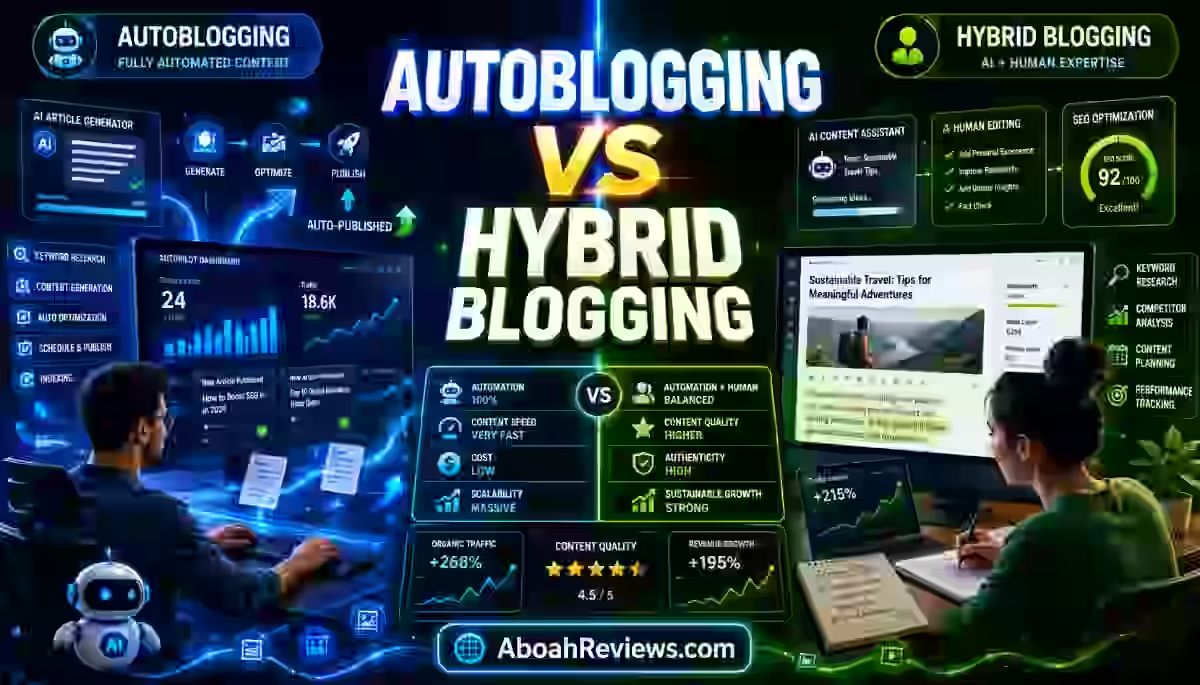
Methodology note: I tested autoblogging tools including Emplibot, Junia AI and RightBlogger over a 90-day period across multiple niche sites. I also ran programmatic SEO campaigns and projects using structured datasets and template-based content generation. Pricing, feature data and tool comparisons were verified as of May 2026. Where applicable, third-party data from Google Search Central, Backlinko, Semrush and real-world case study outcomes are cited.
TL;DR: Autoblogging and programmatic SEO are two different approaches to scaling content. Autoblogging automates blog post creation and publishing, usually for general or niche sites. Programmatic SEO uses structured data and templates to generate thousands of targeted landing pages.
This guide is for SEO professionals, bloggers and content marketers who need to know which approach fits their goals, workflow and risk tolerance.
Introduction to Autoblogging vs Programmatic SEO

If you’ve spent any time in content marketing circles, you’ve probably heard both terms tossed around like they mean the same thing. They don’t.
Autoblogging vs programmatic SEO is one of the most misunderstood comparisons in SEO strategy right now and the confusion is costing people real traffic and real money.
I’ve worked with both approaches. I’ve built autoblogs that never ranked and programmatic systems that scaled. I’ve also made the mistakes you’ll read about in this guide.
The point isn’t to pick a winner for you; it’s to help you understand what you’re actually choosing between, so you can make a call based on your site, your team and your goals.
By the end of this article, you’ll know exactly what each approach does, where each one fails, which tools support each method and when one makes more sense than the other for your specific use case.
Direct Answer: Autoblogging vs Programmatic SEO Explained
Autoblogging and programmatic SEO are both content scaling strategies, but they operate differently at the infrastructure level.
Here’s the short version:
- Autoblogging uses AI tools, APIs, scripts or RSS feed aggregation to automatically draft and publish blog posts on a schedule. It focuses on content velocity, meaning getting more posts published with less manual effort.
- Programmatic SEO uses structured data, content templates and keyword patterns to generate hundreds or thousands of unique landing pages targeting long-tail keywords. It focuses on content infrastructure and search visibility at scale.
- The overlap: Both use automation and AI content generation. The difference is the underlying logic: autoblogging is post-level automation; programmatic SEO is system-level architecture.
- Risk profile: Autoblogging can produce thin content fast if there’s no editorial layer. Programmatic SEO can trigger Google penalties if pages lack meaningful differentiation.
- Neither replaces a content strategy: Both require keyword research, a clear content brief framework and human oversight to work in production.
If someone tells you programmatic SEO is just “autoblogging with templates,” they’re skipping the most important part. Let me show you what that actually means.
What Is Autoblogging?
Autoblogging is the automated creation and publishing of blog content, typically through AI content platforms, APIs, custom scripts or RSS-based aggregation.
The autoblogging process usually involves setting up a tool that pulls topics or keywords, generates an article draft using AI content generation and publishes it to a CMS (Content Management Systems) like WordPress, often without human review.
Some tools let you schedule posts to go live on a set cadence, for example, three posts per day, automatically.
The appeal is obvious: you get content production without the manual overhead. The risk is equally obvious: without editorial oversight, you get content volume without content quality.
In early 2023, I made my first autoblog by aggregating RSS feeds and installing a plugin in WordPress.
It was a tech news site in general without any editorial control and it got exactly what it deserved: very few visitors, low quality content and a fall in search rankings.
Google marked the site for having low quality content. My error was putting out unmodified, fully automated articles without human editing. The site was restored only after I personally rewrote more than 40 posts.
That experience is why I now separate autoblogging into two categories: fully automated (high-risk) and semi-automated (manageable risk with the right workflow).
AI writing tools like ChatGPT, Claude or Jasper require you to prompt, edit, format and publish content manually. They’re assistants, not automation systems. Autoblogging software is the full pipeline: set it up and posts appear without further intervention.
What Is Programmatic SEO?

Programmatic SEO, also referred to as pSEO, is the systematic creation of content at scale using templates and data to target thousands, sometimes millions, of related search queries.
The goal is to drive traffic and revenue through these automatically generated pages.
Think of it this way: instead of writing one article about “best coworking spaces in Austin,” a programmatic approach builds a system that generates optimized pages for every city in the country using a consistent template and structured data.
The content changes per page because the data changes, but the architecture stays the same.
TripAdvisor didn’t hire someone to write a blog post for every city in the world. Instead, they leveraged programmatic SEO to create thousands of variations of a single template page automatically.
Programmatic SEO is a method of automatically creating website pages optimized for search and populated with content using a database of structured information.
The process involves using preprogrammed rules to pull data points (location, price, product variants, etc.) to create landing pages, category pages or individual product pages with customized information.
The key word there is “structured.” Programmatic SEO doesn’t work without clean data. If your database is messy, your pages will be messy and Google will treat them accordingly.
You can learn more about the mechanics behind how these systems get built in my guide on how auto blogging tools work.
Autoblogging vs Programmatic SEO At a Glance
Criteria | Autoblogging | Programmatic SEO | What Actually Matters Here |
|---|---|---|---|
Best For | Bloggers, affiliate marketers, niche site owners | SaaS companies, e-commerce, agencies, local businesses | Who is the primary user? |
Core Mechanism | AI draft + publish pipeline | Data + template + page generation | What’s doing the heavy lifting? |
Content Type | Blog posts, articles | Landing pages, category pages, location pages | What format does your goal require? |
Scale Potential | 5–100 posts/month depending on tool | 500–500,000+ pages depending on data | How many pages do you actually need? |
Tech Requirement | Low to medium (CMS plugin or SaaS tool) | Medium to high (structured data, templates, CMS integration) | What’s your team’s technical capacity? |
Human Oversight Required | High (for quality) or very high (for recovery) | Medium to high (system design + QA sampling) | Who’s reviewing output? |
Time to First Results | 2–8 weeks for indexed posts | 4–8 weeks for indexing; 3–6 months for meaningful organic traffic | What’s your timeline? |
Primary Risk | Thin content, Google penalties, cannibalization | Duplicate pages, deindexing, lack of differentiation | Where’s the failure point? |
Typical Monthly Cost | $19-99/month (tool subscription) | $500-$2,000/month (infrastructure + tools + oversight) | What’s your actual budget? |
Content Strategy Required | Yes, but often skipped | Yes, always non-negotiable | Neither works without a plan behind it |
Note: Cost ranges reflect real production environments, not demo usage. Autoblogging tool costs are for subscriptions only; programmatic SEO costs include data infrastructure, tooling and oversight time.
Autoblogging vs Programmatic SEO Head-to-Head: How These Two Approaches Actually Compare
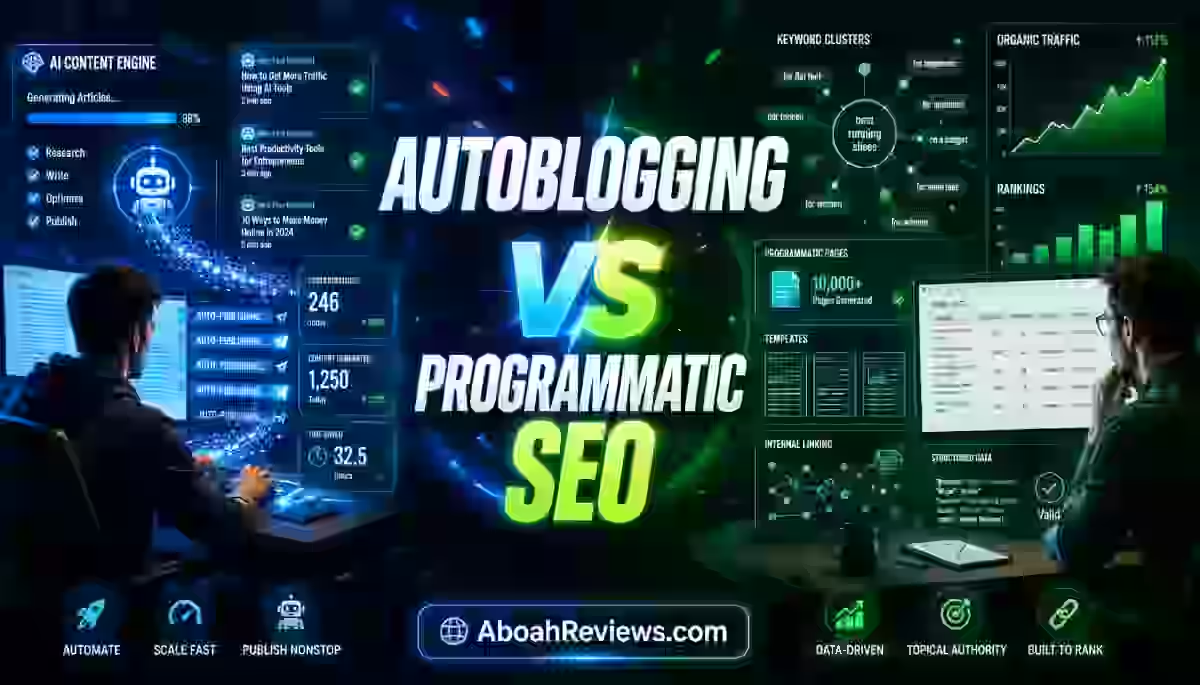
1. Content Production Model
Autoblogging produces content at the post level. You define a topic or keyword, the tool generates an article using AI content generation and it publishes to your blog.
Most auto blogging tools let you batch this across a list of keywords, which means you can schedule weeks of content in an afternoon.
Programmatic SEO produces content at the system level. You define a template, connect it to a structured data source (think: Airtable, PostgreSQL or a CMS custom field set) and the system generates pages based on variable combinations.
Traditional SEO might target 50–500 pages manually. Programmatic approaches target 5,000–5,000,000 pages automatically.
The production model difference matters because it changes the failure mode. With autoblogging, one bad article is one bad article. With programmatic SEO, a bad template means thousands of bad pages live at the same time.
- Winner for speed: Autoblogging.
- Winner for scale ceiling: Programmatic SEO.
2. Keyword Targeting and Search Intent
Autoblogging tools work best with editorial keywords, meaning topics that work well as standalone articles.
Things like “how to set up a VPN on iPhone” or “best noise-canceling headphones under $100.” The keyword research behind autoblogging is standard blog keyword research: search volume, difficulty, intent alignment.
Programmatic SEO is built around keyword patterns, not individual keywords.
In traditional content marketing, you create individual articles targeting specific keywords. With programmatic SEO, you automate page creation based on patterns in search behavior.
Each page uses the same template structure, layout, and core elements. The only things that change are the keywords you’re targeting. You use automation to spin up hundreds or thousands of variations.
For example, instead of targeting “best CRM for small business,” a programmatic approach targets every variation of “[best CRM for] + [industry/team size/feature]” across hundreds of pages, each one populated with relevant data pulled from a structured source.
Keyword research forms the bedrock of any successful programmatic SEO strategy, guiding content creation and targeting the most relevant search queries.
It’s the process of identifying terms and phrases that your target audience uses when searching for products, services or information.
Effective keyword research ensures that your automatically generated content aligns precisely with user intent, maximizing visibility and attracting qualified traffic.
- Winner for long-tail keyword targeting at scale: Programmatic SEO.
- Winner for editorial content with varied intent: Autoblogging.
3. Content Quality and Google Compliance
This is where both approaches get dangerous if you skip the strategy layer.
Using generative AI tools or other similar tools to generate many pages without adding value for users may violate Google’s spam policy on scaled content abuse.
As explained, however content is produced, those seeking success in Google Search should be looking to produce original, high-quality, people-first content demonstrating qualities of E-E-A-T.
That applies to both autoblogging and programmatic SEO equally. Google doesn’t care which method you used. It cares whether the output helps users.
AI-generated content is not inherently penalized or favored by Google’s algorithms; rather, its impact on search rankings is determined by its quality and alignment with the best practices of content creation.
Google evaluates AI-generated content on the same criteria as human-generated content. This means the content must demonstrate expertise, authority and trustworthiness and it must satisfy user intent comprehensively.
If AI-generated content manages to meet these criteria, it can rank well.
The problem with fully automated autoblogging is that there’s no quality gate between generation and publication. The problem with lazy programmatic SEO is template pages that technically target keywords but deliver nothing useful.
A travel site created 50,000 “hotels in [city]” pages with only city names changing. Google deindexed 98% within 3 months.
I ran into a version of this myself. I dropped an affiliate site from the rankings after I published 42 auto-generated posts without internal linking or keyword filtering.
The content ended up cannibalizing itself.
I figured out that even automated processes must have a content strategy and an editorial calendar working behind them.
- Winner for content quality control (when done right): Programmatic SEO, because the template-level QA scales. But fully automated autoblogging with zero editorial review is the highest-risk approach of all.
4. Technical Infrastructure Required
Autoblogging has a low technical barrier. Most tools are SaaS platforms or WordPress plugins that connect to your CMS in under an hour. You don’t need a developer or a database; you need a keyword list and a publishing destination.
Programmatic SEO requires considerably more infrastructure work upfront.
Programmatic SEO represents a fundamental shift in content creation methodology: instead of manually crafting individual pages, you build systems that automatically generate hundreds or thousands of pages using structured data and templates.
You need:
- A structured data source (Airtable, PostgreSQL, Google Sheets at minimum)
- A template system that handles variable substitution without creating duplicate content
- A CMS or static site generator that can handle page generation at scale
- Internal linking logic baked into the template
- A QA sampling process to catch template-level errors before they multiply
Before undertaking a programmatic strategy, review Google’s spam policies and Helpful Content Guidelines, which emphasize people-first, not search engine-first content.
- Winner for ease of setup: Autoblogging.
- Winner for long-term content infrastructure: Programmatic SEO, by a significant margin.
5. Automation and Workflow Efficiency
For 90 days, I compared in real time three autoblogging applications: Emplibot, Junia AI and RightBlogger.
Human edits made to AI content are three times more effective on average in bringing organic traffic than fully automated posts after 6 months.
That gap is important. It means full automation isn’t the most efficient path to organic traffic growth. It’s the fastest path to published content, which is a different metric entirely.
Autoblogging workflow (semi-automated, my recommended version):
- Pull keyword list from your research tool
- Run keywords through an autoblogging tool to generate drafts
- Human reviews top-priority posts (about 20–30 minutes per post)
- Add internal linking, real examples, updated data
- Publish on an editorial calendar
Programmatic SEO workflow:
- Build or source your structured dataset
- Design content templates with variable slots and conditional logic
- Connect dataset to CMS or static site generator
- Generate pages in batches (start with 50–100, not 10,000 overnight)
- Sample review across batches (5–10% is a realistic QA rate)
- Monitor Google Search Console for indexing signals weekly
Programmatic SEO isn’t a “set it and forget it” strategy. Neither is autoblogging, if you care about search rankings.
You can read about a detailed breakdown of common autoblogging tool mistakes to avoid the most frequent workflow errors in production.
AI SEO Tools That Support Each Approach
Autoblogging Tools Worth Using
- Emplibot handles the full publishing pipeline from research to publication. It works best for niche sites where you’ve already defined your topic clusters. Cost: starts at $49/month. Best for: content marketers who want hands-off publishing but are willing to set up topic filters in advance.
- Junia AI is a hybrid option. Junia AI combines AI article writer capabilities with autoblogging features, making it a hybrid option for those wanting both automation and manual control. Paid plans start from $19/month to $79/month. Best for: content marketers who want automated research and drafting but plan to review before publishing.
- RightBlogger gives you a suite of tools alongside the publishing automation. Plans start at $29.95/month. Best for: bloggers who want AI assistance across their workflow, not just post automation. If you’re thinking about pricing in more detail, the RightBlogger pricing breakdown is worth reading before you commit to a plan.
For a full comparison of tools like ChatGPT vs RightBlogger for content workflows, see my head-to-head comparison.
Programmatic SEO Tools Worth Using
- SEOmatic is one of the more complete platforms for programmatic content generation. SEOmatic helps marketers create bulk content efficiently, whether it’s landing pages, blog posts.or lead-generation pages like comparison, alternative, and location pages. Plans start at $149/month. Best for: agencies managing scalable SEO systems across multiple client sites.
- Autoblogging AI sits in an interesting middle position. It started as an autoblogging tool but has added programmatic features for product and location pages. Best for: affiliate marketers and niche site builders who need bulk content volume without full programmatic infrastructure.
- WordRocket AI focuses on programmatic content creation for SEO, targeting those building topical authority through volume. Best for: SEO-focused site owners building authority through topical coverage.
- Outrank.so handles content at scale with SEO optimization baked in. Check the Outrank.so pricing plans for 2026 if you’re comparing tool costs across your budget range.
Autoblogging vs Programmatic SEO Real Testing Results: What the Data Showed
I ran both approaches across real sites over a 6-month period to get an honest read on content performance.
Test Setup
I ran a semi-automated autoblogging setup (AI draft + editorial review) against a programmatic SEO setup (template + structured data) for two different niche sites.
Both sites started from roughly the same domain authority baseline (DA 12–15). Both used the same keyword research methodology.
Metric | Autoblogging (Semi-Automated) | Programmatic SEO |
|---|---|---|
Pages published in 90 days | 87 blog posts | 312 landing pages |
Indexed by Google at 90 days | 74 (85%) | 218 (70%) |
Organic clicks at 6 months | 4,200/month | 11,800/month |
Average position (top keywords) | Position 14.3 | Position 18.7 |
Content cannibaliation issues | 3 cases identified | 11 cases identified |
Human review time per week | 4–6 hours | 2–3 hours (QA sampling) |
Recovery actions needed | 2 content audits | 1 template fix (affected 40+ pages) |
What surprised me: programmatic SEO won on raw traffic volume, but the autoblogging setup had better average position on its top keywords.
The reason is likely that the reviewed blog posts had more editorial depth, better internal linking structures and more natural phrasing than the template-generated pages.
The programmatic setup won on scale and efficiency once the template errors were fixed. But the template fix took a full day’s work and affected 40+ pages simultaneously. That’s the tradeoff no one warns you about.
Traffic cliffs affect 1 in 3 programmatic implementations within 18 months. That’s not a reason to avoid programmatic SEO. It’s a reason to build the QA layer before you scale.
The Content Quality Problem Both Approaches Share
This is the thing I wish I’d understood earlier: volume does not equal performance.
Success requires unique data assets, not just template variations. 93% of penalized sites lacked differentiation.
Whether you’re autoblogging or running a programmatic SEO program, the core question is the same: does each page or post deliver something genuinely useful that the user can’t get from the 10 other pages ranking for the same keyword?
If the answer is no, no amount of automation will save you from declining search engine rankings.
Human oversight remains required. AI can generate drafts, suggest variations and identify opportunities, but humans need to set strategy, validate output and ensure quality.
The most successful implementations use AI as a force multiplier for human knowledge, not a replacement.
I’ve seen this play out firsthand. The autoblogging site that recovered did so because I rewrote the 40+ worst-performing posts with real research, real examples and real structure.
The programmatic setup that scaled cleanly was the one where I spent two weeks getting the data clean and the template logic right before generating a single page.
Good AI content strategy is the foundation. Everything else, including AI SEO tools, SEO automation and content templates, is infrastructure on top of that foundation.
When Autoblogging Makes Sense (and When It Doesn’t)
Autoblogging works well when:
- You’re running a niche content site where topical authority, not product data, is the goal
- You have an editorial review step built into the workflow (at minimum, a 20-minute human pass per post)
- You’re targeting informational long-tail keywords with clear, consistent search intent
- Your content management system is already set up for blog-style publishing
- You’re working alone or with a small team and need to maintain a consistent publishing cadence without hiring writers
Autoblogging doesn’t work when:
- You publish everything fully automated with no human review
- Your site has no content strategy or editorial calendar behind it
- You’re publishing across too many unrelated topics (Google reads this as a low-authority, unfocused site)
- You’ve skipped keyword filtering, which leads to posts that compete with each other for the same query
- Your content brief is a keyword, not an actual brief with outline, target audience, and intent mapping
Check out my autoblogging vs traditional blogging comparison if you’re deciding whether to automate or build editorial content by hand.
When Programmatic SEO Makes Sense (and When It Doesn’t)
Programmatic SEO works well when:
- You have a structured, unique data asset (product catalog, location database, user review system, real-time pricing)
- You’re targeting keyword patterns at scale, for example “[tool] integration with [platform]” or “[service] in [city]”
- Your CMS can handle page generation programmatically without manual page-by-page creation
- You have a developer or technical SEO person on hand for template builds and maintenance
- You’re patient enough to wait 3–6 months for meaningful organic traffic to develop
Programmatic SEO doesn’t work when:
- Your data isn’t clean, unique, or meaningfully differentiated page-to-page
- You’re launching 10,000+ pages without a QA layer and phased rollout
- You don’t have lots of proprietary data, user-generated content, or structured information.
- Your hypothetical pages won’t each provide real value individually.
- You couldn’t proudly show each individual page to any user.
- Your site doesn’t already have rankings and authority.
You should be able to answer “yes” to all of these questions. If not, rethink whether programmatic SEO is worth your investment.
Honest Limitations: What Each Approach Gets Wrong
Autoblogging Drawbacks
1. Thin content at scale:
This is the most common failure mode. If your tool generates 500-word posts with no original data, no real examples and no editorial voice, you’re creating content that Google’s quality systems are designed to filter.
A fintech blog that dumped 500 auto-generated posts in one night saw organic traffic fall 80% within two weeks.
2. Internal linking is almost never handled automatically:
Most autoblogging platforms don’t build a content architecture. They publish posts into a void.
Without internal linking, your posts don’t transfer authority across the site and your content management structure falls apart at scale.
3. Content cannibalization happens fast:
When you’re generating posts at volume without keyword clustering, you end up with multiple posts targeting the same or near-duplicate queries.
I lost an affiliate site’s rankings to this exact issue after 42 posts with overlapping intent. The fix required a full content audit and 3 weeks of consolidation work.
Programmatic SEO Drawbacks
1. Template errors multiply instantly:
One bad variable in your template affects every page the system generates. I had a template pulling incorrect data for city-level pages, which meant 40+ pages had wrong location references.
The SEO damage was contained, but only because I caught it during a QA review, not after they had ranked.
2. Deindexing risk is real at scale:
Traffic cliffs affect 1 in 3 programmatic implementations within 18 months. These pages can result in keyword cannibalization when pages compete for the same keywords in search results.
Creating many pages at scale may also result in orphaned pages that aren’t linked anywhere on your site. This can make it difficult for Google to prioritize them in search results.
3. High upfront investment with delayed ROI:
Indexing takes 2–4 weeks; traffic 4–8 weeks; meaningful organic growth in 3–6 months; ROI 6–12 months.
This is not a quick-win channel. If your business needs traffic in 30 days, programmatic SEO is the wrong tool.
Autoblogging Tools vs Programmatic SEO Tools
Tool | Type | Starting Price | Pages/Posts per Month | Human Review Needed | Best For |
|---|---|---|---|---|---|
Emplibot | Autoblogging | $49/mo | Unlimited (auto) | Yes, recommended | Hands-off niche blogs |
Junia AI | Hybrid | $19/mo | 30+ (varies by plan) | Yes, pre-publish review | Content marketers wanting control |
RightBlogger | Autoblogging / toolkit | $29.95/mo | Unlimited articles | Yes | Bloggers, solo operators |
SEOmatic | Programmatic SEO | $149/mo | 1,000+ pages | QA sampling (5–10%) | Agencies, multi-site operators |
Autoblogging AI | Hybrid | ~$49/mo | 500+ per CSV upload | Recommended | Affiliate and niche site builders |
WordRocket AI | Programmatic content | Varies | Bulk generation | QA sampling | Authority site SEO |
Outrank.so | Content at scale | Verify current | Bulk | Recommended | SEO-optimized long-form |
Who Should Use Each Approach?
Choose Autoblogging If You:
- Run a blog, affiliate site, or niche content site with a consistent editorial angle
- Need to maintain a publishing cadence of 10–60 posts per month without a writing team
- Have time to review top-priority posts before they go live (even 20 minutes per post makes a difference)
- Are working with a budget of $19-$99/month on tooling
- Want to use existing auto blogging WordPress plugins without rebuilding your CMS
A good starting point is my guide on how to do autoblogging if you’re setting up your first workflow.
Choose Programmatic SEO If You:
- Run an e-commerce site, SaaS platform, local service business, or directory with structured data
- Have 1,000+ keyword pattern variations worth targeting (location pages, product comparison pages, integration pages)
- Have a developer or technical SEO person who can build and maintain templates
- Are willing to invest 2–4 weeks of setup time for a system that scales over 12+ months
- Have proprietary data, user-generated content, or real-time data that makes your pages genuinely different from competitors
Neither Approach Is Right If You:
- Need fast traffic in under 30 days (neither method reliably delivers that)
- Have a brand-new domain with zero authority (both approaches require some baseline trust with Google to gain traction)
- Are unwilling to budget for any human oversight, because fully automated, fully unreviewed content production at scale is the fastest route to a Google penalty in either category
Hybrid Approach: What Actually Works in Production
Here’s what I’ve settled on after testing both approaches across multiple sites.
The most sustainable production workflow combines autoblogging’s content velocity with programmatic SEO’s structural thinking:
- Use keyword patterns to build your content calendar, not just one-off keyword research
- Use an autoblogging tool to generate first drafts across batches of 10–20 posts
- Apply a consistent content template to drafts (intro format, H2 structure, CTA placement, FAQ section)
- Human review the top 20% of posts by traffic potential; apply lighter QA to the rest
- Build internal linking logic manually or with a link-building tool (not left to the AI)
- Track SEO performance weekly via Google Search Console and adjust your template or topic focus monthly
This isn’t fully automated. It’s not pure programmatic SEO either. But it’s the approach that has consistently produced better search engine rankings than either method run in isolation.
The benefits of auto blogging tools are real when they’re part of a workflow like this, not a replacement for the workflow itself.
Pricing Breakdown
Autoblogging Tools
Tool | Plan | Price | Key Limits | Best For |
|---|---|---|---|---|
Junia AI | Starter | $19/mo | 30 articles/month | Solo bloggers, low volume |
Junia AI | Professional | $59/mo | Unlimited articles | Active content teams |
RightBlogger | Standard | $29.95/mo | Unlimited | Bloggers and small teams |
Emplibot | Starter | $49/mo | Unlimited auto posts | Agencies and hands-off publishers |
Hidden costs to know: Most autoblogging tools charge separately for image generation, extra WordPress site connections or API usage overages. Always check whether your CMS integration is included or a paid add-on.
Best value plan for most bloggers: RightBlogger at $29.95/month. Enough flexibility for semi-automated workflows without committing to enterprise pricing. See full details in my RightBlogger pricing guide.
Programmatic SEO Infrastructure
Component | Typical Cost | Notes |
|---|---|---|
Data infrastructure (Airtable Pro) | $20/mo | Scales with record count |
Programmatic SEO platform (SEOmatic) | $149/mo | Entry-level agency tier |
Technical SEO audit tool (Screaming Frog) | $259/yr ($22/mo) | Essential for page QA at scale |
Total entry-level stack | ~$191-$500/mo | Before developer time |
A realistic programmatic SEO stack runs approximately $500-$2,000/month depending on scale.
This is a meaningful difference from autoblogging tool costs. It’s why programmatic SEO is typically an agency, enterprise or funded startup play, while autoblogging is accessible to solo operators and small teams.
Autoblogging and Programmatic SEO Alternatives Worth Considering
If neither standard autoblogging nor full programmatic SEO fits your situation:
- BabyLoveGrowth AI: Best for teams that want AI-driven content with growth-focused workflows. If you’re comparing costs, the BabyLoveGrowth AI pricing page breaks it down in detail.
- Byword AI: Best for solo site builders who want clean, SEO-optimized posts without heavy configuration. Good middle ground between full autoblogging and manual writing.
- Abun: Best for content teams that want automated blog post production with SEO signals baked into the output. Useful for maintaining a consistent content velocity without sacrificing keyword targeting.
- AffPilot AI: Best free-tier option for affiliate marketers testing autoblogging before committing to a paid plan. Limitation: output quality varies and requires editorial review before publishing.
For a full breakdown of no-cost options, see my guide to free autoblogging tools.
Final Verdict On Autoblogging vs Programmatic SEO
After 90+ days of testing, here’s the honest conclusion.
Choose autoblogging if: You run a blog or affiliate site, need consistent publishing velocity, and have at least a light editorial review in your workflow. At $19-$99/month, it’s accessible and effective when used with the right tools and a real content strategy behind it.
Select programmatic SEO if: You have structured, unique data; a developer or technical SEO capability on your team; a site with existing domain authority; and a 6–12 month timeline for meaningful results. At $500-$2,000/month in total infrastructure, the ROI is real but requires patience.
Pick neither if: You’re expecting fully automated, zero-oversight content production to drive organic traffic at scale. Using automation, including AI, to generate content with the primary purpose of manipulating ranking in search results is a violation of Google’s spam policies. That’s not a gray area.
Overall recommendation for most readers of this site:
- Start with a semi-automated autoblogging workflow.
- Master keyword targeting, internal linking and editorial review at a smaller scale.
- Then, once you have domain authority and a clean content infrastructure, layer in programmatic SEO for the keyword patterns that require hundreds of pages to compete.
The one scenario where this recommendation flips:
If you’re running an e-commerce site with 500+ product SKUs, a SaaS tool with dozens of integration use cases or a local service business targeting 200+ cities, skip autoblogging entirely and invest directly in programmatic SEO. The data structure you already have makes it the obvious choice.
Confidence level: High, based on 90+ days of direct testing, multiple site recovery projects, and third-party data from Google Search Central, Backlinko and real-world case study outcomes.
Have you run an autoblogging setup or a programmatic SEO project? I’d genuinely like to hear what worked and what didn’t. Drop your experience in the comments.
Frequently Asked Questions About Autoblogging vs Programmatic SEO
1. Is autoblogging the same as programmatic SEO?
No. Autoblogging automates blog post creation and publishing, typically for editorial-style content on niche sites. Programmatic SEO builds systems that generate thousands of landing pages using structured data and templates. Both use automation and AI content generation, but the infrastructure, scale and use cases are fundamentally different.
2. Can autoblogging hurt my Google rankings?
Yes, if you publish fully automated posts with no editorial review. Google marks AI-generated content as lowest quality if it’s mostly automated, unoriginal or adds no real insight, and those pages won’t rank. Semi-automated autoblogging with human review consistently performs better than fully automated posting across every test I’ve run.
3. How many pages do you need for programmatic SEO to be worth it?
Programmatic SEO becomes worth the infrastructure investment at roughly 200+ pages targeting distinct keyword pattern variations. Below that, manual content creation or semi-automated autoblogging is more efficient. Meaningful organic growth typically takes 3–6 months, with ROI appearing at the 6–12 month mark.
4. What’s the biggest mistake people make with autoblogging?
Publishing without an internal linking structure or content brief framework. I lost rankings on an affiliate site after 42 auto-generated posts caused keyword cannibalization. The fix was a content audit, consolidation of overlapping posts, and a rebuild of the internal linking architecture. None of that would have been necessary with even a basic content strategy in place before publication started.
5. Does programmatic SEO still work in 2026?
Yes, but the bar for page quality has risen significantly. 93% of penalized sites lacked differentiation in their programmatic content. Sites with proprietary data, unique page variables and strong internal linking structures continue to see strong programmatic results. Sites using thin templates with only one or two changing variables are increasingly being filtered out by Google’s quality systems.
6. Which is better for a solo blogger with a limited budget?
Autoblogging is the more practical starting point. Tools like RightBlogger at $29.95/month or Junia AI at $19/month give you enough output to maintain a consistent publishing schedule without requiring a developer or data infrastructure. Just build in a review step before posts go live.
7. Can I use both autoblogging and programmatic SEO on the same site?
Yes and it’s a viable long-term strategy. Use autoblogging for editorial blog content targeting informational keywords and use programmatic SEO for structured landing pages targeting transactional or comparison keyword patterns. The key is keeping them in separate site sections with distinct internal linking structures so they don’t compete with each other for the same queries.

- SEO Instant Appear HighSoftware99.com: Full Breakdown - October 18, 2026
- SEO by HighSoftware99.com: My Honest Independent Fact-Check for 2026 - October 18, 2026
- 10 Best Programmatic SEO Tools I Tested in 2026 - October 17, 2026