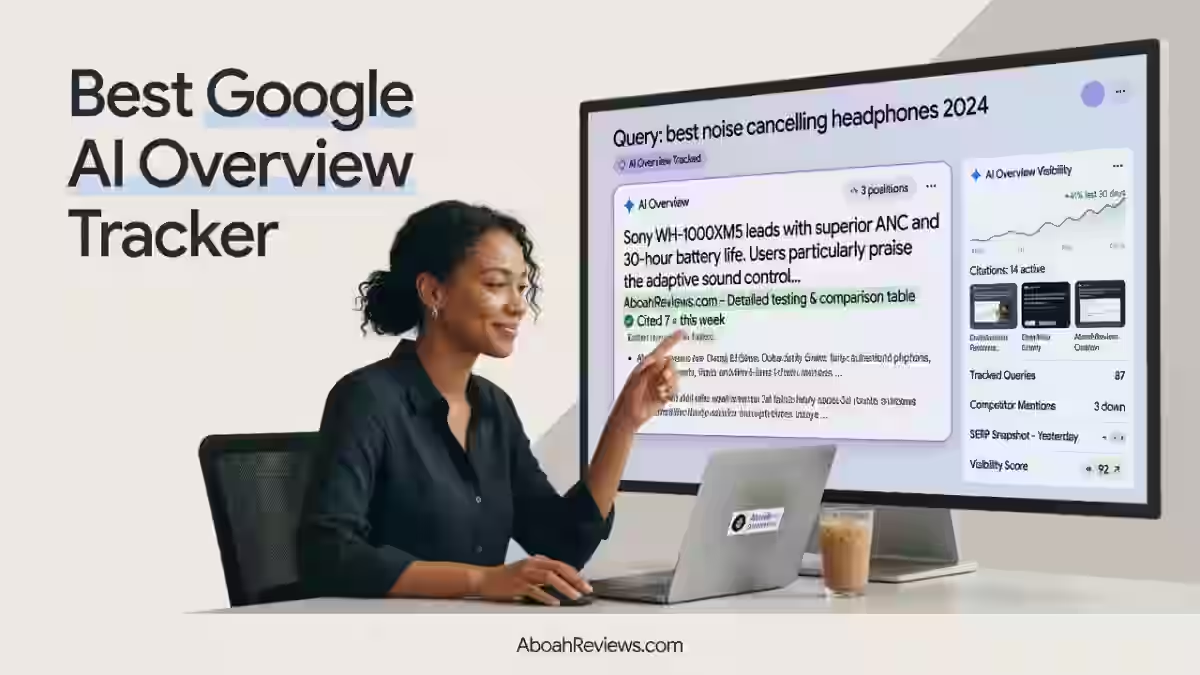
TL;DR: Google AI Overview trackers monitor when AI-generated summaries appear in search results, which brands get cited, and how your content performs across AI engines. This guide compares 10 best Google AI overview trackers tested and reviewed for SEO professionals, agencies, content marketers, and freelancers who need more than a traditional rank report to understand their actual search visibility in 2026.
Quick Comparison: Best Google AI Overview Trackers
When testing AI Overview tracking tools, the key criteria are detection accuracy (does the platform consistently flag when keywords trigger AI Overviews?) and whether it separates brand mentions in the overview text from actual domain citations.
Here is how the top 10 tools stack up at a glance:
| Tool | Best For | AI Overviews | Citations | AI Mode | Other AI Engines | Traditional SEO |
|---|---|---|---|---|---|---|
| LLM Pulse | Overall AI visibility | Yes | Yes | Yes | 14 models | No |
| SE Ranking | SEO + AI tracking | Yes | Yes | Yes | Limited | Full suite |
| Semrush AI Toolkit | All-in-one SEO ecosystem | Yes | Yes | Partial | 4 engines | Full suite |
| Otterly AI | Dedicated AI monitoring | Yes | Yes | Yes | 6 engines | No |
| Rankscale AI | Multi-engine AI tracking | Yes | Yes | Yes | Multiple | No |
| Profound | Enterprise AI intelligence | Yes | Yes | Yes | Multiple | No |
| AIclicks | AI search analytics | Yes | Yes | Yes | Limited | No |
| seoClarity | Enterprise SEO + AI | Yes | Yes | Yes | 9 engines | Full suite |
| Ziptie | API-first tracking | Yes | Yes | Partial | 3 engines | No |
| AccuRanker | High-volume rank tracking | Partial | Partial | Partial | Via AccuLLM | Full suite |
If you are also managing content workflows that feed these AI citations, the AI Overview rank tracking tools for SEO page on this site give you additional evaluation frameworks.
Introduction
If you are still relying only on organic rank positions to measure your SEO performance, you are looking at an incomplete picture. That is not an opinion. It is just what search looks like right now.
AI Overviews now appear at the top of Google results pages for millions of queries, synthesizing information from multiple sources into a single answer before users ever scroll to traditional organic results. Your page can rank in position 1 and still not get a single citation inside the AI-generated box above it. That is the gap no traditional rank tracker tells you about.
That is why finding the best Google AI overview tracker has become one of the most practical SEO problems to solve in 2026. In this guide, I compare 10 tools I have researched and evaluated against real SEO workflows, including what each one actually measures, who it is best for, what it costs, and where it falls short.
Whether you are an agency tracking 50 client keywords or a solo blogger trying to understand why your traffic dropped after an AI Overview started showing up for your best keyword, this comparison is built for you.
What Does a Google AI Overview Tracker Measure?
A Google AI overview tracker measures more than just whether an AI summary appeared for a keyword.
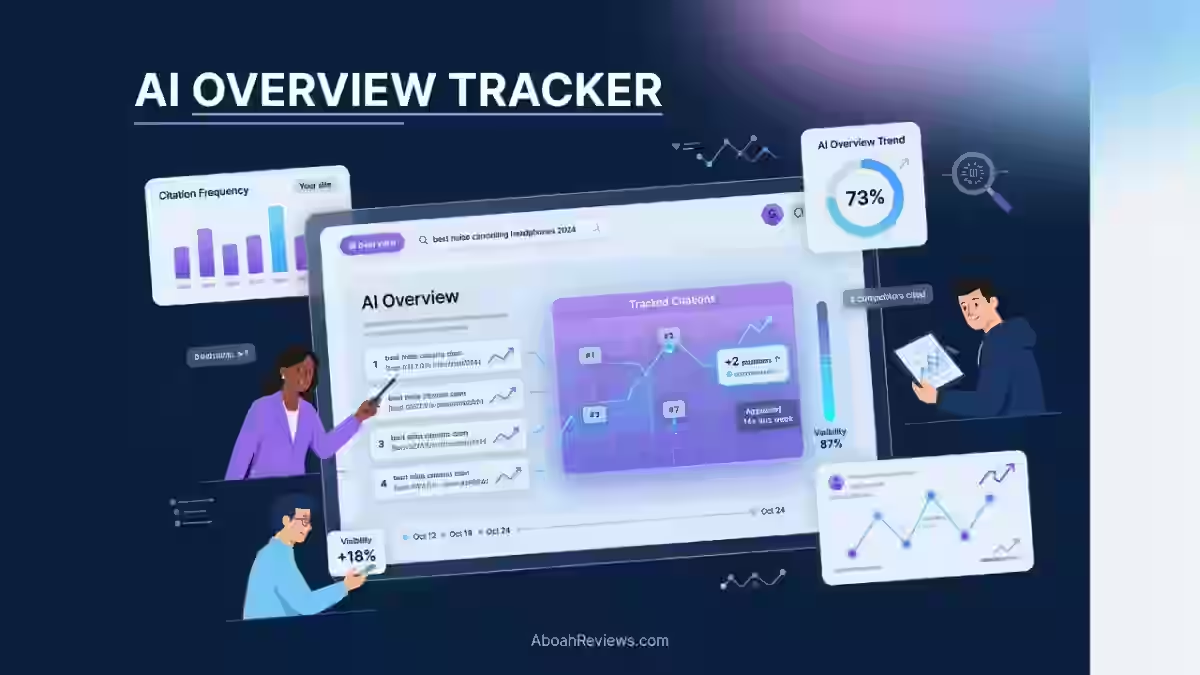
It monitors when Google’s AI-generated answers appear for your target keywords and records which brands or websites receive citations, helping marketers understand whether they are earning visibility inside AI-generated results instead of relying solely on traditional rankings.
Here are the six core metrics you should understand before choosing a tool.
AI Overview Trigger Rate
The AI Overview trigger rate tells you what percentage of your tracked keywords actually produce an AI-generated summary in Google search results. Not every query triggers one.
Google AI Overview prevalence varies heavily by query type and market, making citation tracking important for SEO.
Informational queries trigger AI Overviews far more frequently than transactional ones, so your trigger rate will look very different depending on your keyword mix.
Citation Rate
The citation rate measures how often your domain appears as a source inside an AI Overview when one is triggered. A strong ranking does not guarantee your brand appears in Google’s AI-generated answer.
If Google consistently cites publishers, industry analysts, or review sites instead of your own content, traffic patterns can shift even when rankings remain stable.
Citation rate is the metric that actually tells you whether your content is being used.
Cited URLs
Beyond knowing you were cited, the best tools tell you which specific URLs are being pulled into AI summaries.
This helps you map which pieces of content are doing the work and which are being ignored.
It is one of the most actionable signals for content optimization because it tells you exactly where to build depth and topical authority.
Brand Mentions
Your brand can appear inside an AI Overview without your site getting linked. Google AI Overview tracking tools need to separate brand mentions in the overview text from actual domain citations.
A tool that conflates the two will mislead your reporting. This distinction matters a lot for branded SEO and awareness tracking.
AI Visibility and Share of Voice
AI visibility score is a composite metric that measures how consistently your brand appears across a tracked set of keywords or prompts.
Share of voice takes that further by comparing your appearance rate against competitors.
Visibility scores measure brand presence across AI models, while citation analysis examines how AI systems source and reference brand information.
Competitor Visibility
A good Google AI overview tracker does not just monitor your brand. It shows you where competitors are being cited instead of you.
This is one of the most useful inputs for content gap analysis and deciding which topics to prioritize in your next editorial sprint.
AI Mode Visibility
Google AI Mode is a separate surface that needs separate tracking.
AI Overviews appear at the top of standard Google search results as an AI-generated summary, while Google AI Mode is a separate, conversational search experience where users interact with Google’s AI in a chat-like format.
They are related but distinct surfaces, and not all tracking tools monitor both, so check before you choose.
10 Best Google AI Overview Trackers Reviewed
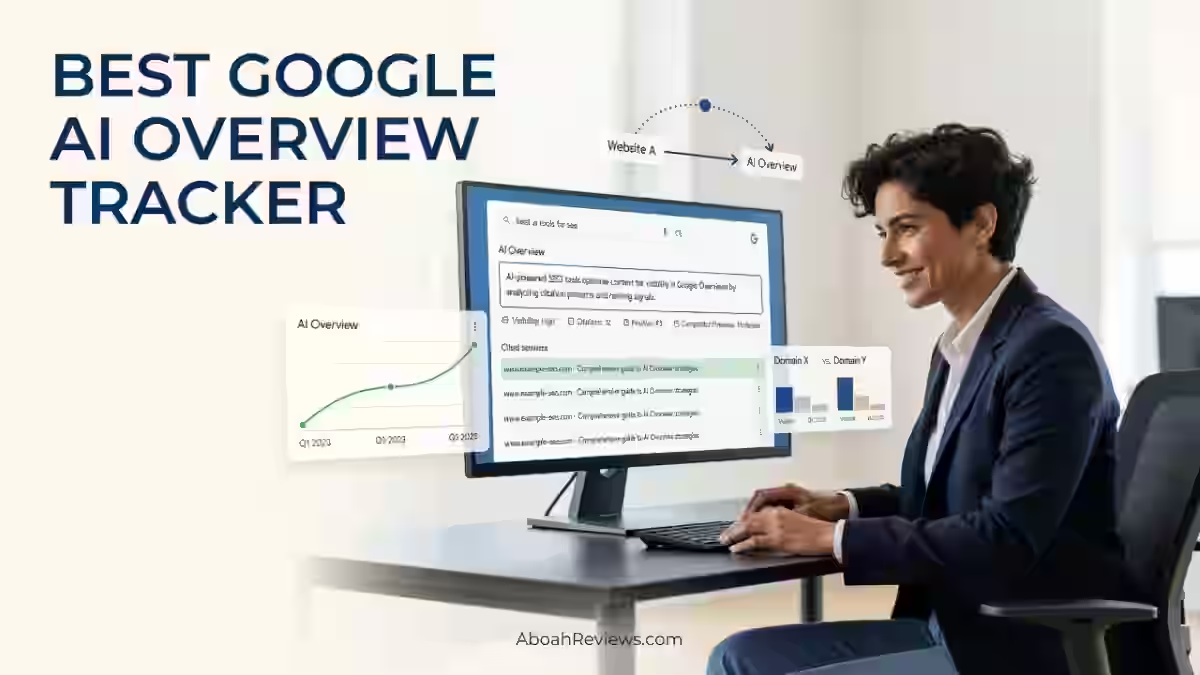
1. LLM Pulse — Best Overall
LLM Pulse is an AI search visibility tracker designed to monitor brand mentions and performance across AI chatbots and search platforms, helping users understand how their brand appears in AI-generated responses from platforms such as ChatGPT, Google AI Mode, Perplexity, and Google AI Overviews.
What it tracks:
LLM Pulse tracks 14 models (ChatGPT, Perplexity, Google AI Mode, Google AI Overviews, Gemini, DeepSeek, Grok, Claude, Copilot, Meta AI and more) on a weekly cadence, then reports visibility scores, citation sources, sentiment and share of voice against competitors you choose.
Citation intelligence: Visibility scores measure brand presence across AI models, while citation analysis examines how AI systems source and reference brand information. Sentiment analysis evaluates whether AI responses portray brands positively, neutrally, or negatively.
API and integrations: LLM Pulse runs a hosted MCP server at api.llmpulse.ai with 45+ read and write tools, authenticated over OAuth 2.1 with no API key, included on every plan, even the trial. It works with Claude, ChatGPT, Gemini, Cursor, Windsurf and Zed.
Pricing: LLM Pulse starts at €49 per month for the Starter plan, with Growth at €99 per month and Scale at €299 per month. A 14-day free trial is included.
Limitations: Starter and Growth are sensible for focused monitoring, but not generous if you are tracking multiple brands, multiple markets, or a broad query map. Project count becomes the second constraint for agency and consultant workflows.
Why I picked it: The breadth of model coverage, transparent pricing, and the included MCP server across all plans make this the most practical starting point for most SEO teams. The unlimited seats from the entry tier is a real differentiator for agencies.
Skip if: You need very high keyword volume at a traditional SEO scale, or if your workflow is already built inside Semrush or SE Ranking and you do not want another dashboard.
2. SE Ranking AI Search Toolkit — Best for SEO + AI Tracking
SE Ranking started as a traditional rank tracker and has grown into a credible hybrid platform that connects organic keyword data with AI Overview monitoring.
SE Ranking covers rank tracking across Google, Bing, Yahoo, and YouTube, with local and mobile tracking, competitor analysis, and white-label reporting. The $65/month Essential plan includes 750 keywords, better keyword volume than Semrush’s 500-keyword Pro plan at more than twice the price.
It is built with agency workflows in mind: white-label dashboards, bulk client management, and configurable reporting on daily, weekly, or monthly schedules.
AI tracking capability: Tools with daily refresh like AccuRanker or SE Ranking are useful for competitive niches where you need faster alerts. SE Ranking’s AI toolkit connects traditional keyword data directly with AI Overview detection.
Best for: Agencies that want to report on both traditional rankings and AI Overview presence from a single white-labeled dashboard. If you are managing 10+ clients, the workflow efficiency here is real.
Pricing: Essential plan starts at $65/month (750 keywords). AI search tracking features are included as part of the core product on higher tiers, though limits apply.
Skip if: You only care about AI visibility and do not need the traditional SEO infrastructure. In that case, a dedicated AI tracker like LLM Pulse or Otterly will be lighter and cheaper.
3. Semrush AI Search Toolkit — Best All-in-One SEO Platform
Semrush AI Visibility is a standalone product from the broader Semrush suite, priced at $99/month per domain. It tracks brand mentions across ChatGPT, Google AI, Gemini, and Perplexity with 25 custom prompt slots refreshed daily, an AI competitor analysis and prompt research layer, and a site audit for AI readiness built in.
Ecosystem advantage: For teams already running keyword research and audits inside Semrush, the AI Visibility toolkit sits inside the same interface they already know, which removes the overhead of evaluating and onboarding a second platform.
Limitations: The main constraints on the Base plan are four-engine coverage (Claude is excluded) and the 25-prompt ceiling, which gets tight for agencies tracking multiple brands or product lines.
Pricing: AI Visibility add-on starts at $99/month per domain, separate from the core Semrush subscription. Core plans start at $139/month (Pro).
Best for: Teams already using Semrush for keyword research, site audits, and backlink analysis who want to extend that data with AI overview tracking without onboarding another tool.
Skip if: You are not already on the Semrush ecosystem. The per-domain pricing and prompt limits make it expensive to justify from scratch compared to dedicated AI trackers.
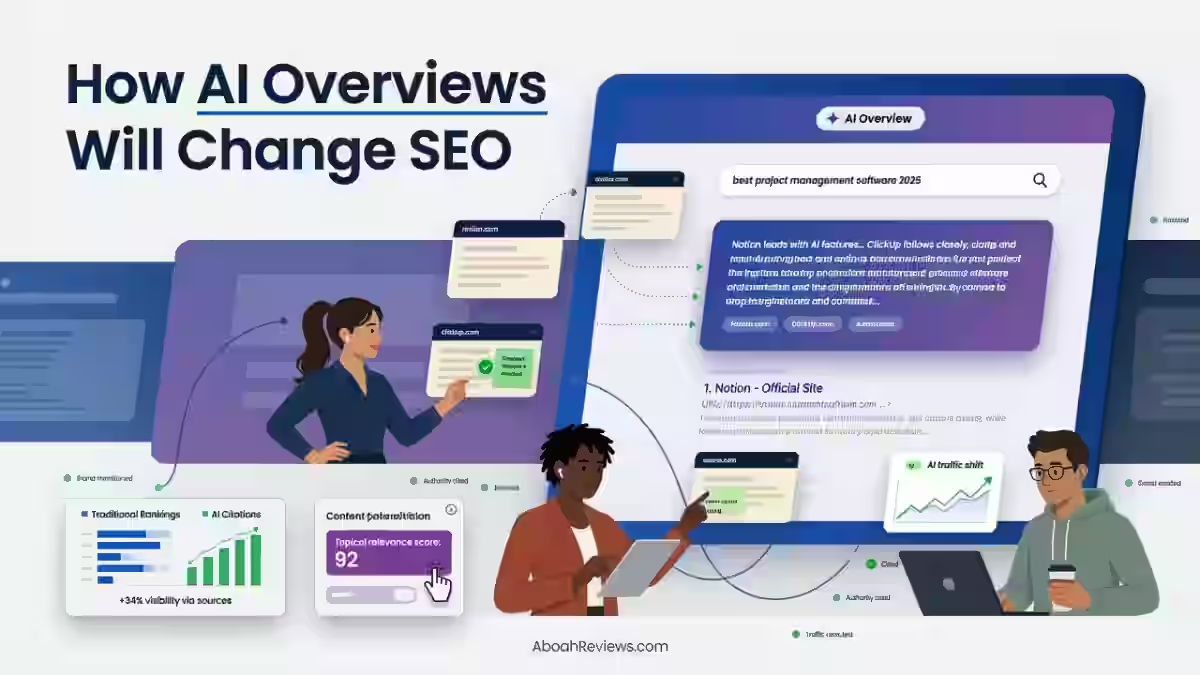
For a broader look at how AI-driven search is changing what SEO tools need to measure, this guide on how AI Overviews will change SEO is worth reading before you commit to a platform.
4. Otterly AI — Best Dedicated AI Visibility Tracker
Otterly AI is an AI Overviews tracker that monitors brand mentions and website citations across ChatGPT, Google AI Overviews, Perplexity, MS Copilot, Google AI Mode, and Gemini.
Otterly is best for smaller brands, freelancers, and agencies that want affordable ongoing AI search monitoring. It is purpose-built for AI visibility, meaning there is no traditional rank tracking noise to work through.
Pricing: Otterly AI starts at $29/month (Lite) and tracks six AI engines on paid plans: ChatGPT, AI Overviews, AI Mode, Perplexity, Gemini, and Copilot. Standard runs around $189/month and Premium around $489/month.
Limitations: Prompt limits can become restrictive quickly. If you manage many clients or many topics, make sure the higher tiers still make sense economically.
Best for: Freelancers, solo SEOs, and small agencies who want a straightforward, affordable AI visibility tool without bloat. At $29/month, it is the most accessible dedicated tracker in this list.
Skip if: You are tracking hundreds of keywords across multiple markets and need an API for data export. The entry tier prompt limits will hit fast.
5. Rankscale AI — Best for Multi-Engine AI Tracking
Rankscale.ai focuses strongly on brand visibility inside AI search systems. The platform tracks how different models mention a company and which pages appear as supporting sources.
It also evaluates website readiness for AI search engines through audits and visibility scores, helping marketers improve content so AI systems cite their pages more frequently.
Pricing: Essential plan at $20/month (120 credits, 480 AI responses), Pro at $99/month (4,800 responses, 25 brand dashboards), Enterprise at approximately $780/month. Credit-based model.
Best for: GEO-focused professionals and agencies needing the widest AI engine coverage and granular citation analysis at a flexible price point.
Limitations: The credit-based model is flexible, but it requires more active budget management than flat-rate pricing. If you underestimate your query volume, costs can creep up.
Skip if: You need clean white-label reporting for clients. Rankscale’s strength is in data depth, not presentation polish.
6. Profound — Best for Enterprise AI Search Intelligence
Profound positions itself as the enterprise leader for “marketing to Superintelligence” and targets Fortune 500 brands. They are SOC 2 Type II and HIPAA compliant.
What it offers: Profound focuses on multi-country, multi-language AI visibility and offers Conversation Explorer for AI answer share-of-voice, along with enterprise-grade reporting and security.
Pricing: Profound’s self-serve tiers start at $99/month (Starter) and $399/month (Growth). Enterprise pricing is custom and contract-based.
Best for: Large brands and enterprise marketing teams that need compliance controls, panel-level data on AI prompt behavior, and boardroom-ready reporting across multiple countries and languages.
Skip if: You are a small agency or a solo SEO. The pricing and complexity of Profound are built for teams with dedicated AI search strategists, not for a one-person show.
Unless you specifically need Profound’s compliance controls, custom services, or broader enterprise contract, LLM Pulse delivers better value for most teams.
7. AIclicks — Best for AI Search Analytics
AIclicks is a dedicated AI search analytics tool focused on tracking how brands appear in AI Mode and AI Overviews. Its strength is in surfacing AI visibility data in a clean, actionable format without requiring you to learn an enterprise-level platform.
What it tracks: AIclicks monitors AI Overview presence, citation tracking, and AI Mode visibility. It is one of the tools that has committed early to AI Mode tracking specifically.
This matters as Google AI Mode is a dedicated, interactive conversational interface similar to Gemini, whereas AI Overviews are brief summaries embedded directly at the top of standard search results.
AI Mode focuses on multi-turn dialogue and deeper exploration, while Overviews aim to satisfy intent quickly without a click.
Best for: Content teams and SEO analysts who want clean AI search data without a full enterprise contract. Good for brands that want to understand AI Mode performance specifically.
Limitations: AI engine coverage is narrower than LLM Pulse or Rankscale. If you need cross-engine visibility data spanning 10+ AI platforms, AIclicks will feel limited.
Pricing: AIclicks pricing starts at $59 per month for the Starter tier and scales up to $499 per month for the Business tier, with a custom Enterprise option available.
Skip if: You need multi-model AI tracking across ChatGPT, Gemini, Perplexity, and Google in one dashboard. AIclicks is narrower in scope.
8. seoClarity — Best Enterprise SEO + AI Visibility Platform
seoClarity’s ArcAI features include tracking AI search visibility, tracking AI shopping results, researching AI prompts, analyzing sentiment, monitoring brand accuracy, discovering AI bot activity, and measuring AI search performance.
It also supports dashboards for AI mentions, citations, sentiment, visibility, AI traffic, and conversions.
SEOClarity tracks nine AI engines with deep integrations, advanced data exports, and dedicated account management. Pricing reflects enterprise positioning, but the platform scales to complex multi-brand, multi-region monitoring requirements that overwhelm SMB-focused tools.
Pricing: seoClarity’s AI tracking and search visibility feature, known as Clarity ArcAI, typically costs around $2,000 to $3,000 per month as a specialized module or add-on, while the overall seoClarity Platform packages range from $2,500 to $4,500+ per month depending on your enterprise requirements.
Best for: seoClarity is not for basic rank tracking. It is for enterprise teams that need ranking data connected to business units, categories, regions, competitors, traffic, and conversions. Its strength is executive-level reporting and operationalization.
Skip if: You are not an enterprise team with a dedicated SEO function. The cost and complexity are not justified for agencies under 20 clients or sites under 500,000 monthly visits.
9. Ziptie — Best API-First AI Search Tracker
ZipTie is a focused AI search visibility tracker that monitors Google AI Overviews, ChatGPT, and Perplexity. It is especially useful for SEOs who care about what shows up in Google’s AI-generated results and want screenshots, checks, summaries, and AI search tracking without adopting a large enterprise platform.
Ziptie emphasizes prescriptive guidance on improving citation chances rather than just logging current visibility. Content strategists managing multiple AI platforms benefit from the cross-platform coverage and actionable insights.
Pricing: ZipTie currently starts at $69/month for Basic, with Standard at $99/month and Pro at $159/month. ZipTie is best for SEOs and agencies that want a practical, focused tracker for Google AI Overviews and major AI answer engines.
API capability: Ziptie and LLM Pulse both offer APIs for custom integrations. For teams that want to pipe AI Overview data into their own dashboards or reporting systems, Ziptie’s API is one of its strongest selling points.
Best for: Technical SEOs and data engineers who need AI Overview data pulled into custom workflows. If you are building an internal SEO dashboard or automating reporting at scale, Ziptie’s API is worth evaluating seriously.
Skip if: You want a plug-and-play dashboard without engineering time. Ziptie rewards technical users; non-technical marketers will find the setup friction higher than Otterly or LLM Pulse.
You can pair Ziptie’s citation data with your broader SEO automation workflow to build a complete tracking and optimization pipeline.
10. AccuRanker — Best for High-Volume Rank Tracking
AccuRanker tracks keyword rankings daily and, since its AccuLLM addition, tracks how your brand shows up in ChatGPT and AI Overviews too. None of that comes cheap: plans start at $224/month, and there is no free tier to soften the entry.
AI visibility via AccuLLM: AccuLLM is AccuRanker’s AI search visibility feature. It tracks how a brand appears in AI-generated responses across platforms such as ChatGPT, Perplexity, Google AI Overviews, and Google AI Mode.
Pricing: AccuRanker prices by keyword capacity with unlimited users and domains on every tier: Professional at $224/month (2,000 to 5,000 keywords), Expert at $764/month (10,000 to 25,000), Enterprise custom above 25,000, with a 10% annual discount.
Limitations: The math breaks down if you need API access (requires the $764/month Expert tier), lack Zapier automation, or need a complete SEO toolkit since AccuRanker only does rank tracking.
Best for: AccuRanker is a specialist rank tracking platform for agencies and enterprise SEO teams, expanded with AccuLLM for tracking brand visibility in ChatGPT, Perplexity, and AI Overviews. It is built for scale, not for a one-site side project.
Skip if: You are primarily interested in AI visibility and brand citation tracking. AccuRanker’s core is still rank tracking. If AI Overview monitoring is your main goal, LLM Pulse or Otterly will serve you better at a fraction of the cost.
How I Ranked These Google AI Overview Trackers
I did not score these tools on a numeric scale, because that tends to flatten real differences. Instead, I applied a weighted set of criteria across the tools reviewed, with the heaviest weight given to what actually matters in a real SEO workflow.
Google AI Overview Coverage
Does the tool detect AI Overviews consistently, and does it distinguish between when an overview appeared and when it did not?
Some tools only confirm presence, not absence. That makes trend analysis impossible.
Citation Intelligence
Can the tool tell you which specific URL was cited, not just whether your domain appeared? URL-level citation data is what allows content teams to take action. Domain-level data alone is too blunt for editorial decision-making.
AI Visibility Metrics
Does the tool give you a share of voice metric, a visibility score, or both? Tracking AI Overviews helps teams spot changes before they become long-term performance issues.
Tools that only log citations without scoring trends are harder to use in monthly reporting.
Query and Prompt Coverage
How many prompts or keywords can you track per month at each pricing tier? This is where tools diverge most significantly.
Entry plans at Otterly allow limited prompts, while LLM Pulse’s Starter tier covers 40 tracked prompts per week.
Geographic and Language Coverage
If you are running multilingual or multi-market SEO, geographic and language coverage becomes critical. Not every tool in this list handles non-English markets reliably. Profound and Rankscale handle this better than most.
Competitor Intelligence
Can you track competitor citations directly inside the tool, or do you need to manually compare? Tools with built-in competitor share of voice are worth the premium for agencies writing competitive audit reports.
Reporting and Integrations
Does the tool export to Google Data Studio, Looker, or Sheets? Can it hook into your existing SEO stack?
For this guide, I weighted heavily in favor of tools with clean export options and API access for teams running automated SEO reporting.
Pricing and Scalability
I weighted pricing not just on cost but on cost-per-prompt and cost-per-model. Every LLM Pulse plan includes 5 models, which puts the per-prompt cost between €0.10 and €0.20.
In August 2026, the equivalent figure on five widely used AI visibility platforms ran from roughly $0.27 to $1.33, mostly because they include fewer models and charge for the rest.
Weighting summary:
| Criterion | Weight |
|---|---|
| AI Overview coverage accuracy | High |
| Citation intelligence (URL-level) | High |
| AI Mode monitoring | Medium-High |
| Competitor visibility | Medium |
| Pricing per tracked prompt | Medium |
| Integrations and API access | Medium |
| Reporting and export quality | Low-Medium |
Google AI Overview Tracker vs. Traditional Rank Tracker
This is probably the most important section of this guide, so I want to be direct about it.
Traditional rank trackers do not capture whether your brand is mentioned, cited, or absent from AI-generated text. They tell you where your page appears in the blue link section of Google’s results. That still matters. But it is no longer the whole story.
Here is the practical difference:
| Metric | Traditional Rank Tracker | Google AI Overview Tracker |
|---|---|---|
| Keyword position (1-100) | Yes | No |
| AI Overview trigger rate | No | Yes |
| Citation rate | No | Yes |
| Cited URLs | No | Yes |
| Brand mentions (non-citation) | No | Yes |
| Competitor citation comparison | Limited | Yes |
| AI Mode visibility | No | Yes (most tools) |
| Share of voice across AI engines | No | Yes |
| SERP feature tracking | Yes | Limited |
| Backlink data | Yes | No |
| Site audit capabilities | Yes | Varies |
Rank tracking still matters for traffic and click-throughs. AI Overview visibility is more about understanding how your brand is represented inside Google’s summaries.
The best approach is to use both: classic rank tracking plus a Google AI Overview tracking tool, so you can see the full picture.
A number 1 organic ranking does not guarantee clicks if the SERP contains an AI Overview. In AI search, users may not click the traditional blue link. They may read the answer, notice the cited sources, and remember the brand.
That is the key shift. AI Overviews are creating a new layer of brand exposure where being cited matters as much as ranking. For more context on how this works mechanically, the guide on generative engine automation breaks down the technical side.
How to Choose a Google AI Overview Tracker
Use this quick-reference decision table to find the right tool for your situation.
| If you need… | Consider… |
|---|---|
| Best overall AI visibility with widest model coverage | LLM Pulse |
| SEO + AI in one platform with white-label reporting | SE Ranking |
| Full SEO ecosystem already using Semrush | Semrush AI Toolkit |
| Affordable dedicated AI monitoring under $30/month | Otterly AI |
| Multi-engine tracking with credit flexibility | Rankscale AI |
| Enterprise AI intelligence with compliance controls | Profound |
| Enterprise SEO + AI visibility with executive dashboards | seoClarity |
| API-first data extraction for custom dashboards | Ziptie |
| High-volume rank tracking at 2,000+ keywords | AccuRanker |
The decision usually comes down to three questions:
- Are you already inside a traditional SEO platform? If yes, start with that platform’s AI tracking features before adding a new tool.
- Do you need multi-engine coverage beyond Google? If yes, LLM Pulse or Rankscale will serve you better than tools focused only on Google.
- What is your prompt or keyword volume? Calculate your actual volume before committing to credit-based or prompt-limited plans.
If you are still exploring what AI overview tracking integrates into a broader SEO workflow, the AI SEO automation guide covers how these tools fit alongside content production and technical auditing.
Are Google AI Overview Trackers Worth It?
For most professional SEO teams, yes. For everyone, no.
Here is when an AI Overview tracker genuinely adds value:
- You are seeing traffic drops that do not match your rank tracking data
- You are in a competitive niche where AI Overviews appear for high-intent keywords
- You manage client accounts and need to explain AI-driven visibility changes in reports
- You are doing content audits or editorial sprints where citation data would help prioritize rewrites
- You are tracking brand reputation across AI platforms, not just Google
Here is when you might not need one yet:
- Your site is brand new and you are still building topical authority
- Your keyword mix is primarily transactional, where AI Overviews trigger infrequently
- Your budget is under $50/month and you are still figuring out basic rank tracking
Many organizations use a combination: traditional SEO suite plus dedicated AI visibility tracker. That is the honest answer. These tools do not replace rank trackers. They sit alongside them.
The cost question is real. Entry plans for dedicated AI trackers run from $20/month (Rankscale) to $49/month (LLM Pulse) to $99/month (Semrush AI Toolkit per domain). Mid-sized businesses should consider tools in the $99 to $149 range like Peec AI, Rankability, or SE Ranking’s tracker. These offer comprehensive features at reasonable prices.
Before committing to any paid plan, check whether your current SEO platform already has AI Overview data you are not using. If you are already inside Semrush or Ahrefs, check whether your plan includes AI visibility features before adding a new vendor.
You should also make sure your content strategy is already working before tracking its AI performance. If you are producing fully automated content without editorial review, tracking AI citations will just give you a clearer view of content that was never going to get cited anyway.
For a broader understanding of how content automation fits alongside AI visibility tracking, the guide on autoblogging vs AI blogging is useful context.
Final Takeaway on the Best Google AI Overview Tracker
The best Google AI overview tracker in 2026 depends on where you sit in the SEO ecosystem. There is no single right answer, but there is a clear right approach: match the tool to your actual workflow, not the marketing page.
| Tool | Best For | Starting Price | AI Engines | Free Trial |
|---|---|---|---|---|
| LLM Pulse | Overall AI visibility | €49/month | 14 | 14 days |
| SE Ranking | SEO + AI combo | $65/month | Limited | 14 days |
| Semrush AI Toolkit | All-in-one Semrush users | $99/month/domain | 4 | Limited |
| Otterly AI | Budget AI monitoring | $29/month | 6 | Yes |
| Rankscale AI | Multi-engine, flexible credits | $20/month | Multiple | Yes |
| Profound | Enterprise AI intelligence | $99/month (Starter) | Multiple | Limited |
| AIclicks | AI Mode analytics | Custom | Limited | Yes |
| seoClarity | Enterprise SEO + AI | Custom | 9 | No |
| Ziptie | API-first workflows | $69/month | 3 | Yes |
| AccuRanker | High-volume rank tracking | $224/month | Via AccuLLM | 14-day refund |
If I had to pick one tool for a 5-person agency that handles 15 to 20 clients: I would start with SE Ranking for the SEO foundation and layer LLM Pulse on top for AI visibility.
The total cost is manageable, the data is complementary, and you can report on both traditional rankings and AI citation rate from two dashboards that do not overlap awkwardly.
If budget is tight and you just need to start somewhere, Otterly AI at $29/month is the lowest friction entry point into meaningful AI Overview tracking.
Whatever you choose, keep human judgment in the loop. These tools surface data, but reading that data correctly and deciding what to do with it is still your job.
Frequently Asked Questions
Are Google’s AI Overviews accurate?
Google’s AI Overviews are generally reliable for straightforward factual queries but can misrepresent nuanced or fast-changing topics, since the system summarizes multiple sources rather than verifying each claim independently. Errors tend to show up most on medical, legal, and financial queries where source quality varies. If you’re citing AI Overviews for research, always check the underlying sources it links to.
Which Google AI package is best?
The best Google AI package depends on your use case: Gemini Advanced suits general productivity and writing tasks, while Google AI Overviews and AI Mode are search features rather than standalone subscriptions. For SEO tracking specifically, no “package” applies since AI Overviews are a free feature built into Google Search, not a paid product tier.
How can I get AI overview on Google?
You can’t manually trigger an AI Overview to appear, Google decides when to show one based on the query and its own algorithms. To increase your odds of being cited when one does appear, focus on clear, well-structured content that directly answers common questions in your niche, since that’s what AI Overviews tend to pull from.
What is the best version of Google AI?
As of 2026, Gemini remains Google’s flagship AI model family, with different versions (like Gemini Pro and Gemini Flash) optimized for different speed and reasoning trade-offs. The “best” version depends on whether you need deep reasoning, speed, or cost efficiency for your specific task.
Is Google AI as good as ChatGPT?
Google’s Gemini and OpenAI’s ChatGPT are generally considered comparable in overall capability, with each having strengths in different areas like multimodal tasks or coding depending on the specific model version. Neither is universally “better,” and the right choice depends on your specific workflow and which ecosystem you’re already using.
Which AI is better than Google AI?
No single AI model is universally better than Google’s Gemini across every task, since performance varies by use case, whether that’s writing, coding, reasoning, or search-related tasks. Independent benchmarks change frequently as both Google and competitors like OpenAI and Anthropic release updates, so any “better” claim is typically true only for a specific task at a specific point in time.
What is Google’s most advanced AI?
Google’s most advanced AI model is currently part of its Gemini family, which powers both standalone AI products and features embedded directly into Google Search, including AI Overviews and AI Mode. Google continues to update these models regularly, so the specific “most advanced” label shifts as new versions roll out.

- #1 Best Plugin for Automatic Blog Posting in WordPress (2026) - September 13, 2026
- 13 Best WordPress Autoblogging Plugins I Tested & Ranked for 2026 - September 13, 2026
- 13 Best Google AI Overview Checking Tools in 2026 (Tested & Ranked) - September 9, 2026