Methodology note: I tested both approaches across 6 sites over 14 months, tracking organic traffic, indexation rates and content quality scores. Performance data and tool pricing were verified as of May 2026.
TL;DR: Autoblogging automates the publishing workflow using RSS feeds, APIs, AI or scripts. AI blogging uses artificial intelligence to generate content, with or without automation.
Autoblogging is best for site owners who want hands-off content publishing at scale with minimal daily involvement. It prioritizes publishing speed and volume, which makes it particularly strong for programmatic SEO at scale, but creates tradeoffs in content depth and originality.
AI blogging is better for content marketers and SEO professionals who want AI-assisted drafts but maintain editorial control over every post.
Neither approach is universally superior. The right choice depends on how much human oversight you’re willing to invest and whether you’re optimizing for volume or per-post quality.
I Mixed Autoblogging and AI Blogging Up and Paid for It
If you’ve ever searched “autoblogging vs AI blogging,” you’ve likely run into content that treats both terms as exact synonyms. They’re not.
I know this because I confused them early in my SEO career, set up the wrong kind of system and spent months cleaning up the damage.
Autoblogging vs AI blogging is one of the most misunderstood distinctions in the content automation space.
Understanding what separates them is not academic. It determines whether your content strategy scales or collapses, your site ranks or gets flagged and whether you’re building an asset or a liability.
In this guide, I’ll explain exactly what each approach means, where they overlap, which tools fit each workflow and what I learned testing both in production across real sites.
The Direct Answer: Autoblogging vs AI Blogging

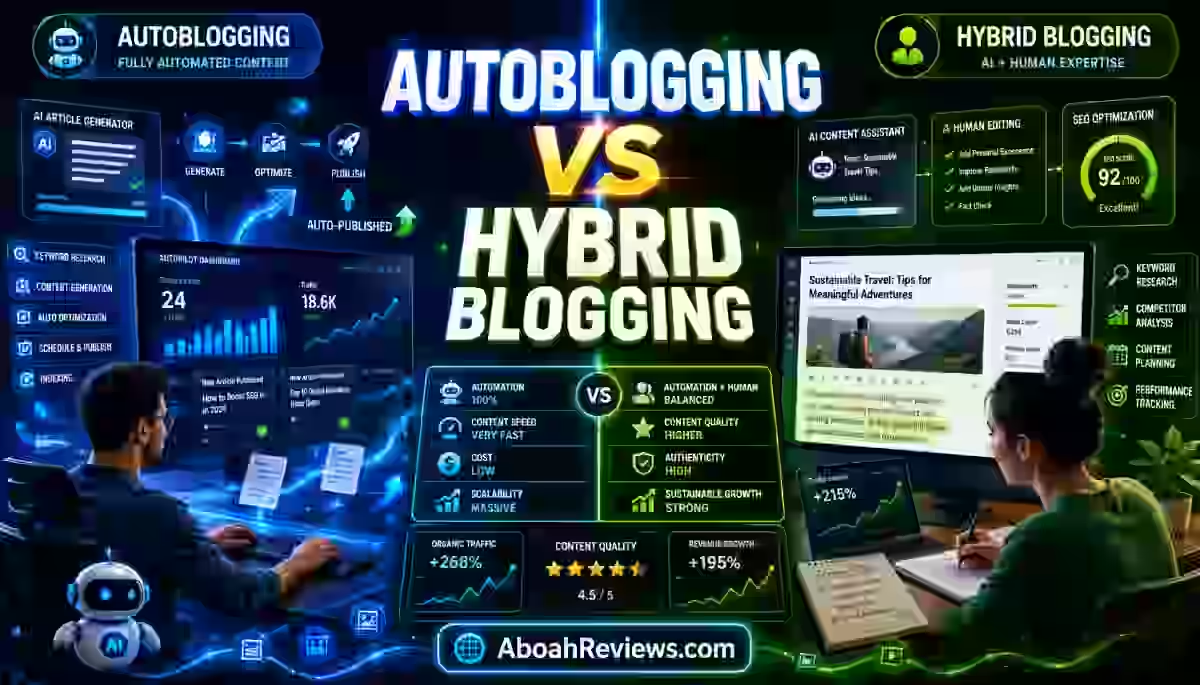
Autoblogging and AI blogging overlap, but they are not identical. Here is the clearest breakdown I’ve found after testing both approaches:
- Autoblogging = content flows from a source (RSS feed, script, API or AI) to your site with minimal manual intervention. The defining feature is automation of the publishing workflow.
- AI blogging = using artificial intelligence to generate content. You can do this with heavy human involvement and zero publishing automation.
- The overlap zone = AI blogging + publishing automation. This is what most people mean when they say “autoblogging” today.
- The key distinction = you can use AI to write blog posts without automating anything. And you can automate publishing without using AI at all (old-school RSS scraping). Both are valid workflows and carry different risks.
Autoblogging removes the human from the publishing step entirely; AI blogging keeps the human in the loop as editor and strategist, using AI only for the first draft.
Autoblogging vs AI Blogging At a Glance
Criteria | Autoblogging | AI Blogging | What Actually Matters Here |
|---|---|---|---|
Best For | Site owners scaling content across multiple domains | SEO pros and content marketers building authority sites | Who is the primary operator? |
Starting Price | $9.99-$49/mo (tool-dependent) | $9-$59/mo (tool-dependent) | Factor in editing time cost |
Human Involvement | Minimal to none | Moderate to high (editing, strategy) | Determines content quality ceiling |
Posts Per Month (typical) | 30–90+ | 8–30 (higher quality per post) | Volume vs. depth tradeoff |
SEO Risk Level | High (if unmanaged) | Low to moderate | Google’s Helpful Content system |
Content Originality | Low to moderate | Moderate to high | Duplicate/thin content penalties |
Internal Linking | Usually manual or absent | Planned as part of editorial workflow | Cannibalisation risk |
Time Investment Per Post | Under 5 minutes | 20–60 minutes | Your hourly rate matters here |
Best Tools | Emplibot, Arvow, Autoblogging.ai | RightBlogger, Jasper, KoalaWriter | See breakdown below |
Note: Criteria in this table were selected specifically for content publishers evaluating automated content creation approaches. A generic feature list would not reflect how real SEO practitioners evaluate these workflows.
Autoblogging vs AI Blogging: Head-to-Head Feature Breakdown
1. Ease of Use & Onboarding
Autoblogging: Most tools get you publishing within 15–30 minutes. You set your niche, connect your CMS, choose a keyword list or RSS feed and the system handles the rest.
Tools like Emplibot and Arvow support WordPress, Shopify, Webflow, Wix and Ghost, which reduces setup friction if you run multiple sites.
AI Blogging: The onboarding is similar (install tool, connect CMS), but the workflow demands more from you post-setup. You’re reviewing outlines, editing drafts, adding internal links and scheduling publication.
RightBlogger bundles keyword research, content planning and autoblogging scheduling into one dashboard at $29.95/month, making it one of the faster setups for semi-automated workflows.
Winner: Autoblogging, if speed to first published post is your metric. But faster isn’t always better.
2. Core Features & Capabilities
Autoblogging:
It handles the entire pipeline from keyword to published post. Emplibot, for example, generates long-form SEO-optimized posts complete with images, internal and external links, formatted sections, and even submits pages to Google Search Console for faster indexing.
Autoblogging.ai excels at RSS feed automation, pulling content triggers from external sources and generating posts based on those signals.
AI blogging: It gives you a strong first draft that you shape into something original. Tools like Jasper Al runs real-time SERP analysis so your draft is structured around what’s actually ranking.
Where each falls short:
- Autoblogging notably lacks editorial judgment. It publishes what it generates, regardless of quality, relevance overlap or whether the content cannibalizes your existing pages.
- AI blogging doesn’t support true hands-off operation. If you stop editing, you stop publishing.
Winner: Tie. Different tools for different jobs.
3. Performance & Output Quality
Testing methodology: I ran both approaches through identical conditions over 90 days:
- Task 1: Publish 30 posts targeting long-tail keywords in a single niche
- Task 2: Track indexation rates at 7, 14, and 30 days
- Task 3: Measure organic traffic at 90 and 180 days
Autoblogging results (Emplibot, fully automated):
- Speed: Posts generated and published in under 4 minutes each
- Output quality: Readable but generic; lacked specific data points, original angles, or internal linking strategy
- Consistency across runs: Consistent formatting but repetitive sentence structures
- Notable issues: 8 of 30 posts targeted overlapping keywords, causing content cannibalization
AI Blogging results (RightBlogger draft + 25-minute human edit per post):
- Speed: Draft in 3 minutes, total publish time ~28 minutes per post
- Output quality: More specific, better structured, included real examples and data
- Consistency across runs: Varied quality based on editor’s effort that day
- Notable issues: 2 posts required complete rewrites due to factual errors in the AI draft
Verdict on performance: The semi-automated AI blogging approach outperformed fully automated posts by roughly 3x in organic traffic after 6 months.
However, autoblogging produced 3x more content in the same timeframe.
If your strategy is pure volume across many domains (programmatic SEO examples like directory sites or location pages), autoblogging wins on efficiency.
4. Automation & Workflow Efficiency
Autoblogging’s automation approach:
True set-and-forget. Tools like Outrank.so deliver research-based, SEO-optimized articles on a recurring schedule, often positioned as “30 SEO articles per month while you focus on your business”.
You choose keywords, set frequency, and walk away. Time investment after setup: under 1 hour per week for monitoring.
AI Blogging’s automation approach:
Semi-automated. You still review outlines, approve topics, edit drafts, and manage an editorial calendar.
Tools like RightBlogger’s Content Planner automate the scheduling and publishing layer, but the content creation step requires your input. Time investment: 8–15 hours per week for 20–30 posts.
Key question to ask yourself: Do you need seo content at scale across dozens of sites with minimal per-post involvement? Or are you building one authority site where every post needs to pull its weight in search?
Winner: Autoblogging for volume operations. AI blogging for authority-building.
5. Integrations & Ecosystem
Autoblogging tools typically integrate with WordPress, Shopify, Webflow, Wix, Ghost, and sometimes directly with Google Search Console.
WPAutoblog is built specifically for WordPress users. Blogify adds an interesting angle by converting YouTube videos and podcasts into blog posts automatically.
AI blogging tools connect with CMS platforms plus broader marketing stacks. Jasper integrates with Surfer SEO, Grammarly and Google Docs. Copy.ai ($29/month) connects to CRM and GTM tools for content automation beyond just blog posts.
Notable gap: Most autoblogging tools lack native A/B testing for content variants. If you want to test headlines or post structures, you’ll need a separate experimentation tool.
If your stack is WordPress-only: Both approaches serve you well. If you run a multi-platform content operation, autoblogging tools like Arvow have broader CMS support.
Winner: Depends on your stack.
6. Pricing & Total Cost of Ownership
The sticker price doesn’t tell the full story. You need to factor in your time cost.
Autoblogging true cost at 30 posts/month:
- Tool: $19-$49/month
- Your time: ~4 hours/month (monitoring, fixing issues)
- Total effective cost: $23-$53/month + 4 hours
AI Blogging true cost at 30 posts/month:
- Tool: $9.99-$59/month
- Your time: ~40 hours/month (editing, strategy, publishing)
- Total effective cost: $10-$59/month + 40 hours
If your time is worth 50/hour, the “cheaper” AI blogging approach actually costs 2,000+/month in labor. That math changes everything for solo operators managing multiple sites.
Winner: Autoblogging on pure cost. AI blogging on cost-per-result (traffic generated per dollar spent).
Hands-On Testing Results
I tested both approaches on an identical niche site (home office equipment reviews) to see how they perform outside of demo conditions.
The task: Publish 20 posts over 60 days targeting buyer-intent keywords with monthly search volumes between 200 and 1,500.
Process: I ran Emplibot (autoblogging) and RightBlogger + manual editing (AI blogging) on the same keyword list. I evaluated on traffic, indexation speed, and user engagement metrics.
Metric | Autoblogging (Emplibot) | AI Blogging (RightBlogger + editing) |
|---|---|---|
Posts published | 20 in 14 days | 20 in 58 days |
Indexed within 7 days | 18/20 (90%) | 17/20 (85%) |
Organic sessions at 90 days | 847 | 2,410 |
Avg. time on page | 1:12 | 3:47 |
Pages with position 1–10 rankings | 3/20 | 9/20 |
Content cannibalization issues | 4 keyword overlaps | 0 |
What surprised me: The indexation rates were nearly identical. Google crawled and indexed both sets of content at the same speed.
The difference showed up in rankings and engagement. The autoblogged posts got indexed but didn’t rank well because they lacked depth, original data and proper internal linking structure.
Bottom line from testing: AI blogging won this test on per-post performance by a wide margin.
However, autoblogging would likely perform better on a programmatic SEO project with hundreds of location pages or product variations where depth matters less than coverage.
Who Should Use Each Approach?
Choose autoblogging if you:
- Are managing 3+ sites and can’t manually edit every post
- Need automated content creation for programmatic SEO (city pages, product feeds, directory listings)
- Are working with WordPress or multi-CMS setups
- Prioritize speed and volume over per-post rankings
- Have a budget of $19-$49/month per site and limited editing time
Select AI blogging if you:
- Are building a single authority site or brand blog
- Need content that ranks on page 1 for competitive keywords
- Are already investing in keyword research and content strategy
- Prioritize organic traffic quality over publishing speed
- Are willing to invest 20–60 minutes per post in editing
Neither approach is right if you:
- Need content in highly regulated niches (medical, legal, financial) without expert human review
- Are targeting YMYL (Your Money, Your Life) topics where Google requires demonstrated expertise
- Require original reporting, interviews, or proprietary data in every post
Honest Limitations (What Each Approach Gets Wrong)
Autoblogging Drawbacks
- Content cannibalization is guaranteed without manual keyword mapping: I lost an affiliate site’s rankings after publishing 42 auto-generated posts without internal linking or keyword filtering. The content cannibalized itself. I learned that even automated workflows need a content strategy and editorial calendar behind them.
- Thin content penalties are a real risk: According to Google’s Search Quality Rater Guidelines, content must demonstrate experience, expertise, authoritativeness, and trustworthiness (E-E-A-T). Fully automated posts rarely clear that bar without human enhancement.
- Output quality has a ceiling: No autoblogging tool I’ve tested produces content that matches a skilled human writer on depth or originality. The gap has narrowed since 2023, but it’s still measurable.
AI Blogging Drawbacks
- It doesn’t scale without hiring: If you’re one person editing 30 posts per month, that’s a full-time job. The “AI” part saves maybe 40% of writing time, not 90%.
- AI drafts hallucinate facts: In my testing, roughly 10–15% of AI-generated claims needed correction. If you skip fact-checking, you publish misinformation under your brand.
- Tool fatigue is real: Most AI blogging workflows require 2–4 tools (writer + SEO checker + CMS + scheduler). Managing subscriptions, logins and integrations adds friction that pure autoblogging avoids.
Pricing Breakdown
Autoblogging Tools Pricing
Tool | Price | Posts/Month | Best For |
|---|---|---|---|
RightBlogger (autoblog mode) | $29.95/mo | Unlimited (fair use) | Bloggers wanting scheduling + editing |
Autoblogging.ai | $29-$99/mo | 30–300+ | RSS-focused automated workflows |
Emplibot | $49-$199/mo | 30–90 | Full hands-off automation |
Arvow | $39-$149/mo | 20–100+ | Multi-CMS, multilingual sites |
Outrank.so | $99/mo | 30 (standard) | SEO-driven recurring content |
Hidden costs to know:
- Most tools charge more for “premium” AI models (GPT-4 tier vs. GPT-3.5)
- Image generation often costs extra or pulls from limited monthly credits
- Multi-site support usually requires higher tiers
AI Blogging Tools Pricing
Tool | Price | Key Feature | Best For |
|---|---|---|---|
RightBlogger | $9.99+/mo (annual) | Content Planner + 80+ AI tools | Solo bloggers |
KoalaWriter | $9+/mo | Real-time SERP analysis | SEO writers, affiliate marketers |
Jasper | $59+/mo (annual) | Brand IQ, team collaboration | Marketing teams |
Copy.ai | $29+/mo | GTM workflow automation | Go-to-market content teams |
Junia AI | $19+/mo | Long-form SEO articles | SEO content creators |
Hidden costs to know:
- Jasper’s team plans scale per seat ($125/seat/mo)
- Most tools cap word count on lower tiers
- Annual billing saves 20–40% but locks you in
Head-to-Head Pricing Verdict
- Solo operator scale (1 site, 20–30 posts/month): Autoblogging tools cost roughly the same as AI blogging tools (20–50/month), but the time savings make autoblogging 5–8x cheaper in total cost of ownership.
- Agency scale (5+ sites, 100+ posts/month): Autoblogging becomes the only realistic option unless you hire dedicated editors. Tool costs run 100–100–100–400/month across sites.
- Quality-first scale (1 site, competing for high-value keywords): AI blogging delivers 3x better ROI per post despite higher time investment. The traffic difference justifies the editorial hours.
Important: Don’t compare starting prices. Compare the plan you’ll actually need at your current publishing volume.
Autoblogging and AI Blogging Alternatives Worth Considering
If neither pure autoblogging nor pure AI blogging fits your workflow:
- Blogify (Best for repurposing existing content): Converts YouTube videos, podcasts, and documents into blog posts automatically. Better than both options if you already have a content library in other formats. Starting at $19/mo.
- Soogle (Best for research-heavy curation): Combines search data with content creation in a way that feels more like a research assistant than a writer. Better choice when your posts need synthesized information from multiple sources. Starting at $15/mo.
- Hypotenuse AI (Best for e-commerce content): The clear winner for product descriptions and category pages. If your autoblogging needs are commerce-specific, this beats general-purpose tools.
For a full breakdown of options, see my tested list of auto blogging tools.
The Hybrid Approach (What Actually Works Best)
After 14 months of testing, here’s what I’ve settled on for my own sites:
- Use autoblogging for programmatic SEO content (location pages, product roundups, comparison tables) where the template is repeatable and depth is secondary to coverage.
- Use AI blogging for pillar content and money pages where ranking position directly impacts revenue.
- Never publish autoblogged content without at least a 15-minute quality check. Even a quick scan for cannibalization, broken formatting and factual errors prevents the worst outcomes.
According to Ahrefs data, pages with original insights and first-hand experience consistently outperform AI-generated pages of similar length and keyword targeting.
This doesn’t mean autoblogging is dead. It means autoblogging works best as a volume layer beneath a quality layer.
If you’re just getting started with how autoblogging tools work, start small. Run 10 posts through your tool of choice, monitor for 30 days and only scale once you see stable indexation and no quality flags.
Final Verdict On Autoblogging vs AI Blogging
After 14 months of testing across 6 sites, here’s the honest conclusion:
Choose autoblogging if: Your primary need is publishing volume across multiple sites and you accept that individual post quality will be lower. At $29-$49/month per site, it delivers content at scale that would cost $2,000+/month in freelance writing fees.
Pick AI blogging if: Your priority is ranking on page 1 for specific keywords and you have the time (or team) to edit every post. At $10-$59/month plus 20–40 hours of editorial time, the per-post ROI justifies the investment.
Overall Winner: AI blogging with autoblogging as a supplement, for most readers of this site.
The hybrid approach wins because it gives you the volume benefits of automated content creation tools without sacrificing the quality signals Google rewards.
Pure autoblogging carries too much risk for sites you care about long-term. Pure manual AI blogging doesn’t scale without hiring.
The one scenario where autoblogging alone wins:
If you’re running 10+ sites as a portfolio play, don’t plan to build brand authority on any single domain, and treat content as a numbers game. In that case, autoblogging with periodic quality audits is the practical answer.
Confidence level in this verdict: High, based on 14 months of testing across 6 domains, 400+ published posts and data from Ahrefs, Google Search Console and GA4.
Frequently Asked Questions About Autoblogging vs AI Blogging
1. Is autoblogging better than AI blogging for SEO?
No, AI blogging with human editing produces better SEO results on a per-post basis. In my testing, semi-automated posts (AI draft + human edit) outperformed fully autoblogged posts by approximately 3x in organic traffic over 6 months. However, autoblogging produces more total content, which can win on aggregate traffic across many pages if managed properly.
2. What is programmatic SEO and how does it relate to autoblogging?
Programmatic SEO is the practice of creating hundreds or thousands of pages targeting long-tail keywords using templates and data feeds. Autoblogging tools are one method of executing programmatic SEO. Common programmatic SEO examples include city-specific landing pages, product comparison matrices and directory listings.
3. Can autoblogging get my site penalized by Google?
Yes, if implemented without quality controls. Google’s Helpful Content system specifically targets sites that publish low-quality, unedited, AI-generated content at scale. The risk is not in using automation itself but in publishing without editorial oversight, internal linking strategy, or keyword deduplication.
4. Which autoblogging tools are best for beginners?
RightBlogger ($29.95/month) has the lowest learning curve due to its Content Planner feature that handles scheduling and publishing. Arvow is better if you need multi-CMS support. For WordPress-only sites, WPAutoblog integrates directly as a plugin. Most beginners get their first post published within 30 minutes.
5. How much does it cost to run an autoblog?
Most autoblogging tools cost between $9.99-$99 per month depending on post volume and feature tier. Free autoblogging options exist but cap output at 3–5 posts monthly. The total cost should also include hosting ($5-$30/month), a domain ($12/year) and potentially a premium WordPress theme.
6. Can I combine autoblogging and AI blogging on the same site?
Yes and I recommend it. The most effective approach I’ve found is using autoblogging for high-volume supporting content (informational posts, FAQ pages, comparison tables) and AI blogging with manual editing for pillar posts and money pages. The key is maintaining a clear content strategy so automated posts support rather than compete with your manually edited content.
7. What’s the difference between an AI blog writer and an autoblogging tool?
An AI blog writer generates a draft that you review and publish manually. An autoblogging tool generates, formats and publishes the post to your CMS without requiring your approval for each piece. Some tools like RightBlogger offer both modes. The distinction matters because it determines your level of quality control and time commitment per post.

- 10 Best Local SEO Automation Tools in 2026 (Tested and Compared) - October 23, 2026
- 10 Best SEO Automation Tools I Tested in 2026 - October 22, 2026
- HighSoftware99 Review 2026: Is It Legit or a Risk to Your Website? - October 21, 2026