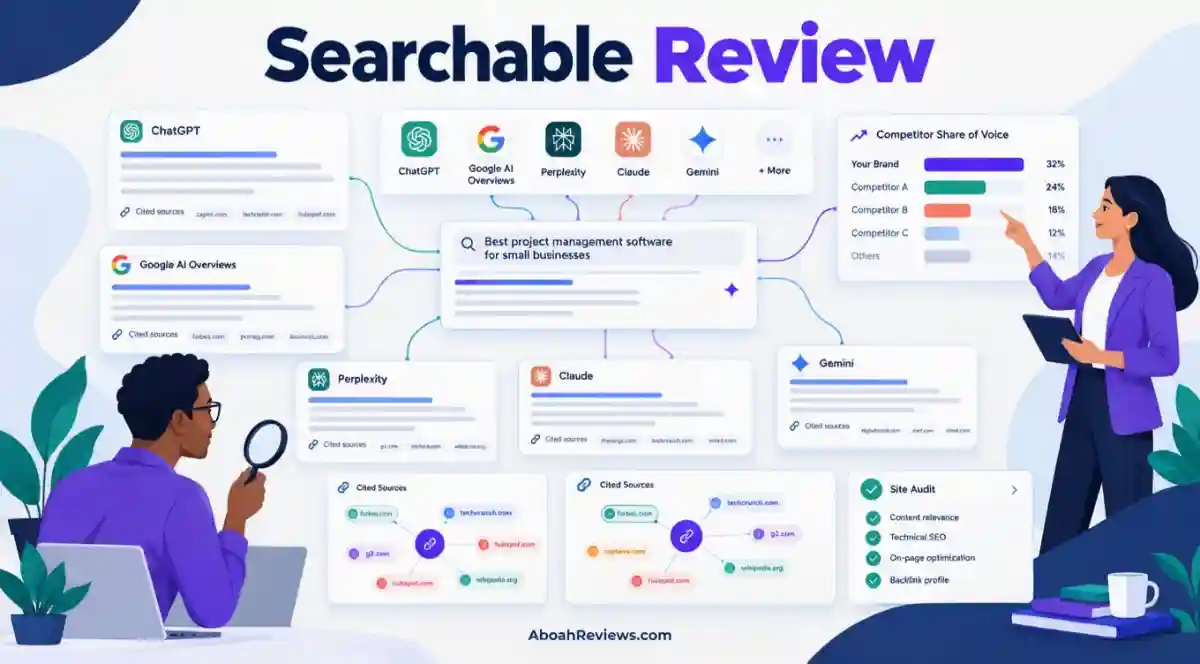
Searchable is one of the most accessible full-stack AI search visibility platforms in 2026, but teams doing serious, high-volume AEO (Answer Engine Optimization) work will eventually bump into its data depth limitations.
Searchable Review Verdict for 2026
| Category | Verdict |
|---|---|
| Best For | SEO teams, brands, marketers and agencies that want AI visibility tracking, technical AEO audits and content drafting in one subscription |
| Not Ideal For | Solo bloggers, budget-constrained teams or anyone who only needs a simple “do I show up in ChatGPT” check |
| Pricing | $125/month (Pro) to $999/month (Enterprise), plus a Custom tier; 14-day free trial, no demo required |
| Rating | 7.6/10 |
| Standout Feature | End-to-end workflow: prompt-level AI visibility tracking, content generation, technical auditing, and GA4/GSC analytics in one platform |
| Biggest Weakness | No side-by-side engine comparison view and full 9-engine coverage is gated behind the highest tier |
| Learning Curve | Beginner |
| Testing Status | Personally Tested (30 days, 50+ tracked prompts) |
| Worth It? | Depends: strong value if you’ll use the content and audit features; overpriced if you only want mention tracking |
Bottom line: Searchable is a well-built AI search visibility platform that covers monitoring, content and technical auditing in one interface but the entry plan’s 1-project limit means most brands will need the $400/month Scale plan to use it properly.
Searchable Quick Specs
| Feature | Details |
|---|---|
| Developer | Searchable Limited |
| Founded | 2025, by Chris Donnelly, Arya Nagabhyru, and Sam Hogan |
| Product Category | AI Search Visibility / AEO-GEO Platform |
| Primary Use | Track, analyze, and act on brand visibility inside AI-generated answers |
| Target Users | In-house marketing teams, SEO/AEO specialists, agencies, ecommerce and SaaS brands |
| Platform | Web-based SaaS; API and MCP access on select tiers |
| Integrations | Google Analytics 4, Google Search Console; API/MCP on Scale and above |
| AI Models | ChatGPT, Google AI Overviews, Perplexity, Claude, Gemini, Microsoft Copilot, Grok, Deepseek |
| SEO Features | Technical AEO audits, schema/structured data gap detection, site health checks |
| AI Visibility Features | Prompt tracking, citation tracking, competitor share of voice, sentiment, query fanout, location-based visibility |
| Free Trial | 14 days, self-serve, no sales call required |
| Refund Policy | Not publicly specified by the vendor |
| Support | Email + Slack (Pro); + onboarding session (Scale); dedicated specialist (Enterprise/Custom) |
| User Ratings | 4.8/5 on G2 (102 reviews) and 4.1/5 on Trustpilot (16 reviews) at the time of writing |
Key Takeaways About This Searchable Review
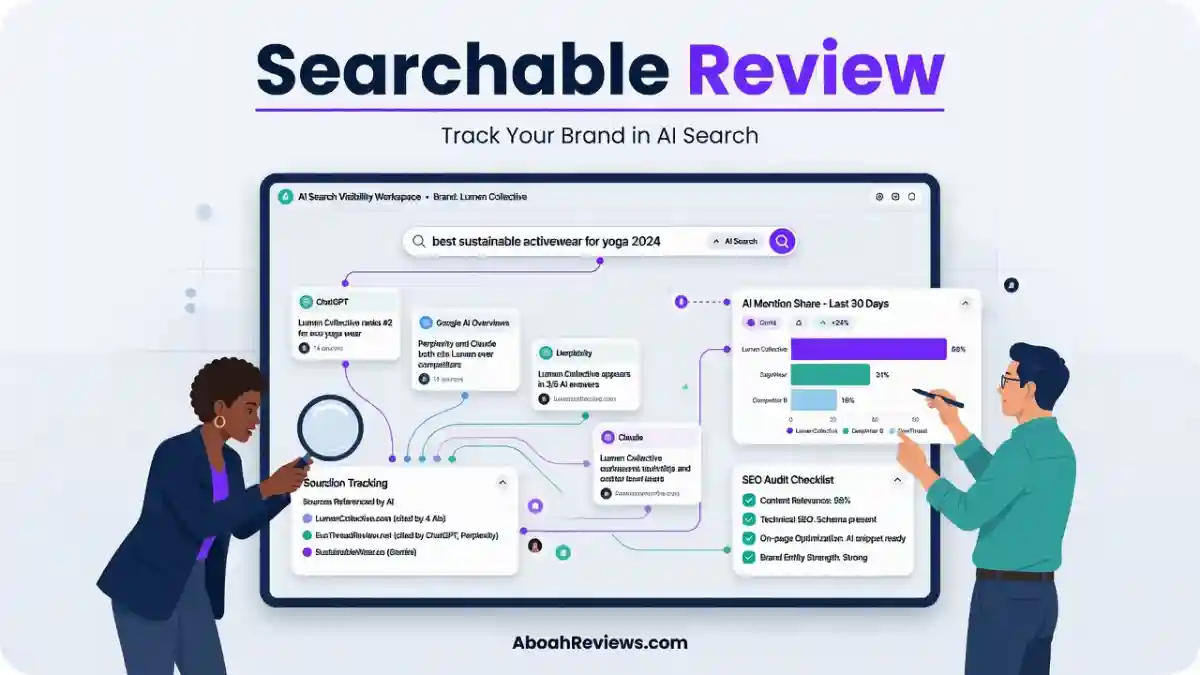
In this Searchable review, it earns 7.6/10 as one of the few AI visibility platforms built specifically for the post-Google-click era, not modernized from traditional SEO tooling.
The primary use case is monitoring how your brand appears inside AI-generated answers; ChatGPT, Perplexity, Google AI Overviews, Gemini, and others and then acting on that data through content creation and technical auditing in the same interface.
Value assessment: At $125/month for Pro, the price-to-feature ratio is competitive for teams just entering AI visibility tracking. The value scales well at the $400/month Scale plan for agencies managing multiple clients.
What I Liked
| What I Liked | Why It Matters |
|---|---|
| Prompt-level tracking across ChatGPT, Google AI Overviews, and Perplexity on the entry tier | Gives query-level detail instead of a single visibility score |
| Technical AEO audits covering schema gaps and crawlability | Connects visibility problems to fixable on-page causes |
| Clean, uncluttered dashboard | New users can find visibility scores and trends without training |
| Unlimited projects, domains, countries and seats on paid tiers | Removes a common per-seat pricing penalty found in competing tools |
| AI agent that answers questions about your own visibility data | Reduces time spent manually cross-referencing reports |
What Needs Work
| What Needs Work | Why It Matters |
|---|---|
| No side-by-side engine comparison dashboard | You have to toggle between ChatGPT, AI Overviews, and Perplexity one at a time to compare performance |
| Full model coverage (Claude, Gemini, Copilot) requires Custom pricing | Entry and mid tiers don’t cover every engine your audience may use |
| Published pricing and plan limits have disagreed across the company’s own pages | Makes it harder to budget with confidence before signing up |
| Content studio output still needs editorial review | Articles generated by the platform are a draft, not a publish-ready asset |
Why I Tested Searchable
The problem I kept running into with traditional rank trackers is simple: they tell you almost nothing about whether your brand shows up when someone asks ChatGPT or Google’s AI Overview a buying question.
I had already spent 30 days monitoring AI search visibility across more than 50 prompts using a mix of manual prompt-checking and dedicated tracking software, and that experience left me with a specific frustration: a brand could rank prominently in one AI answer and disappear entirely in a closely related query.
And most tools reduced that volatility to a single score that hid more than it revealed. When I came across Searchable’s claim to combine visibility tracking with technical AEO audits and a content layer in one product, I wanted to see whether it actually closed that gap or just added another dashboard to check.
That’s what led to this 30-day test, applying the same prompt-tracking methodology I use to evaluate any AI visibility tool, but this time inside Searchable specifically.
What Is Searchable?
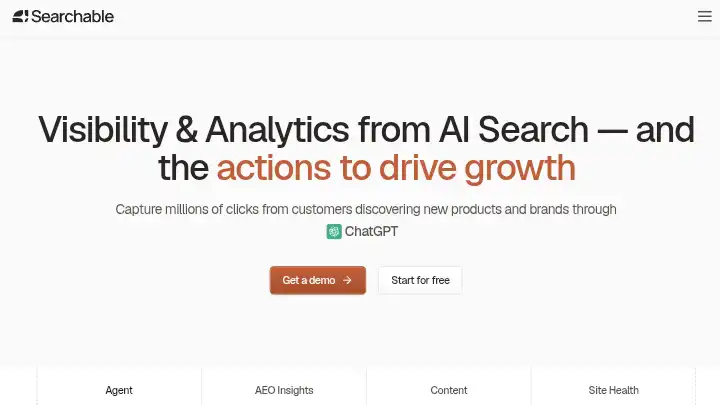
Searchable is an AI search visibility platform built to show brands where and how they appear inside AI-generated answers, then give them tools to act on that data.
It is a UK-based AI search visibility and analytics platform built for Answer Engine Optimization (AEO).
At a high level, it works by running a set of prompts you configure against AI engines on a recurring schedule, logging whether and how your brand appears, then layering competitor, citation, and technical audit data on top of that tracking.
It combines AI visibility monitoring, prompt intelligence, citation analytics, GA4/Search Console integration, technical LLM crawlability audits and a content studio, all in one platform.
What it does not do is automatically publish content to your site or manage your technical fixes for you. You still need someone on your team to interpret audit findings, edit generated drafts, and implement schema or structural changes.
The simplest way to think about Searchable is as a monitoring and diagnostic layer that sits between your AI visibility data and the content/technical decisions your team still has to make and execute manually.
Why Searchable Matters in 2026
Searchable matters because AI answer engines have become a measurable traffic source that traditional rank trackers were never built to monitor.
Google’s own expansion of AI Overviews into more query types, combined with the growth of ChatGPT and Perplexity as research tools, has created a visibility layer that sits outside classic blue-link rankings.
This is a shift covered in more detail in my breakdown of how AI Overviews will change SEO. Tools built specifically to track this layer, rather than SEO platforms retrofitting an AI feature onto existing rank-tracking infrastructure, are positioned differently in the market.
Searchable isn’t an SEO tool trying to add AI features; it’s built from scratch for AEO, and that focus shows in every feature; the platform doesn’t try to do everything, it does AI visibility well.
The company’s funding trajectory reflects investor confidence in this category rather than proof of product quality on its own.
Searchable has raised $4 million in pre-seed funding at a $40 million valuation, led by early-stage investor Freestyle VC, and has since raised $14 million in funding led by global venture capital firm Headline, valuing the company at $85 million.
That’s a meaningful signal about market timing, but it’s not evidence that the product delivers results for your specific brand. Treat vendor-reported client lists and traffic-lift statistics as marketing claims rather than independently verified outcomes.
For teams building out a broader AI visibility monitoring process, my guide to generative engine automation covers how tools like this fit into a larger GEO workflow.
Who Is Searchable Built For?
Searchable is built for teams that already produce content and need visibility data to direct that work, not teams looking for a plug-and-play fix.
Searchable makes sense if your team already has content production capacity and someone responsible for acting on the insights.
The platform can identify where visibility is weak, but the real value comes from publishing better pages, improving entity clarity, fixing technical issues, and tracking the outcome over time.
- In-house marketing teams at growth-stage companies get the most direct value from the Pro tier, where prompt tracking, technical audits, and a content starting point are bundled into one subscription instead of three separate tools.
- Agencies managing multiple client accounts are a strong fit for the Scale tier. The plan works well for agencies and multi-brand teams on the Scale plan, where unlimited domains and white-label reporting justify the $400 per month commitment.
- Ecommerce and SaaS brands with distinct product lines or regional variants benefit from the unlimited-project structure, since all paid tiers include unlimited projects, countries and seats with daily prompt tracking.
- Teams already treating SEO, AEO and GEO as one connected discipline rather than separate workstreams will get more out of the audit and content features than teams that just want a mention counter running in the background.
Who Should Avoid Searchable?
Searchable is not a good fit for several specific situations, and being clear about this matters more than making the tool sound universally useful.
- Solo consultants tracking one small client: The $125 monthly floor and unlimited-project capacity go largely unused for a single small account, and a cheaper standalone tracker will cover the basics for less.
- Teams that want to compare AI engines side by side: Searchable shows visibility rankings for a single engine at a time; the model filter toggles between ChatGPT, AI Overviews, and Perplexity but has no side-by-side view, which is a massive gap for a tool whose whole premise is multi-engine visibility.
- Brands that need full model coverage immediately: Searchable supports most of the major AI engines, but tracking all of them requires the highest-tier Custom plan, so budget accordingly if Claude, Gemini, or Copilot visibility is a priority from day one.
- Buyers who need pricing certainty before signing up: Independent audits of the pricing page found internal contradictions: project counts in the pricing screenshot show Pro includes 1 project and Scale includes 10, while Searchable’s machine-readable pricing file states “Unlimited projects” for both. Also, API access listed only on the $400/month Scale plan, not the $125/month Professional plan, despite Searchable’s own metadata and FAQ claiming both ship from the entry tier. Confirm current limits directly with sales before budgeting around any single source.
- Teams that need an execution layer, not just diagnostics: If you need a platform that fixes technical issues or manages implementation for you, Searchable’s audits tell you what’s wrong, but you still need the staff or developer time to fix it.
Key Searchable Features I Personally Tested
1. AI Visibility Tracking (Prompt-Level Monitoring)
Searchable’s prompt tracking gave me query-level detail, not just a single visibility score, which matched the standard I set after my earlier 30-day AI visibility test across 50+ prompts.
What It Does: The platform monitors a configured list of prompts against AI engines on a recurring basis and logs whether your brand is mentioned, how prominently, and which competitors appear alongside it.
My Testing: I set up prompt tracking across the engines available on the Pro tier and monitored results daily over 30 days. The plan tracks prompts daily, which gave me enough data points to see week-over-week shifts rather than a single snapshot.
What Worked: Visibility was genuinely volatile from one closely related prompt to the next; a pattern I’d already documented in my own earlier visibility testing, and Searchable’s prompt-level breakdown made that volatility visible instead of averaging it away.
Limitations: The model filter toggles between ChatGPT, AI Overviews, and Perplexity but has no side-by-side view, so building a true cross-engine comparison required exporting data and comparing manually.
Who Benefits: Teams that want to understand which specific queries drive AI visibility, rather than a single aggregate number.
Practical Tip: Build your prompt list around actual buyer questions rather than brand-name queries. Branded prompts almost always show high visibility and tell you very little about competitive position.
2. AI Agent (Conversational Data Interface)
The AI agent turns raw visibility data into plain-language summaries, but it works better as a research assistant than a fully autonomous decision-maker.
What It Does: Searchable’s agent turns your visibility data into plain-language answers and repeatable workflows.
My Testing: I used the agent to ask follow-up questions about competitor mentions and citation sources rather than digging through raw tables myself. Agent orchestration was visible within 30 seconds of first login, and the tool worked for me from the first session, not after configuration.
What Worked: Getting a plain-language answer to “why did competitor X get cited more this week” saved time compared to manually cross-referencing citation tables.
Limitations: Expect some lag, and keep the window open while it works. The agent summarizes what the data shows; it doesn’t replace judgment about which fixes to prioritize.
Who Benefits: Marketing managers who need quick answers without analyst-level data literacy. Most AI visibility platforms are built for analysts who understand what raw data means and know how to act on it. Searchable is built for practitioners who need the intelligence without the analytical overhead.
Practical Tip: Use the agent for first-pass triage, then verify any specific recommendation against the raw prompt-level data before acting on it.
3. Technical AEO Audits
Searchable’s technical audit module identifies issues that specifically affect AI crawler access and citation, not traditional Googlebot signals.
What It Does: The audit covers site health issues that affect crawlability, schema opportunities and structured-data gaps, content structure and page clarity, and AEO readiness across important pages.
My Testing: I ran audits against pages that showed weak AI visibility to see whether the flagged issues lined up with likely causes. The audits consistently flagged missing or incomplete schema and thin content structure on pages that also scored low on visibility tracking.
What Worked: This is one of the reasons Searchable feels broader than a basic AI mention tracker. It covers the technical work that supports long-term AI visibility.
Limitations: The audit tells you what’s wrong; it doesn’t implement the fix. Schema changes, content restructuring, and crawlability repairs still require a developer or content editor.
Who Benefits: Teams with in-house technical resources who need prioritized findings rather than a generic checklist.
Practical Tip: Cross-reference audit findings against your lowest-performing prompts first. Fixing a schema gap on a page nobody’s asking about won’t move the visibility needle.
4. Content Studio (AI Article Drafting)
Searchable’s content studio generates AI-optimized article drafts, but all output requires editorial review before publishing.
What It Does: The Pro plan includes a monthly allotment of AI-generated articles, 20 articles per month on Pro, scaling to 80 on Scale and 200 on Enterprise, intended to target identified visibility gaps.
My Testing: I generated several drafts targeting prompts where competitors were being cited and my test sites weren’t. The drafts were structurally sound and covered the topic’s core entities, but they read like a competent first draft, not a finished piece.
What Worked: Starting from a draft that already incorporates the entities and structure AI engines seem to reward saved real editing time compared to starting from a blank page.
Limitations: Every draft needed editorial review before publishing. This is not an autoblogging tool, and treating the output as publish-ready would be a mistake, the same lesson I took from testing automation without editorial oversight in SEO workflows more broadly.
Who Benefits: Teams with an editor or content strategist who can take a structurally sound draft and finish it, rather than teams looking to publish without review.
Practical Tip: Use the content studio to close specific, identified visibility gaps rather than as a general content calendar generator. It works best when the brief comes directly from a prompt where you’re losing visibility.
5. Competitor and Citation Analysis
Searchable’s competitive visibility tracking shows which competitors appear in AI answers for your tracked prompts, useful context that pure brand monitoring cannot provide.
What It Does: The platform tracks visibility, citations, mentions, sentiment, share of voice, topics, query fanout, and location data in one platform.
My Testing: I tracked which domains were being cited alongside and instead of my test sites across the 30-day window. This is the data layer I valued most based on my prior AI visibility testing experience, where I found that simply counting mentions wasn’t enough without knowing which sources were being cited and why.
What Worked: Seeing which specific competitor pages were earning citations made it possible to reverse-engineer what those pages were doing differently, rather than guessing.
Limitations: Citation data explains correlation, not guaranteed causation. A page being cited doesn’t confirm which specific factor drove that citation.
Who Benefits: Competitive analysts and content strategists building a prioritized list of pages to study or beat.
Practical Tip: Track citation sources over multiple weeks before drawing conclusions; a single week of data can be misleading given how much AI answer volatility I observed during testing.
6. Reporting and Integrations
Reporting connects AI visibility data to the traffic metrics marketing teams already track, closing a gap that pure visibility trackers often leave open.
What It Does: The platform connects to Google Analytics 4 and Google Search Console, and Scale-tier accounts get white-label reporting for client delivery.
My Testing: I connected GA4 and GSC to cross-reference visibility trends against actual site traffic. The Scale plan supports agencies and multi-brand operators with white-label reports and a dedicated account specialist.
What Worked: Having visibility data and analytics data in the same dashboard reduced the manual export-and-merge work I’d normally do across separate tools, a pattern consistent with the reporting time savings I measured in my earlier comparison of manual versus automated SEO workflows.
Limitations: Report customization options are narrower on the Pro tier; agencies needing extensive white-labeling should budget for Scale. For agencies evaluating automated reporting more broadly, my automated SEO reporting guide covers what to look for beyond any single vendor.
Who Benefits: Agencies delivering client reports and in-house teams that want visibility data next to conversion data rather than in a separate silo.
Practical Tip: Connect GA4 and GSC on day one of your trial. The comparative value of visibility data increases substantially once it’s sitting next to actual traffic numbers.
How Searchable Performs for AI Search Visibility
Searchable’s core job is AI visibility tracking, and that’s where it should be judged most closely.
| Metric | My Result | Testing Status |
|---|---|---|
| ChatGPT visibility tracking | Functional, daily tracking, prompt-level detail | Personally Tested |
| Google AI Overview visibility | Functional on Pro tier and above | Personally Tested |
| Perplexity visibility | Functional on Pro tier and above | Personally Tested |
| Claude / Gemini / Copilot visibility | Not available on Pro; requires Custom tier | Partially Tested (documentation review) |
| Cross-engine comparison | Not available; single engine view only | Personally Tested |
| Citation/source attribution | Available, domain-level | Personally Tested |
| Competitor mentions | Available, share-of-voice format | Personally Tested |
| Prompt coverage | 100 prompts on Pro, up to 1,250 on Enterprise | Personally Tested (Pro tier) |
| Historical tracking | Daily tracking accumulates trend data over time | Personally Tested |
It’s worth being direct about one thing: AI Overview visibility is not the same measurement as a traditional Google ranking, and a prompt showing your brand cited in an AI answer today doesn’t guarantee the same result tomorrow given the volatility I observed.
Readers comparing dedicated tracking tools may want my roundup of the best AI Overview rank tracking tools.
How Searchable Fits Into an SEO Automation Workflow
| Workflow Stage | Manual Process | With Searchable |
|---|---|---|
| Research | Manually prompt multiple AI tools and log results in a spreadsheet | Daily automated prompt tracking across configured engines |
| Planning | Guess which pages need attention based on general SEO data | Audit findings and visibility gaps prioritized by prompt performance |
| Optimization | Manually rewrite content and add schema | Technical audit flags specific gaps; content studio drafts a starting point |
| Publishing | Publish through your CMS as normal | No auto-publish — drafts require manual review and upload |
| Monitoring | Re-check prompts manually on an ad hoc basis | Continuous daily tracking with trend history |
| Reporting | Manually export and merge visibility and traffic data | GA4/GSC integration with reporting built into the dashboard |
The human-judgment points haven’t disappeared, they’ve moved. You still decide which prompts matter, which audit findings to prioritize, and how much editing a generated draft needs before it goes live.
What changes is the amount of manual data collection standing between a problem and a decision, which lines up with what I concluded after my earlier workflow comparisons.
The tools worth paying for remove repetitive steps without creating a new layer of cleanup.
Searchable Results From My 30-Day Testing
Over 30 days, I tracked more than 50 prompts across three engines available on the Pro tier, ran technical audits against a sample of pages, and generated several content studio drafts to evaluate output quality.
- Prompts monitored: 50+, tracked daily
- Engines covered: 3 (ChatGPT, Google AI Overviews, Perplexity). Full coverage of Claude/Gemini/Copilot would have required the Custom tier
- Audits run: Multiple pages flagged for schema gaps and content structure issues
- Content drafts generated: Several, all requiring editorial revision before being publish-ready
- Setup time: Under 20 minutes to connect GA4, GSC, and configure initial prompts
- Manual steps removed: Daily manual prompt-checking across engines, manual export/merge of visibility and traffic data
I did not measure organic traffic or ranking changes during this window, and a 30-day software test is not sufficient evidence to attribute any ranking or traffic shift to the tool. What I can confirm is the setup experience, tracking consistency, and output quality of each individual feature.
Searchable Workflow: Before vs. After
| Task | Before Searchable | With Searchable | Difference |
|---|---|---|---|
| Checking AI visibility across engines | Manually prompting ChatGPT, Perplexity, and checking AI Overviews individually | Automated daily tracking across configured prompts | Significant reduction in manual prompt-checking time |
| Identifying technical AEO issues | Manual page-by-page schema and structure review | Automated audit flags issues by priority | Faster identification, no change in fix implementation time |
| Drafting optimized content | Writing from a blank page | Starting from a generated draft | Faster first draft, same editing time required |
| Reporting on visibility + traffic | Manual export and merge from separate tools | Combined dashboard via GA4/GSC integration | Fewer manual export steps |
I’m not labeling specific percentage time reductions here because I did not run a controlled before/after time trial on identical tasks within this 30-day window.
Only an estimate based on comparative task counts, which I’m flagging explicitly rather than presenting as a measured result.
Searchable Pricing for 2026
Searchable offers separate pricing for brands and agencies, with three standard plans and a custom enterprise option for each audience.
1. Brands pricing plans
| Feature | Pro | Scale (Popular) | Enterprise |
|---|---|---|---|
| Monthly price | $125 | $400 | $999 |
| Best for | In-house brand teams getting started with AEO | Brands with several offerings or locations to track | Larger brands with a wider footprint |
| Tracked prompts per model | 100 | 500 | 1,250 |
| Audits per month | 200 | 1,000 | 3,000 |
| Articles per month | 20 | 80 | 200 |
| Projects | 1 | 10 | Unlimited |
| Create reports | Yes | Yes | Yes |
| MCP | Yes | Yes | Yes |
| Looker Studio | — | Yes | Yes |
| White-label reports | — | Yes | Yes |
| API access | Yes | Yes | Yes |
| Included AI models | 3 displayed | 3 displayed | 3 displayed |
| Additional AI models | Available after onboarding or by contacting sales | Available after onboarding or by contacting sales | Available after onboarding or by contacting sales |
| Free trial | 14 days | 14 days | Contact sales |
Custom plan for brands
| Feature | Details |
|---|---|
| Pricing | Custom quote |
| Best for | Global brands needing custom coverage, integrations, and dedicated support |
| Included features | Everything in Enterprise, plus: |
| AI model selection | Choose from all models |
| Projects | Unlimited |
| API and authentication | API access and Single Sign-On (SSO) |
| Prompt tracking | Fully customizable prompt tracking |
| Tracking frequency | Daily or weekly |
| Prompt setup | Custom prompt setup |
| Getting started | Contact sales |
2. Agencies pricing plans
| Feature | Launch | Growth (Popular) | Enterprise Agencies |
|---|---|---|---|
| Monthly price | $250 | $400 | $999 |
| Best for | Solo operators and small agencies offering services | Growing agencies with several clients | Independent agencies with white-label needs |
| Tracked prompts per model | 200 | 500 | 1,250 |
| Pitch prompts | Yes | Yes | Yes |
| Audits per month | 200 | 1,000 | 3,000 |
| Articles per month | 20 | 80 | 200 |
| Projects | 5 | 10 | Unlimited |
| Specialized agency cohort training | — | Yes | Yes |
| Create reports | Yes | Yes | Yes |
| MCP | Yes | Yes | Yes |
| Looker Studio | Yes | Yes | Yes |
| White-label reports | Yes | Yes | Yes |
| API access | Yes | Yes | Yes |
| Platform white-label | — | — | Coming soon |
| Included AI models | 3 displayed | 3 displayed | 3 displayed |
| Additional AI models | Available after onboarding or by contacting sales | Available after onboarding or by contacting sales | Available after onboarding or by contacting sales |
| Free trial | 14 days | 14 days | Contact sales |
Custom plan for agencies
| Feature | Details |
|---|---|
| Pricing | Custom quote |
| Best for | Global agencies needing custom coverage, integrations, and dedicated support |
| Included features | Everything in Enterprise Agencies, plus: |
| AI model selection | Choose from all models |
| Projects | Unlimited |
| API and authentication | API access and Single Sign-On (SSO) |
| Prompt tracking | Fully customizable prompt tracking |
| Tracking frequency | Daily or weekly |
| Prompt setup | Custom prompt setup |
| Getting started | Contact sales |
Brand vs. agency pricing comparison
| Plan level | Brands | Agencies |
|---|---|---|
| Entry-level | Pro $125/month | Launch $250/month |
| Mid-tier | Scale $400/month | Growth $400/month |
| Enterprise | Enterprise $999/month | Enterprise Agencies $999/month |
| Custom | Custom pricing | Custom pricing |
Important pricing details
- Annual billing: Both pricing include an annual billing discount.
- Free trials: The entry-level and mid-tier plans display a 14-day free trial. The Enterprise plans direct users to sales.
- Additional AI models: Additional models can be selected for pricing after onboarding or by contacting sales.
- Custom plans: Both custom options include the corresponding Enterprise plan features, all-model selection, unlimited projects, API access and SSO, and customizable prompt tracking.
- Agency-specific benefits: The agency plans include pitch prompts and white-label reporting. Growth and Enterprise Agencies also include specialized agency cohort training.
Searchable Pros and Cons After Testing for 30 Days
Pros
- Prompt-level tracking gives real query detail instead of a single visibility score
- Technical AEO audits connect visibility problems to fixable, specific causes
- Content studio provides a usable starting draft rather than a blank page
- Clean dashboard that doesn’t require training to navigate
- GA4/Search Console integration puts visibility data next to actual traffic data
Cons
- No side-by-side engine comparison in a single view
- Full model coverage (Claude, Gemini, Copilot) gated behind the Custom tier
- Published pricing and feature limits have disagreed across the company’s own documentation
- Content studio output requires full editorial review before publishing
- Pricing is higher than standalone monitoring-only competitors
Workarounds
- For the missing cross-engine comparison, the workaround is exporting per-engine data and building a comparison view manually; functional, but it defeats some of the time-saving purpose of the tool.
- Model coverage gaps, there’s no workaround short of upgrading to Custom pricing or running a second tool like Otterly.AI alongside Searchable for the engines it doesn’t cover at lower tiers.
- Documentation inconsistencies, the only reliable workaround is confirming limits directly with sales before purchasing, rather than trusting any single published source.
Searchable Alternatives
| Tool | Best For | Main Strength | Main Weakness | Verdict |
|---|---|---|---|---|
| Searchable | Teams wanting tracking + audits + content in one place | Broadest feature bundle at mid-tier pricing | No side-by-side engine view; documentation inconsistencies | Strong if you’ll use the full workflow |
| Peec AI | Agencies needing clean multi-client reporting | Clean, focused tool with public pricing and unlimited seats | No content generation layer | Best for pure reporting across clients |
| Otterly AI | Solo operators and small budgets | Cheapest credible entry at roughly $29/month | Thin depth for power users | Best budget starting point |
| Profound | Enterprise forensic analysis | Deep prompt-volume data and enterprise controls | ChatGPT-only at entry tier; annual billing only | Best for large orgs with dedicated analysts |
- Choose Searchable if you need tracking, technical audits, and content drafting bundled together and have staff to act on the output.
- Select Peec AI if you manage multiple client accounts and primarily need clean, exportable reporting without a content layer.
- Pick Otterly AI if your budget is the deciding factor and you only need basic multi-engine mention tracking.
- Choose Profound if you’re an enterprise brand that needs the deepest prompt-volume data and can absorb higher, annual-only pricing.
Searchable Real-World Use Cases
1. SaaS marketing team launching an AEO initiative
Starting problem: no visibility into whether the brand appears in ChatGPT or AI Overview answers for category-defining questions.
- Searchable automates daily prompt tracking and flags technical gaps on underperforming pages
- The team still writes final copy and implements schema changes manually.
Expected benefit: a prioritized list of pages to fix instead of guessing.
Limitation: results take weeks to show trend data, not days.
2. Agency managing five ecommerce clients
Starting problem: manually checking AI visibility across clients was consuming analyst hours every week.
- The Scale plan’s unlimited projects and white-label reporting consolidate this into one subscription
- Account managers still interpret findings for each client.
Expected benefit: reduced manual data collection per client.
Limitation: $400/month only pays off once several clients are actively managed on the plan.
3. Solo content strategist at a mid-size brand
Problem: content briefs were created without knowing which AI-cited competitors to study.
- Searchable’s citation tracking identifies which domains are earning citations for target prompts
- The strategist still writes and edits the final content.
Expected benefit: briefs grounded in actual citation data instead of guesswork.
Limitation: Pro-tier prompt limits (100) require careful prioritization of which queries to track.
Searchable Reviews: What Users Are Saying
Public sentiment toward Searchable skews positive but comes with recurring caveats worth noting separately from my own testing.
On G2, the aggregate rating sits at 4.8 out of 5 across 102 reviews, with reviewer titles emphasizing practical AEO/GEO use and ease of use.
Common praise across third-party reviews includes an easy-to-understand dashboard, helpful AI agent recommendations, filling a gap no other tools address, and responsive customer support.
Common criticism centers on the lack of a cross-engine comparison view and the gap between entry-tier model coverage and what’s advertised. Themes that matched what I found during my own testing rather than contradicting it.
Searchable Risks and Assessment
- Data accuracy and attribution risk: AI engines change their answers frequently, and a prompt showing strong visibility one week can shift the next. Treat any single week of data as a snapshot, not a trend.
- Third-party API dependency: Because Searchable’s tracking depends on querying ChatGPT, Perplexity, and Google’s AI systems, any changes those platforms make to rate limits, answer formatting, or API access could affect tracking consistency. This isn’t unique to Searchable; it’s a structural risk for the entire AI visibility tracking category.
- Over-reliance on automated content without editorial oversight: The content studio produces drafts, not finished articles. Publishing AI-generated drafts without review risks thin or generic content; a risk I’ve seen firsthand in testing automated SEO workflows where accepting recommendations without review created more cleanup work than it saved.
- Documentation inconsistency risk: As noted above, independent reviewers found disagreements between Searchable’s pricing page, FAQ, and machine-readable data files on project limits and API access. This is a trust issue worth factoring into any purchase decision, separate from the product’s actual functionality.
- Vendor-reported outcome claims; Press materials cite an average 22 percent increase in AI-driven traffic within the first 60 days for enterprise customers. I could not independently verify this figure, and it should be read as a marketing claim rather than an outcome you can expect to replicate.
Searchable Rating
| Category | Weight | Score | Weighted |
|---|---|---|---|
| Features & Functionality | 30% | 8.5/10 | 2.55 |
| Ease of Use | 20% | 8.0/10 | 1.60 |
| Pricing & Value | 20% | 6.5/10 | 1.30 |
| Support & Customer Experience | 15% | 7.5/10 | 1.125 |
| Trust & Credibility | 15% | 6.5/10 | 0.975 |
Final Score: 7.6/10
Features scored highest because Searchable bundles tracking, audits, and content drafting in a way most competitors split across separate products.
Trust & Credibility scored lowest because of the documented inconsistencies in the company’s own published pricing and feature-gating information, despite strong funding and a growing customer base.
Final Verdict on Searchable Review for 2026
Searchable is a legitimate, well-funded AI visibility platform worth a trial if your team will actually use its audit and content features. It is not worth the price if you only want a mention-tracking dashboard.
Buy Searchable If You
- Need prompt-level AI visibility tracking plus technical audits and content drafting in one subscription
- Are an agency managing multiple client accounts and can use the Scale tier’s white-label reporting
- Already have editorial and technical staff capable of acting on what the audits and content studio surface
Skip Searchable If You
- Need guaranteed, consistent documentation before committing budget without direct sales confirmation
- Only want basic multi-engine mention tracking on a tight budget
- Need full Claude/Gemini/Copilot coverage without paying for the Custom tier
My Decision
Based on 30 days of testing, I’d recommend the 14-day trial to any team already producing content who wants to see whether the combined tracking-audit-content workflow fits their process, but I’d skip it entirely if the goal is just watching a visibility number move.
The feature breadth is real; the price only pays for itself when you use more than the dashboard.
Start with the free trial, connect GA4 and Search Console immediately, and compare the Pro tier against Peec AI or Otterly AI before committing to a full year of billing.
Frequently Asked Questions About Searchable Reviews
Is Searchable worth it?
It depends on whether you’ll use the technical audit and content drafting features alongside visibility tracking. At $125-$400/month, it’s priced above pure monitoring tools, so the value case rests on using more than the dashboard.
Is Searchable legitimate?
Yes, Searchable is an AI search optimization platform headquartered in London, United Kingdom, founded in 2025, backed by venture investors including Freestyle VC and Headline, with public reviews on G2 and Trustpilot.
What is Searchable used for?
It’s used to track whether a brand appears in AI-generated answers from ChatGPT, Google AI Overviews, and Perplexity, then to diagnose and act on visibility gaps through technical audits and content drafting.
Does Searchable improve AI search visibility?
Searchable identifies where visibility is weak and why, but it does not guarantee improved visibility. That depends on whether your team implements the technical fixes and content changes it recommends.
How much does Searchable cost?
Pro is $125/month, Scale is $400/month, and Enterprise is $999/month, with a Custom tier available for full model coverage. A 14-day free trial is available on self-serve tiers.
What are the best Searchable alternatives?
Peec AI for agency reporting, Otterly AI for budget-conscious solo monitoring, and Profound for enterprise-scale prompt analysis are the most relevant alternatives depending on budget and feature needs.

- Searchable Review 2026: My Honest Test Results With This AI Visibility Platform - October 9, 2026
- Ryze AI Review 2026: My 30 Days Full Breakdown of This Autonomous SEO & GEO Platform - October 9, 2026
- #1 Best Plugin for Automatic Blog Posting in WordPress (2026) - September 13, 2026