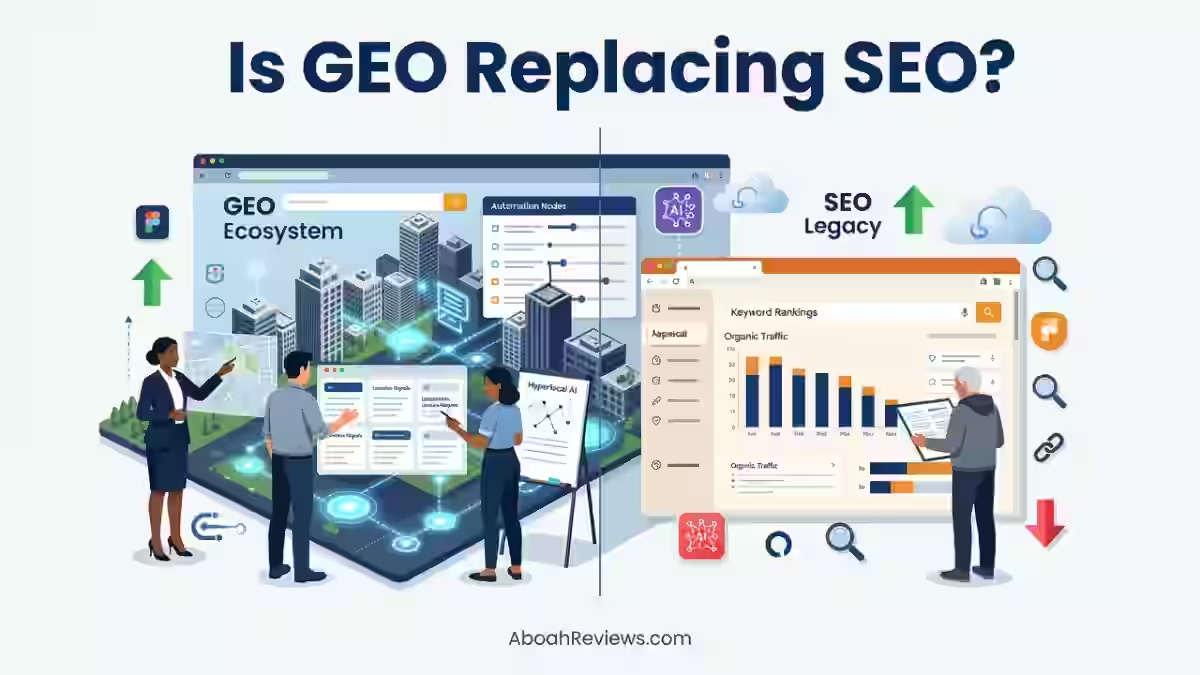
TL;DR: Is GEO replacing SEO? GEO is not replacing SEO; it’s an evolution and extension of SEO. AI search features still rely on the foundational technical crawling, indexing and authority metrics of standard SEO to source and verify information.
How SEO and GEO Differ
- SEO (Search Engine Optimization): Focuses on ranking a website on search engine result pages to earn clicks and direct traffic
- GEO (Generative Engine Optimization): Focuses on structuring data and content so AI engines can easily read, synthesize and cite your brand inside direct answers.
- Core Focus: SEO targets keywords and link placements; GEO targets topical authority, clear context and direct answers.
Why SEO Stays Essential for GEO
- Crawling and Indexing: If an AI crawler cannot properly index your site, your content will not appear in AI-generated summaries.
- High Correlation: A large share of AI citations are pulled directly from top-ranking traditional search results.
- Trust Signals: Standard authority markers like E-E-A-T (Experience, Expertise, Authoritativeness, and Trustworthiness) matter equally to search algorithms and large language models.
The winning strategy is SEO plus GEO, not one or the other.
For a deeper breakdown, I have a dedicated generative engine optimization guide that goes into GEO strategy in much more detail.
Introduction
Is GEO replacing SEO? Not at all. GEO is expanding what “search visibility” means, not erasing what came before it.
If you have been reading headlines about SEO being dead or GEO taking over everything, I want you to slow down for a second. The picture is more complicated and honestly, more interesting.
I have been doing SEO work across content sites, affiliate blogs and autoblogging projects for a few years now. I have watched Google AI Overviews roll out, seen traffic numbers drop on some sites and watched other sites hold strong.
What I have learned is that the people panicking the most about GEO are often the ones who never fully understood SEO in the first place.
In this guide, I am going to break down what SEO is, what GEO is, how they differ and why the smart move is to build both into your workflow, not choose between them.
Is GEO Replacing SEO?
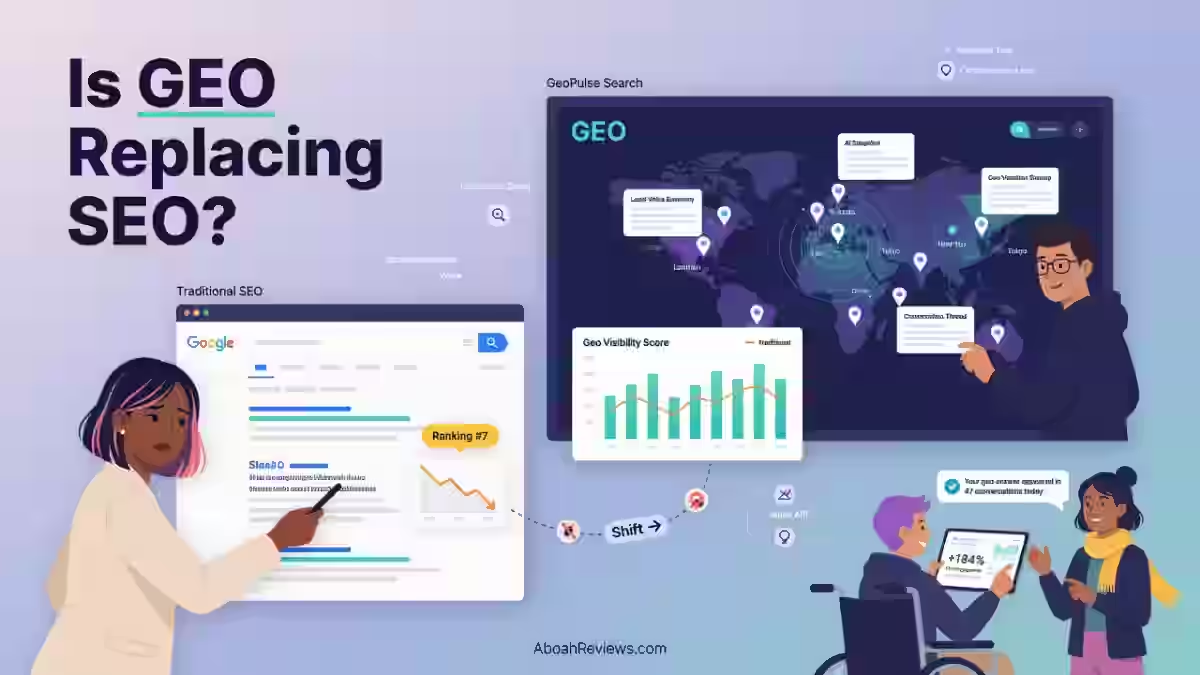
No, GEO adds a second optimization layer on top of SEO, targeting visibility inside AI-generated answers rather than replacing the traditional search ranking process. The two serve different but complementary goals.
Here is the core distinction:
- SEO helps your content rank in traditional Google search results so people can find and click through to your site.
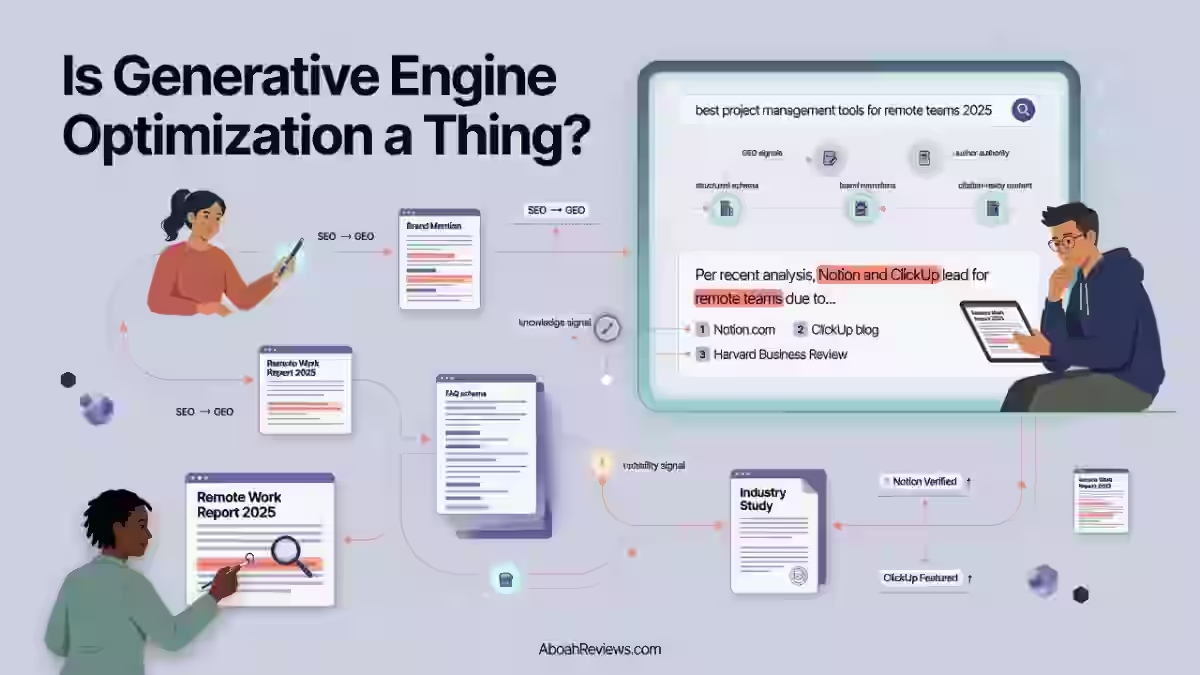
- GEO helps your content get cited, quoted, or mentioned inside AI-generated answers from platforms like ChatGPT, Perplexity, Claude, Google Gemini, and Google AI Overviews.
- Both matter because search behavior is splitting. Some users still type queries into Google and click links. Others now ask AI systems and read synthesized answers.
In early 2025, Google saw over 14 billion searches per day, while ChatGPT handled just 37 million.
That gap tells you traditional search is not going anywhere. But the gap is also closing faster than most people expected and that is why understanding GEO now actually gives you an edge.
Traditional SEO earns you a position on a results page, while GEO earns you a position inside the answer itself. Those are not equivalent outcomes and the tactics required to achieve each one are meaningfully different.
What Is SEO?
SEO (Search Engine Optimization) is the practice of improving a website’s visibility in traditional search engine results pages (SERPs) to drive organic traffic.
Think of it as everything you do to help Google, Bing or DuckDuckGo understand your content well enough to rank it for relevant searches.
The SEO ecosystem covers a lot of ground, but it comes down to a few core pillars:
Core SEO components:
- Keyword research: Identifying what your audience searches for and how they phrase it
- Search intent: Matching your content to the actual purpose behind a query (informational, commercial, transactional, or navigational)
- Technical SEO: Site speed, crawlability, Core Web Vitals, structured data, indexing
- On-page SEO: Title tags, headers, meta descriptions, internal linking, and content structure
- Backlinks: Links from other websites that signal authority and trust to Google
- Content quality: Depth, accuracy, originality, and usefulness for the reader
- E-E-A-T: Experience, Expertise, Authoritativeness, and Trustworthiness, which Google’s Search Quality Rater Guidelines use to evaluate content quality
What SEO is trying to achieve:
- Higher rankings for target keywords
- More organic traffic from search engines
- Better visibility across the search results page
- Clicks that convert into leads, sales, or subscribers
If you are just getting started with the mechanics of how content gets produced and published at scale, my guide on how autoblogging works covers the automation side of content creation that many SEO teams now use to support their content pipelines.
What Is GEO?
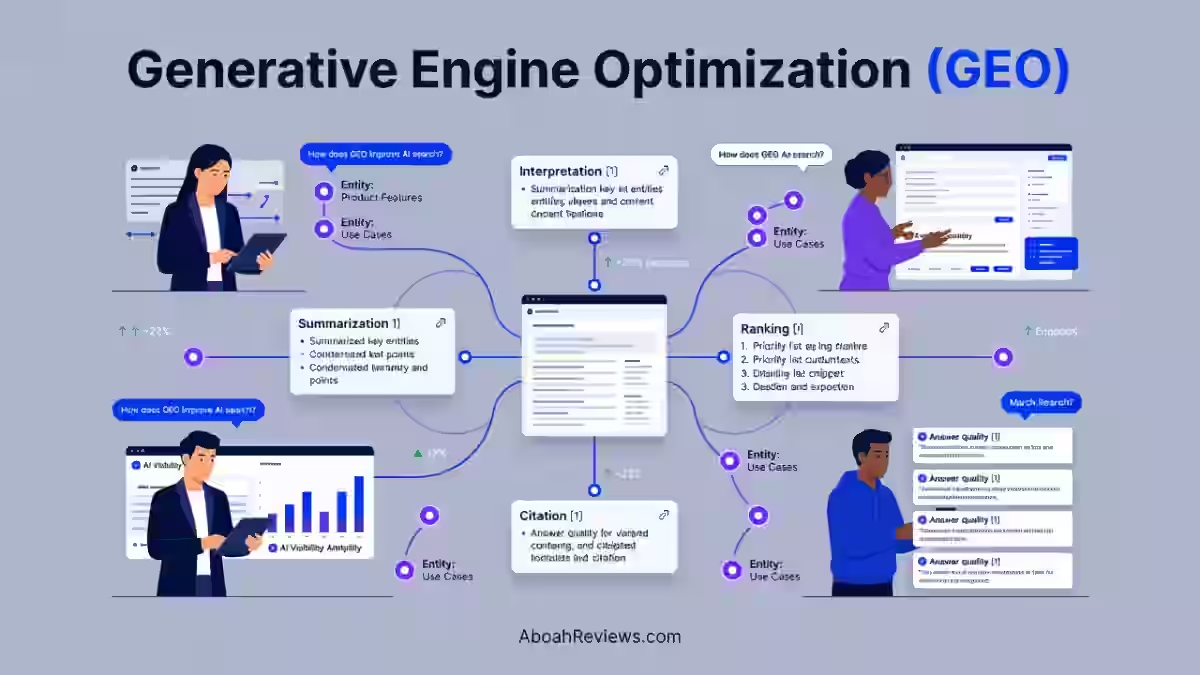
GEO (Generative Engine Optimization) is the practice of structuring your content and digital presence so that AI-powered platforms cite, reference, or recommend your brand when users ask questions.
These platforms include ChatGPT, Google AI Overviews, Google Gemini, Microsoft Copilot, Anthropic’s Claude, xAI Grok and Perplexity.
The major generative search platforms you need to understand right now are:
- Google AI Overviews: Appears at the top of Google search results for qualifying queries
- Google AI Mode: Google’s fully conversational search interface (rolling out in 2025 and beyond)
- ChatGPT: OpenAI’s conversational AI, increasingly used as a research and recommendation tool
- Google Gemini: Google’s AI assistant integrated across Search, Workspace, and Android
- Microsoft Copilot: Bing-powered AI assistant embedded in Windows and Microsoft 365
- Perplexity: An AI search engine that cites sources inline and presents synthesized answers
- Anthropic’s Claude: An advanced AI assistant focused on high-token context windows, ethical guardrails and deep research capabilities.
- xAI Grok: Elon Musk’s real-time AI integrated directly into X (formerly Twitter), utilizing live social data for current event insights.
Key Capabilities of Generative Search Platforms
- Hybrid Retrieval: Blends traditional web indexing with real-time semantic synthesis.
- Inline Sourcing: Links directly back to publication domains to verify factual claims.
- Multimodal Input: Supports simultaneous analysis of voice, text, images and code.
- Agentic Execution: Automates multi-step workflows like booking, shopping, and data extraction.
Platform Comparison Matrix
| Platform | Primary Data Engine | Core Strength | Monetization Model |
|---|---|---|---|
| Google AI Overviews | Google Search Index | Seamless search integration | Ad-supported real estate |
| Google AI Mode | Gemini 1.5/2.0 Engine | Deep multi-turn research | Ecosystem lock-in |
| ChatGPT | Bing Index & Web Crawlers | Creative & analytical tasks | Premium subscriptions |
| Microsoft Copilot | Bing Search Graph | Enterprise & Windows utility | Corporate licensing |
| Perplexity | Multi-LLM Aggregator | Real-time academic sourcing | Pro tiers & sponsored slots |
| Anthropic’s Claude | Specialized Web Crawling | Long-form document analysis | Developer & Pro API access |
| xAI Grok | X Social Graph & Real-Time Web | Breaking news & public sentiment | Premium social subscriptions |
Core GEO concepts you need to know:
- AI citations: When a generative AI answer links to or names your content as a source
- Brand mentions: When an AI model references your brand name, even without a clickable link
- Entity recognitio: How AI systems identify and associate your brand with specific topics or expertise areas
- Answer extraction: How AI pulls structured facts, definitions or summaries from your content
- Topical authority: How well your site establishes deep, consistent expertise across a subject area
- Source credibility: Whether AI models treat your site as a trustworthy, authoritative reference
SEO vs GEO: What Is the Difference?
The clearest way to see the difference between SEO and GEO is to put them side by side. They share some foundations but serve different channels with different success metrics.
Factor | SEO | GEO |
|---|---|---|
Primary goal | Search rankings | AI visibility and citations |
Main environment | Traditional search engines | Generative AI platforms |
Key outcome | Clicks and organic traffic | Citations, mentions, and inclusion |
Keyword targeting | Central to strategy | Useful but less central |
Backlinks | Major authority signal | Indirectly important |
Entity optimization | Important | Highly important |
Content structure | Important | Critical for extraction |
Measurement | Rankings, impressions, CTR | Citations, AI mentions, referral traffic |
Conversion path | User clicks link, visits site | User reads AI answer, may or may not visit site |
Content format | Varied | Answer-first, structured, definition-heavy |
From Ahrefs’ research on a dataset of 15,000 prompt, an average of 12% of the sources cited in ChatGPT, Gemini, and Copilot rank in the top 10 Google organic search results for the same query, meaning SEO tactics alone will not guarantee visibility in AI.
That is probably the most important data point in this whole conversation. Ranking number one on Google does not automatically get you into AI answers.
And getting cited by AI does not automatically mean you rank number one on Google. You have to build for both.
Why GEO Does Not Replace SEO
AI Search Still Depends on Search Infrastructure
AI search systems cannot function without the same crawling and indexing infrastructure that traditional SEO relies on.
Before a generative AI can reference your content, it needs to have encountered that content during training or through real-time retrieval, and that access depends on your content being crawlable and indexable.
Google’s AI Overviews, for example, pull from pages that Google has already crawled and indexed.
If your site has crawl errors, thin pages blocked by robots.txt, or slow load times, your content is invisible to both traditional Google rankings and AI-generated answers.
The technical SEO fundamentals you already know are not optional extras for GEO; they are prerequisites. If your site has technical issues that block crawling, no amount of GEO strategy will fix that.
Start with your SEO automation fundamentals to make sure your technical setup is solid before worrying about AI visibility.
SEO Builds the Authority GEO Needs
GEO visibility is largely downstream of the authority signals that SEO builds.
AI systems do not randomly pull content from obscure corners of the internet. They tend to cite sources that already demonstrate strong trust and credibility signals.
What does that include?
- Backlinks from authoritative sites: Still one of the strongest signals that a source is credible
- Brand mentions: Your brand being referenced across multiple publications, even without a link
- Author credibility: Named authors with verifiable expertise and bylines across respected outlets
- Topical authority: A consistent body of content that demonstrates deep knowledge in a specific area
- Original research and data: First-party studies, surveys, and case studies that other publishers reference
This is why a site with zero backlinks and no domain authority rarely shows up in AI answers, even when its content is well-structured. The authority SEO builds over time is exactly what GEO needs to function.
Traditional Search Traffic Still Matters
Google Search remains the dominant discovery channel for most websites, and ignoring traditional SEO to chase AI visibility is a mistake most sites cannot afford.
Google Search and Google Discover together drive 20-40% of referral traffic to most major publishers, making it their largest external traffic source.
AI Overviews are changing click behavior. Organic CTR plummeted from 1.41% to 0.64% for queries with AI Overviews. That is a real problem.
But the solution is not to abandon SEO. The solution is to optimize for both traditional rankings and AI citation simultaneously, which is exactly what the rest of this guide covers.
How GEO Is Changing SEO
Ranking for Keywords to Being the Source AI Cites
The goal of search optimization is shifting from earning a top-10 ranking to becoming the source an AI model references in its synthesized answer.
These two outcomes sometimes overlap, but they are not the same thing.
When someone asks Perplexity “what is the best autoblogging tool for a small content team,” they do not get 10 blue links.
They are getting a synthesized paragraph that names two or three options, explains why those options fit the context, and cites its sources inline.
If your site is not named in that paragraph, you have lost that user completely, regardless of where you rank on Google.
With AI tools generating content previews, being the quoted source is the new SEO win.
Keyword Density to Topical Coverage
GEO pushes content strategy from individual keyword targeting toward full topical coverage of a subject area.
AI systems do not retrieve content the way keyword-match algorithms do. They look for sources that demonstrate comprehensive knowledge.
This means:
- Building topic clusters that cover primary, secondary, and adjacent questions
- Identifying related entities (people, products, tools, concepts) connected to your main topic
- Addressing subtopics that a thorough expert would naturally cover
- Matching multiple layers of search intent within one content ecosystem
- Using semantic SEO to signal depth, not just keyword frequency
If you are using AI tools to help build that content volume, my AI SEO automation guide walks through how to do that without sacrificing content quality.
Backlinks Alone to Broader Brand Authority
Link building is no longer the only authority signal that matters. GEO adds new dimensions to how authority is established and recognized.
What is increasingly important alongside backlinks:
- Digital PR: Getting your brand mentioned in news articles, industry reports, and expert roundups
- Expert contributions: Bylines, quotes, and guest posts in respected industry publications
- Author profiles: Clear author pages with credentials, social presence, and publication history
- Third-party references: Being named in podcasts, YouTube videos, or industry newsletters
- Industry citations: Having your original data or research cited by other publishers
Long Introductions to Direct Answers
AI systems extract content most reliably from pages that answer the question immediately, without preamble. The writing style you have always heard about (get to the point fast) is now more important than ever.
Practically, this means:
- Placing the main answer in the first sentence under each heading
- Using short definition blocks for key terms
- Structuring information in numbered lists and tables
- Making important facts easy to pull out of context without losing meaning
Does GEO Affect Google Search Rankings?
GEO does not work as a direct Google ranking factor, and there is no special “GEO meta tag” or proprietary GEO schema you need to add to your site.
GEO is about optimizing content for visibility inside AI-generated answers, not about tricking Google’s traditional ranking algorithm.
The signals that help you appear in AI Overviews, like clear structure, strong E-E-A-T, and topical authority, are the same signals Google has been rewarding in traditional search for years.
You are not doing something new; you are doing existing best practices more intentionally.
In the U.S., 13.14% of searches in March 2025 triggered an AI Overview, and 88% of these queries are informational in nature.
That means the vast majority of queries that trigger AI answers are the same informational queries that SEO has always targeted. Your existing SEO investment is already partially working for GEO. You just need to sharpen it.
How to Optimize Content for Both SEO and GEO
Start With Search Intent
Identify the actual question behind the keyword before writing a single word. Search intent is the difference between writing content that ranks and writing content that sits on page 4 of Google.
- Informational intent: The user wants to learn something (“what is GEO in SEO”)
- Commercial intent: The user is evaluating options (“best autoblogging tools for beginners”)
- Transactional intent: The user is ready to act (“buy RightBlogger subscription”)
Each intent type requires a different content approach, tone, and structure. AI systems are particularly good at handling informational queries, which is exactly why GEO matters most for educational and research-style content.
Answer the Main Question Immediately
Put the direct answer to the article’s main question in the first two to three sentences, before any background or context. This is the single biggest structural change most SEO writers need to make for GEO.
Here is how to do it:
- Write the answer in one or two plain sentences
- Follow immediately with supporting evidence or explanation
- Use the rest of the article for nuance, examples, and depth
AI models pull short, direct answers from content. If your answer is buried in paragraph 6 after a long backstory, you are invisible to those systems, even if you rank on page 1.
Build Comprehensive Topic Coverage
Cover every angle of your main topic that a knowledgeable expert would naturally address, including definitions, comparisons, examples, FAQs, and use cases.
Breadth and depth both matter here.
What comprehensive topical coverage looks like in practice:
- Primary entity: define it clearly and early
- Secondary entities: cover related tools, concepts, or people connected to the topic
- Related questions: address the questions users ask before and after the main query
- Statistics and data: include specific numbers that make claims verifiable and quotable
- Real examples: use actual case studies or personal experience (more on that shortly)
If you want to see how autoblogging compares to programmatic SEO as content scaling strategies, that comparison page is a good example of comprehensive topical coverage done right.
Strengthen E-E-A-T Signals
Demonstrate first-hand experience with the topic you are writing about.
Google’s Quality Rater Guidelines specifically look for evidence that the person writing has actually done the thing they are describing.
Here is what I mean. I tested three autoblogging tools side by side over 90 days: Emplibot, Junia AI and RightBlogger. The semi-automated approach (AI draft plus human editing) outperformed fully automated posts by roughly 3x in organic traffic after 6 months.
That kind of specific, first-hand data is what both human readers and AI systems treat as credible. It is not something a generic AI-generated article can fake.
Other E-E-A-T signals to build in:
- Cite authoritative external sources (Ahrefs, Semrush, Google documentation)
- Identify the article’s author with a bio and credentials
- Include dates and update logs to show the content is current
- Link to your own original testing and research where it exists
Read my Emplibot review and Junia AI review if you want to see how I evaluated those tools in practice.
Make Content Easy to Extract
Structure your content so any important fact, definition, or answer can stand alone when pulled out of context. AI systems do not read articles the way humans do. They extract segments.
Practical formatting checklist:
- Use descriptive H2 and H3 headings that include the topic (not clever wordplay)
- Write paragraphs of 3 sentences or fewer
- Use tables for comparisons and data points
- Use numbered lists for steps, ranked items, or sequential processes
- Use bullet points for unranked feature lists
- Include a FAQ section at the end (exactly what this article does)
- Add a short definition box or TL;DR at the top
Build Brand and Entity Authority
Make sure your brand is consistently described, named, and referenced across multiple platforms and publications.
AI models build knowledge about entities over time by aggregating mentions from across the web.
What this looks like in practice:
- Consistent brand name, description, and category across your site, social profiles, and directory listings
- Author pages that connect your name to your published work
- Guest posts or contributions to industry publications that mention your brand in context
- Digital PR efforts that result in third-party coverage
- Links from industry-relevant sites that reinforce your topical focus
GEO Strategies That Can Improve AI Search Visibility
Here are 10 specific GEO strategies worth building into your content workflow:
- Create answer-first content: Put the direct answer in the opening sentence of every section
- Target conversational queries: Write for how people actually speak and ask questions, not just how they type keywords
- Cover related questions: Use tools like Google’s People Also Ask and Semrush’s Keyword Gap to identify questions orbiting your main topic
- Build topical authority: Publish a cluster of articles around each core topic, not just one-off posts
- Use structured content: Tables, lists, definitions, and headers make extraction easier for AI systems
- Publish original data: Run surveys, report test results, or document case studies that other sites cannot replicate
- Establish named authors: Give every article a byline connected to a real person with a verifiable track record
- Earn authoritative mentions: Digital PR, expert quotes in industry publications, and podcast appearances all count
- Optimize entity information: Make sure your brand’s name, category, and description are consistent everywhere online
- Monitor AI citation: Track how often your brand appears in AI-generated answers and which topics drive those mentions
Winning strategies in the current environment include focusing on AI citations, deep expertise, multi-platform presence, and prioritizing revenue signals over raw traffic volume.
How to Measure GEO Performance
Traditional SEO Metrics
These are the metrics you already track, and you should keep tracking them alongside GEO metrics:
- Organic rankings: Position tracking for target keywords in Google Search Console and tools like Ahrefs or Semrush
- Organic clicks: How many users click through from SERPs to your site
- Impressions: How often your pages appear in search results, even if not clicked
- CTR: Click-through rate from impressions to visits
- Organic conversions: Leads, signups, or purchases that come from organic traffic
- Backlinks: Total referring domains and authority of linking sites
GEO Metrics
These are newer, less standardized metrics, but tracking them gives you a clearer picture of your AI visibility:
- AI citations: How often your content is cited by name in AI Overviews, ChatGPT, or Perplexity responses
- AI brand mentions: How often your brand name appears in AI-generated answers, with or without a link
- Share of AI answers: What percentage of relevant AI responses in your category include your brand
- Citation frequency: How consistently you appear across repeated queries on the same topic
- AI referral traffic: Sessions that come from ChatGPT, Perplexity, or other AI platforms (trackable via Google Analytics 4 with source/medium filtering)
- Competitor AI visibility: How often your main competitors appear in AI answers where you do not
New KPIs have appeared in 2025: “AI citation share,” “overview visibility,” and “zero-click displacement rate,” and teams increasingly track click yield from pages cited by AI Overviews separately from regular organic CTR.
Why GEO Measurement Is Different From SEO Measurement
GEO metrics are inherently less consistent than SEO metrics because AI-generated answers vary by query, platform, location, personalization, and time.
There is no stable ranking position to monitor. The same question asked twice can produce different answers.
This creates a measurement challenge that SEO professionals are not used to dealing with.
AI-referred sessions grew over 66% in some early-2025 cohorts, yet they still represent 0.15% of total traffic for most sites
That means the absolute numbers are still small, but the growth rate tells you which direction this is heading.
A page may influence an AI answer without generating a single direct click.
Brand recognition, trust, and recall can still build even when no click occurs, which is why GEO success sometimes looks more like a brand awareness metric than a traffic metric.
SEO vs GEO vs AEO
Three terms. Three overlapping but distinct optimization disciplines.
- SEO (Search Engine Optimization): Optimizing content to rank in traditional search engine results pages and drive organic clicks to your website.
- AEO (Answer Engine Optimization): Optimizing content to appear in featured snippets, knowledge panels, and structured answer boxes in traditional search. Think position zero on Google.
- GEO (Generative Engine Optimization): Optimizing content to be cited, mentioned, or recommended by AI-powered generative search platforms.
Factor | SEO | AEO | GEO |
|---|---|---|---|
Target environment | Traditional SERPs | Featured snippets, knowledge panels | AI-generated answers |
Primary goal | Organic rankings and clicks | Win position zero | AI citations and mentions |
Key content format | Varied | Concise, direct answers | Answer-first, structured |
Main signal | Backlinks, relevance | Concise structured answers | Topical authority, entity recognition |
Measurement | Rankings, clicks, impressions | Featured snippet presence | AI citation frequency, brand mentions |
Main platforms | Google, Bing | Google, Bing | ChatGPT, Perplexity, Gemini, AI Overviews |
GEO and AEO entered the marketing lexicon in 2025 as AI-powered search tools gained traction, and the terminology is still settling.
In practice, the three disciplines share a lot of common ground:
- Content that answers questions clearly (AEO best practice) also gets picked up by AI systems (GEO)
- Content that builds strong authority for rankings (SEO) also improves AI citation rates (GEO).
You are not choosing between three separate strategies. You are weighting the same content fundamentals differently depending on your visibility goals.
Will SEO Still Matter in the Future?
Yes, SEO will still matter, because the fundamentals of helping machines understand, index, and evaluate content have not changed, even as the machines themselves have evolved.
Organic traffic in 2025 is experiencing what industry analysts call “The Great Decoupling,” where search engine usage continues to rise while clicks to websites decline.
Research shows that 68% of Google searches now end without any click to a website, up from 58.5% in the U.S. and 59.7% in the EU in 2024.
That is a real shift. But it does not mean SEO is dying. It means the definition of search visibility is widening.
Being visible in AI answers is now part of what “search visibility” means, in addition to traditional rankings.
Nearly a third (31.3%) of the US population will use generative AI search in 2026, according to an EMARKETER forecast.
This will push marketers to optimize for platforms like ChatGPT, Google AI Overviews, and Perplexity alongside traditional search engines.
The future of search optimization looks like this:
- Technical SEO remains foundational: crawlable, fast, well-structured sites will always win
- Useful content remains the core product: thin, low-effort content fails in both traditional search and AI answers
- Search intent remains the north star: understanding what users actually want has never been more important
- Authority remains the currency: backlinks, brand reputation, and E-E-A-T are more valuable now, not less
- GEO adds a new optimization layer: structuring content for AI extraction without abandoning the SEO fundamentals
If you want to see where autoblogging and AI content tools fit into this evolving picture, my piece on the future of autoblogging explores how content automation is adapting to AI search.
Final Verdict: SEO and GEO Are Better Together
So, is GEO replacing SEO? No. And I do not expect that answer to change in the next two to three years, even as AI search continues to grow.
Here is the clearest way I can put it:
SEO is the foundation. It gets your content crawled, indexed, and trusted by search systems. GEO is the next floor on top of that foundation. It gets your content cited, quoted, and recommended by AI systems.
You cannot build the second floor without the first one already standing.
What I am actually doing in my own workflow is pretty straightforward. I keep writing content that answers real questions directly, that demonstrates real experience, and that covers topics thoroughly.
I make sure my technical setup is clean, my authors are identified, and my internal linking is tight.
Then, on top of that, I am paying more attention to how the first sentence under every heading reads when pulled out of context, whether my tables and lists are formatted for easy extraction.
And whether my brand is consistently described across external mentions. That is GEO. And as you can see, most of it is just better SEO.
The winning strategy is not SEO versus GEO; it is an integrated SEO plus GEO plus AEO approach that makes your content easy to find, easy to trust, and easy for any system (human or machine) to extract and share.
What is your current balance between traditional SEO and AI visibility work? Are you already tracking AI citations, or does that feel like a step too far for your team right now?
Drop your experience in the comments.
Frequently Asked Questions About GEO and SEO
Is GEO Better Than SEO?
Neither is better than the other because they optimize for different outcomes. SEO drives organic search rankings and clicks. GEO drives visibility and citations inside AI-generated answers. SEO earns you the right to be discovered, and GEO earns you the right to be recommended. Both are necessary for a complete content and visibility strategy.
Will GEO Replace Traditional SEO?
No, GEO will not replace traditional SEO. Google still handles over 14 billion searches per day compared to ChatGPT’s 37.5 million, so traditional search remains the dominant discovery channel. GEO adds a new optimization layer for AI platforms but does not eliminate the need for strong organic rankings.
Is GEO a Google Ranking Factor?
No, GEO is not a confirmed Google ranking factor. GEO is about optimizing for visibility inside AI-generated answers. The content signals that help you appear in AI Overviews (strong structure, clear answers, topical authority, E-E-A-T) overlap heavily with existing Google ranking signals. There is no special GEO tag, schema, or setting to configure.
What Is the Difference Between SEO and GEO?
SEO optimizes content to rank in traditional search engine results pages and drive clicks to your site. GEO optimizes content to be cited or mentioned inside AI-generated answers from platforms like ChatGPT, Perplexity, Google AI Overviews, and Gemini. GEO differs from SEO in that it focuses on optimizing a brand or entity to appear in AI-powered outputs, rather than driving clicks through organic search rankings.
Does GEO Improve Google Rankings?
Not directly. GEO practices like clear content structure, strong topical authority, and E-E-A-T signals can improve your overall content quality, which may indirectly support Google rankings. But there is no direct causal relationship between GEO optimization and higher Google search positions.
How Do I Optimize My Website for GEO?
Start by structuring your content for easy AI extraction: answer questions immediately, use clear headings, include tables and lists, build topical authority across a subject area, and demonstrate first-hand expertise. Tactics that increase inclusion in AI-generated results include citing sources clearly, including expert quotes, and adding timely statistics. Make sure your technical SEO is clean so AI systems can crawl and index your content.
Does SEO Help With ChatGPT Visibility?
Yes, indirectly. ChatGPT and similar AI models are trained on web content, and the sites that appear more frequently and authoritatively across the web tend to be referenced more in AI outputs. Strong SEO, which builds backlinks, brand mentions, and authoritative content, creates the foundation that makes AI citation more likely. However, ranking well on Google does not guarantee ChatGPT visibility, and vice versa.
Can a Website Rank in Google but Not Appear in AI Answers?
Absolutely, and this happens regularly. An average of 12% of the sources cited in ChatGPT, Gemini, and Copilot rank in the top 10 Google organic search results for the same query. A site can rank on page 1 for a keyword while being completely absent from AI-generated answers on the same topic. The two systems reward different signals, which is exactly why you need to optimize for both independently.
How Do I Measure GEO?
Measure GEO by tracking AI citations (how often your brand or content is named in AI answers), AI referral traffic in Google Analytics 4 (sessions from ChatGPT or Perplexity), and brand mention frequency in AI responses. Tools like Semrush, Ahrefs, and emerging AI monitoring platforms are adding GEO tracking features. Manual spot-checking by asking relevant questions to ChatGPT, Perplexity, and Gemini is still one of the most reliable methods.
Should Businesses Invest in SEO or GEO?
Both, but start with SEO. A strong SEO foundation, including technical health, quality content, and domain authority, is a prerequisite for effective GEO. Once your SEO fundamentals are solid, layer in GEO practices like answer-first writing, entity optimization, and digital PR. Smaller businesses and individual bloggers should focus on building domain authority through SEO before heavily prioritizing GEO-specific tactics.