Quick Answer: What Are The Best Etsy SEO Tools in 2026?
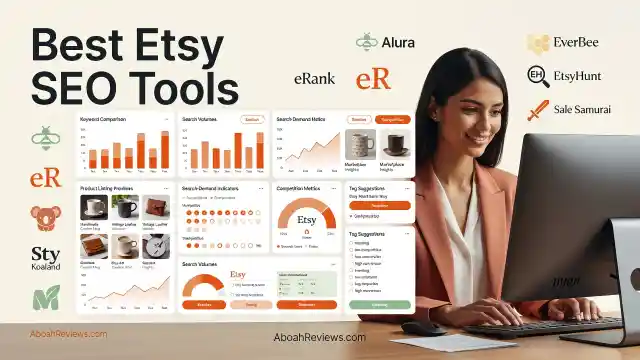
The best Etsy SEO tools help sellers find buyer search terms, audit listings, research competitors and validate demand on Etsy’s marketplace. The right one depends on your budget, experience level and specific research needs, with several top options including:
- Alura – Best all-in-one Etsy SEO tool for established sellers who want keyword research, listing optimization, competitor tracking, and Pinterest marketing in a single dashboard.
- eRank – Best value Etsy SEO tool overall; the most features per dollar with a genuinely useful free plan that makes it the right starting point for most sellers.
- EverBee – Best for product research; the Chrome extension’s sales estimate overlay is the fastest way to validate product ideas and understand competitive demand before creating anything.
- EtsyHunt – Best for competitor research; the lowest-priced paid plan on this list ($3.99/month) combined with strong shop and product database depth makes it the go-to for understanding what competitors are doing.
- Koalanda – Best budget-friendly option for part-time sellers who want simple keyword research without paying for features they’ll never use.
- Sale Samurai – Best for long-tail keyword discovery and the only tool on this list with built-in A/B listing testing at this price point.
- Marmalead – Best for keyword engagement scoring, but hard to recommend over eRank at $19/month with no free plan and mixed user reviews in 2026.
- Etsy Search Analytics – Best for tracking your own shop’s performance; free, built into Etsy and the only tool that shows real conversion data per keyword.
- Etsy Marketplace Insights – Best free keyword research tool for accuracy; uses actual Etsy search data rather than estimates, but limited to 15 searches per week.
Why Etsy SEO Tools Are Important for Etsy Sellers
If you sell on Etsy and your listings aren’t showing up in search, the problem is usually one of three things: the wrong keywords in your titles and tags, weak listing structure or not knowing what buyers are actually searching for.
The good news is that there are Etsy SEO tools built to solve exactly these problems. Etsy runs on search. Every solid Etsy SEO effort starts with keyword research. Without it, you’re guessing what shoppers type and on Etsy, guessing is expensive.
That’s why dedicated Etsy SEO tools exist. They pull keyword data directly from the Etsy platform, show you what competitors are doing, estimate demand for different product types, and help you structure listings in a way that the Etsy algorithm rewards.
What this article covers: The best Etsy SEO tools for keyword research, product research, competitor analysis, listing optimization and shop performance tracking. This guide is for Etsy sellers at every level, from new shops to established sellers scaling to hundreds of listings.
Quick Comparison of the Best Etsy SEO Tools
| Tool | Best For | Free Plan | Standout Feature |
|---|---|---|---|
| Alura | All-in-one Etsy SEO | Yes | AI listing optimization + Pinterest marketing |
| eRank | Keyword research + audits | Yes | Most features per dollar, 2M+ users |
| EverBee | Product research | Yes | Estimated sales and revenue data |
| EtsyHunt | Competitor research | Yes | Largest product and shop analytics database |
| Koalanda | Budget-friendly SEO | Yes | Simple keyword research, affordable pricing |
| Sale Samurai | Keyword discovery | Yes (20/mo) | Real Etsy search volume data |
| Marmalead | Keyword optimization | No | Keyword engagement and trend scoring |
| Etsy Search Analytics | Shop performance tracking | Yes (built-in) | Actual search traffic data for your shop |
| Etsy Marketplace Insights | First-party keyword research | Yes (15/week) | Real Etsy search volume, no estimates |
Pricing note: Figures in this article were verified from vendor pricing pages and third-party sources in late 2026. Always confirm current pricing directly with each tool before purchasing.
1. Alura – Best All-in-One Etsy SEO Tool
Alura covers keyword research, listing optimization, review management, and marketing tools in one platform. Its Growth plan adds Pinterest marketing, A/B listing tests, an Etsy Ads optimizer, and profit tracking.
It’s the most feature-complete option on this list and the right choice for sellers who want to manage their entire Etsy operation from one dashboard.
The standout feature is the AI listing optimizer. It doesn’t just suggest keywords; it rewrites listings and can publish changes directly to your Etsy shop from within the tool.
That’s faster than copy-pasting between tools, though it also means you should review suggestions carefully before applying them.
Key Features
- Keyword Finder with Etsy-specific search volume estimates
- AI listing optimizer with direct publishing to Etsy
- Product research and competitor shop analysis
- Pinterest marketing tool (paid plans)
- Review management and email follow-up sequences
- Etsy Ads optimizer (Growth and Professional plans)
- Profit calculator and revenue tracker
- Chrome extension for research on the Etsy site
Pros
- Covers the most ground of any tool on this list
- AI listing rewrite is genuinely useful for sellers with large catalogs
- Pinterest integration is a real differentiator at the mid-tier price point
- Free plan is permanent, not a countdown trial
Cons
- More expensive at the higher tiers than keyword-only tools
- AI-generated listing copy can sound generic without editing
- Some features feel like they were added to expand the plan tiers rather than solve real problems
Pricing
Alura has four pricing plans: a free plan plus three paid tiers called Basic, Growth, and Professional. On annual billing they cost $7.99, $14.99, and $29.99 a month. Paid month to month, the same plans run $11.99, $29.99, and $69.99.
Alura Free gives 5 searches per tool per day, 10 listings to optimize, limited databases, a profit calculator, and the extension.
Buy If
You want one tool that covers keyword research, listing optimization, competitor tracking, review requests, and Pinterest marketing. Especially good for sellers managing 50+ listings who need to streamline their workflow.
Skip If
You only need keyword research and want to minimize costs. eRank does most of what Alura does for keyword and listing work at a lower price.
You can read the full Alura review on AboahReviews for a deeper look at the tool’s individual features.
2. eRank – Best Etsy SEO Tool for Keyword Research
eRank is the best value Etsy SEO platform of 2026. Paid plans run $5.99 to $29.99 per month, and annual billing trims up to 25% more. The Free plan is real too: 5 keyword lookups and 5 listing audits per day, forever.
eRank claims over 2 million active sellers, making it the most widely used tool in this space. What sets it apart from more expensive options is depth without excessive pricing. The free plan is genuinely usable, not just a teaser.
For sellers who want to understand keyword demand, run listing audits, and track trends without spending a lot each month, eRank is the most practical choice.
One thing I noticed during testing: eRank’s keyword data is presented in buckets rather than precise numbers at some plan levels.
That means you’ll see “High” or a range rather than an exact search volume figure. It’s workable, but sellers who want specific numbers will need to upgrade to Pro or Expert.
Key Features
- Keyword research with search volume, competition level, and trend data
- Listing audit tool that scores your listings and flags optimization gaps
- Rank tracker for monitoring where your listings appear in Etsy search
- Competitor keyword and shop analysis
- Trending keywords and seasonal trend data
- Integrations with Etsy, Amazon, Printify, Shopify, eBay, and Teachers Pay Teachers
- Chrome extension
- AI Listing Helper (paid plans)
Pros
- Best free plan of any third-party tool on this list
- Most features per dollar across the paid tiers
- Huge user base means good community support and tutorials
- Multi-platform support (not just Etsy)
Cons
- Keyword volume shown in buckets on lower plans
- Dashboard can feel cluttered for new users
- Chrome extension has mixed ratings
Pricing
Pricing: Free plan at $0; Basic $5.99, Pro $9.99, Expert $29.99 per month; annual billing saves up to 25%.
eRank’s paid plans allow 100, 200, or 500 keyword lookups a day, plus 50 to 500 listing audits and 10 to 100 AI Listing Helper uses.
Buy If
You want a fully featured Etsy SEO tool at the lowest possible cost. Perfect for sellers on a budget, beginners testing their first listings, and experienced sellers who want depth without paying for tools they won’t use.
Skip If
You need sales estimates or revenue data alongside keyword research. That’s EverBee’s territory, not eRank’s primary strength.
See the full eRank review for a complete feature breakdown.
3. EverBee – Best Etsy Product Research Tool
EverBee is built around a specific problem: figuring out which products are actually selling before you invest time and money creating them.
Where eRank focuses on keyword research and listing audits, EverBee puts product data first.
Its Chrome extension overlays sales estimates and revenue figures directly on Etsy search results pages, which makes competitive research much faster than using a separate web app.
EverBee wins product research. Its 4.7-star extension puts sales and revenue estimates on every Etsy search. The accuracy of those estimates is the ongoing debate in the Etsy seller community.
No third-party tool has access to Etsy’s actual transaction data, so these figures are modeled estimates. They’re useful for comparing products and understanding relative demand, but I would not treat them as exact revenue projections.
Key Features
- Product research with estimated monthly sales and revenue
- Chrome extension that overlays data on Etsy search results
- Competitor shop analytics
- Keyword research with search volume data
- Amazon research as well as Etsy product research
- Email marketing tool for building a customer list (paid plans)
- Trend analysis with historical data (Business plan)
Pros
- Chrome extension is genuinely the best in this category for fast product research
- Sales estimates give a useful signal even if not precise
- Clean, modern interface
- Covers Amazon in addition to Etsy
Cons
- Sales data is estimated, not actual Etsy figures
- eRank is better for listing SEO and keyword research; EverBee excels at product research with sales analytics
- Growth and Business plans are more expensive than eRank’s equivalent tiers
Pricing
EverBee Pricing: Hobby Plan (Free) with limited features; Growth Plan at $29.99/month (or $19.99/month paid yearly); Business Plan at $99/month (or $69/month paid yearly).
EverBee Free includes 50 searches per month total, basic product research, and most features locked.
Buy If
You want to validate product ideas before creating them. EverBee is the right tool when your priority is understanding what’s selling and estimating demand, especially if you’re in the print-on-demand space or launching new product lines.
Skip If
Your main need is keyword research or listing optimization. eRank covers both at a lower price. Many sellers use both: eRank’s free plan for keywords, EverBee for product validation.
Check out the full EverBee review for more detail on how the sales estimates hold up in practice.
4. EtsyHunt – Best for Etsy Competitor Research
EtsyHunt positions itself around the claim of having the largest database of Etsy products of any third-party tool. That makes it particularly strong for competitor research.
You can analyze individual shops, see which products are driving the most traffic, examine the tags and pricing strategies of top sellers in your niche, and track changes over time.
EtsyHunt offers analysis of products, keywords, shops, and listing optimization. It is a broadly covered Etsy data analysis tool.
It’s also one of the most affordable options with a genuinely useful free tier. The Basic plan starts at $3.99/month, which makes it accessible to sellers who are just getting started with SEO research.
Key Features
- Product research with trend and competition data
- Shop analyzer to examine competitor shops in detail
- Keyword research with search volume and competition scoring
- Listing optimizer with AI-generated tag and title suggestions
- Batch keyword analysis for researching multiple terms at once
- Chrome extension
- Photo background editor for listings (bonus feature)
- Shop tracking to monitor specific competitor shops over time
Pros
- One of the most affordable paid plans on this list ($3.99/month)
- Strong competitor shop analysis
- Good database depth for product and niche research
- Free plan is genuinely useful for basic research
Cons
- Interface is less polished than Alura or EverBee
- Some text and borders not properly aligned, and the transitions and connections between features are not as smooth as competing tools
- Less useful for digital product sellers or vintage shops
Pricing
EtsyHunt offers Free, Basic, Pro, Team, and Enterprise pricing plans. EtsyHunt costs from $3.99 to $59.99 month-to-month. Annual plans have excellent discounts.
Buy If
You want the most affordable way to research competitors and products at a paid tier, or you want a tool with a solid free plan to test before committing to a subscription.
Skip If
You mainly need clean keyword data for listing optimization rather than deep competitor intelligence. eRank or Sale Samurai give you better keyword research at similar price points.
See the EtsyHunt review for more on how the competitor tracking features work in practice.
5. Koalanda – Best Budget-Friendly Etsy SEO Tool
Koalanda is a lightweight tool focused on keyword research and listing optimization. It’s not trying to compete with the full feature sets of Alura or EverBee.
Its value is simplicity and low cost. If you’re a part-time Etsy seller who wants keyword data without paying for features you’ll never use, Koalanda is worth considering.
Koalanda is a lightweight Etsy SEO tool focused on keyword research and listing optimization. It helps sellers find high-potential keywords, analyze competition, and improve listing visibility with simple, easy-to-use features.
The free plan lets you test the tool before committing. The paid annual plan is among the cheapest in this category.
Key Features
- Keyword research with competition and search volume data
- Shop analyzer for reviewing your own and competitor shops
- Listing optimization suggestions
- Product trend tracking
- Category analysis to understand what’s performing in a niche
Pros
- Very affordable, especially on annual billing
- Clean interface that’s easy for beginners
- Free plan available to test before subscribing
- Good for regional keyword research
Cons
- Koalanda only supports Etsy, no growth beyond Etsy to Amazon, POD, or KDP
- Basic keyword and market research only, missing advanced AI optimization tools
- Less data depth than eRank or EtsyHunt at a similar price point
- Email support only, no live chat
Pricing
Koalanda Yearly: $5.99/month ($71.88/year). Koalanda Monthly: $11.99/month ($143.88/year). Free plan with limited features also available.
Buy If
You’re a part-time Etsy seller who wants simple keyword research without overpaying for a tool with features you won’t use. Koalanda is a reasonable starting point before scaling up to eRank or Alura.
Skip If
You need sales estimates, advanced competitor tracking, or multi-platform research. The more established tools give you significantly more data depth for a comparable price.
6. Sale Samurai – Best Etsy Keyword Research Tool for Product Sellers
Sale Samurai focuses on keyword discovery and search volume data. Its strength is surfacing long-tail keyword phrases that have real search volume on Etsy but face lower competition than broad terms.
If your strategy involves launching products into niches where you can rank quickly, Sale Samurai’s keyword data is worth looking at.
The tool delivers keyword research through both a web app and a Chrome extension. Sale Samurai is the only tool on this list with built-in A/B listing testing. That’s a genuinely useful feature for sellers who want to test different titles or descriptions and see which version drives more clicks.
Key Features
- Keyword research with search volume, competition, and tag suggestions
- Long-tail keyword discovery
- Chrome extension for research on the Etsy site
- A/B listing testing
- Competitor tag research
- Shop analytics
Pros
- Strong long-tail keyword data
- A/B listing testing is unique in this price range
- Freemium tier includes 20 keyword searches per month
- Straightforward pricing with one main paid plan
Cons
- Focus is keyword discovery, so sellers who need sales estimates or listing audit depth will find other tools more useful
- 3-day free trial is short for evaluating the full feature set
- No built-in listing optimizer or AI writing features
Pricing
Plans cost $19.99 monthly or $16.65 per month billed yearly. The freemium tier includes 20 keyword searches per month. A 3-day trial requires no credit card to start.
Confirm current pricing at the Sale Samurai website before purchasing.
Buy If
You want clean, search-volume-focused keyword research and the A/B testing feature is appealing. Good for sellers launching frequently and iterating on listing copy.
Skip If
You need a full-stack tool with product research, listing audits, and competitor analysis. eRank covers more ground at a lower starting price.
Read the full Sale Samurai review for more detail on keyword accuracy.
7. Marmalead – Best for Etsy Keyword Optimization
Marmalead has been in the Etsy SEO space since 2015 and remains one of the most recognized tools for keyword analysis.
Its focus is narrower than Alura or EverBee: it’s built specifically around keyword research and optimization, with features designed to help sellers understand not just search volume but keyword engagement, competition, and trend direction.
Marmalead has been an Etsy SEO staple since 2015. While it hasn’t shipped major new features in recent years, its core keyword research experience remains one of the most intuitive in the space.
The honest note: Marmalead’s Trustpilot ratings have been poor in recent years. Marmalead has a 2.1 Trustpilot score, which is worth noting given larger sample sizes from competitors.
I mention this not to dismiss the tool, but because user experience signals matter when you’re choosing software you’ll use regularly. Test it before committing.
Key Features
- Keyword search with search volume, engagement score, and competition level
- Storm brainstorming tool for generating keyword variations
- Trending keywords with historical pattern data
- Listing grader
- Multi-shop support for sellers managing more than one Etsy store
Pros
- Keyword engagement scoring is a useful differentiator
- Storm brainstorming tool generates creative keyword variations
- Multi-shop support on higher plans
- Interface is clean and focused
Cons
- No free plan. Marmalead pricing: $19/month, no free plan, verified 2026-08-15.
- More expensive than eRank for less breadth
- Poor recent user reviews compared to alternatives
- Feature set hasn’t expanded significantly in several years
Pricing
Marmalead pricing: $19/month monthly, $16/month annual, $300 lifetime option.
Buy If
You’re a serious keyword researcher who wants engagement data and trend scoring alongside search volume, and you don’t need product research or listing automation in the same tool. Marmalead’s keyword depth is legitimate for sellers who use it correctly.
Skip If
You’re price-sensitive or just starting out. eRank gives you comparable keyword data with a free plan and much better user reviews. Marmalead is harder to justify at $19/month with no free tier when eRank starts at $0.
You can find a detailed Marmalead review on AboahReviews.
8. Etsy Search Analytics – Best for Tracking Your Shop’s Search Performance
Etsy Search Analytics is built directly into the Etsy seller dashboard and is free for every seller with an active shop.
It shows you the actual search terms buyers used to find your listings, along with impressions, clicks, conversion rates per keyword, and traffic source breakdowns.
This is different from every other tool on this list. The other tools give you estimated or modeled data about how the broader Etsy marketplace behaves. Etsy Search Analytics shows you the exact keywords shoppers used to find your listings in Etsy’s search. That’s first-party data about your own shop, not an estimate.
One of the most valuable features in Etsy analytics is buried: the Search Terms report. To find it, go to Stats then Search Analytics. This shows you the exact keywords shoppers used to find your listings.
Key Features
- Exact search terms driving traffic to your listings
- Impressions, clicks, and conversion rates per keyword
- Traffic source breakdown (Etsy search, Etsy app, direct, etc.)
- Filter data by date range (up to 12 months)
- Filtered search traffic data (buyers using sidebar filters)
- No third-party account required
Pros
- Completely free with any Etsy seller account
- Shows actual buyer behavior, not estimates
- Conversion data per keyword is extremely valuable for optimizing titles and tags
- No accuracy limitations. This is real Etsy data
Cons
- Only shows data for your own shop, not competitor or market-wide keyword data
- Historical data limited to approximately 12 months
- No keyword suggestion or brainstorming features
- Can’t be used for new product research before you have live listings
Pricing
Free for all Etsy sellers. No subscription required.
Buy If
You have an active Etsy shop. There is no reason not to use this. It’s free and it shows real search data that no third-party tool can replicate.
Skip If
You’re looking for new keyword ideas or market research before launching. For that, you need a tool like eRank or EtsyHunt.
9. Etsy Marketplace Insights – Best Free Etsy Keyword Research Tool
Etsy Marketplace Insights is a keyword research tool built directly into the Etsy seller dashboard. Unlike Search Analytics, which shows what buyers searched to find your shop specifically, Marketplace Insights shows search volume data for any keyword across the entire Etsy platform.
Etsy Marketplace Insights is Etsy’s own keyword tool for sellers, and it’s free. The data comes directly from Etsy’s internal systems, which means it’s not estimated or modeled the way third-party tools’ data is.
If you’ve used third-party SEO and keyword research tools like eRank and Marmalead before, the interface of Marketplace Insights will look familiar. But there is a critical difference in the quality of the information. Third-party tools are estimating what Etsy’s search volumes probably look like. Marketplace Insights shows what they actually are.
The limitation is search volume: the results of your 15 free searches remain available to you for 7 days from the time you originally searched that keyword. That’s a relatively tight limit for sellers doing serious keyword research.
Key Features
- Real Etsy search volume data (not estimates)
- Keyword demand trends
- Competition level data
- Accessible directly from Etsy Shop Manager
- No third-party account or subscription required
Pros
- Uses actual Etsy data, more reliable than third-party estimates
- Free with any Etsy seller account
- No setup required
Cons
- Limited to 15 free keyword searches per week
- Less comprehensive than paid third-party tools for research at scale
- No competitor shop analysis, listing audits, or rank tracking
- Interface is simpler than dedicated tools
Pricing
Free for all Etsy sellers. No subscription required.
Buy If
You want the most accurate keyword data available for occasional research. Good for validating keyword ideas before you commit to creating a product or rewriting a listing.
Skip If
You’re doing large-scale keyword research or need competitor analysis alongside volume data. At 15 searches per week, you’ll hit the ceiling quickly if you’re actively launching or optimizing a large catalog.
How to Choose the Best Etsy SEO Tool
Consider Your Etsy SEO Goals
The right tool depends on what problem you’re trying to solve.
- Keyword research: eRank, Sale Samurai, or Marmalead. eRank is the best starting point for most sellers because of its combination of free tier depth and low paid plan pricing.
- Product research: EverBee or EtsyHunt. If validating product ideas is your primary need, EverBee’s sales estimate overlay makes competitive research faster than any other tool.
- Competitor analysis: EtsyHunt or Alura. EtsyHunt’s database depth is strong for competitor shop analysis. Alura covers this alongside keyword research and listing optimization.
- Listing optimization: Alura, eRank, or Marmalead. Alura’s AI rewrite is the fastest way to bulk-optimize listings. eRank’s listing audit is the most practical tool for identifying specific gaps. Marmalead’s engagement scoring helps prioritize which keywords are worth pursuing.
- Shop performance tracking: Use Etsy Search Analytics and Etsy Marketplace Insights. Both are free and provide first-party data that third-party tools can’t replicate.
Compare Free and Paid Features
Most tools on this list offer a free plan or free trial. I would not pay for any Etsy SEO tool without testing the free version first.
The free tiers with the most practical value:
- eRank free: 5 keyword lookups and 5 listing audits per day, forever
- EtsyHunt free: basic product and keyword research
- Alura free: 5 searches per tool per day
- Etsy Marketplace Insights: 15 searches per week (actual Etsy data)
- Etsy Search Analytics: unlimited access to your own shop’s search data
Evaluate Keyword Data Accuracy
No third-party Etsy SEO tool has access to Etsy’s actual search volume data. All of them are modeling or estimating it. That’s worth understanding when you use their numbers.
The most accurate keyword data available to Etsy sellers is from Etsy’s own tools: Marketplace Insights for general keyword volumes and Search Analytics for your own listing performance.
Third-party tools are useful for research at scale, brainstorming, and competitive analysis, but treat their search volume figures as directional signals, not precise measurements.
This is the same limitation that applies to all marketplace SEO tools. It’s not a reason to avoid them, but it is a reason to verify keyword decisions against your actual shop data once you have traffic.
Consider Ease of Use and Integration
eRank, Alura, and EverBee all offer Chrome extensions that overlay data on the Etsy website.
This is a significant usability advantage over web-app-only tools, because you can research competitors and validate keywords without switching between browser tabs.
If you’re new to Etsy SEO, start with eRank’s free plan. The interface can feel busy, but the underlying help documentation is extensive, and the user community is large enough that most questions have already been answered somewhere.
Check Pricing and Subscription Limits
| Tool | Free Plan | Paid Starting Price | Annual Discount |
|---|---|---|---|
| eRank | Yes (5 lookups/day) | $5.99/month | Yes (up to 25%) |
| EtsyHunt | Yes | $3.99/month | Yes |
| Koalanda | Yes | $5.99/month (annual) | Yes |
| Sale Samurai | Yes (20 searches/month) | $9.99/month | Yes |
| Alura | Yes (5 searches/tool/day) | $7.99/month (annual) | Yes |
| Marmalead | No | $19/month | Yes ($16/month annual) |
| EverBee | Yes (50 searches/month) | $29.99/month | Yes |
| Etsy Search Analytics | Free (included with Etsy) | N/A | N/A |
| Etsy Marketplace Insights | 15 searches/week | N/A | N/A |
How to Use Etsy SEO Tools to Improve Your Listings
Step 1: Research Relevant Etsy Keywords
Start by identifying what buyers in your product category are actually searching for. Use eRank, Koalanda, or Etsy Marketplace Insights to look up 10 to 20 keywords related to your product.
For each keyword, look at three things: estimated search volume (how many people are searching for it), competition level (how many listings are competing for that term), and relevance (does this phrase accurately describe your product?).
Don’t just target high-volume terms. A keyword with 50,000 monthly searches and 200,000 competing listings is harder to rank for than a more specific term with 5,000 monthly searches and 20,000 competitors.
Step 2: Find Low-Competition, High-Demand Keywords
The most valuable keywords for a new or growing Etsy shop are specific phrases with meaningful demand and manageable competition. Tools like eRank show you a competition score alongside search volume to help identify these.
Look for long-tail phrases of three or more words. “Personalized graduation gift for her” is easier to rank for than “gift” or “graduation gift,” and buyers using that phrase usually have higher purchase intent.
Step 3: Optimize Your Etsy Product Titles
Your title is one of the most important ranking signals on Etsy.
A well-structured title includes a clean front shot: “Rustic Wooden Serving Tray, Handmade Farmhouse Kitchen Decor, Personalized Gift for Mom.” Lead with your primary keyword, then add descriptive modifiers, then include secondary keywords.
Titles can be up to 140 characters. Use the full length. Each phrase you include is an additional opportunity to match a buyer’s search query.
Step 4: Improve Your 13 Etsy Listing Tags
Use all 13 tags and avoid repeating words that are already in your title, as Etsy’s search engine automatically combines words from both fields to find matches.
Use multi-word tags. Instead of using “silver” and “necklace” as two separate tags, use “silver necklace” as one. This frees up space for more descriptive phrases.
In 2026, broad tags like “gift” or “handmade” are virtually useless because they are too competitive. Instead, use specific phrases like “personalized nurse graduation gift” or “sustainable vegan leather wallet.”
Step 5: Optimize Product Descriptions and Attributes
The first 160 characters of your description are the most important for both SEO and buyer engagement. Include your primary keyword naturally in the opening paragraph.
Fill out every listing attribute Etsy provides for your product category. Attributes feed into Etsy’s filtered search, which means buyers using sidebar filters to narrow results won’t find your listing if the attribute is blank.
Step 6: Analyze Competitor Listings
Use EtsyHunt, EverBee, or Alura to look at the top-performing listings in your category. Note which keywords appear in their titles, what their tag structure looks like, how they price products, and how many listings they carry.
The goal here is not to copy. It’s to understand what’s working in your niche and find gaps that you can fill with your own listings.
Step 7: Monitor Search Performance and Update Listings
Once your listings are live, use Etsy Search Analytics to track which search terms are driving traffic and which are converting to sales. This is where the first-party data becomes especially valuable.
Keywords that drive impressions but no clicks need better photos or titles. Keywords that drive clicks but no sales suggest a pricing or product presentation issue. Update your lowest-performing listings every 60 to 90 days based on what the data shows.
Are Paid Etsy SEO Tools Worth It?
Paid Etsy SEO tools are worth it for sellers who are actively launching new products, managing more than a dozen listings or trying to understand what’s working in a competitive niche.
For most established Etsy sellers, the data depth in paid plans saves more time than the subscription costs.
That said, the free options available in 2026 are significantly better than they were a few years ago. eRank’s free plan, Etsy Search Analytics, and Etsy Marketplace Insights together give most sellers everything they need to start improving their listings without spending anything.
When free tools are sufficient: You have fewer than 20 listings, you’re validating a product idea before investing in a full launch, or you’re new to Etsy SEO and want to learn the basics before paying for advanced features.
When upgrading makes sense: You’re managing 50+ listings and need bulk auditing, you’re launching new products regularly and need deeper keyword research, you want sales estimates to validate product decisions before creating inventory, or you’re managing multiple Etsy shops.
One limitation to be clear about: no paid tool on this list can guarantee your listings will rank. Etsy’s algorithm considers listing quality, conversion rate, recency, review count, shipping speed, and customer service history alongside keywords.
Tools help with the keyword and optimization side. The rest depends on your product and business.
Free vs. Paid Etsy SEO Tools: What’s the Difference?
| Feature | Free Tools | Paid Tools |
|---|---|---|
| Keyword search limits | 5–20 searches/day or week | 100–500 searches/day |
| Historical keyword data | Limited or none | Available (varies by tool) |
| Competitor tracking | Basic or none | Full shop and product tracking |
| Listing audits | Limited | Full audits with recommendations |
| Product research | None | Sales estimates, revenue data |
| Sales estimates | No | Yes (EverBee, EtsyHunt) |
| Advanced analytics | No | Yes |
| AI listing optimization | No | Yes (Alura, eRank Expert) |
| A/B testing | No | Sale Samurai (paid plan) |
The practical difference comes down to scale and depth. Free tools are enough for occasional research and monitoring. Paid plans are worth it once you’re actively launching, optimizing, and tracking at scale.
Final Verdict: Which Etsy SEO Tool Should You Choose?
Here’s the summary across all nine tools, matched to the type of seller most likely to benefit from each one.
- Best for beginners: eRank. The free plan is the most useful of any third-party tool on this list, the documentation is thorough, and the paid plans are the most affordable in this category. Start here before trying anything else.
- Best all-in-one tool for established sellers: Alura. If you’ve grown past 50 listings and want keyword research, listing optimization, competitor tracking, and marketing tools in one place, Alura’s Growth plan at $14.99/month (annual billing) covers the most ground.
- Best for product research: EverBee. The Chrome extension’s sales estimate overlay is the fastest way to validate product ideas and understand competitive demand. Use it alongside eRank for keyword research.
- Best for competitor analysis: EtsyHunt. The lowest paid plan in this list ($3.99/month) combined with strong competitor shop tracking makes EtsyHunt a good choice for sellers who want to understand what competitors are doing.
- Best free options: Use all three. Etsy Search Analytics for your own shop data, Etsy Marketplace Insights for keyword validation, and eRank’s free plan for research at scale.
- Best for keyword optimization specifically: Marmalead’s engagement scoring is a legitimate differentiator if keyword research is your primary focus, but the lack of a free plan and mixed user reviews make it hard to recommend over eRank unless you’ve specifically tested both and prefer Marmalead’s interface.
The honest answer for most sellers is that you don’t need one perfect tool. You need to understand what problem you’re trying to solve. For keyword research, eRank. For product validation, EverBee. For your own shop’s performance data, Etsy’s native tools. Combining two or three of these covers everything an active Etsy seller needs.
The best Etsy SEO tools are the ones you’ll actually use consistently. Start with the free tiers, run them against your real listings, and upgrade to paid plans only once you’ve confirmed they’re saving you meaningful time or generating insights you can act on.
Frequently Asked Questions About The Best Etsy SEO Tools
What is the best Etsy SEO tool for beginners?
eRank is the best starting point for most beginners. Its free plan gives you 5 keyword lookups and 5 listing audits per day at no cost, forever. The interface takes some getting used to, but the documentation is extensive and the user community is large. You can do real keyword research and listing optimization without spending anything.
Which SEO tool is best for Etsy?
eRank is the best starting point for most Etsy sellers due to its usable free plan, low paid tiers from $5.99/month, solid keyword research, listing audits, and competitor tracking. EverBee suits product/sales validation better, while Marmalead or Alura fit deeper keyword scoring or all-in-one needs. Always pair any tool with free Etsy Marketplace Insights and review recommendations manually.
Can I make $10,000 a month on Etsy?
Yes, some full-time sellers in the top few percent reach $10,000+ in monthly sales (or higher), especially with digital products, strong niches, large catalogs, and consistent optimization. However, the average active seller generates roughly $157 in gross merchandise sales per month based on recent Etsy filings, and most shops earn far less after fees, materials, and time. Success requires treating it as a real business with validated demand rather than a side hustle.
Does SEO work on Etsy?
Yes, Etsy SEO works by improving listing relevance through optimized titles, tags, attributes, descriptions, and photos so the platform’s search algorithm can match your items to buyer queries. It drives visibility and traffic when combined with quality signals like click-through rates, conversions, and shop performance, but it does not guarantee sales on its own. Results depend on competition, listing quality, and ongoing buyer behavior data.
Can ChatGPT help with Etsy SEO?
Yes, ChatGPT can draft titles, descriptions, tag ideas, and shop policies or brainstorm buyer personas quickly. It lacks real-time Etsy search volume, competition data, or algorithm insights, so suggestions are often generic or overly competitive and need heavy editing plus validation from specialized tools like eRank or Marketplace Insights. Use it as a writing aid, never as a complete SEO solution.
Is Etsy still worth it in 2026?
Yes for sellers with a validated niche, strong photography, solid margins (after ~10-15%+ fees), and disciplined SEO, as it still provides built-in buyer traffic that is hard to replicate elsewhere. Competition has tightened, Offsite Ads and other fees pressure margins, and AI listings created frustration (prompting recent Etsy crackdowns), yet GMS and buyer numbers have shown recent growth for well-run shops. It works best as one channel alongside your own store once you scale.
How long does it take for Etsy SEO to work?
Listing updates usually index within 24-48 hours, with early visibility signals in 1-2 weeks. Meaningful ranking, traffic, and sales improvements typically take 30-90 days as Etsy gathers click, favorite, and conversion data. Highly competitive niches or new shops can take 3-6 months; low-competition long-tail keywords and consistent shop activity speed things up.
Why are so many people leaving Etsy?
Sellers cite rising competition from mass-produced and AI-generated listings that undercut handmade work on price and search rankings, combined with fees (listing, transaction, processing, and mandatory Offsite Ads for many), policy frustrations, and declining sales for undifferentiated shops. Active seller numbers dropped in prior years partly from setup fees weeding out dormant accounts, though Etsy has since tightened AI rules and seen some buyer recovery. Many shift to their own sites or alternatives for better control and margins.
How to get noticed on Etsy?
Optimize titles (front-load main keywords), use all 13 tags with researched buyer phrases, complete attributes/categories, and add high-quality unedited photos of the actual item. Use tools like eRank or Marketplace Insights for keyword and competitor data, keep listings active with fresh updates, price competitively after fees, and focus on conversion factors such as shipping, reviews, and customer service. Consistency and testing beat one-time changes.

- 7 Top Etsy SEO Tools I Tested in 2026 (Honest Verdict) - November 12, 2026
- 9 Best Etsy SEO Tools I Personally Tested in 2026 - November 12, 2026
- Koalanda Review 2026: I Tested This Etsy SEO Tool’s Free and Paid Plans - November 11, 2026