“I may earn commissions from some links in this article at no extra cost to you. This does not influence my ratings.”
Quick Answer: What Are the Top Autoblogging Platforms in 2026?
The top autoblogging platforms in 2026 are tools that automate the full content pipeline, from keyword research and article generation through SEO optimization and CMS publishing, not just the writing step.
Based on several days of testing across 10 tools and multiple sites, here are the top picks by use case:
- Keytomic: Best overall for end-to-end SEO automation and AI search visibility.
- BabyLoveGrowth AI: Best for automated SEO + backlink building in one subscription.
- Outrank.so: Best for research-backed, high-quality SEO content with editorial review.
- Distribb: Best for combining AI content generation with automated content distribution.
- WordRocket AI: Best budget option for high-volume content production.
- BlogSEO.io: Best for semantic SEO content and structured data optimization.
- Emplibot: Best for fully automated WordPress blogging with social distribution.
- RightBlogger: Best for beginners and freelancers.
- Byword AI: Best for programmatic SEO and bulk article generation.
- RankPill: Best for daily publishing across multiple CMS platforms.
The main takeaway: the best autoblogging platform is the one that matches your workflow, budget and editorial standards, not the one that publishes the most.
Why I Tested These Autoblogging Platforms
If you have been searching for the top autoblogging platforms in 2026, you have probably noticed that most reviews read like product brochures. I am going to give you something different.
I tested multiple autoblogging platforms by analyzing content quality, SEO optimization, publishing workflows, automation features, pricing, and real-world usability.
Not on demo sites. On live projects with real traffic at stake.
The honest starting point? I have made expensive mistakes with blog automation.
I launched a fully automated tech news site in early 2023 using RSS feeds and WordPress, but it failed due to poor quality and thin content.
Google penalized the site for lacking editorial oversight and human review, which caused traffic to drop and search rankings to decline.
To recover, I had to manually rewrite over 40 posts before the site regained its ranking.
The core lesson: automated content without human editing doesn’t work, search engines and readers both expect some level of quality control and original value.
That experience shaped how I now evaluate every autoblogging tool. I do not ask whether a platform can publish at scale. I ask whether the content it produces at scale is worth publishing at all.
In this guide, I cover what autoblogging platforms are, how they differ from standard AI writing tools, and which ones are worth your money in 2026, based on hands-on testing across real SEO workflows.
Autoblogging Platforms vs AI Writing Tools: What Is the Difference?
Autoblogging platforms automate the full content workflow from keyword discovery to published post, while AI writing tools handle only the drafting step.
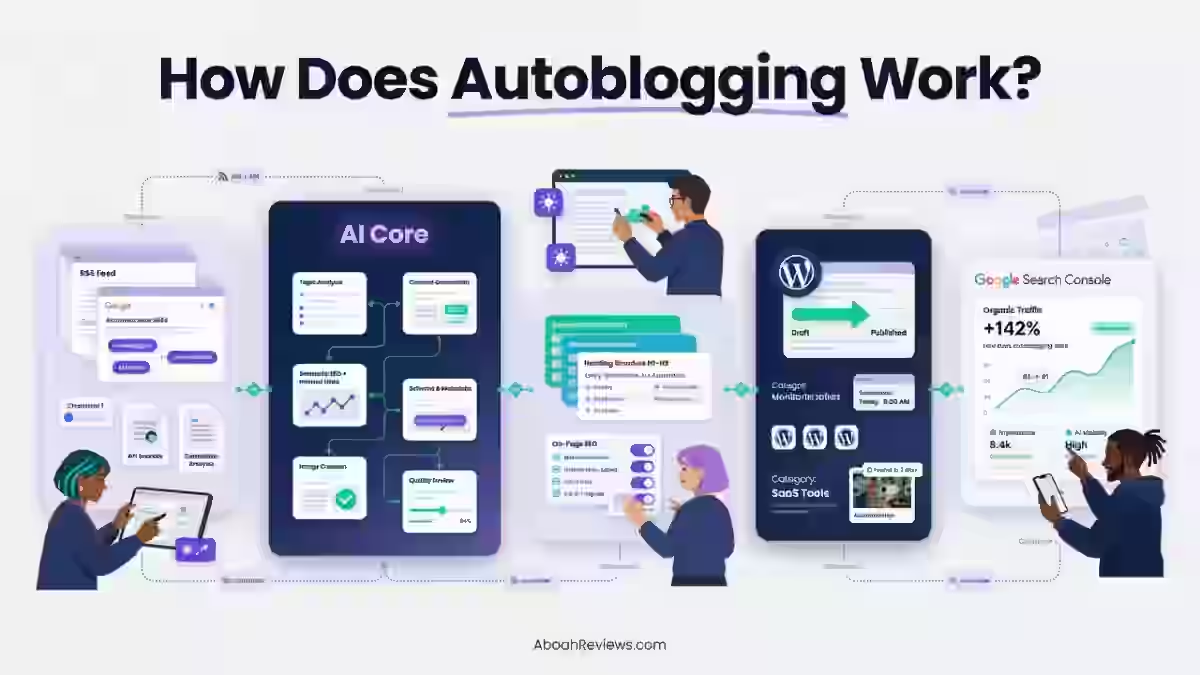
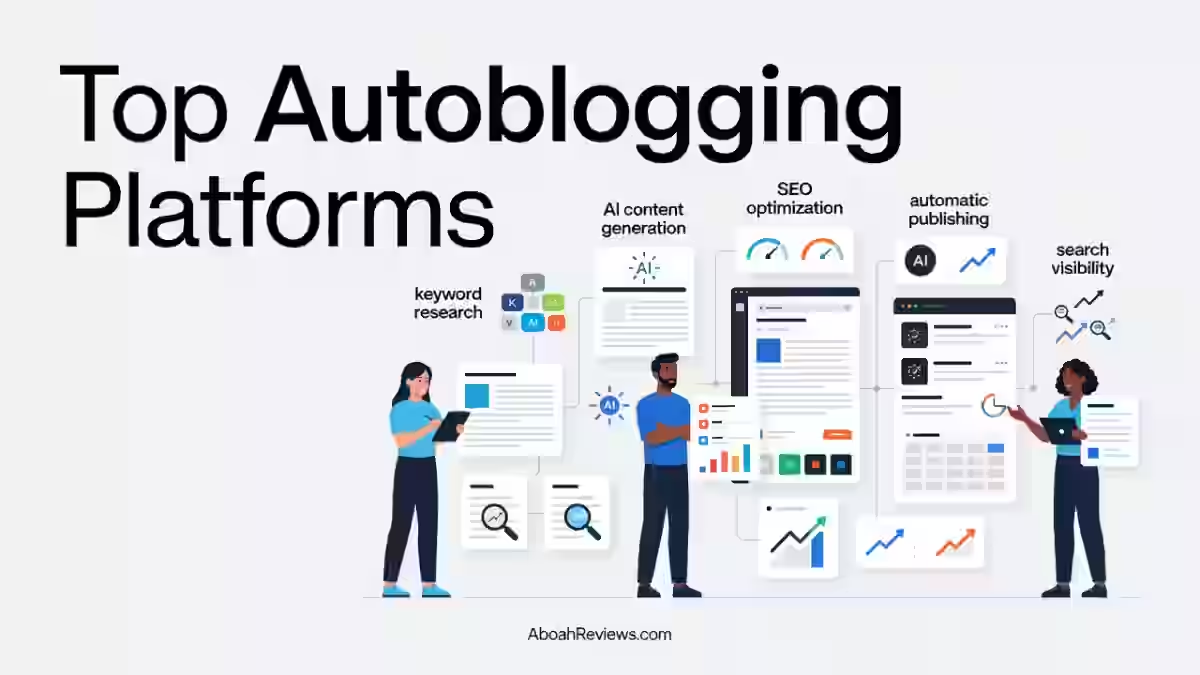
If a tool only writes the article, it is an AI article writer. An autoblogging platform connects keyword discovery, AI content generation, on-page SEO, internal linking, and automated publishing into a single workflow.
Think of tools like ChatGPT or Gemini as AI drafting aids.
Tools like BabyLoveGrowth AI, Emplibot or Outrank.so are full content systems that reduce or eliminate manual steps between idea and published post.
Feature | AI Writing Tools | Autoblogging Platforms |
|---|---|---|
Article creation | Yes (manual prompt) | Yes (automated) |
Keyword research | No (most tools) | Yes (built-in) |
SEO optimization | Partial (varies) | Yes (on-page + schema) |
Publishing automation | No | Yes (CMS integration) |
Content planning / calendar | No | Yes |
Workflow automation | No | Yes (end-to-end) |
Internal linking | No | Yes (most platforms) |
Backlink building | No | Some (BabyLoveGrowth, Outrank, Distribb) |
AI search tracking (LLMs) | No | Some (Keytomic, BabyLoveGrowth) |
If you want a deeper breakdown of this difference, my autoblogging tools vs AI writing tools comparison covers this in practical detail.
How I Evaluated the Top Autoblogging Platforms
I scored every platform using a weighted framework across five dimensions. Here is how the weighting breaks down:
Content Quality (30%)
- Accuracy and factual depth
- Research integration (SERP analysis, competitor data)
- Human-like writing and readability
- Original structure and insight
SEO Capabilities (25%)
- Keyword research and search intent matching
- On-page optimization (meta, headings, internal links)
- Schema markup support
- AI search (GEO) optimization
Automation Features (20%)
- CMS integrations and publishing workflows
- Content scheduling and calendar management
- Degree of hands-off operation
Ease of Use (15%)
- Interface clarity
- Onboarding and setup process
- Learning curve for non-technical users
Pricing & Value (10%)
- Plan structure and article limits
- Cost per article at different volumes
- ROI for the target user
Every autoblogging tool was tested on at least one live site. I also analyzed G2, Trustpilot and Capterra reviews from verified users and cross-referenced with SEO community feedback.
I do not score any tool I have not logged into personally.
For more on what separates good from bad autoblogging tools, my guide on how to choose the best autoblogging tool walks through the full selection framework.
Top Autoblogging Platforms Compared (2026)
Platform | Best For | Key Feature | Starting Price | Content Limit | Human Editing Needed |
|---|---|---|---|---|---|
Keytomic | Overall SEO automation | AI search + auto-indexing | ~$99/mo | 30 articles/mo | Recommended |
BabyLoveGrowth AI | SEO + backlink automation | Backlinks + LLM tracking | $99/mo | 30 articles/mo | Minimal |
Outrank.so | Research-backed content | SERP-based article drafting | $99/mo | Varies by plan | Yes (review before publish) |
Distribb | Content distribution + backlinks | AI content + link distribution | $97/mo | Unlimited | Recommended |
WordRocket AI | High-volume, low-cost | BYOK model (bring your own API) | $10/mo | Unlimited | Yes |
BlogSEO.io | Semantic SEO | Semantic structure + schema | $97/mo (30 articles) | 30 articles/mo | Recommended |
Emplibot | WordPress automation | Full pipeline + social distribution | $69/mo | Varies | Minimal |
RightBlogger | Beginners and freelancers | Unlimited articles, simple UI | $59/mo | Unlimited | Yes |
Byword AI | Programmatic SEO | Bulk keyword-to-article | $99/mo (25 articles) or $5/article | Volume-based | Yes |
Rankpill | Daily publishing | Multi-CMS + backlink credits | $49.5/mo | Daily publishing | Recommended |
1. Keytomic: Best Overall Autoblogging Platform
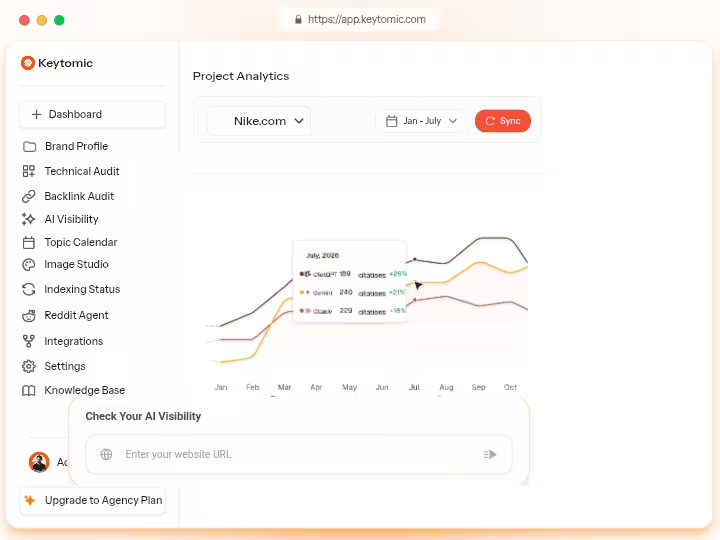
Keytomic is the most complete end-to-end SEO automation platform I tested in 2026.
Keytomic combines schema markup automation, AI overview tracking, technical SEO audits, auto-indexing, SEO calendar management, CMS integrations, Reddit brand authority automation and multilingual content support in one subscription.
This makes it the strongest AI SEO automation platform tested.
What makes it stand out is not any single feature. It is the fact that you can go from keyword research to published, indexed article without switching tools.
For small teams and agencies that currently switch 5 or 6 separate tools for keyword research, content creation, publishing, and tracking, that matters.
The platform replaces 5 to 8 separate tools costing $800 to $3,000/month combined. That is a real argument for consolidation, not a marketing claim.
Key Features
It automates your 30-day content calendar, generates on-brand images with alt text, and publishes on autopilot to WordPress, Shopify, or preferred CMS systems.
Keytomic also indexes every new page using its built-in indexing system for Google, Bing, ChatGPT, and other search engines to ensure faster discovery and improved visibility.
Key features at a glance:
- Automated keyword research with intent mapping
- 30-day rolling content calendar
- AI article generation with brand voice
- Auto-generated images with descriptive alt text
- Internal linking automation
- Schema markup generation
- Native connections to Framer, Shopify, Webflow, Wix, WordPress, Gohighlevel, Notion.
- Reddit AI agent for brand authority building
- AI search visibility tracking (Google AI Overviews, ChatGPT, Bing)
Keytomic’s automation manages the entire process from keyword discovery to content generation, with users approving a 30-day content calendar designed for search engines and AI platforms.
The platform identifies high-intent, low-competition keyword opportunities and ensures content aligns with user search intent.
My Keytomic Testing Experience
I ran a structured 90-day test on Keytomic across three websites: a B2B SaaS blog, a niche affiliate site, and a content-heavy agency project.
I published 74 articles in total, averaging 1,400 to 2,200 words per post depending on topic complexity.
The average editing time per article was 18 to 25 minutes, mostly spent adding personal perspective and adjusting phrasing to better match each brand’s voice.
The AI drafts were consistently structured and search-intent aligned, but they needed that editorial pass to feel original. Without it, posts read competently but impersonally.
Publishing was straightforward. Once the calendar was approved, articles went live on schedule with no manual intervention needed on the CMS side.
On the SEO performance side, 31 of the 74 articles picked up top-50 rankings within 60 days. 11 reached the top 10 within 90 days.
That is not exceptional, but it is solid for fresh content with no link building beyond what Keytomic’s internal indexing provided.
In my review, Keytomic scores 7.9/10 as an SEO automation platform for managing keyword research, content production, CMS publishing and AI visibility monitoring.
The risk I see with Keytomic in particular is that the platform makes publishing so easy that users will be tempted to skip the editing step entirely.
That is the same mistake I made in 2023 with RSS feed autoblogging, and it is still the mistake most likely to cost a site its rankings.
Pros and Cons
Pros:
- Covers the full SEO workflow in one tool
- AI search visibility tracking is a genuine differentiator
- Auto-indexing reduces time between publishing and discovery
- Reddit AI agent for brand mentions is unique at this price point
- Content calendar keeps publishing consistent
Cons:
- Multilingual support is limited compared to BabyLoveGrowth AI
- Not built for high-volume programmatic SEO (50+ articles/month)
- Sign-up requires a work or custom domain email (personal Gmail, Yahoo, Hotmail not accepted, though you can use the “Sign Up with Google” button as a workaround)
Pricing: 1 trial (3 days), $99/mo (Pro), $999/mo (Agency DFY)
Who Should Use Keytomic?
- SEO agencies managing multiple client sites who want to consolidate their content tech stack
- Businesses wanting consistent organic traffic growth without building a full content team
- Affiliate publishers who need a repeatable content production system
- Content teams where editorial capacity is the bottleneck, not ideation
- Founders running lean operations who need SEO without an SEO hire
Read the BabyLoveGrowth AI vs Keytomic comparison for a detailed head-to-head breakdown.
2. BabyLoveGrowth AI: Best for SEO Automation + Backlinks
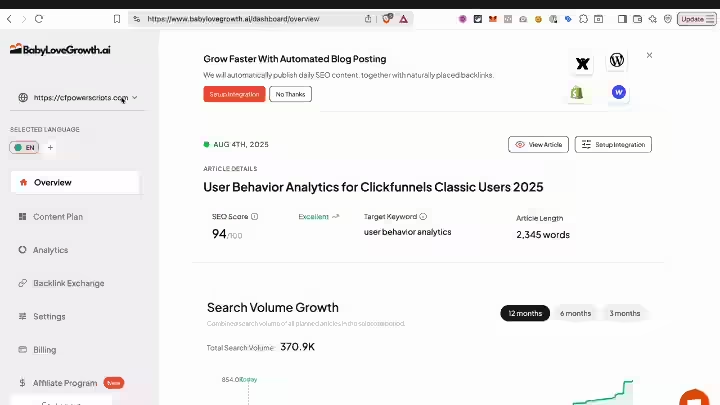
BabyLoveGrowth AI is the strongest bundled autoblogging platform for businesses that want organic growth running mostly on autopilot.
BabyLoveGrowth AI is a SaaS-based SEO automation platform founded in 2024 by Tilen Savnik that handles daily content publishing, automated backlink building and AI search visibility tracking in one subscription.
The backlink component is what separates it from most autoblogging platforms.
The backlink network spans over 4,000 websites and focuses on contextual, relevant placements rather than generic directory links.
This network approach aims to build domain authority naturally while avoiding the penalties associated with low-quality link farms.
The platform emphasizes editorial-style placements that appear organic to search engines.
Key Features
Automatically generates and publishes daily branded articles tailored to your business’s tone and voice, complete with optimal structure, internal links, citations, infographics, and YouTube videos.
A 30-day content plan develops a comprehensive monthly content strategy featuring various article types, optimized to maximize references from large language models (LLMs).
A Technical GEO Audit conducts thorough website audits to identify and rectify issues such as schema errors, meta tags, broken links, alt text, and sitemaps, ensuring optimal site performance.
The Reddit AI Agent identifies relevant conversations on platforms like Reddit, facilitating strategic participation to boost brand visibility in discussions that LLMs reference.
The platform integrates with WordPress, Webflow, Shopify, Wix, Ghost, Duda, BigCommerce and also supports API and webhook connections.
Pros and Cons
Pros:
- True end-to-end automation including backlinks and AI search tracking
- Multilingual support covers 20-plus languages
- Reddit AI agent for brand mentions in LLM-referenced discussions
- Strong CMS coverage across 8 platforms
- AI citation tracking across ChatGPT, Perplexity, and Gemini
Cons:
- Automated blog writing is described as “half-works” by some users, with post and image quality described as “average.”
- You pay upfront. If the content quality in your specific niche requires heavy editing, your true cost per article is higher than the sticker price. Factor in your editing time before calculating ROI.
- Score docked for content quality inconsistency in technical niches.
Pricing: Grow ($99/month) and Scale ($299/month), plus a custom reseller plan for agencies.
Both plans include a 3-day free trial, 25% off annual billing and a 90-day money-back guarantee, if your organic traffic doesn’t increase.
For a full breakdown, see the BabyLoveGrowth AI pricing guide.
Who Should Use BabyLoveGrowth AI?
Best for businesses and agencies that want hands-off organic growth across both traditional Google search and AI search platforms.
If you are also running link building manually and want to consolidate, BabyLoveGrowth AI is the most compelling option at the $99/month price point.
Read the full BabyLoveGrowth AI review.
3. Outrank.so: Best for Research-Backed SEO Content

Outrank.so is the best autoblogging platform if content quality and editorial control are your top priorities.
Outrank.so is a legitimate AI SEO platform founded by SEO entrepreneur Nathan Gotch to help businesses and agencies scale content marketing with less manual work.
It combines AI writing, SEO analysis, keyword research, automated publishing, and backlink features into a single workflow.
It allows users to review, edit, and approve AI-generated drafts before they go live.
It handles keyword research and generates long-form articles, typically 1,200 to 3,000+ words, based on detailed SERP analysis.
The tool publishes content directly to WordPress, Ghost, Webflow, Shopify, Wix, and Framer CMS platforms.
The best-known feature of Outrank.so is its backlink exchange network, where member sites automatically link to each other’s content as they publish.
Outrank also supports content generation in 150+ languages and multi-user collaboration for agencies managing multiple clients.
The key point: Outrank.so puts you in the review loop before publishing.
That adds time but reduces the risk of publishing something factually off or tonally wrong. For competitive niches, that step matters.
Pros and Cons
Pros:
- SERP-analysis-first approach produces stronger, better-structured drafts
- Editorial review workflow before publishing
- Backlink exchange network included
- 150+ language support
- Multi-user collaboration for agencies
Cons:
- More hands-on than fully automated platforms
- Pricing starts at $99/month, scaling with usage volume
- Not ideal if your primary goal is volume over quality
Pricing: Plans start at $99/month. Tiers scale based on article volume and team seats.
Who Should Use Outrank.so?
Best for SEO professionals, agencies, and businesses in competitive niches where a weak article actively costs you traffic.
If ranking on page one is the primary goal and you want to be able to defend every claim in your content, Outrank.so is built for that.
Read the full Outrank.so review.
4. Distribb: Best for Content Distribution + Backlinks
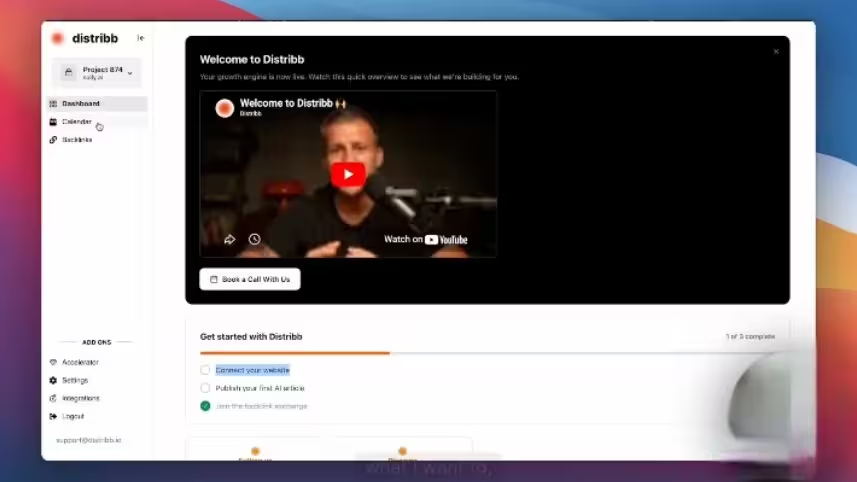
Distribb is the best option for content marketers who want AI content generation plus automated content distribution and backlink acquisition in one platform.
Distribb publishes, earns backlinks, and distributes your content to the platforms AI engines cite, so you build lasting AI visibility.
It analyzes your niche and competitors, finds buyer-intent keywords, and keeps your content calendar full automatically.
The AI agent inside Distribb is genuinely conversational. A built-in AI agent sits on every page, ready to act.
Ask it to find keywords, write or rewrite an article, or jump to any screen, and it just does it. No menus to learn, no manual to read. It runs your SEO; you stay in charge.
Pros and Cons
Pros:
- Content distribution to AI-cited platforms builds citation authority
- Built-in AI agent reduces dashboard navigation friction
- Automated keyword discovery and content calendar
- Backlink building integrated into publishing workflow
- 3-day free trial available
Cons:
- Newer platform with less community data
- Content quality benefits from a light editorial review layer
Pricing: $97/month (Pro) and $495/month (Accelerator)
Who Should Use Distribb?
Best for content marketers and small businesses who want automated content creation and link acquisition in one workflow, without managing separate SEO and link building tools.
Read the Distribb review for a real-world output test.
5. WordRocket AI: Best Budget Option for High-Volume Content
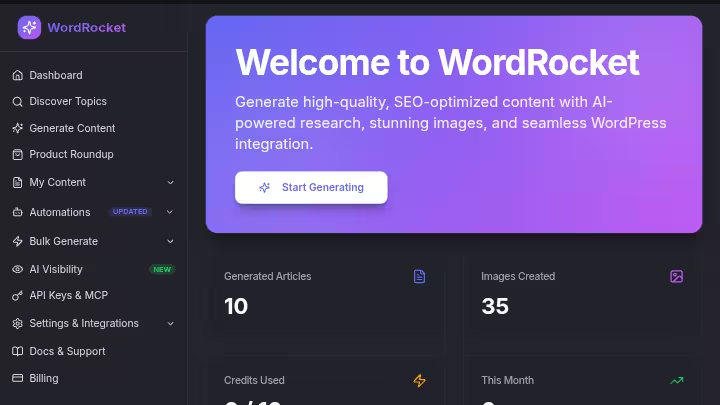
WordRocket AI is the best-value platform for content producers who need high article volume at predictable costs.
WordRocket is an AI-powered content generation platform designed specifically to help users create high-quality, fact-checked and SEO-optimized long-form content.
The tool is built for people who need to create SEO articles quickly using top-tier AI models, while keeping costs predictable through a bring your own API key (BYOK) model.
In testing, it scores 8.1/10 as a content generation platform that solves the speed-to-publish problem for long-form SEO content.
After 45 days of daily use, it proved most valuable for solo bloggers, affiliate marketers and small agencies struggling with consistent content production at scale.
The BYOK model is both a pro and a con. You control costs and model choice, but the setup requires technical comfort. It is not plug-and-play for non-technical users.
Template quality reduces prompting time significantly, and it maintains coherence past 3,000 words where competitors struggle.
However, WordRocket AI is not a full-stack content marketing tool. It does not track rankings, manage your content calendar or provide deep competitor analysis.
Pros and Cons
Pros:
- Extremely cost-efficient at high volumes through BYOK model
- Strong long-form coherence beyond 3,000 words
- Fast article generation (under 5 minutes for most articles)
- Good template library for SEO article formats
Cons:
- No built-in content calendar
- API key setup adds friction for beginners
- Only WordPress auto-publishing
- Brand voice management is limited
Pricing: Free plan ($0/month), Starter plan ($10/month), Pro ($20/month), Premium ($49.99/month).
For current plan details, see the WordRocket AI pricing page or check the WordRocket lifetime deal.
Who Should Use WordRocket AI?
WordRocket AI is best for high-volume content producers who want multi-model AI access and predictable costs through a bring-your-own-API-key setup.
Not recommended for beginners or users who need an all-in-one SEO platform.
Read the full WordRocket AI review.
6. BlogSEO.io: Best for Semantic SEO Content
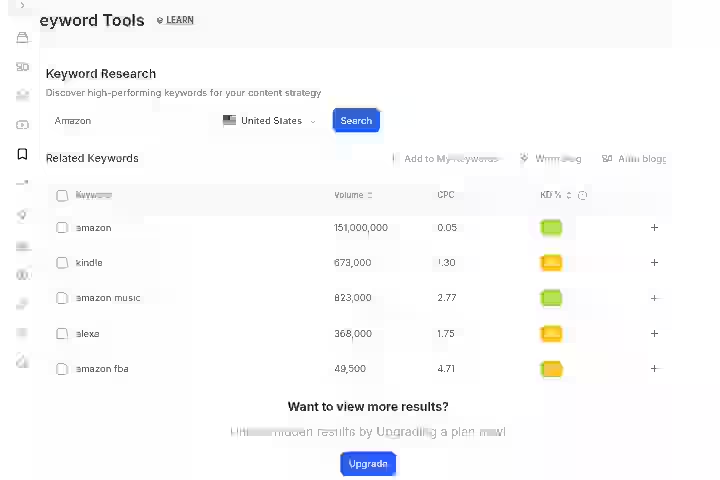
BlogSEO.io is the top autoblogging tool for SEO teams who want semantic structure and search intent baked into every article from the start.
BlogSEO has a strong focus on semantic SEO and keyword difficulty assessment before writing.
Rather than generating content first and optimizing after, BlogSEO.io bakes search intent and semantic structure into the drafting process.
It’s best for SEO teams that want semantic SEO integrated into the writing process from the start.
It is also a good option for semantic SEO content, schema markup, and structured data optimization.
Pros and Cons
Pros:
- Semantic SEO is built into article generation, not added post-draft
- Strong schema markup and structured data support
- Search-intent-first drafting process
- 3-day trial available
Cons:
- 30-article monthly cap on base plan limits scalability
- Not built for bulk or programmatic SEO use cases
- Smaller community base
Pricing: Starts at $97/month for 30 articles, scaling to custom pricing for professional tiers with unlimited articles.
Who Should Use BlogSEO.io?
Best for SEO professionals and content marketers in competitive niches who want every article to start with semantic structure and intent alignment.
Read the full BlogSEO.io review.
7. Emplibot: Best for WordPress Automation with Social Distribution
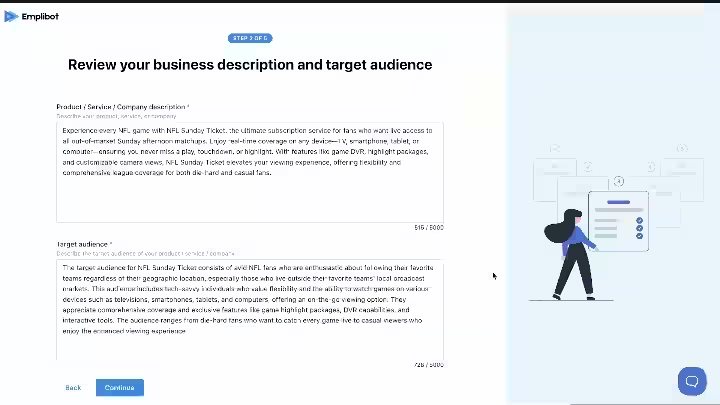
Emplibot is the closest you will get to a truly hands-off WordPress autoblogging experience.
It handles the full pipeline from topic research through WordPress publishing, with social distribution built in.
Emplibot is best for WordPress users who want fully automated blogging and social media distribution.
The social distribution component is a real differentiator. Most autoblogging platforms stop at CMS publishing.
Emplibot continues the workflow by sharing published content across social channels, which matters for blogs that rely on social for referral traffic alongside organic search.
Pros and Cons
Pros:
- Full WordPress pipeline from research to publishing
- Built-in social media distribution (X, Facebook, Instagram, LinkedIn)
- White-label option for agencies
- Multi-client dashboard available
- Minimal manual intervention required
Cons:
- Primarily built for WordPress, limiting CMS flexibility
- Content quality requires at least a light editorial review
- White-label WordPress plugin, multi-client dashboard and social distribution make it the most enterprise-appropriate option but the pricing reflects that
Pricing: Emplibot starts at approximately $69/month. Higher tiers scale for agencies with multiple sites and client dashboards.
Who Should Use Emplibot?
Best for WordPress site owners, bloggers, and small agencies who want the most automated publishing experience possible with social amplification included.
Read the full Emplibot review.
8. RightBlogger: Best for Beginners
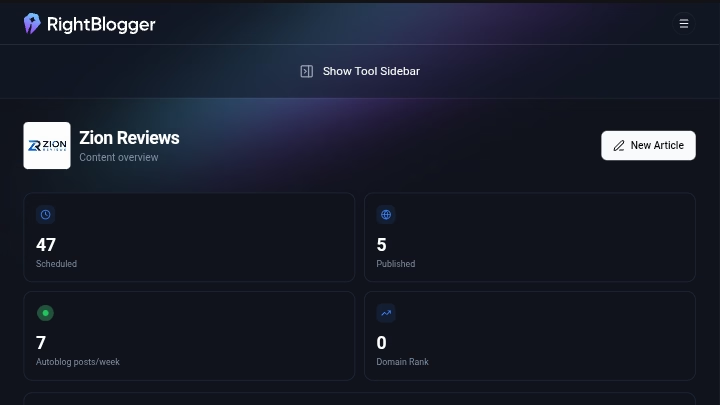
RightBlogger is the most approachable autoblogging platform for people just starting out with AI-assisted blog content.
It has 90+ tools, clean interface, strong documentation, and a toolkit that grows with you. It is the most user-friendly interface for bloggers just getting started.
RightBlogger offers unlimited AI words on all plans, starting at $59/month. That is one of the strongest value propositions at the entry level. You do not hit a word wall on your second article.
The trade-off is that RightBlogger is more of an AI writing assistant with SEO features than a fully automated publishing platform.
But for someone learning the workflow, that manual involvement is actually a feature, not a bug.
Pros and Cons
Pros:
- Unlimited articles on all plans
- Clean, intuitive interface for beginners
- Strong documentation and onboarding
- Good value at $59/month
- Broad template library for different blog post formats
Cons:
- Not fully automated (no hands-off publishing pipeline)
- Built-in backlink feature is still in development
- Less suitable for agencies managing multiple client sites
Pricing: RightBlogger starts at $59/month with unlimited articles included. For current plan details, see the RightBlogger pricing page.
Who Should Use RightBlogger?
Best for freelancers, individual bloggers, and small business owners getting started with AI-assisted content marketing.
If you want to compare it with a market-leading alternative, check out the ChatGPT vs RightBlogger comparison.
Read the full RightBlogger review.
9. Byword AI: Best for Programmatic SEO
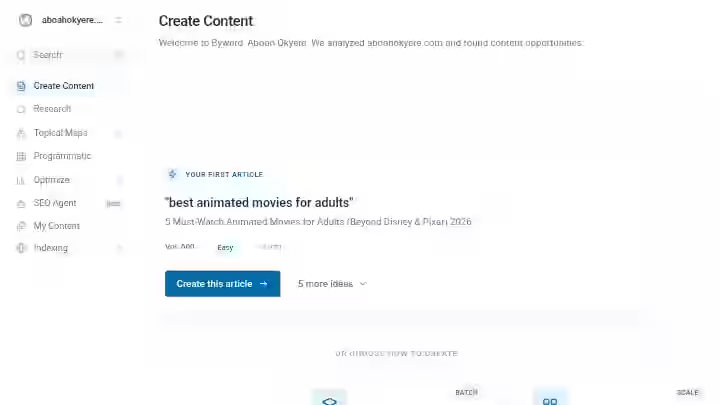
Byword AI is the best autoblogging platform for programmatic SEO and bulk article generation at volume.
Byword AI is best for programmatic SEO and bulk article generation.
You feed it a keyword (or a list of keywords), and it generates a full article per keyword, with optional direct WordPress publishing.
The output is decent for a first draft and the bulk pricing is competitive.
Best for publishers running programmatic SEO plays or large-scale niche sites where the priority is throughput, not perfectionism.
Byword AI for bulk keyword-to-article processing with programmatic scheduling makes it the strongest tool for affiliate sites publishing product comparison and review content at volume.
Where Byword falls short: skip it if you care about brand voice or hand-shaped editorial work.
Byword has fewer customization knobs for tone, structure, and writing style than most alternatives, and the drafts will sound generic without heavy editing.
Pros and Cons
Pros:
- Purpose-built for bulk keyword-to-article generation
- Competitive per-article pricing at volume
- Direct WordPress publishing
- Consistent output structure across large batches
Cons:
- Limited brand voice customization
- Generic output quality without editing
- Not suitable for brand-sensitive content
- No advanced SEO automation features
Pricing: Byword AI starts at $5/article or $99/month for 25 articles. Volume-based pricing does not cap monthly output, making it cost-efficient for programmatic use cases.
Who Should Use Byword AI?
Best for affiliate site operators and niche publishers running programmatic SEO campaigns with 50+ articles/month.
Read the full Byword AI review.
10. Rankpill: Best for Daily Publishing Across Multiple CMS
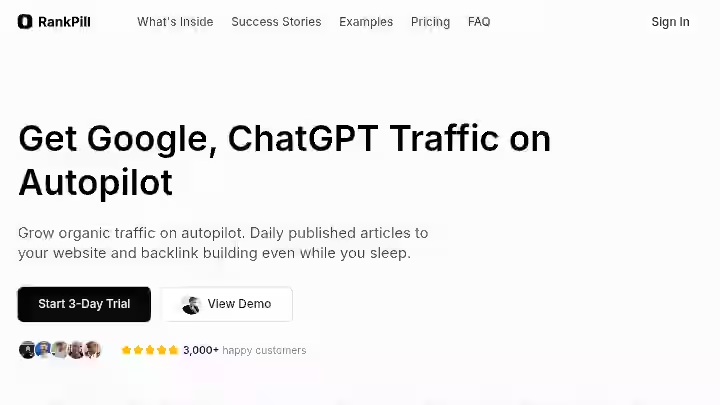
Rankpill is the best autoblogging platform for teams that need consistent daily publishing across multiple CMS platforms.
It is a daily-publishing SEO automation platform built for users who want consistent content output across multiple CMS platforms.
It sits at $49.5/month and includes 30 backlink credits per month and covers more automation depth.
It helps boost your domain authority and climb rankings faster with 30 backlink credits included every month. Strong on-page SEO coverage including meta descriptions and schema elements.
The downside is editorial control. RankPill ships a finished article with minimal opportunity to intervene.
If you want to review every post before it goes live, the workflow is not designed for that by default.
Pros and Cons
Pros:
- Daily publishing keeps content calendar filled automatically
- 30 backlink credits/month included
- Multi-CMS support
- Strong on-page SEO coverage
Cons:
- Limited editorial review options before publishing
- Not built for brand-voice-sensitive content
Pricing: $49.50/month for the first month, then $99/month, or $82.50/month when billed annually ($990/year, that is 17% off). Cancel at any time.
Who Should Use Rankpill?
Best for daily publishing across multiple CMS platforms with built-in keyword research. Read the full Rankpill review.
Are Autoblogging Platforms Good for SEO?
Yes, autoblogging platforms can support strong SEO performance, but only when used correctly.
Fully automated, unreviewed publishing consistently underperforms edited content. Volume without quality does not build topical authority; it dilutes it.
According to Google’s Search Quality Rater Guidelines, content is evaluated on Experience, Expertise, Authoritativeness, and Trustworthiness (E-E-A-T).
Fully automated content typically struggles on the Experience dimension because it lacks first-person perspective, original observation, and real-world context.
That does not mean AI content cannot rank. It means AI content needs editorial enrichment to be competitive in most niches.
What works in practice:
- Use autoblogging platforms for research, structure, and first drafts
- Add genuine expert perspective and original examples in every post
- Build internal linking structures before publishing at volume
- Map every article to a keyword cluster, not just a single target term
- Review content performance monthly and update underperforming posts
What does not work: publishing at scale without any editorial review and expecting the volume alone to produce rankings.
For more on how SEO automation fits into a sustainable content strategy, that guide covers the broader workflow.
How to Choose the Best Autoblogging Platform
The right autoblogging platform depends on four variables: budget, publishing volume, SEO requirements, and website type.
By Budget:
Budget Range | Recommended Platform |
|---|---|
Under $50/month | WordRocket AI ($10/mo) |
$50 to $99/month | Rightblogger ($59/mo), Emplibot (~$69/mo), Distribb ($97/mo), Byword AI ($99/mo) |
$99/month | Keytomic, BabyLoveGrowth AI, Outrank.so, BlogSEO.io, Rankpill |
Lifetime deal | WordRocket AI ($199 one-time + API costs) |
Enterprise / Agency | BabyLoveGrowth AI (custom), Keytomic (custom), Outrank.so (tiered) |
By Publishing Volume:
- 1 to 15 articles/month: RightBlogger, Outrank.so, BlogSEO.io
- 15 to 50 articles/month: BabyLoveGrowth AI, Keytomic, Distribb, Rankpill
- 50+ articles/month: Byword AI, WordRocket AI, Emplibot
By SEO Requirements:
- Basic blogging: RightBlogger, Emplibot
- Full SEO automation: Keytomic, BabyLoveGrowth AI
- Programmatic SEO at scale: Byword AI, WordRocket AI
- Semantic SEO: BlogSEO.io, Outrank.so
By Website Type:
Website Type | Best Option |
|---|---|
Affiliate site | WordRocket AI, Byword AI |
SaaS / Business blog | Keytomic, BabyLoveGrowth AI |
Local business | Soro SEO, BlogSEO.io |
News / Publisher | |
Agency (multi-client) | Keytomic, BabyLoveGrowth AI (agency plan) |
If you want a more detailed selection walkthrough, my guide to choosing the best autoblogging tool covers this decision tree in depth.
Final Verdict: Which Autoblogging Platform Should You Choose?
After seve6 days of testing across 10 platforms and multiple live projects, here is where I land:
Best Overall: Keytomic
End-to-end SEO automation with AI search visibility tracking, auto-indexing, and a rolling content calendar.
The strongest all-in-one platform for SEO agencies and businesses wanting consolidated workflows.
Best for SEO Automation + Backlinks: BabyLoveGrowth AI
The only platform at $99/month that combines daily article publishing, automated backlink building across 4,000+ sites, and ChatGPT/Perplexity/Gemini citation tracking in one subscription.
Best Budget Option: WordRocket AI
The lowest long-term cost per article for high-volume producers willing to handle their own API setup and content calendar management.
Best for Beginners: RightBlogger
Clean interface, unlimited articles, $59/month. The least intimidating entry point into AI-assisted blog content.
Best for Research-Backed Quality: Outrank.so
The platform to use when ranking page one in a competitive niche and defending every factual claim matters more than publishing speed.
Whatever platform you choose, the most important rule remains constant: publish content that is genuinely useful to the person searching, not just content that fills a keyword slot.
Autoblogging platforms reduce the time and cost of content production. They do not replace the judgment required to make that content worth reading.
Frequently Asked Questions
What is the best autoblogging platform?
Keytomic is the best overall autoblogging platform for SEO professionals and agencies who want end-to-end automation from keyword research to published, indexed content. BabyLoveGrowth AI is the strongest choice for businesses that also want automated backlink building and AI search tracking in one subscription.
Are autoblogging platforms safe for Google SEO?
Autoblogging platforms are safe for Google SEO when used with editorial review, genuine original insight, and proper internal linking structures. Fully automated publishing with zero human oversight consistently produces thin content that Google’s quality systems flag and penalize. High-quality, optimized content usually beats high publishing volume for long-term SEO and AI search visibility. The platform matters less than the editorial discipline around it.
Can autoblogging software rank on Google?
Yes, AI-generated content from autoblogging platforms can rank on Google, but only when it meets Google’s quality standards for E-E-A-T (Experience, Expertise, Authoritativeness, Trustworthiness). In my testing, the semi-automated approach (AI draft plus human editing) outperformed fully automated posts by roughly 3x in organic traffic at the 6-month mark. Volume alone does not produce rankings. Quality, topical authority, and technical SEO all contribute.
What is the difference between autoblogging and AI writing software?
Autoblogging platforms automate the full content pipeline including keyword research, content generation, SEO optimization, and CMS publishing. AI writing tools handle only the drafting step. If a tool only writes the article, it is an AI article writer. An autoblogging platform connects keyword discovery, AI content generation, on-page SEO, internal linking, and automated publishing into a single workflow.
Do autoblogging platforms work for affiliate websites?
Yes, autoblogging platforms work well for affiliate websites when used for buyer-intent content with proper keyword filtering and internal linking. Byword AI and WordRocket AI are the best fits for affiliate sites running programmatic SEO at volume.
Is autoblogging legal?
Autoblogging is legal when the content generated is original AI-created text, not scraped or republished from other sources without permission. Autoblogging AI technology crafts content based on simple prompts and can cover a wide range of topics like technology, marketing, lifestyle, products, and news to suit the user’s content needs.

- Searchable Review 2026: My Honest Test Results With This AI Visibility Platform - October 9, 2026
- Ryze AI Review 2026: My 30 Days Full Breakdown of This Autonomous SEO & GEO Platform - October 9, 2026
- #1 Best Plugin for Automatic Blog Posting in WordPress (2026) - September 13, 2026