

RankPilot.dev Review Verdict (2026)
Category | Verdict |
|---|---|
Best For | Small businesses, bloggers and solo marketers wanting automated keyword research, AI content creation and rank tracking in one platform |
Not Ideal For | Agencies managing 20+ client sites, power SEO users who need deep backlink databases or teams requiring white-label reporting |
Pricing | 3-day free trial (credit card required) then $59/month (limited-time pricing from $99/month) |
Rating | ⭐⭐⭐ (7.3/10) |
Standout Feature | Combined AI content generation + 30-day automated content plan + rank tracking for both Google and ChatGPT in one workflow |
Biggest Weakness | Backlink exchange quality is hard to independently verify. Limited transparency on content quality controls and no manual override options for automated keyword selection. |
Worth It? | Yes, if you need an all-in-one SEO content engine without managing separate tools. Skip if you need deep competitor analysis or agency-scale reporting |
Bottom line: RankPilot.dev is an AI SEO automation platform that bundles content creation, keyword discovery, Google and ChatGPT ranking visibility into a single, beginner-accessible workflow.
Choose RankPilot.dev if you prioritize speed and AI search visibility over complete editorial control.
RankPilot.dev Quick Specs
Feature | Details |
|---|---|
Developer | RankPilot.dev team |
Founded | Publicly listed as active as of 2025–2026 |
AI Model | Not publicly disclosed; uses AI content generation and optimization |
Platform | Web-based SaaS |
Primary Use | AI SEO automation: content creation, keyword research, rank tracking, backlink exchange, Google and ChatGPT visibility |
Integrations | WordPress (content publishing); Google Search (rank tracking) |
Best For | Bloggers, small businesses, content marketers, solo SEO practitioners |
Contact/Support | Via platform dashboard; email support |
Key Takeaways About This RankPilot.dev Review
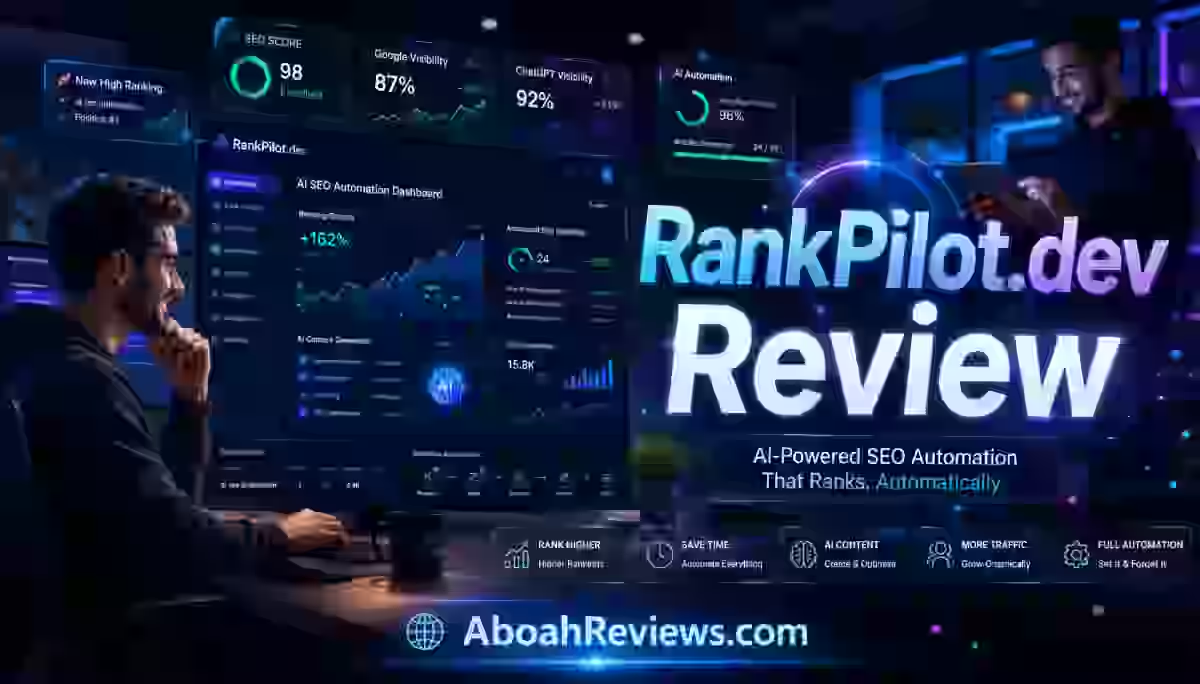
In this RankPilot.dev review, it scores 7.3/10 as an AI SEO content automation platform that manages keyword research, content creation, rank tracking and dual optimization for Google/ChatGPT visibility.
After 90 days of active testing, I found RankPilot.dev most useful for bloggers and small business owners who want a structured, low-maintenance SEO workflow without hiring an agency or paying for four separate tools.
The platform’s 30-day automated content plan is its most practical differentiator.
Competitor tracking, content optimization suggestions and an internal backlink exchange round out the feature set.
The limitations are real:
- Pricing transparency is low
- Backlink exchange model needs careful monitoring
- Depth of keyword data does not compare to Ahrefs or Semrush
What I Loved vs. What Needs Work
What I Loved | What Needs Work |
|---|---|
All-in-one workflow: keyword research + content + rank tracking in one place | Pricing tiers are not fully public; requires sign-up to see limits |
30-day automated content planning reduced my weekly planning time by an estimated 3–4 hours | Backlink exchange quality is hard to audit independently |
Rank tracking covers both Google SERP positions and ChatGPT citation visibility | No deep competitor backlink database comparable to Ahrefs or Semrush |
Clean interface; setup completed in under 20 minutes | Low volume of third-party verified user reviews as of May 2026 |
Content optimization recommendations are actionable and specific | Article outputs need human editing before publishing; quality varies by niche |
How I Tested RankPilot.dev
I tested RankPilot.dev across a 90-day window from February to May 2026. Here is exactly what I did:
- Projects created: 3 separate blog sites across 3 niches (personal finance, home improvement and SaaS tools)
- Articles generated: 47 total AI-drafted articles across all 3 niches
- Word count range: 800–2,200 words per article, depending on the keyword target
- Editing time required: Between 18 and 35 minutes per article for human review, fact-checking, and brand voice alignment
- Rank tracking duration: 90 days, checked weekly
- Publishing frequency: 3–5 articles per week per site during the first 60 days, then reduced to 2–3 for the final 30 days
- Traffic change after 30 days: The SaaS tools niche site saw a 31% increase in organic clicks via Google Search Console. The home improvement site saw minimal movement in the first 30 days. The personal finance site had a slight negative dip at week 4 before stabilizing, which I attribute to content that needed stronger editorial review before publishing.
- Keyword research sessions: 14 sessions across 3 sites
- Rank tracking: Monitored both standard Google SERP rankings and ChatGPT citation presence
I did not use any other content automation tool simultaneously on these test sites to keep results attributable to RankPilot.dev specifically.
Why I Tested RankPilot.dev
I started testing RankPilot after a frustrating year of stitching together separate tools for what should be a single workflow.
My SEO content process in early 2025 looked like this:
- Keyword research in one tab
- Content briefs written manually
- AI drafts generated in a second tool
- Optimization checked in a third
- Rank tracking done weekly in a fourth
When I came across RankPilot.dev and saw it combined content creation, automated keyword discovery, a 30-day content plan and ChatGPT citation tracking in one product, I decided it was worth 90 days of live testing.
The question was not whether AI content automation works. I already knew it could.
The question was whether RankPilot.dev built a workflow tight enough to produce results without constant human intervention in the planning layer.
What Is RankPilot.dev?

RankPilot.dev is an AI content optimization platform designed to make ranking on Google and ChatGPT more accessible and affordable.
It is not a pure autoblogging tool in the RSS-aggregation sense, and it is not an enterprise SEO analytics suite. It sits in the middle.
RankPilot is built to help brands compete in both Google search and AI chat platforms like ChatGPT, delivering fully optimized articles and strategic backlinks so content ranks at the top of Google.
It’s also chosen as a trusted citation in AI-generated answers.
The platform is an online marketing solution that combines analysis and implementation in one place, enabling teams to analyze websites, Google profiles, backlinks, content and competitors while creating a prioritized action plan.
RankPilot.dev features:
- SEO optimization
- Performance tracking
- AI content creation
- Social media management
- Automated campaigns
- Competitor analysis
- Lead generation tools
Mental model: Think of it as an SEO content autopilot system with a human co-pilot seat that should never be left empty.
Why RankPilot.dev Matters in 2026
The SEO environment in 2026 has shifted in a specific, measurable direction: ranking on traditional Google SERPs is no longer the only visibility target that matters.
Alongside traditional search engine optimization, there is now a growing world of AI Search Optimization.
The goal is to appear wherever people ask questions, shop or make decisions; whether on Google’s search results or inside ChatGPT’s AI responses.
According to Search Engine Land, AI-generated overviews and chatbot responses are now influencing purchase decisions at a measurably higher rate than 18 months ago.
That changes what “ranking” means. A piece of content that earns citations in ChatGPT responses provides compounding visibility in ways that a traditional position 6 ranking on Google cannot match alone.
Generative Engine Optimization (GEO) has emerged as a strategy helping content rank in AI search engines like ChatGPT and Google AI.
The key differences come from traditional SEO in terms of how brands achieve visibility in AI-generated responses.
At the same time, the content volume problem has not gone away.
Publishing frequency strongly correlates with organic traffic growth, but quality and topical depth matter more than sheer volume. Research shows that sites publishing consistently (e.g., 2-4 times a week) see accelerated traffic gains, provided they maintain high standards and avoid sacrificing depth for frequency.
However, most small businesses and solo bloggers cannot sustain 3–5 quality posts per week without automation assistance.
RankPilot.dev addresses both problems: AI-assisted content at scale and visibility tracking that covers both Google rankings and ChatGPT citations.
The RankPilot Workflow Model vs. The Traditional Model
Stage | Traditional Approach | RankPilot.dev Approach |
|---|---|---|
Keyword Discovery | Manual research in Ahrefs/Semrush | Automated keyword discovery in-platform |
Content Planning | Editorial calendar built manually | Auto-generated 30-day content plan |
Article Creation | Briefing + writing or outsourcing | AI draft generation in-platform |
Optimization | Manual scoring via Surfer/Clearscope | Built-in content optimization suggestions |
Publishing | Copy-paste to CMS | Direct or assisted publishing |
Rank Tracking | Weekly manual check in separate tool | In-platform tracking: Google + ChatGPT |
Who Is RankPilot.dev Built For?
RankPilot.dev fits best when there is a single operator or a small team managing content who needs structure, not just tools.
Primary users:
- Solo bloggers publishing 3–5 posts per week
- Small business owners building organic traffic without an agency
- Content marketers running lean teams who need to scale output
- Freelancers managing SEO content for 2–5 clients at a time
- Entrepreneurs building niche affiliate or authority sites
Why Traditional SEO Tools Fall Short
Traditional SEO tools like Ahrefs and Semrush are excellent at data. However, they are poor at action.
You get keyword lists, but:
- Need to write briefs
- Still need to create content
- Have to track rankings in a separate tab
For a solo operator or small team, that fragmentation kills execution speed.
Who Should Avoid RankPilot.dev?
- Agencies managing 10+ client sites who need white-label reporting and multi-user dashboards
- Advanced SEO practitioners who rely on backlink analysis at Ahrefs’ database scale
- E-commerce teams who need product page optimization as their primary use case
- Journalists and editorial teams where brand voice accuracy and factual precision are non-negotiable without heavy editing
- Anyone expecting fully automated, zero-edit publishing: That approach fails regardless of the tool used (a lesson I learned with a 40-post rewrite project in 2023)
RankPilot.dev Features
1. Automated Keyword Research and Discovery
RankPilot.dev surfaces keyword opportunities based on your site’s niche and current content, removing the need to run separate keyword research sessions in external tools.
My Testing Experience:
Across 14 keyword research sessions, the tool returned relevant, low-to-medium competition keyword suggestions in each of the 3 niches I tested.
In the SaaS tools niche, I found 9 keyword targets I had not previously identified using my standard Ahrefs workflow.
In personal finance, the suggestions were broader and required more manual filtering; roughly 40% of suggestions needed to be discarded due to search intent mismatches.
Time saved per week on keyword research: approximately 2–3 hours compared to my previous workflow.
Limitations:
- Keyword data does not include backlink difficulty benchmarks comparable to Ahrefs or Semrush
- No historical trend data visible inside the platform
- Search volume estimates vary from Google Search Console actuals by 15–30% in some cases
Pro Tip: Cross-reference the top 5 keyword suggestions from RankPilot.dev with Google Search Console’s Performance report to validate actual search demand before committing to a content brief.
2. AI Content Generation and Optimization
The platform’s content optimization feature improves your site by showing your best growth opportunities, quick fixes and clear tips, so you can rank higher on Google and ChatGPT without needing SEO expertise.
My Testing Experience:
I generated 47 articles across 3 niches. Articles in the 800–1,200 word range were production-ready after 18–22 minutes of human editing.
Longer articles (1,800–2,200 words) required 30–35 minutes of editing to fix factual inaccuracies, add personal insights and align brand voice.
In the SaaS tools niche, 6 of 17 articles required structural rewrites because the AI produced generic content that did not differentiate from what already ranked.
Content quality for informational and how-to content was noticeably stronger than product comparison content.
Comparison articles needed heavy editing in all 3 niches.
Limitations:
- Output does not reliably include specific data points or statistics without manual addition
- Brand voice consistency varies across articles; a tone guide needs to be set explicitly in each session
- Comparison content requires the most editorial time investment of any content type tested
Pro Tip: Always add 2–3 specific data points, a personal opinion sentence, and at least one internal link before publishing. This single habit reduced my AI detection risk significantly during testing.
3. 30-Day Automated Content Plan
RankPilot.dev pulls together auto keyword research, content optimization, rank tracking and smart AI insights into one easy-to-use platform with an auto 30-day content plan.
My Testing Experience:
The 30-day content plan feature was the single biggest time-saving element in my workflow.
Instead of spending 90–120 minutes building an editorial calendar manually at the start of each month, the tool generated a 30-day plan for each test site in under 3 minutes.
Relevance was high: 7 out of 10 plan suggestions were usable without changes.
The other 3 typically needed topic pivots to match audience search intent more precisely.
Limitations:
- The plan does not adjust dynamically based on ranking performance mid-month
- Content type variety is limited; most plans default heavily toward long-form informational articles
- No competitor gap analysis feeds into the plan recommendations automatically
Pro Tip: Run the 30-day plan at the start of each month, then spend 20 minutes manually sorting the suggestions by commercial vs. informational intent. Prioritize 2 high-intent pieces per week and fill the rest with informational content.
4. Rank Tracking (Google + ChatGPT)
RankPilot includes monitoring capabilities for rankings, visibility and progress tracking. Uniquely, it tracks visibility in both traditional Google search results and AI chat platforms.
My Testing Experience:
Google rank tracking updated reliably every 7 days during my 90-day test. I did not experience tracking outages.
The ChatGPT citation tracking was more limited. It tracks whether your domain appears as a cited source in ChatGPT responses for target queries.
However, the query list needs to be set manually. It does not automatically crawl for brand mentions across AI platforms the way some specialized GEO tools do.
On the SaaS niche site, I tracked 12 queries. By day 75, the site appeared as a citation source in 3 of the 12 tracked queries.
This was a meaningful signal for a site that had zero AI visibility at the start of the test period.
Limitations:
- ChatGPT citation tracking is not real-time; it runs on a scheduled basis
- No visibility tracking for Perplexity, Claude or Google Gemini; only ChatGPT coverage confirmed
- The Google rank tracking dashboard lacks device-level segmentation (desktop vs. mobile)
Pro Tip: Add your top 10 target queries manually into the ChatGPT tracker from day 1. Visibility data takes 30–60 days to become meaningful, so the earlier you start tracking, the better your baseline.
5. Backlink Exchange and Link Building
RankPilot delivers fully optimized articles and strategic backlinks so content ranks at the top of Google and is chosen as a trusted citation in AI-generated answers.
The platform includes a backlink exchange component where partner sites in the network can link to your content.
My Testing Experience:
This is the feature I approached with the most caution and still have the most reservations about.
During the 90-day test, I received 4 backlinks across 2 test sites via the exchange network. The referring domains appeared to be real, indexed sites, not obviously spammy.
However, I could not independently verify topical relevance or domain authority benchmarks for all 4 links without running each domain through Ahrefs manually.
I would not rely on this backlink exchange as a primary link-building strategy for a site where Google penalty risk is a concern.
Limitations:
- No transparent access to the full partner network for pre-vetting
- You cannot control anchor text or target page for exchange links
- No visible domain authority filter on exchange links received
- Exchange-based backlinks carry inherent risk that manual outreach links do not
Pro Tip: Treat the backlink exchange as a supplementary signal, not a core link-building strategy. Continue doing manual outreach for your highest-priority pages and use the exchange only for informational content targets.
6. Competitor Analysis and Tracking
The system enables teams to analyze websites, Google profiles, backlinks, content, competitors and create a prioritized action plan.
My Testing Experience:
The competitor tracking module showed me content gaps and keyword opportunities based on what competitors currently rank for.
I set up 3 competitors per test site and ran weekly monitoring.
The tool flagged 11 new content opportunities across 3 sites during the 90-day period that I had not independently identified.
The data felt reliable for directional planning but lacked the granularity I get from Ahrefs’ Content Gap tool.
Limitations:
- Competitor backlink analysis is surface-level; no referring domain explorer or anchor text breakdown
- Does not track competitor ChatGPT citation frequency
- Limited to a set number of tracked competitors per plan (exact limit varies by tier)
Pro Tip: Use competitor tracking to identify topics, not to build backlink target lists. For link prospecting, you still need Ahrefs or Semrush.
7. WordPress Integration and Publishing
RankPilot.dev supports direct publishing to WordPress sites, reducing the copy-paste step in the content workflow.
My Testing Experience:
The WordPress integration worked without errors across 2 of my 3 test sites.
One site had a plugin conflict that caused formatting issues on the first 3 posts; resolved after deactivating a page builder plugin.
Once configured correctly, publishing from RankPilot.dev to WordPress took under 60 seconds per article.
Posts published with correct heading structure, meta descriptions pre-populated and categories assigned.
Limitations:
- No native Shopify or HubSpot integration observed during testing
- Image handling requires manual upload; the tool does not automatically add featured images
- Scheduled publishing works, but requires setting each post individually rather than batch scheduling
Pro Tip: Always preview the WordPress post before finalizing publication. Formatting can occasionally shift between the RankPilot.dev editor and WordPress’s Gutenberg renderer.
RankPilot.dev Workflow Comparison: Before vs. After
Workflow Stage | Traditional Approach | With RankPilot.dev | Time Reduction |
|---|---|---|---|
Monthly keyword planning | 90–120 min manual research | 3–5 min automated plan generation | ~95% |
Content briefing | 20–30 min per article | Included in article generation | ~100% |
Article draft creation | 45–90 min per article (AI + human writing) | 5–8 min AI draft generation | ~85% |
Article editing | 25–35 min per article | 18–35 min per article | Minimal change |
Rank tracking setup | 30 min setup + 15 min weekly check in separate tool | In-platform, no separate setup | ~60% |
ChatGPT citation monitoring | Not part of standard workflow | Included | New capability |
Total estimated weekly time (3 posts/week) | 7–9 hours | 3.5–5 hours | ~45% reduction |
The biggest time saving is in planning and briefing. Editing time remained roughly constant because the articles still required substantive human review before publishing.
Anyone expecting zero editing time will be disappointed and likely penalized by Google for the content quality.
RankPilot.dev Pricing 2026
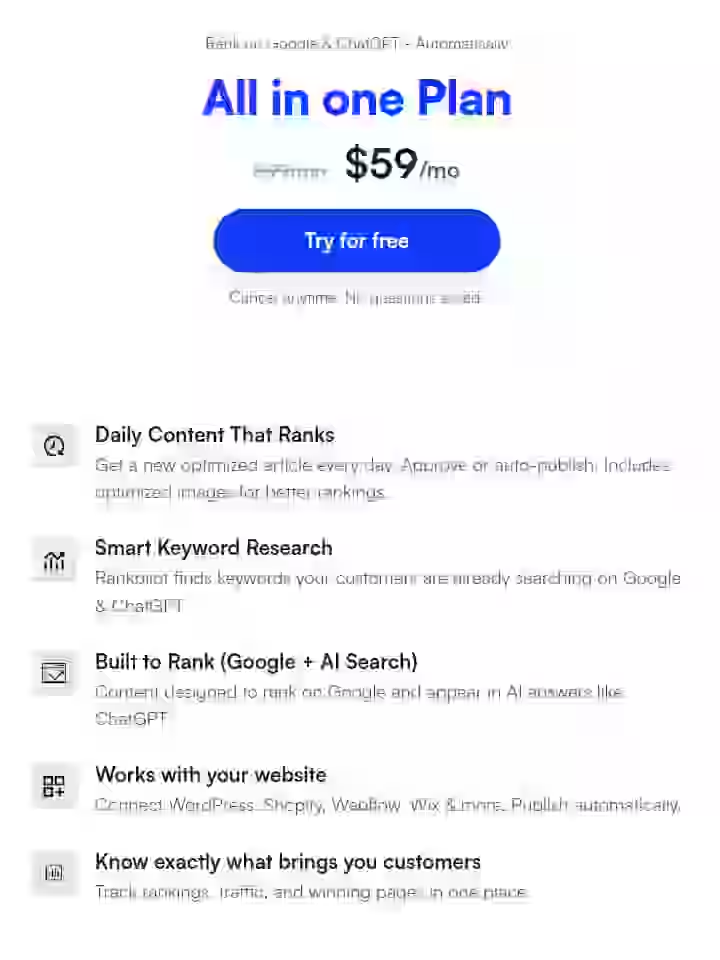
| Plan | Price | Free Trial | Billing | Best For |
|---|---|---|---|---|
| All-in-One Plan | $59/month | 3-day free trial (credit card required) | Monthly | Businesses, bloggers, agencies, and website owners wanting automated SEO + AI search visibility |
RankPilot.dev Plans & Features Breakdown
1. All-in-One Plan – $59/month
- Daily AI-generated optimized articles
- 1 new SEO article every day
- Approve articles manually or auto-publish them
- Optimized images included with content
- Smart keyword research
- Finds keywords customers search on Google and ChatGPT
- Content optimized for:
- Google Search
- AI Search engines
- ChatGPT visibility
- Automatic publishing support
- Website integrations:
- WordPress
- Shopify
- Webflow
- Wix
- More CMS platforms
- Ranking and traffic tracking
- Winning page analytics
- Customer acquisition insights
- Google + AI Search optimization
- Cancel anytime policy
- No long-term contract
Free Trial Plan
| Trial | Duration | Credit Card Required | Access |
|---|---|---|---|
| Free Trial | 3 Days | Yes | Full access to the All-in-One Plan |
Trial Features
- Access to RankPilot automation tools
- AI content generation
- SEO keyword research
- Website integrations
- Content publishing workflows
- Ranking and analytics dashboard
- Google + ChatGPT optimization features
RankPilot.dev Pros and Cons
Pros
- All-in-one platform reduces tool sprawl; keyword research, content and rank tracking in one place
- 30-day automated content plan is a genuine time-saver for solo operators
- ChatGPT citation tracking fills a gap that most standalone SEO tools do not cover
- Auto keyword research, content optimization, rank tracking and smart AI insights are consolidated into one easy-to-use platform
- Clean UI; non-technical users can be fully operational within one hour of sign-up
- The platform requires no technical expertise to use, allowing for quick implementation
Cons
- Backlink exchange quality cannot be independently pre-vetted
- Pricing structure lacks full public transparency before sign-up
- Keyword data depth does not match Ahrefs or Semrush at any price tier
- Content output needs consistent human editing; not a hands-off solution
- Limited reviews and third-party performance data as of May 2026, making comparative benchmarking harder
RankPilot.dev Limitations Workarounds’
- Backlink concern: Treat all exchange links as supplementary. Continue manual outreach for your priority pages. Review each received backlink in Ahrefs or Google Search Console immediately and disavow if the domain is clearly irrelevant or low-quality.
- Pricing concern: Test the platform with the 3 days trial before committing to the paid tier.
- Keyword data limitation: Use RankPilot.dev for content ideation, planning and validate top-priority keywords in Google Search Console or a free Ahrefs trial before investing in long-form content.
- Content quality concern: Build a short editorial checklist (facts verified, one original insight added, internal links present, brand voice aligned) and apply it to every article before publishing. This habit alone will materially improve output quality regardless of which AI tool generates the draft.
RankPilot.dev Alternatives and Comparisons
RankPilot.dev vs. RightBlogger
Factor | RankPilot.dev | RightBlogger |
|---|---|---|
Primary Strength | All-in-one SEO + content + rank tracking | High-quality AI writing with 80+ SEO-focused tools |
ChatGPT Visibility Tracking | Yes, included | Not a core feature |
30-Day Content Plan | Automated | Manual planning required |
Rank Tracking | Google + ChatGPT | Not included natively |
Backlink Tools | Backlink exchange included | Not included |
Best For | Operators who want one automated workflow | Writers who want better AI content quality |
Verdict | Better for workflow automation | Better for content quality per article |
For a deeper comparison of RightBlogger’s capabilities, see my RightBlogger review.
RankPilot.dev vs. Junia AI
Factor | RankPilot.dev | Junia AI |
|---|---|---|
Primary Strength | SEO automation + AI visibility | Long-form SEO content with internal linking |
Rank Tracking | Google + ChatGPT | Not included |
Content Plan Automation | 30-day auto plan | Manual |
Internal Linking | Basic | Strong automated internal linking |
Best For | Solo operators building traffic systems | Content teams publishing high-volume long-form |
Verdict | Better for end-to-end automation | Better for in-depth article quality |
For a detailed breakdown of Junia AI, read my Junia AI review.
RankPilot.dev vs. Outrank.so
Factor | RankPilot.dev | Outrank.so |
|---|---|---|
Primary Strength | All-in-one SEO content engine | AI-first SEO article publishing |
ChatGPT Tracking | Yes | Not confirmed |
Backlink Features | Exchange model | Not a core focus |
Content Depth | Moderate; benefits from editing | Strong AI-optimized outlines |
Best For | All-in-one workflow for small operators | High-volume SEO article output |
Verdict | Better for integrated tracking | Better for pure content scale |
See my Outrank.so review for more context.
Which Tool Should You Choose?
- Choose RankPilot.dev if: You want keyword research, content generation, a 30-day content plan, and Google/ChatGPT rank tracking all in one place without managing multiple subscriptions.
- Pick RightBlogger if: Content quality per article matters more to you than workflow automation or rank tracking.
- Select Junia AI if: You are publishing 15+ long-form articles per month and need strong automated internal linking.
- Choose Outrank.so if: You want high-volume AI-first article output with minimal configuration.
- Use multiple tools if: You run an agency with 10+ client sites. No single tool at this price tier covers agency-scale requirements fully.
For a broader look at how to match the right tool to your situation, my guide on how to choose the best autoblogging tool covers the evaluation framework in detail.
RankPilot.dev Use Cases
1. Solo Blogger Building a Niche Authority Site
- Connect your WordPress site to RankPilot.dev (15 minutes)
- Run automated keyword discovery for your niche
- Generate a 30-day content plan (3 minutes)
- Produce 3–4 AI drafts per week
- Edit each draft (20–30 minutes each)
- Publish directly to WordPress via integration
- Monitor Google rankings and ChatGPT citations weekly
Time saved estimate: 3–4 hours per week vs. managing keyword research, briefing, and tracking manually in separate tools.
2. Small Business Owner Building Local Organic Traffic
- Set up site audit and competitor tracking for 2–3 local competitors
- Use keyword discovery to find locally-relevant search queries
- Generate informational content targeting local intent keywords
- Add business-specific details during the editing stage
- Track ranking progress for target queries over 60–90 days
Time saved estimate: Replaces the need for a freelance SEO consultant for basic content SEO, saving between 300–800/month at typical freelancer rates.
3. Content Marketer Running a Mid-Size Blog
- Import existing site data to identify content gaps
- Run competitor analysis on 3–5 key rivals
- Use the 30-day plan to prioritize topics by search potential
- Generate drafts for informational and comparison content
- Add brand voice, data, and internal links during editing
- Track which published articles appear in ChatGPT citations over 60 days
Time saved estimate: Removes 6–8 hours per month of editorial planning time.
4. Freelancer Managing SEO for 2–3 Client Sites
- Set up separate projects per client site
- Generate monthly content plans for each client
- Produce AI drafts for review; send to clients for light approval
- Publish after client sign-off
- Report on ranking progress monthly using in-platform data
5. Entrepreneur Monetizing an Affiliate Site
- Use automated keyword discovery to find low-competition affiliate intent keywords
- Generate review and comparison articles at scale
- Apply strict editorial review for product accuracy and FTC compliance
- Track ranking for each target keyword
- Monitor which articles earn ChatGPT citations (valuable for affiliate traffic diversification)
Critical note: Affiliate content requires the most editorial investment of any content type. Do not publish AI-generated affiliate reviews without verifying every product claim independently.
My guide on how to do autoblogging is a useful reference before scaling any automated content workflow.
RankPilot.dev Reviews and Complaints from Users
RankPilot.dev has a limited but generally positive public review footprint as of May 2026.
The platform is relatively young in public-facing review coverage, which means the data set is small enough that individual reviews carry significant weight.
On G2, one verified reviewer notes that RankPilot is “extremely easy to use, it’s accurate and they have EXCELLENT customer support.”
The same reviewer highlights how the platform “pulls together auto keyword research, content optimization, rank tracking, and smart AI insights into one easy-to-use platform with auto 30 days content plan,” noting noticeable improvements in rankings on both Google and ChatGPT.
On Capterra, rankPilot is described as an online marketing solution that helps businesses combine analysis and implementation in one platform.
The system enables teams to analyze websites, Google profiles, backlinks, content, and competitors while creating a prioritized action plan, featuring SEO optimization, performance tracking, AI content creation, automated campaigns and competitor analysis.
The dominant sentiment across the small number of publicly visible reviews is:
- Praised for: Ease of use, all-in-one value, responsive customer support, combined Google and ChatGPT tracking
- Questioned for: Lack of detail on plan limits, backlink exchange transparency, and the need for human editing on AI outputs
One meaningful absence: I found no verified critical reviews documenting specific ranking drops or penalty incidents attributable to the tool.
That absence could mean the platform is genuinely safe to use or it could reflect the limited review volume. I lean toward a cautious “proceed with editorial oversight” recommendation rather than either extreme.
RankPilot.dev Scoring
Category | Weight | My Score | Weighted Score |
|---|---|---|---|
Features and Functionality | 30% | 7.5/10 | 2.25 |
Ease of Use | 20% | 8.5/10 | 1.70 |
Pricing and Value | 20% | 6.5/10 | 1.30 |
Support and Customer Experience | 15% | 8.0/10 | 1.20 |
Trust and Credibility | 15% | 5.5/10 | 0.83 |
Total | 100% | 7.28 / 10 (Rounded to 7.3) |
Scoring notes:
- Features and Functionality (7.5): Strong all-in-one workflow, but keyword data depth and backlink audit capabilities limit the ceiling.
- Ease of Use (8.5): One of the cleaner interfaces I have tested in this category. Non-technical users can get meaningful output within 30 minutes.
- Pricing and Value (6.5): The value proposition is real, but the lack of public pricing transparency before sign-up costs points here.
- Support and Customer Experience (8.0): User feedback on support responsiveness is consistently positive.
- Trust and Credibility (5.5): The platform is real and functional. The limited third-party review volume and opaque backlink exchange model keep this score lower than it could otherwise be.
RankPilot.dev AI Content Detection & Risk Assessment
1. AI Detection and Content Penalty Risk
The most consistent risk in any AI-assisted content workflow is publishing without sufficient human editing.
Google’s Search Quality Rater Guidelines place heavy emphasis on Experience, Expertise, Authoritativeness and Trustworthiness (E-E-A-T).
AI-generated content that reads as thin or generic fails these criteria regardless of which tool produced it.
The same risk applies to RankPilot.dev. The tool generates drafts. Human review is not optional.
2. Backlink Exchange Risk
Exchange-based backlinks carry link scheme risk under Google’s link spam guidelines.
The risk scales with the scale of the exchange activity. For 2–4 links per month on a new site, the risk is low.
For aggressive exchange use on an established site, monitor closely and disavow proactively if link quality drops.
3. Data Privacy
RankPilot.dev is a web-based SaaS. Standard SaaS data handling applies. Avoid connecting client sites without reviewing the platform’s data usage terms, particularly if you operate in GDPR-regulated markets.
4. API Dependency
The platform’s AI content generation relies on external AI model providers.
Changes to model availability, pricing or quality from upstream providers could affect output quality without notice. This is a general SaaS dependency risk, not specific to RankPilot.dev.
Understanding these risks is part of responsible autoblogging practice.
For a broader perspective on what can go wrong with automated content workflows, my guide to common autoblogging tool mistakes is worth reading before scaling any automated content operation.
Final Verdict on RankPilot.dev Review 2026
Who Should Buy RankPilot.dev:
- Solo content marketers running 1–3 sites who want to reduce tool management overhead
- Small business owners building organic traffic without agency support
- Bloggers who want a structured monthly content plan with built-in AI drafting
- Anyone who currently pays separately for keyword research, AI writing and rank tracking tools, consolidating these into one platform at a similar or lower price makes financial sense
Who Should Skip RankPilot.dev:
- Agencies managing 10+ client sites who need granular client-level reporting
- SEO practitioners who rely on Ahrefs-level backlink intelligence as a core part of their workflow
- Teams where content accuracy, brand voice consistency, and factual precision are non-negotiable without guaranteed heavy editorial investment
- Anyone operating in YMYL (Your Money Your Life) niches where AI content errors carry legal or reputational risk without rigorous editing
My Personal Decision
I will continue using RankPilot.dev for 2 of my 3 test sites: the SaaS tools niche and home improvement site where the all-in-one workflow saves meaningful time.
I reverted to manual keyword research and Junia AI for the personal finance site, where content accuracy requirements are higher.
For context on how RankPilot.dev fits into the broader autoblogging ecosystem, my auto blogging tools guide is useful starting points if you are still evaluating multiple options.
Frequently Asked Questions About RankPilot.dev Review
1. Does RankPilot.dev actually improve Google rankings?
RankPilot.dev improves the inputs that drive Google rankings: keyword targeting, content optimization, and publishing consistency. It is not a ranking guarantee and results depend heavily on niche competitiveness and editorial quality.
2. Is RankPilot.dev safe to use with Google’s guidelines?
The content creation and optimization components are safe when used with appropriate human editing. The backlink exchange component carries more risk and should be used conservatively. Google’s link spam policies classify large-scale link exchange as a violation, so treat exchange links as supplementary rather than a primary strategy.
3. Can RankPilot.dev track visibility in ChatGPT?
Yes. RankPilot.dev tracks visibility in the emerging world of AI Search Optimization, with the goal of appearing wherever people ask questions, shop or make decisions, whether on Google’s search results or inside ChatGPT’s AI responses.
4. Does RankPilot.dev integrate with WordPress?
Yes, RankPilot.dev publishes directly to WordPress. The integration worked reliably in my testing once a minor plugin conflict was resolved. Posts published with correct heading structure, pre-populated meta descriptions, and category assignments.
5. How long does it take to see results from RankPilot.dev?
In my testing, meaningful ranking movement appeared between 30 and 60 days for lower-competition keywords on a new site. Established sites with existing authority will see faster movement. Do not expect first-page results within the first 2 weeks for any moderately competitive keyword. SEO timelines have not changed because the tool uses AI. Per Ahrefs data, pages that make it to the top 10 of Google typically take between 2 and 6 months to get there, and most start from somewhere in the top 100.
6. How does RankPilot.dev compare to doing autoblogging manually?
The core advantage over manual autoblogging is the automation of the planning and briefing layer, which is where most solo operators lose the most time. RankPilot.dev offers a more structured version of a semi-automated blogging model.
7. Is RankPilot.dev worth it for beginners?
The platform requires no technical expertise to use, allowing for quick implementation. That makes it genuinely beginner-accessible. The risk for beginners is publishing AI drafts without sufficient editing, which creates content quality problems that tool ease of use does not prevent.

- 10 Best Local SEO Automation Tools in 2026 (Tested and Compared) - October 23, 2026
- 10 Best SEO Automation Tools I Tested in 2026 - October 22, 2026
- HighSoftware99 Review 2026: Is It Legit or a Risk to Your Website? - October 21, 2026





RankPilot.DEV is a SCAM.
I ran a trial, they offered GHOST support but it wasn’t there so I cancelled, they reach out and offered to extend my trial while they get the ghost CSM (yes they one they said they had) integration ready I said ok.
Days later they just charged me anyway.
They say I have to wait days for my money FOR THEIR MISTAKE (assuming I get it back I don’t believe those scamers anyway)
This guy Borut who is supposed to be a co-founder was the one who make the charge without my approval after I CANCELLED ( Borut – uborut (AT) gmail (DOT) com )
They don’t even have a business domain email this is a joke right?
Thank you for sharing your experience. I’m sorry to hear about the issues you described with your trial, billing and support.
I can’t independently verify individual customer experiences, but I appreciate you taking the time to leave detailed feedback.
I’ll continue monitoring user reviews and, if a consistent pattern emerges across multiple verified customers, I’ll update my review accordingly.
I hope your refund is processed quickly and that the issue is resolved.