TL;DR: This article reviews the 10 best local SEO automation tools in 2026, covering Google Business Profile management, citation building, rank tracking, review automation, and reporting. The main conclusion: no single tool does everything well, and the right choice depends almost entirely on which local SEO task costs you the most time.
Introduction
Local SEO has a time problem. Managing Google Business Profiles, building citations, tracking map-pack rankings across neighborhoods, monitoring reviews and keeping business information consistent across hundreds of directories is repetitive, detail-heavy work.
Do it manually across more than a handful of locations and it will consume your week.
Local SEO automation tools exist to take that repetitive work off your plate. The best ones handle data collection, distribution and reporting automatically so you can spend your time on decisions instead of data entry.
The worst ones create a new layer of work: incomplete syncs, alerts that require manual follow-up, and reports that look complete but are missing half the information you actually need.
Here is what I found when I looked at the 10 most-talked-about local SEO automation tools in 2026.
What Are Local SEO Automation Tools?
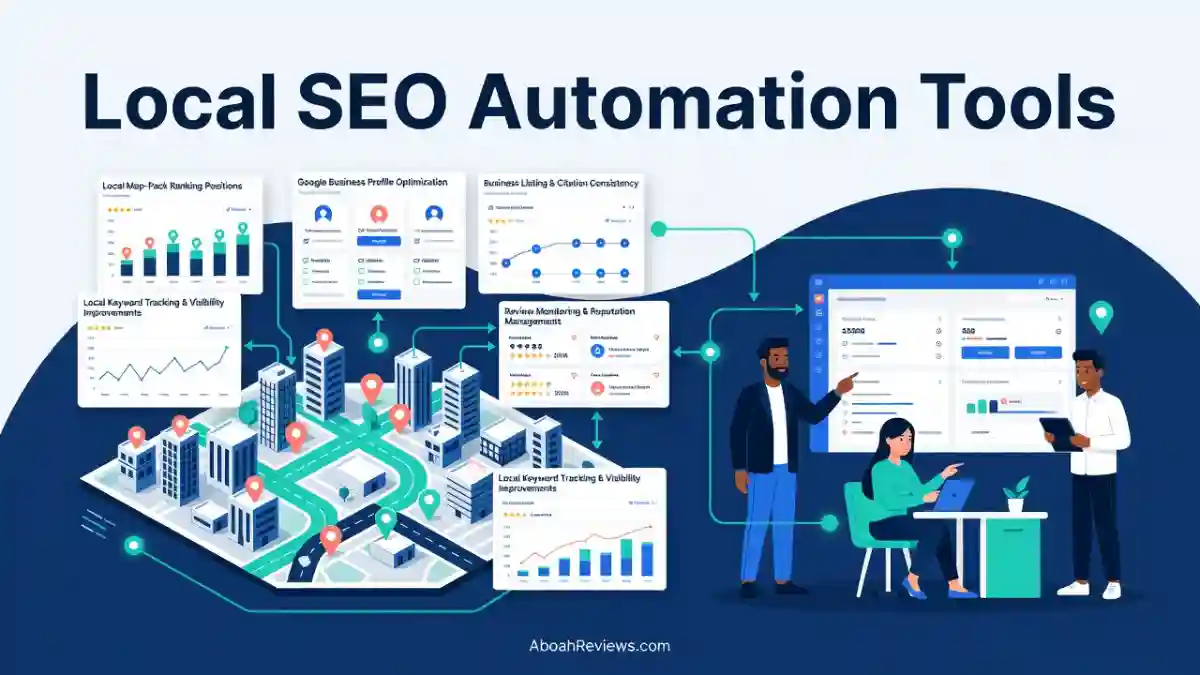
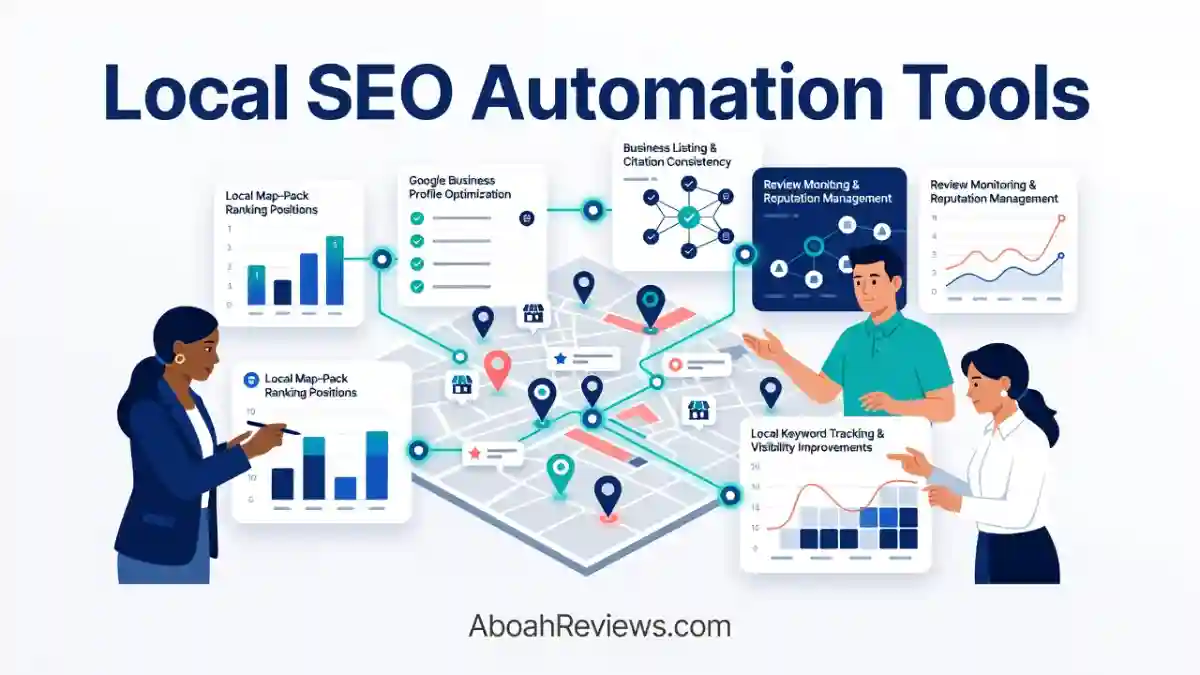
Local SEO automation tools are software platforms that handle repetitive local search tasks without requiring manual execution every time.
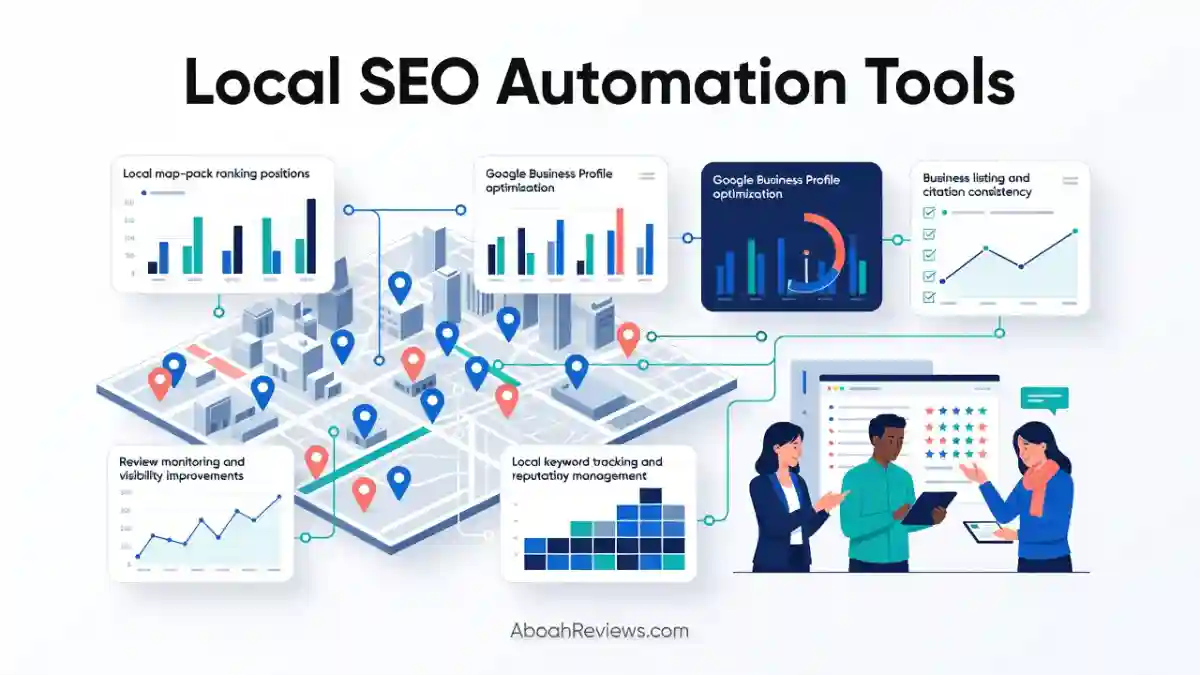
The best tools in this category automate some combination of Google Business Profile management, citation distribution and consistency monitoring, local keyword and map-pack rank tracking, review generation and response workflows, and SEO reporting.
How Local SEO Automation Works
Most local SEO automation tools connect to your Google Business Profile through the Google Business Profile API, to citation directories through direct integrations or aggregators like Data Axle and Neustar Localeze, and to search results through SERP scrapers or proprietary rank-tracking systems.
You set up your business information once, and the tool monitors, distributes, and reports changes automatically.
The important detail is that automation handles distribution and monitoring well. It handles optimization decisions poorly.
A tool can automatically push your NAP (name, address, phone number) to 100 directories. It cannot decide whether your business categories are correct, whether your service descriptions match current search intent, or whether your photo strategy is working.
Which Local SEO Tasks Should Be Automated?
- Distributing business information to citation directories
- Monitoring NAP inconsistencies across listings
- Tracking local keyword rankings and map-pack positions
- Generating scheduled Google Business Profile posts
- Monitoring incoming reviews across platforms
- Drafting review response templates
- Sending automated review request sequences
- Generating recurring local SEO reports and dashboards
- Alerting you to unauthorized Google Business Profile edits
What Still Requires Manual SEO Work?
- Choosing the right primary and secondary business categories
- Writing original Google Business Profile descriptions
- Deciding which services to highlight based on seasonal or competitive changes
- Evaluating whether a citation source is worth pursuing
- Responding to complex or negative reviews with genuine context
- Interpreting ranking changes and diagnosing causes
- Making decisions about local content strategy and page targeting
Comparison Table: Best Local SEO Automation Tools at a Glance
Pricing was checked against official vendor pages as of October 2026. Where pricing varies across sources, I have used the most commonly reported current figure and noted discrepancies.
| Tool | Best Use Case | GBP Management | Citation Automation | Geo-Grid Tracking | Review Automation | Starting Price |
|---|---|---|---|---|---|---|
| Distribb | Content + GBP posts + backlinks in one workflow | Posts and review reply drafts | No | No | Review reply drafting | $97/mo (Pro) |
| BrightLocal | All-in-one local reporting and audits | Yes (Manage tier+) | Pay-as-you-go | Yes (Local Search Grid) | Yes (Grow tier only) | $39/mo (1 location) |
| Semrush Local | Existing Semrush users needing local add-on | Yes | Yes (via Yext network) | Limited | Yes | $20/location/mo (add-on) |
| Localo | GBP optimization with guided task workflows | Yes (core feature) | Monitoring only | Yes (geo-grid) | Yes (AI responses) | $49/mo (1 profile) |
| Local Falcon | Visual map-pack rank tracking | No | No | Yes (best-in-class) | No | $24.99/mo |
| Whitespark | Citation building and cleanup | No (tracking only) | Yes (manual + tool) | Yes (rank tracker) | Yes (Reputation Builder) | From $14/mo |
| Moz Local | Affordable listing distribution | No | Yes (~90+ directories) | No | Limited | $16/location/mo |
| Yext | Enterprise multi-location listings | Yes | Yes (large network) | Location visibility reporting | Yes | $199/location/yr (Essentials) |
| Birdeye | Review and reputation management at scale | Google reviews only | No | No | Yes (full suite) | ~$299/location/mo |
| Google Business Profile | Free local SEO foundation | Yes (direct) | No | No | Manual only | Free |
Note: BrightLocal pricing varies by location count. Yext enterprise pricing is custom. Semrush Local requires a base Semrush subscription starting at approximately $139.95/month.
1. Distribb: Best Overall Local SEO Automation Tool
Distribb is the best choice if your main local SEO bottleneck is publishing consistent content, building passive backlinks, and keeping your Google Business Profile active without assembling a multi-tool workflow.
Distribb’s Pro plan at $97 a month covers Google Business Profile posts and review replies, automatic keyword research, 30 articles a month, backlinks, and AI-search visibility, all running without constant manual input.
The Accelerator plan at $495 a month includes everything in Pro, 90 articles a month, and a human reviewing every piece before it publishes.
Volume discounts apply per site: 10% off at two to five sites, 20% at six to nine, 30% at ten to nineteen, and custom pricing above twenty. There is no setup fee and no contract.
You can read my full Distribb review for a detailed breakdown of the 90-day test results. There is also a Distribb pricing page if you want to compare plans before committing.
What Distribb Does Well
Distribb combines content production, passive link acquisition, and social distribution at a price point that has no direct equivalent in the current market.
For a local business or agency that needs regular GBP posts, content published on a schedule, and backlinks coming in without a manual outreach operation, this is one of the few platforms that covers all three without requiring you to connect five separate tools.
Distribb covers citations and listings less deeply than a tool built specifically for citations. If citation auditing is a core deliverable in your service offering, pair Distribb with BrightLocal rather than using it as your only tool.
Who Should Use Distribb
Local businesses and agencies who need content publishing and GBP activity to happen automatically, and who do not need granular citation auditing or a geo-grid rank tracker as part of the same platform.
Who Should Avoid Distribb
Agencies whose clients specifically ask for citation audits, NAP consistency reports, or geo-grid rank visualization. Distribb does not currently fill those gaps.
2. BrightLocal: Best All-in-One Local SEO Platform
BrightLocal is the best choice for agencies and freelancers who need a complete local SEO reporting, auditing, citation, and review management platform under one login.
BrightLocal is a local SEO platform valued for Google Business Profile tracking and local ranking audits, positioned as the alternative to Semrush and Ahrefs for the specific niche of local search.
It is distinctive for its citation building and reputation management modules that generalist SEO tools skip.
Pricing
BrightLocal offers three plans for one location:
Track at $41/month, Manage at $54/month, and Grow at $65/month. Annual billing is about 25% cheaper.
Grow runs roughly $179 at 11 to 20 locations, $269 at 21 to 30, $449 at 41 to 50, and $899 at 100 locations.
Review monitoring and management is only available on the Grow plan. Track and Manage include no review monitoring, no review generation campaigns, and no review widgets.
Citation Builder is pay-as-you-go, starting at $3.20 per citation, or $2 with bulk credits.
What BrightLocal Does Well
BrightLocal’s Local Search Grid (geo-grid rank tracking), citation auditing, and white-label reporting are genuinely useful. The reporting is clear enough for client-facing use without heavy customization.
It is one of the few tools in this space that gives you meaningful control over reporting formats, which matters when you are running a local SEO agency.
What BrightLocal Does Poorly
Reviewers report that BrightLocal does not scale smoothly past around fifty locations.
If you are managing a large number of locations, the per-location pricing compounds quickly and enterprise tools like Yext may become a more practical option.
BrightLocal also does not write or publish content for you. It tracks and reports. If content production is part of your local SEO workflow, you will need a separate tool.
Who Should Use BrightLocal
Local SEO agencies managing one to fifty client locations who need audits, rank tracking, citation management, and review monitoring in one place.
Who Should Avoid BrightLocal
Single-location small businesses who do not need the depth of reporting BrightLocal provides, and large enterprises managing 100+ locations where per-location pricing becomes expensive.
3. Semrush Local: Best for SEO and Local Listings Combined
Semrush Local makes sense only if you are already paying for a Semrush subscription and want to add local listing management without switching platforms.
Semrush’s listing management functionality, built in partnership with Yext’s data network, lets you manage NAP data, reviews, and local pages inside the broader Semrush dashboard.
It is not sold as a standalone product. Access requires a Semrush subscription, which as of 2026 starts around $139.94/month for the entry Pro plan, with local-specific features added on top.
The Semrush Local add-on starts at $20/month per location on top of the Semrush subscription.
What Semrush Local Does Well
If you are managing technical SEO, content, keyword research, and local SEO for the same clients, having everything inside Semrush reduces context switching.
The listing management pulls from Yext’s network, which is one of the larger directory distribution systems available.
What Semrush Local Does Poorly
Its local functionality is less specialized than dedicated local tools such as BrightLocal or Whitespark.
You will not find the same depth of citation auditing, geo-grid tracking, or review workflow management that you get from tools built specifically for local SEO.
Pricing also scales quickly for multi-location businesses compared to dedicated local-only tools.
Who Should Use Semrush Local
SEO teams already paying for a Semrush plan who want basic local listing management without adding another platform to their stack.
Who Should Avoid Semrush Local
Anyone who does not already use Semrush. Adding a $139.95/month base plan plus a per-location fee to access local features does not make financial sense if local SEO is your primary focus.
4. Localo: Best for Google Business Profile Optimization
Localo is the most focused GBP optimization tool in this list, and it is the best choice for businesses or agencies who want guided, actionable recommendations for improving their Google Business Profile performance.
Localo is a local SEO platform centered on Google Business Profile management, local rank tracking, Smart Tasks, reviews, and posts.
Single Business is $49 a month ($39 a month billed annually) for one profile. Pro is $169 a month ($149 billed annually) for up to 60 profiles and 30 optimization seats. Enterprise is custom for 120+ profiles.
Localo simplified its plans in early 2026, so older third-party price lists may be out of date. Confirm pricing on Localo’s own pricing page before subscribing.
What Localo Does Well
Instead of dumping hundreds of generic recommendations at you, the platform analyzes your specific Google Business Profile, looks at your competitors, understands your local market, and then creates a personalized weekly task list.
Features include:
- Local keyword ranking tracking with geo-grid rank tracking for specific geographic points
- Google Business Profile auditing with recommendations for optimization
- Online review management including AI-generated response suggestions
- AI content publisher for creating and scheduling posts for Google Business Profiles
Localo has received positive user feedback, with 4.5 out of 5 stars on Trustpilot across 39 reviews at the time of writing.
What Localo Does Poorly
Citations Manager in Localo tracks opportunities but confirmation remains manual. It does not provide automated citation submission.
If you need full citation automation, Whitespark or Moz Local is a better fit. Localo also does not provide native Google Search Console or Looker Studio connections, which limits its usefulness as a reporting tool for agencies who need to pull everything into one dashboard.
Who Should Use Localo
Small businesses managing one Google Business Profile who want clear, guided weekly tasks rather than raw data. Agencies managing up to 60 profiles who want a clean GBP-focused workflow.
Who Should Avoid Localo
Businesses who need automated citation distribution, deep backlink analysis, or full-site technical SEO alongside their local SEO work.
5. Local Falcon: Best for Automated Local Rank Tracking
Local Falcon is the best tool in this list for visualizing exactly where a business appears in Google Maps across a geographic area, grid point by grid point.
Local Falcon maps Google Maps rankings across a grid of GPS coordinates, giving you an immediate visual picture of where a business dominates and where it disappears.
Standard plans range from $24.99 to $199.99 per month. Enterprise plans range from $499 to $4,999 per month.
What Local Falcon Does Well
The geo-grid visualization is genuinely the best in this category. For client presentations, showing a color-coded map of where a business ranks at street level is far more persuasive than a spreadsheet of keyword positions.
Local Falcon also supports Google Maps and organic result tracking, and the interface is clean enough that clients can understand the output without your explanation.
It works best as a client-facing reporting tool combined with a more operationally focused platform like BrightLocal. The visual output converts skeptical clients faster than any spreadsheet.
What Local Falcon Does Poorly
Local Falcon does not manage listings, build citations, handle reviews, or produce content. It is a single-function tool. If you use it, you will need other tools alongside it.
The credit-based pricing model can also become expensive if you run frequent scans across many locations.
Who Should Use Local Falcon
Agencies that need to demonstrate local ranking progress to clients visually, and businesses trying to understand how their Google Maps presence varies by neighborhood or service area.
Who Should Avoid Local Falcon
Businesses looking for an all-in-one local SEO platform. Local Falcon provides data, not execution.
6. Whitespark: Best for Citation Building and Cleanup
Whitespark is the best option when citation quality is your main priority, particularly when you need manually built citations rather than automated submissions.
Unlike BrightLocal, Whitespark uses modular pricing. Citation Finder costs $33 to $149/month depending on search volume. Reputation Builder runs $79/month per location. Local Platform starts at just $1/month per location.
The citation discovery is strong, and the manual citation building service (done by humans, not automated) ensures quality that automated submissions often miss.
What Whitespark Does Well
Whitespark’s manual citation building service is genuinely differentiated.
Automated citation tools push your information to directories in bulk, but they do not check whether the listing was actually approved, displayed correctly, or placed in the right category. Whitespark’s human citation builders catch those details.
What Whitespark Does Poorly
The full suite costs $128+ per month before multi-location fees, which erodes the per-tool value against unified platforms.
Whitespark’s modular pricing means you pay for each tool separately, which adds up quickly if you need citation finding, rank tracking, and reputation management at the same time.
Who Should Use Whitespark
Local SEO specialists who prioritize citation accuracy over speed, agencies whose clients have significant NAP inconsistency problems, and businesses recovering from a messy citation history.
Who Should Avoid Whitespark
Small businesses who need a single all-in-one platform at a fixed monthly price. The modular structure can be confusing and the combined cost can exceed more complete platforms.
7. Moz Local: Best for Business Listing Management
Moz Local is the most affordable automated listing distribution tool in this list, making it the right starting point for single-location businesses that need consistent directory presence without a large monthly budget.
Moz Local focuses on syncing and monitoring NAP data across a curated set of roughly 90+ directories, positioned as a lighter, more affordable option than full enterprise suites.
As of 2026, entry pricing is reported at $16/month, making it one of the cheaper starting points, though it offers less multi-location bulk tooling than platforms like Synup or Yext.
However, pricing varies across sources. Three pricing tiers have been reported: Lite at $16/month, Preferred at $24/month, and Elite at $33/month per location, with an annual billing discount available. Verify current pricing directly on Moz’s website before subscribing, as figures have changed.
What Moz Local Does Well
For a single-location business that simply needs its information consistent across the major directories and does not want to manage citations manually, Moz Local provides a straightforward automated sync at a low cost. The setup is simple and does not require significant SEO knowledge.
What Moz Local Does Poorly
Moz Local has a smaller publisher network than Yext and does not offer GBP post automation. It also lacks the geo-grid rank tracking, detailed review management, and in-depth reporting that agencies typically need for client work.
Who Should Use Moz Local
Single-location small businesses who need basic listing consistency without a complicated setup or high monthly cost.
Who Should Avoid Moz Local
Agencies managing multiple clients or businesses that need full-featured review management, rank tracking, and reporting alongside their listing distribution.
8. Yext: Best for Enterprise and Multi-Location SEO
Yext is the most complete enterprise listing management platform available, but it is priced and structured for businesses with 50 or more locations, not for small businesses or single-location operators.
Yext pushes verified listing data to a large directory network in real time and is one of the more enterprise-oriented platforms in this category, with review management and local pages layered in.
Yext self-serve tiers are reported at $199, $449, $499, and $999 per year per location on annual billing only. Enterprise pricing is custom.
Yext’s official pricing page was not loading at time of writing, so these figures have been sourced from multiple third-party sources and could not be independently verified directly from Yext.
What Yext Does Well
Yext’s directory network is one of the largest available. Review management and local pages are layered into the core platform, making it more complete than many enterprise alternatives.
For a brand managing 100+ locations, having a single system that syncs all listings, handles reviews, and produces location-level reporting has real operational value.
What Yext Does Poorly
Pricing is per location and scales fast. Annual lock-in is the norm. For small agencies or businesses that want to try before committing at scale, Yext’s structure creates friction.
There is also a dependency risk: if you cancel Yext, your listings may revert to whatever was there before, since Yext maintains those listings through its own network connection rather than making permanent edits directly on each directory.
Who Should Use Yext
Enterprise brands with 50 or more locations that need consistent, real-time listing data across a large directory network and have budget to match.
Who Should Avoid Yext
Small businesses, freelancers, and agencies with fewer than ten locations. The cost per location and the annual commitment structure make it difficult to justify at smaller scale.
9. Birdeye: Best for Review and Reputation Automation
Birdeye is the strongest platform in this list for businesses where online reviews are a primary driver of new customers, particularly in healthcare, home services, automotive, and hospitality.
Birdeye combines review generation, listings monitoring across 200+ sites, AI-drafted review responses, and messaging in a single platform, with per-location pricing built for multi-location reporting.
As of a February 2026 pricing update, plans run Starter at $299/location/month, Growth at $349, and Dominate at $449, with a custom Premium tier for four or more locations.
Birdeye does not publish pricing directly on its website. The figures above come from third-party sources and could not be independently verified from Birdeye’s own pricing page.
What Birdeye Does Well
Beyond reviews, Birdeye offers surveys, referral programs, and webchat, making it more of a customer experience platform than purely a review tool.
For multi-location businesses where reviews are a core acquisition channel, the combination of automated review requests, centralized inbox, and sentiment analysis provides genuine operational value.
What Birdeye Does Poorly
Birdeye’s starting price is among the highest in this list. At $299/location/month, it is difficult to justify for a business with one location and modest review volume.
It also does not provide the geo-grid rank tracking, technical citation auditing, or deep local reporting that agencies typically need alongside reputation management.
Who Should Use Birdeye
Multi-location businesses in review-driven industries where reputation is a direct revenue factor and where the volume of incoming reviews justifies an automated management platform.
Who Should Avoid Birdeye
Single-location small businesses, solo practitioners, and agencies looking for a complete local SEO platform rather than a reputation management system.
10. Google Business Profile: Best Free Foundation for Local SEO
Google Business Profile is the starting point for any local SEO strategy. Every other tool in this list builds on top of it, but none of them replaces it.
Google Business Profile is free, with no meaningful limitations. Every feature in GBP is available at no cost: posts, photos, Q&A, product and service listings, booking integration, and messaging.
GBP has a direct line to Google’s local algorithm. Updates made in GBP push directly to Search and Maps.
What Google Business Profile Does Well
It is free, directly connected to Google’s local ranking systems, and gives you control over how your business appears across Google Search and Google Maps.
Performance data is built in, and you can see how your profile compares to competitors in the same category. For a business just starting local SEO, this is where all work begins.
What Google Business Profile Does Poorly
Google Business Profile does not offer automated citation distribution, rank tracking, review request workflows, or cross-platform monitoring. It also does not produce the kind of formatted reporting that agencies need for client presentations. It is a foundation, not a complete local SEO management system.
Who Should Use Google Business Profile
Every local business, full stop. Even businesses using every other tool in this list should manage their Google Business Profile directly rather than relying entirely on third-party tools to make changes.
How to Choose the Best Local SEO Automation Software
The best local SEO automation tool depends on your primary workflow bottleneck, not on which platform has the most features.
Google Business Profile Management and Optimization
If your GBP is incomplete, inconsistently updated, or not competitive with other listings in your area, start with Localo for guided optimization or Distribb if you also need regular content published to the profile automatically.
Local Keyword and Map-Pack Rank Tracking
For visual geo-grid tracking, Local Falcon is the strongest dedicated tool. BrightLocal includes a Local Search Grid that covers most agencies’ needs without requiring a separate subscription.
Citation Building and NAP Consistency
Whitespark leads on citations for quality. Moz Local works for affordable automated distribution. BrightLocal covers both monitoring and pay-as-you-go citation building inside one platform.
Review Monitoring and Response Workflows
Birdeye is the most complete platform for high-volume review management. BrightLocal’s Grow plan covers review monitoring at a lower price point for agencies. Localo includes review response drafting on its paid plans.
Automated Audits and SEO Reporting
BrightLocal has the strongest automated local SEO reporting in this list. White-label reports are available on higher tiers. For agencies who need reporting that pulls everything together, BrightLocal is the default choice. For a broader view of automated SEO reporting beyond local, that guide covers the full landscape.
Multi-Location Support, Integrations, and API Access
Yext and BrightLocal both support large location counts, but with different strengths. Yext suits enterprise directory sync at scale. BrightLocal suits agency reporting and auditing across multiple clients. Neither handles content production. You will likely need Distribb or a separate content tool alongside either platform.
Pricing Per Location, User, or Tracked Keyword
Prices in this category run from $1 a month per location to $599 a month, so the right pick depends on which of the four core jobs you need done.
Budget first for the task that costs you the most time, then add tools from there.
Best Local SEO Automation Tools by Use Case
Best for Small Businesses with One Location
Localo or Google Business Profile (free) + Moz Local. A single-location business does not need enterprise pricing. Start with your GBP directly, add Localo for guided optimization at $49/month, and add Moz Local at $16/month for affordable listing distribution. Total: around $65/month for a complete small-business local SEO stack.
Best for Local SEO Agencies
BrightLocal + Distribb. BrightLocal handles auditing, rank tracking, citations, and white-label reporting. Distribb handles content publishing, GBP posts, and backlinks. Together they cover what agencies need without requiring five separate tools. For more on building agency workflows, the local SEO automation tools for agencies guide covers the combination in more detail.
Best for Businesses with Multiple Locations
BrightLocal (up to 50 locations) or Yext (50+ locations). BrightLocal is the more practical choice for agencies managing between 5 and 50 client locations. Yext becomes worth considering when you need a large directory network and have budget to match the per-location cost.
Best for Google Maps Ranking Improvements
Localo + Local Falcon. Localo provides actionable GBP optimization tasks that directly affect Maps rankings. Local Falcon shows you exactly where those improvements are showing up at the neighborhood level. Used together, they give you both the optimization guidance and the visual proof of progress.
Best for Local Citations and Business Listings
Whitespark for quality. Moz Local for affordability. If your citation history is messy and you need human-quality cleanup, Whitespark is the right call. If you are starting from scratch and need consistent automated distribution at a low cost, Moz Local handles it.
Best for Automated Content and Location Pages
Distribb. Distribb’s Pro plan covers automatic keyword research, 30 articles a month, and GBP posts running without manual input. For agencies producing location-specific content at scale, this removes one of the most time-consuming parts of the local SEO workflow.
For a broader look at how this fits into a full automation strategy, the SEO automation guide explains the framework.
Best Free Local SEO Automation Tools
Google Business Profile is the only genuinely useful free tool in this category. Most tools offer a free trial (BrightLocal offers 14 days, Localo offers 14 days, Distribb offers 3 days) but no permanent free tier with meaningful automation.
Whitespark offers a free tier for its Local Platform at $1/month per location, which is close to free, but the core citation and rank tracking tools are paid.
Pros and Cons of Local SEO Automation
Benefits
- Time savings on repetitive tasks: Data collection, citation monitoring, rank tracking, and report generation take significantly less manual time when automated. In my 21-day comparison of manual and automated SEO workflows, simple data collection and reporting were the easiest tasks to automate with the clearest time savings.
- Consistency: Automated tools check citations and business information on a schedule you would not maintain manually.
- Scale: Managing 20 or 50 locations manually is not practical. Automation makes it manageable.
- Faster client reporting: Automated reports remove several hours of formatting work per client per month.
- Alerts and monitoring: Automated alerts for unauthorized GBP edits, new reviews, or citation inconsistencies catch problems before they affect rankings.
Limitations
- Automation does not substitute for strategy: A tool can publish a GBP post automatically. It cannot decide whether the post is relevant to what local customers are searching for this month.
- Review responses require human judgment: Automated review response templates work for positive reviews. They frequently fail for negative or complex reviews that require genuine context and empathy.
- Citation quality varies by tool: Automated citation submissions are faster but sometimes result in unconfirmed or incorrectly formatted listings. Manual citation building catches more errors.
- Over-reliance creates cleanup work: I found this directly in my own testing. Automation that runs without review can produce irrelevant content, overlapping page targeting, and recommendations that look technically correct but do not serve the actual SEO goal.
Why Automation Does Not Guarantee Higher Local Rankings
Google’s local ranking system uses three primary factors: relevance, distance, and prominence.
Automation can help with relevance (keeping your profile complete and active) and prominence (consistent citations and review volume), but it cannot change your physical location relative to a searcher.
Also, it cannot substitute for the genuine signals that come from real customer engagement, authoritative backlinks, and content that accurately reflects what your business actually does.
Local SEO automation removes repetitive work. It does not remove the need for strategic judgment.
How to Automate a Local SEO Workflow
Here is the sequence I would follow when setting up a local SEO automation workflow from scratch.
Step 1: Audit Existing Business Listings and Website Pages
Before automating anything, find out what you are working with. Use BrightLocal’s citation audit or Whitespark’s Citation Finder to identify where your business information is incorrect, incomplete, or missing.
Check your website’s location pages for duplicate content and thin pages that do not serve real search intent.
Step 2: Optimize the Google Business Profile
Complete every section of your GBP directly before connecting third-party tools. This means primary and secondary categories, full service list, business description with natural keyword usage, photos, Q&A, and posts.
Tools like Localo can guide you through this with prioritized task lists if you are not sure where to start.
Step 3: Set Up Local Keyword and Geo-Grid Tracking
Connect BrightLocal or Local Falcon to start tracking your map-pack positions before making changes.
You need a baseline to measure against. Without pre-automation rank data, you cannot determine whether your workflow actually improved anything.
Step 4: Fix Inconsistent Citations and Business Information
Use your citation audit results to correct NAP inconsistencies. For a small number of high-priority directories, fix listings manually.
For a larger distribution, Moz Local or Whitespark can push consistent information automatically. Do not automate distribution before fixing the information you are distributing.
Step 5: Establish Compliant Review Request and Response Workflows
Set up automated review request sequences through your chosen tool (Birdeye, BrightLocal Grow, or Localo). Review Google’s guidelines on review solicitation before running any sequence.
Never offer incentives for reviews, and never request reviews only from customers you believe will leave positive feedback.
Step 6: Automate Recurring Reports and Alerts
Set up weekly or monthly automated reports in BrightLocal or your chosen platform. Set alerts for GBP changes, new negative reviews, and significant ranking drops.
The goal is to find out about problems automatically rather than discovering them when a client calls to ask why their rankings dropped.
Step 7: Review Leads, Calls, Conversions and Local Visibility Monthly
Automation should reduce how much time you spend on data collection, not eliminate the time you spend on analysis. Every month, look at call volume, GBP interaction data, and rank changes together.
If a GBP optimization improved impressions but did not improve calls, that tells you something automation cannot figure out on its own.
For a complete look at how this type of structured approach fits into broader SEO workflows, the local SEO automation overview covers the methodology in more detail.
How Local SEO Relates to AI Search Visibility in 2026
This is a topic that has come up repeatedly since Google started surfacing AI Overviews for local queries.
When I spent 30 days monitoring AI search visibility across 50+ search prompts, one of the clearest findings was how much variation there is between closely related queries.
A business that appears prominently in AI Overviews for “best plumber in [city]” might not appear at all for “emergency plumber near me,” even when both queries seem to target the same intent.
For local businesses, this means that AI search visibility is not a replacement for Google Maps visibility. They are different surfaces with different signals.
Local SEO automation tools optimize primarily for Google Maps and traditional organic local results. AI visibility in platforms like Google AI Overviews, ChatGPT, and Perplexity draws on a different set of signals, including entity recognition, content authority, and third-party references.
No local SEO automation tool currently guarantees AI citation. If a vendor claims their tool will get you into AI Overviews, treat that with skepticism.
What a well-run local SEO workflow does is build the kind of profile, citation consistency, and content authority that makes a business more likely to be recognized as a relevant entity in AI systems. That is different from guaranteed placement.
For more on how to think about this, the AI search visibility guide explains what can be influenced and what cannot.
Final Verdict: Which Local SEO Automation Tool Should You Choose?
- Agencies managing multiple clients: BrightLocal is still the default starting point for auditing, rank tracking, citation management, and white-label reporting. Add Distribb if your clients need regular content and GBP posts without your team producing them manually.
- Small businesses with one location: Start with Google Business Profile directly, then add Localo at $49/month for guided optimization. Add Moz Local at $16/month for automated listing distribution. That combination covers the core local SEO tasks at under $70/month combined.
- Multi-location brands: BrightLocal handles up to around 50 locations practically. Beyond that, Yext becomes worth evaluating, particularly if directory network scale and real-time sync matter more than local SEO reporting depth.
- Businesses prioritizing Google Maps visibility: Localo and Local Falcon together give you optimization guidance and visual proof of ranking progress at the neighborhood level.
- Review-driven industries: Birdeye is the most complete platform for automating review generation and management, though the cost per location is high and needs to be justified by the volume of reviews your business generates.
Choose based on your workflow requirements and total cost, not feature count. A tool that automates five things you do not need is worth less than a tool that automates one thing that currently takes you three hours a week. That is still the main lesson from every workflow test I have run.
Frequently Asked Questions About Local SEO
What are the best local SEO tools?
The best local SEO tools depend on your specific needs. BrightLocal is the best all-in-one platform for agencies. Localo is the best tool specifically for Google Business Profile optimization. Local Falcon leads on geo-grid rank tracking. Whitespark is strongest for citation building. Distribb is the best option for automating local content and GBP posts together.
Is SEO dead now with AI?
No. AI search surfaces like Google AI Overviews, ChatGPT, and Perplexity have changed how some queries are answered, but Google Search and Google Maps remain the primary surfaces where local businesses gain or lose customers. AI visibility is an additional consideration, not a replacement. Local SEO automation tools still address the core signals that drive local rankings.
What are the best SEO automation tools?
For local SEO specifically, BrightLocal, Localo, and Distribb cover the most ground at reasonable prices. For broader SEO automation including technical audits, keyword research, content optimization, and reporting, the SEO automation tools overview covers the full category.
What is the best local SEO software for 2026?
BrightLocal is the best all-in-one local SEO software for agencies in 2026. Localo is the best GBP-focused platform for small businesses and freelancers. There is no single tool that covers every local SEO task well, so the best answer depends on whether your priority is auditing, listing management, review management, rank tracking, or content production.
How can I do local SEO?
Start by claiming and fully completing your Google Business Profile. Then build consistent citations across major directories. Track your map-pack rankings so you have a baseline. Actively manage reviews by requesting them after positive customer interactions. Produce location-relevant content on your website. Use local SEO automation tools to handle the repetitive monitoring and reporting, and spend your time on the strategic decisions those tools cannot make for you.
How much should I pay for local SEO?
For a single location using self-serve tools, a practical budget is $50 to $100/month covering GBP optimization, listing management, and basic rank tracking. For agencies providing local SEO as a service, tool costs typically range from $150 to $500/month depending on the number of client locations and the depth of reporting required. For enterprise multi-location brands, costs scale significantly with location count. Published prices across this category run from $1 a month per location to $599 a month depending on which tasks you need covered.
What will local SEO look like in 2026 and beyond?
AI Overviews are appearing more frequently for local queries, which means that businesses need to think about both traditional map-pack visibility and AI entity recognition. Citation consistency, profile completeness, and review authority remain core ranking signals. The main change is that AI systems are increasingly drawing on structured business information and authoritative third-party references, which makes the foundational local SEO work more important, not less.
What is the difference between SEO and local SEO?
General SEO optimizes for visibility in broad organic search results. Local SEO optimizes specifically for location-based queries and the Google Maps local pack. Local SEO involves signals that general SEO does not: Google Business Profile optimization, NAP citation consistency across directories, proximity to the searcher, and review signals. The tools, workflows, and metrics are different, though there is significant overlap in technical and content fundamentals.
Disclaimer:
AboahReviews.com covers SEO automation, AI search visibility, and local SEO tools from an independent perspective. Where pricing and features have been sourced from third parties rather than official vendor pages, this is noted in the article. Pricing for tools including BrightLocal, Localo and Yext should be confirmed directly with the vendor before purchasing.

- 10 Best Local SEO Automation Tools in 2026 (Tested and Compared) - October 23, 2026
- 10 Best SEO Automation Tools I Tested in 2026 - October 22, 2026
- HighSoftware99 Review 2026: Is It Legit or a Risk to Your Website? - October 21, 2026