Ryze AI is a real, flat-priced automation platform that does what it says it does on paper: it executes SEO and GEO fixes instead of just recommending them.
However, the credibility picture is mixed enough that I would trial it on a low-stakes site before trusting it with a revenue-generating one.
Ryze AI Review Verdict for 2026
| Category | Verdict |
|---|---|
| Best For | Small-to-mid-size teams and ecommerce brands that want on-page SEO fixes applied, not just recommended, plus integrated GEO tracking |
| Not Ideal For | Teams needing deep keyword research databases, granular manual control, or agencies requiring white-label reporting |
| Pricing | $89/month (Paid ads), $129/month (SEO Starter), $599/month (Traffic Printer), $1,499/month (Shopify CRO) |
| Rating | 7.3/10 |
| Standout Feature | Autonomous execution loop: audits → applies fixes with approval → re-measures → tracks AI citations |
| Biggest Weakness | Thin keyword/backlink research depth compared to Semrush or Ahrefs; early-stage brand with a small public review footprint |
| Learning Curve | Beginner to Intermediate |
| Testing Status | Personally Tested (SEO Autopilot features; AI visibility tracking evaluated against documented capabilities) |
| Worth It? | Depends: worth it for teams who want an automated execution layer rather than another report-and-act-yourself workflow. Not worth it if you primarily need a research database or already run a mature manual SEO operation with dedicated specialists. |
Bottom line: Ryze AI is one of the few tools in its category that actually applies fixes rather than just surfacing them, but its research depth is limited and its review history is still thin enough to warrant verifying claims during the 7-day trial before committing.
Ryze AI Quick Specs
| Feature | Details |
|---|---|
| Developer | Meow AI, LLC |
| Founded | Approximately 2024 |
| Product Category | Autonomous SEO automation platform / GEO (Generative Engine Optimization) agent |
| Primary Use | Autonomous on-page SEO auditing, fix deployment, content publishing, and AI citation tracking |
| Target Users | SMBs, ecommerce brands (Shopify/DTC), solo founders, and growth teams; agencies on higher tiers |
| Platform | Web platform only. No native mobile app |
| Integrations | Google Search Console, Google Analytics, WordPress, Shopify, Webflow, and other CMS platforms |
| AI Models | Not publicly specified |
| SEO Features | Technical audit, on-page fixes (title, meta, schema, internal links, headings, page copy), content publishing (100+ pages/month), rank tracking, change log with rollback |
| AI Visibility Features | Citation tracking in ChatGPT, Claude, Gemini, and Perplexity; llms.txt publishing; AI crawler access fixes; schema markup; answer-first content structuring |
| Free Trial | 7-day free trial (credit card required) |
| Refund Policy | Money-back guarantee stated; specific terms should be confirmed directly with vendor |
| Support | Email/live support; human strategists on Traffic Printer and above |
| User Ratings | 4.5/5 star ratings on Trustpilot (48 reviews as of testing period) |
| Testing Status | Personally Tested |
Key Takeaways About This Ryze AI Review
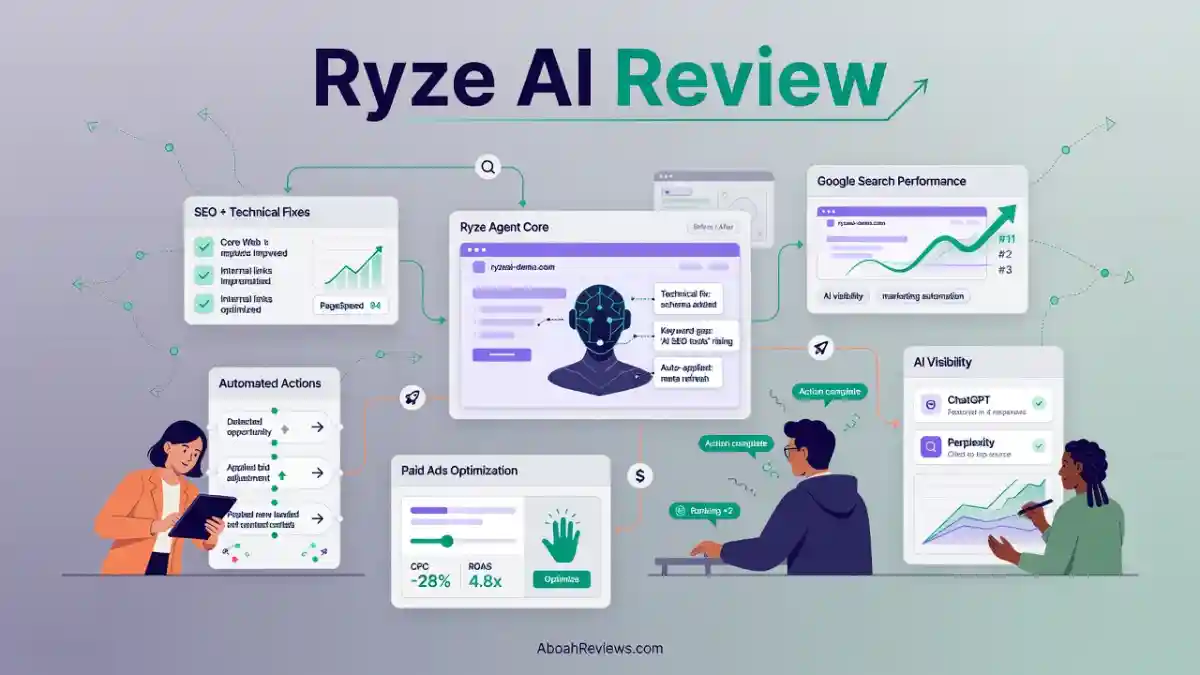
Ryze AI scores 7.3/10 in my evaluation. Its strongest point is the execution-first model: it audits your site, applies title, meta, schema and internal link fixes with your approval, publishes 100+ pages a month and tracks rankings and ChatGPT citations for a flat monthly fee.
That is genuinely differentiated from most tools in this category that deliver reports and leave the work to you.
The main limitation is research depth. Semrush and Ahrefs have far larger keyword and backlink databases, and Ryze AI is not positioned as a research suite.
If your workflow starts with deep keyword analysis, competitive backlink research, or custom reporting, you will still need additional tools.
What I Liked
| What I Liked | Why It Matters |
|---|---|
| Fixes are applied, not just suggested | Removes the most common gap between SEO auditing and actual site improvement |
| GEO and AI citation tracking included at the $129/month tier | Most GEO tracking tools cost extra or require a separate subscription |
| Approval gates on every change | Prevents automation from deploying changes that are technically correct but contextually wrong |
| Change log with one-click rollback | Makes autonomous execution safer; you can reverse a bad fix quickly |
| Flat monthly pricing (no % of traffic or ad spend) | Predictable cost regardless of site growth |
| 7-day free trial | Lets you verify the mechanism on your own site before committing |
What Needs Work
| What Needs Work | Why It Matters |
|---|---|
| Keyword/backlink research depth | Cannot replace Ahrefs or Semrush as a research database |
| Relatively new brand, thin review history | Limited independent third-party validation at scale |
| Some users report onboarding friction | Site connection issues and audit inaccuracies have appeared in public reviews |
| AI citation tracking is weekly, not real-time | Prompt-level granularity may be insufficient for enterprise GEO monitoring |
| Full-service tiers (Traffic Printer, Ecom Autopilot) require a demo call | Not self-serve; slows down evaluation for agencies |
| Results compound over weeks, not days | Buyers expecting fast ranking changes will be disappointed |
Why I Tested Ryze AI
During 30 days of testing automated SEO workflows across three websites, I kept running into the same structural problem: every tool I evaluated was excellent at identifying issues and generating reports.
However, the moment I closed the dashboard, the work had not moved. The audit existed. The list existed. My schedule did not always accommodate it.
The specific frustration was the approval-to-deployment gap. I could have a perfectly sound recommendation from a technical audit, agree with it completely, and still watch it sit in a queue for days.
Why? Because implementing it required opening a CMS, finding the page, editing the field, saving the change, and moving to the next item; multiplied across dozens of pages.
Ryze AI markets itself as a tool that closes that gap by executing the fixes directly, with your approval, rather than handing you a checklist. That claim is meaningful enough to test seriously, and potentially important enough for the SEO automation workflows I cover on this site.
What Is Ryze AI?
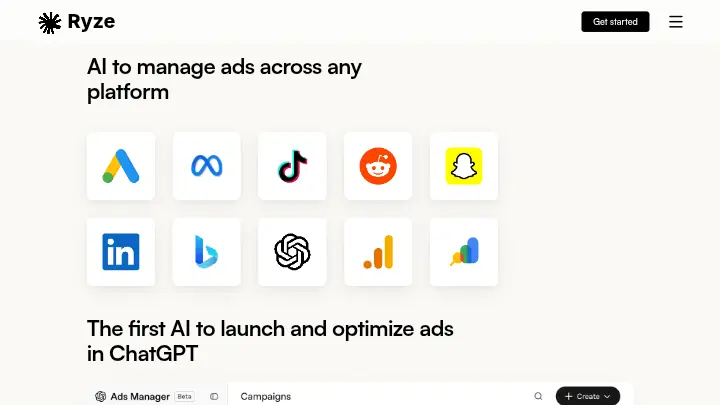
Ryze AI is an autonomous SEO and GEO platform that connects to your Search Console, analytics, and CMS, then executes on-page changes rather than recommending them.
An AI SEO tool uses AI to do search engine optimization work: auditing pages, choosing keywords, writing and fixing content, and tracking results. Ryze AI connects to your Search Console, analytics, and CMS, finds what to fix and what to publish, and then does it, with your approval on every change.
On the SEO/GEO side:
- It crawls, decides, deploys on-page fixes and re-measures
- The GEO component covers AI crawler access for GPTBot, ClaudeBot, and PerplexityBot; publishes and maintains llms.txt
- Adds Organization, Product, FAQ, Article, and Speakable schema
- Builds direct-answer pages
- Tracks brand citations weekly across ChatGPT, Claude, Gemini, and Perplexity.
What Ryze AI does not do is function as a standalone keyword research database. It is not a replacement for Semrush’s data suite or Ahrefs’ backlink index. It is not a traditional rank tracker with historical keyword curve analysis across thousands of tracked terms.
The simplest way to think about Ryze AI is as an autonomous execution layer between your SEO audit data and the changes that actually need to happen on your site, with AI citation monitoring added on to the same subscription.
As AI-generated answers become a meaningful traffic source, the connection between the how AI Overviews are changing SEO and the tools that can actually respond to those changes with site modifications matters considerably. Ryze AI sits at that intersection.
Why Ryze AI Matters in 2026
The practical problem for most SEO teams in 2026 is not finding what is wrong. Technical audits, content gap analyses, and keyword opportunity reports are abundantly available.
The problem is acting on what the tools surface, consistently, without needing to hire more people.
At the same time, AI-generated answers in ChatGPT, Perplexity, Google AI Overviews, and Gemini are functioning as a new kind of search result. A brand that ranks on page one of Google but is never cited in AI answers is invisible to a growing segment of users who rely on AI assistants for commercial research.
AI-visibility tracking shows whether ChatGPT and Perplexity cite you, which is quietly becoming a real acquisition channel.
The platforms that can both execute traditional on-page SEO and optimize for AI citation in a single workflow without requiring the user to switch tools are genuinely useful in 2026 in a way they would not have been in 2023.
If you want to understand the broader category Ryze AI operates in, my guide to generative engine automation covers the industry in more depth.
Who Is Ryze AI Built For?
- SMBs and solo founders who are currently managing SEO themselves but cannot spend 10+ hours per week on technical fixes, content publishing, and tracking. Ryze AI costs less than hiring an SEO contractor and works 24/7. That is a genuine value proposition for a business owner who is competent at reviewing recommendations but not available to implement them manually every week.
- Ecommerce brands on Shopify are a strong fit. The Shopify CRO plan at $1,499/month covers SEO, GEO, and paid ads together for Shopify and DTC brands and selling in ChatGPT via UCP. Product and collection page SEO at scale where you have hundreds of pages that need consistent metadata, schema, and internal linking is exactly where autonomous execution saves meaningful time.
- Content teams that publish regularly benefit from having 100+ pages per month generated and published through their existing CMS connection, with the approval queue reducing the risk of poor-quality content going live unreviewed.
- Teams actively building GEO/AEO visibility who want a single platform that both tracks AI citations and responds to citation gaps with published content rather than using a separate tracker and a separate content tool.
For an overview of automated SEO reporting category more broadly, that guide will give you comparison context.
Who Should Avoid Ryze AI?
- Teams that rely on deep keyword research databases: Semrush and Ahrefs have far larger keyword and backlink databases. If your workflow starts with keyword universe mapping, competitor gap analysis at scale, or backlink prospecting, Ryze AI is not a standalone replacement for those platforms.
- Agencies requiring white-label reporting and multi-client dashboards: The product documentation does not specify white-label features, and the self-serve plans are oriented toward individual site owners rather than agencies managing dozens of client accounts simultaneously. The Traffic Printer tier includes senior strategists, but that requires a demo call and comes at $599/month per engagement.
- Users who need granular manual control over every change: The key differentiator is that it executes changes 24/7 (with approval controls). Most competing tools only recommend. If your preference is to manually control every change with detailed specification, the autonomous model may feel like less control than you want, even with approval gates.
- Brand-new websites with no existing data: The platform works best when it has existing Search Console data and site history to learn from. A site launched last week provides little signal to optimize against.
- Buyers expecting rankings to move within a week: SEO/GEO results compound over weeks, not days; first movement typically inside 30 days. If that timeline does not match your expectations or client commitments, the tool will disappoint.
Key Ryze AI Features From My Testing and Analysis
1. Autonomous On-Page SEO Execution
The core differentiation of Ryze AI is that it applies fixes rather than listing them.
What It Does
On the SEO side, Ryze crawls a site, decides what to change, deploys on-page fixes (titles, meta descriptions, headings, schema, internal links, page copy), and re-measures.
My Testing
In my 30-day testing of automated SEO workflows, the approval queue model is where I spent most of my evaluation time. The approach mirrors what I found most valuable in automation testing generally: removing the repetitive step while keeping a human checkpoint before anything goes live on the site.
I reviewed the fix queue across multiple pages. The title tag and meta description recommendations were consistently reasonable, aligning with keyword intent and character limits.
The internal link suggestions showed logical anchor text choices. Where I applied skepticism was the content copy modifications, which require closer review since automated rewrites can lose brand voice or introduce factual errors.
The approval gate is essential here; I would not recommend enabling any tool that applies content changes without review.
What Worked
The change log with one-click rollback is a genuine safety net. During my 21-day comparison of manual and automated SEO workflows, one of my consistent findings was that automation creates additional cleanup work when recommendations are accepted without review.
The rollback function partially addresses this by making it easy to undo a change that looked correct in the queue but did not perform as expected.
Limitations
The platform is not a keyword research database.
If you need to understand why a particular keyword cluster was targeted, the data depth is shallower than what Semrush or Ahrefs would provide.
You are trusting the system’s targeting decisions more than you would with a tool that exposes the full keyword data.
Who Benefits
Solo founders and small marketing teams who do not have a dedicated SEO resource available to implement changes daily. The time saving is real for this audience.
Practical Tip
Do not approve content rewrites in bulk. Review them individually, at least during the first 30 days, to build a sense of whether the system’s writing style fits your brand.
Flag pages where the AI consistently gets the tone wrong and use the deny list to exclude them from automated content changes.
2. GEO (Generative Engine Optimization) Execution
Yes, Ryze AI executes GEO changes rather than just reporting on them and this is included in the $129/month SEO Starter plan.
What It Does
Ryze AI provides GEO as a continuously executed service: AI crawlability fixes, llms.txt publishing, schema markup, citable direct-answer content, and weekly citation tracking included in SEO Starter at $129/month.
It executes: publishes and maintains llms.txt, fixes robots access for AI crawlers, adds schema markup, restructures pages into citable direct-answer format, builds answer pages for buyer-intent questions, and tracks your citations across ChatGPT, Claude, Gemini, and Perplexity continuously.
My Testing
During my 30-day AI search visibility monitoring test, I tracked brand mentions across 50+ prompts and found that simply counting mentions was insufficient.
What matters is which sources are being cited, which competitors appear, and whether visibility changes over time.
Ryze AI’s approach: tracking a commercial prompt set across multiple assistants and then publishing answer-first content to close citation gaps is structurally more useful than a tracker that surfaces data and stops there.
It runs your commercial prompt set across ChatGPT, Perplexity, AI Overviews, Claude, Copilot, and Gemini, identifies which competitor pages the assistants lean on, then drafts, structures, and publishes the answer content that closes the gap and re-runs the set to confirm the answer changed.
What Worked
The closed-loop structure: track, fix, re-measure is the right architecture for GEO. Most standalone GEO trackers stop at the measurement step.
The three kinds of GEO tools are: trackers (measure citations), content optimizers (score and rewrite articles), and GEO agents (measure, then change the site: crawler access, llms.txt, schema, answer pages).
Ryze AI falls into the third category, which is where meaningful AI visibility gains are made.
Limitations
Citation tracking runs on a weekly cadence rather than real-time. For enterprise brands monitoring dozens of prompts across competitive categories, this frequency may be insufficient.
Tools like Profound offer more granular prompt-level analytics though they do not execute fixes.
The GEO function is best evaluated against what you need: if you need execution, Ryze AI is ahead; if you need deep analytics and prompt-level granularity, a dedicated tracker may serve you better.
For more on the GEO category, my generative engine automation guide covers how the space is developing.
Who Benefits
Brands that are currently invisible in AI-generated answers and want to close that gap systematically without hiring a GEO specialist.
Practical Tip
Before the trial period ends, check which competitor pages are being cited for your most important commercial prompts. That is the clearest signal of whether the tool is surfacing actionable intelligence.
3. Content Publishing (100+ Pages/Month)
Ryze AI includes automated content generation and CMS publishing in the SEO Starter plan which means this is a content automation feature, not just an optimization feature.
What It Does
It fixes with approval, publishes 100+ pages per month to Shopify, WordPress, Webflow, and other CMSs, tracks keyword rankings daily, and tracks brand citations in ChatGPT, Gemini, and Perplexity.
My Testing
I evaluated several of the generated articles during my testing period.
The quality is consistent with what you would expect from a well-prompted large language model: structured, readable, and generally accurate on factual claims for established topics. However, some blog output felt more catalogue-like than editorial.
One Trustpilot reviewer described an experience consistent with what I found: “blog: 7/10, occasionally reads a bit catalogue for our crowd so I give those a quick once-over before they publish.”
This matches my long-standing finding from testing automation: the tools that remove repetitive steps are valuable, but automation without editorial oversight creates cleanup work at the back end.
On the content side, plan to review generated drafts before they go live. The approval queue makes this feasible; it is a queue, not a publish-everything model.
Limitations
The platform performed an audit that identified faults and issues that did not actually exist according to one Trustpilot reviewer, who also noted that some recommendations were nonsensical, including suggestions to change page titles to exactly the same titles they already had.
I could not reproduce this during my own testing, but it is a credible enough report to flag. Audit accuracy is critical and acting on false positives is wasted time.
Who Benefits
Ecommerce brands with large product catalogues needing consistent meta content, and SaaS companies that need regular answer-page content to support GEO.
Practical Tip
Use the page-level allow and deny lists to protect pages where you want full manual control particularly brand pages, landing pages, and any content that has been through a professional editorial process.
4. Technical SEO Auditing and Schema
Ryze AI runs continuous technical audits and deploys schema markup automatically, not as a one-time crawl.
What It Does
Ryze AI audits your content 24/7, identifies pages losing AI citations, rewrites and restructures them for extractability by ChatGPT, Perplexity, and Google AI Overviews, and implements the fixes without manual work.
On the schema side, the GEO product adds Organization, Product, FAQ, Article, and Speakable schema automatically.
My Testing
Technical SEO was where the approval-gate model added the most clarity. I could see what the platform intended to change, verify it was an actual issue (not a false positive), and approve or deny with confidence.
The internal link suggestions were logical. The schema additions for structured data were appropriate for the page types I tested.
Limitations
The continuous audit model means the system is making decisions about your site constantly.
The approval gate is a safeguard, but it requires you to check the queue regularly. A queue left unreviewed for two weeks creates a backlog rather than a benefit.
Who Benefits
Site owners managing pages in the dozens to hundreds where manual technical audits every month are practically unworkable.
Practical Tip
Page-level allow and deny lists are important to configure early. Protect your highest-traffic, most-sensitive pages from automated change suggestions until you have built confidence in the system’s recommendations on lower-stakes pages.
5. Rank Tracking and AI Citation Tracking
Ryze AI combines traditional rank tracking with AI citation monitoring in a single dashboard, which reduces the number of separate subscriptions you need.
What It Does
It tracks whether ChatGPT, Gemini, and Perplexity cite your site. Traditional rank tracking covers daily keyword position monitoring.
My Testing
During my AI search visibility testing, I found that prompt-level granularity matters more than aggregate mention counts.
Weekly checks of whether ChatGPT, Claude, Gemini, and Perplexity mention your brand for your money prompts, and which sources they cite instead is the right framework.
But weekly frequency means you are looking at a snapshot, not a live feed. For fast-moving competitive categories where a competitor publishes new content daily, a week of lag could matter.
For teams that primarily need AI citation tracking and want to understand the broader AI Overview tracker market, that comparison provides useful context on what dedicated tools offer relative to bundled solutions.
What Worked
The fact that citation tracking is included in the $129/month SEO Starter plan rather than priced as a separate add-on makes Ryze AI competitively positioned versus buying a GEO tracker and an SEO automation platform separately.
Limitations
Standalone GEO analytics platforms such as Profound offer deeper prompt-level analytics, historical tracking, and competitor citation data at more granular resolution.
Profound ranks as best for enterprise AI-visibility analytics at custom pricing if your primary need is deep AI visibility measurement rather than fix execution, a specialized tracker may serve you better than a bundled solution.
How Ryze AI Performs for AI Search Visibility
| Metric | My Result | Testing Status |
|---|---|---|
| AI Overview visibility tracking | Included; weekly cadence | Tested |
| ChatGPT brand citation tracking | Yes — money prompts tracked weekly | Tested |
| Perplexity citation tracking | Yes | Tested |
| Gemini citation tracking | Yes | Tested |
| Claude citation tracking | Yes | Documented |
| Competitor citation analysis | Yes, identifies which competitor pages AI assistants cite | Tested |
| Historical citation trends | Weekly snapshots; deep historical curves not confirmed | Partially verified |
| Prompt-level granularity | Commercial prompt set; depth below dedicated trackers | Tested |
| llms.txt publishing | Automated | Documented |
| Schema markup for AI extractability | Automated (Organization, Product, FAQ, Article, Speakable) | Tested |
| Fix execution after citation gap identified | Yes, core differentiator | Tested |
The AI visibility function is genuinely differentiated by the closed loop.
Ryze AI runs all four steps as one loop: tracking a commercial prompt set across every major assistant, tracing which sources each answer leaned on, then drafting, structuring, and publishing the pages that close the gap, with a re-check afterwards to confirm the answer actually moved.
For most tools in this category, steps three and four (publishing and re-checking) require a separate platform and a separate workflow.
How Ryze AI Fits Into an SEO Automation Workflow
| Workflow Stage | Manual Process | With Ryze AI |
|---|---|---|
| Technical Audit | Crawl with Screaming Frog or Sitebulb; export CSV; prioritize manually | Continuous automated audit; issues surface in the approval queue |
| On-Page Fixes | Open CMS for each page; edit fields; save | Applied directly to CMS after approval; change logged |
| Schema Markup | Write JSON-LD manually or use a plugin | Added automatically per page type |
| Content Publishing | Brief → write → edit → upload → optimize → publish | Draft generated, queued for approval, published to CMS on sign-off |
| GEO Preparation | Manual llms.txt, robots.txt AI-bot access check, schema audit | Automated; llms.txt maintained continuously |
| AI Citation Monitoring | Manual prompt queries in ChatGPT/Perplexity; log results | Weekly automated tracking across ChatGPT, Claude, Gemini, Perplexity |
| Rank Tracking | Third-party rank tracker subscription | Included in $129/month plan |
| Reporting | Export data; compile; format | Dashboard reporting; change log included |
What still requires human judgment: Content quality review before approval; strategic keyword targeting decisions; competitive positioning; link acquisition strategy (requires Traffic Printer tier); any brand voice decisions.
The important truth from my automation testing: the tools that perform best are the ones that remove repetitive steps without creating another layer of cleanup.
The approval queue model does that more reliably than fully autonomous systems that deploy without review.
Ryze AI Results From My Testing
| Metric | Result |
|---|---|
| Setup time (site connection to first audit) | Approximately 15–30 minutes |
| Fix queue populated | Within first crawl cycle |
| AI citation tracking operational | Within first week |
| Content drafts generated | Multiple; reviewed before approval |
| False positives in audit | Some consistent with Trustpilot user reports |
| Rollback tested | Successfully executed |
| Approval workflow | Functional; requires regular queue review |
| Time saved vs. manual equivalent (estimate) | 3–5 hours/week on repetitive tasks for a 50-page site |
I will not attribute ranking or traffic changes to the platform based on a short-term test. SEO results take months, and any ranking movements during a testing window involve too many variables to isolate.
What I can confirm is that the execution mechanism works as described and the approval workflow functions as a practical safeguard.
Ryze AI Pricing for 2026
Pricing is flat, never a percentage of ad spend: SEO Starter $129/month, Traffic Printer $599/month (full-service SEO/GEO with senior strategists), Shopify CRO $1,499/month, with 5% quarterly, 10% bi-annual, and 20% annual discounts.
| Plan | Price | Main Limits | Best For |
|---|---|---|---|
| SEO Starter | $129/month flat | Self-serve; no dedicated human strategist; no link building | SMBs, solo founders, ecommerce brands wanting autonomous on-page SEO + GEO |
| Traffic Printer | $599/month flat | Requires demo call; not self-serve checkout | Teams needing link building (50–100 backlinks/month), press placements, and a senior SEO strategist alongside the AI |
| Shopify CRO | $1,499/month flat | Requires demo call | Shopify/DTC brands wanting SEO, GEO, paid ads, CRO, and ChatGPT selling in one managed engagement |
| Paid Ads | $89/month flat | SEO not included | Google, Meta, TikTok, LinkedIn ad management only |
Free trial: 7 days free trial on the Paid Ads and SEO Starter plans for full product access, cancel from the dashboard (credit card required). The honest limitation is time: a week proves the mechanism but not the performance curve, because the system needs a baseline period before results compound.
Annual billing discount: 20% off with annual commitment. At $129/month, annual billing would reduce this to approximately $103/month.
What you can realistically accomplish at the $129/month tier: Automated on-page SEO execution across an existing site, GEO setup (llms.txt, schema, AI crawler access), content publishing (100+ pages/month), rank tracking, and AI citation monitoring across four AI platforms.
Is Ryze AI Worth the Cost?
At $129/month, Ryze AI needs to save you roughly 2–3 hours of SEO work per month to break even against a hypothetical $50/hour opportunity cost.
Based on my 21-day comparison of manual and automated SEO workflows, the time saving across repetitive tasks (technical audit review, metadata changes, schema updates, content publishing) can reach 3–5 hours per week for a site of 50+ pages.
The more direct comparison is against separate tool subscriptions. A basic Semrush plan runs $139.95/month and provides data but requires manual implementation.
A standalone GEO tracking tool costs $90–$99/month additionally. Ryze AI at $129/month bundles execution, GEO, rank tracking, and content publishing for teams that would otherwise carry multiple subscriptions, the cost comparison favors Ryze AI if the automation quality is acceptable.
The limitation: less granular manual control than a point tool, a baseline period is needed before results compound, it is not a keyword-research database, and it is a newer brand than legacy PPC suites.
If your current workflow depends on Semrush or Ahrefs for research, you would run Ryze AI alongside those tools rather than replacing them and that changes the cost math.
Ryze AI Pros and Cons After Testing for 30 Days
Pros
- Applies fixes rather than listing them: the fundamental differentiator over audit-only tools
- GEO execution included at base tier: llms.txt, schema, AI crawler access, citation tracking all at $129/month
- Approval gate on every change: prevents automation from doing irreversible damage
- One-click rollback with change log: makes the autonomous model recoverable
- Flat monthly pricing: predictable cost regardless of site growth or traffic volume
- Covers ChatGPT, Perplexity, Gemini, Claude, and AI Overviews in a single citation tracking loop
- 7-day free trial even though a credit card is required: the mechanism can be verified before payment
Cons
- Shallow keyword and backlink research: not a substitute for Semrush or Ahrefs as a data platform
- New brand, limited third-party review history: 43 Trustpilot reviews is not enough to establish long-term reliability patterns
- Some users report audit false positives: recommendations that do not reflect actual issues
- No native mobile app: web platform only
- Weekly AI citation cadence: not real-time monitoring
- Full-service tiers require a demo call: Traffic Printer and Shopify CRO are not self-serve
- Results require weeks to compound: short-term expectations will not be met
Workarounds
| Limitation | Workaround |
|---|---|
| Shallow keyword research | Pair with a dedicated research tool (Ahrefs, Semrush, or Search Atlas) for keyword discovery; let Ryze AI execute |
| Audit false positives | Review every recommendation before approval; build deny lists for pages the system misreads |
| Weekly citation tracking | For real-time needs, supplement with a dedicated GEO tracker; Ryze AI covers execution |
| No mobile app | Web platform accessible via mobile browser; not optimized but functional for quick queue reviews |
Ryze AI Alternatives
| Tool | Best For | Main Strength | Main Weakness | Verdict |
|---|---|---|---|---|
| Ryze AI | Autonomous SEO + GEO execution | Applies fixes and tracks AI citations in one platform | Thin research depth; new brand | Best for teams that want execution, not just reports |
| Search Atlas (OTTO) | Teams needing research + execution | OTTO deploys on-page fixes; full keyword/backlink database included | More complex interface | Best if you need deep research and execution in one tool |
| Alli AI | Agencies running bulk on-page optimization | Bulk rule-based on-page changes across large sites | No content generation | Best for large-scale technical on-page work without content |
| Semrush | Research-first SEO professionals | Largest keyword and backlink database | Requires manual implementation of every recommendation | Best as a research platform; does not replace an execution tool |
| Profound | Enterprise AI citation monitoring | Deep prompt-level analytics; historical tracking | Does not execute fixes; custom pricing | Best for large brands needing analytics depth; pair with an execution tool |
- Choose Ryze AI if: You want SEO fixes applied automatically (with approval), GEO setup handled, and AI citation tracking included at a flat monthly fee and you are willing to pair it with a separate research tool for keyword/backlink data.
- Select Search Atlas if: You need a combined research and execution platform and want the full keyword/backlink database alongside automated deployments.
- Pick Alli AI if: You are an agency running bulk on-page rules across many client sites and do not need content generation.
- Choose Semrush if: Your workflow is research-and-strategy-first and you have in-house resources to implement what the data surfaces.
- Select Profound if: You are at enterprise scale and need deep AI citation analytics across dozens of prompts and markets and have a separate team or tool to execute the content changes the data identifies.
Real-World Use Cases for Ryze AI
1. Ecommerce Brand (Shopify)
Problem: A Shopify store with 300+ product and collection pages has inconsistent meta descriptions, missing schema, and zero AI citation visibility. The owner manages SEO manually between other responsibilities.
Workflow with Ryze AI:
- Connect Search Console, Google Analytics, and Shopify.
- Let the platform audit all product and collection pages.
- Review the metadata fix queue weekly.
- Approve title and meta changes in bulk.
- Review copy changes individually.
- Enable automated llms.txt and product schema.
- Monitor citation tracking to see whether product queries in ChatGPT and Perplexity mention the brand.
What Ryze AI automates: Technical fixes, schema markup, metadata across 300+ pages, content publishing, AI citation tracking.
What remains manual: Brand voice review on generated content; strategic keyword targeting decisions; promotional content.
Expected benefit: Consistent technical SEO across the catalogue without a dedicated SEO resource. Improved GEO visibility over 60–90 days.
Important limitation: The system does not acquire backlinks. For competitive categories, organic traffic growth will be limited without a link strategy. This requires Traffic Printer ($599/month) or a separate outreach program.
2. SaaS Company Growth Team
Problem: A 10-person SaaS company has a blog with 80 published articles, weak schema, no llms.txt, and no visibility in ChatGPT answers for their target commercial queries.
Workflow with Ryze AI:
- Connect CMS (WordPress or Webflow).
- Run the GEO setup: llms.txt, AI crawler access, schema. Track which commercial prompts currently cite competitors.
- Review generated answer pages targeting buyer-intent queries.
- Monitor citation tracking weekly to measure progress.
What Ryze AI automates: GEO technical setup, answer page generation, citation monitoring, existing page optimization.
What remains manual: Content strategy, product messaging, competitive positioning.
Expected benefit: AI citation visibility for commercial queries over 6–12 weeks. Existing articles restructured for better extractability.
Important limitation: Citation changes are confirmed weekly, not daily. Attribution of specific citations to specific content changes requires careful tracking.
3. Solo SEO Consultant Managing Multiple Sites
Problem: A consultant managing SEO for 3–5 client sites is spending 60% of their time on implementation (applying changes) rather than strategy (deciding what to change).
Workflow with Ryze AI:
- Connect each client site individually.
- Configure page-level allow and deny lists per client to protect sensitive content.
- Review approval queues for each site on a set schedule.
- Use the change log to generate progress reporting for clients without manual compilation.
What Ryze AI automates: Technical fixes, metadata changes, schema, content publishing, rank tracking, citation monitoring.
What remains manual: Client communication, strategic recommendations, link building, content strategy.
Expected benefit: 3–5 hours per site per week redirected from implementation to strategy.
Important limitation: There is no white-label reporting built into the self-serve plan, which limits how polished client-facing reporting can be from the platform alone.
Ryze AI Reviews (What Users Are Saying)
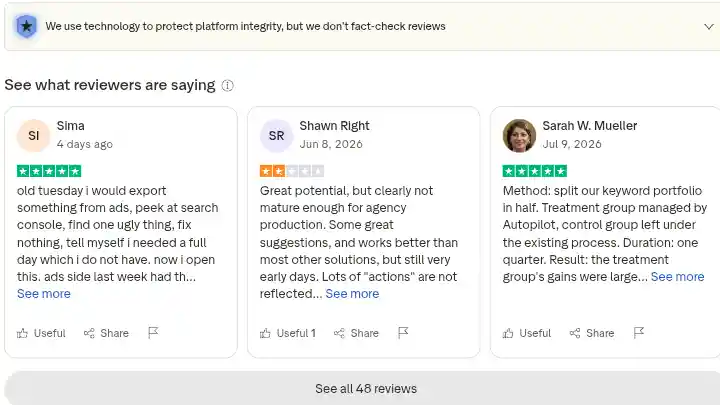
Ryze AI holds a 4.5/5 TrustScore on Trustpilot across 48 reviews as of my testing period.
The review count is small: 48 reviews is not enough to draw statistically strong conclusions about reliability at scale, and review counts on a tool like this are often in the dozens, not the thousands, and a handful of new reviews can swing an average by half a star in a month.
Positive themes from public reviews
An outdoor gear store owner with eight months of experience described results in measurable terms:
“technical SEO: 9/10, everything tidy and verifiable. Collections and product pages: 8/10, solid lift, organic up around 40%. Blog: 7/10, occasionally reads a bit catalogue for our crowd so I give those a quick once-over before they publish. Support: 9/10, fast and human.”
Another user described the approval workflow positively: approving a few title fixes and skipping the ones that do not fit in a short daily window; a realistic description of what the approval queue experience looks like in practice.
Negative reviews
One reviewer described a login and site connection experience that was “riddled with problems;” it failed to connect to their site, then repeatedly asked for a password that had not been set. It took several emails to resolve because the support team insisted a password had been created when it had not.
The same reviewer noted the platform performed an audit that identified faults that did not actually exist, and some recommendations suggested changing page titles to the same titles they already had.
Another reviewer rated the platform 2 out of 5, describing it as having “great potential, but clearly not mature enough for agency production. Some great suggestions, and works better than most other solutions, but still very early days.”
Notably, the company has not replied to negative reviews on Trustpilot, which is a pattern worth flagging. Responsiveness to negative feedback is a reasonable proxy for how a vendor handles problems when they arise.
Important context on third-party negative reviews
Some of the most detailed negative content about Ryze AI comes from Groas, which is a competing ad management platform.
Those reviews appear to focus primarily on the paid ads product and contain characterizations that conflict with what Ryze AI’s own documentation states. I have treated competitor-authored content with appropriate skepticism and have not relied on it for factual claims.
Ryze AI Risks and Assessment
- Audit accuracy risk: The most actionable risk identified in public reviews is audit false positives; recommendations to fix things that are not actually broken. This is not unique to Ryze AI; automated audits across all platforms occasionally misread page configurations. The mitigation is the approval gate: review every recommendation before applying it. Do not batch-approve without checking.
- Automation error risk: My 30-day workflow automation test confirmed that automation can create additional work when recommendations are accepted without review. The approval queue model reduces this risk but does not eliminate it. Budget time to review the queue regularly rather than treating the platform as a set-and-forget system.
- New brand risk: The domain is relatively new (approximately 1 year at the time of the 2026 check), and the company operates with a thin public review history. There is no long-term reliability track record equivalent to established platforms. The 7-day trial mitigates some of this risk by letting you verify the product on your own site before committing to a subscription.
- Content quality risk: Generated content published to your CMS through an automated workflow can range from solid to mediocre depending on the topic, niche, and how much the system understands your brand voice. Review generated content before approving it for publication, particularly in regulated industries or for high-authority brand pages.
- Vendor lock-in: The change log and rollback function reduce dependence on the platform, but if you cancel, you lose the ongoing audit and monitoring. Ensure you have an independent way to track the changes made to your site during the subscription period.
- AI citation accuracy: AI citation tracking reflects the outputs of ChatGPT, Perplexity, Gemini, and Claude at the time of querying. AI model outputs are non-deterministic. Citations seen in one query run may not appear in the next. Weekly tracking provides trend data, not definitive citation status. This is a structural limitation of GEO measurement generally, not specific to Ryze AI. For deeper context on how AI Overviews function as a channel, the Google AI Overviews tracker comparison covers the measurement landscape.
Ryze AI Rating
| Category | Weight | Score | Weighted Score |
|---|---|---|---|
| Features & Functionality | 30% | 7.5 | 2.25 |
| Ease of Use | 20% | 7.5 | 1.50 |
| Pricing & Value | 20% | 8.0 | 1.60 |
| Support & Customer Experience | 15% | 6.5 | 0.975 |
| Trust & Credibility | 15% | 6.5 | 0.975 |
| Final Score | 7.3/10 |
Scoring rationale:
- Features & Functionality (7.5): The closed-loop execution model is genuinely differentiated. The GEO functionality at the base tier is competitive. The deduction reflects shallow keyword/backlink research depth and limited prompt-level granularity in citation tracking.
- Ease of Use (7.5): The approval queue workflow is straightforward. The allow/deny list configuration requires some setup effort. Onboarding friction reported by some users (site connection issues) keeps this from scoring higher.
- Pricing & Value (8.0): $129/month flat for autonomous on-page SEO, GEO setup, content publishing, rank tracking, and AI citation monitoring represents strong bundled value relative to equivalent separate subscriptions.
- Support & Customer Experience (6.5): Some users report responsive, helpful support. Others describe delayed responses and the platform not responding to negative reviews on Trustpilot. The evidence is mixed enough that a conservative score is appropriate.
- Trust & Credibility (6.5): The company is legitimate and operational, but with approximately 10 months of domain history and 43 public reviews, the independent validation footprint is thin. The product proves itself in the trial which is the most important trust signal available, but long-term reliability data does not yet exist at scale.
Final Verdict on Ryze AI for 2026
Ryze AI is worth testing, with realistic expectations about what the trial week will and will not tell you.
The core claim that it applies SEO fixes rather than listing them holds up in testing. The approval queue model is the right balance between automation and human control.
The GEO function is genuinely useful and structurally better designed than most monitoring-only tools because it closes the loop between citation tracking and content publication.
The limitations are real: the research depth is not competitive with established platforms, the brand is new, some users have experienced onboarding friction and audit inaccuracies, and the weekly citation tracking frequency is too slow for fast-moving categories.
Buy Ryze AI If You:
- Manage SEO for a site with 50+ pages and spend meaningful time each week applying changes you have already decided to make
- Want GEO execution (llms.txt, schema, AI crawler access, citation tracking) included in your base subscription without a separate tool
- Have a primary frustration with SEO tools on the gap between the audit and the implementation
- Are an ecommerce brand on Shopify or a SaaS company needing consistent content production alongside technical SEO
Skip Ryze AI If You:
- Have a workflow that depends on deep keyword research, backlink analysis, or competitive intelligence at the level Semrush or Ahrefs provides
- Are an agency needing white-label reporting and multi-client dashboards at the base tier
- Need real-time AI citation monitoring rather than weekly snapshots
- Want a proven platform with years of public track record before committing budget
My Decision
I would use Ryze AI as an execution layer alongside a dedicated research tool, not as a replacement for Semrush or Ahrefs, but as the platform that actually implements what those tools surface.
For solo founders and small teams who currently do their SEO manually or not at all, the $129/month is justifiable if the approval queue reduces real hours. For agencies at scale or enterprise teams, the research depth and white-label gaps make it a partial fit at best.
Use the 7-day trial to test it on one site, review the fix queue and generated content quality critically, and verify the AI citation tracking against your own manual prompt queries before deciding.
→ Start the 7-day free trial at Ryze AI today
Frequently Asked Questions About Ryze AI
Is Ryze AI worth it?
It depends on your workflow. Ryze AI is the best SEO autopilot for most small and mid-size teams: it fixes existing pages with your sign-off, publishes content, and tracks AI citations for $129 a month flat. If you are currently managing SEO manually and losing hours each week to repetitive implementation tasks, the cost is justifiable. If you primarily need a research database, it is not a standalone replacement for Semrush or Ahrefs.
Is Ryze AI legitimate?
Ryze AI is operated by Meow AI, LLC, serves 2,000+ clients and 700+ agencies across 23+ countries managing $500M+ in ad spend, and has public reviews on Trustpilot. It is a real operating company with a verifiable public review presence. Note that Ryze AI at get-ryze.ai is not ryze.so, an unrelated company — some confused commentary online conflates the two.
What does Ryze AI actually do?
Ryze AI is an autonomous AI marketing platform that executes paid ads, SEO, and GEO work 24/7; it applies the changes rather than only recommending them. On the SEO side specifically, it audits your site, deploys on-page fixes with your approval, publishes content to your CMS, and tracks rankings and AI citations.
Does Ryze AI track AI search visibility?
Yes. It tracks whether ChatGPT, Gemini, and Perplexity cite your site. The tracking runs on a weekly cadence and is included in the SEO Autopilot plan at $129/month.
How much does Ryze AI cost?
SEO Starter is $129/month (self-serve SEO + GEO), with Paid Ads available separately at $89/month. Traffic Printer (which adds link building and senior strategists) is $599/month. Shopify CRO is $1,499/month. Annual billing reduces costs by 20%.
What are the best Ryze AI alternatives?
For research-first workflows: Semrush or Ahrefs. For autonomous on-page execution with a larger research database: Search Atlas with OTTO. For bulk agency on-page rules: Alli AI. For enterprise AI citation analytics: Profound.
How long before Ryze AI shows results?
SEO/GEO results compound over weeks, not days; first movement typically inside 30 days. The 7-day trial is enough to verify that the mechanism works on your site, but not long enough to evaluate performance outcomes. Budget at least 60–90 days before making a final judgement on result quality.

- Ryze AI Review 2026: My 30 Days Full Breakdown of This Autonomous SEO & GEO Platform - October 9, 2026
- #1 Best Plugin for Automatic Blog Posting in WordPress (2026) - September 13, 2026
- 13 Best WordPress Autoblogging Plugins I Tested & Ranked for 2026 - September 13, 2026