
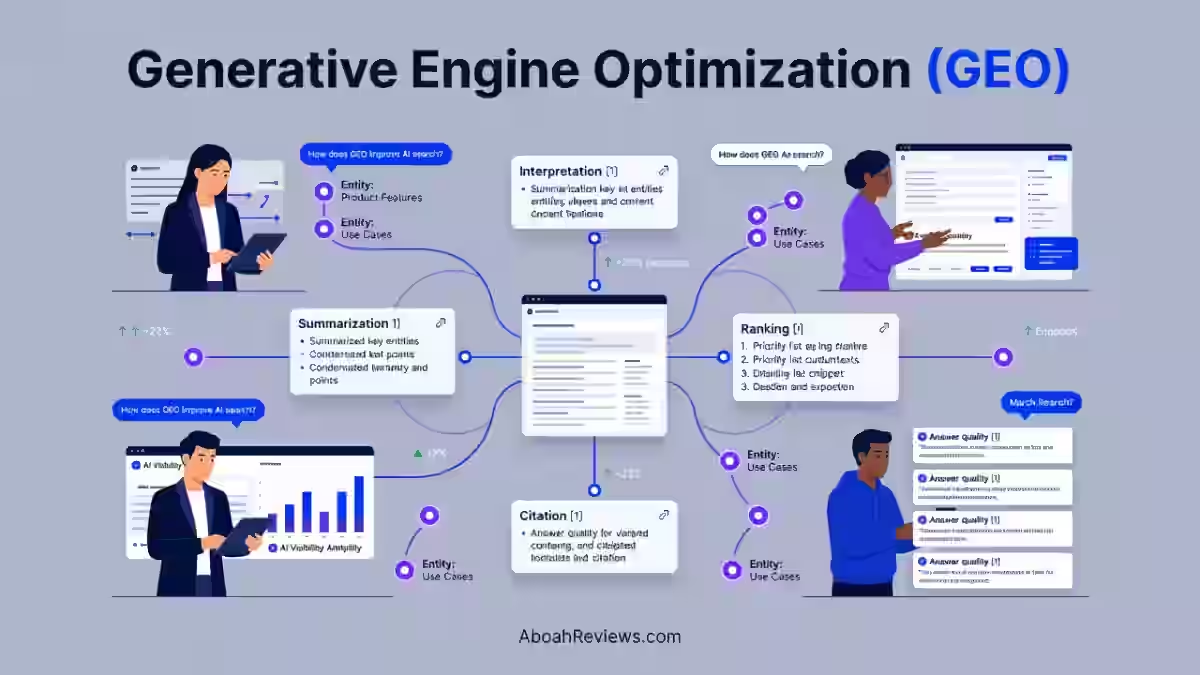
TL;DR: Generative Engine Optimization (GEO) is the practice of structuring content so that AI-powered search tools and large language models (LLMs) can easily read, summarize and cite it.
Instead of aiming for a top-ranked blue link like in traditional SEO, GEO focuses on becoming the direct source or brand mentioned inside an AI-generated answer.
Key Differences: SEO vs. GEO
- Goal: SEO drives traffic directly to a website via search rankings. GEO ensures your brand is part of the conversational synthesis inside an AI response.
- Metrics: SEO tracks organic clicks and keyword positions. GEO measures brand citations, visibility, and inclusion in generative results.
- Format: SEO optimizes for keyword density and backlinks. GEO prioritizes clear facts, direct answers, and natural language.
Best Practices for GEO Success
- Answer directly: Write clear summaries, definitions and FAQs that immediately answer specific user questions.
- Use conversational phrasing: Target long-tail, question-based prompts that people naturally type or speak to AI assistants.
- Build authority: Ensure your brand has a consistent, trusted footprint across external platforms like Reddit, Wikipedia and industry review sites.
- Structure technical data: Apply schema markup and clear headings (H2s/H3s) to help AI web crawlers parse your content effortlessly.
The key takeaway: GEO is an extension of good SEO, not a replacement for it.
Introduction to Generative Engine Optimization (GEO)
Search behavior is splitting in two. A growing share of queries now get answered directly inside an AI-generated summary and the person asking never sees a “ten blue links” page at all.
If you have noticed that your organic traffic numbers look different even when your rankings have stayed the same, you are not imagining things.
AI-generated answers are changing where search ends for many users. Instead of clicking through to a blog post or landing page, people are getting synthesized responses directly inside the search interface.
That shift is what makes the best autoblogging tools conversation change and it is also what has pushed Generative Engine Optimization from a niche academic term into something that SEO professionals and content marketers need to understand in 2026.
I want to be straightforward about something from the start: GEO is not a secret algorithm you can game, and nobody has published a definitive ranking formula for AI-generated answers.
What I will share in this guide is grounded in documented research, observed behavior across AI platforms and the same SEO fundamentals that have held up through every algorithm change I have seen since 2016.
Here is what this guide covers:
- What GEO means and where the term actually came from
- How AI search retrieves, selects, and synthesizes information
- The difference between GEO, SEO, AEO, and related terms
- Honest benefits and genuine limitations of GEO
- Step-by-step guidance on how to do GEO
- How to measure AI visibility without losing sight of business outcomes
- Tools worth considering, and mistakes worth avoiding
If you are already doing SEO well, most of this will feel familiar. That is intentional.
What Is Generative Engine Optimization (GEO)?
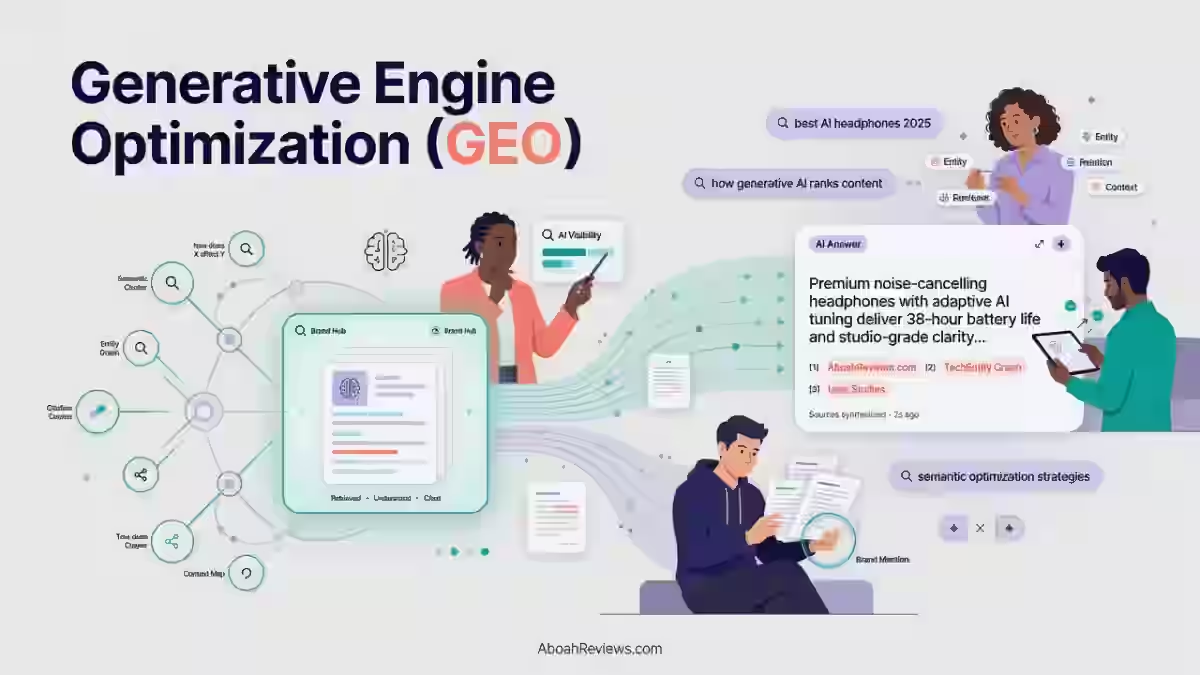
Generative Engine Optimization is a set of content and technical practices aimed at improving how your information appears within AI-generated answers, not just traditional search results.
The goal is to be retrieved, cited, or recommended by AI systems when they construct responses to user queries.
GEO focuses on AI search platforms, including Google AI Overviews, Google AI Mode, Perplexity, ChatGPT, Claude, Gemini and Microsoft Copilot, that synthesize responses from multiple sources rather than returning a ranked list of links.
GEO does not exist in isolation from SEO. It builds on the same foundation: crawlable pages, authoritative content, clear information architecture and strong E-E-A-T signals.
The difference is that GEO pays specific attention to how AI systems select and synthesize sources, which creates some additional considerations beyond traditional ranking optimization.
If you have been following solid SEO automation practices and investing in content quality, you are already doing a significant portion of what GEO requires.
The rest is a matter of understanding how generative systems work and adjusting where necessary.
What Does GEO Stand For?
GEO stands for Generative Engine Optimization. The “generative engine” part refers specifically to AI systems that generate answers by synthesizing information, rather than returning a list of links for users to evaluate themselves.
The term distinguishes optimization for AI-driven answer surfaces from traditional search engine optimization, which has historically focused on blue-link rankings.
That distinction matters because the output format, source selection process, and citation behavior of generative engines operate differently from traditional search ranking.
Where Did the Term GEO Come From?
The term “Generative Engine Optimization” entered the literature on 16 November 2023, when Pranjal Aggarwal, Vishvak Murahari, Tanmay Rajpurohit, Ashwin Kalyan, Karthik Narasimhan and Ameet Deshpande uploaded “GEO: Generative Engine Optimization” to arXiv.
The authors are affiliated with Princeton University, the Allen Institute for AI, Georgia Tech, and IIT Delhi.
The paper coined the term Generative Engine Optimization and was the first to demonstrate in a controlled experiment that content can be deliberately optimized for higher visibility in AI-generated answers.
The paper named the discipline, built GEO-BENCH (a benchmark of 10,000 queries across nine domains), and measured the visibility lift from nine content strategies inside a generative engine prototype.
It is worth noting that the paper was presented at the ACM SIGKDD 2024 conference, even though it first appeared as a preprint in November 2023.
Industry usage of the term has since broadened beyond the academic paper’s original framing, and practitioners now use GEO, AEO, AI SEO, and LLM optimization interchangeably.
Treat the academic definition as a starting point, not a fixed standard.
What Is a Generative Engine?
A generative engine is an AI system that produces a synthesized, written answer to a user query rather than returning a ranked list of source links.
Large language models have ushered in a new paradigm of search engines that use generative models to gather and summarize information to answer user queries.
Current generative engines include Google AI Overviews, Google AI Mode, ChatGPT (with and without browsing), Perplexity, Gemini, Microsoft Copilot, and Claude.
Each platform has different retrieval methods, citation behaviors, and update frequencies, which matters significantly for how you think about optimization.
Traditional search engines return a list of pages and ask users to evaluate them. Generative engines synthesize an answer and, in some cases, provide citations.
The user’s experience is different, the visibility metrics are different and the strategies required to appear in those answers have some meaningful differences from traditional SEO.
Why Did Generative Engine Optimization Become Important?
AI-generated answers are handling a growing share of search queries.
This means brand visibility, citations, and mentions inside AI responses are becoming relevant alongside traditional rankings and clicks.
That shift in where information is consumed is what makes GEO worth understanding.
That said, it is important not to overstate the case. Traditional search is still dominant.
Most users still encounter blue-link results, and organic traffic from traditional search remains the primary channel for most websites.
GEO is worth attention as an emerging discipline, not as an urgent replacement for what you are already doing.
The practical reason GEO matters now is that the habits users are forming around AI search are likely to persist and grow.
Brands that understand how AI systems select sources are better positioned to build content that works well in both traditional and AI-driven search experiences.
Does Google Have a Separate GEO Ranking System?
Google has not published a standalone “GEO algorithm.”
AI Overviews and AI Mode are part of Google’s broader search systems, which are informed by the same quality signals that have always shaped search ranking: relevance, authority, helpfulness, and technical accessibility.
What the data shows is that AI Overviews do not simply mirror traditional rankings.
In mid-2025, data from Ahrefs confirmed that 76% of URLs cited in Google AI Overviews ranked in the top 10 organic results for the same query. However, this strong correlation dropped significantly over the following months.
By early 2026, that figure sits at 38%, per Ahrefs’ study.
That divergence matters, but it does not mean there is a separate system to target. The new lever is page-level signal (schema markup, content structure, entity richness, FAQ format) plus topical authority, not raw blue-link ranking.
Optimizing for AI Overviews as if it were a separate algorithm is the wrong frame. Building content that is genuinely useful, clearly structured, and technically accessible is the correct frame and it happens to serve both traditional and AI-driven visibility.
How Does Generative Engine Optimization Work?
Generative Engine Optimization works by improving the conditions under which AI systems can discover, understand, and use your content when constructing answers to user queries.
The process is not a direct input-output relationship. You cannot instruct an AI system to cite you.
The general flow looks like this:
- User submits a query
- AI system retrieves relevant information (via real-time web retrieval, training data, or both)
- System selects sources based on relevance, quality, authority, and clarity
- System synthesizes a coherent answer from multiple sources
- Answer is delivered, sometimes with citations or links
Your optimization work affects steps 2, 3, and 4. You cannot control step 5 directly.
How AI Search Retrieves Information
Two primary retrieval methods determine how AI platforms access information, and the distinction affects which strategies are actually useful.
- Real-time web retrieval is used by Google AI Overviews, Google AI Mode, Perplexity, and ChatGPT with browsing enabled. Unlike ChatGPT’s hybrid of training data and selective web retrieval, Perplexity performs a real-time web search for every single query. It draws from multiple search APIs including Google and Bing, retrieves and reads candidate pages, and synthesizes a detailed answer with inline numbered citations. For real-time retrieval, pages must be crawlable, indexable, and fresh. Strategies that improve traditional SEO performance, like technical health and content updates, directly support visibility here.
- Training data is the basis for LLMs responding without live retrieval, such as ChatGPT without browsing enabled or Claude in standard conversational mode. Visibility in training data comes from long-term authority, broad citation across credible sources, and content that has been widely referenced over time. This is a slow lever with no guaranteed timeline.
Many platforms use a hybrid of both methods, and the balance shifts depending on query type, platform configuration, and user settings.
Analysis of 680 million citations found that only 11% of domains are cited by both ChatGPT and Perplexity.
Google AI Overviews and Google AI Mode cite the same URLs only 13.7% of the time, despite reaching similar conclusions.
Each platform has distinct source preferences, citation mechanics, and content signals. This is why one-size-fits-all GEO is an incomplete approach.
How AI Systems Select and Use Sources
Source selection varies by platform and is not fully documented by any of the major AI providers.
Based on credible third-party research and observed behavior, the factors that appear broadly relevant are:
- Topical relevance to the specific query
- Information quality and clarity, including how directly the content answers the question
- Source credibility and authority, including signals like E-E-A-T, domain trust, and third-party citations
- Content freshness, particularly for time-sensitive queries
- Query context and intent, which affects what kind of content is prioritized
Six factors decide citation in AI Overviews: topical authority, E-E-A-T, content comprehensiveness, structured formatting, page-level trust, and site-level authority working together.
It is also worth noting that AI search citation concentration occurs among a relatively small number of outlets. That does not mean smaller sites cannot win, but they usually need sharper structure, better evidence and stronger corroboration.
How AI Systems Generate Answers
AI systems generate answers by synthesizing information drawn from multiple sources into a coherent response.
Unlike traditional search, which returns discrete links, generative engines construct a single written answer that may incorporate information from several pages at once.
This synthesis process means that a single AI answer can reflect your content even if you are not explicitly cited.
Your information might appear in synthesized form without attribution, which is one reason why measuring GEO purely through citation counts gives an incomplete picture.
A brand can appear in an AI answer as a direct citation with a link, a named mention without a link, a recommendation in a comparative context, or indirectly through synthesized information that originated from your content.
Each of these has different value and different measurement implications.
How AI Citations and Links Work
Citation behavior varies significantly between platforms, and there is no reliable way to force citation from any of them. Here is how the major platforms differ:
- Perplexity cites sources prominently with inline numbered links. Typical Perplexity responses include 5 to 10 inline citations, with each claim linked to its source. This citation density creates multiple opportunities for visibility within a single answer.
- Google AI Overviews cites selectively, and the collapse from 76% to 38% top-10/AIO overlap inside a year is the canonical evidence that AIO is doing its own retrieval. Pages ranking #4 on Google can be invisible in AIO. Pages ranking #80 can be cited.
- ChatGPT without browsing may not cite at all, synthesizing from training data without attribution.
- Gemini and Copilot have variable citation patterns depending on query type and the platform context in which they are accessed.
The four types of AI visibility to track are: direct citations with links, named brand mentions without links, brand recommendations in a comparative context, and implicit use of information without attribution.
What Is Query Fan-Out?
Query fan-out is the process by which an AI system breaks a complex user query into multiple sub-queries to retrieve more comprehensive information before generating a response.
The most likely explanation for the widening gap between organic rankings and AI Overview citations is the query fan-out process, a mechanism that Google has confirmed is central to how AI Overviews are constructed.
This matters for GEO because content that addresses related subtopics, entities, and follow-up questions is more likely to contribute to answers to complex queries.
A page that answers a narrow question well may be retrieved as part of a broader query’s fan-out even if that specific narrow question was not the user’s original input.
Query fan-out is a retrieval mechanism. It is not something you optimize for directly.
What you can do is ensure that your content covers a topic with enough depth and breadth that it is a useful source for multiple sub-queries related to your subject area.
What Are the Benefits of Generative Engine Optimization?
GEO offers real potential benefits, but none of them are guarantees. Here is an honest breakdown of what you can reasonably expect from a well-executed approach.
Increased Visibility in AI-Generated Search Experiences
Appearing in AI answers creates brand exposure at the moment a user is actively researching a topic.
That exposure happens inside the search interface itself, before any click, which means even users who do not visit your site have encountered your brand or information.
For brands competing in categories where awareness is a meaningful step in the funnel, this type of pre-click visibility has real value.
It is different from traditional organic traffic, but it is not worthless.
Greater Presence During High-Intent Research
AI search is commonly used during product research, vendor comparison, and decision-making.
A brand that appears in AI answers during these high-intent research moments is better positioned than one that is absent, even if the immediate click-through rate is lower than traditional search.
This makes GEO particularly valuable for SaaS companies, B2B services, considered e-commerce purchases, and professional services where users often research extensively before converting.
Opportunities for Brand Discovery by New Audiences
AI answers can surface a brand to users who would not have encountered it through traditional search results.
If your page ranks at position 35 for a keyword but gets cited in an AI Overview for a related query, you have reached a user who would not have found you through organic search alone.
This brand discovery effect is real but difficult to measure directly. Branded search volume trends can serve as an indirect indicator.
Potential Referral Traffic
AI citations do generate referral traffic, but the volume is variable and platform-dependent.
Perplexity-referred traffic converts at 3.1 times the rate of standard Google organic, and average revenue per Perplexity-referred session is higher than ChatGPT’s for B2B SaaS.
Traffic from AI platforms is a real but variable outcome, not a reliable replacement for organic search volume. Treat it as an additional channel, not a primary one.
Stronger Brand Authority Signals
Content that earns citations, third-party references, and AI mentions tends to reflect stronger overall brand authority.
The practices that support AI visibility, original research, clear expertise signals, credible external references, also strengthen the foundation of your SEO.
GEO is not separate work sitting on top of SEO. Done right, it reinforces the same signals.
Preparedness for Evolving Search Behavior
Brands that build AI visibility now are better positioned as AI search continues to develop.
The citation patterns, platform behaviors, and measurement tools will all continue to change.
Building the right content and technical foundation now means less catch-up work later.
Honest Limitations of Generative Engine Optimization
This section exists because credibility requires it. GEO is genuinely useful, but the marketing around it has outpaced what the evidence actually supports.
Here is what you need to know before investing time or budget.
There Is No Universal GEO Ranking Formula
No AI platform has published a definitive list of GEO ranking factors.
Anyone claiming to have a proprietary formula for guaranteed AI citations is speculating.
The research that does exist, including the Princeton GEO paper, identifies correlations, not confirmed causal mechanisms.
AI Results Are Not Stable or Predictable
AI-generated answers can change significantly between queries, sessions, and platform updates.
A brand that appears consistently in AI answers this month may be absent next month due to model updates, new competitor content, or changes in how the platform weights certain signals.
Different AI Platforms Use Different Retrieval Methods
Each platform has distinct source preferences, citation mechanics, and content signals.
A brand that ranks well in Google AI Overviews may be completely invisible in Perplexity or ChatGPT Search.
Treating all AI platforms as a single target is a shortcut that produces incomplete results.
Training Data vs. Real-Time Retrieval Create Different Visibility Timelines
For platforms using real-time retrieval, improvements to crawlability and content quality can affect AI visibility relatively quickly.
For platforms drawing on training data, there is no reliable timeline at all.
Visibility in training data is a function of long-term authority and widespread citation, which cannot be manufactured quickly.
Citation Behavior Is Inconsistent Across Platforms
By early 2026, the figure of top-10 pages appearing in AI Overview citations had dropped to 38% in Ahrefs data and as low as 17%.
Semantic completeness, structured data, E-E-A-T signals, and multi-modal content now influence AI Overview selection independently of ranking position.
That inconsistency across platforms and over time makes citation behavior difficult to predict or rely on.
AI Mentions Do Not Automatically Generate Traffic
A brand mentioned in an AI answer may generate awareness without a corresponding click.
For brands measuring GEO purely through referral traffic, this can make AI visibility appear less valuable than it is.
For brands counting AI mentions as a proxy for business outcomes, it can make it appear more valuable than it is.
GEO Measurement Is Still Developing
There is no standardized GEO measurement framework.
Most available tools are early-stage and measure different things using different methodologies.
Benchmark cautiously and compare against competitors rather than relying on absolute numbers.
GEO Overlaps Heavily With Good SEO
The majority of GEO best practices are identical to SEO best practices.
Building strong E-E-A-T signals, maintaining technical health, creating genuinely useful content, and earning relevant third-party references are not new requirements.
GEO does not require an entirely separate strategy.
Industry Terminology Is Still Inconsistent
GEO, AEO, AI SEO, and LLM optimization are used interchangeably across the industry.
Treat these as working frameworks, not settled standards, and define your terms clearly when discussing them with clients or colleagues.
GEO vs. SEO: What Is the Difference?
SEO and GEO overlap significantly but focus on different search experiences.
SEO improves visibility across traditional and AI search. GEO focuses specifically on how a brand or its information appears within AI-generated answers.
In practice, a strong SEO foundation is a prerequisite for effective GEO.
A site with poor technical SEO, thin content, or weak authority will struggle with GEO regardless of what AI-specific tactics are applied on top.
Dimension | SEO | GEO |
|---|---|---|
Primary goal | Visibility across all search results | Visibility within AI-generated answers |
Key outcomes | Rankings, organic traffic, clicks | Citations, mentions, AI referral traffic, brand representation |
Primary KPIs | Rankings, organic sessions, conversions | AI visibility, citation share, mention context, referral traffic |
Content signals | Relevance, authority, E-E-A-T, UX | Relevance, authority, E-E-A-T, answerability, source credibility |
Technical requirements | Crawlability, indexability, page experience | Crawlability, indexability, structured data, clear information architecture |
Success timeline | Weeks to months | Variable; training data representation can take longer |
Measurement tools | Google Search Console, rank trackers | AI visibility platforms, brand monitoring, referral analytics |
Relationship | Foundation for GEO | Extension of SEO |
Is GEO Replacing SEO?
No. GEO is not replacing SEO. The actions required to appear in AI Overviews, such as improving page structure, semantic clarification, strengthening E-E-A-T signals and technical optimization, are exactly the same signals that Google’s classic algorithm values.
A site that cannot be crawled or indexed cannot appear in AI-generated answers that use real-time retrieval.
A site with thin, low-quality content is not a useful source for AI synthesis. The fundamentals have not changed; the output format has.
How SEO and GEO Work Together
The most useful frame is to think of GEO as the top layer of a well-built SEO foundation, not a separate discipline.
Here is how the layers integrate:
- Technical SEO ensures content is accessible and crawlable
- High-quality original content provides useful information for AI synthesis
- Topical authority signals relevance to a subject area
- First-hand experience differentiates content from generic information
- Brand and entity signals support recognition across platforms
- AI visibility monitoring identifies gaps and opportunities
If you want to go deeper on how this layered approach works from the ground up, the AI SEO automation guide covers the full workflow.
GEO vs. AEO vs. AI SEO vs. LLM Optimization
These terms are related and frequently used interchangeably. The differences between them are subtle, and the industry has not settled on rigid definitions.
What follows is a working guide, not a definitive taxonomy.
Term | Primary Emphasis | Common Usage |
|---|---|---|
GEO (Generative Engine Optimization) | Visibility in AI-generated answers across generative search platforms | Broad industry term; originates from 2023/2024 academic research |
AEO (Answer Engine Optimization) | Optimizing for direct answers, including featured snippets and voice search | Predates GEO; often used interchangeably with GEO in AI search context |
AI SEO | SEO practices adapted for AI-influenced search environments | Broad umbrella term; often interchangeable with GEO |
LLM Optimization | Improving representation within large language model outputs, including training data | More specific; often focuses on training data visibility |
AI Search Optimization | Broad term for improving visibility across AI-driven search experiences | Informal; interchangeable with GEO and AI SEO |
Are GEO, AEO and AI SEO the Same Thing?
Practically speaking, they overlap significantly and most practitioners use them interchangeably.
Where they differ: AEO has roots in featured snippet and voice search optimization, which predate generative AI.
LLM optimization specifically addresses training data representation. GEO is the most commonly used umbrella term for AI-generated answer visibility in 2026.
The recommendation is to use whichever term your audience recognizes and define it clearly when you introduce it.
Arguing about terminology is a lower-value activity than building content that works across all of these definitions.
Is Generative Engine Optimization Worth It?
GEO is worth the investment for brands that already have a solid SEO foundation and operate in categories where AI search behavior is relevant to their audience.
It is not worth prioritizing over fundamental SEO work if the site has significant technical issues, thin content, or weak authority.
GEO Is Likely Most Valuable For
- SaaS and B2B companies: AI search is frequently used during software research and vendor comparison. If your buyers use ChatGPT or Perplexity to evaluate tools, AI visibility matters.
- E-commerce brands in considered purchase categories: Outdoor gear, home improvement, health and wellness, and similar categories see significant AI-assisted research.
- Publishers and content-driven brands: Original research and documented expertise are natural candidates for AI citation.
- Professional services: Legal, financial, medical, and consulting brands compete heavily for AI recommendations.
- Agencies: Brands that advise clients on search visibility need fluency in AI search to serve those clients well.
- Local businesses competing for recommendations: AI answers increasingly surface local business recommendations for service queries.
For a more detailed breakdown of which AI autoblogging tools and content approaches work best for different use cases, that guide covers the full spectrum.
When GEO Should Not Be Your Primary Investment
Address these SEO fundamentals before focusing on AI-specific visibility:
- Significant technical SEO problems (crawlability, indexability, broken site structure)
- Thin, low-quality, or outdated content across core topic areas
- Weak topical coverage in your primary subject areas
- Poor user experience metrics (Core Web Vitals failures, mobile issues)
- Lack of domain authority or relevant backlinks
- Indexing issues on important pages
The Right Approach: SEO First, Then GEO
Build and maintain a strong SEO foundation, then layer AI visibility monitoring and GEO-specific improvements on top.
GEO built on a weak SEO foundation delivers little. GEO reinforcing an already-healthy site can meaningfully extend your visibility into AI-generated answer surfaces.
If you are starting from scratch on the content side, the how to do autoblogging guide is a practical entry point for understanding how to build content systematically before worrying about AI-specific optimization.
How to Do Generative Engine Optimization
The core principle here is straightforward: do not optimize for an imaginary AI ranking trick.
Build content and a website structure that makes it easy for people, and AI systems, to discover, understand, verify, and use your information.
Choosing which claims to source, adding original observations and structuring answers lead to the most useful information. That is what GEO-ready content looks like in practice.
1. Create Original, Helpful Content That Earns Its Place as a Source
Original content earns citations; recycled content does not.
Before publishing, ask: Would a journalist, researcher, or AI system have a reason to cite this page over the hundreds of others on this topic?
AI systems trained on the web are increasingly good at recognizing content that adds nothing to existing information.
If your page is a summary of summaries, it is not a useful source for AI synthesis. Original testing, documented methodology, first-hand data, and genuine perspective are what differentiate citable content from filler.
2. Answer Important Questions Directly and Completely
Place direct answers immediately after the relevant heading. Do not bury answers in preamble.
AI Overviews favor content that is easy to extract. Headers signal topic boundaries, lists make items individually parseable, and tables allow direct comparison.
All of these reduce the work the AI system has to do to pull a coherent answer.
Use the inverted pyramid: answer first, detail second. Support concise answers with evidence, context, and nuance. This structure serves both human readers and AI retrieval.
3. Demonstrate First-Hand Experience
Experience refers to demonstrated, first-hand knowledge of the subject.
Does the author have direct involvement with what they are writing about?
Google rewards content that could not have been written by someone who had only read about the topic: original examples, real deployment data, proprietary case studies, and specific details that reflect lived experience.
Formats that signal genuine first-hand experience include:
- Original product or service testing with documented methodology
- Screenshots, photos, and video from real use
- Case studies with actual data and stated outcomes
- Before-and-after comparisons with specific numbers
- Expert commentary from named, credible contributors
- Documented experiments including null results
This is not a cosmetic requirement. AI systems that retrieve content, and the human editors who review it, increasingly distinguish between original observation and recycled information.
4. Build Topical Authority Through Depth, Not Volume
Topical authority comes from covering a subject and its related subtopics in meaningful depth, not from publishing the highest volume of posts on a keyword.
A smaller number of genuinely authoritative pages outperforms a large number of thin ones for both SEO and AI visibility.
Cover related entities, questions, and subtopics naturally. Use contextual internal linking to connect related pages and signal topical relationships.
5. Strengthen Brand and Entity Signals
Consistent, accurate brand information across all platforms strengthens entity recognition by AI systems.
Maintain consistent business information (name, address, phone number, website, social profiles) everywhere it appears.
Key entity signals to maintain:
- Detailed About, Team, and Author pages linked from relevant content
- Schema markup for Organization, Person, and relevant content types
- Google Business Profile and LinkedIn presence
- Wikipedia page where warranted and eligibility exists
- Consistent NAP information across directories
Develop relevant third-party references: media mentions, industry directories, and authoritative external links to your brand. AI systems that index the broader web encounter the same third-party sources that search crawlers do.
6. Support Important Claims With Credible, Primary Sources
According to Google’s Search Quality Rater Guidelines, E-E-A-T (Experience, Expertise, Authoritativeness, Trustworthiness) serves as a core evaluation standard used by human quality raters to assess the reliability and safety of search results, guiding automated ranking systems to reward helpful, people-first content.
One concrete way to signal trustworthiness is to cite primary sources rather than secondary summaries.
Attribute all statistics to their original source with links. Distinguish clearly between facts, opinions, and estimates. Avoid citing outdated statistics when newer data is available.
Factual specificity matters: content with specific data points, statistics, quotes and verifiable claims receives preferential citation.
The Princeton GEO study found that adding statistics improved visibility by up to 40%.
7. Implement Technical SEO That Supports Discoverability
A page that cannot be crawled or indexed cannot appear in AI answers that use real-time retrieval. This is not a GEO-specific point; it is a basic requirement.
A page that Googlebot cannot render or that fails basic technical standards will not be considered for citation regardless of content quality.
Structured data does not guarantee AI citations, but it improves machine readability. Implement schema markup accurately where relevant:
- Article schema for content pages
- FAQPage schema for FAQ sections
- HowTo schema for instructional content
- Organization and Person schema for entity signals
- Product and Review schema for e-commerce
Schema markup is the highest-ROI page-level lever. Pages with schema markup are cited 2.3 times more often in AI search results over pages without.
Maintain strong page experience signals: Core Web Vitals compliance, mobile usability, and HTTPS.
8. Make Information Easy for Both People and AI Systems to Process
Use clear, descriptive headings that telegraph the content of each section. Write in plain language.
Use tables to compare information that would be confusing in prose. Define technical terms when first introduced. Break complex processes into numbered steps.
The goal is not to format content for AI systems at the expense of human readability.
The goal is to format content that serves human readers well, which happens to also make it easier for AI systems to parse and extract.
The most defensible strategy is one built on topical authority and comprehensive topic coverage across formats, which tends to be durable across model changes.
9. Earn Relevant Third-Party Mentions and References
Third-party authority comes from genuine editorial decisions by credible sources, not from manufactured mentions or paid placements. Pursue it through:
- Digital PR and expert commentary in industry publications
- Original research that other sources want to cite
- Expert contributions to relevant platforms (industry events, podcasts, publications)
- Earning relevant, contextual backlinks from authoritative sources
Avoid and actively disavow: artificial mentions, paid placements disguised as editorial content, link schemes, and manufactured authority signals.
These are manipulation tactics with reputational and algorithmic risk, and AI systems that index the broader web will encounter the same third-party signals that search crawlers do.
10. Keep Content Accurate, Current, and Clearly Dated
Research reveals that 53% of content cited in AI search had been updated within the last six months, and pages updated within the past 12 months are 2 times more likely to earn citations.
Review content on a defined schedule, not just when traffic drops. Update statistics, product information, pricing, and industry data as it changes.
Add clear publication and last-updated dates. Sites that simply change publication dates without meaningful content updates face consequences from Google’s refined freshness evaluation.
Only update dates when you have made meaningful improvements: new data, additional sections, refreshed examples, updated statistics.
How to Improve Visibility in Specific AI Search Platforms
No method guarantees citation or recommendation on any platform.
What follows reflects publicly available information and observed platform behavior, not documented ranking formulas.
The training data vs. real-time retrieval distinction covered earlier directly affects which strategies apply to which platforms.
Keep that distinction in mind as you read through each platform’s specifics.
Google AI Overviews
Google AI Overviews use real-time web retrieval from Google’s index, which means strong foundational SEO directly supports visibility.
Crawlability and indexability are prerequisites. E-E-A-T and entity density are now effectively mandatory filters: 96% of AI Overview citations come from sources with strong E-E-A-T signals.
Helpful, clearly organized, authoritative content is the primary lever. Structured data improves machine readability.
There is no documented “AI Overviews ranking formula” separate from Google’s broader quality systems. The best approach is to treat AI Overviews as a product of strong SEO, not a separate optimization target.
Google AI Mode
Google AI Mode is conversational and multi-turn, which means content that addresses complex, multi-part queries is better positioned.
Anticipating follow-up questions within your content improves its usefulness for AI Mode’s query-fan-out retrieval process.
Same foundational requirements apply as for AI Overviews: crawlability, quality, and authority.
No documented “AI Mode ranking formula” exists separately from Google’s broader quality systems.
ChatGPT (With and Without Browsing)
- Without browsing: Visibility depends on long-term authority, widespread citation across credible sources, and content that was broadly indexed before training cutoffs. 28% of ChatGPT’s most-cited pages have zero Google organic visibility. Eighty percent of ChatGPT-cited URLs do not rank in Google’s top 100. The two visibility surfaces simply do not correlate the way intuition suggests.
With browsing enabled: Operates more like real-time retrieval. Crawlability, freshness, and information quality become directly relevant.
Focus on discoverability, credibility signals, and genuinely useful information rather than trying to engineer specific prompt responses.
Perplexity
Perplexity performs a real-time web search for every single query. New content can be cited by Perplexity within hours of being indexed.
This makes it the platform where content freshness and crawlability have the most immediate impact.
Typical Perplexity responses include 5 to 10 inline citations, with each claim linked to its source.
This citation transparency makes it the most trackable platform for GEO measurement and the most accessible for smaller brands willing to invest in original, well-structured content.
Perplexity favors comprehensive guides, original research, recent updates, comparison articles, expert opinions with credentials, and well-structured how-to content.
It tends to avoid thin content, promotional material, and outdated information.
Gemini
Gemini draws on Google’s index and knowledge systems for many queries, which means foundational SEO signals are directly relevant.
Entity recognition and consistent brand information support visibility.
Avoid chasing undocumented Gemini-specific ranking formulas; the same quality signals apply here as they do for AI Overviews.
Microsoft Copilot
Copilot is powered by Bing’s index and OpenAI models. Bing SEO fundamentals apply directly.
Verify Bing indexing and crawlability separately from Google using Bing Webmaster Tools, since Google Search Console data does not reflect Bing indexing status.
Copilot’s enterprise integration through Microsoft 365 makes it particularly relevant for B2B brands.
Employees using Microsoft productivity tools may encounter Copilot responses for work-related research queries, which makes Copilot worth treating as a primary platform for B2B content strategies, not an afterthought.
Claude (Anthropic)
Claude in standard conversational mode draws on training data. Long-term authority and widespread citation across credible sources are the primary levers here.
Claude with tool use or retrieval capabilities behaves more like a real-time retrieval system.
There is limited public documentation about Claude’s specific retrieval behavior, so avoid prescribing specific tactics beyond what applies broadly: be a credible, authoritative, widely-cited source in your topic area over time.
Generative Engine Optimization Examples
Each of the following examples illustrates a specific, concrete transformation. The goal is to show what GEO-ready content actually looks like versus content that has no real reason to be cited.
1. SaaS Company: Project Management Software
Before: A blog post titled “Best Project Management Software” lists 10 tools with one-paragraph descriptions pulled from each tool’s own marketing copy.
No original testing, pricing accuracy verification or screenshots.
After: The same article includes:
- documented hands-on testing of each tool across defined use cases (remote teams, agencies, construction projects)
- original screenshots from real accounts
- independently verified pricing as of a stated date
- a feature comparison table with specific limits and plan tiers
- limitations observed during testing
- a named author with verifiable expertise.
Why it matters for GEO: The revised version is a primary source. The original is a secondary summary that AI systems have no reason to prefer over any other list article on the same topic.
When an AI system is choosing which source to cite for a query about project management software for remote teams, it will favor the version that has original data.
2. E-Commerce Brand: Outdoor Gear Retailer
Before: Product pages contain manufacturer descriptions. The buying guide for hiking boots repeats generic advice about “choosing the right fit.”
After: Product pages include:
- independently measured specifications (verified against manufacturer claims)
- in-store staff demonstration video
- buyer FAQ sections drawn from real customer questions
- a buying guide based on documented testing of 12 boots across different terrain types
- links to third-party reviews from specialist outdoor publications.
Why it matters for GEO: AI systems answering “best hiking boots for wide feet” have a reason to cite original product data. They do not have a reason to cite rephrased manufacturer copy.
3. Local Business: Law Firm
Before: Generic practice area pages (“We handle personal injury cases in [City]”). No author attribution. No case process explanations. No client education content.
After: Practice area pages;
- written by named attorneys with bar credentials
- explaining state-specific legal processes in plain language
- citing relevant statutes
- addressing common client questions with verified answers
- referencing the firm’s documented case history where ethically permissible.
- consistent business information across Google Business Profile
- bar association directories and the firm’s own site.
Why it matters for GEO: AI systems answering legal questions in a specific jurisdiction favor authoritative, specific, verifiable information from credentialed sources. Generic pages with no author attribution offer no credibility signals.
4. Publisher: Independent Research Site
Before: Annual survey published as a press release summary with no methodology, no raw data, and no named researchers.
After: Full survey methodology published alongside findings.
- Data available for download
- Named researchers with institutional affiliations
- Findings presented with confidence intervals and stated limitations
- A dedicated landing page that other publications can link to as the primary source.
Why it matters for GEO: Original research with documented methodology is the type of primary source AI systems cite. A press release summary is a secondary summary of a primary source. AI systems will cite the primary source if it is accessible.
4. Before-and-After Content Transformation
Here is a specific content block transformation that illustrates the difference between citable and uncitable writing:
Before: “Many experts recommend drinking eight glasses of water per day for optimal health.” (No source. Common claim. Adds nothing new.)
After: “The ‘eight glasses a day‘ guideline is not supported by a specific scientific consensus.
The U.S. National Academies of Sciences recommends approximately 3.7 liters of total water intake per day for men and 2.7 liters for women, from all beverages and food sources combined [link to primary source].
Individual needs vary significantly based on body size, activity level, climate, and health status.”
The revised version is a primary-source-backed, nuanced answer. The original is a repeated claim with no citation value.
AI systems have no reason to prefer your version of that claim over anyone else’s. The revised version gives them a reason.
How to Measure Generative Engine Optimization
GEO measurement is still developing. No standardized framework exists. The measurement approach below is practical rather than exhaustive, and it connects AI visibility to business outcomes rather than treating it as a standalone metric.
AI Visibility
Track the percentage of your tracked prompts where the brand appears in AI-generated answers. Use a set of prompts relevant to your core topics and buyer journey stages.
Monitor across multiple platforms: Google AI Overviews, Perplexity, ChatGPT, Copilot, Gemini, and Claude.
Track competitor visibility for the same prompts. Relative visibility matters more than absolute numbers because citation behavior varies so much by topic and platform.
AI Citations
Measure citation frequency (how often your content is cited with a link), citation share (your citations as a proportion of total citations in your topic area), and which specific URLs are cited most often.
Track citation context: what claim or topic prompted the citation.
Brand Mentions
Monitor mention frequency across AI platforms, including mentions without links. Note whether mentions are positive, negative, neutral, or comparative.
Track whether your brand is mentioned unprompted or only in response to direct queries.
AI Referral Traffic
In GA4, identify referral sessions from AI platforms using the source/medium report. Look for “perplexity.ai”, “chat.openai.com”, “gemini.google.com”, and related referral sources.
Track engagement quality (session duration, pages per session, bounce rate) and conversion behavior for AI-referred users separately from other traffic sources.
Traditional SEO Metrics (Which Remain Relevant)
GEO does not replace traditional SEO measurement. Continue tracking:
- Organic impressions and CTR via Google Search Console
- Keyword rankings for target topics
- Organic traffic by page and topic cluster
- Branded search volume (an indirect signal of AI-driven brand discovery)
- Backlinks and referring domains (relevant to both SEO and GEO)
Business Outcomes
The metrics that matter most are the ones connected to revenue.
Track leads and lead quality from AI-driven channels, sales and revenue attributed to AI-referred sessions, assisted conversions involving AI referral touchpoints, and pipeline contribution for B2B brands.
Suggested GEO Measurement Dashboard
Report in this sequence to maintain a clear connection between AI activity and business outcomes:
Prompt visibility >> Citation share >> Brand mentions >> AI referral traffic >> Branded search demand >> Leads/conversions
Report AI metrics alongside, not instead of, traditional SEO and business metrics. Benchmark against competitors rather than against absolute targets.
Generative Engine Optimization Tools
Tools in this space are early-stage and evolving rapidly.
Evaluate capability claims critically, and treat any tool that promises “guaranteed AI citations” with significant skepticism.
AI Visibility Tracking Tools
These platforms monitor brand appearance across AI-generated answers for tracked prompts.
Key features to evaluate: how many AI platforms are monitored, prompt library size and customization, frequency of checks, and historical data availability.
Current options include platforms like Profound, BotRank, Ahrefs Brand Radar, and several newer entrants.
Features and accuracy vary significantly. Run a trial period before committing to any platform.
AI Citation Monitoring Tools
These track when and where content is cited in AI-generated answers.
Distinguish between tools that detect citations with links versus unlinked brand mentions. Both types of visibility are worth tracking, but they represent different outcomes.
Brand Mention Monitoring Tools
Several traditional brand monitoring tools (Mention, Brand24, Brandwatch) have added AI answer monitoring.
These overlap with citation monitoring but may capture a broader range of mention types, including comparative mentions and recommendation contexts.
Competitor AI Visibility Tools
Side-by-side competitor visibility tracking helps identify topic areas where competitors appear in AI answers and your brand does not.
That gap analysis is more actionable than absolute citation counts.
Traditional SEO Tools With AI Search Features
Established platforms like Semrush, Ahrefs, and Moz have added AI visibility features to their existing products.
Evaluate whether these are genuine AI visibility monitoring capabilities or bolt-ons that repackage existing data.
What to Look for When Evaluating a GEO Tool
Criterion | What to Ask |
|---|---|
Platform coverage | Which AI platforms does it monitor? Does it include the platforms most relevant to your audience? |
Prompt tracking | Can you define custom prompts? How many? How frequently are they checked? |
Citation tracking | Does it detect cited URLs? Unlinked mentions? Context around the mention? |
Competitor monitoring | Can you track competitor visibility alongside your own? |
Historical data | How far back does data go? Can you identify trends over time? |
Reporting | Can you export data? Build custom dashboards? Schedule reports? |
API access | Is API access available for integration with your existing reporting stack? |
Pricing | Is pricing transparent? What is the pricing model (per prompt, per platform, per seat)? |
No tool can guarantee AI citations. Any tool that claims to “get you cited by AI” is making a claim the evidence does not support.
Generative Engine Optimization Checklist
Use this before publishing new content and when auditing existing pages.
- Crawlability and Indexability
- Content Quality
- Brand and Entity Signals
- Accuracy and Freshness
- Competitive and AI Visibility
Common Generative Engine Optimization Mistakes to Avoid
Treating GEO as a Replacement for SEO
GEO built on a weak SEO foundation delivers little. Fix technical SEO, content quality, and authority before focusing on AI-specific visibility.
The practices are not sequential; they overlap. But deprioritizing fundamentals in favor of AI tactics is a reliable path to wasted effort.
Chasing Undocumented AI Ranking Hacks
No one has a verified formula for guaranteed AI citations. Tactics marketed as “AI ranking hacks” are speculation.
Focus on durable content quality instead. Anyone selling a proprietary GEO formula is selling something the evidence does not support.
Publishing Generic AI-Generated Content at Scale
AI systems are increasingly able to recognize recycled, low-information content.
Publishing large volumes of generic content is more likely to dilute authority than build it, and AI systems trained on the web are getting better at recognizing content that adds nothing new.
If you are evaluating autoblogging as part of your strategy, the autoblogging vs. traditional blogging comparison lays out the tradeoffs honestly.
Creating Thousands of Low-Value Pages to Capture AI Queries
Volume without depth is counterproductive.
A smaller number of genuinely authoritative pages outperforms a large number of thin ones for both SEO and AI visibility.
Content cannibalization is a real risk when you prioritize quantity over depth.
Ignoring Technical SEO
A page that Googlebot cannot render or that fails basic technical standards will not be considered for citation regardless of content quality.
Technical SEO is not a “nice to have” in GEO; it is a prerequisite.
Making Unsupported or Exaggerated Claims
AI systems that retrieve content with unsupported claims reduce the credibility of that content as a source.
Accuracy is a signal, not an afterthought. Overpromising in your content may appear to work in the short term but erodes source credibility over time.
Attempting to Manipulate Brand Mentions Artificially
Manufactured mentions, fake reviews, and coordinated self-citation are manipulation tactics with reputational and algorithmic risk.
AI systems index the broader web. They encounter the same third-party sources that search crawlers do. Artificial authority signals are not durable.
Treating All AI Platforms as Identical
Each platform has distinct source preferences, citation mechanics, and content signals.
A brand that ranks well in Google AI Overviews may be completely invisible in Perplexity or ChatGPT Search.
A strategy built for one platform needs to account for the behavioral differences across the platforms your audience actually uses.
Measuring AI Visibility Without Connecting It to Business Outcomes
Citation share and AI mention frequency are proxy metrics. They have value only when connected to traffic, leads, and revenue.
Reporting AI visibility as a standalone metric without a business outcome connection produces impressive-looking numbers that are difficult to defend in a budget conversation.
Ignoring User Experience in Favor of AI Optimization
Content optimized for AI retrieval at the expense of human readability is self-defeating. AI systems retrieve content that serves human users well.
A page that is technically well-structured but unpleasant to read is not a good source. The two goals are aligned, not competing.
GEO Is How Search Visibility Evolves, Not How It Gets Replaced
Generative Engine Optimization is the practice of improving how your brand, content, and information appear in AI-generated answers.
It is an extension of good SEO practice, not a replacement for it, and the durable foundations of AI visibility are the same ones that have always underpinned effective search marketing.
The brands that will build genuine AI visibility over time are the ones that focus on:
- Technical accessibility and crawlability
- Genuinely useful, original content
- First-hand experience and documented expertise
- Topical authority built through depth
- Credible, primary-source-backed claims
- Consistent brand and entity signals
- Relevant third-party references and citations
- Continuous measurement tied to business outcomes
None of those are new requirements. What is new is the output format, the citation behavior, and the measurement tools needed to track performance across AI platforms.
If you are running a small team or a solo operation, start with the checklist in this guide and apply it to your 10 most important pages.
If you are running an agency, build GEO evaluation into your standard content audit workflow alongside traditional SEO metrics.
The goal is not to manipulate AI into mentioning your brand. It is to build information that AI systems, and the people who use them, have a genuine reason to retrieve, trust, and use.
If you have questions about how any of this applies to your specific situation, or if you have tested GEO approaches and want to share what worked or what did not, leave a comment below.
Frequently Asked Questions About Generative Engine Optimization
Is GEO Replacing SEO?
No. GEO is not replacing SEO. Foundational SEO work, including technical health, content quality, crawlability, and authority building, is a direct prerequisite for GEO effectiveness. A site with poor SEO foundations will not perform in AI-generated answers regardless of what AI-specific tactics are applied on top.
Is Generative Engine Optimization the Same as SEO?
GEO and SEO overlap significantly but are not identical. SEO covers the full spectrum of search visibility, including traditional blue-link rankings, featured snippets, local search, and AI-generated answers. GEO focuses specifically on how a brand or its information appears within AI-generated answers. Most GEO best practices are extensions of good SEO practice.
How Long Does It Take to See Results from GEO?
Results timelines vary significantly by platform and retrieval method. For platforms using real-time web retrieval (Google AI Overviews, Perplexity), crawlability and content updates can affect AI visibility within days to weeks. Sites starting from scratch on a topic may wait 3 to 6 months before observing regular citations. For platforms drawing on training data without real-time retrieval, there is no reliable timeline, and visibility improvement is a long-term effort.
Can Small Businesses Do GEO?
Yes, with realistic expectations. Local businesses, niche publishers, and small e-commerce brands can build AI visibility by focusing on accurate business information, original content that addresses specific local or niche queries, and consistent third-party references, all without enterprise-scale resources. Start with the 10 most important pages on your site and apply the checklist in this guide before expanding.
Do I Need to Pay for GEO Tools to Get Started?
No. The foundational GEO practices (content quality, technical SEO, entity signals, primary source citations) do not require paid AI visibility tools. Manual spot-checking across AI platforms is a reasonable starting point. Paid tools become useful when you need to monitor visibility systematically across multiple platforms, track competitor presence, or report GEO metrics at scale.
How Do I Know If My Brand Is Appearing in AI-Generated Answers?
Start with manual spot-checking: query Google AI Overviews, Perplexity, ChatGPT, and Gemini for your brand name, your core topics, and common comparison queries in your category. Note whether your brand appears as a citation, a mention, or a recommendation. For systematic monitoring across many prompts and multiple platforms, use a dedicated AI visibility tracking tool. GA4 referral source reporting can also confirm whether AI platforms are sending traffic to your site.
What Is the Difference Between GEO and AEO?
GEO (Generative Engine Optimization) focuses on visibility within AI-generated answers from generative search platforms. AEO (Answer Engine Optimization) originated from featured snippet and voice search optimization and predates generative AI. In practice, most professionals now use the terms interchangeably in the context of AI search. Where a distinction matters: AEO has a longer history and established playbook for featured snippets; GEO specifically addresses the synthesis behavior of generative AI platforms.
Is Generative Engine Optimization a Real Thing?
Yes. The Princeton GEO study (Aggarwal et al., ACM SIGKDD 2024) is the founding document of Generative Engine Optimization. The GEO-bench framework tested approximately 10,000 queries across nine datasets and proved that targeted content optimization can boost AI visibility by 22 to 41 percent. The term is grounded in documented research, and the behavior it describes, AI systems selecting and synthesizing sources for generated answers, is observable across multiple platforms today.
What Are the Top Platforms for Generative Engine Optimization?
The primary platforms to target for GEO in 2026 are Google AI Overviews, Google AI Mode, Perplexity, ChatGPT (with and without browsing), Gemini, and Microsoft Copilot. Which platforms matter most depends on where your audience actually conducts research. For B2B brands, Copilot’s enterprise integration through Microsoft 365 makes it a higher priority than its general market share suggests. For brands targeting researchers and high-intent buyers, Perplexity’s transparent citation system makes it the most trackable and accessible platform for building AI visibility.

- Generative Engine Optimization (GEO): The Complete Guide to Winning AI Search in 2026 - August 14, 2026
- 10 Best AI Autoblogging Tools I Tested for 2026 - August 12, 2026
- How to Automate Blog Content Posting to Social Media With RSS Feeds (2026) - August 11, 2026