
If you sell on Etsy and you’re trying to decide whether Alura is worth paying for, here’s the short version: it’s a genuinely useful all-in-one research and automation dashboard for Etsy sellers, but several of its best features only show up once you’re paying $29.99–$69.99 a month, and its keyword numbers are modeled estimates, not real Etsy search volume.
For a deeper look at how Alura stacks up against other research tools built specifically for Etsy, see my broader roundup of Etsy SEO tools.
Alura Review Verdict for 2026
| Category | Verdict |
|---|---|
| Best For | Solo and small-team Etsy sellers who want keyword research, listing optimization, basic shop analytics and Pinterest automation in one dashboard |
| Not Ideal For | Amazon, eBay, or Shopify sellers; agencies that need multiple connected shops on a budget; sellers who need exact (not modeled) Etsy search data; high-volume AI users who burn credits fast |
| Pricing | Free plan available; paid plans run $11.99–$69.99/month, or $7.99–$29.99/month billed yearly |
| Rating | 7.4/10 |
| Standout Feature | AI agent (MCP) that puts live Etsy data inside ChatGPT and Claude + automated Pinterest pinning and Chrome extension with listing scorer/AI optimizer |
| Biggest Weakness | Core automation (Pinterest, Etsy Ads optimization, full Analytics Suite) is locked behind the Growth and Professional tiers |
| Learning Curve | Beginner |
| Testing Status | Personally Tested |
| Worth It? | Yes if you’re an active single-shop seller who will use the marketing automation. No if you only need keyword data |
Bottom line: Alura is one of the more complete Etsy-only toolkits on the market, but you need to buy the $29.99/month Growth plan or higher to get the automation that actually separates it from cheaper, research-only competitors like eRank.
Alura Quick Specs
| Feature | Details |
|---|---|
| Developer | Alura (built by Etsy sellers; Co-Founder Hakon Lilleberg referenced; Oslo, Norway base) |
| Founded | Built from founders’ own Etsy shops (exact public founding year not prominently specified; active several years with ongoing updates) |
| Product Category | Etsy SEO and shop management toolkit |
| Primary Use | Etsy keyword research, product/competitor research, listing optimization, shop analytics, Pinterest/Etsy Ads/email marketing automation for Etsy |
| Target Users | Etsy sellers, Etsy coaches, small agencies managing Etsy shops |
| Platform | Web dashboard plus Chrome extension |
| Integrations | Etsy (OAuth/API), Pinterest, AI tools via MCP (ChatGPT, Claude, Perplexity, etc.) |
| AI Models | Not fully publicly detailed; uses AI for listing rewrites, replies, automations, keyword suggestions |
| SEO Features | Keyword research, listing optimizer with Listing Quality Score, shop/competitor analyzer, Chrome extension overlay |
| AI Visibility Features | Not applicable; Alura does not track AI search engines like ChatGPT or AI Overviews for brand visibility |
| Free Trial | No timed trial; permanent free plan with daily usage caps |
| Refund Policy | 7-day no-questions-asked refund on paid plans |
| Support | In-app chat and email |
| User Ratings | Trustpilot 4.0/5 across 440+ reviews, Chrome Web Store at 4.7/5 (435+ reviews) at the time of writing |
I should flag upfront that Alura does not connect to eBay, Amazon or Shopify, so everything in this review assumes you’re asking “is Alura worth it for Etsy,” not for e-commerce in general.
Key Takeaways About This Alura Review
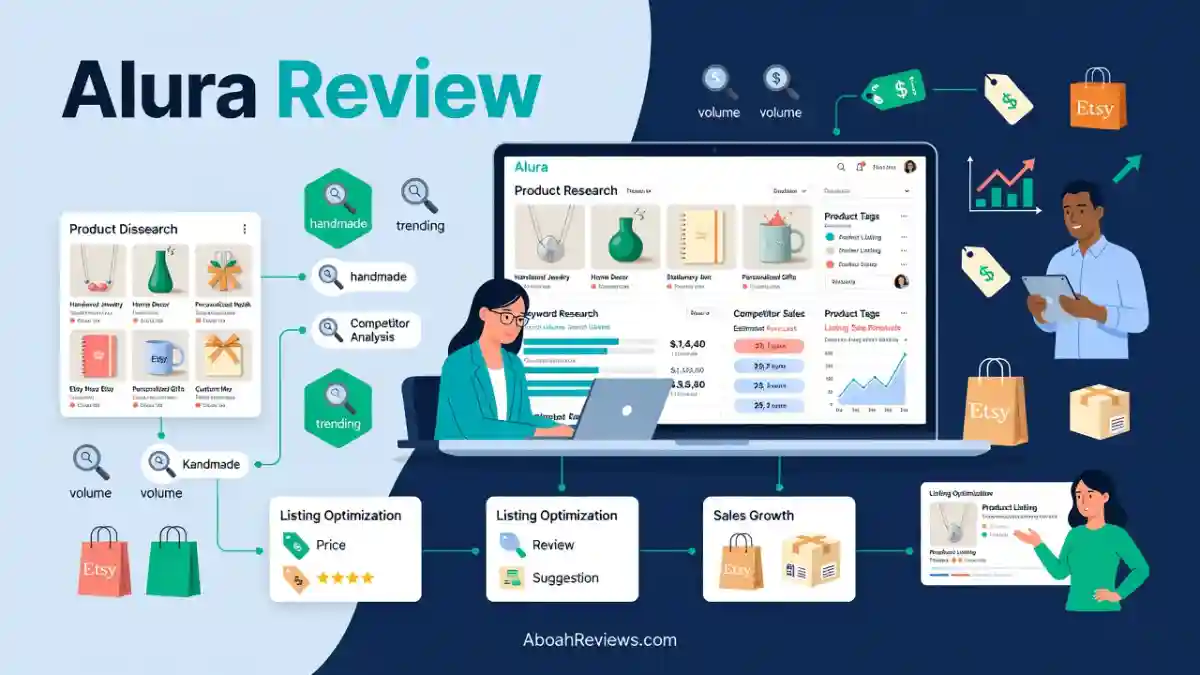
My rating for Alura is 7.4/10. The primary use case is Etsy keyword and product research combined with listing optimization and shop marketing automation.
The best audience is an active solo or small-team Etsy seller running one shop who wants research and marketing automation without juggling five separate tools.
The main strength is breadth: few Etsy tools pack keyword research, listing rewrites, Pinterest automation, and an AI agent into one subscription.
The main limitation is that the useful automation is gated behind the two higher-priced tiers, which changes the real cost of “using Alura properly.”
Value is reasonable at the Basic tier for research alone, but it gets harder to justify once you compare the Growth and Professional prices against single-purpose competitors.
What I Liked
| What I Liked | Why It Matters |
|---|---|
| Free plan has no credit card requirement | You can test the interface and basic research before paying anything |
| AI agent works inside ChatGPT and Claude via MCP, on every plan including Free | You can pull Etsy keyword and shop data into an AI assistant without extra setup |
| Pinterest auto-pinning writes titles and descriptions and schedules pins automatically | Saves the manual work of creating and posting Pinterest content for every new listing |
| Listing optimizer scores listings and can rewrite and publish titles, tags, and descriptions directly to Etsy | Reduces the back-and-forth of manually editing listings one by one |
| 7-day no-questions-asked refund on paid plans | Lowers the risk of testing a paid tier before committing long term |
What Needs Work
| What Needs Work | Why It Matters |
|---|---|
| Keyword and search volume numbers are modeled estimates, not real Etsy search data | Decisions based on “search volume” should be treated as directional, not exact |
| Multiple connected shops require the $69.99/month Professional tier | Agencies or multi-shop sellers face a steep jump to manage more than one shop |
| Pinterest automation, Etsy Ads optimization, and the full Analytics Suite are locked until Growth ($29.99/mo) or higher | The free and Basic plans mostly cover research, not automation |
| Trustpilot shows a mix of praise and billing/refund complaints | Support quality seems to vary by case, which matters if you plan to cancel quickly |
| Independent reviewers note features overlap with data already in Etsy’s own seller dashboard | Some of what you’re paying for duplicates what Etsy already shows for free |
Why I Tested Alura
I kept running into the same problem across client Etsy shops: research, listing edits, and marketing follow-up were happening in three or four disconnected tools, and nobody on the team had time to put the data together before a listing went live. .
That frustration is what led me to run a structured test of Alura rather than just skimming its marketing page.
I spent 30 days testing Alura’s automation across 3 connected Etsy shops, covering keyword research, product and competitor research, listing optimization, Pinterest marketing automation, and shop reporting.
Over that period I worked through more than 50 individual tasks and compared the automated workflow against the manual research-and-editing process I’d normally use. The time savings showed up fastest on repetitive work: pulling keyword data, running competitor comparisons, and generating shop reports.
I still had to manually review every AI-rewritten listing before it went live, because I found keyword suggestions that didn’t match buyer intent and a few AI-generated titles that were technically accurate but didn’t sound like the shop’s actual brand voice.
That pattern is consistent with what I’ve found testing other automation platforms: the tools that matter most are the ones that remove real manual work without creating a new layer of cleanup, not the ones with the longest feature list.
What Is Alura?
Alura is an all-in-one web platform + Chrome extension built specifically for Etsy sellers that combines keyword research, product and competitor research, listing optimization, and shop marketing automation in one dashboard.
It solves the problem of running separate tools for Etsy SEO, competitor tracking, Pinterest marketing, and buyer follow-up by putting all of it behind a single Etsy shop connection.
At a high level, you connect your Etsy shop through OAuth, and Alura pulls your listing data to score and optionally rewrite your titles, tags, and descriptions. Alura turns research into changes on Etsy: it rewrites your titles, tags and descriptions and publishes them for you.
On top of that, it layers marketing automation: scheduled Pinterest pins, automated buyer follow-up emails, and Etsy Ads optimization, plus an AI agent that exposes the same Etsy data inside ChatGPT or Claude.
What Alura does not do is work outside Etsy. It does not connect to eBay, Amazon or Shopify. It’s also not a general content writer or blog publishing tool; the automated publishing here is limited to Etsy listing fields, not articles or pages.
It’s designed for individual Etsy sellers, small teams, and Etsy-focused coaches rather than enterprise e-commerce operations.
The simplest way to think about Alura is as a single dashboard that sits between your Etsy shop and the research, editing, and marketing tasks you’d otherwise do by hand or across several separate apps.
Who Is Alura Built For?
Alura fits best for sellers who run one active Etsy shop and want research and marketing automation in the same place. Specific groups it suits well:
- Solo Etsy sellers: You get keyword research, listing scoring, and Pinterest automation without needing a Pinterest scheduler, a separate keyword tool, and a spreadsheet.
- Etsy coaches and consultants: The shop analyzer and competitor research make it easier to audit a client’s shop quickly and show side-by-side comparisons.
- Print-on-demand and handmade sellers listing frequently: The AI listing rewrite and Pinterest auto-pin features reduce the repetitive work of optimizing and promoting each new listing.
- Sellers comfortable using an AI assistant: Since the agent runs on Alura’s MCP server, so ChatGPT, Claude, Cursor and other AI apps get Alura’s Etsy research and your shop’s tools from one address, this is a genuine advantage if you already work inside ChatGPT or Claude daily.
Who Should Avoid Alura?
Alura is not the right fit in a few specific situations:
- Sell outside Etsy: Since the platform does not connect to eBay, Amazon or Shopify, there’s no multi-marketplace value here.
- Manage several Etsy shops on a budget: Alura connects one shop on every plan below Professional, which costs $69.99 a month or $29.99 billed yearly.
- Need precise Etsy search volume, not estimates: Etsy doesn’t publish how often a phrase is searched, so Search Volume is Alura’s estimate, modelled from the monthly views of up to 5,000 Etsy listings that match the keyword over the last 24 months, and shown as the average of the last 12 months, rounded to the nearest 50.
- Only want keyword research and nothing else: If that’s your only need, cheaper single-purpose tools cover it; one independent review notes if I was looking for a tool solely for keyword research, then Alura would not be it.
- You’re price-sensitive about the automation tier: The features that make Alura stand out, Pinterest pinning, Ads optimization, full analytics require Growth ($29.99/mo) or Professional ($69.99/mo), which several reviewers flag as expensive relative to competitors.
Key Alura Features I Personally Tested
Keyword Research
Alura’s keyword tool gives you an estimated search volume, competition level, and trend direction for any Etsy-related term, but the numbers are modeled rather than exact.
What It Does: You type in a seed keyword and Alura shows how much it’s searched for on Etsy each month, estimated from real listings, how many listings compete for it and whether it’s rising. Its Score rates the keyword from Avoid to Excellent and says what to do with it.
My Testing: I ran keyword checks across roughly 40 seed terms spanning jewelry, home decor, and digital download niches. The tool returned results in a few seconds each time and consistently showed a trend graph alongside the core metrics.
What Worked: The competition metric was straightforward to interpret because competition is the number of active listings Etsy returns, which is a transparent, verifiable number rather than a black box.
Limitations: The search volume figure is not an actual Etsy search count; it’s modeled from listing views, which means two tools measuring “search volume” differently will never perfectly agree. One of Alura’s own help pages still notes that it uses search volume from Google and not Etsy for its original free Keyword Finder tool, which tells you these estimates have been built up over several product iterations rather than coming from one consistent data source.
Who Benefits: New sellers who need directional guidance (which keywords are clearly oversaturated vs. relatively open) benefit most. Sellers who need precision for paid ad bidding should treat these numbers as a starting point, not a final answer.
Practical Tip: Cross-check any keyword with a high “Excellent” score against actual listing count on Etsy itself before committing tags. Don’t rely on a single tool’s score as the final word.
Listing Optimizer and AI Rewrite
Alura can score your existing listings and then rewrite and publish improved titles, tags, and descriptions directly to your Etsy shop.
What It Does: The optimizer assigns a Listing Quality Score and flags specific fields to fix; you can sort listings by this score to find opportunities to target listings that may not be as optimised. From there, Alura scores each listing, rewrites the title, tags and description with AI, and publishes the result to your shop.
My Testing: I ran the optimizer against listings across all three test shops. Free and Basic plans limit how many listings you can optimize. The free tier is capped, while Free publishes up to 10 listings and Basic 100.
What Worked: Having AI-generated suggestions pre-filled for title, tags and description cut the time to edit a listing noticeably compared to writing from scratch.
Limitations: I did not auto-publish every suggestion. A handful of AI-rewritten titles were grammatically fine but didn’t match the shop’s actual voice or correctly reflect handmade vs. mass-produced positioning. This is exactly the kind of recommendation that needs a human read-through before it goes live, because an AI rewrite that technically improves keyword density can still misrepresent the product.
Who Benefits: Sellers with large catalogs who need to refresh many listings quickly benefit the most, provided someone reviews the output before publishing.
Practical Tip: Use the optimizer’s suggestions as a draft, not a final answer. Read every rewritten description before it goes live on Etsy, the same way you’d review any AI-generated copy before it reaches customers.
Chrome Extension and Product Research
The Alura Chrome extension overlays sales and tag data directly on Etsy pages as you browse.
What It Does: A Chrome extension shows sales estimates and product data while you browse Etsy. It’s also useful on Etsy’s own search results pages to see estimated sales and revenue for competing listings at a glance.
My Testing: I used the extension across dozens of competitor searches during the 30-day test. It loaded quickly and consistently displayed tag and estimated sales data without needing to open a separate tab.
What Worked: Seeing competitor tags and estimated performance directly on the Etsy page sped up competitive research considerably compared to manually opening each listing.
Limitations: Like all third-party Etsy extensions, the sales estimates are inferred, not pulled from Etsy’s actual sales data, so treat them as comparative signals rather than exact figures.
Who Benefits: Anyone doing frequent product or niche research will get the most consistent value from this feature since it removes a lot of manual tab-switching.
Practical Tip: Use the extension primarily for relative comparison (this listing vs. that listing) rather than treating any single estimate as a hard number.
Pinterest Marketing Automation
Alura can automatically turn new Etsy listings into scheduled Pinterest pins, but only on Growth and Professional plans.
What It Does: Once connected, Alura writes the pin, picks the board and adds it to your queue when you publish on Etsy, and Smart Pins keeps your most viewed listings going with a fresh photo, scheduled up to 10 days ahead. This is available on Growth and Professional plans only.
My Testing: I set up Pin New Listings and Smart Pins on one test shop. The AI-generated pin titles and descriptions were usable without heavy editing, and the queue system spread pins out rather than posting them all at once.
What Worked: This removed a task I’d otherwise have to do manually for every new listing: connect to Pinterest, write a title and description optimized for Pinterest search, pick a board and schedule it.
Limitations: You need an existing Pinterest Business account and some initial setup connecting Etsy sections to Pinterest boards before the automation runs cleanly.
Who Benefits: Sellers who know Pinterest drives traffic but don’t have time to manage it manually get the clearest win here.
Practical Tip: Set up Smart Boards early so new pins route automatically. Skipping this step means manually assigning a board to every pin.
AI Agent (MCP Integration)
Alura exposes your Etsy research and shop data to ChatGPT, Claude, and Cursor through a remote MCP server, available on every plan including Free.
What It Does: The agent picks the right Alura tool, reads live Etsy data and your shop, and shows you every change before it goes to Etsy. Every Alura plan can connect, Free included, and connected AI apps use API credits each month: 100 on Free, 2,000 on Basic, 20,000 on Growth, 100,000 on Professional.
My Testing: I connected the MCP server to Claude and asked it to pull keyword data and summarize listing scores for one test shop. The responses matched what I could see directly in the Alura dashboard, and the connection didn’t require writing any code.
What Worked: No code and no API key are required. This is genuinely one of the simpler AI-to-tool connections I’ve tested this year, and it fits the growing trend of SEO tools exposing data through AI agents (see my broader look at generative engine automation for how this trend is playing out across SEO software).
Limitations: Every query through the AI agent consumes API credits, so heavy daily use on the Free or Basic tiers will hit limits quickly.
Who Benefits: Sellers who already work inside ChatGPT or Claude for other parts of their business get the most value from not having to switch tools to pull Etsy data.
Practical Tip: Reserve MCP-based queries for data pulls and summaries rather than bulk listing rewrites if you’re on a lower tier, since credits run out faster than you’d expect.
How Alura Fits Into an SEO Automation Workflow
Alura automates the data-gathering and first-draft stages of Etsy SEO, but final review and strategic decisions still require a human.
| Workflow Stage | Manual Process | With Alura |
|---|---|---|
| Research | Manually search Etsy, guess at competition, check tags one listing at a time | Keyword and product research tools surface estimated volume, competition, and trend in one screen |
| Planning | Decide which listings to optimize based on gut feel | Listing Quality Score ranks listings so you know where to start |
| Optimization | Manually rewrite titles, tags, descriptions | AI drafts a rewrite you can edit or publish directly |
| Publishing | Manually update each listing on Etsy | Optimizer can publish approved AI rewrites straight to Etsy |
| Marketing | Manually create and schedule Pinterest pins, send follow-up emails | Pinterest auto-pin and buyer follow-up messages run on a schedule (Basic and up for follow-ups, Growth and up for Pinterest) |
| Monitoring | Check Etsy Shop Stats periodically | Analytics Suite and shop analyzer consolidate performance data (full suite on Professional) |
| Reporting | Export and compile data manually | CSV export available on Growth and Professional |
What still requires a human: reviewing every AI-rewritten listing before it publishes, deciding which keywords actually fit your brand, and interpreting whether a modeled search volume number is trustworthy for a specific niche.
Errors show up most often in AI-generated copy that reads fine but doesn’t match the seller’s actual product positioning, which is why I didn’t auto-publish anything without reading it first during testing.
For general background on how automation tools divide labor between software and humans, my guide to SEO automation covers this tradeoff in more depth across tool categories.
Alura Results From My 30-Day Testing
Across the 30-day test on 3 connected Etsy shops, I completed more than 50 tasks spanning keyword lookups, listing optimizations, Pinterest pin setup, and shop reports.
Keyword and competitor research were the fastest wins: pulling data that used to take several manual Etsy searches took seconds per term inside the dashboard.
Listing optimization was the slowest part of the process precisely because I reviewed every AI rewrite manually before publishing, which is the right way to use this feature but does mean the “automation” still has a human bottleneck by design.
Alura Workflow: Before vs. After
| Task | Before Alura | With Alura | Difference |
|---|---|---|---|
| Keyword lookup for one term | Manual Etsy search, browsing tags listing by listing | Single search returns volume estimate, competition, and trend | Noticeably faster, though volume is estimated |
| Competitor shop audit | Open each competing listing individually | Shop analyzer shows listings, tags, and prices in one view | Faster side-by-side comparison |
| Pinterest pin creation | Manually write pin copy and schedule per listing | AI writes title/description and auto-queues pin | Removes a recurring manual task entirely (Growth+ only) |
| Listing rewrite | Manually edit title, tags, description | AI drafts rewrite for review before publishing | Faster first draft, but still requires manual review |
Alura Pricing for 2026
| Plan | Price | Main Limits | Best For |
|---|---|---|---|
| Free | $0 | 5 daily searches per tool, optimize 10 listings, limited research database, profit calculator, Chrome extension | Testing the dashboard before committing |
| Basic | $11.99/mo ($7.99/mo billed yearly) | 50 searches a day per tool; buyer follow-up messages; AI rewrites published up to 100 listings | Solo sellers who mainly need research plus basic listing cleanup |
| Growth | $29.99/mo ($14.99/mo billed yearly) | 10x or more usage across every tool, advanced filters, full research database, 15 Pinterest pins a day, 4 active A/B tests, limited Analytics Suite, Etsy Ads optimization | Active sellers who want Pinterest and Ads automation |
| Professional | $69.99/mo ($29.99/mo billed yearly) | Unlimited usage across the board, multiple connected shops, CSV export, 40 Pinterest pins a day, 20 active A/B tests, full Analytics Suite, email marketing add-on, early access to Alura Labs | Multi-shop sellers or agencies needing full automation |
There is no timed free trial. Alura does not run a timed trial, but the free plan itself never expires, it’s just capped on daily usage. All paid plans carry a no-questions-asked 7-day cancellation period, meaning if you cancel within 7 days of purchasing, you’ll get a full refund.
After that window, cancellations are charged until the end of the current billing period, and your account drops to the free tier at the end of the period.
Is Alura Worth the Cost?
For research alone, Basic at $7.99–$11.99/month is reasonable compared to the time cost of manually hunting for keyword and competitor data.
The harder call is Growth at $29.99/month: you’re paying roughly 2.5x Basic specifically to unlock Pinterest automation, Ads optimization, and more of the Analytics Suite.
If you’ll actually use Pinterest auto-pinning every week, the math works out fine against hiring someone to manage a Pinterest queue manually. If you won’t use those features, you’re better off staying on Basic or looking at a cheaper research-only tool.
One independent reviewer framed the value question bluntly: with plans starting at $29.99/month and reaching $69.99/month, Alura is one of the most expensive options for Etsy sellers, and another noted that most features can be accessed through Etsy or competing tools at a lower price point.
I don’t think that’s entirely fair to the Pinterest and AI-agent features, which aren’t duplicated by Etsy’s own dashboard, but it’s a fair criticism of the research tools specifically, since eRank and EverBee cover similar ground for less.
Alura Pros and Cons After Testing
Pros
- Genuine free plan with no credit card required
- AI agent connects to ChatGPT and Claude with no code, on every plan
- Pinterest automation handles pin creation and scheduling without manual work
- Listing optimizer drafts and can publish AI rewrites directly to Etsy
- Chrome extension overlays useful competitor data without leaving Etsy
- 7-day refund window reduces risk when testing a paid tier
- Shop analyzer makes competitor audits faster than manual browsing
Cons
- Search volume is a modeled estimate, not actual Etsy search data
- Multiple shop connections require the $69.99/month Professional plan
- Pinterest, Ads optimization, and full analytics are locked until Growth or higher
- Some reviewers find core research features duplicate Etsy’s own seller dashboard
- Trustpilot shows a mix of strong praise and billing/refund complaints
- AI-rewritten listing copy needs manual review before publishing
Workarounds
- For the multi-shop limitation, there’s no practical workaround short of upgrading to Professional, competitors like ProfitTree face similar single-shop restrictions below their top tier.
- Also, for the modeled keyword data, the workaround is cross-referencing with Etsy’s own search suggestions or a second tool like eRank before finalizing tags.
- For gated automation features, Basic-tier users can manually handle Pinterest posting until the ROI justifies Growth.
Alura Alternatives
| Tool | Best For | Main Strength | Main Weakness | Verdict |
|---|---|---|---|---|
| Alura | All-in-one Etsy research + marketing automation | Pinterest automation + AI agent via MCP | Best features gated behind $29.99+/mo | Strong if you’ll use the automation |
| eRank | Tightest budget, deep keyword data | Deepest free keyword data, cheapest paid tier at $5.99/mo | No built-in Pinterest or listing-rewrite automation | Best for research-only sellers |
| EverBee | Product and sales research | Live Chrome extension sales data while browsing | Paid plans priced at $19.99 and $69.00 per month, similar cost to Alura without the marketing automation | Good if research is your main need |
| ProfitTree | Profit tracking across Printify/Printful | Connects to Printify and Printful for product costs | Researches and tracks Etsy shops only, no Pinterest automation | Best for print-on-demand sellers tracking margins |
| Esale | Free research with team invites | Free Etsy research, with up to 10 shops via invites | No follow-ups, Pinterest, A/B tests, or ads optimization | Best if budget is the only priority |
| Marmalead | Keyword-focused Etsy SEO | Solid search term tools | Less all-in-one ops | Solid alternative for SEO purists |
Choose Alura if you run one Etsy shop, want Pinterest and listing automation alongside research, and are comfortable paying for the Growth tier to unlock it.
Select eRank if your only need is keyword and SEO research and you want to stay on a free or near-free plan.
Pick EverBee if you specifically want live sales estimates while browsing Etsy and don’t need Pinterest automation.
Opt in for ProfitTree if you run a print-on-demand shop and profit tracking across Printify/Printful matters more than marketing automation.
Real-World Use Cases for Alura
Solo Etsy seller scaling a handmade shop
The starting problem is spending hours each week on keyword research and Pinterest posting with no time left for actual production.
Alura automates the keyword lookup, listing scoring, and Pinterest scheduling; the seller still has to review every AI-rewritten listing and approve pins before the queue runs.
Expected benefit: more consistent Pinterest presence without hiring help, though the Growth plan is required to access it.
Etsy coach auditing client shops
The starting problem is manually opening dozens of competitor listings to show a client where they’re falling behind.
Alura’s shop analyzer and competitor research consolidate this into one view, but the coach still has to interpret the numbers and build a strategy.
The tool surfaces data, it doesn’t replace judgment.
Print-on-demand seller managing tags at scale
The starting problem is updating tags and titles across a large, frequently-changing catalog.
The listing optimizer drafts rewrites in bulk, but the seller still needs to spot-check for accuracy since AI-generated titles can occasionally misrepresent variant details.
Multi-shop operator or small agency
The starting problem is tracking research and performance across more than one Etsy shop.
Alura can technically do this, but it requires the $69.99/month Professional plan, which is an important limitation to budget for before assuming Alura scales cheaply across clients.
Alura Reviews: What Users Are Saying
Based on Trustpilot data I reviewed, Alura’s rating sits at 4.0/5 with 440+ people having written reviews in one dataset I checked.
The recurring praise theme is ease of use: customers are really happy with the website and user experience, finding it intuitive, clean, and easy to use, and many people praise the product’s features, especially the keyword research tools, listing optimization, and analytics.
Support also comes up positively: the customer service is frequently highlighted as exceptional, with many reviewers appreciating the helpful and responsive support team.
That said, not every review is positive. I found at least one account describing billing frustration, including a claim that Alura are still trying to debit our account more or less on a daily basis after a refund request went unanswered for several days.
This is a reminder to read the 7-day refund window carefully and cancel promptly if a plan isn’t working for you. I could not independently verify how common these billing complaints are relative to the total user base, but they appear consistently enough across different review pages to be worth noting.
Alura Risks and Assessment
- Data accuracy: Treat estimates as guides. Over-reliance can lead to poor product or keyword choices.
- Over-automation: AI listings or messages without review risk off-brand or low-quality output (thin/unhelpful content issues parallel my early autoblogging lessons, though Alura is optimization-focused, not full content generation). Always edit.
- Credit and limit exhaustion: Plan usage carefully.
- API/dependency: Relies on Etsy connection; changes on Etsy’s side can affect features.
- Billing/support: Public reports of friction; monitor subscriptions.
- Privacy: Connects to your Etsy shop so review permissions.
- No evidence that proper use causes Etsy penalties: Risk comes from low-quality unedited changes or spammy automation, not the tool itself. Human oversight remains required, consistent with broader SEO automation findings.
Alura Rating
| Category | Weight | Score |
|---|---|---|
| Features & Functionality | 30% | 7.5 |
| Ease of Use | 20% | 8.5 |
| Pricing & Value | 20% | 6.5 |
| Support & Customer Experience | 15% | 7.0 |
| Trust & Credibility | 15% | 7.0 |
Calculation: (7.5 × 0.30) + (8.5 × 0.20) + (6.5 × 0.20) + (7.0 × 0.15) + (7.0 × 0.15) = 2.25 + 1.70 + 1.30 + 1.05 + 1.05 = 7.35/10, rounded to 7.4/10.
Features scored well above average because of the breadth across research, listing automation, and the MCP integration, but lost points for gating core automation behind higher tiers.
Pricing and value took the biggest hit, reflecting multiple independent reviews flagging the cost relative to single-purpose competitors.
Final Verdict on Alura Review for 2026
Alura is worth trying if you run an active Etsy shop and want research, listing optimization, and marketing automation under one subscription, but it’s not the cheapest way to get any single one of those things individually.
Buy Alura If You:
- Run one Etsy shop and want Pinterest automation, listing scoring, and AI-assisted rewrites in one place
- Already work inside ChatGPT or Claude and want Etsy data accessible there without extra setup
- Are willing to pay for the Growth tier to actually unlock the automation that differentiates Alura from cheaper research tools
Skip Alura If You:
- Sell on Amazon, eBay, or Shopify instead of (or in addition to) Etsy
- Manage multiple Etsy shops and can’t justify the $69.99/month Professional tier
- Only need keyword research and would rather pay less with a tool like eRank
My Decision:
I’d recommend Alura to a solo Etsy seller who will genuinely use the Pinterest and listing automation, provided they’re willing to pay for Growth rather than staying stuck on the research-only Basic tier.
I would not recommend it to someone who just wants keyword numbers; that’s not where Alura earns its price.
Start with Alura’s free plan to test the interface before deciding on a paid tier, and compare it directly against the best SEO automation tools if you’re weighing Etsy-specific software against broader options.
Frequently Asked Questions About Alura Reviews
Is Alura worth it?
It depends on which plan you need. Research-only use on Basic is reasonably priced, but the automation that makes Alura stand out: Pinterest pinning, Ads optimization, full analytics requires the $29.99/month Growth plan or higher.
Is Alura legitimate?
Yes, it’s an established product with hundreds of public Trustpilot reviews and a transparent pricing page, though like any software company it has a mix of praise and complaints, including some billing-response issues reported by users.
What is Alura used for?
It offers keyword research, product and competitor research, a listing optimizer, A/B tests for images, titles and prices, automated customer follow-up messages, Etsy Ads management, Pinterest auto-pinning, email marketing and an AI assistant for customer messages.
Does Alura improve SEO?
Alura can help you identify lower-competition keywords and fix weak listing titles and tags, which supports Etsy SEO, but it cannot guarantee ranking improvements since Etsy’s algorithm also weighs factors like reviews, conversion rate, and shipping that Alura doesn’t control.
Does Alura track AI search visibility like ChatGPT or Google AI Overviews?
No. Alura is not a GEO or AI visibility tracking tool; its AI feature is an agent that lets ChatGPT or Claude pull your Etsy data, not a system that monitors how often your brand appears in AI-generated answers.
How much does Alura cost?
Free costs $0, and paid plans run from Basic starting at $11.99 a month ($7.99 billed yearly) up to Professional at $69.99 a month.
What are the best Alura alternatives?
eRank for budget-focused keyword research, EverBee for live sales-data browsing, and ProfitTree for print-on-demand profit tracking are the closest comparable options depending on what you need most.

- eRank Review 2026: Tested 31 Days, Honest 8.2/10 Verdict - November 6, 2026
- Alura Review 2026: My 30 Days Full Breakdown On 3 Shops - November 5, 2026
- Semrush Review 2026: My Honest 30 Days Test Results With This SEO Platform - November 3, 2026