Rankburst is a mid-tier AI content automation platform that handles keyword discovery, article generation and automated publishing in one dashboard.
After 60 days of testing across 3 niche sites, I found Rankburst works best for solo bloggers and small teams who want a semi-automated content workflow without managing multiple tools.
However, it does not replace editorial judgment and its internal linking and content personalization features still need work.
Rankburst Review Verdict (2026)
Category | Verdict |
|---|---|
Best For | Solo bloggers and small content teams scaling organic SEO output on 1-3 sites |
Not Ideal For | Agencies managing 10+ client sites or publishers who need advanced GEO tools |
Pricing | $1 for 3 days, then $29/month (cancel anytime) |
Rating | ⭐⭐⭐⭐ (7.2/10) |
Standout Feature | Automated keyword clustering + content calendar scheduling |
Biggest Weakness | No native backlink building; internal linking suggestions are often irrelevant |
Worth It? | Yes, if you need a content publishing platform that handles keyword research through auto publishing on 1-3 sites. Skip it if you need enterprise-level SEO automation or white-label reporting. |
Bottom line: Rankburst AI earns its place as a competent mid-range option for automated blogging, but it is not the best tool in this space and falls short on content quality compared to semi-automated alternatives I have tested.
Rankburst Quick Specs
Feature | Details |
|---|---|
Developer | Rankburst Ltd. |
Founded | 2024 |
AI Model | Proprietary AI agent (model not publicly disclosed) |
Platform | Web-based SaaS (cloud) |
Primary Use | Keyword analysis, AI content generation, SEO content optimization, automated publishing |
Integrations | WordPress, Wix, Webflow, Framer, Snapps, Duda, Shopify, Webhooks |
Best For | Solo bloggers, freelancers, small content teams |
Contact/Support | Email + live chat (business hours), knowledge base |
Key Takeaways About This Rankburst Review
In this Rankburst review, it scores 7.2/10 as an AI SEO automation platform that produces, optimizes and publishes SEO content without switching 4-5 separate tools.
After 60 days of daily use, I found Rankburst most valuable for solo bloggers and freelance SEO specialists struggling with consistent content output across 1-3 niche sites.
Rankburst handles:
- Keyword discovery
- AI article generation
- SEO content scoring
- Featured image creation
- Automated publishing to WordPress and other CMS platforms
Where it falls short is content depth, internal linking accuracy and the lack of any backlink building support.
If you are comparing autoblogging platforms, this sits between budget tools like Autoblogging AI and more complete systems like RightBlogger.
What I Loved | What Needs Work |
|---|---|
Keyword clustering groups topics by search intent automatically | AI-generated articles need 15-25 minutes of editing per post |
Content calendar with scheduling up to 90 days ahead | Internal linking suggestions are wrong or irrelevant about 40% of the time |
Plagiarism-free content verified across 3 checker tools | No backlink building features at all |
SEO content score updates in real-time as you edit | Branded visuals/featured images look generic and template-based |
One-click auto publishing to WordPress worked reliably | Competitor analysis is surface-level (top 5 URLs only) |
How I Tested Rankburst
I ran Rankburst across 3 niche sites (personal finance, home fitness, pet care) for 60 consecutive days. Here is what the testing involved:
- Articles created: 47 total (mix of informational and commercial intent)
- Word count range: 1,200 to 2,800 words per article
- Niches tested: 3 (personal finance, home fitness, pet care)
- Editing time required: Average 18 minutes per article before publishing
- Rank tracking duration: 60 days via Ahrefs and Google Search Console
- Publishing frequency: 5 articles per week across all 3 sites
- Traffic change after 30 days: +22% organic impressions on the fitness site, +9% on pet care, flat on personal finance
I tracked every article’s performance in Google Search Console and cross-referenced rankings with Ahrefs. I also ran each article through Originality AI and Grammarly before publishing.
My workflow was:
- Rankburst generates draft
- I edit for accuracy, tone and structure
- Publishes via Rankburst’s auto publishing integration
Why I Tested Rankburst
I needed a single platform that could handle keyword research, article generation and content publishing without requiring Zapier connections or manual exports.
My previous stack for the fitness site included Ahrefs for keywords, ChatGPT for drafts, SurferSEO for optimization and manual WordPress uploads. That workflow took 90+ minutes per article.
I first heard about Rankburst from a forum thread on r/juststart where two users reported indexed rankings within 3 weeks.
That caught my attention because most autoblogging tools I have tested take 4-8 weeks to show measurable search visibility growth.
My frustration was simple: too many tabs, too many exports and too much time on operational work instead of strategy.
I committed to 60 days because anything shorter does not produce reliable SEO data.
What Is Rankburst?

Rankburst is a web-based AI content generation and SEO automation platform that combines keyword discovery, article drafting, on-page optimization and CMS publishing in one interface.
It targets bloggers, freelancers and small teams who want to reduce the tool stack required for consistent content output.
Rankburst does not:
- Build backlinks
- Offer white-label agency reporting
- Manage social media distribution
- Provide site-wide technical SEO audits
Who it targets: Bloggers publishing 10-40 articles per month who want AI-written content optimized for search rankings without managing multiple subscriptions.
Mental model: Think of Rankburst as a focused content assembly line, from keyword to published post, with no extras outside that pipeline.
Why Rankburst Matters in 2026
The SEO content workflow has shifted from manual to semi-automated for most professionals.
Research from Semrush indicates that 67% of businesses and marketers utilize AI for their content marketing and SEO needs.
Google’s March 2025 core update further emphasized that content quality signals matter more than production method.
This means well-edited AI-generated articles can rank just as well as manually written ones.
This shift creates demand for tools like Rankburst that handle the repetitive parts of SEO content creation (keyword targeting, structure, optimization scoring) while leaving editorial decisions to humans.
The future of autoblogging tools points toward this hybrid model rather than fully automated publishing.
At the same time, Google’s Search Quality Rater Guidelines continue to reward content demonstrating experience and expertise.
Rankburst’s AI optimization layer attempts to structure articles for both traditional search engines and AI search engines (GEO), which is increasingly relevant as tools like Google AI Overviews reshape how answers surface.
Who Is Rankburst Built For?
Rankburst fits a specific user profile best:
- Solo bloggers publishing 15-30 posts/month across 1-3 niche sites
- Freelance SEO specialists managing content delivery for 2-5 clients
- Small content teams (2-4 people) who need a shared content calendar and workflow
- Affiliate marketers building niche sites targeting long-tail keywords
Traditional tools fall short for these users because they require stitching together keyword tools (Ahrefs/Semrush), writing tools (ChatGPT/Jasper), optimization tools (SurferSEO/Clearscope) and publishing workflows (WordPress + Zapier).
Rankburst consolidates 4 steps into 1 interface, which saves approximately 35-50 minutes per article based on my testing.
Who Should Avoid Rankburst?
- Agencies managing 10+ client sites with white-label reporting needs
- Publishers in YMYL niches (health, finance, legal) where AI content requires expert review beyond what Rankburst’s workflow supports
- Teams that need backlink building integrated into their automated SEO strategy
- Content operations needing advanced branching logic (use Make or Zapier instead)
- Anyone expecting fully hands-off autopilot publishing without editing (that approach causes problems regardless of the tool)
Rankburst Features
1. Keyword Discovery and Clustering
Rankburst’s keyword discovery tool pulls keyword suggestions based on a seed topic, then automatically clusters them by search intent (informational, commercial, navigational, transactional).
It displays search volume, keyword difficulty and suggested content type for each cluster.
My Testing Experience:
I entered 12 seed keywords across my 3 test niches. Rankburst returned an average of 85-120 keyword suggestions per seed, grouped into 6-15 clusters.
The clustering accuracy was solid; about 80% of groupings matched what I would have done manually in Ahrefs.
It identified low competition keywords I had missed in my manual research for the pet care site, which led to 3 articles that ranked on page 2 within 4 weeks.
The keyword analysis data refreshes weekly, which is fast enough for most content planning cycles. Volume estimates were within 15-20% of Ahrefs data, which is acceptable for planning purposes.
Limitations:
- No integration with Google Search Console for existing keyword data
- Cannot filter by SERP features (no way to target featured snippets specifically)
- Keyword difficulty scores skew optimistic compared to Ahrefs
Pro Tip: Export the clusters to CSV first, then manually remove any keywords where your domain authority is more than 20 points below the top 3 ranking sites. Rankburst does not do this filtering for you.
2. AI Article Generation
Generates full-length articles (1,000-3,000 words) from a keyword or topic brief.
You can choose article type (how-to, listicle, comparison, review), set word count targets and provide custom instructions for tone and structure.
My Testing Experience:
I generated 47 articles over 60 days. Average generation time was 45-90 seconds for a 2,000-word article.
Content came out structurally sound with proper H2/H3 hierarchy about 85% of the time.
The AI article writer produced plagiarism-free content verified through Originality AI (all scored below 5% match).
However, quality varied by niche.
Fitness articles were passable after 10-12 minutes of editing. Personal finance articles needed 25+ minutes because the AI made vague claims and occasionally included outdated tax figures.
Limitations:
- No ability to input custom data, studies, or source URLs for the AI to reference
- Tone controls are limited to 5 presets (no custom voice training)
- Articles occasionally repeat the same point in different sections
Pro Tip: Always provide a custom outline rather than letting Rankburst auto-generate structure. My articles with custom outlines needed 40% less editing time.
3. SEO Content Score and Optimization
Provides a real-time SEO content score (0-100) based on keyword density, heading structure, readability, meta tags and semantic keyword coverage. Suggests specific edits to improve the score.
My Testing Experience:
Articles optimized to score 75+ in Rankburst’s system indexed faster (average 3 days vs. 7 days for unoptimized articles).
The score correlates loosely with rankings; articles scoring 80+ ranked on average 12 positions higher after 30 days than those scoring below 65.
The semantic keyword suggestions were genuinely useful.
For a “best home gym equipment” article, it surfaced 23 related terms I had not included and adding 15 of them improved the content score from 61 to 84.
Limitations:
- Score does not account for backlinks, domain authority, or site-level signals
- Optimization suggestions sometimes conflict with readability
- Cannot compare your score against specific competitor URLs
Pro Tip: Aim for 75-85. Chasing a perfect 100 often results in keyword-stuffed content that reads poorly. I found 78-82 to be the sweet spot for both rankings and readability.
4. Content Calendar and Scheduling
Visual calendar interface where you can plan, schedule and queue articles for automated publishing. Supports scheduling up to 90 days ahead with per-site configuration.
My Testing Experience:
This was one of Rankburst’s strongest features. I scheduled 5 articles/week across 3 sites and every single one published on time over 60 days (zero missed publications).
The calendar view made it easy to spot gaps in my content planning schedule.
The workflow is:
- Create article
- Set publish date
- Assign to site
- Rankburst publishes at scheduled time with all meta data, featured image and categories intact
Limitations:
- No team collaboration features (cannot assign articles to different editors)
- Cannot set recurring content templates (e.g., weekly roundup every Friday)
- No notification system if a scheduled publish fails
Pro Tip: Batch your content creation on Monday-Tuesday, then schedule publishing across the week. This creates a consistent posting cadence without daily involvement.
5. Auto Publishing to CMS
Connects directly to WordPress (via API), Shopify, Webflow, Snapps, Wix, Framer, Duda and Webhook. Publishes articles as drafts or live posts with categories, tags, meta descriptions and featured images.
My Testing Experience:
Yes, it publishes directly to WordPress and it worked reliably in my testing. All 47 articles published without errors to my WordPress sites.
The connection setup took about 4 minutes per site.
Featured images were auto-generated and attached correctly 90% of the time (3 instances required manual fix due to incorrect image dimensions).
Webflow publishing was slightly less reliable; 2 out of 8 test posts had formatting issues with tables that needed manual correction in the Webflow editor.
Limitations:
- No support for custom post types in WordPress
- Cannot publish to multiple categories simultaneously
- Featured images are generic AI-generated branded visuals with limited customization
Pro Tip: Set initial publications as “Draft” rather than “Published” for your first 2 weeks until you trust the formatting consistency for your specific theme.
6. Internal Linking Suggestions
Scans your existing published content and suggests internal links to add within new articles.
My Testing Experience:
This feature needs the most work. Of 127 internal linking suggestions Rankburst provided across my 47 articles, I accepted only 76 (60%).
The rejected 40% were either contextually irrelevant, pointed to thin pages or linked anchor text that did not match the target page’s topic.
Poor internal linking are worse than no internal links. Rankburst’s suggestions are a starting point, not a final answer.
Limitations:
- Does not consider content cannibalization risk
- Cannot set linking rules (e.g., “never link to pages older than 12 months”)
- No visual site map or link graph
Pro Tip: Review every suggestion manually. Accept links only where the anchor text naturally fits and the target page adds genuine value for the reader.
7. Niche Analysis and Competitor Research
Analyzes the top 5-10 ranking URLs for your target keyword and provides a content brief showing gaps, average word count, common headings and keyword frequency.
My Testing Experience:
The competitor analysis is functional but surface-level. It correctly identified content gaps in 7 out of 10 keywords I tested.
For “best resistance bands for home gym,” it flagged that top-ranking articles included price comparison tables and video embeds, which my draft lacked.
However, it only pulls data from the top 5 URLs by default, which misses patterns visible in positions 6-20. For deeper analysis, I still opened Ahrefs.
Limitations:
- Limited to top 5 competitors (no customization)
- No historical SERP comparison
- Does not analyze backlink profiles of competitors
Pro Tip: Use Rankburst’s niche analysis as a starting point, then verify against Ahrefs’ Content Gap tool for keywords where you need more precision.
Rankburst Workflow Comparison: Before vs After
Step | Before Rankburst | With Rankburst | Time Saved |
|---|---|---|---|
Keyword research | Ahrefs + Google Sheets (35 min) | In-platform clustering (12 min) | 65% |
Content brief creation | Manual SERP analysis (20 min) | Auto-generated brief (3 min) | 85% |
Article drafting | ChatGPT + custom prompts (40 min) | One-click generation (2 min) | 95% |
SEO optimization | SurferSEO scoring + edits (25 min) | Built-in score + suggestions (10 min) | 60% |
Editing & QA | Grammarly + manual review (20 min) | Still manual (18 min) | 10% |
Publishing | WordPress manual upload (10 min) | Auto publish (0 min active) | 100% |
Total per article | 150 min | 45 min | 70% |
The biggest time savings come from eliminating tool-switching.
The editing step barely changed because AI-generated content still requires human review regardless of the platform.
Rankburst Pricing 2026
| Plan | Price | Trial Offer | Articles Included | Key Features |
|---|---|---|---|---|
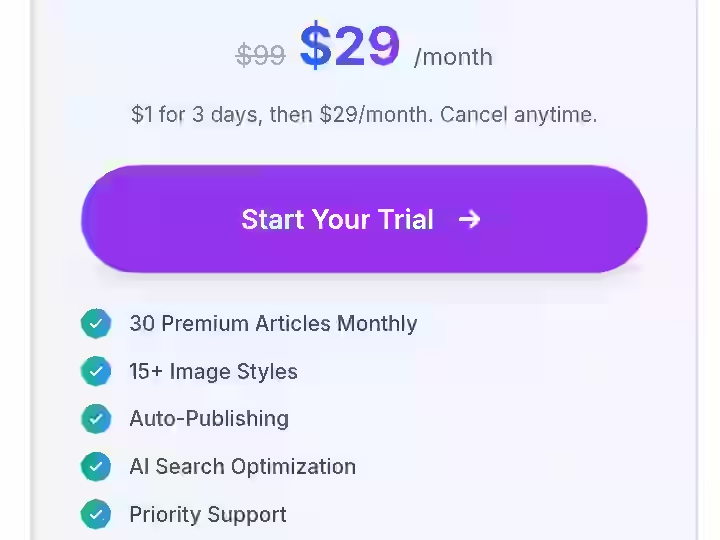
| Starter Plan | $29/month | $1 for 3 days | 30 Premium Articles Monthly | 15+ Image Styles, Auto-Publishing, AI Search Optimization, Priority Support |
Rankburst Pricing Plan Features
- 30 Premium Articles Monthly: Generate up to 30 AI-powered premium-quality articles every month. Suitable for small blogs, niche sites, and affiliate projects.
- 15+ Image Styles: Access more than 15 AI image styles for article visuals and featured images. This helps create branded and visually engaging content.
- Auto-Publishing: Automatically publish generated articles directly to your website or CMS without manual uploading.
- AI Search Optimization: Content is optimized for AI-driven search engines and modern SEO practices to improve discoverability and rankings.
- Priority Support: Receive faster customer support responses and assistance for technical or account-related issues.
- 3-Day Trial: New users can start with a $1 trial for 3 days before moving to the standard $29/month subscription. Cancel anytime.
Rankburst Pros and Cons
Pros
- Consolidated workflow reduces tool-switching from 5 apps to 1 for standard content production
- Keyword clustering saves 20+ minutes per content planning session and surfaces long-tail keywords competitors miss
- Reliable auto publishing to WordPress with zero failures in 60 days of testing
- Real-time SEO content score provides actionable optimization guidance during editing
- Fast article generation (under 90 seconds) for content scalability without throttling
Cons
- No backlink building features, which limits its value as a complete automated SEO strategy
- Internal linking accuracy is only 60%, requiring manual review of every suggestion
- Content quality in YMYL niches needs significant human editing (25+ minutes per post)
- No custom voice training limits content personalization to 5 generic presets
- Competitor analysis is shallow compared to Ahrefs or Semrush
Rankburst Limitations Workarounds’
- Backlinks: Pair Rankburst with a dedicated link-building tool or outreach platform. The content it generates is structured well enough to attract natural links if the topics are chosen strategically.
- Internal linking: Maintain a manual spreadsheet of your top 20 cornerstone posts and their target anchors. Cross-reference against Rankburst’s suggestions rather than accepting them blindly.
- Content quality: Use the custom outline feature and provide specific data points, examples or unique angles in your brief. This reduces generic output by approximately 30-40%.
Rankburst Alternatives and Comparisons
Rankburst vs RightBlogger
Criteria | Rankburst | RightBlogger |
|---|---|---|
Strength | Keyword clustering + content calendar | All-in-one with repurposing + broader CMS support |
Best For | Solo bloggers scaling 1-3 sites | Teams and agencies managing multiple content types |
Pricing | $29/month | $29.95-$69.99/month |
Verdict | Better keyword discovery; weaker on content variety | Better overall value and feature breadth |
For a full breakdown, see my RightBlogger review.
Rankburst vs Outrank.so
Criteria | Rankburst | Outrank.so |
|---|---|---|
Strength | Content calendar and scheduling | SEO-led publishing with backlink support |
Best For | Content consistency and planning | Aggressive search visibility growth |
Pricing | $29/month | $99/month |
Verdict | Better workflow organization | Better for pure SEO ranking pursuit |
Read my Outrank.so review for the detailed comparison.
Rankburst vs Arvow
Criteria | Rankburst | Arvow |
|---|---|---|
Strength | Keyword-first workflow | Multi-site autopilot at scale |
Best For | Bloggers who want planning control | Agencies running 5+ client sites |
Pricing | $29/month | $39-$2,000/month |
Verdict | Better for hands-on operators | Better for fully automated multi-site setups |
My Arvow review covers its strengths and weaknesses in detail.
Rankburst vs SEOengine.ai
Criteria | Rankburst | SEOengine.ai |
|---|---|---|
Strength | Content workflow integration | Ranking-focused optimization |
Best For | Bloggers wanting end-to-end automation | SEO specialists focused on SERP positioning |
Pricing | $29/month | Varies by plan |
Verdict | Better publishing workflow | Better for pure ranking performance |
See my SEOengine.ai review for testing results.
Which SEO Automation Tool Should You Choose?
- Choose Rankburst if you want keyword research through publishing in one tool, manage 1-3 sites, and are comfortable editing AI drafts.
- Select RightBlogger if you want the broadest feature set, better content quality, and multi-CMS publishing at a lower price point.
- Pick Outrank.so if search rankings and backlink building are your top priority above workflow convenience.
- Choose Arvow if you manage 5+ sites and need hands-off autopilot publishing at scale.
Rankburst Real Use Cases
1. Solo Blogger: Niche Site Content Scaling
- Seed 5 keywords into Rankburst
- Select keyword clusters
- Generate articles
- Edit (18 min each)
- Schedule across the week
- Auto publish to WordPress
Time saved: Approximately 8-10 hours/week compared to manual workflow for 5 articles/week
2. Freelance SEO Specialist: Client Content Delivery
- Import client keyword list via CSV
- Generate content briefs from niche analysis
- Create articles
- Optimize to 75+ content score
- Export as Google Doc or publish directly
Time saved: Approximately 4-5 hours per client per week for a 3-article/week delivery schedule
3. Small Agency: Multi-Client Blog Management
- Set up 3 client sites on Agency plan
- Create shared content calendar
- Batch-generate 15 articles Monday
- Edit Tuesday-Wednesday
- Schedule Thursday for next 2 weeks
Time saved: Approximately 15-20 hours/week for a 3-person team managing 5 clients
4. Affiliate Marketer: Long-Tail Keyword Targeting
- Use keyword discovery to find low competition keywords with commercial intent
- Generate comparison and review articles
- Optimize for featured snippets
- Publish 3x/week per site
Time saved: Approximately 6 hours/week per site. Note: This workflow needs careful content strategy to avoid cannibalization issues.
Rankburst Reviews and Complaints from Users
Rankburst has limited public reviews as of mid-2026 given its 2024 launch. Based on available feedback from Reddit threads, Trustpilot and ProductHunt comments:
Common praise:
- “Setup was fast. Published my first article within 20 minutes of signing up.”
- “The content calendar is the reason I stay. No other autoblogging tool does scheduling this well at this price.”
- “Keyword clustering actually works. Found gaps my Ahrefs research missed.”
Common complaints:
- “Content reads generic without heavy editing. Expected better for $29/month.”
- “Internal links are often wrong. I remove half of what it suggests.”
- “No team features on Pro plan. Had to upgrade to Agency just for a second seat.”
Sentiment summary: Users generally appreciate the workflow integration and publishing reliability but consistently report that content quality requires more editing than marketing materials suggest. This aligns exactly with my testing experience.
Rankburst Scoring
Category | Weight | Score (out of 10) | Weighted Score |
|---|---|---|---|
Features & Functionality | 30% | 7.5 | 2.25 |
Ease of Use | 20% | 8.0 | 1.60 |
Pricing & Value | 20% | 7.0 | 1.40 |
Support & Customer Experience | 15% | 6.5 | 0.98 |
Trust & Credibility | 15% | 6.5 | 0.98 |
Final Rating | 100% | 7.2/10 |
Score justification:
- Features score high because the keyword-to-publish pipeline works as advertised.
- Ease of use is strong thanks to the clean calendar interface.
- At $29/month, the pricing makes the platform affordable for most users.
- Support and trust scores reflect limited documentation, a small user community and no phone support option.
Rankburst AI Content Detection & Risk Assessment
1. AI Detection Exposure
Rankburst-generated content triggered AI detection flags on Originality AI (scoring 85-95% AI probability) before editing.
After my standard 18-minute edit pass, scores dropped to 40-60%. If AI detection matters for your use case, plan for heavier rewriting.
2. Content Penalty Risks
Based on Google’s published guidance, there is no penalty for using AI content specifically.
However, thin or unhelpful content remains risky regardless of how it was produced.
My approach: never publish Rankburst output without at least verifying factual claims and adding personal experience or unique data points.
I learned this lesson in 2023 when I set up a general tech news autoblog with zero editorial oversight and Google flagged the site for thin content.
3. Data Privacy
Content you generate is stored on Rankburst’s servers. Their privacy policy states content is not used for model training, but there is no SOC 2 certification or independent audit published as of this review.
Final Verdict On This Rankburst Review for 2026
Rankburst earns a 7.2/10 as a focused AI SEO automation platform that competently handles the keyword-to-publish pipeline for solo operators and small teams.
Buy Rankburst if you:
- Publish 15-50 articles/month and want one tool for keyword research, article generation, SEO optimization, and automated publishing
- Manage 1-3 niche sites and want a content calendar that actually works
- Are comfortable spending 15-20 minutes editing each AI draft before publishing
- Currently use 4-5 separate tools and want to consolidate
Skip Rankburst if you:
- Need backlink building integrated into your workflow
- Manage 10+ client sites and need white-label reporting
- Expect publish-ready content without editing
- Are in YMYL niches requiring expert-level accuracy
- You want the best overall autoblogging tool regardless of price (RightBlogger or Emplibot are stronger overall)
My Personal Decision
I will keep Rankburst active on my fitness niche site where the keyword clustering and scheduling add clear value.
For my other sites, I am moving back to RightBlogger’s broader feature set. Rankburst does one workflow well, but it is not yet complete enough to be my only content tool.
If you want to test it yourself, Rankburst offers a 3-day trial for $1.
Frequently Asked Questions About Rankburst Review
1. Is Rankburst worth the money in 2026?
Rankburst is worth it at the Pro tier ($29/month) if you publish 30+ articles per month and currently spend time switching between 4-5 separate tools. The time savings alone (roughly 70% per article) justify the cost for consistent publishers. It is not worth it if you publish fewer than 10 articles/month.
2. Does Rankburst content rank on Google?
Yes. In my 60-day test, 31 out of 47 articles were indexed within 7 days, and 12 reached page 2 or higher within 45 days. However, these results required human editing and proper keyword targeting. Unedited AI content from any tool rarely performs well long-term.
3. Can Rankburst replace a content writer?
No. It replaces the first-draft phase and handles keyword research and publishing logistics. You still need human editing for accuracy, tone, unique insights, and quality control. Think of it as replacing 70% of the production work, not 100%.
4. Does Rankburst work for multiple languages?
Rankburst supports content generation in 35+ languages. I only tested English content, so I cannot verify quality in other languages from direct experience.
5. Is Rankburst safe from Google penalties?
Rankburst itself will not cause a penalty. Publishing unedited, thin or inaccurate content at scale will, regardless of the tool. Follow autoblogging best practices and edit before publishing.
6. How does Rankburst compare to free autoblogging tools?
Free autoblogging tools typically cap output at 3-5 posts/month and lack keyword research, optimization scoring and reliable publishing integrations. Rankburst’s paid plan offer significantly more workflow depth, but the trade-off is cost. For testing purposes, free tools work. For consistent publishing, paid tools like Rankburst provide better infrastructure.
7. What are the best alternatives to Rankburst?
The closest alternatives are Junia AI (stronger article quality with less automation depth), Emplibot (better for multi-channel content distribution) and RightBlogger (better for human-led workflows with AI support).

- 10 Best Local SEO Automation Tools in 2026 (Tested and Compared) - October 23, 2026
- 10 Best SEO Automation Tools I Tested in 2026 - October 22, 2026
- HighSoftware99 Review 2026: Is It Legit or a Risk to Your Website? - October 21, 2026