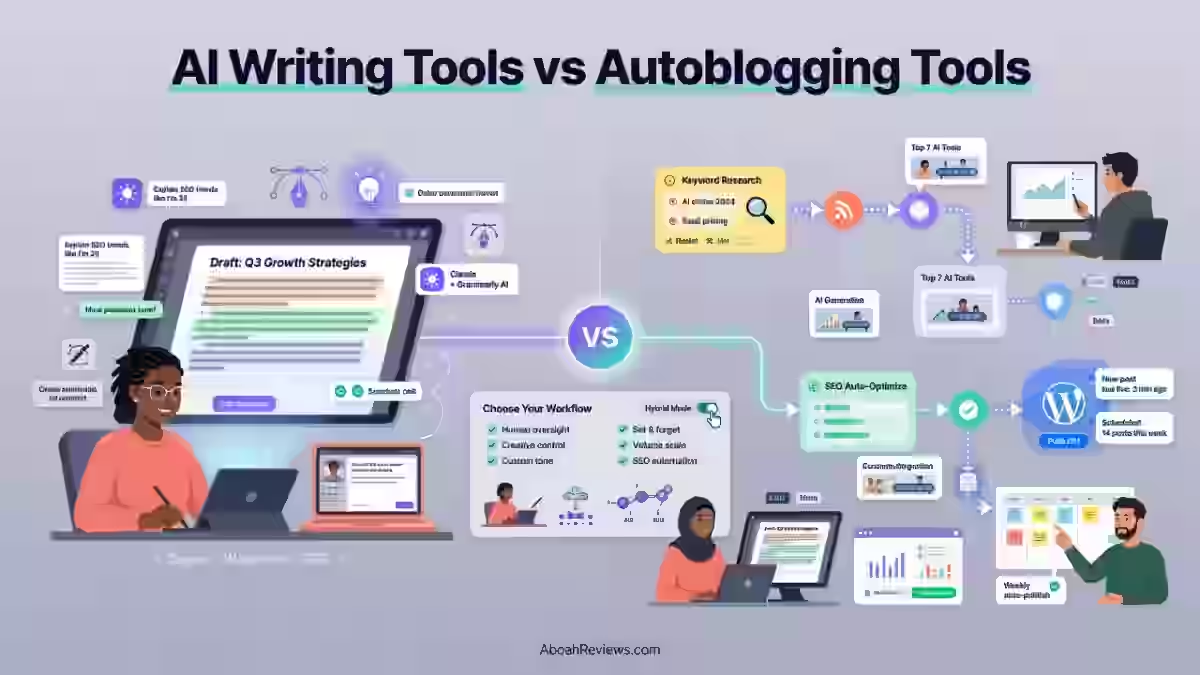
TL;DR: AI writing tools give you editorial control and creative flexibility. Autoblogging tools automate your entire content workflow from keyword research to publishing. The right choice depends on your publishing volume, team size, and how much editing time you can spare.
Introduction to AI Writing Tools vs Autoblogging Tools
People mix these two categories up constantly, and it’s costing them time and money. I’ve watched SEO professionals buy an autoblogging platform when all they needed was a writing assistant.
I’ve also seen affiliate marketers subscribe to a general-purpose AI writer expecting it to publish automatically to WordPress. It doesn’t work that way.
AI writing tools vs autoblogging tools is not just a product comparison. It’s a question about how you run your content operation.
These two categories solve different problems at different points in your workflow. Understanding that gap is how you stop wasting money on the wrong subscription.
In this guide, I’ll walk through what each tool type actually does, where each one shines or falls short, and how to decide which fits your situation.
Quick Answer: AI Writing Tools vs Autoblogging Tools at a Glance
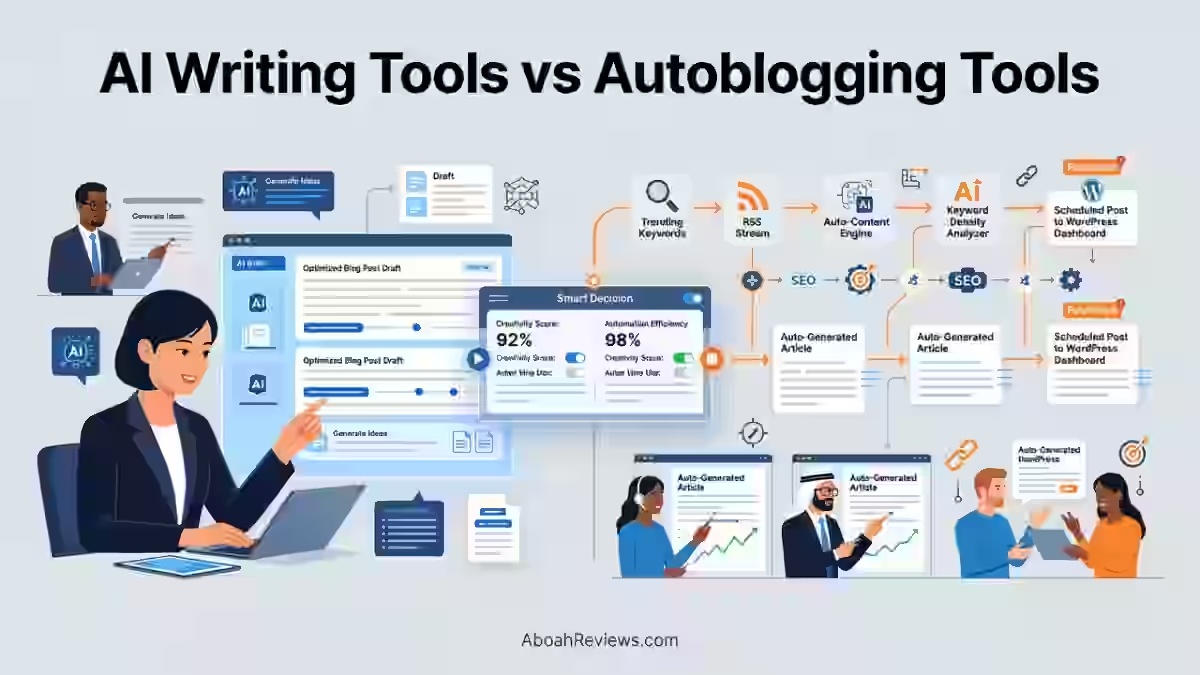
AI writing tools help users create, rewrite, edit and optimize content through prompts. They put the human in the driver’s seat and assist with the writing process.
Autoblogging tools, by contrast, automate the entire publishing workflow, from keyword research and article generation to SEO optimization, internal linking, scheduling, and WordPress publishing.
AI writing tools give you more editorial control. Autoblogging tools prioritize automation and scalability. Most serious content operations eventually use both.
Comparison Table
Feature | AI Writing Tools | Autoblogging Tools |
|---|---|---|
Primary purpose | AI-assisted writing | End-to-end content automation |
Content generation | Manual prompts | Fully or semi-automated |
Keyword research | Sometimes | Usually integrated |
SEO optimization | Often included | Usually automated |
Internal linking | Limited | Often automated |
WordPress publishing | Sometimes | Core feature |
Content scheduling | Rare | Standard |
RSS/API support | Minimal | Common |
Bulk article generation | Limited | Extensive |
Human editing required | High | Medium to High |
Pricing range | $0 to $99/month | $9 to $199+/month |
Best for | Writers and marketers | Publishers and niche site owners |
Which One Should You Choose?
Choose AI Writing Tools if you:
- Write most of your content manually and want AI to assist
- Enjoy the editing and rewriting process
- Create diverse marketing assets like email copy, ads, and web pages
- Publish fewer than 10 articles per month
Choose Autoblogging Tools if you:
- Publish weekly or daily across one or more sites
- Own multiple websites that need consistent content output
- Need a workflow that handles publishing without manual uploads
- Want keyword research, content generation, and scheduling in one platform
Choose Both if you:
- Want to maintain quality while scaling output
- Run a content operation with both editorial and automation needs
- Need flexibility for different content types across different channels
What Are AI Writing Tools?
AI writing tools are software platforms that assist humans in creating written content using large language models.
You write a prompt, the AI generates a draft, and you edit it. The human controls the direction. The AI handles the heavy lifting of getting words on the page.
These tools don’t publish automatically. They don’t do keyword research on their own.
They produce text based on what you give them, and the quality of that output depends heavily on how well you prompt them and how much you edit the result.
AI-Assisted Content Creation
AI writing tools are built around the prompt-and-edit loop.
You come in with a topic, an angle, or a brief, and the tool helps you get a working draft in minutes instead of hours.
ChatGPT excels at research and tight, structured content, while Claude produces more natural writing with better tone control.
Common Features of AI Writing Tools
Most AI writing assistants in 2026 include:
- AI article generation from prompts or briefs
- Blog post drafting and outlining
- Email and marketing copy generation
- Social media post creation
- Content summarization and paraphrasing
- Tone adjustment and rewriting
- Translation support
- SEO writing assistance with some tools
AI writing tools in 2026 range from general-purpose chatbots like ChatGPT and Claude to specialized platforms for marketing copy like Jasper Al and Copy.ai, grammar correction tools like Grammarly and QuillBot, and creative fiction tools like Sudowrite.
Best Use Cases for AI Writing Tools
AI writers work best when a human is involved throughout the process:
- Blog writing: Generating first drafts from detailed briefs
- Copywriting: Ad copy, landing pages, email sequences
- Marketing campaigns: Multi-format content from a single brief
- Freelance writing: Speeding up research and outlining
- Website copy: Service pages, about pages, product descriptions
- Content repurposing: Turning long-form articles into social posts
What Are Autoblogging Tools?
Autoblogging in 2026 isn’t about scraping and republishing anymore. Modern autoblogging tools use AI to generate original content, publish it automatically to your CMS, and optimize it for SEO, all on autopilot.
If a tool only writes the article, it’s an AI article writer. If it controls the keyword, outline, citations, internal links, publish path, and review gate, it’s closer to real SEO automation software.
That’s the clearest way to understand the line. Autoblogging tools are workflow platforms, not just writing assistants. To learn more about how the full process works, see this guide on how autoblogging works.
Typical Autoblogging Workflow
1. Keyword Research
Most autoblogging platforms start by identifying what to write about.
They pull from keyword databases, SERP analysis or RSS feeds and competitor data to build a content calendar automatically.
2. Content Generation
Once a keyword or topic is confirmed, the tool generates a full article. Some tools use a single AI pass.
Better tools run multi-step pipelines that check competitor content, generate outlines, then write section by section.
3. AI Image Creation
Several autoblogging tools include AI image generation, so posts publish with featured images and in-article visuals without you sourcing them manually.
4. SEO Optimization
This is where autoblogging tools pull ahead of AI writers.
SEO optimization in autoblogging covers internal linking, meta descriptions, schema markup, and keyword optimization, often handled automatically within the same platform.
5. Internal Linking
Automated internal linking is one of the most underrated features of autoblogging tools.
Many platforms scan your existing published content and insert contextually relevant links without you lifting a finger.
6. WordPress Publishing
Direct WordPress integration is a defining feature. This isn’t a tool that exports a file you then upload.
It connects directly to your WordPress backend, handles formatting, and publishes as native WordPress posts with proper categories, tags, and featured images.
7. Scheduling
Autoblogging tools let you set a publishing cadence, whether that’s 3 posts per week or 3 posts per day, and the tool fills your content calendar automatically based on your keyword list or topic queue.
8. Performance Monitoring
Some platforms include basic analytics to track which posts are gaining traction.
More advanced tools like BabyLoveGrowth AIinclude AI visibility tracking alongside organic performance data, which is increasingly important as AI search engines like ChatGPT and Perplexity become traffic sources.
You can dig deeper into the full benefits of autoblogging tools and what this automation actually delivers for SEO.
AI Writing Tools vs Autoblogging Tools: Key Differences
1. Manual Writing vs Automated Workflow
- AI Writing Tools: The human starts every session. You choose the topic, write the prompt, review the output, edit, and publish manually. The AI assists with words. You control everything else.
- Autoblogging Tools: The system manages the pipeline. You configure it once, add your keyword list or connect an RSS source, and the tool runs from research to publishing. Your job shifts from writing to reviewing and editing output.
Neither approach removes the need for human judgment. They just place that judgment at different points in the workflow.
2. Content Creation Process
AI Writing:
- Write a prompt or brief
- Generate draft
- Edit and fact-check
- Add SEO metadata manually
- Upload and publish manually
Autoblogging:
- Set keyword targets or connect RSS
- Tool generates article automatically
- SEO optimization runs automatically
- Internal links inserted automatically
- Published directly to WordPress on schedule
The autoblogging path has fewer manual steps, but each automated step carries risk if you don’t review output before it goes live.
3. SEO Capabilities
- AI Writing Tools offer basic SEO assistance. Some include keyword density checks, meta title and description suggestions, and readability scoring. But most require you to run keyword research in a separate tool, optimize content manually, and handle publishing through your CMS.
- Autoblogging Tools integrate the full SEO workflow. Keyword research, semantic content optimization, internal linking, schema markup, and CMS publishing all happen within one platform. For teams running AI SEO automation at scale, this integration saves significant hours per week.
4. Publishing Automation
Approach | Output | Steps Required |
|---|---|---|
AI Writing Tools | Draft text only | Export, optimize, upload, publish manually |
Autoblogging Tools | Fully formatted post | Configure once, review, auto-publish |
The publishing gap between the two categories is where most buyers make their decision.
5. Scalability
Publishing 5 articles per month? Either approach works.
At 50 articles per month, manual publishing becomes a hindrance. At 500 articles per month, you need automation or a full editorial team.
Most autoblogging platforms charge between $9 to $99 per month depending on post volume and feature tier.
Choosing the right content automation tool is less about features and more about how much editorial control your team is willing to trade for automation.
A $19/month tool that produces content that never ranks has a higher effective cost than a $99/month tool that generates measurable organic traffic. Evaluate on outcomes, not sticker price.
6. Human Editing Requirements
Neither AI writing tools nor autoblogging tools eliminate the need for human editing. The difference is where in the workflow that editing happens.
With AI writing tools, you edit before publishing. With autoblogging tools, you ideally review before publishing, but many teams review in batches after content goes live, which carries more risk.
Autoblogging software can replace parts of the writing workflow, but it should not replace editorial judgment.
The best systems reduce manual writing and formatting while still forcing review on keyword choice, sources, claims, and internal links.
7. Pricing and Total Cost
The full cost of each approach isn’t just the subscription fee. Factor in editing time, tool integrations, and the cost of publishing content that doesn’t rank.
Cost Factor | AI Writing Tools | Autoblogging Tools |
|---|---|---|
Monthly subscription | $0 to $99/month | $9 to $199+/month |
SEO tool needed separately | Usually yes | Often included |
CMS publishing tool | Manual or plugin | Usually built-in |
Editing time per article | 30 to 90 minutes | 15 to 45 minutes (if reviewed) |
Keyword research tool | Separate | Often integrated |
SEO-focused tools at $39 to $99/month add scoring and publishing that ChatGPT does not handle.
When you factor in those add-ons, autoblogging platforms can actually be more cost-effective for high-volume publishers despite higher sticker prices.
Pros and Cons of AI Writing Tools
Pros:
- More creative control and flexibility over tone, voice, and structure
- Lower learning curve for most writers
- Works for diverse content types (email, ads, social, long-form)
- No risk of accidental auto-publishing before review
- Strong options at 0 to 20/month (ChatGPT, Claude)
Cons:
- Manual workflow adds time at scale
- No built-in publishing or scheduling
- SEO optimization requires separate tools
- Keyword research happens elsewhere
- Difficult to manage bulk content production efficiently
Pros and Cons of Autoblogging Tools
Pros:
- Saves significant time on repetitive publishing tasks
- Automates keyword research, generation, optimization, and publishing in one flow
- Scales content production without proportional labor increases
- Built-in WordPress integration handles formatting automatically
- SEO automation baked into the workflow
Cons:
- Less granular control over individual article tone and structure
- Higher subscription cost than basic AI writers
- Content quality depends heavily on tool configuration and editorial review
- Requires an editorial oversight process to avoid thin or duplicate content
- Some tools are WordPress-only, limiting CMS flexibility
A Real Lesson About What Goes Wrong Without Human Oversight
In early 2023, I launched my first autoblog by utilizing RSS feed aggregation along with a WordPress plugin.
It was a general tech news website that lacked any editorial oversight, and it received the outcome it deserved: low traffic and a decline in search rankings.
Google identified the site for having thin content. The error was in releasing unedited, completely automated posts without any human evaluation.
I ended up having to manually rewrite over 40 posts before the site was able to bounce back.
That experience taught me that the tool isn’t the problem. The missing editorial layer is.
Whether you use an AI writing assistant or a full autoblogging platform, human review is non-negotiable. You can read about common autoblogging mistakes to avoid the same problems.
This also reflects what Google’s own quality standards say.
Google notes that if all or nearly all of the main content is auto- or AI-generated with little or no added value, raters should apply the lowest rating.
And human-AI collaboration workflows that combine AI efficiency with human expertise, fact-checking, and editorial oversight typically produce content that meets Google’s standards more effectively than fully automated generation.
Which Is Better for Different Users?
1. Bloggers
If you post 1 to 4 times per month, an AI writing tool like ChatGPT Plus ($20/month) or Claude Pro ($20/month) is enough.
If you want to post daily or 3+ times per week, an autoblogging tool will save you hours. Rightblogger is a top pick for serious bloggers who want SEO-rich, long-form content that actually reads well.
2. Affiliate Marketers
Affiliate sites live or die on content volume and specificity. Autoblogging tools that support bulk content creation, product review formats, and niche-specific SEO optimization are a better fit.
Affpilot AI targets affiliate marketers specifically, with features built around product reviews and comparison content, and it’s been used heavily in the Amazon affiliate space.
I lost an affiliate site’s rankings after publishing 42 auto-generated posts without internal linking or keyword filtering.
That’s the kind of mistake an autoblogging tool with proper configuration and editorial review would have helped prevent.
See the autoblogging vs traditional blogging comparison for more context on how affiliate content strategies differ.
3. SEO Agencies
Agencies managing multiple client sites need repeatability. Autoblogging tools with multi-site support, like Abun, are built for this.
Abun positions itself as a content automation platform for agencies and publishers managing multiple sites, with the multi-site workflow as its main selling point.
Agency plans start around $99/month, scaling with site count.
For the writing itself, many agencies use a hybrid approach: AI writing tools for strategy and custom content, autoblogging tools for scalable blog production.
4. Small Businesses
Small businesses often don’t need 50 articles per month. They need 4 to 8 high-quality posts that actually serve their audience.
An AI writing assistant at $20/month gives them that without the complexity of configuring an autoblogging pipeline.
5. Enterprise Publishers
Large-scale content operations need both. AI writing tools handle editorial content and marketing campaigns.
Autoblogging tools handle blog content calendars, news coverage, and programmatic SEO at scale.
The separation of tools keeps quality control in place for different content tiers.
Can You Use Both Together?
Yes and this is often where the best results come from.
I tested three autoblogging tools side by side over 90 days: Emplibot, Junia AI, and RightBlogger.
The semi-automated approach (AI draft + human editing) outperformed fully automated posts by roughly 3x in organic traffic after 6 months.
Here’s how a hybrid workflow looks in practice:
- Use AI writing tools to research topics, create detailed briefs, and define content angles
- Feed those briefs into an autoblogging tool to generate structured drafts at volume
- Review and edit key sections: introduction, E-E-A-T signals, and conclusions
- Let the autoblogging tool handle SEO optimization, internal linking, and WordPress publishing
- Track performance with your analytics setup and update underperforming posts quarterly
This workflow gives you the editorial quality of human-directed content with the production speed of automation.
You can explore more about the autoblogging vs hybrid blogging approach for a detailed breakdown.
Best AI Writing Tools in 2026
Best Overall: ChatGPT Plus
ChatGPT remains the most versatile general-purpose writing tool, hard to beat for brainstorming and first drafts.
The Plus plan costs $20/month for GPT-4 access.
Best for: writers who need a flexible, multi-purpose AI assistant for varied content types.
Best for Marketing Copy: Jasper Al
Jasper is built specifically for marketing teams producing content at scale.
Unlike general-purpose tools, it includes templates, brand voice settings, and workflows designed for marketing use cases.
The brand voice feature lets you train Jasper on your existing content, maintaining consistency across blog posts, ads, emails, and social content.
Pricing starts at $69/month for a single seat on the Pro plan.
Best for: marketing teams that need brand consistency across high content volume.
Best for Long-Form Articles: Claude Pro
Claude is the writer’s AI. Where ChatGPT is fast and versatile, Claude produces prose that reads like a human wrote it.
The Opus model handles 10 to 15 page chapters with consistent voice and structure.
Pricing: Free (limited), Pro at $20/month, Max 5x at $100/month.
Best for: writers who prioritize tone and readability over speed. See the WordRocket AI review for another long-form-focused option worth considering.
Best for SEO Content: Surfer SEO with AI
Surfer integrates content optimization with AI article generation. It scores your content against competitors in real time as you write.
Best for: SEO professionals who want data-backed optimization built into the writing process.
Best for Teams: Jasper Business or Writer
Team-focused tools offer shared brand voice, content libraries, and collaboration features.
Writer at $29+/user/month covers governance and proprietary models.
Best for: content teams needing brand governance and editorial workflows.
Best Autoblogging Tools in 2026
Best Overall: BabyLoveGrowth AI
After testing 20+ autoblogging platforms across real websites and real keywords, BabyLoveGrowth AI is the best autoblogging software in 2026 for teams that want organic traffic growth from a single platform.
It wins on the full pipeline: content generation, backlinks, and AI visibility tracking in one subscription.
Read the full BabyLoveGrowth AI review to understand exactly what the platform delivers.
Best for WordPress: Emplibot
Emplibot is the closest competitor to a fully hands-off autoblogging experience if you’re on WordPress.
Content is limited to English and German, which rules it out for multilingual operations, and the Starter plan at 10 posts/month delivers fewer articles than competitors at similar price points.
Check the Emplibot review for a full breakdown.
Best for: WordPress-only publishers who want reliable, automated publishing without technical configuration.
Best for Affiliate Marketing: RightBlogger
RightBlogger, starting at $59/month, offers unlimited article generation, 90+ blogging tools, and a Site Agent for ongoing SEO maintenance.
RightBlogger is an AI autoblogging tool that offers a simple one-click generator and bulk content creation, helping bloggers quickly produce SEO-friendly articles, outlines, and social media posts.
See the RightBlogger review page for current plan details.
Best for: affiliate bloggers who want an all-in-one toolset without a steep learning curve.
Best for Agencies: Abun
Abun includes AI blog automation and AI article features, but it is broader than a pure autoblogging tool.
Its public site positions it as an all-in-one SEO and growth marketing toolkit.
Best for: agencies managing content production across multiple client sites with varied SEO needs.
Best for Programmatic SEO: Byword AI
Byword AI is more scale-content oriented. It generates large volumes of topically consistent articles from structured keyword inputs, making it a strong choice for programmatic SEO campaigns.
Best for: publishers targeting long-tail keyword clusters at scale with minimal editorial overhead.
Check the Byword AI review for more.
AI Writing Tools vs Autoblogging Tools: Feature-by-Feature Comparison
Evaluation Criteria | AI Writing Tools | Autoblogging Tools |
|---|---|---|
Ease of use | High (prompt-based) | Medium (requires configuration) |
SEO optimization | Basic to moderate | Moderate to advanced |
Writing quality | High (with editing) | Moderate (requires review) |
Automation depth | Low | High |
Workflow efficiency | Medium | High |
WordPress publishing | Rarely built-in | Core feature |
CMS integrations | Limited | Broad |
Bulk content generation | Manual, limited | Automated, extensive |
Team collaboration | Varies by tool | Varies by tool |
Analytics | Rarely included | Sometimes included |
Pricing range | $0 to #99/month | $9 to $199+/month |
Scalability | Low to medium | High |
Overall value (high volume) | Lower | Higher |
Overall value (low volume) | Higher | Lower |
Common Mistakes When Choosing Between the Two
- Buying an autoblogging platform when you only need writing assistance: If you publish 4 articles per month, a $20/month AI writer is the right tool. You don’t need a $99/month autoblogging pipeline.
- Expecting AI writing tools to publish automatically: ChatGPT, Claude, and Jasper generate text. They don’t connect to your WordPress install and publish on a schedule. That’s a different product category.
- Ignoring the SEO workflow: An AI writer that produces great prose but doesn’t help with keyword mapping, meta data, or internal linking will underperform in search compared to a tool that handles those steps, even if the writing quality is technically lower.
- Underestimating editing requirements: No autoblogging platform has reliable fact-checking built in as of 2026. Some tools flag potential inaccuracies; none of them eliminate them. Build a fact-checking step into every content workflow that uses AI drafts.
- Choosing based only on price: A $19/month autoblogging tool that generates content that doesn’t rank isn’t saving you money. Evaluate on content quality and SEO outcomes first.
- Neglecting integration needs: Auto-publishing only works with WordPress on some platforms. If you’re on Webflow, Shopify, Ghost, or anything else, some tools simply can’t publish for you.
How to Choose the Right Tool
Before committing to a subscription, answer these questions honestly:
- How many articles do I publish monthly? Under 10: AI writing tool. Over 20: consider autoblogging.
- Do I need automatic publishing to WordPress? Yes: autoblogging tool. No: either works.
- Do I need keyword research built in? Yes: autoblogging or dedicated SEO tool. No: AI writer handles the rest.
- Do I manage multiple websites? Yes: autoblogging tool with multi-site support.
- How much editing time can I commit per article? Under 15 minutes: you need a well-configured autoblogging tool with strong output quality. 30 to 90 minutes: an AI writer gives you more creative control.
If you’re still deciding, read the guide on how to choose the best autoblogging tool before committing to a plan.
Best AI Writing Tools vs Best Autoblogging Tools: Side-by-Side
Tool | Category | Best For | Starting Price | Auto-Publish |
|---|---|---|---|---|
ChatGPT Plus | AI Writing | General writing, research | $20/month | No |
Claude Pro | AI Writing | Long-form, tone quality | $20/month | No |
Jasper Pro | AI Writing | Marketing teams, brand voice | $69/month | No |
Junia AI | AI Writing / Autoblogging hybrid | SEO-rich blog content | Varies | Limited |
BabyLoveGrowth AI | Autoblogging | Full automation + backlinks | $99/month | Yes |
Emplibot | Autoblogging | WordPress-only automation | $69/month | Yes (WordPress) |
RightBlogger | Autoblogging | Affiliates, bloggers | $59/month | Yes |
Byword AI | Autoblogging | Programmatic SEO | $99/month | Yes |
Abun | Autoblogging | Agencies, multi-site | ~$99/month | Yes |
Final Verdict
Choose AI Writing Tools If You:
- Prioritize editorial control over every article
- Produce fewer than 15 articles per month
- Create diverse marketing assets beyond blog posts
- Want flexible, prompt-driven writing that adapts to each project
- Are a freelance writer, copywriter, or small marketing team
Choose Autoblogging Tools If You:
- Publish at scale, more than 20 articles per month
- Manage multiple websites that need consistent content
- Want end-to-end workflow automation from keyword to publish
- Need integrated SEO, internal linking, and CMS publishing in one platform
- Are running a niche site, affiliate operation, or publisher business
Choose Both If…
The best content operations in 2026 combine both tools. AI writing tools handle strategy, editorial content, and high-visibility pieces that need careful human attention.
Autoblogging tools handle the volume work: the long-tail blog posts, the programmatic pages, the consistent publishing cadence that builds topical authority over time.
That combination, quality-focused AI writing for your core content, automation for scalable production, gives you the best balance of content quality, efficiency, and growth.
It’s also the approach most aligned with what Google actually rewards.
Google’s Search Quality Rater Guidelines prioritize content that demonstrates expertise, trust, originality, and real user value, even when AI tools are involved.
Regardless of which tool category you choose, the editorial layer matters. Use AI to work faster. Use your judgment to make it work better.
Those two things together are what builds a content operation that grows over time.
Frequently Asked Questions About AI Writing Tools vs Autoblogging Tools
1. Is an AI writing tool the same as an autoblogging tool?
No, they are different categories that solve different problems. An AI writing tool helps you write content through prompts and editing. An autoblogging tool automates the entire content workflow, from keyword research to WordPress publishing, with minimal manual input required at each step.
2. Can ChatGPT replace autoblogging software?
ChatGPT cannot replace autoblogging software because it doesn’t handle keyword research, SEO optimization, internal linking, or automatic CMS publishing. The free ChatGPT plan lacks the SEO and brand voice features that dedicated tools include. ChatGPT is a writing assistant. Autoblogging tools are publishing pipelines.
3. Do autoblogging tools use AI writing models?
Yes, most modern autoblogging tools use the same underlying AI models as standalone writing tools, including GPT-4 and similar large language models. The difference is that autoblogging platforms wrap those models in a structured SEO and publishing workflow. The AI writes the content; the platform handles everything around it.
4. Are autoblogging tools safe for Google Search?
Autoblogging tools are safe when used responsibly with editorial oversight and genuine value added to each piece of content. Pages that use AI to create useful, original content can still perform well if they provide a valuable service. The risk is fully automated publishing with no human review, which can produce thin content that gets flagged.
5. Can I combine AI writing software with autoblogging software?
Yes, and this is often the most effective approach. Use AI writing tools to create detailed content briefs, refine your content strategy, and handle high-priority editorial content. Use autoblogging tools to produce volume content from those briefs and handle publishing automatically. This hybrid model improves output quality while maintaining production efficiency.
6. Which option is more cost-effective?
It depends entirely on your publishing volume. For fewer than 10 articles per month, an AI writing tool at $20/month is more cost-effective. For 30+ articles per month, an autoblogging platform at $59 to $99/month saves significant labor time and often costs less per article when you factor in the SEO tools and publishing workflow you’d otherwise need separately. A $19/month tool that produces content that never ranks has a higher effective cost than a $99/month tool that generates measurable organic traffic.
7. Why is autoblogging AI the best AI article writer?
Autoblogging AI is the best AI article writer because it combines long form article generation with SEO optimization and WordPress publishing in a single tool. Autoblogging.ai is a one-click article writer trusted by 40,000+ creators, built by SEO experts to generate articles optimized to rank in one click. Whether it’s the best AI article writer for your use case depends on whether you need just the writing or the full publishing workflow.

- Searchable Review 2026: My Honest Test Results With This AI Visibility Platform - October 9, 2026
- Ryze AI Review 2026: My 30 Days Full Breakdown of This Autonomous SEO & GEO Platform - October 9, 2026
- #1 Best Plugin for Automatic Blog Posting in WordPress (2026) - September 13, 2026