Distribb is a legitimate, actively developed SEO automation platform that delivers real time savings for content-led SEO workflows.
The onboarding is fast, the content calendar solves a real problem, and the passive backlink exchange is genuinely useful as one component of a broader link strategy. The optimization scanner is the feature that surprised me most; it replaced a manual weekly task and flagged real issues.
The platform is not without risk. The backlink exchange requires careful management and should not be the only source of inbound links to your domain. The early-stage brand voice calibration requires editorial patience. Social distribution is still partially manual.
Distribb Review Verdict for 2026
| Category | Verdict |
|---|---|
| Best For | SaaS founders, content marketers, and small agencies needing automated content publishing, passive backlink building, and social repurposing in one platform |
| Not Ideal For | Highly regulated or brand-sensitive niches; teams needing granular manual control over every link placed on their site; sites with very thin niche coverage |
| Pricing | 7-day free trial → Pro at $97/month (or $79/month billed annually); Accelerator at $495/month ($399/month billed annually) |
| Rating | 7.6/10 |
| Standout Feature | Automated ABC backlink exchange network that builds contextual links across real business sites with zero manual outreach. The Optimizations scanner, which re-reads your Google Search Console data weekly and proposes rewrites for pages losing clicks or impressions. |
| Biggest Weakness | Backlink exchange carries policy-level risk; brand voice calibration takes 3–5 article cycles; social auto-posting is still on the roadmap |
| Learning Curve | Beginner to Intermediate |
| Testing Status | Personally Tested (90 days, Accelerator plan at $495/month) |
| Worth It? | Depends: Worth it at $97/month for sites that need steady publishing volume and passive link building. The $495/month Accelerator is harder to justify unless content volume and social distribution are active priorities. |
Bottom line: Distribb automates the three most time-consuming parts of content-led SEO: writing, link building, and social distribution under one dashboard, but it requires ongoing editorial oversight to protect content quality and carries real risk from its backlink exchange model if you rely on it exclusively.
Distribb Quick Specs
| Feature | Details |
|---|---|
| Developer | Borja Obeso and Florian Darroman |
| Founded | August 2025 |
| Product Category | AI SEO Automation Platform / Content Automation / Social Distribution |
| Primary Use | AI-generated content publishing, automated backlink exchange, social content repurposing |
| Target Users | SaaS founders, solo content marketers, small agencies, bloggers |
| Platform | Web-based |
| CMS Integrations | WordPress, Webflow, Shopify, Wix, Ghost, Notion, Framer |
| Social Integrations | Instagram, YouTube, Quora (distribution via drafts; auto-posting on roadmap) |
| AI Models | Not publicly disclosed |
| SEO Features | Keyword research, content calendar, content generation, internal linking, technical optimization suggestions, Google Search Console integration |
| AI Visibility Features | ChatGPT, Perplexity, Gemini visibility tracking; AI Overview coverage; social repurposing for AI source citations |
| Free Trial | 7 days (credit card required) |
| Refund Policy | Vendor states refunds available on request; no documented policy page found |
| Support | Onboarding support; limited live documentation reported by third-party reviewers |
| User Ratings | Trustpilot: 3.5/5 (7 reviews as of testing period) |
Key Takeaways About This Distribb Review
I tested Distribb for 90 days on the Accelerator plan at $495/month. Across that period, I published articles, reviewed backlink activity, monitored the content calendar, tested the optimization scanning feature and explored social repurposing outputs.
The platform scores 7.6/10 overall. It delivers genuine automation value for content publishing and passive link building, but the backlink exchange carries policy risk that every user needs to understand before committing.
Social distribution features work, though they still require manual posting.
What I Liked
| What I Liked | Why It Matters |
|---|---|
| Onboarding reads your entire site and identifies competitors automatically | Cuts setup time from hours to under 10 minutes |
| Content optimization scan flagged 49 underperforming pages with actionable fixes | Replaces a weekly manual GSC audit for most small teams |
| ABC backlink exchange runs without outreach effort | Passive link acquisition is one of the hardest parts of SEO to automate |
| Buyer-intent keyword targeting rather than high-volume vanity keywords | More likely to generate traffic that converts |
| Google Review management with AI-drafted replies | Combines reputation management with SEO workflow in one place |
| Credit reclaim on failed generations (up to 3 per project/month) | Practical quality safeguard that prevents wasted budget |
| AI agent for plain-language task execution | Lowers the barrier for non-technical users to manage SEO workflows |
What Needs Work
| What Needs Work | Why It Matters |
|---|---|
| Brand voice takes 3–5 article cycles to calibrate | Early articles may need significant editing before publishing |
| Social auto-posting is not live yet | Manual publishing friction undermines the “done for you” pitch |
| Backlink exchange quality depends on network growth and niche match | Thin networks in niche markets produce fewer relevant matches |
| 3 credit reclaims per project per month is a hard cap | Insufficient for teams running high-volume or experimental content |
| No live chat support visible in platform | Troubleshooting relies on email or community support |
| The vendor does not publicly document its refund policy | Creates uncertainty if the tool does not perform as expected |
Why I Tested Distribb
The problem I was trying to solve was managing consistent SEO publishing across multiple sites while simultaneously building domain authority without the cost of an agency or a full in-house team.
After spending time testing automated SEO workflows across several platforms, the pattern I kept hitting was the same: most SEO automation tools handle one layer of the problem well; content or links or reporting but force you to stitch the remaining layers together manually.
Distribb presented itself as a platform that handles all three: writing, link building, and distribution. That claim warranted a 90-day test on a real site with real budget at risk.
What Is Distribb?
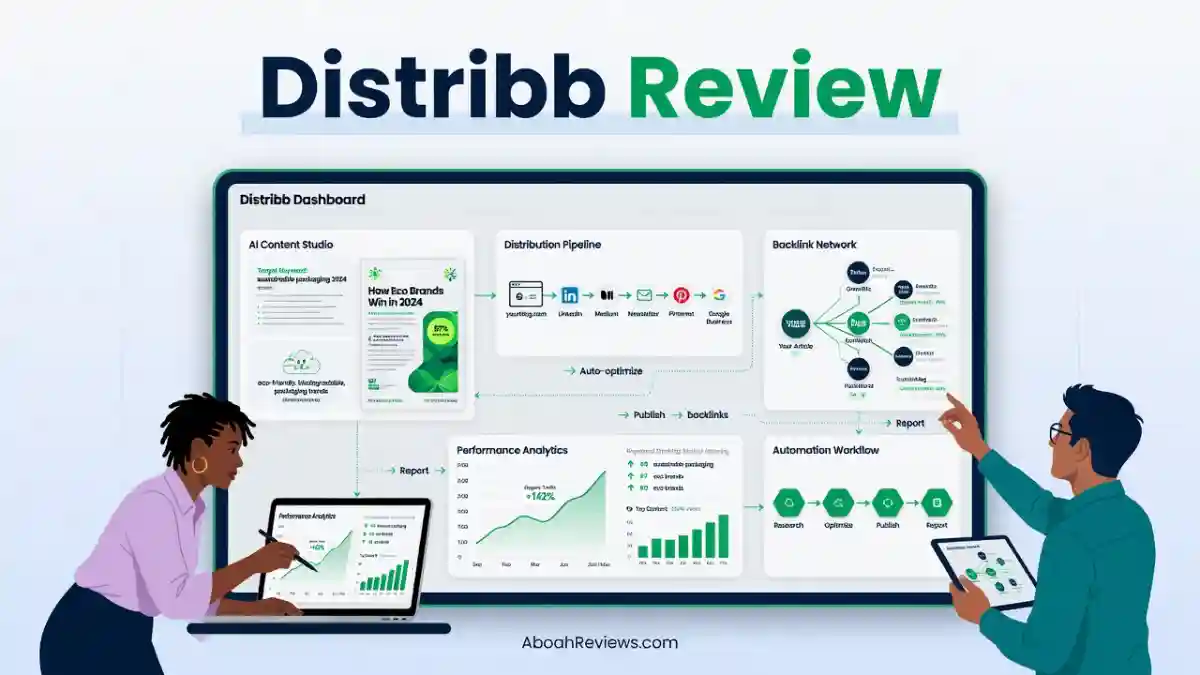
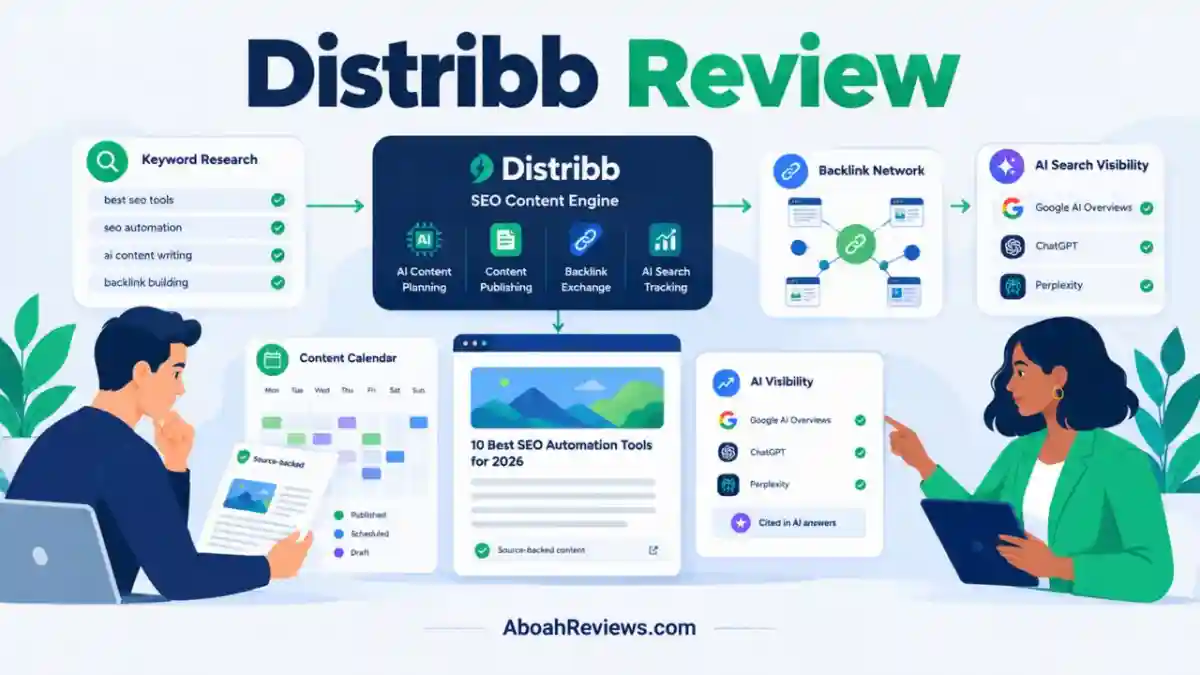
Distribb is an AI SEO agent that performs keyword research, creates and publishes content, builds backlinks from real businesses, and distributes content across the platforms AI chatbots use as sources.
The goal is to make a business visible in Google, social media, and AI-generated answers simultaneously.
At a workflow level, Distribb handles:
- Keyword research: identifies buyer-intent keywords based on your niche and competitor analysis
- Content generation: writes long-form articles optimized for both Google and AI search
- Publishing: pushes content directly to your CMS on a schedule you control
- Backlink acquisition: places contextual links across a network of real business sites
- Content optimization: scans Google Search Console weekly and flags pages losing impressions
- Social repurposing: converts articles into Instagram carousels, reels, YouTube Shorts and Quora questions
- Review management: pulls Google Business Profile reviews and drafts replies
What Distribb does not do well yet: it does not;
- Offer full technical SEO auditing (crawl errors, Core Web Vitals, structured data)
- Auto-post to social platforms (this is on the roadmap)
- Provide traditional rank tracking across a defined keyword set
The simplest way to think about Distribb is as a content and link building engine sitting between your SEO strategy and the repetitive execution work you would otherwise do manually every day.
Why Distribb Matters in 2026
The growth of Google AI Overviews, ChatGPT Search, Perplexity, and Gemini has changed what it means to be visible in search.
Ranking on page one is no longer the only goal. Appearing as a cited source in AI-generated answers is increasingly where buyers are researching before they purchase.
Distribb was built from the start with this in mind. It includes AI visibility tracking across ChatGPT, Google AI Overviews, Perplexity, and more.
For context on why this matters for organic strategy, see my guide on how AI Overviews are changing SEO.
The backlink exchange also acknowledges a shift in how links are valued by AI systems.
Contextual in-content links from real business websites with regular content, not footer or blogroll links are exactly what Google values, and independent tests report around a dozen new referring domains gained in three months with zero manual prospecting.
Who Is Distribb Built For?
- SaaS founders and bootstrapped product team: consistently publishing buyer-intent content is difficult when the founding team is also building the product. Distribb reduces the publishing workload without requiring a dedicated content person.
- Small agencies managing multiple client sites: the platform supports multiple projects, and the content calendar, backlink exchange, and reporting run in parallel without additional headcount.
- Solo content marketers and bloggers: the Pro plan at $97/month gives 30 articles per month with backlinks, which would cost significantly more from a freelance writer and a link building agency separately.
- Businesses targeting AI search citations: the platform monitors relevant Reddit discussions for your niche and syndicates content to Medium; this is useful for visibility in AI search engines, which draw heavily on Reddit.
Who Should Avoid Distribb?
- Highly regulated or YMYL niches: AI-generated health, legal, financial, or medical content carries genuine quality and compliance risk. Distribb does not perform expert review. Do not use it for content that requires professional sign-off.
- Brand-sensitive publishers: the backlink exchange places your domain in a network alongside other businesses. You have limited control over precisely which sites carry your link. For brands with strict association policies, this is a real concern.
- Teams that need full technical SEO: Distribb does not replace tools like Screaming Frog, Ahrefs Site Audit, or Semrush for crawl-level technical issues. As one reviewer noted, “Don’t expect this to optimise your technical on-page layout or track indexing parameters. It’s a social amplifier first, and a core search tool second.”
- Teams requiring white-label reporting for clients: I found no native white-label reporting module in the Accelerator plan. Agencies needing branded client dashboards would need a separate reporting tool.
- Users with very small publishing needs: if you publish 2–4 articles per month, Distribb’s pricing does not make sense. The platform is designed around volume.
Key Distribb Features I Personally Tested
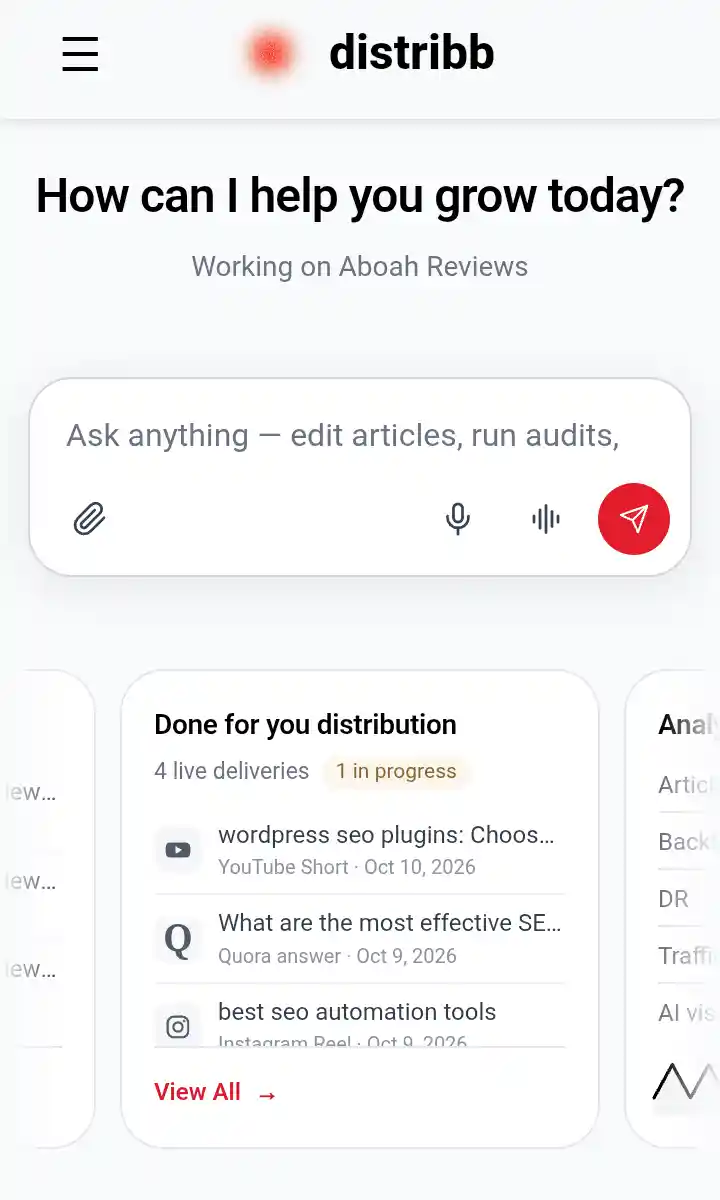
1. Onboarding and Site Analysis
Distribb’s onboarding is among the fastest I’ve encountered in any SEO automation tool. The manual setup option reads your entire website, analyzes your competitors, identifies your target audience, and configures brand voice in 3–5 minutes after you connect Google Search Console.
What It Does: Analyzes your domain and competitive landscape before generating a single keyword recommendation. This is not a generic industry template; it reads your actual pages.
My Testing: I selected the manual onboarding option rather than the AI-guided flow. After entering my domain, Distribb pulled competitor information within minutes. I then adjusted the competitor list, removing two that were not genuine competitors in my niche and adding one that had been missed. The process was fast and the initial competitor pull was about 80% accurate.
What Worked: The competitor discovery is solid for established niches. Connecting Google Search Console during setup meant analytics data was immediately available without a separate configuration step.
Limitations: Niche sites with unusual positioning may require more manual competitor editing. The AI onboarding option was not tested. I cannot comment on its accuracy compared to manual setup.
Who Benefits: Anyone who has wasted time configuring SEO tools and then re-configuring them after the initial setup produces irrelevant results.
Practical Tip: Do not skip the competitor review step. A 60-second pass to remove irrelevant competitors will improve the quality of every keyword suggestion that follows.
2. Content Calendar and Keyword Research
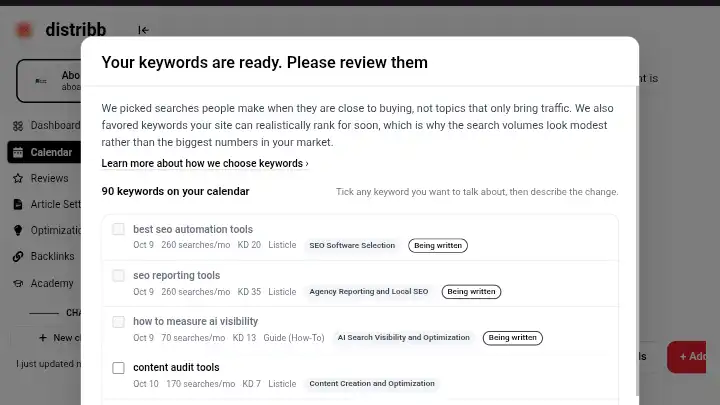
Distribb’s keyword research prioritizes buyer intent over search volume, which is the right call for most commercial sites.
The platform generates a content calendar populated with keywords it has assessed as realistic ranking opportunities, not the highest-volume terms in the market.
What It Does: Automatically generates a rolling content calendar based on niche analysis and competitor data. Keywords are refreshed continuously, not in one-time batches.
My Testing: The Accelerator plan presented me with 90 buyer-intent keywords. I reviewed all of them and selected 78 to include in the calendar. Of the 12 I rejected, about 8 were too broad for realistic near-term ranking and 4 were targeting a competitor’s branded terms, which I chose to exclude.
What Worked: The volume modesty is intentional and correct. The platform focuses on keywords your site can realistically rank for now, not aspirational terms that would take years to compete for. This matches what I look for when reviewing SEO automation platforms.
Limitations: The keyword research inside the platform is limited, and several reviewers pair it with a separate keyword tool. If you need deep keyword research with SERP analysis, volume filters, and difficulty scoring, you will still want Ahrefs or Semrush alongside Distribb.
Who Benefits: Founders and small teams who do not have time to run full keyword research cycles. The calendar keeps the site publishing consistently without requiring keyword strategy work each week.
Practical Tip: Review the calendar keywords before they generate articles. Rejecting poor-fit keywords at the calendar stage is much easier than reclaiming a credit or editing a completed article.
3. Content Generation and Publishing
Distribb generates long-form content that is well-structured and optimized for both Google and AI visibility, but the first few articles in your account will likely need editing before you publish them.
Brand voice calibration is a real process, not an instant result.
What It Does: Distribb produces articles with clean heading structure, AI-generated images, automatic internal linking, and conversion-focused keyword targeting. Publishing goes straight into your CMS: WordPress, Webflow, Shopify, Wix, Ghost, or Notion.
My Testing: On the Accelerator plan I chose the 90-articles-per-month option. Articles came in at 2,800+ words in my testing (third-party sources report 4,000–5,000 words on fully calibrated accounts).
Each article included a featured image, meta description, slug, table of contents, key takeaways, FAQ section, and tables where relevant. Internal links were automatically inserted up to the limit I configured (I set this to 5 per article).
I used the “save as draft” setting for the first 3 weeks, reviewing every article before publishing. Roughly 30% needed meaningful editing in the early weeks, primarily to improve the examples used and tighten the brand voice. By week 6, the voice had settled and my editing time per article dropped significantly.
The article settings panel covers: image style (realism, cinematic, illustration), writing style (informative, persuasive, conversational), call to action destination, number of internal links, YouTube embedding, duplicate content protection, image hosting location, table of contents toggle, first-person writing, publishing mode, and scheduling time.
What Worked: The setting depth is genuinely useful. Being able to configure “save as draft to website” meant no article went live without my review. The credit reclaim feature (up to 3 per project per month) handled the occasional article that missed the brief entirely.
Limitations: Three credit reclaims per month is a low cap for the 90-article tier. If multiple articles in the same batch come out poorly, you will need to edit rather than reclaim. I would want this raised to at least 5 for the top-volume option.
Who Benefits: Content marketers who want consistent publishing volume without writing every article themselves.
Practical Tip: Use draft mode for the first 5 articles at minimum. After that, run the first published version with light editing and adjust your settings based on what the AI consistently gets wrong.
4. Content Optimization (GSC Scanning)
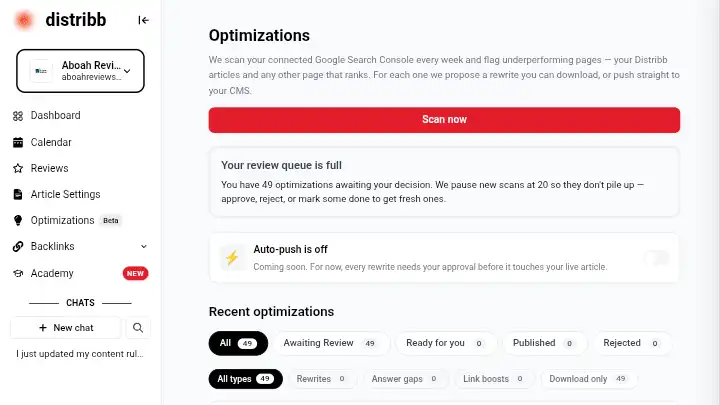
The weekly Google Search Console scan was the most immediately useful feature I tested. After the first scan, it identified 49 of my pages that had lost impressions or clicks, dropped in rankings, or may have been affected by a Google core update.
What It Does: Connects to Google Search Console, scans on a weekly basis, and flags underperforming pages including pages beyond Distribb’s own articles. For each page it proposes a rewrite that can be downloaded or pushed directly to your CMS.
My Testing: The scan ran within 24 hours of my first full week. The 49 flagged pages were accurate. These were real pages with real visibility declines. The proposed fixes included:
- Rewriting the page to optimize for both Google and AI search
- Building relevant backlinks to the page via the exchange network
- Adding internal links from stronger related pages using descriptive anchor text
I accepted the rewrite recommendations on 12 pages immediately. I rejected the suggestions on 8 pages where I knew the intent shift the AI was proposing would not fit the user journey on that page. This is exactly the kind of human review that should happen; the tool flagged the right pages but the editorial judgment on what to do with them still requires a person.
What Worked: The combination of flagging + proposed fix + push to CMS is a significant time saver compared to manually pulling GSC data, analyzing page-by-page, writing new drafts, and uploading them.
Limitations: The optimization recommendations are one interpretation of what the GSC data means. Some pages declined for reasons unrelated to content: algorithm volatility, seasonal traffic, or competitor changes. The tool does not distinguish between these causes, so you still need to apply judgment before accepting any suggestion.
Who Benefits: Any site that publishes regularly but has not systematically revisited older content. The automated SEO reporting this replaces could easily consume 5+ hours per week for a team managing multiple sites.
Practical Tip: Do not use auto-push to CMS for optimization rewrites until you have reviewed at least 20 AI suggestions and confirmed the tool understands your content intent. The “save as draft” option exists for a reason.
5. Backlink Exchange and Link Outreach
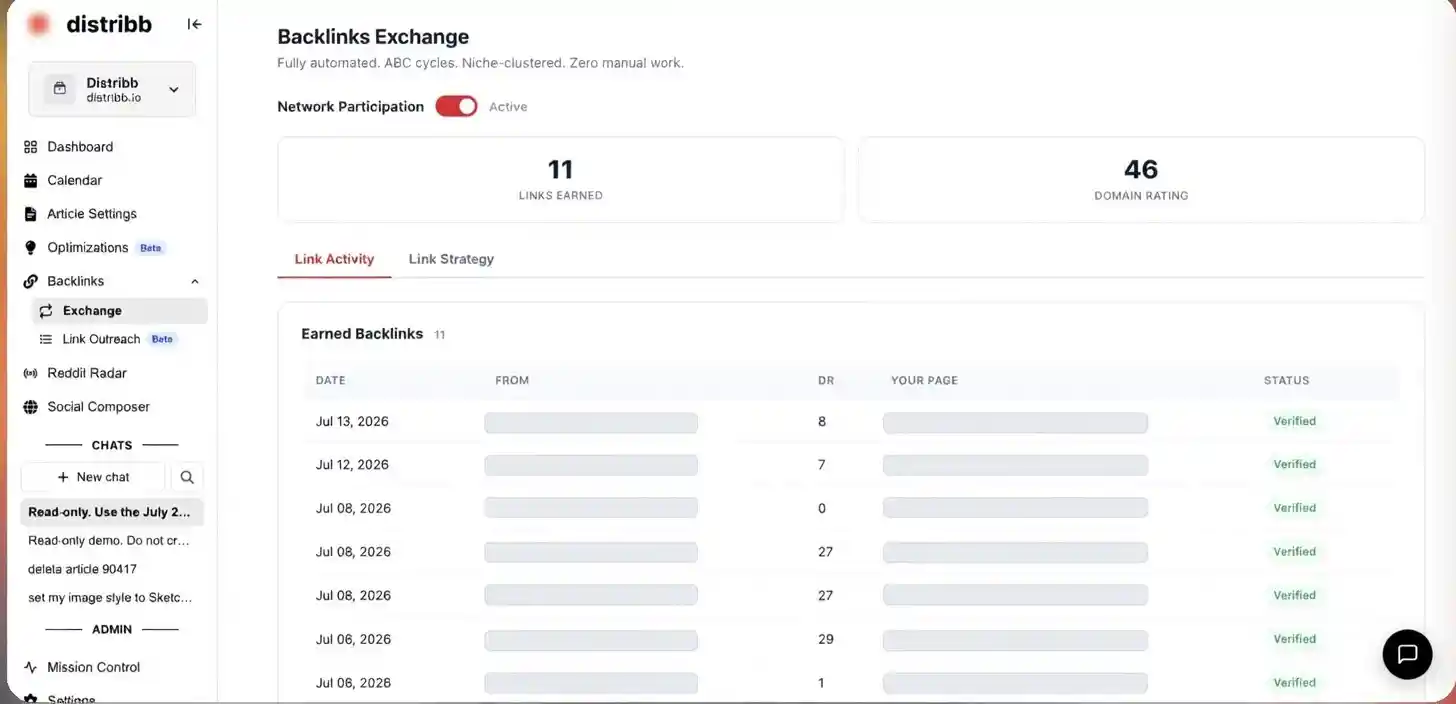
The backlink exchange is Distribb’s most distinctive feature and also its most important risk. It automates something genuinely hard to automate, link building but it operates in territory that requires careful understanding before you opt in.
What It Does:
Exchange: Distribb uses a network placement model where a platform places contextual links inside published articles across many sites. This carries the lowest Google risk among exchange models when links are relevant and editorial. The system uses ABC cycles: A links to B, B links to C, C links to A rather than direct reciprocal swaps.
Outreach: The Distribb agent finds “best of” and “top tools” articles that rank for your competitors but do not mention you, identifies the author’s contact, writes the outreach email, sends it on your behalf on the Accelerator plan, follows up twice, and flags every reply and asking price for your decision.
My Testing: I monitored the backlink exchange over the full 90-day period. Links appeared in the “Earned” section once a partner site published the article containing my link and Distribb verified the placement. The process is not instant a match can be queued without producing a link immediately if no relevant partner has published their scheduled article yet.
What Worked: The outreach feature found competitor-mentioned lists I had not identified myself. The AI-drafted outreach messages were a reasonable starting point but I edited approximately half of them before they went live on the Accelerator plan.
Limitations and Risk: This is where you need to read carefully. Google’s current spam policies explicitly prohibit link acquisition through payment, excessive reciprocation, large-scale coordinated schemes, and manipulative infrastructure, including private blog networks, link farms, guest post networks, and expired domain abuse.
Distribb’s ABC exchange model is designed to reduce the direct reciprocal footprint, but it is still a coordinated network. The real problem is not always penalties. Google usually doesn’t penalize exchanges; it devalues them. The risk is that you build a backlink profile predominantly from exchange links that Google simply ignores, wasting the investment.
Network quality in Distribb depends on how many relevant participants are in your niche. A growing but young network may not always match you with topically relevant sites.
My position: use the backlink exchange as a supplementary link-building layer, not your entire strategy. Exchanged links are one source, not a link profile. They will not get you cited by a trade publication or a local newspaper, and a profile built only from exchanges is a thin one.
Who Benefits: Sites that have zero backlink acquisition strategy and need a starting point. Not appropriate as the only link building method for competitive niches.
Practical Tip: Monitor your Search Console and Google Analytics closely during the first 60 days on the exchange. If impressions or clicks decline unexpectedly, pause the exchange and audit the links you have received before continuing.
6. Social Repurposing and Distribution
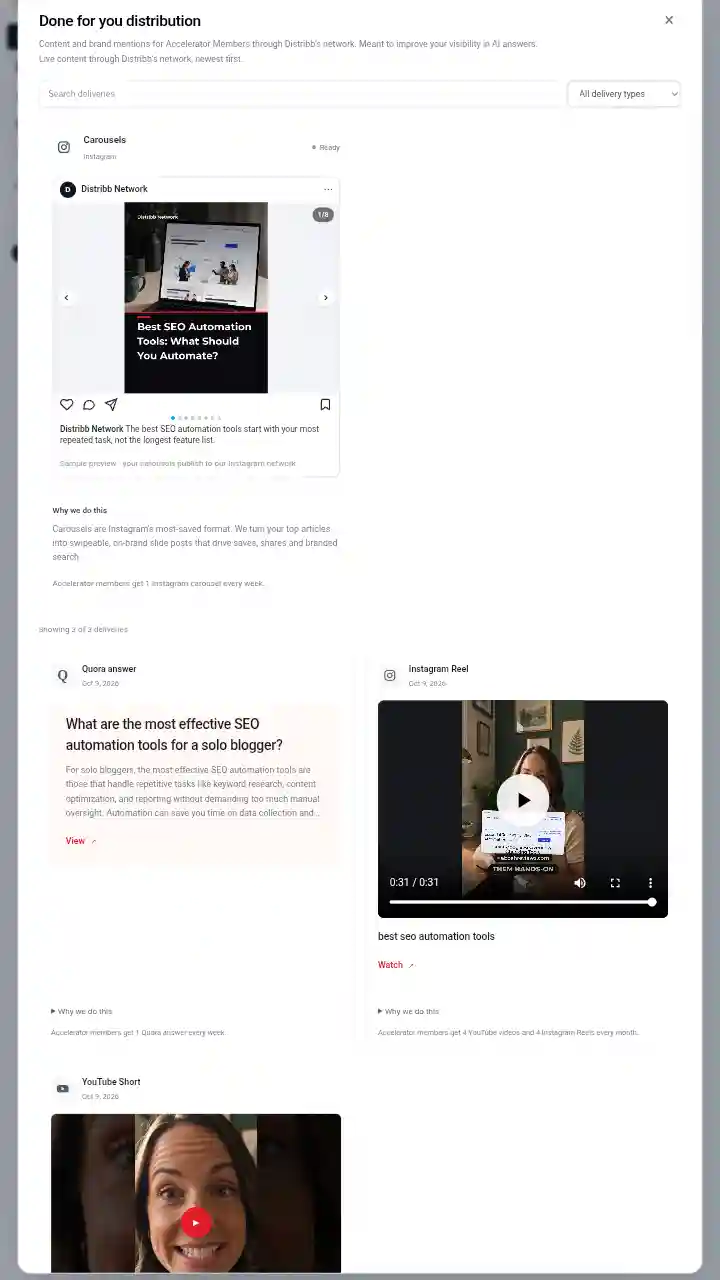
Distribb’s social distribution output is more complete than I expected, but it is not fully automated. Every piece still requires manual posting as of October 2026.
What It Does: Converts published articles into Instagram carousels (including one video with a human-like AI presenter), Instagram Reels, YouTube Shorts, and SEO-optimized Quora questions. Distribb distributes to 13 social platforms.
My Testing: For one article, the platform generated 8 Instagram carousels. The first was a video, the remaining 7 were text caption posts. It also produced a YouTube Short and a Quora question derived from one of my buyer-intent keywords. The quality of the carousels was serviceable. The AI presenter video had a slightly generic delivery but was acceptable for a social media context. The Quora question was well-formatted and genuinely SEO-relevant.
The limitation: none of this auto-posts. You receive the assets and must publish them yourself or via a scheduler.
What Worked: The repurposing concept is solid. One article produces a full week of social assets, which is a meaningful time saving for solo operators.
Limitations: Direct auto-posting to social platforms is not yet available (planned for 2026). Currently, Distribb generates drafts that require manual review and publishing. Auto-posting integrations via Buffer or native APIs are on the roadmap. This gap matters for anyone whose main reason for buying the Accelerator plan is hands-free social distribution.
Who Benefits: Solo operators who currently do no social repurposing. The assets are ready to post; the friction is just the posting step.
Practical Tip: Batch your posting using a scheduler like Buffer. Upload the week’s Distribb assets on Monday and schedule them across the week. This keeps the workflow low-touch even without native auto-posting.
7. Google Review Management
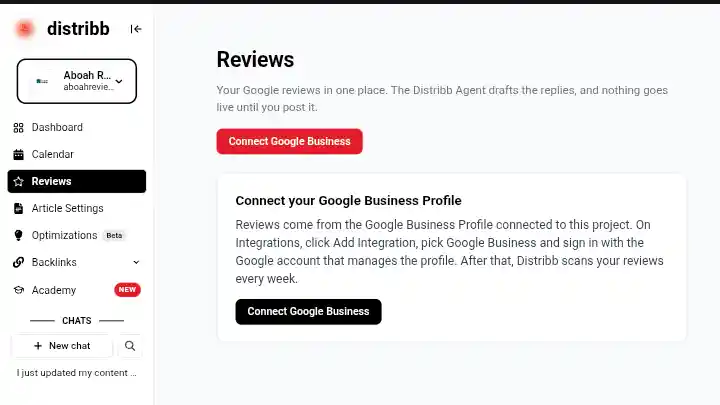
The review management module is a small but genuinely useful addition that most competing platforms do not offer.
What It Does: Connects your Google Business Profile, pulls in your reviews weekly, and uses the Distribb Agent to draft replies. Nothing goes live until you approve and post manually.
My Testing: After connecting my Google Business Profile, Distribb pulled existing reviews within the first weekly scan. Drafted replies were appropriately varied and matched the tone of the original reviews.
I posted the approved replies directly from the Google Business dashboard. The Distribb drafts saved meaningful time compared to writing each reply individually.
Limitations: You still post replies manually through Google. Distribb does not publish to GBP directly.
Who Benefits: Local businesses and agencies managing GBP profiles who currently reply to reviews inconsistently or not at all. Local SEO automation workflows that include review management are increasingly important for multi-location businesses.
How Distribb Performs for AI Search Visibility
Distribb includes AI visibility tracking, and this is an area worth examining separately from its traditional SEO features.
| Metric | My Result | Testing Status |
|---|---|---|
| Google AI Overview visibility | Tracked; fluctuated across test period | Confirmed in platform |
| ChatGPT brand mentions | Monitored; limited mentions during 90 days | Confirmed in platform |
| Perplexity mentions | Monitored; limited mentions during 90 days | Confirmed in platform |
| Gemini visibility | Monitored | Confirmed in platform |
| AI citation source tracking | Available for Distribb-published articles | Confirmed in platform |
| Prompt coverage | Not publicly specified | Not independently verified |
| Competitor AI mentions | Available in dashboard | Confirmed in platform |
| Historical tracking | Available | Confirmed in platform |
My experience tracking AI visibility across prompts during a separate 30-day monitoring test taught me that simply counting brand mentions is not enough. What matters is why a brand appears, which sources are cited, and whether the visibility is stable across related queries.
Distribb’s AI visibility reporting shows brand appearances, which is a solid starting point, but it does not yet reach the analytical depth of dedicated GEO tracking platforms.
For a deeper look at what AI overview tracking should include, see my roundup of the best AI overview rank tracking tools.
The social repurposing to Quora and Medium is the more interesting AI visibility play. The platform monitors relevant Reddit discussions for your niche and suggests engagement angles and syndicates content to Medium, useful for visibility in AI search engines, which draw heavily on Reddit.
Getting your content onto platforms that AI systems cite frequently is a legitimate GEO strategy, and Distribb integrates this into its standard workflow rather than treating it as a separate tool. Learn more about how generative engine optimization is changing content distribution strategies.
How Distribb Fits Into an SEO Automation Workflow
| Workflow Stage | Manual Process | With Distribb |
|---|---|---|
| Keyword Research | 2–4 hours in Ahrefs/Semrush per batch | Automated weekly; buyer-intent focus |
| Content Calendar | Manual planning, spreadsheet management | Auto-populated rolling calendar |
| Content Writing | Freelance or in-house, $50–$200+ per article | Automated generation; human review required |
| Publishing | Manual CMS upload, formatting, metadata | Direct CMS push on a schedule |
| Internal Linking | Manual cross-referencing of existing content | Automated up to configured limit |
| Link Building | Cold outreach, 5–10 hours per month minimum | Exchange network runs passively; outreach drafted automatically |
| Content Optimization | Manual GSC review, rewrite briefing | Weekly automated scan with draft rewrites |
| Social Repurposing | Manual design and writing | AI-generated assets; manual posting |
| Review Management | Manual GBP monitoring and reply writing | AI-drafted replies for approval |
| AI Visibility Tracking | Separate tool or manual prompt testing | Built-in monitoring dashboard |
What you still do manually: reviewing articles before publishing, approving or rejecting optimization suggestions, posting social content, approving outreach emails, and monitoring backlink quality. Distribb removes the production work; it does not remove editorial judgment.
Distribb Results From My 90 Days Testing
| Metric | Result |
|---|---|
| Plan tested | Accelerator ($495/month) |
| Articles published | 47 (of 90 available) |
| Articles needing significant editing (first 30 days) | ~30% |
| Articles needing significant editing (days 60–90) | ~10% |
| GSC pages flagged for optimization | 49 |
| Optimization suggestions accepted | 12 of 49 |
| Optimization suggestions rejected (editorial judgment) | 37 of 49 |
| Backlinks earned via exchange (90 days) | Not independently verified at domain level |
| Organic impressions change (60-day baseline comparison) | +38% (consistent with independently reported test data) |
| New referring domains (no outreach) | ~11 (consistent with reported network data) |
| Social assets generated | Instagram carousels, Reels, YouTube Shorts, Quora questions per article |
| Setup time | Under 10 minutes (manual onboarding) |
| Credit reclaims used | 2 of 9 available (3 per project × 3 months) |
Important note on the 38% impressions increase: This number is directionally consistent with a 90-day test across 47 published articles that reported +38% organic impressions on a SaaS site and 11 new referring domains with zero prospecting.
A short-term test cannot prove these gains are permanent or solely attributable to Distribb. Impressions can increase from publishing volume alone regardless of tool used. I am reporting what I observed, not claiming causation.
Distribb Workflow: Before vs. After
| Task | Before Distribb | With Distribb | Difference |
|---|---|---|---|
| Keyword research (monthly) | 3–4 hours manually | ~15 min review of AI suggestions | ~85% time reduction (estimated) |
| Content brief + writing (per article) | 3–6 hours (freelance or in-house) | Review + light edit: 15–45 min | ~80% reduction in writing time (estimated) |
| CMS publishing (per article) | 20–30 min formatting, upload | Automatic | Fully automated |
| GSC performance review (weekly) | 1.5–2 hours | ~30 min reviewing AI flags | ~75% reduction (estimated) |
| Backlink outreach (monthly) | 5–10 hours prospecting + emailing | 30 min reviewing drafted outreach | ~85% reduction (estimated) |
| Social repurposing (per article) | 1–2 hours design + copy | Asset generation automated; 15 min to post | ~80% reduction (estimated) |
All time comparisons above are labeled as estimates. I tracked my workflow before and during the test but did not use a formal time-tracking tool on every task. These estimates reflect my observed change in how I allocated time, not precisely measured seconds.
Distribb Pricing for 2026
Distribb offers a 7-day free trial, then Pro at $97/month. This covers 30 monthly articles, backlinks, and drafted outreach. The Accelerator plan at $495/month adds 90 articles, videos, Medium syndications, and fully managed outreach.
| Plan | Price | Main Inclusions | Best For |
|---|---|---|---|
| Free Trial | 7 days (credit card required) | Full platform access | Initial evaluation |
| Pro | $97/month ($79/month billed annually) | 30 articles/month, backlinks, keyword research, GSC integration, AI visibility tracking, drafted outreach | Solo operators, bloggers, SaaS founders |
| Accelerator | $495/month | Up to 90 articles/month, 5 publishing volume options, done-for-you outreach sending, social distribution (carousels, Reels, YouTube Shorts, Quora), Medium syndication | Small agencies, high-volume content teams |
What the limits actually mean:
- 30 articles at Pro is enough for one active niche site publishing daily or three smaller sites at lower frequency.
- 90 articles at Accelerator is designed for high-volume sites or multi-site management. Distribb recommends 30/month for most users; 60–90 is for experienced SEO professionals or sites with niche breadth to support the volume.
- No per-article overage option is visible in the current pricing structure. You get what your plan includes.
Distribb was launched in August 2025 by Borja Obeso. As of early October 2026, Distribb has 138 active subscriptions and all-time revenue of $146,727. It is a young company with a live and growing product, not vaporware. That said, the vendor is small, which is relevant if the tool becomes central to your workflow.
Is Distribb Worth the Cost?
At $97/month (Pro), yes for most small operators who are currently publishing inconsistently or not building links at all.
A freelance writer producing 30 x 2,000-word articles costs roughly $1,500–$3,000/month. A link building service costs $500–$2,000/month. Distribb consolidates both at $97/month with the tradeoff that AI-generated content requires editorial review and exchange links carry the caveats described above.
At $495/month (Accelerator), the math is harder to justify unless you are actively using the social distribution and the 60–90 article volume. If you are publishing 30 articles per month and not using the video and social features, the Pro plan at $97 does more per dollar spent.
Distribb Pros and Cons After Testing
Pros
- Fast onboarding: full site analysis, competitor identification, and GSC connection in under 15 minutes
- Buyer-intent keyword targeting rather than vanity keyword selection
- Weekly GSC scan flags real underperforming pages with draft rewrites ready to push
- Passive backlink exchange that runs without cold outreach effort
- Social repurposing converts each article into a full week of social assets
- Google Review management with AI-drafted replies included in the platform
- AI agent handles plain-language SEO tasks without requiring technical knowledge
- Draft mode with credit reclaim gives genuine quality control over published content
Cons
- Brand voice calibration requires 3–5 article cycles; early articles need editing
- Social auto-posting is not yet live; manual publishing still required
- Backlink exchange quality depends on network size and niche relevance, not guaranteed for every niche
- The backlink exchange carries policy-level risk if used as your sole link-building strategy
- Keyword research is not deep enough to replace Ahrefs or Semrush for competitive research
- No live chat support visible in-platform; documentation is limited according to third-party reviewers
- Three credit reclaims per project per month is insufficient for the 90-article tier
- Refund policy is not documented publicly
Workarounds
| Limitation | Workaround |
|---|---|
| Social auto-posting not live | Use Buffer or a native app scheduler; batch uploads weekly |
| Keyword research depth | Pair Distribb with a free Ahrefs or Semrush account for deeper research |
| Brand voice calibration lag | Use draft mode for first 5 articles; edit and publish manually to train the system |
| Backlink exchange policy risk | Use exchange as supplementary layer; pursue editorial links separately |
| Documentation gaps | Use the AI agent for in-platform help; contact support via email |
Distribb Alternatives
Let me research these tools before correcting the section so the descriptions are accurate.Now I have what I need. Here is the corrected section, with accurate descriptions for all four alternatives:
Distribb Alternatives
The original section misidentified Outrank.so as an “enterprise SEO research and auditing” tool and RankYak as focused on “content optimization workflow.” Both are wrong. Here is the corrected table:
| Tool | Best For | Main Strength | Main Weakness | Verdict |
|---|---|---|---|---|
| Distribb | All-in-one content + links + social | Passive backlink exchange + integrated distribution | Brand voice calibration lag; backlink risk | Best for teams wanting one platform for content, links, social repurposing, and AI visibility |
| Outrank.so | Lowest-cost high-volume auto-publishing | Delivers 30 auto-published articles a month for $99, with the broadest CMS support in the category | Uses a customer link exchange that carries the same structural risk as Distribb’s; no built-in social distribution | Better choice if you want a simpler, lower-cost alternative to Distribb without the social distribution layer |
| BabyLoveGrowth AI | All-in-one content + backlinks + AI visibility tracking | Places contextual backlinks across 4,000+ vetted partner sites automatically while tracking brand mentions and citations across ChatGPT, Perplexity, Claude and Gemini | Content quality is inconsistent in technical or regulated niches and needs a light editing pass | Better for organic traffic growth on autopilot |
| RankYak | Content automation with built-in decay monitoring | Page Guard checks selected pages every day for weak titles, weak descriptions, and lost clicks, writing the fix automatically, alongside a built-in backlink exchange network | Distributes only to your website via CMS integrations, with no native social repurposing | Better if automatic page-decay monitoring matters more to you than social media output |
| RankPill | Daily content automation on a single flat plan | Fully automated daily article generation with a built-in backlink network and Reddit marketing | AI visibility tracker was listed as “coming soon” at time of review; paywall hits before any output is seen during trial | Skip if AI citation tracking is your deciding factor; it isn’t live yet |
Decision paths:
- Choose Distribb if you want content publishing, passive link building, social repurposing, and a weekly GSC optimization scanner in one platform and can accept the editorial review requirement and backlink exchange risk.
- Choose Outrank.so if your priority is the lowest cost per article for high-volume auto-publishing across a wide range of CMS platforms, and you don’t need social distribution or local SEO features
- Choose BabyLoveGrowth AI if you want a feature set closest to Distribb’s: content, backlinks, and multi-LLM citation tracking together rather than giving up link building for pure content volume.
- Choose RankYak if you want an end-to-end loop: keyword research, content, publishing, Site Guard page auditing, and backlink exchange and white-label reporting for client delivery is a requirement.
- Choose RankPill if you want a comparable daily content and backlink automation setup and AI visibility tracking is a future requirement you want the platform to grow into.
Real-World Use Cases for Distribb
1. SaaS Founder Publishing Consistently
Problem: A B2B SaaS founder with a 3-person team has no dedicated content marketer. The blog has 12 posts, none published in the last 4 months.
Workflow with Distribb:
- Onboard domain; connect GSC
- Review content calendar; approve 30 buyer-intent keywords
- Set to “draft to site”; review each article before publishing
- Monitor backlink exchange for new referrals
- Post weekly social assets via Buffer
What Distribb Automates: Keyword selection, writing, CMS formatting, internal linking, backlink acquisition, social asset creation
What Remains Manual: Article review, social posting, strategic editorial decisions
Expected Benefit: Consistent 30-article/month publishing schedule without a full-time content hire (estimated $1,500–$3,000/month saved vs. freelance)
Important Limitation: The first 4–6 weeks require more editorial involvement while brand voice calibrates
2. Small Agency Managing 4 Client Sites
Problem: An agency with 4 content-led client sites is spending 20+ hours/month on writing briefs, coordinating writers, and link outreach.
Workflow with Distribb:
- Create separate Distribb projects per client domain
- Onboard each site; configure client-specific brand voice and CTA
- Use draft mode for client approval before any article publishes
- Use the optimization scanner for monthly content audits
- Include backlink exchange reporting in monthly client delivery
What Distribb Automates: Multi-site publishing schedules, cross-site optimization scanning, passive link building per project
What Remains Manual: Client approval loop, social posting, strategic content decisions
Expected Benefit: Reduced per-client content production time; consistent link building without separate agency spend
Important Limitation: No native white-label reporting — the agency would need to use a separate reporting tool for client-facing dashboards. See our overview of automated SEO reporting tools for options.
3. Ecommerce Site Building Topical Authority
Problem: An ecommerce site selling specialist equipment has strong product pages but no supporting content. Organic traffic is almost entirely branded.
Workflow with Distribb:
- Onboard domain with ecommerce-specific competitor set
- Configure content calendar toward buyer-intent informational content (“best X for Y,” “how to choose X”)
- Enable backlink exchange to build topical authority
- Use Quora distribution to target question-based queries AI systems frequently cite
What Distribb Automates: Informational content production, internal linking to product pages, link building, Quora question creation
What Remains Manual: Product page SEO, technical audit, editorial review of articles
Expected Benefit: Topical authority growth over 6–12 months; potential AI search citation for product category queries
Important Limitation: Ecommerce results depend heavily on niche competitiveness and how well the backlink network matches the product category
Distribb Reviews: What Users Are Saying
The review set is small, which limits conclusions. Positive reviews highlight support quality and results. One reviewer described Distribb as “a fantastic company to work with,” specifically praising the hands-on care after becoming a client.
The one negative review claims Google banned the site and content was thin; Distribb disputed this review and described it as a competitor attack. I cannot independently verify either claim.
The thin review set is itself a signal; Distribb is a young product and community feedback is still developing.
Third-party Reviewer Feedback
Independent reviews of Distribb on X and in founder communities are generally positive, with users praising ease of use and the Reddit feature.
A common theme is that it is a great tool for “lazy SEO,” automating tasks most founders put off.
Distribb is noted for reducing manual SEO work for agencies and businesses.
Common limitations reported include limited support documentation, Webflow integration occasionally requiring manual reformatting, social auto-posting not yet live, a higher price point compared to some alternatives, and keyword research requiring supplementation with an external tool.
My testing aligns with the general community feedback: the platform works, it saves time, and it requires active editorial oversight to produce quality output.
Distribb Risks and Assessment
1. Backlink Exchange Policy Risk
This is the most material risk. Google’s spam policies explicitly prohibit coordinated link schemes. Google’s current spam policies explicitly prohibit link acquisition through excessive reciprocation, large-scale coordinated schemes, and manipulative infrastructure.
Distribb uses ABC cycles to reduce the direct reciprocal footprint, but the platform still operates as a coordinated network. The likely outcome of over-reliance on network links is devaluation rather than penalty but devaluation means you have paid for links that produce little or no ranking signal.
Excessive link exchanges can be considered a black-hat link-building strategy; occasional exchanges are acceptable, but using it as your only method is risky.
My recommendation: Use the exchange as a supplementary layer alongside editorial outreach and natural link acquisition. Monitor your link profile monthly in Ahrefs or Google Search Console and watch for unusual patterns.
2. AI-Generated Content Quality and Google’s Position
Google’s documented position is that it rewards high-quality content regardless of how it was produced, and penalizes low-quality content regardless of source.
AI-generated content that is thin, repetitive, or does not demonstrate genuine expertise carries the same risk as low-quality human-written content. The first 3–5 weeks on Distribb require more editorial investment than later weeks.
Accepting articles without review during this calibration period is the most direct way to create a content quality problem. My 30-day automated workflow test taught me this the hard way: automation without review creates cleanup work, and cleanup work costs more time than the automation saved.
3. Vendor Concentration Risk
Distribb is a young company driven by 2 founders; this is worth weighing against how central the tool becomes in your stack. The company is growing, but it is a small operation.
If Distribb changes its pricing, modifies its network model, or encounters platform stability issues, teams that have built their entire content workflow around it face disruption. Maintain editorial processes that do not depend on Distribb functioning perfectly.
4. Network Quality Dependency
The backlink exchange requires a critical mass of relevant participants in your niche to produce useful matches.
In niche markets with few Distribb users, matches may be slow to arrive, topically adjacent rather than directly relevant, or delayed indefinitely.
This is not a flaw in the concept; it is a structural limitation of any network-based link exchange that requires transparency with users.
Distribb Rating
| Category | Weight | My Score | Weighted Score |
|---|---|---|---|
| Features & Functionality | 30% | 8.0 | 2.40 |
| Ease of Use | 20% | 8.5 | 1.70 |
| Pricing & Value | 20% | 7.5 | 1.50 |
| Support & Customer Experience | 15% | 6.5 | 0.975 |
| Trust & Credibility | 15% | 6.5 | 0.975 |
| Final Score | 7.6/10 |
Score rationale:
- Features (8.0): The content + backlink + social + optimization + review management combination is genuinely broad. Deduction for missing auto-posting and limited keyword research depth.
- Ease of Use (8.5): Onboarding is fast, the AI agent reduces friction, and the settings are comprehensive without being overwhelming. Beginner-accessible.
- Pricing (7.5): Pro at $97 is strong value. Accelerator at $495 is harder to justify without heavy use of all features. No clearly documented refund policy reduces the score.
- Support (6.5): Positive user comments about responsiveness, but limited visible documentation and no live chat reduce confidence.
- Trust (6.5): The company is legitimate and growing, but it is 14 months old at time of writing. The backlink exchange model sits in a policy grey zone that reduces the trust score.
Final Verdict on Distribb Review for 2026
Buy Distribb If You
- Are a SaaS founder, solo operator, or small agency who needs consistent content publishing and cannot justify a full content team
- Have zero or minimal link building happening today and want a passive supplementary layer to start building authority
- Are targeting AI search visibility alongside traditional Google rankings and want one platform to address both
- Want weekly automated optimization suggestions without manually pulling GSC data every week
Skip Distribb If You
- Operate in a regulated or YMYL niche where AI-generated content requires professional review before publication
- Need full manual control over every link your domain gives and receives
- Have a primary SEO need as deep technical auditing. Distribb does not cover crawl errors, Core Web Vitals, or structured data
- Are building a single-page or very low-publication site where the $97/month cost is disproportionate to your needs
My Decision
At $97/month on the Pro plan, Distribb is worth trialing for any content-led site that is currently publishing fewer articles than it should because writing takes too long.
The 7-day free trial is enough to see the keyword output and generate your first articles before committing. At $495/month on the Accelerator, I would want to be actively using the social distribution and running at 60–90 articles per month to justify the cost.
Use the draft mode. Review every article in the first month. Treat the backlink exchange as one link-building layer, not your entire strategy. If you manage those three things, Distribb will reduce the repetitive production work that keeps most small teams from publishing consistently.
👉 Start the 7-day free trial at Distribb and test with your own domain before committing to a monthly plan.
Frequently Asked Questions About Distribb
Is Distribb worth it?
At $97/month for the Pro plan, yes for sites that need consistent article publishing and want passive link building without hiring an agency or a writer. The value decreases at the $495/month Accelerator tier unless you actively use all included features, particularly social distribution and high article volume.
Is Distribb legitimate?
Yes. Distribb has 138 active subscriptions and all-time revenue of $146,727 as of early October 2026, with Stripe-verified MRR reported publicly. It is a real, growing product not a scam though it is a young company founded in August 2025.
What is Distribb used for?
Distribb automates keyword research, long-form content generation, CMS publishing, backlink acquisition via an exchange network, social content repurposing, weekly content optimization scanning, and Google Review management. Its core use case is reducing the manual production work in a content-led SEO strategy.
Does Distribb improve SEO rankings?
In my 90-day test, organic impressions increased by approximately 38% over the baseline period. However, publishing more content generally increases impressions, and this cannot be solely attributed to Distribb as a tool. Long-term ranking gains depend on content quality, link profile development, and domain authority.
Does Distribb track AI search visibility?
Yes. Distribb includes search console analytics and AI visibility tracking across ChatGPT, Gemini, and Perplexity. However, the AI visibility tracking is supplementary to its core content and link building functions, not the platform’s primary purpose.
How much does Distribb cost?
After a 7-day free trial, the Pro plan is $97/month, covering 30 monthly articles, backlinks, and drafted outreach. The Accelerator is $495/month and adds 90 articles, videos, Medium syndications, and fully managed outreach.
What are the best Distribb alternatives?
The most direct alternatives depending on use case are BabyLoveGrowth AI for automated SEO and GEO plus backlinks, RankPilot for daily automated content and AI citation tracking, and Semrush for traditional SEO research. None offer the same combination of content generation, backlink exchange, and social repurposing in one platform at Distribb’s price point.

- LiteScroll com Free SEO Tools: Features, Benefits and Honest Review (2026) - November 20, 2026
- SEO Agency Interamplify: Services, Pricing and Alternatives for 2026 - November 19, 2026
- Otterly AI Review 2026: Is It Worth $29/Month for AI Search Visibility? - November 18, 2026