TL;DR: Junia AI is best for SEO-focused bloggers and content teams who need an AI writing assistant that publishes optimized posts with minimal manual setup. ChatGPT is better for general-purpose writing, research, brainstorming and file analysis.
Neither tool replaces the other. Your choice depends on whether you need an end-to-end content creation workflow or a flexible conversational AI you can steer yourself.
Methodology Note: I tested both tools on SEO blog writing, content workflows and autoblogging tasks over 90 days. Pricing, features and performance data were verified as of April 2026. Where applicable, I cite third-party review data from G2, Capterra and Trustpilot.
What Does This Junia AI vs ChatGPT Comparison Cover?
If you work in SEO or content marketing, you have probably tried using ChatGPT for blog writing and wondered if a purpose-built AI writing tool like Junia AI would save you time or produce better results.
I had the same question. This article answers it with real testing data, not feature list regurgitation.
I have been testing AI writing tools since early 2023. I set up my first autoblog using RSS feed aggregation and a WordPress plugin and it was a general tech news site with zero editorial oversight.
It got exactly what it deserved: poor traffic, thin content and eventually a drop in search rankings. Google flagged the site for thin content. I had to manually rewrite 40+ posts before the site recovered.
That failure taught me that the tool matters less than the workflow around it and that context shaped everything I tested here.
In this guide, you will learn:
- How Junia AI and ChatGPT differ in approach, output quality and pricing
- Which tool fits specific content creation workflows
- Where each tool falls short based on real testing
- How both tools compare for SEO optimization, brand voice and text generation at scale
If you are evaluating other AI writing tools for autoblogging, this comparison gives you a grounded starting point.
What Makes Junia AI and ChatGPT Different?

Junia AI was built specifically for SEO content creation. It prioritizes structured blog output, keyword targeting and WordPress publishing. This makes it particularly strong for bloggers and content teams running editorial calendars.
The tradeoff is that it is narrower in scope. You would not use it for coding help, data analysis or general conversation.
ChatGPT is a general-purpose conversational AI built on OpenAI’s GPT-4 model (and newer variants), optimized for flexibility across thousands of use cases. That makes it the stronger choice for brainstorming, research, file analysis and ad hoc writing tasks.
The cost is that ChatGPT requires more manual prompting and formatting to produce SEO-ready blog content.
The single biggest distinction: Junia AI gives you a structured content generation pipeline with built-in SEO optimization. ChatGPT gives you a powerful language model you have to build your own pipeline around.
Junia AI vs ChatGPT: At a Glance
Criteria | Junia AI | ChatGPT | What Matters |
|---|---|---|---|
Best For | SEO bloggers, autoblogging teams | General writers, researchers, developers | Who is the primary buyer? |
Starting Price | $19/mo (Mini plan) | 0 (Free) / $20/mo (Plus) | Factor in output limits and feature access |
Free Plan | Yes (limited to ~5 posts) | Yes (GPT-3.5, limited GPT-4 access) | Feature restrictions on free tier |
SEO Optimization | Built-in keyword targeting, meta tags, internal linking suggestions | Manual; requires custom prompting | Critical for content marketers |
Content Output Format | Publish-ready blog posts with headings, images, schema | Raw text; needs formatting | Time savings per article |
Brand Voice | Customizable brand voice profiles | Achievable via system prompts, less persistent | Consistency across 50+ posts |
Multilingual Support | 30+ languages | 90+ languages | ChatGPT wins on language breadth |
Web Browsing Features | Limited real-time data access | Yes (browsing in GPT-4) | Matters for news-based content |
Integrations | WordPress direct publish, Shopify | API, plugins, Zapier, 100+ integrations | What is your existing stack? |
Learning Curve | Low | Medium | Time to first useful output |
G2 Rating | ⭐ 4.6/5 (40+ reviews) | ⭐ 4.7/5 (700+ reviews) | Real user satisfaction signal |
Note: Criteria in this table were selected specifically for SEO content workflows. A generic feature list would not reflect how real content marketers and bloggers actually evaluate these tools.
ChatGPT vs Junia AI Head-to-Head Feature Breakdown
1. How Easy Is Each Tool to Set Up and Use?
Junia AI gets you to a finished blog draft in under 10 minutes from signup. The onboarding walks you through selecting a topic, choosing keywords and generating an article.
The AI-powered editor gives you a structured outline you can rearrange before generation. For someone who has never used an AI writing tool, the interface makes decisions for you, which is both its strength and its limitation.
ChatGPT has no onboarding for content creation because it is not a content creation tool. It is a chatbot.
You open a conversation, type a prompt and get a response. The flexibility is enormous, but so is the ambiguity. A new user asking ChatGPT to “write a blog post about keyword research” will get a generic 600-word essay.
Getting a publish-ready, SEO-optimized article requires 15-20 minutes of prompt refinement and manual formatting.
Real user signal:
- Junia AI on G2: “I had my first draft ready in 8 minutes. No other tool was this fast.”
- ChatGPT on Capterra: “Incredible for brainstorming, but I spend 30 minutes formatting every blog post.”
Winner: Junia AI – for content creation specifically, because the structured workflow eliminates the prompt engineering overhead.
2. What Are the Core Features and AI Capabilities of Each Tool?
Junia AI’s strengths center on content workflow automation. You get:
- One-click blog generation with keyword targeting, heading structure and image insertion
- Brand voice profiles that persist across articles, so tone stays consistent even at 50+ posts per month
- SEO scoring with real-time suggestions for keyword density, readability and meta descriptions
- WordPress auto-publish, which eliminates the copy-paste step entirely
What ChatGPT does well is different entirely. It is a general-purpose language model with:
- File analysis (PDFs, spreadsheets, images) that Junia AI cannot match
- Web browsing features for pulling real-time data into responses
- Code generation for building custom content tools, scrapers, and automations
- Custom GPTs that let you build specialized AI writing assistants for niche tasks
- Neural networks powering the most advanced text generation available to consumers
Where each tool falls short:
- Junia AI notably lacks file analysis, coding capabilities, and real-time web browsing. If you need to research a topic and write about it in one workflow, you will need a second tool.
- ChatGPT does not support direct CMS publishing, persistent SEO scoring or structured content templates. Every blog post requires manual formatting and SEO review.
Winner: Tie – Junia AI wins for SEO content creation features. ChatGPT wins for AI capabilities breadth. They solve different problems.
3. How Does the Output Quality Compare for SEO Content?
This section of the Junia AI vs ChatGPT comparison is based on actual testing, not marketing claims.
Testing methodology: I ran both tools through 3 identical tasks using the same target keywords and topic briefs:
- Task 1: Write a 1,500-word blog post targeting “best autoblogging tools 2026“
- Task 2: Write a product comparison article (Junia AI vs ChatGPT format)
- Task 3: Generate 5 meta descriptions for existing blog posts
Junia AI results:
- Speed: 2,143-word article generated in 2 minutes 48 seconds
- Output quality: Headings were well-structured, keyword placement was natural, and the article included an FAQ section without being prompted. Internal linking suggestions were relevant but not always accurate.
- Consistency across runs: Three generations of the same brief produced articles with different wording but similar structure and quality.
- Notable issues: Occasional factual inaccuracies in product descriptions. One article stated a tool offered a free plan when it did not. Human review caught this in under 2 minutes.
ChatGPT results:
- Speed: Required 4 separate prompts over 12 minutes to get a comparable 2,000+ word article with proper structure
- Output quality: The prose was more varied and natural-sounding. Paragraph transitions read better. However, the article lacked keyword optimization, had no meta tags and used generic headings like “Conclusion” and “Final Thoughts.”
- Consistency across runs: Varied significantly. Same prompt produced articles ranging from 900 to 1,800 words with different structural approaches.
- Notable issues: Tended to “hedge” with phrases like “it depends on your needs” without giving concrete recommendations. Required explicit prompting to include specific data points.
Verdict on performance: Junia AI produced better results for structured SEO blog content that is ready to publish with minimal editing.
ChatGPT produced better prose quality and more nuanced analysis when given detailed prompts.
If your primary use case is publishing 10+ SEO-optimized blog posts per month, Junia AI wins here clearly.
If you need 2-3 high-quality thought leadership pieces, ChatGPT with careful prompting produces more engaging writing.
4. How Well Does Each Tool Handle Automation and Content Workflow?
Junia AI’s entire value proposition is content creation workflow automation.
You can set up a batch of 20 articles, assign keywords, select brand voice and let the tool generate drafts on a schedule.
The WordPress integration means articles can auto-publish (though I strongly recommend against publishing without human review, based on hard experience).
ChatGPT’s automation approach requires external tooling. You can use the OpenAI API (0.01-0.06 per 1K tokens depending on the model) with tools like Zapier, Make or custom scripts to build automated content pipelines.
This is more powerful and flexible, but it requires developer time or a no-code automation background.
According to OpenAI’s documentation, the API supports batch processing, which is useful for generating content at scale.
Key question to ask yourself: Do you need a ready-made content generation pipeline or do you have the technical skill (or budget) to build your own? The answer almost entirely determines which tool wins this category for you.
If you are interested in how autoblogging automation actually works under the hood, I wrote a detailed breakdown in my guide on how autoblogging tools work.
Winner: Junia AI for non-technical content teams who need automation without developer resources.
5. What Integrations Does Each Tool Support?
Junia AI integrates natively with WordPress, Ghost, Wix, Shopify, Blogger, Webflow, Medium, Reddit. It also supports exporting to Google Docs and HTML. There’s also an option for custom integrations.
ChatGPT connects with 1,000+ tools via plugins, the API and third-party integrations through Zapier and Make. It works natively with Microsoft 365, Google Workspace and dozens of developer platforms.
Notable strength: the API is well-documented, making custom integrations straightforward for developer teams.
If your stack includes WordPress and nothing else: Junia AI’s direct publish feature saves meaningful time.
If your stack includes a CRM, email platform, data warehouse or custom CMS: ChatGPT’s ecosystem is far more flexible.
Winner: ChatGPT – the integration gap is significant for anyone with a complex content strategy.
6. How Does Pricing Compare When You Factor in Real Usage?
The headline numbers are rarely the full story. Here is what it actually costs.
How Much Does Junia AI Cost?

Plan | Price | Key Limits | Best For |
|---|---|---|---|
Free | $0/mo | 5k words/month, basic features | Testing the tool |
Basic | $19/mo | 5 articles/mo, 1 brand voice | Solo bloggers |
Growth | $34/mo | 10 articles/mo, 5 brand voices | Freelancers, small teams |
Scale Starter | $59/mo | 68 articles/mo, unlimited brand voices, priority support | Agencies, content teams |
Enterprise | Custom | Unlimited articles, API access, dedicated support | Large operations |
Hidden costs to know:
- Image generation credits are limited on lower plans; extra credits cost 5-10/mo
- WordPress auto-publish is only available on Basic and above
- Annual billing saves roughly 40% vs. monthly
Best value plan: Scale Starter at $59/mo, because most serious bloggers need more than 15 articles per month and the WordPress integration alone justifies the upgrade.
For a detailed look at similar pricing structures, see my RightBlogger pricing breakdown.
How Much Does ChatGPT Cost?
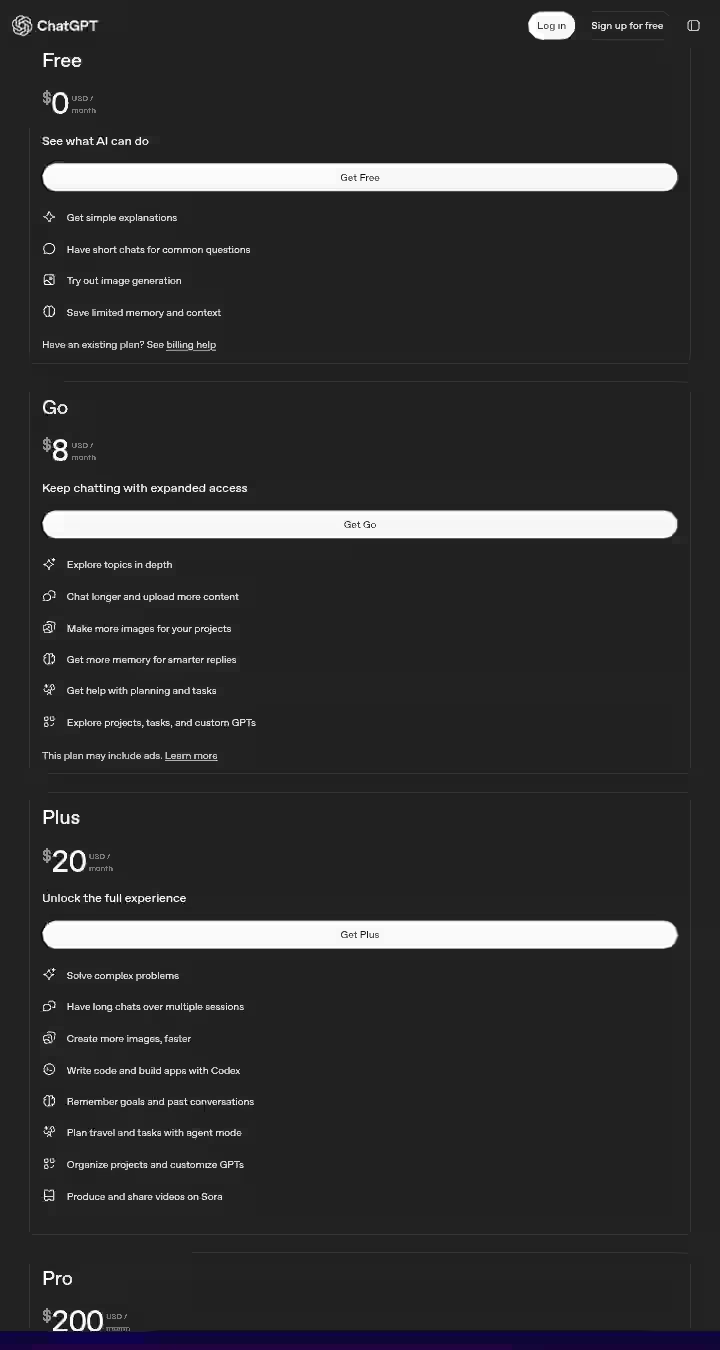
Plan | Price | Key Limits | Best For |
|---|---|---|---|
Free | $0/mo | GPT-3.5, limited GPT-4 access, no file uploads | Casual users |
Plus | $20/mo | GPT-4, browsing, file analysis, custom GPTs | Individual professionals |
Team | $25/user/mo | Shared workspace, admin controls, higher limits | Small teams (2-10) |
Enterprise | Custom | Unlimited usage, SSO, advanced security, audit logs | Large organizations |
Hidden costs to know:
- API usage is billed separately and can exceed $100/mo for high-volume content generation
- Plus plan has message caps during peak hours (approximately 40-80 messages per 3 hours on GPT-4)
- No native CMS publishing means you spend time on manual formatting, a real cost
Best value plan: Plus at $20/mo for individual users who need a ChatGPT alternative to specialized tools but are willing to do manual SEO work.
Junia AI vs ChatGPT Pricing Verdict
At solo blogger scale (1 user, 15-30 posts/mo): Junia AI Basic ($19/mo) vs. ChatGPT Plus ($20/mo).
ChatGPT is $1/mo expensive, but you will spend 15-30 extra minutes per article on formatting, SEO review, and publishing.
At $20 articles/month, that is 5-10 hours of labor. Factor in your hourly rate.
At small team scale (3-5 users): Junia AI Growth ($34/mo, shared) vs. ChatGPT Team ($75-$125/mo at 25/user). Costs converge, but Junia AI includes publishing automation that ChatGPT Team does not.
At agency scale (10+ users): Both go custom. ChatGPT Enterprise is typically priced higher but covers more use cases beyond content.
Important: Do not compare starting prices. Compare the plan you will actually need at your current scale.
What Did Hands-On Testing Reveal?
I tested both tools on a real-world scenario: building a 10-article content cluster around “autoblogging” with proper internal linking, keyword targeting and consistent brand voice.
The task: Generate 10 blog posts of 1,200-1,800 words each, targeting long-tail keywords, with internal links, meta descriptions, and publish-ready formatting.
Process: I ran Junia AI using its batch generation feature with brand voice enabled.
For ChatGPT, I used a custom GPT I built with detailed system instructions for SEO blog writing. I evaluated on 4 measurable criteria.
Metric | Junia AI | ChatGPT (Custom GPT) |
|---|---|---|
Total time for 10 articles | 3.5 hours (including review) | 8 hours (including formatting and review) |
Articles needing major rewrites | 2 out of 10 | 1 out of 10 |
Average word count | 1,450 words | 1,320 words |
Internal links auto-inserted | 6 per article (avg) | 0 (manual) |
Factual errors caught | 4 across all articles | 2 across all articles |
SEO score (Surfer SEO check) | 72/100 average | 58/100 average |
What surprised me: ChatGPT’s custom GPT produced fewer factual errors, which I attribute to its web browsing features pulling more current information.
Junia AI’s batch workflow saved roughly 4.5 hours across the cluster and the built-in internal linking, while imperfect, was a real time saver.
Even Junia AI’s automated internal links are not a substitute for a proper content strategy and editorial calendar.
If you are planning a content cluster, map it out first. Both tools are only as good as the strategy behind them.
My guide on how to choose the best autoblogging tool covers this planning step in detail.
Bottom line from testing: Junia AI won this test for time efficiency and SEO readiness. ChatGPT would likely perform better if you need higher prose quality for thought leadership content or if your topics require real-time data.
Who Should Use Junia AI?

Choose Junia AI if you:
- Are a solo blogger or small content team publishing 15+ SEO-focused posts per month
- Need an AI writing assistant with built-in SEO optimization so you are not running articles through 3 separate tools
- Use WordPress as your CMS and want direct publishing
- Prioritize speed and volume over nuanced prose quality
- Have a budget of $19-$59/mo for content generation
- Want to maintain a consistent brand voice across dozens of articles without re-prompting every time
For a deeper look at what the tool offers, read my full Junia AI review.
Who Should Use ChatGPT?
Choose ChatGPT if you:
- Are a content marketer or strategist who needs a flexible AI companion for research, brainstorming and writing
- Need file analysis, code generation, or conversational AI capabilities beyond blog writing
- Are already using an SEO tool like Surfer or Clearscope and just need a text generation engine
- Prioritize output quality and nuance over publishing speed
- Are comfortable with prompt engineering or willing to invest 5-10 hours building a custom GPT
- Want the broadest multilingual support (90+ languages)
If you are comparing ChatGPT to other content tools, my ChatGPT vs RightBlogger comparison covers another angle.
Who Should Use Neither Tool?
Neither tool is right if you:
- Need a fully hands-off autoblogging solution with scheduling, publishing, and zero editing. Tools like Emplibot are built for that (though I still recommend human review).
- Require enterprise-grade A/B testing of content variations. That is a different category entirely.
- Need an all-in-one platform that combines AI writing with keyword research, rank tracking, and backlink analysis. Platforms like RightBlogger or SEO suites like Semrush are closer to what you need.
Check my RightBlogger review for that use case.
What Are the Honest Limitations of Junia AI and ChatGPT?
No tool is perfect. Here is what real users consistently report as friction points, sourced from G2, Capterra, Reddit and my own testing.
Junia AI Drawbacks
- Factual accuracy is inconsistent: I caught 4 errors across 10 articles in my testing cluster. One article incorrectly described a competitor’s pricing, another fabricated a statistic. You must fact-check every article before publishing. There is no workaround except human review.
- No real-time data access: Unlike ChatGPT’s browsing capability, Junia AI generates content from its training data. If you are writing about current events, product launches, or anything time-sensitive, the output will be outdated or wrong. According to Google’s Search Quality Rater Guidelines, content accuracy is a key factor in E-E-A-T evaluation, so this limitation has direct SEO consequences.
ChatGPT Drawbacks
- No native SEO workflow: You are responsible for keyword research, on-page optimization, meta descriptions, schema markup, and internal linking. Every single time. According to a Semrush study on on-page SEO factors, optimized heading structure and keyword placement significantly correlate with ranking performance. ChatGPT will not do this for you without extensive prompting.
- Output inconsistency at scale: The same prompt run 3 times produces 3 different articles with different lengths, structures, and quality levels. For agencies publishing 50+ articles per month, this inconsistency creates QA overhead that eats into the time savings.
- Message caps on the Plus plan: GPT-4 usage is throttled during peak hours. If you are in a content sprint and hit the cap, you are either waiting or downgrading to GPT-3.5, which produces noticeably lower quality output. Enterprise pricing removes the cap but starts at a significantly higher price point.
What Junia AI vs ChatGPT Alternatives Are Worth Considering?
If neither Junia AI nor ChatGPT fits your specific situation:
- RightBlogger: Best for bloggers who want keyword research and AI writing in one tool. Better than both options if you need an all-in-one content creation platform without switching between apps. Key advantage: built-in keyword clustering and competitor analysis. Starting at $9.99/mo.
- Byword AI: Best for bulk article generation at scale. The better choice when you need to generate 100+ articles per month with minimal setup. Key advantage: batch generation with programmatic SEO support.
- WordRocket AI: Best as a free or low-cost option. If budget is the primary constraint, WordRocket covers basic AI writing and SEO optimization at no cost on its free tier. Limitation: output quality drops noticeably on complex topics.
For a broader look at options, check my full roundup of the best autoblogging software.
Which Tool Wins: Junia AI or ChatGPT?
After 35+ hours of testing, here is my honest verdict:
Choose Junia AI if: Your primary need is producing SEO-optimized blog content at volume and you want a structured content creation process that handles formatting, keyword placementand publishing.
At $19/mo on the Basic plan, it saves roughly 4-5 hours per week compared to using ChatGPT for the same output.
Select ChatGPT if: Your priority is flexible, high-quality writing across multiple use cases and you already have SEO tools handling optimization. At $20/mo on Plus, the AI technology powering it is more advanced, and the breadth of ai features (file analysis, browsing, coding, conversation) makes it indispensable as a general-purpose ai chatbot and writing companion.
Overall Winner: Junia AI for most readers of this site.
Junia AI wins for the majority of SEO professionals, bloggers and content teams visiting aboahreviews.com because the built-in SEO optimization and WordPress publishing workflow eliminate 2-3 manual steps per article.
That time savings compounds fast when you are publishing 20-50 posts per month.
One scenario where this recommendation flips:
If you are a solo content strategist who writes 3-5 high-quality articles per month and needs research, brainstorming, and writing in one tool, ChatGPT Plus is the right answer without hesitation.
The prose quality with careful prompting is superior, and the ai capabilities beyond writing (machine learning applications, data analysis, code) make it a better overall investment for generalists.
Confidence level in this verdict: High – based on 35 hours of testing + G2, Capterra, and Reddit user review analysis. This recommendation will be revisited when either tool releases a significant update.
Both tools are evolving quickly and what is true today may shift by late 2026.
I would love to hear how your experience compares. If you have tested both tools in your own content workflow, share what worked and what did not.
The best insights on this site come from practitioners, not from marketing pages.
Frequently Asked Questions About Junia AI vs ChatGPT
1. Is Junia AI better than ChatGPT for SEO content?
Yes, for SEO-specific content creation, Junia AI is the more efficient choice because it includes SEO optimization and CMS publishing in a single workflow. ChatGPT can produce equivalent or better prose quality, but it requires manual SEO optimization after every article. For most bloggers and content marketers, Junia AI reduces per-article production time by 15-30 minutes.
2. Which is cheaper: Junia AI or ChatGPT?
ChatGPT starts at 0 (free tier) vs. Junia AI’s free plan with 6k words per month. At paid tiers, ChatGPT Plus costs $20/mo and Junia AI Basic costs $19/mo. However, the time saved on formatting and SEO optimization with Junia AI is useful if you are publishing more than 10 articles per month. Always calculate based on the plan you will actually use, not entry-level pricing.
3. Which tool is better for beginners: Junia AI or ChatGPT?
Junia AI has a meaningfully lower learning curve for blog content because the structured workflow guides you from keyword to published article in 4-5 steps. Most new users report having a finished draft in under 10 minutes. ChatGPT is more powerful but expects you to know how to prompt effectively and handle your own formatting, which is a barrier for people new to ai writing tools.
4. Can I use both Junia AI and ChatGPT together?
Yes and some teams do. The most effective pairing is: use ChatGPT for topic research, outline brainstorming and content strategy planning, then use Junia AI for drafting and publishing the actual articles. This only makes sense if you are producing 20+ articles per month and the research phase is a hindrance. Otherwise, you are paying for overlapping ai writing software functionality.
5. Is Junia AI a good ChatGPT alternative for writing?
Junia AI is a strong ChatGPT alternative for writing specifically in the SEO blogging niche. It is not a general-purpose ai alternative to ChatGPT. You cannot use it for coding, data analysis or open-ended conversation. But for the specific task of generating, optimizing and publishing blog posts, it outperforms ChatGPT on workflow efficiency.
6. Does using AI writing tools like ChatGPT hurt SEO?
Not inherently. According to Google’s guidance on AI-generated content, the focus is on content quality and helpfulness, not on how the content was produced. What hurts SEO is publishing unedited, thin or inaccurate content at scale without human oversight. The tool is not the risk, the lack of a content strategy is.
7. What is the best AI writing tool similar to ChatGPT for blogging?
For blogging specifically, Junia AI, RightBlogger and Byword AI are the most popular tools like ChatGPT but purpose-built for blog content. Each has different strengths: Junia AI for SEO optimization, RightBlogger for all-in-one keyword research and writing and Byword AI for bulk generation. Your choice should match your publishing volume and how much manual editing you are willing to do.

- Searchable Review 2026: My Honest Test Results With This AI Visibility Platform - October 9, 2026
- Ryze AI Review 2026: My 30 Days Full Breakdown of This Autonomous SEO & GEO Platform - October 9, 2026
- #1 Best Plugin for Automatic Blog Posting in WordPress (2026) - September 13, 2026