Hypotenuse AI Review Verdict (2026)
Category | Verdict |
|---|---|
Best For | E-commerce brands needing bulk product descriptions and product catalog content at scale |
Not Ideal For | Solo bloggers wanting deep SEO automation or writers building pure autoblogging workflows |
Pricing | $29/mo (Entry), $87/mo (Essential), $150/mo (Blog Pro), custom price (Blog Custom). E-commerce plans are custom-quoted. |
Rating | ⭐⭐⭐7.4/10 |
Standout Feature | Bulk product description generation with Shopify integration |
Biggest Weakness | Blog articles over 1,500 words lose coherence and require heavy editing |
Worth It? | Yes, for e-commerce teams with hundreds of SKUs and content marketers. Skip if you need a dedicated autoblogging or full-stack SEO tool. |
Bottom line: Hypotenuse AI is a strong AI copywriting tool for e-commerce content and short-form marketing copy. It is worth paying for if your primary need is scaling product descriptions, social media content and brand-consistent blog posts.
However, it falls short as a standalone solution for SEO-driven blog content at scale.
Key Takeaways About This Hypotenuse AI Review
In this Hypotenuse AI review, it scores 7.4/10 as an AI copywriting and e-commerce content platform that solves the problem of scaling product and marketing copy without losing brand consistency.
After 30 days of daily use across three content types: e-commerce product descriptions, SEO blog articles and social media content; I found Hypotenuse AI most valuable for content marketers, e-commerce teams, and SEO professionals scaling product catalog content and social media content across multiple channels.
Hypotenuse AI is a Singapore-born generative AI startup that provides an end-to-end platform for e-commerce product data and content.
It uses AI agents to enrich product attributes, generate SEO-optimized product descriptions and blog articles and standardize product imagery.
If that matches your workflow, this tool deserves your attention. If you are a blogger looking for a content at scale solution for long-form articles, Junia AI or RightBlogger may serve you better.
What I Loved | What Needs Work |
|---|---|
Bulk product description generation is genuinely fast and accurate for short-form copy | Long-form blog articles get repetitive past 1,500 words |
Shopify integration works without friction | SEO features are limited on lower-tier pricing plans |
Content Detective pulls web-sourced talking points into drafts | Content Detective pulls outdated information a noticeable percentage of the time |
HypoChat is useful for brainstorming and repurposing content | AI detection rates on output are high without manual rewriting |
30+ language support makes it useful for global product catalogs | Pricing jumps between tiers are steep, and renewal prices may increase |
How I Tested Hypotenuse AI
I used Hypotenuse AI daily for 30 days across multiple content types and niches. Here is what that looked like:
- Articles created: 22 blog posts across health, SaaS, and home decor niches
- Product descriptions generated: 85 descriptions for a test Shopify store (home goods niche)
- Word count range: 800 to 2,500 words per blog post; 80 to 250 words per product description
- Editing time required: 10 to 15 minutes per product description; 35 to 55 minutes per blog post
- Social media outputs: 30 Instagram captions, 15 Facebook ads, 10 Google ads copies
- Rank tracking duration: 30 days using Ahrefs for 12 of the blog posts published on a test site
- Publishing frequency: 5 articles per week for four weeks
- Traffic change after 30 days: Modest. Of the 12 tracked articles, 3 reached page 2 of Google within 30 days. None cracked page 1 without significant manual optimization. Product descriptions on the Shopify store saw improved indexation.
I tested across the Entry plan ($29/month) and the Blog Pro plan ($150/month) to compare feature gaps.
I also cross-referenced output quality against several alternatives I have reviewed previously, including tools covered in my best auto blogging software roundup.
What Is Hypotenuse AI?

Hypotenuse AI is an AI content generation platform built mainly for e-commerce brands and marketers. The idea is simple: you give it a few keywords, and it automates the creation of all sorts of written content.
Its main uses are generating SEO-optimized product descriptions, marketing copy, blog articles, and social media content, often in large batches.
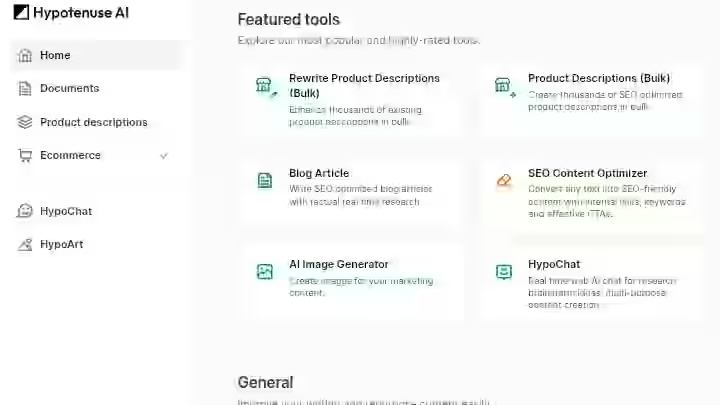
The platform comes with a few key tools, like Content Detective for fact-checking, HypoChat for a more conversational writing experience, and HypoArt for generating AI images.
What Hypotenuse AI does not do:
- Replace a full content strategy tool
- Handle keyword research, competitor gap analysis or rank tracking
- Produce publish-ready blog posts without editing.
- Offer the kind of automated WordPress publishing workflows you find in dedicated auto blogging tools.
Who it targets: E-commerce brands managing product catalogs, content marketers producing ad copy and social media content and agencies needing batch generation for clients.
Think of it as a fast AI drafting assistant for product-heavy businesses, not a full SEO content engine.
Hypotenuse AI Quick Specs
Feature | Details |
|---|---|
Developer | Hypotenuse Technologies Pte. Ltd. |
Founded | 2020, by Joshua Wong and Low Lin Hui (Y Combinator S20 batch) |
AI Model | GPT-4 based, with proprietary fine-tuning |
Platform | Web-based SaaS |
Primary Use | E-commerce content, product descriptions, blog articles, ad copy, social media content |
Integrations | Shopify, WordPress, Webflow, BigCommerce, Amazon, Walmart, Target, Akeneo, Salsify, Stibo Systems, Plytix, PIMcore, and API access |
Best For | E-commerce brands, content marketers, agencies managing product catalogs |
Why I Tested Hypotenuse AI
I kept seeing Hypotenuse AI mentioned in e-commerce circles and on Product Hunt, usually alongside claims about bulk product descriptions and AI image generation.
Most reviews I read were surface-level and did not test it in a real SEO workflow. That frustrated me.
I needed to know: Can this tool actually produce content that ranks? Does the Shopify integration save real time, or is it just a gimmick? And how does it compare to the AI article writers I have already tested at AboahReviews.com?
So I committed to 30 days. I set up a test Shopify store, created a test WordPress site, and ran the tool through its paces across e-commerce content, blog content, social media, and advertising copy.
The goal was straightforward: find out where Hypotenuse AI actually saves time and where it creates more work.
Why Hypotenuse AI Matters in 2026
The timing for AI content tools is both favorable and risky.
On the favorable side, content demand keeps accelerating. E-commerce brands need more product descriptions, more landing page content, more social media content and more blog posts than ever.
E-commerce sites that invest in unique, keyword-optimized product descriptions are better positioned to capture organic traffic, which accounts for over 50% of all website visits, while avoiding the ranking limitations associated with duplicate content.
On the risky side, Google has tightened its grip on AI content quality. Google’s ranking systems aim to reward original, high-quality content that demonstrates qualities of E-E-A-T: expertise, experience, authoritativeness, and trustworthiness.
Google’s focus is on the quality of content, rather than how content is produced. This means AI-generated content is not penalized by default, but content that is low-quality or clearly unedited AI output is treated harshly.
According to analysis of the December 2025 Google core update, AI-generated content sites without human editing saw major traffic drops, while sites with strong internal linking structures and topic modeling gained disproportionately.
This creates a specific workflow need: tools that can speed up first-draft creation while leaving room for human editing, fact-checking, and brand voice refinement.
Hypotenuse AI positions itself in this space, particularly for e-commerce. The question is whether its output quality justifies the cost and time investment.
For anyone building their content strategy around AI tools, understanding how auto blogging tools work is now table stakes.
Who Is Hypotenuse AI Built For?
Hypotenuse AI targets:
- Businesses, marketers and content creators who need to produce content as quickly as possible
- E-commerce businesses needing bulk product descriptions
- Content marketers searching for SEO-optimized blog posts and ad copy
- Agencies managing content for multiple clients
- Freelancers seeking to meet deadlines with quality writing
Specifically, here are the primary users I identified during testing:
- E-commerce store owners with large product catalogs who need product descriptions, meta titles, and category page content
- Marketing teams creating Facebook ads, Google ads, Instagram captions, and LinkedIn posts
- Agencies managing content for multiple brands who need batch generation with brand voice controls
- Freelancers handling short-form marketing content for clients across niches
Why Traditional Tools Fall Short
Traditional workflows for writing 200+ product descriptions involve spreadsheets, multiple copywriters, and weeks of back-and-forth.
Hypotenuse AI’s batch generation can condense that into hours.
Similarly, manually writing press releases, ad copy, and social media content across platforms creates bottlenecks that batch-oriented AI tools solve well.
Who Should Avoid Hypotenuse AI?
- SEO-focused bloggers who need deep keyword optimization, SERP analysis, and publish-ready long-form content. The blog SEO features are thin on lower plans.
- Anyone on a tight budget. The Entry plan at $29/month offers only 50,000 words and limited features. The real power is in higher tiers.
- Content teams expecting zero-edit output. Articles over 1,500 words tend to get repetitive and lose focus, feeling more like a collection of loosely related paragraphs than a cohesive article. You still need an editor.
- Users who need strong plagiarism checker access. The built-in Copyscape integration is only available on higher plans.
- Anyone who needs automated WordPress publishing workflows. The publishing integration exists, but it is not as streamlined as purpose-built auto blogging WordPress plugins.
Hypotenuse AI Features
1. AI Blog Writer
You input a topic or keyword, choose a title, and Hypotenuse AI generates an outline. You can edit the outline, then generate the full article.
My Testing Experience:
I generated 22 blog articles across three niches. Articles in the 800 to 1,200 word range came out decent. They had clear structure, reasonable flow, and needed about 20 to 30 minutes of editing.
Once I pushed past 1,500 words, quality dropped noticeably. The tool started repeating similar points across sections, and paragraphs began to feel disconnected.
Most blog posts took 15 to 20 minutes to generate, including research and fact-checking through Content Detective. But editing time on top of that brought my real per-article time to 45 to 55 minutes for anything over 1,200 words.
Limitations:
- Long-form coherence weakens past 1,500 words
- Limited outline options; you often need to add your own headings
- No automatic internal or external linking on the Entry or Essential plans
Pro Tip: Use Hypotenuse AI to generate 800 to 1,200 word first drafts, then expand and refine manually. Do not rely on it for 2,500+ word pillar content without significant rework.
2. Bulk Product Description Generator
Upload a CSV file or connect your Shopify store, and Hypotenuse AI generates product descriptions in batch. You can set tone of voice, keyword targets, and formatting rules.
My Testing Experience:
This is where Hypotenuse AI earns its keep. I connected a test Shopify store with 85 products and generated descriptions in under two hours.
About 60% of the descriptions were usable with minor tweaks. The remaining 40% needed a rewrite of the opening line or a more specific feature callout, but that is still far faster than writing from scratch.
This feature is designed to mass-generate product descriptions. Either by uploading a CSV file or by using the Shopify integration, Hypotenuse AI generates SEO-friendly descriptions automatically, in bulk.
It is a time-saving tool for e-commerce businesses with many hundreds or thousands of products.
Limitations:
- Descriptions can sound generic if your product data (attributes, features) is thin
- Brand voice controls are more effective on higher-tier plans with custom AI models
Pro Tip: Feed it detailed product attributes in your CSV. The richer your input data, the better the output. Do not upload bare product names and expect compelling copy.
3. Content Detective
Content Detective scans the web for your topic, pulls out key points, and provides sources. It is a nice touch for adding credible evidence to drafts without juggling a bunch of open tabs.
My Testing Experience:
Content Detective saved me time on about half of the articles I wrote. It pulled relevant statistics and talking points for well-covered topics.
For niche or technical topics, though, the sources were sometimes outdated or only tangentially relevant. I found myself verifying every source it pulled, which partially negated the time savings.
Limitations:
- The Content Detective feature can struggle in practice. Testing shows it pulls outdated information a portion of the time and does not have a reliable fact-checking process.
- Only available as a more featured experience in the Blog Pro plan
Pro Tip: Treat Content Detective output as a research starting point, not a finished source list. Always verify dates and accuracy before publishing.
4. HypoChat
HypoChat is an AI chatbot integrated into the platform. It has been trained to understand human-style questions and generate speedy, accurate answers while connected to the web.
You can also upload PDFs and documents as reference material.
My Testing Experience:
I used HypoChat primarily for brainstorming blog angles, repurposing existing content into social media formats, and generating LinkedIn posts from longer articles.
It performed well for these shorter, conversational tasks. Where it struggled was in maintaining accuracy for fact-heavy queries.
It is not a replacement for ChatGPT’s depth in conversational research, but it is convenient for staying inside the platform.
Limitations:
- The HypoChat feature was slower than the other features from time to time.
- Document upload limits vary by plan (20 docs on Entry, 50 on Essential)
Pro Tip: Use HypoChat for content repurposing, not primary research. It shines when you paste in a finished blog post and ask it to generate Instagram captions, LinkedIn posts, or email subject lines from that content.
5. HypoArt (AI Image Generation)
HypoArt generates images from text prompts, similar to other AI image generation tools.
My Testing Experience:
The images were acceptable for placeholder use or social media graphics, but I would not use them for hero images on a professional site.
Quality is limited to standard on the Entry plan and improves to premium on the Essential plan and above.
For product-focused visuals, the enterprise e-commerce plans offer background replacement and image editing features that are more practical.
Limitations:
- Standard quality on the Entry plan looks noticeably lower-resolution
- Not suitable for product photography replacement
- Limited creative control compared to dedicated AI image generation tools like Midjourney
Pro Tip: Use HypoArt for quick social media visuals and blog post illustrations, not for primary branding assets.
6. Ad Copy and Social Media Templates
Hypotenuse AI provides templates for Facebook captions, Instagram captions, and Google ads copy. It also covers website copy templates for headlines, landing page content, and meta descriptions.
My Testing Experience:
I generated 30 Instagram captions, 15 Facebook ads, and 10 Google ads variations.
The Instagram captions and Facebook ads were the strongest performers. They had a natural tone, reasonable length, and included relevant calls-to-action.
Google ads copy needed more manual refinement to fit character limits and match specific audience targeting.
Limitations:
- No built-in A/B testing or performance prediction
- Tone of voice controls are basic on lower plans
Pro Tip: Generate 3 to 5 variations per ad, then pick the best and tweak. The batch approach works better than trying to get one perfect output.
7. SEO Pro Mode (Blog Pro Plan Only)
SEO pro mode includes an article analyzer and optimizer, with reference to SERP and People Also Ask data.
My Testing Experience:
This feature is locked behind the Blog Pro plan ($150/month). I tested it during my trial at this tier. It references top SERP results and PAA questions, which helps with outline creation.
The article analyzer gives basic readability and keyword density feedback. It is not as deep as Surfer SEO or Clearscope, but it adds value over the bare-bones SEO features in lower plans.
Limitations:
- Only available at $150/month and above
- Analysis depth is lighter than dedicated SEO optimization tools
- Not a replacement for a proper content strategy workflow
Pro Tip: If blog content is your primary use case, the Blog Pro plan is the minimum viable tier. The Entry and Essential plans lack the SEO features that make AI blog content competitive.
Hypotenuse AI Workflow Comparison: Before vs After
Step | Traditional Workflow | With Hypotenuse AI | Time Reduction |
|---|---|---|---|
Product description (per item) | 20 to 30 min writing, 10 min editing | 2 min generating, 8 min editing | ~65% |
Blog article (1,200 words) | 3 to 4 hours research + writing | 15 min generating, 35 min editing | ~55% |
Instagram captions (batch of 10) | 60 to 90 min | 10 min generating, 15 min editing | ~70% |
Google ads copy (5 variations) | 45 to 60 min | 8 min generating, 20 min editing | ~55% |
Product catalog (50 items) | 2 to 3 days | 4 to 5 hours | ~75% |
The biggest time savings showed up in batch product descriptions and social media content. Blog articles saved less time because editing requirements scaled with word count.
For context on how these numbers compare to other tools, see my comparison of free vs paid autoblogging tools.
Hypotenuse AI Pricing 2026
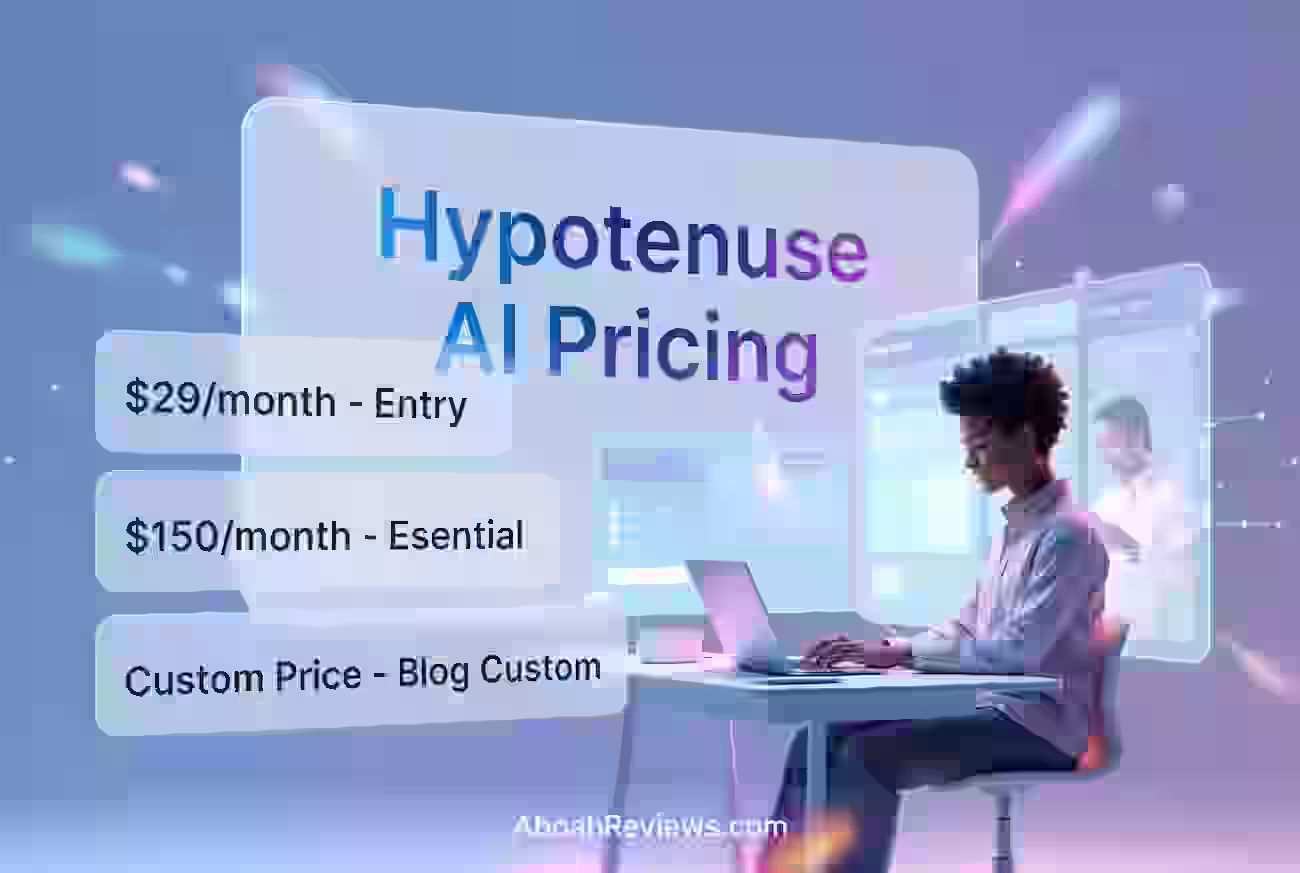
Hypotenuse AI splits its pricing into two main tracks: one for marketers and SEO professionals, and another built specifically for e-commerce brands.
Marketing and SEO Plans
Plan | Monthly Price | Annual Price (per month) | Words/Month | Seats | Key Features |
|---|---|---|---|---|---|
Entry | $29 | $19 | 50,000 | 1 | SEO blog articles, CMS integrations, HypoChat with 20 document uploads, HypoArt standard quality, 20+ content types, 30+ languages |
Essential | $87 | $56 | 250,000 | 1 | Adds plagiarism checker, unlimited HypoChat access with 50 document uploads, and HypoArt premium quality |
Blog Pro | $150 | Custom | 180,000 | 3 | Everything in Essential plus technical writing for healthcare, law, and finance, SEO pro mode with article analyzer and SERP features, real-time research with internal and external links, brand voice lite |
Blog Custom | Custom | Custom | Custom | Custom | Blog Pro features plus custom seats and word limits, bespoke AI models based on brand guidelines, custom formatting and workflows, dedicated account manager |
Hypotenuse AI E-Commerce Plans
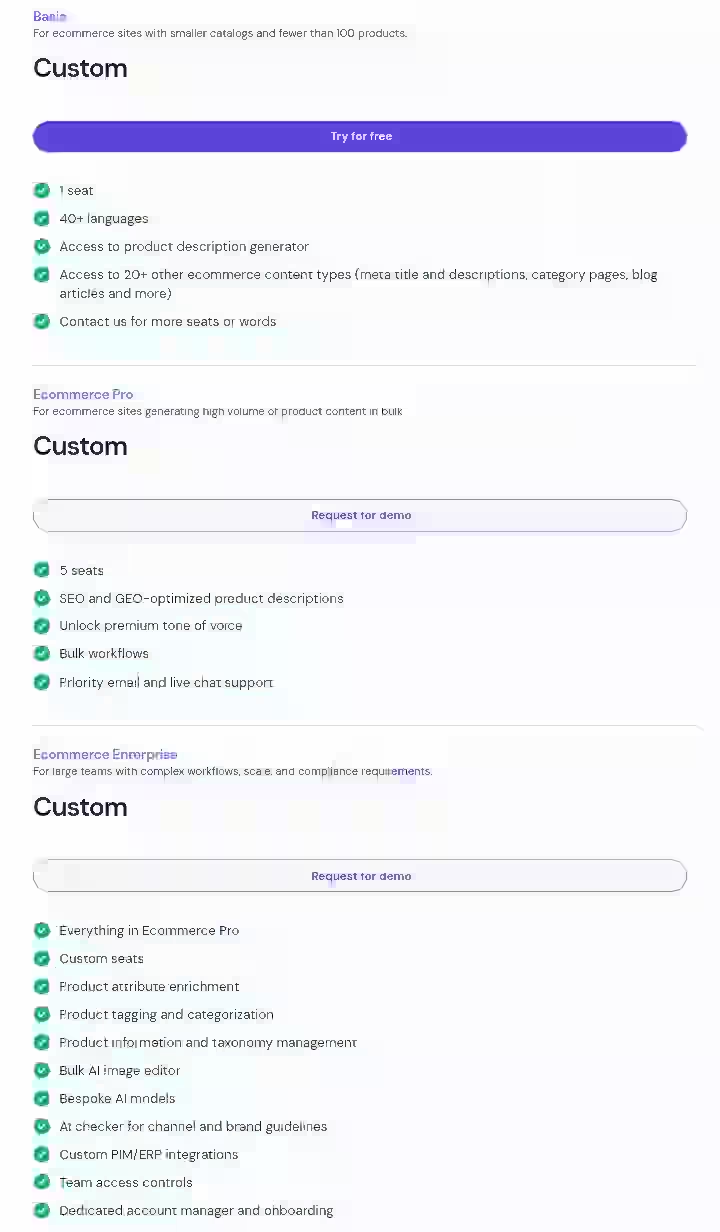
All e-commerce plans (Basic, Pro, Enterprise) require custom quotes.
The e-commerce plans are built for businesses managing product catalogs, with a focus on bulk product description generation, enriching product data and monitoring SEO for product pages.
| Plan | Pricing | Seats | Best For |
|---|---|---|---|
| Basic | Custom | 1 | Small ecommerce stores (<100 products) |
| Ecommerce Pro | Custom | 5 | High-volume ecommerce content teams |
| Ecommerce Enterprise | Custom | Custom | Large teams with complex workflows |
Note: A free 7-day trial is available with no credit card required at signup. That is a genuine plus. You can test the tool without commitment.
Hypotenuse AI E-commerce Pricing Plan Breakdown (2026)
1. Basic Plan
Designed for smaller ecommerce businesses with limited catalogs.
Key Features:
- 1 seat
- Supports 40+ languages
- Access to product description generator
- Access to 20+ ecommerce content types:
- Meta titles & descriptions
- Category pages
- Blog articles
- Additional content formats
- Option to request more seats or words
Positioning Insight:
This is the entry-level automation layer, focused on generating product and supporting content without advanced workflow capabilities.
2. Ecommerce Pro Plan
Built for scaling ecommerce teams producing content in bulk.
Key Features:
- 5 seats
- SEO and GEO-optimized product descriptions
- Premium tone of voice options
- Bulk workflows for large-scale content production
- Priority email and live chat support
Positioning Insight:
This tier introduces true operational scale, combining optimization (SEO/GEO) with workflow automation, ideal for marketplaces or growing DTC brands.
3. Ecommerce Enterprise Plan
Engineered for large organizations with complex systems and data structures.
Key Features:
- Everything in Ecommerce Pro
- Custom seat allocation
- Product attribute enrichment
- Product tagging and categorization
- Product information & taxonomy management
- Bulk AI image editing
- Bespoke AI models (custom-trained)
- AI compliance checker (brand + channel guidelines)
- Custom PIM/ERP integrations
- Advanced team access controls
- Dedicated account manager & onboarding
Positioning Insight:
This is a full-stack AI content infrastructure, integrating deeply into enterprise ecommerce ecosystems (PIM, ERP, governance and compliance layers).
Important note: Multiple user reports indicate that renewal prices can jump by 15 to 40% after the first year, which is a significant price hike that can change the long-term value of the platform. Factor this into your budgeting.
Hypotenuse AI Pros and Cons
Pros
- Batch product descriptions are genuinely useful: This is the tool’s core strength. Connecting Shopify and generating hundreds of descriptions in hours is a real time-saver.
- Template variety covers most marketing channels: From Google ads to Instagram captions to LinkedIn posts to press releases, the template library covers common short-form needs.
- Content Detective adds research value: When it works, it pulls relevant talking points and sources that speed up the drafting process.
- User experience is clean: Users consistently praise the software for its ease of use and ability to generate high-quality content quickly.
- Multi-language support is practical: 30+ languages makes it genuinely useful for global e-commerce brands managing a product catalog across markets.
Cons
- Long-form blog quality degrades: It occasionally repeats similar sentences within the same blog, and this repetition sometimes disrupts the flow.
- SEO features are gated behind expensive plans: The Entry and Essential plans lack SEO pro mode, making them weak choices for blog-focused workflows.
- AI detection rates are high: The content has been flagged by AI detectors, with some tests showing high detection rates. This matters for brand credibility and potentially for SEO.
- Content Detective is unreliable for niche topics: Outdated sources and thin research on less-covered subjects reduce its practical value.
- Pricing increases on renewal: The lack of transparency around year-two pricing is a real concern for budget-conscious teams.
Hypotenuse AI Drawbacks Workarounds
- For long-form quality: Use Hypotenuse AI for the first draft outline and initial paragraphs, then finish manually. Or use a more blog-focused tool like Abun for long-form and reserve Hypotenuse for product content.
- For AI detection: Run output through a manual rewrite pass, focusing on sentence structure variety and adding personal examples. This adds 15 to 20 minutes per article but significantly reduces detection scores.
- For Content Detective accuracy: Cross-reference every statistic and source against the original before publishing. Use it as a brainstorming aid, not a fact source.
- For pricing surprises: Lock in an annual plan and confirm renewal pricing in writing before your first term ends.
Hypotenuse AI Alternatives & Comparisons
Hypotenuse AI vs Jasper
Category | Hypotenuse AI | Jasper |
|---|---|---|
Strength | E-commerce product content, batch generation, Shopify integration | Brand campaigns, team collaboration, 50+ templates |
Best For | E-commerce brands scaling product catalogs | Marketing teams focused on brand voice consistency |
Pricing | From $29/month | From $69/month |
Verdict | Pick Hypotenuse if e-commerce content is your focus. Pick Jasper if brand campaign management and team features matter more. |
Hypotenuse AI vs ChatGPT
Category | Hypotenuse AI | ChatGPT |
|---|---|---|
Strength | Structured templates, batch generation, Shopify integration, Content Detective | Conversational flexibility, deep reasoning, broader knowledge base |
Best For | Structured marketing and e-commerce workflows | General-purpose writing, research, brainstorming |
Pricing | From $29/month | Free tier; Plus at $20/month |
Verdict | Use Hypotenuse for templated, repeatable content workflows. Use ChatGPT for research, brainstorming, and custom prompts. They serve different purposes. |
Hypotenuse AI vs Dedicated Autoblogging Tools
Category | Hypotenuse AI | |
|---|---|---|
Strength | E-commerce content, short-form marketing copy | Full blog automation, WordPress publishing, internal linking |
Best For | Product-heavy businesses | Blog-first SEO strategies |
Verdict | If you need blog articles that publish automatically to WordPress with images, internal links, and SEO optimization, a dedicated autoblogging tool is the better choice. Hypotenuse excels at product content. |
Which Tool Should You Choose?
- You sell physical products online and need hundreds of product descriptions: Hypotenuse AI
- You run a content blog and need automated publishing: An autoblogging tool
- You need brand-consistent marketing copy across a large team: Jasper Al
- You want maximum flexibility with no templates: ChatGPT
- You need AI articles optimized for SEO with minimal editing: Check tools like ClickRank AI or BlogSEO.io
Hypotenuse AI Use Cases
1. E-Commerce Store Owner (Shopify)
- Connect Shopify store to Hypotenuse AI
- Select products needing descriptions
- Set brand voice, target keywords, and description length
- Batch generate descriptions
- Review, edit top-selling product descriptions manually
- Push back to Shopify
Time saved estimate: 70 to 80% compared to manual writing. A 200-product catalog that previously took two weeks can be drafted in a single day.
2. Freelance Content Marketer
- Use Hypotenuse AI templates for ad copy, Instagram captions, and LinkedIn posts
- Generate 3 to 5 variations per client brief
- Edit and submit the best version
- Use HypoChat for brainstorming headline ideas
Time saved estimate: 50 to 60% on short-form deliverables. Less effective for long-form blog assignments.
3. Agency Managing Multiple E-Commerce Clients
- Set up separate brand voice profiles (requires Blog Pro or Custom plan)
- Batch generate product descriptions per client using custom AI models
- Use Content Detective for client blog articles
- Export to client CMS via WordPress or Webflow integration
Time saved estimate: 60 to 75% on product content. Blog content requires more oversight.
4. Content Marketer Building a Content Marketing Calendar
- Use HypoChat to brainstorm topics from a seed keyword
- Generate blog outlines using the AI article writer
- Create first drafts at 800 to 1,200 words
- Edit, add original examples, and optimize manually
- Generate corresponding social media content from the blog draft
Time saved estimate: 40 to 55% on the full content pipeline from idea to social distribution.
Hypotenuse AI Reviews and Complaints from Users
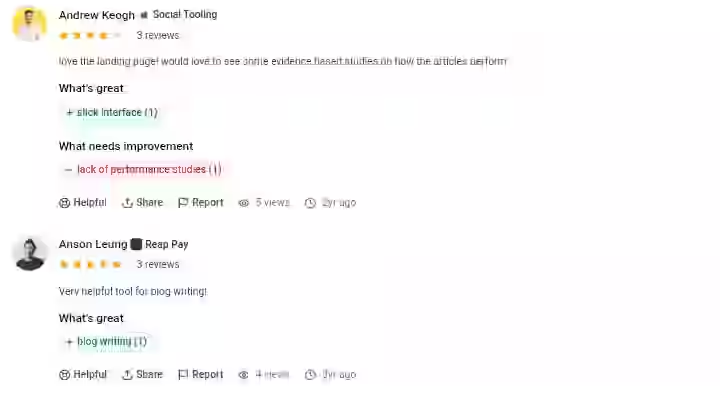
Community sentiment on Hypotenuse AI is generally positive for its core use case, with consistent praise for speed and ease of use.
On G2, users consistently praise the software for its ease of use and ability to generate high-quality content quickly, making it a valuable tool for writers and marketers.
Many appreciate how it saves time and enhances productivity. However, some users note that it occasionally requires minor edits to perfect the output.
A recurring complaint is that subscription prices feel too high relative to what competitors offer, particularly for users focused on blogging rather than e-commerce.
On Product Hunt, Hypotenuse AI receives high praise for its ability to automate content creation, particularly in generating product descriptions and blog writing. Users appreciate its ease of use and the time-saving benefits it offers.
One area of concern: some users find the design not fully user-friendly, noting you have to search inside the website to find specific tools like the chat option, with a long menu bar containing different features.
I noticed this during my testing too. The dashboard could benefit from better navigation for users who need quick access to specific templates.
The user experience improves significantly once you know where things are, but the initial learning curve is steeper than it needs to be.
If you are comparing the overall user experience across AI tools, my common autoblogging tool mistakes guide covers what to watch for.
Hypotenuse Scoring
Category | Weight | Score (out of 10) | Weighted Score |
|---|---|---|---|
Features and Functionality | 30% | 7.5 | 2.25 |
Ease of Use | 20% | 7.0 | 1.40 |
Pricing and Value | 20% | 6.5 | 1.30 |
Support and Customer Experience | 15% | 7.5 | 1.13 |
Trust and Credibility | 15% | 9.0 | 1.35 |
Final Score: 7.4/10 |
- Features score well because of the breadth of templates, batch generation, and e-commerce integrations. Blog SEO features on lower plans drag this down.
- Ease of use is good once you learn the layout, but initial navigation is confusing.
- Pricing loses points for the steep tier jumps and reported renewal price increases.
- Support is responsive, with priority support on higher plans. Lower plans rely on email.
- Trust and credibility score high because of recognition in media such as TechCrunch, Forbes, TechRadar and Tech in Asia, with founders named to Forbes 30 Under 30 Asia. SOC 2 compliance and support for 30+ languages also add confidence.
Hypotenuse AI Detection and Content Risk Assessment
This section of the Hypotenuse AI review is relevant for anyone publishing AI-generated content at scale.
- AI detection exposure: Some tests show Hypotenuse AI content flagged at high rates by AI detection tools. This is worth knowing if you operate in niches where Google scrutiny is high (health, finance, legal) or if your clients require human-written content guarantees.
- Content penalty risks: According to Google’s documentation, using automation, including AI, to generate content with the primary purpose of manipulating ranking in search results is a violation of spam policies. However, not all use of automation, including AI generation, is spam. The risk lies in publishing unedited output at scale without adding value. Use AI as a starting point, not a finished product. Use it to generate outlines and first drafts, then have someone with actual expertise rewrite key sections.
- Data privacy: Hypotenuse AI positions itself with enterprise-grade privacy and SOC 2 compliance. This is a meaningful differentiator from many competitors in the AI writing space.
- Practical recommendation: Always edit AI output before publishing. Add original examples, rewrite repetitive sections, and verify all factual claims. This is not optional if you want to build sustainable organic traffic. For more on how this fits into a broader strategy, see my guide to the benefits of auto blogging tools.
Final Verdict On Hypotenuse AI 2026
BUY if:
- You run an e-commerce store with a large product catalog and need batch product descriptions
- Need short-form marketing content (Instagram captions, Facebook ads, Google ads, LinkedIn posts, ad copy) generated quickly
- You manage multiple brands and need brand voice controls at the enterprise level
- Product data enrichment and Shopify integration are priorities in your workflow
SKIP if:
- Your primary need is long-form blog content optimized for SEO rankings
- Want a tool that publishes directly to WordPress with full automation (images, internal linking, scheduling)
- You are on a tight budget and need maximum value from a single plan
- Need content that passes AI detection without heavy manual editing
My personal decision:
I will keep using Hypotenuse AI specifically for product description projects and short-form social media content.
For blog content and SEO-focused articles, I rely on WordRocket AI or more specialized tools. That division of labor gets me the best results with the least wasted time.
Frequently Asked Questions About Hypotenuse AI Review 2026
1. Is Hypotenuse AI good?
Yes, Hypotenuse AI is good for its core use case: generating bulk product descriptions, short-form marketing copy, and e-commerce content. Users commend the quality of the generated content, noting it surpasses other AI writing tools for e-commerce. Overall, Hypotenuse AI is recommended for its efficiency and effectiveness in producing high-quality content.
2. Is Hypotenuse AI better than ChatGPT?
For structured, repeatable e-commerce workflows like batch product descriptions and templated ad copy, Hypotenuse AI is more efficient than ChatGPT because of its built-in templates and Shopify integration. For open-ended research, brainstorming, and flexible writing tasks, ChatGPT remains more capable. They serve different purposes and work well when used together.
3. Can I legally publish a book written by AI?
Copyright law around AI-generated content varies by jurisdiction and is still evolving. In the United States, the Copyright Office has generally held that works must have human authorship to be copyrightable. You can legally publish AI-generated text, but you may not be able to claim full copyright protection over purely AI-generated portions. Always consult a legal professional for your specific situation.
4. How much does Hypotenuse AI cost?
The Entry plan costs $29/month ($19/month billed annually). The Essential plan costs $87/month ($56/month billed annually). The Blog Pro plan starts from $150/month. E-commerce plans require custom quotes. There is a free 7-day trial with no credit card required.
5. Does Hypotenuse AI work with Shopify?
Yes. Hypotenuse AI integrates with platforms like Shopify, Salesforce Commerce Cloud, Salsify, Webflow and WordPress, enabling teams to push content directly into their existing workflows. The Shopify integration is one of its strongest features, allowing bulk product description generation directly from your store’s product data.
6. Does Hypotenuse AI have a plagiarism checker?
Yes, the platform offers a built-in plagiarism checker with Copyscape integration. However, it is not available on the Entry plan. You need the Essential plan or above to access plagiarism checking.
7. Is Hypotenuse AI content detectable as AI?
In my testing and based on independent reports, Hypotenuse AI content is frequently flagged by AI detection tools. Manual editing and rewriting are necessary if you need content that reads as human-written. This is a common limitation across AI writing tools, not unique to Hypotenuse AI.

- Ryze AI Review 2026: My 30 Days Full Breakdown of This Autonomous SEO & GEO Platform - October 9, 2026
- #1 Best Plugin for Automatic Blog Posting in WordPress (2026) - September 13, 2026
- 13 Best WordPress Autoblogging Plugins I Tested & Ranked for 2026 - September 13, 2026