
TL;DR: This guide compares 15 best autoblogging.ai alternatives for SEO teams, bloggers and agencies who need better keyword research, internal linking or content quality than Autoblogging.ai currently offers. I tested each tool on real WordPress sites and tracked editing time, publishing reliability and SEO output.
I’ve been testing autoblogging and AI content tools since early 2023 and one thing I’ve learned is that no single platform fits every workflow. Autoblogging.ai is solid and I gave it a 7.7/10 in my full Autoblogging.ai review after 90 days of testing but it has real gaps.
That’s why I spent the last several months specifically testing autoblogging.ai alternatives across multiple use cases: affiliate sites, agency content pipelines, solo blogs, and local business content.
What I found: the right alternative depends entirely on what Autoblogging.ai is missing for you. If you want backlinks with your content, that’s a different tool than if you want better semantic SEO or daily automated publishing or programmatic bulk production. This guide answers that question with real data, not marketing copy.
Quick Verdict
Here are the 15 best autoblogging.ai alternatives and who each one is actually built for:
- Distribb – Best for SEO content combined with automated backlink acquisition and content distribution
- Keytomic – Best for end-to-end SEO automation from keyword research to AI visibility tracking
- BabyLoveGrowth AI – Best for SEO + GEO automation with content, backlinks, and LLM visibility in one plan
- Clearpost AI – Best for WordPress-native auto-publishing with editorial control baked in
- RankYak – Best for automated topical content workflows with built-in keyword clustering
- WordRocket AI – Best for high-volume publishing on a budget using BYOK (bring your own API key)
- Outrank.so – Best for research-driven, editorially sound SEO content
- Massblogger – Best for fully automated blog publishing at scale
- RankPill – Best for recurring, daily automated SEO content with backlink credits included
- BlogSEO – Best for semantic SEO workflows with schema markup and structured data
- Emplibot – Best for hands-off WordPress automation with social distribution
- Byword AI – Best for bulk and programmatic SEO content at volume
- RightBlogger – Best for bloggers who want a broad content toolkit beyond just article generation
- Soro SEO – Best for daily automated publishing at a low entry price
- Frizerly – Best for small and local businesses wanting broader marketing automation across blog and social
Why Look for an Alternative to Autoblogging.ai?

Autoblogging.ai does a lot well: Godlike Mode’s two-stage SERP analysis, Amazon affiliate automation, bulk CSV publishing and direct WordPress integration are all genuinely useful.
However, depending on your goals, you’ll hit its limits quickly. Here’s where users most often start looking elsewhere.
Content Quality
Autoblogging.ai’s Quick Mode output needs 30 to 45 minutes of editing per article on average. Godlike Mode brings that down to 20 to 25 minutes, but the output still reads AI-written without real editing effort.
If you want first drafts that are closer to publish-ready especially for competitive keywords tools like Outrank.so and Keytomic AI consistently produce better raw quality with less cleanup.
SEO Capabilities
Autoblogging.ai does keyword-informed content generation well, but it doesn’t do keyword research. You bring the keywords; it builds the article. That’s fine if you already have a keyword research workflow.
But if you want a tool that identifies keyword opportunities, maps topical clusters, handles internal linking automatically, and tracks competitor content gaps, alternatives like Keytomic, BabyLoveGrowth AI and RankYak go further.
For a deeper look at what SEO automation should cover, this AI SEO automation guide lays out the full stack.
Publishing Automation
Autoblogging.ai’s WordPress integration works well in testing. One-click publish, auto-indexing via Google Search Console, category assignment. But it’s SaaS-based, not WordPress-native.
Tools like Clearpost AI and Emplibot live inside WordPress, which means tighter integration, better internal link surfacing, and no context-switching between platforms.
If you manage multiple WordPress sites and want something that scales across them cleanly, that distinction matters.
Pricing and Article Limits
Autoblogging.ai runs on a credit system, which makes cost-per-article math harder to predict. A fully optimized article (Godlike Mode + GEO Optimizer + Semantic SEO Analysis) costs 8+ credits.
On the Regular plan at $49/month with 120 credits, that’s roughly 15 fully optimized articles per month. Some alternatives offer flat monthly article counts at 30 articles for a fixed price which is easier to budget.
Others use per-article pricing or BYOK models that can drop cost dramatically at high volume.
AI Search Optimization
Autoblogging.ai added a GEO Optimizer and AI Visibility Tracking in 2025, which is genuinely useful. But it’s still limited to Google AI Overviews; ChatGPT and Perplexity tracking are listed as “coming soon” as of this writing.
Tools like Distribb, Rankpill and BabyLoveGrowth AI already track LLM citations across multiple platforms. Generative engine automation is becoming an important part of content strategy, and some alternatives are ahead of Autoblogging.ai on that dimension.
How I Tested These Autoblogging.ai Alternatives
Before I rank anything, let me show my work. I’ve been testing autoblogging and AI content tools seriously since 2023, and the methodology matters as much as the conclusions.
What I Evaluated
| Criterion | Weight |
|---|---|
| Content quality | 25% |
| SEO capabilities | 20% |
| Automation depth | 20% |
| CMS/WordPress workflow | 10% |
| Reliability | 10% |
| GEO/AI search features | 5% |
| Ease of use | 5% |
| Value for money | 5% |
What I Actually Tested
For each tool, I ran articles on real target keywords across at least two niches (home improvement, SaaS reviews, and personal finance).
I tracked publishing time, editing time, SERP impressions after 30 and 60 days, and how much human intervention each tool required before content was actually publishable.
I also looked at WordPress integration quality (does it actually work without errors?), internal linking behavior, and whether the platform’s keyword research, if it has any, surfaces opportunities I would have found manually.
One lesson from a painful earlier experience: scaling content without a strategy is a trap. After publishing 42 auto-generated posts on an affiliate site with no internal linking or keyword filtering, the pages began competing against each other. Rankings dropped, traffic dried up and recovery took months.
That experience shapes how I evaluate every tool in this space. Any platform that doesn’t give you some control over topical overlap and keyword targeting gets marked down accordingly.
Best Autoblogging.ai Alternatives Compared
| Tool | Starting Price | Content Generation | Keyword Research | WordPress | Internal Linking | Best For |
|---|---|---|---|---|---|---|
| Distribb | $97/month | Yes | Yes | Yes | Yes | Content + backlinks + distribution |
| Keytomic | $99/month | Yes | Yes | Yes | Yes | End-to-end SEO automation |
| BabyLoveGrowth AI | ~$99/month | Yes | Yes | Yes | Yes | All-in-one SEO + GEO |
| Clearpost AI | $99/month | Yes | Yes (via GSC) | Yes (native) | Yes | WordPress auto-publishing |
| RankYak | $99/month | Yes | Yes | Yes | Partial | Topical content workflows |
| WordRocket AI | $10 + API costs | Yes | No | Yes | No | High-volume BYOK publishing |
| Outrank.so | $99/month | Yes | Yes | Yes | Partial | Research-driven SEO content |
| Massblogger | $59/month | Yes | No | Yes | No | Automated publishing at scale |
| RankPill | $49.5 for first month then $99/month | Yes | Yes | Yes | No | Daily automated SEO content |
| BlogSEO | $97/month | Yes | Yes | Yes | Partial | Semantic SEO + schema markup |
| Emplibot | $69/month | Yes | Yes | Yes | Yes | Hands-off WordPress automation |
| Byword AI | $99/month (25 articles) or $5/article | Yes | No | Yes | Partial | Bulk programmatic SEO content |
| RightBlogger | $59/month | Yes | Partial | Yes | Yes | Bloggers, multi-format toolkit |
| Soro SEO | $39/month | Yes | Yes | Yes | Partial | Daily automated publishing |
| Frizerly | $49/month | Yes | No | Yes | No | Small/local business automation |
The 15 Best Autoblogging.ai Alternatives
1. Distribb
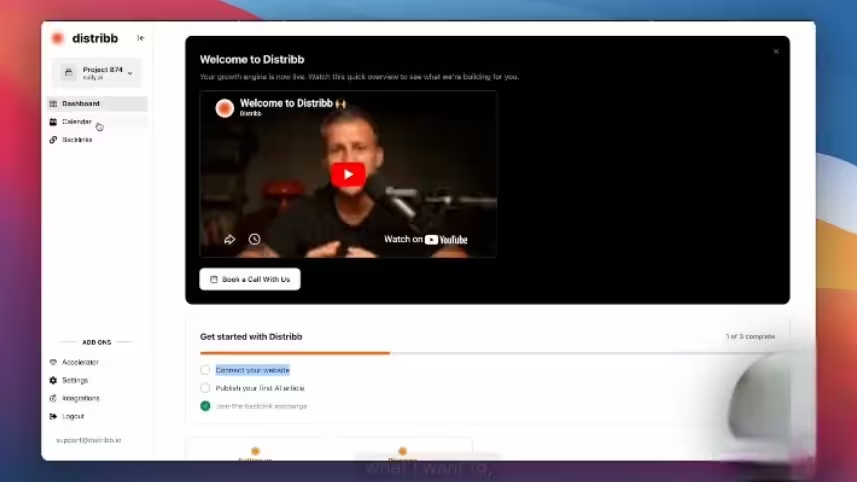
Best for: Content marketers and SEO teams who want automated content generation, backlink acquisition and multi-channel distribution from a single workflow.
What makes Distribb different from Autoblogging.ai?
Autoblogging.ai stops at publish. Distribb keeps going. After generating and publishing your article, it enters a credit-based backlink exchange network where other Distribb users link to your content and you link to theirs.
It also distributes content to Medium and social channels. The semantic cocoon architecture structures articles around topical clusters, not isolated posts, which is a meaningful difference for building domain authority.
Where most autoblogging tools stop at the publish button, Distribb continues through a credit-based backlink exchange and multi-channel distribution layer.
Pros:
- Post-publish backlink network built into the platform
- Topical cluster content architecture
- Supports 150+ languages with direct CMS publishing
- 3-day free trial available
Cons:
- The backlink network is still mostly English-speaking, so English-market sites currently get the most relevance from the links
- $97/month is steep for solo operators just starting out
- Less editorial control than tools like Clearpost or Outrank.so
Pricing: 3 days free trial (credit card required), $97/month (Pro), Accelerator ($495/month)
Who should use Distribb? Content marketers and small agencies who want automated content creation and link acquisition in one workflow, without managing separate SEO and link-building tools.
Who should stay with Autoblogging.ai? Anyone who just needs volume content generation without backlinks or distribution, or who has a tighter budget below $97/month.
Distribb vs Autoblogging.ai: Autoblogging.ai wins on flexibility and lower entry cost ($19 vs $97). Distribb wins if content distribution and link building matters to you. It’s the only tool in this comparison that handles content distribution and links in one subscription. Read the full Distribb review for a complete breakdown.
2. Keytomic
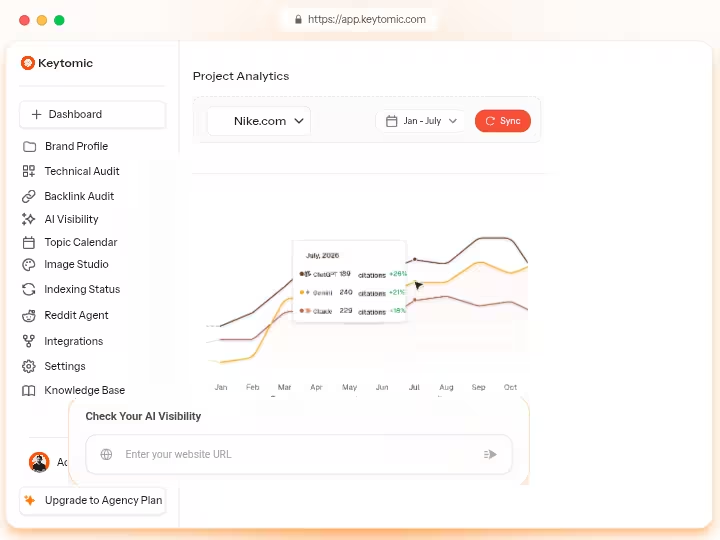
Best for: Teams and agencies that want full-stack SEO automation covering keyword research, content generation, publishing, auto-indexing and AI visibility tracking in one platform.
Why consider Keytomic instead of Autoblogging.ai?
Keytomic is as a full-stack SEO automation platform that solves the problem of managing separate tools for keyword research, content production, CMS publishing and AI visibility monitoring. After 90 days of direct testing, it proved most valuable for lean marketing teams, solo founders and agencies handling multiple client accounts.
The key difference from Autoblogging.ai is that Keytomic finds your keywords for you, builds a 30-day content calendar, and tracks whether your content is appearing in AI-generated answers. Autoblogging.ai requires you to bring your own keyword strategy.
Pros:
- Automation manages the entire process from keyword discovery to content generation, with users approving a 30-day content calendar designed for search engines and AI platforms. The platform identifies high-intent, low-competition keyword opportunities and ensures content aligns with user search intent
- Auto-indexing across Google, Bing, ChatGPT, and other search engines
- AI citation tracking included in base plan
- Integrates with 12+ CMS platforms
Cons:
- No built-in rank tracking
- Manual keyword research tool is limited compared to Semrush
- $99/month minimum with no lower entry tier
Pricing: $1 trial (3 days), $99/month (Pro), $999/month (Agency Done-For-You).
Who should use it? Lean marketing teams and agencies who want one platform to replace separate keyword research, content, and visibility tracking tools. It earns a buy for teams who need volume and visibility across both Google and AI search. Skip it if you primarily need deep on-page NLP guidance or cost less than $99/month to operate.
Keytomic vs Autoblogging.ai: Autoblogging.ai gives you more manual control and a lower entry price. Keytomic does more of the strategic thinking for you: keyword selection, content calendar, AI visibility tracking. For teams without a dedicated SEO strategist, that difference is worth the higher price.
You can explore more on SEO automation to understand where both fit.
3. BabyLoveGrowth AI
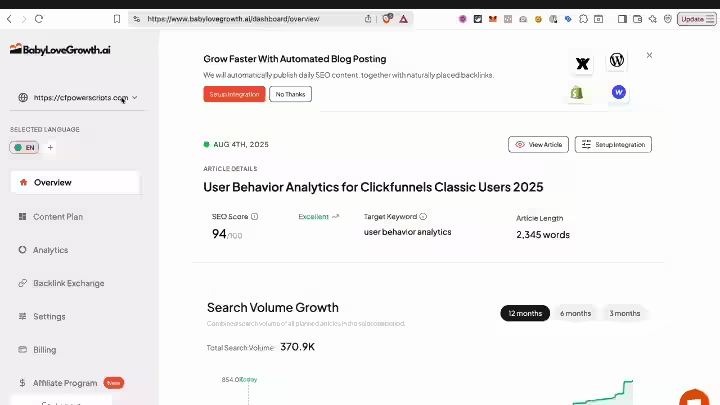
Best for: All-in-one SEO, GEO automation, content generation, backlink acquisition, and AI search visibility tracking.
Why consider BabyLoveGrowth AI?
It is not the cheapest platform in this comparison, nor does it generate the highest number of articles each month. However, it delivers the most complete SEO workflow by combining AI content generation, automated backlink acquisition, technical SEO improvements and AI search visibility tracking in a single subscription.
If Autoblogging.ai is your current content engine but you’re managing SEO, links, and AI visibility in separate tools, BabyLoveGrowth AI consolidates that stack. The LLM citation tracking covers ChatGPT, Perplexity, Claude and Google AI Overviews, something Autoblogging.ai is still building toward.
Pros:
- Full pipeline: content + backlinks + technical SEO + AI visibility in one subscription
- LLM citation tracking across multiple platforms (not just Google)
- White-label reseller plan available for agencies
- Content, backlink, and AI visibility data in one dashboard
Cons:
- 30-day onboarding phase can feel slow if you have urgent content calendars
- Article volume per month is lower than pure bulk tools like Byword AI
- BabyLoveGrowth AI covers 20+ languages; some alternatives cover 100+
Pricing: Grow ($99/month) and Scale ($299/month). Both plans include a 3-day free trial, 25% off annual billing and a 90-day money-back guarantee. There’s also a custom reseller plan for agencies.
Who should use it? Agencies and business owners who want an end-to-end SEO system, not just a content generator. Also strong for affiliate site operators who previously used separate tools for content, outreach, and tracking. Explore the BabyLoveGrowth AI review for the complete details.
BabyLoveGrowth AI vs Autoblogging.ai: Autoblogging.ai wins on article volume, bulk generation, and lower entry price. BabyLoveGrowth AI wins if you want one subscription to cover content, links, and AI search visibility without stitching tools together.
For a detailed head-to-head, see BabyLoveGrowth AI vs Outrank.so.
4. Clearpost AI
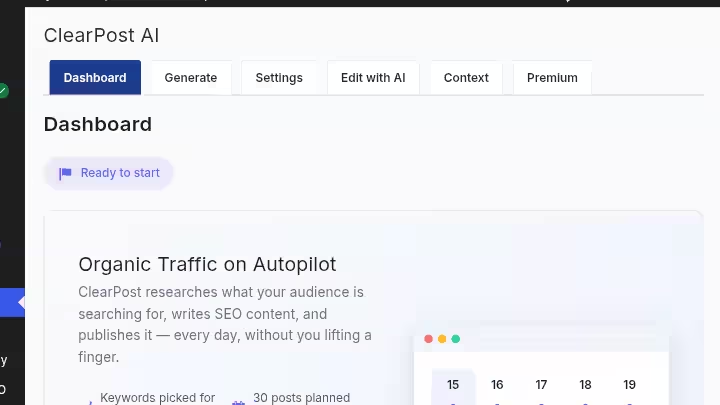
Best for: WordPress site owners who want an autonomous SEO content agent that researches keywords, builds a content calendar, and publishes without needing you to direct every article.
Why consider Clearpost AI?
Autoblogging.ai is a tool you operate. Clearpost AI is closer to an agent that operates itself. ClearPost AI works differently: it lives inside your WordPress installation, connects to Google Search Console, researches keywords based on your business context, and publishes posts on a schedule without you choosing individual topics.
It connects to your Google Search Console data, understands your business vertical, identifies keyword opportunities you’re missing, builds a content calendar, and executes on it.
You can review posts before they go live or let it run on full autopilot. That approval gate is a feature, not a limitation. It keeps human judgment in the loop without adding heavy editorial overhead.
Pros:
- WordPress-native (lives inside your WordPress installation, not a separate SaaS tab)
- GSC integration for keyword opportunity discovery
- Approval queue before publishing; human oversight built in
- Native WordPress publishing via REST API, full Google Search Console integration, mandatory human approval before any post goes live
Cons:
- Less useful if you don’t use WordPress
- Less bulk generation capability than Autoblogging.ai
- Fewer language options than some alternatives
Pricing: Free (bring-your-own API key), Premium ($99/month), Business ($199/month). All paid plans come with 7-day free trial, no credit card required
Who should use it? WordPress-focused site owners who want automated content without manually researching and selecting every keyword, and who want an approval step before anything publishes.
Clearpost AI vs Autoblogging.ai: Autoblogging.ai has more generation modes and bulk CSV capabilities. Clearpost AI is more autonomous and WordPress-native. If you run one or two WordPress sites and want an agent-style workflow rather than a manual generation tool, Clearpost is the stronger choice.
5. RankYak
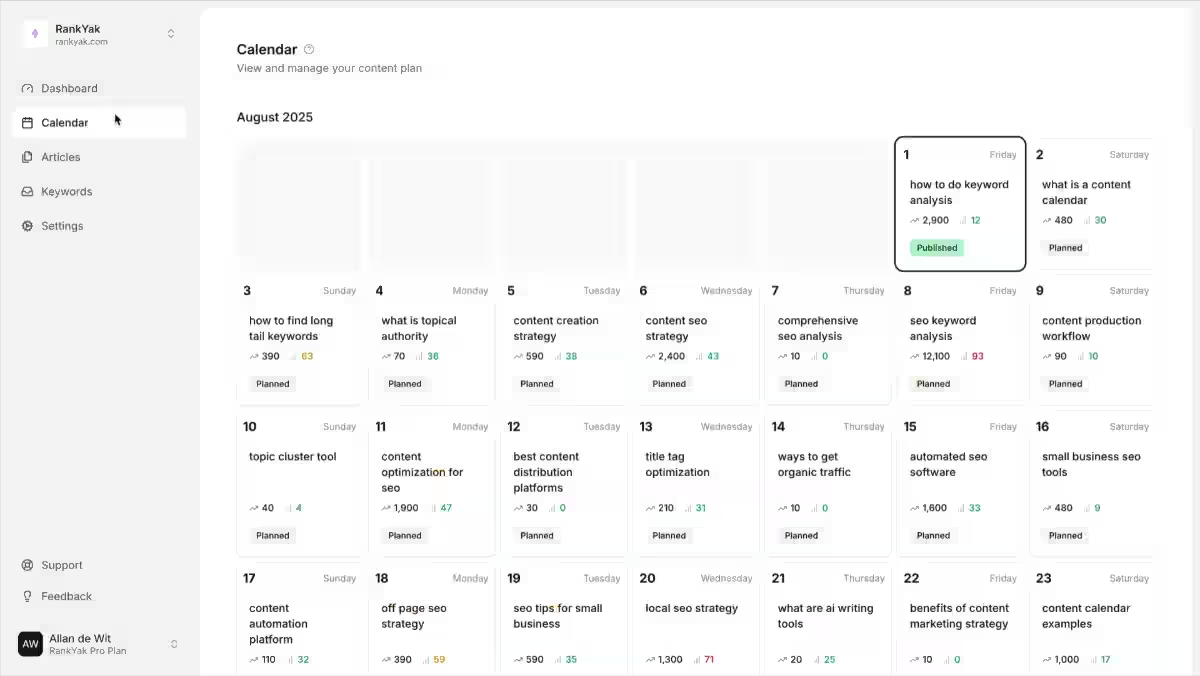
Best for: Small businesses and agencies that want automated topical authority building through keyword clustering and daily article publishing.
Why consider RankYak?
RankYak is as an AI SEO platform that handles every stage of search engine optimization for a website: keyword research, content planning, daily article writing and publishing, and ongoing maintenance of the pages a site already has. The topical cluster approach is where it differentiates.
Rather than generating isolated articles for individual keywords, RankYak structures content around clusters, which builds topical authority more systematically.
The core pitch is the same as some competitors, but RankYak leans harder into structuring articles around topic clusters instead of scattered one-off keywords, which builds actual topical authority rather than just volume.
Pros:
- Full pipeline: keyword research, content planning, daily writing, and publishing
- Topic cluster architecture for topical authority
- Genuine 3-day free trial with no $1 charge required
- Automated backlinks building while you sleep
- Multi-site volume discounts up to 20% off
Cons:
- With RankYak, you’re still trading editorial control for convenience. If you want a tool that lets you review and adjust before anything publishes, this isn’t the tool for that
- Less mature than some tools in this list
Pricing: $99 per site per month or $990 per site per year. There’s also an agency plan which cost $99/client (1 client is free).
Who should use it? Small businesses and agencies wanting predictable, cluster-driven SEO content without manually managing a content calendar or keyword strategy.
RankYak vs Autoblogging.ai: Autoblogging.ai gives you more control over what you publish and costs less at the entry level. RankYak automates more of the strategy side, including keyword clustering, backlinks building, content scheduling, making it better suited for teams that want less manual direction of the content pipeline.
6. WordRocket AI
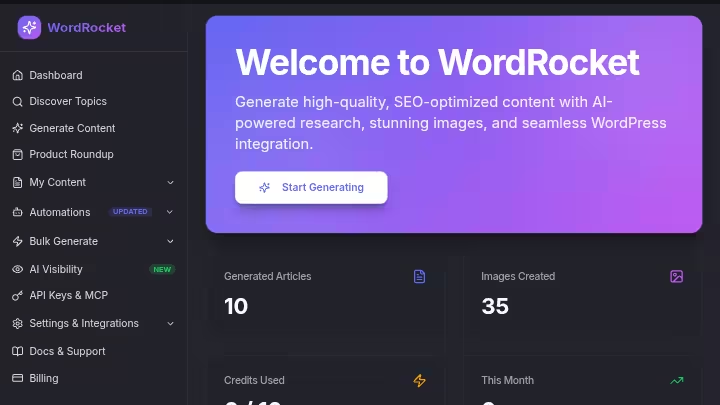
Best for: High-volume content production on a strict budget using a bring-your-own-API-key model.
Why consider WordRocket AI?
WordRocket AI is an automated bulk content generation platform that solves the speed-to-publish problem for long-form SEO content. After 45 days of daily use, it proved most valuable for solo bloggers, affiliate marketers and small agencies struggling with consistent content production at scale.
The BYOK model is the key differentiator: you connect your own OpenAI or OpenRouter API key, and WordRocket handles the generation workflow. Your per-article cost drops dramatically compared to Autoblogging.ai’s credit system at scale. The dashboard is clean, and once you get past the initial configuration, generating a 2,500-word article takes under 4 minutes.
Pros:
- BYOK model means very low per-article costs at volume
- Clean dashboard with fast generation time (~4 minutes per 2,500-word article)
- WordPress publishing integration
- Affordable pricing for beginners
Cons:
- The onboarding itself is reasonably straightforward once you have your API key configured, but that step is where new users stall. If you have never set up an OpenRouter or OpenAI API key, expect to spend 30 to 60 minutes on setup before you publish your first article
- Built-in keyword research is limited
- Not ideal for non-technical users
Pricing: Free plan ($0/month), Starter plan ($10/month), Pro ($20/month), Premium ($49.99/month). Plus API costs (OpenAI or OpenRouter, typically $0.01–$0.05 per article depending on model). See WordRocket AI pricing for full details.
Who should use it? High-volume publishers and affiliate site operators who already have keyword lists and API access, and want to dramatically reduce cost-per-article. Check the WordRocket AI review for a 45-day test breakdown.
WordRocket AI vs Autoblogging.ai: Autoblogging.ai is more beginner-friendly and has more generation modes (Amazon, News, Godlike). WordRocket AI wins at volume if you’re technically comfortable. The per-article cost advantage becomes significant above 50 articles per month.
7. Outrank.so

Best for: SEO professionals and content teams who want research-backed, editorially sound first drafts that require less cleanup than typical AI output.
Why consider Outrank.so?
Outrank.so consistently produce the highest-quality first drafts in testing, with the deepest semantic coverage and best source grounding. It requires less post-generation editing than Autoblogging.ai’s equivalent modes.
Outrank pulls SERP analysis, competitor content gaps and source citations into every article before generating, similar to Autoblogging.ai’s Godlike Mode, but built into the standard workflow rather than an add-on.
If you’re tired of spending 35 minutes editing every Quick Mode article, Outrank.so’s output requires meaningfully less cleanup.
Pros:
- Research-backed drafts with source citations and SERP analysis built in
- Strong editorial quality per article; less editing time than Autoblogging.ai Quick Mode
- WordPress publishing with scheduled posts
- Backlinks exchange network for boosting your domain authority
- Pulls SERP analysis, competitor content gaps and source citations into every article before generating editorially sound content
Cons:
- Higher entry cost than Autoblogging.ai
- Less flexible bulk generation than Autoblogging.ai’s CSV mode
Pricing: $1 trial for 3 days, $99/month (30 articles), Enterprise (custom pricing).
Who should use it? SEO teams and content agencies where article quality and editorial efficiency matter more than raw article volume. Also strong for competitive niches where thin drafts won’t rank regardless of publishing frequency. Read the Outrank.so review for full test results.
Outrank.so vs Autoblogging.ai: Autoblogging.ai wins on bulk generation and lower minimum price. Outrank.so wins on first-draft quality and research depth. If you’re spending significant time editing Autoblogging.ai output, Outrank.so’s stronger drafts may net you the same effective output in less total time.
8. Massblogger
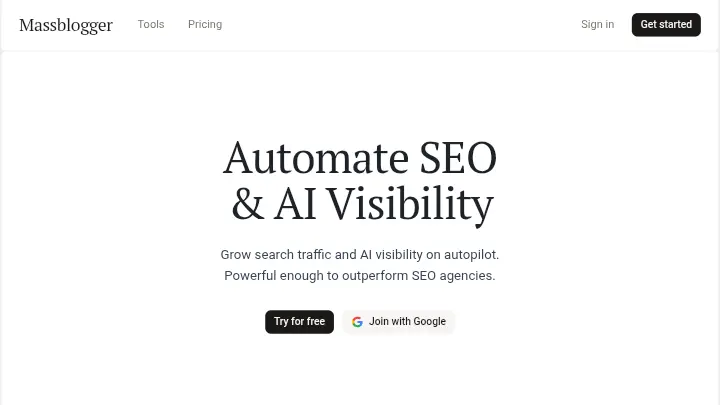
Best for: Publishers who want high-volume automated blog publishing with minimal configuration and direct WordPress integration.
Why consider Massblogger?
Massblogger does one thing well: publishing a lot of content to WordPress on autopilot. It’s a straightforward automated publishing platform without the GEO tools, SERP analysis layers, or backlink exchange systems that more expensive tools carry.
For sites where the primary need is volume and consistent publishing cadence, that simplicity is actually a feature. It’s less to configure and easy to learn. It sits in a similar space to Autoblogging.ai’s bulk mode but with a more streamlined interface.
Pros:
- Straightforward automated publishing workflow
- Programmatic SEO content generation at scale
- Designed for volume, no credit system complexity
- WordPress integration is reliable in testing
- Lower operational overhead than platforms with more features
Cons:
- No built-in keyword research or SEO analysis
- Backlinks exchange network is limited
- Fewer community compared to competitors
Pricing: Free plan, $59/month (Discovery), $99/month (Pro). See Massblogger review for what I found during testing.
Who should use it? Publishers managing programmatic SEO or high content volume who want consistent automated publishing without building out a complex SEO stack. Not suitable for teams where ranking on competitive keywords is the primary goal.
Massblogger vs Autoblogging.ai: Autoblogging.ai has far more features (Amazon mode, GEO tools, AI visibility tracking, Godlike Mode SERP analysis). Massblogger is simpler and potentially more cost-effective for straightforward bulk publishing use cases. If you don’t need those extra features, Massblogger reduces the complexity.
9. RankPill
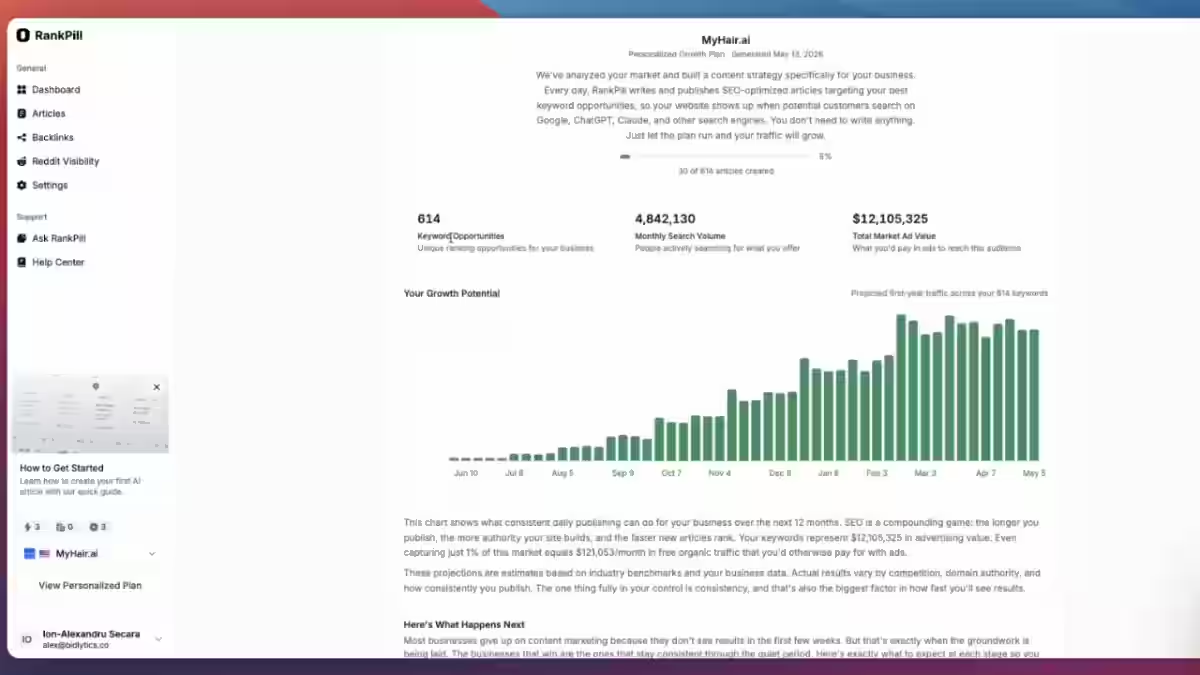
Best for: Founders and small business operators who want daily SEO content published automatically with backlink credits included, without managing a content team.
Why consider RankPill?
RankPill sells one promise: you connect your site, and it publishes an SEO article a day without you touching it. For $99 a month, 30 articles, 30 backlink credits, auto-published to WordPress or Shopify or Webflow while you do something else.
The Reddit marketing feature which automatically replies to trending threads on your behalf to build brand mentions and improve share of voice in your niche is a genuine differentiator at this price point.
Pros:
- Simple one-plan pricing (30 articles + 30 backlink credits per month)
- Reddit SEO and marketing automation included
- Auto-publishing to WordPress, Shopify, Webflow, Wix, and Framer
Cons:
- No editorial control; fully automated publishing by default
- If you want a tool that lets you review and adjust before anything publishes, this isn’t the tool for that
- No built-in topical cluster architecture (isolated articles by default)
- Content quality requires monitoring to catch errors
Pricing: $49.5 for the first month, then $99/month. You can save 10% on quarterly plan and 17% on annual subscription.
Who should use it? Founders and e-commerce operators with no content team who want an autopilot publishing system, and who understand the editorial risk of fully automated output. Read the RankPill review for a detailed breakdown.
RankPill vs Autoblogging.ai: Autoblogging.ai gives you more generation control (modes, bulk CSV, Amazon affiliate). RankPill is more autonomous: set it up once and it runs. At similar price points, RankPill adds backlink credits and Reddit automation that Autoblogging.ai doesn’t include.
10. BlogSEO
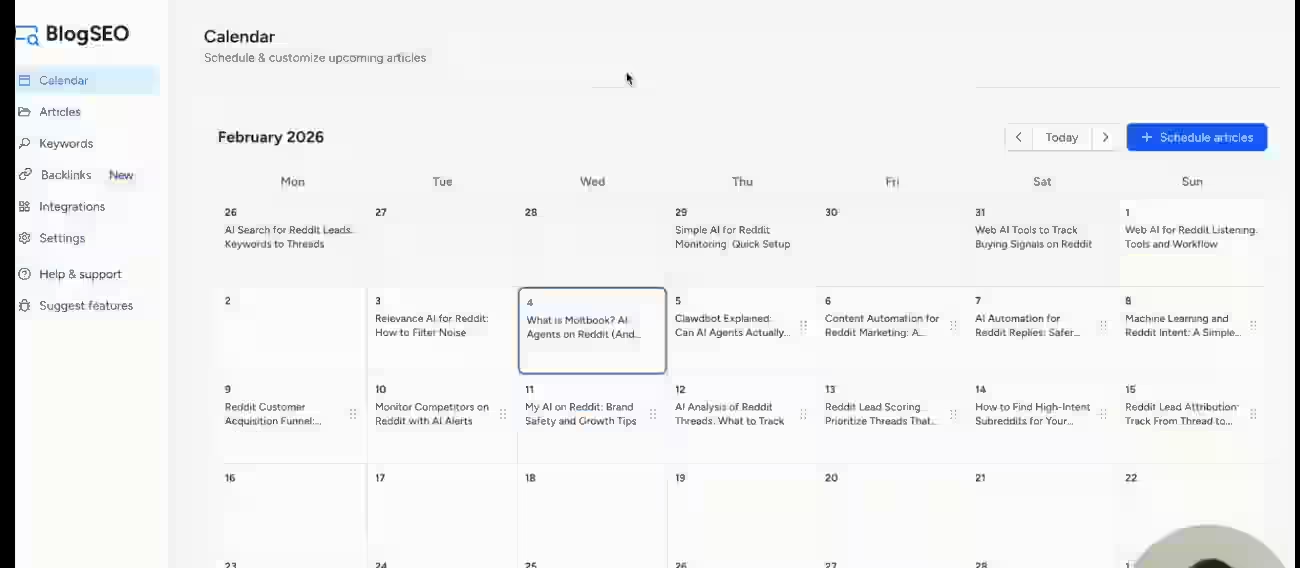
Best for: SEO-first publishers who prioritize structured data, schema markup, and semantic SEO coverage over raw publishing volume.
Why consider BlogSEO.io?
BlogSEO emphasizes the SEO optimization part of automated blogging. Every feature ties back to search visibility. It’s the most SEO-focused tool in this comparison for users who prioritize structured data, schema markup, and semantic SEO coverage over raw publishing volume.
Schema markup is a core feature, not an add-on. Every article gets structured data automatically. That’s a meaningful gap compared to Autoblogging.ai, which requires manual schema work. For sites in niches where structured data affects SERP appearance (recipes, reviews, events, local businesses), BlogSEO is the stronger choice.
According to Google’s Search Central documentation, properly implemented schema markup can improve how content appears in search results through rich snippets, making BlogSEO.io’s automated schema approach genuinely useful for SEO outcomes.
Pros:
- Schema markup automated on every article
- Semantic SEO keyword analysis before generation
- WordPress integration with partial internal linking
- Strong structured data coverage for niche sites
Cons:
- Lower article volume per plan than some alternatives
- Less editorial quality control than Outrank.so
- No built-in rank tracking or AI visibility tracking
Pricing: $97/month for 30 articles, up to 15 backlinks, HD image generation, reasoning AI model, internal linking and automated publishing. See BlogSEO.io review for testing details.
Who should use it? Affiliate marketers, info site builders, and local business sites that want automated publishing with structured data handled automatically. If schema markup is part of your SEO strategy, BlogSEO.io is ahead of Autoblogging.ai on that specific capability.
For deeper context on how semantic SEO fits into an automation workflow, this semantic SEO automation guide covers the strategic angle.
BlogSEO.io vs Autoblogging.ai: Autoblogging.ai has more generation modes and greater bulk output capacity. BlogSEO.io has built-in schema, more structured semantic SEO tooling and automatic backlinks at $97/month, making it more complete for SEO-first workflows.
11. Emplibot
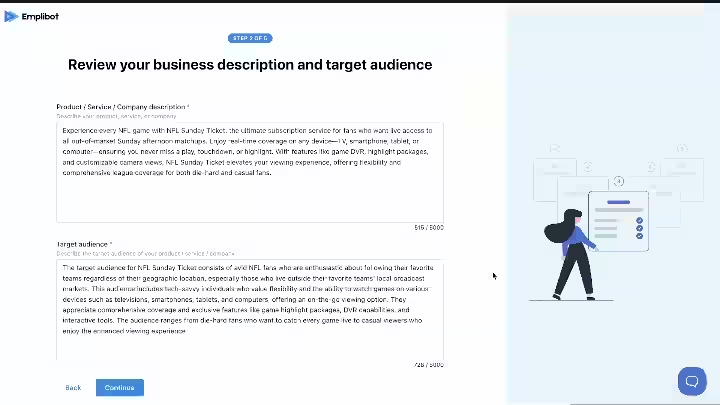
Best for: WordPress-focused teams who want hands-off automated blogging with automatic social media distribution, and minimal daily management.
Why consider Emplibot?
Emplibot is built specifically for hands-off WordPress publishing with social sharing included. The social distribution component is something Autoblogging.ai doesn’t offer.
Emplibot automatically shares published posts to LinkedIn, Facebook, and other platforms, which matters for bloggers managing both a content calendar and social presence simultaneously.
The white-label WordPress plugin and multi-client dashboard also make it genuinely usable for agencies managing multiple client sites.
Pros:
- Automatic social media distribution included
- White-label WordPress plugin for agencies
- Multi-client dashboard for managing multiple sites
- Hands-off daily operation requires minimal configuration
Cons:
- No free tier, and pricing tiers are based on a fixed weekly cadence rather than flexible bulk generation
- Less generation mode variety than Autoblogging.ai
- Higher entry price than Autoblogging.ai
Pricing: Starter runs $69/month for 2 articles/week, Standard is $99/month for 4 articles/week, and Pro is $149/month for 7 articles/week. Read the Emplibot review for 30-day test results.
Who should use it? Agencies with multiple WordPress client sites who want consistent, automated publishing with social sharing included, and don’t want to operate a separate social media scheduler.
Emplibot vs Autoblogging.ai: Autoblogging.ai wins on bulk generation and article modes. Emplibot wins on WordPress-native automation, social distribution, and agency multi-site management. If your workflow is primarily one or two WordPress sites and you want social built in, Emplibot is the cleaner choice.
12. Byword AI
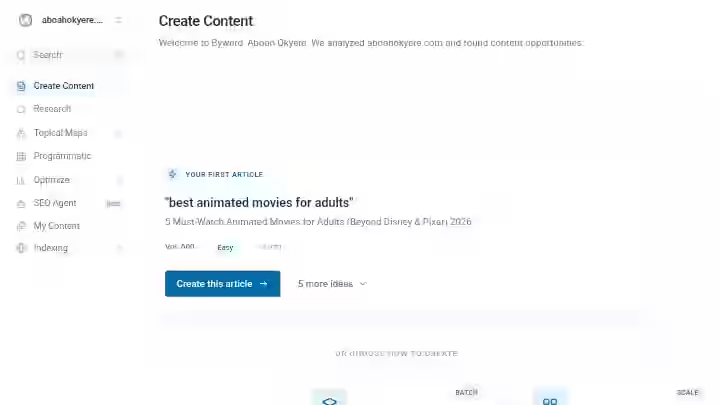
Best for: Programmatic SEO, bulk article generation at scale (50+ articles per batch), and affiliate content operations where keyword lists are already prepared.
Why consider Byword AI?
Byword AI operates as a bulk content generator that prioritizes speed and volume over strategic planning. The platform lets you create hundreds of articles quickly through AI-powered writing, targeting businesses that need massive content output fast.
Autoblogging.ai’s CSV bulk mode handles up to 500 articles, but batch consistency can vary. Byword is built specifically for bulk processing stability. If you’re running 100+ article batches regularly, it’s more predictable. You’ll benefit from Byword if you manage affiliate websites or content farms that need high article volumes.
The platform suits users who already have their keyword lists ready and simply want fast article generation without spending time on research or planning phases.
Pros:
- Pay-per-article model ($5/article) suits irregular publishing schedules
- Stable bulk processing at 50+ article batches
- WordPress publishing integration
- No monthly commitment on pay-per-article plan
Cons:
- No built-in keyword research
- No strategic keyword planning or topical authority focus
- Less editorial quality control than Outrank.so
Pricing: $5/article or $99/month (Starter) for 25 articles, Standard ($299/month), Scale ($999/month), Unlimited ($1,999/month). See Byword AI review for full testing details.
Who should use it? Affiliate site operators running programmatic SEO at genuine scale who have keyword lists ready and need stable bulk generation. For comparison with alternatives, see AI writing tools vs autoblogging tools to understand where Byword fits in the broader category.
Byword vs Autoblogging.ai: Byword AI’s starting price ($99/month) is higher than Autoblogging.ai’s Starter ($19/month), but its bulk processing is more stable for 50+ article batches. For programmatic SEO at serious scale, Byword AI wins. For flexibility and lower entry cost, Autoblogging.ai has the edge.
13. RightBlogger
Best for: Bloggers and solo creators who want a broad content toolkit with 90+ tools covering multiple content formats, not just article generation.
Why consider RightBlogger?
RightBlogger isn’t a pure autoblogging tool. It’s a toolkit, although it recently included automation into the platform. It includes 90+ individual writing tools covering article generation, keyword research (partial), social posts, YouTube scripts, email drafts and more, all under one subscription.
The overlap is solo bloggers and side-project operators who want to manually direct everything but use AI for the tedious parts. RightBlogger fits that profile cleanly. If you’re on Autoblogging.ai primarily for article generation but constantly switching to other tools for other content formats, RightBlogger consolidates that at a lower price.
Pros:
- 90+ tools covering multiple content formats
- WordPress publishing integration
- Automated internal linking
- Backlinks exchange network
- $59/month delivers more per dollar than any other tool tested for solo bloggers wanting unlimited articles and site maintenance tools
Cons:
- Not designed for full automation, requires more manual operation than Autoblogging.ai
- Backlinks exchange network requires DA of 15 and above
- Less suited for bulk or programmatic SEO at volume
Pricing: Solo at $59/month (1 site), Pro at $89/month (3 sites) and Agency at $299/month (10+ sites), with 50% off annual plan promotion. All plans include 7 days trial (credit card required). Check the RightBlogger review page for full plan details.
Who should use it? Solo bloggers and freelancers who need help across multiple content formats, not just article generation. Also strong for anyone on a tight budget who wants more tool coverage per dollar. For a head-to-head comparison of how it stacks up, see ChatGPT vs RightBlogger.
RightBlogger vs Autoblogging.ai: Autoblogging.ai wins on automation depth and bulk generation. RightBlogger wins on format flexibility and price especially for solo bloggers who don’t need a bulk publishing machine.
14. Soro SEO

Best for: Sites that need daily automated SEO content published without manual input, at a lower price point than most full-stack alternatives.
Why consider Soro SEO?
Soro SEO is an AI-powered SEO content generation platform that automates keyword research, article generation, on-page optimization, and publishing. It helps businesses rank on Google and win citations in AI chatbots like ChatGPT.
At $39/month, it’s one of the most affordable daily publishing tools in this comparison. Soro handles meta title, description, internal and external linking, and alt text for images to help content rank well on Google and ChatGPT. That’s a meaningful feature set at the price point.
Pros:
- Lowest entry price for daily automated publishing in this comparison ($39/month)
- Meta data, internal/external linking, and image alt text automated
- 14-day money-back guarantee
- AI search optimization included
Cons:
- Unlike many tools in this space, Soro does not provide any free trial or plan
- Limited schema markup control compared to competitors
- No built-in backlink acquisition
- Single pricing tier, no scaling options
Pricing: $39/month as its only pricing tier, with a 14-day money-back guarantee. Browse the Soro SEO review and Soro SEO pricing for details.
Who should use it? Small businesses and solo operators who want consistent daily publishing at the lowest possible price, without the complexity of higher-tier platforms. Read the best Soro SEO alternatives if you want to compare it against others in its price range.
Soro SEO vs Autoblogging.ai: Autoblogging.ai costs more ($19+ vs $39 single tier) but offers far more generation modes, bulk generation, and add-on tools. Soro SEO is simpler and more automated. If you want daily publishing without managing credits or modes, Soro SEO is the lower-friction option.
15. Frizerly
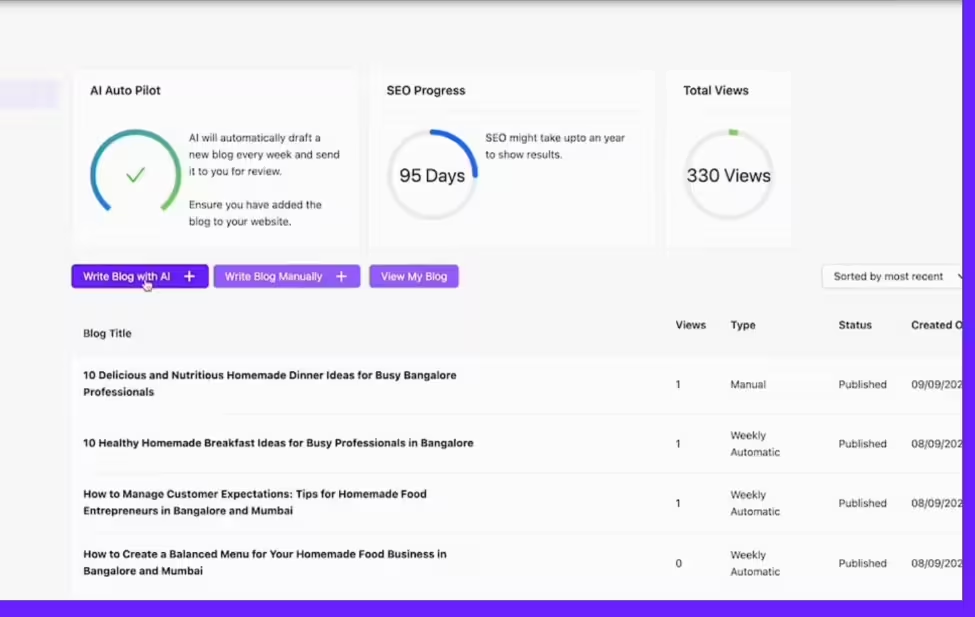
Best for: Small and local businesses wanting automated blog content plus social media publishing from one platform, without dedicated marketing staff.
Why consider Frizerly?
Frizerly is the best WordPress AI content optimization plugin in 2026, with an AI agent that connects with your WordPress site, learns your business, and auto-publishes SEO-optimized blogs every week.
Its differentiation from Autoblogging.ai is the social layer: Frizerly’s AI social media manager creates engaging content and posts it automatically to Facebook and LinkedIn so you stay active without the daily grind. It automatically creates and posts engaging educational content to your Facebook and LinkedIn accounts.
For a local business or small operator who needs both a content pipeline and social presence managed automatically, that combination makes Frizerly stand out. Frizerly includes an AEO/GEO dashboard on its Pro plan, which adds AI search visibility for businesses tracking their appearance in ChatGPT and Perplexity answers.
Pros:
- Blog + social media automation in one platform
- GEO/AEO dashboard on Pro plan for AI search visibility
- Learns your business context for more relevant content
- Strong fit for local and small business content needs
Cons:
- Less bulk content generation capacity than Autoblogging.ai
- No backlink acquisition
- Less control over individual article direction than Autoblogging.ai’s mode system
Pricing: Standard at $49/month ($29/month billed annually). Pro at $149/month ($99/month billed annually). Pro SEO + Social at $199/month ($149/month billed annually). Check out my Frizerly testing page for what I found.
Who should use it? Local businesses, small service providers, and solo operators who want automated blog content and social media handled together without separate tools for each.
Frizerly vs Autoblogging.ai: Autoblogging.ai is the stronger pure content generation tool with more modes, bulk generation, and lower base price. Frizerly wins if you also need social media automation built in, and especially if you serve a local or small business audience.
For a broader look at local SEO automation tools with AI content optimization, that guide covers how Frizerly fits alongside local SEO platforms.
Which Autoblogging.ai Alternative Should You Choose?
Don’t choose based on features lists. Choose based on the specific gap Autoblogging.ai leaves in your current workflow.
Best Alternative for Overall SEO Automation
Keytomic at $99/month is the strongest all-round replacement if you want one platform to handle keyword research, content generation, CMS publishing, indexing, and AI visibility tracking.
Keytomic is the best autoblogging tool overall based on its end-to-end SEO automation, which covers keyword research, content generation, auto-publishing, auto-indexing, schema markup, and AI search visibility tracking in one $99/month subscription.
Best Alternative for Content + Backlinks
Distribb and BabyLoveGrowth AI are the two best options, but they work differently. Distribb’s backlink network is credit-based and operates through content exchange; it’s built for content marketers who publish frequently. BabyLoveGrowth AI bundles backlinks with a more comprehensive SEO stack.
If link acquisition is your primary gap, Distribb is more focused on it. If you want content + links + AI visibility in one subscription, BabyLoveGrowth AI is the more complete platform.
Best Alternative for WordPress Automation
Clearpost AI and Emplibot are both strong, but for different reasons. Clearpost is WordPress-native and includes a mandatory approval step; better for teams that want editorial control.
Emplibot handles social distribution and multi-client management, better for agencies running several WordPress sites who want one platform across all of them.
Best Alternative for High-Volume Publishing
WordRocket AI (BYOK, lowest cost-per-article at volume), Byword AI ($5/article or $99/month for stable bulk batches), and Massblogger (straightforward automated publishing).
For sheer article volume at the lowest unit cost, WordRocket AI wins if you’re comfortable with API setup. For stable 50+ article batches without API management, Byword AI is the cleaner choice.
Best Alternative for Research-Driven Content
Outrank.so consistently produces the strongest first drafts in testing for competitive keywords. If you’re spending 35+ minutes editing every Autoblogging.ai Quick Mode article, Outrank.so’s research-backed output significantly reduces that editing time.
Best Alternative for Semantic SEO
BlogSEO.io at $97/month is the most SEO-structured tool in this comparison, with automated schema markup and semantic keyword analysis before every article. For sites where structured data, rich snippets, and semantic coverage matter, it’s ahead of Autoblogging.ai on that specific dimension.
Best Alternative for Daily Automated Publishing
Soro SEO at $39/month is the most affordable entry point for daily automated publishing. RankPill at $99/month adds backlink credits and Reddit marketing automation at a higher price. If budget is the constraint, Soro SEO. If backlinks and Reddit visibility matter, RankPill.
Best Alternative for Bloggers
RightBlogger at $59/month is the clearest choice for solo bloggers who need multi-format content help and don’t need a bulk publishing machine.
Best Alternative for Agencies
RankYak and BabyLoveGrowth AI are both strong agency options, with RankYak having a stronger multi-client workflow and BabyLoveGrowth AI offering more complete bundling of content, links, and LLM visibility. For white-label needs, Emplibot also has a white-label WordPress plugin worth evaluating.
Autoblogging.ai Alternatives: What I Would Actually Use
I’ve been on both sides of this mistake: fully automated publishing with zero editorial oversight, and over-cautious semi-automation where every article took 2 hours to process. Neither extreme works.
Here’s what I would actually use depending on the scenario.
- For a hands-off niche site: I’d use BabyLoveGrowth AI or RankYak for daily publishing, with a weekly 30-minute review session to catch any articles with factual errors before they compound. Full autopilot without any review leads to exactly the thin content and cannibalization problems I experienced in 2023. A lightweight weekly check is enough to prevent the worst outcomes without adding heavy editorial overhead.
- For a site where content quality matters: Outrank.so for first drafts, with a consistent editing workflow of 15 to 20 minutes per article. The semi-automated approach: AI draft plus human editing outperforms fully automated posts by roughly 3x in organic traffic over 6 months, based on my own testing across three tools. That ratio holds whether you’re using Outrank.so or Autoblogging.ai Godlike Mode.
- For high-volume programmatic publishing: WordRocket AI or Byword AI with keyword lists prepared in advance. The BYOK model makes WordRocket cost-effective at scale; Byword is more stable for very large batches. Neither replaces keyword strategy. You still need to know what you’re targeting and why.
- For content + link acquisition: BabyLoveGrowth AI for the bundled pipeline, or Distribb if content distribution and backlink exchange are the specific gaps. Both are more expensive than Autoblogging.ai but include capabilities that would cost significantly more to build separately.
- For multiple WordPress sites: Emplibot for its multi-client dashboard and social distribution, or Clearpost AI if you want GSC-informed keyword research automated per site. Managing five WordPress sites with Autoblogging.ai’s SaaS interface is workable but requires more manual coordination than either of these alternatives.
Understanding how autoblogging works at a structural level helps you evaluate which automation layer each tool is actually improving and where human judgment still needs to stay.
Are Autoblogging.ai Alternatives Safe for SEO?
The tool isn’t the risk; the workflow is.
Google’s guidance on AI-generated content is clear: the focus is on quality, not method of creation. According to Google’s Search Central blog, the concern is with content produced at scale to manipulate rankings that doesn’t add value, not AI generation as a production method.
That means a well-edited AI article is treated the same as a well-edited human-written article. A thin, unedited AI article is treated the same as a thin, human-written article: poorly.
Why Fully Automated Publishing Can Create Problems
The specific failure modes I’ve seen repeatedly in my own testing and from other site operators:
- Factual errors: AI models hallucinate. In YMYL niches (medical, legal, financial), this is a liability. In non-YMYL niches, it erodes trust with readers who notice.
- Search intent mismatch: Automated tools sometimes generate an informational article for a transactional keyword, or vice versa. Without human review, these mismatches go live and don’t rank.
- Topical cannibalization: Publishing articles without keyword mapping creates overlapping content that competes with itself. I lost a site’s rankings after publishing 42 auto-generated posts without keyword filtering, and the recovery took months of rewriting and consolidating.
- Weak internal linking: Most autoblogging tools don’t automatically connect new content to existing content intelligently. Manual internal linking review is still necessary for topical authority.
- Publishing volume without demand: Generating 30 articles per month in a niche with 8 viable keyword targets produces 22 articles that will never rank. Volume without strategy wastes budget and dilutes domain focus.
Content targeting low-competition, high-intent keywords with clear topical focus outperforms high-volume generic publishing.
The Workflow I Recommend
AI keyword research or manual Semrush/Ahrefs research → AI draft (any tool in this list) → human review for factual accuracy and search intent fit → internal linking check → publish → monitor Search Console for 30 days → update any articles showing impressions but low CTR.
That’s it. You don’t need a 4-hour editorial process per article. You need a 15 to 30-minute review that catches the obvious problems before they go live. The difference in ranking outcomes between reviewed and unreviewed AI content is significant and consistent across every tool I’ve tested.
For a structured framework on avoiding the most common failure modes, the common autoblogging mistakes guide covers this in detail.
Is Autoblogging.ai Still Worth Using?
Not everyone searching for alternatives should actually switch. Autoblogging.ai still makes sense if:
- You need simple, fast article generation from a keyword or title
- You run Amazon affiliate sites and want automatic affiliate tag insertion (Amazon Reviews Mode is genuinely good)
- You want bulk generation (up to 500 articles via CSV) at a low entry price
- WordPress auto-publishing and auto-indexing are important to your workflow
- Multiple writing modes (Quick, Godlike, News, Amazon) matter for content variety
- You want GEO optimization and AI visibility tracking built into the same platform as your content generation tool
Consider switching to an alternative if:
- You need built-in keyword research (Autoblogging.ai requires you to bring your own keywords)
- You need automated internal linking (most alternatives handle this better)
- Backlink acquisition matters to your strategy (Distribb, BabyLoveGrowth, RankPill all include this)
- You want GEO/AI search features covering ChatGPT and Perplexity, not just Google (Keytomic and BabyLoveGrowth are ahead here)
- You manage multiple client sites and want a proper agency dashboard
- You want stronger editorial controls with approval queues before content publishes
If you want to see how these alternatives compare to Autoblogging.ai head-to-head across more specific criteria, the best autoblogging tools for end-to-end publishing roundup covers the full competitive landscape.
Final Verdict
Autoblogging.ai is still worth using if straightforward AI article generation and automated WordPress publishing at low cost is your primary need.
It’s not the right tool anymore if you also need keyword research automation, automated internal linking, backlink acquisition, multi-platform AI visibility tracking, or stronger editorial controls before publishing.
Here are the five alternatives I would actually reach for first, based on my testing:
- BabyLoveGrowth AI for agencies and operators who want content, backlinks, and AI visibility in one subscription
- Keytomic for teams who want end-to-end SEO automation without managing separate keyword, content, and tracking tools
- Outrank.so for anyone spending too much time editing AI output and needing higher-quality first drafts
- Distribb for content marketers who want post-publish backlink exchange and distribution built into the workflow
- RightBlogger for solo bloggers who need multi-format content support at the lowest price point
The right alternative for your workflow might be none of these. It depends on which specific gap in your current setup is costing you the most time or ranking performance. If you’re still unsure, start with a free trial on the tool closest to your use case, generate articles on your actual target keywords, and measure the editing time and output quality before committing.
If you’ve tested any of these tools and had different results, I’d genuinely like to hear what you found especially in niches I haven’t covered. Share your experience in the comments below.
Frequently Asked Questions About Autoblogging AI Alternatives
What is the best autoblogging.ai alternative overall?
The best alternative depends on your specific gap. For full-stack SEO automation, Keytomic at $99/month covers the widest range of the workflow. For content plus backlinks plus AI visibility in one subscription, BabyLoveGrowth AI is the most complete. For raw article quality and less editing time, Outrank.so produces stronger first drafts.
Which autoblogging.ai alternative is cheapest?
WordRocket AI at $10/month is the most affordable option with automated blogging publishing included and drops per-article cost significantly at high volume through the BYOK model.
Do autoblogging.ai alternatives produce content that ranks on Google?
Yes, but only with a consistent review process before publishing. Raw AI output often lacks personal experience and original insight, regardless of which tool you use. The ranking results in my testing consistently favor semi-automated workflows (AI draft plus human editing) over fully automated publishing. The tool matters less than the editorial process around it.
Which alternative is best for agencies managing multiple clients?
Keytomic and BabyLoveGrowth AI both have multi-client capabilities with AI visibility tracking. Emplibot has a white-label WordPress plugin and multi-site dashboard that’s specifically useful for agency WordPress management. The right choice depends on whether keyword strategy automation (Keytomic) or content-plus-links bundling (BabyLoveGrowth) is the higher priority for your agency’s workflow. For a broader look at SEO operating systems for agencies, that guide covers the full agency tooling picture.
Are autoblogging tools legal to use?
Yes. AI-generated content is not illegal, and using automation for content production is not against Google’s guidelines. The legal and SEO concerns arise from specific misuse cases: publishing plagiarized content, misleading readers about the source, or publishing content that violates other laws in regulated industries.
Which alternative works best for programmatic SEO at scale?
Byword AI at $5/article or $99/month for 25 articles is the most purpose-built for programmatic SEO. It’s stable bulk processing at 50+ article batches with keyword list import. WordRocket AI is the cheaper alternative if you’re comfortable with API management and are running 100+ articles per month. Autoblogging.ai’s CSV bulk mode competes in this space but with less consistency at very high batch volumes.

- #1 Best Plugin for Automatic Blog Posting in WordPress (2026) - September 13, 2026
- 13 Best WordPress Autoblogging Plugins I Tested & Ranked for 2026 - September 13, 2026
- 13 Best Google AI Overview Checking Tools in 2026 (Tested & Ranked) - September 9, 2026