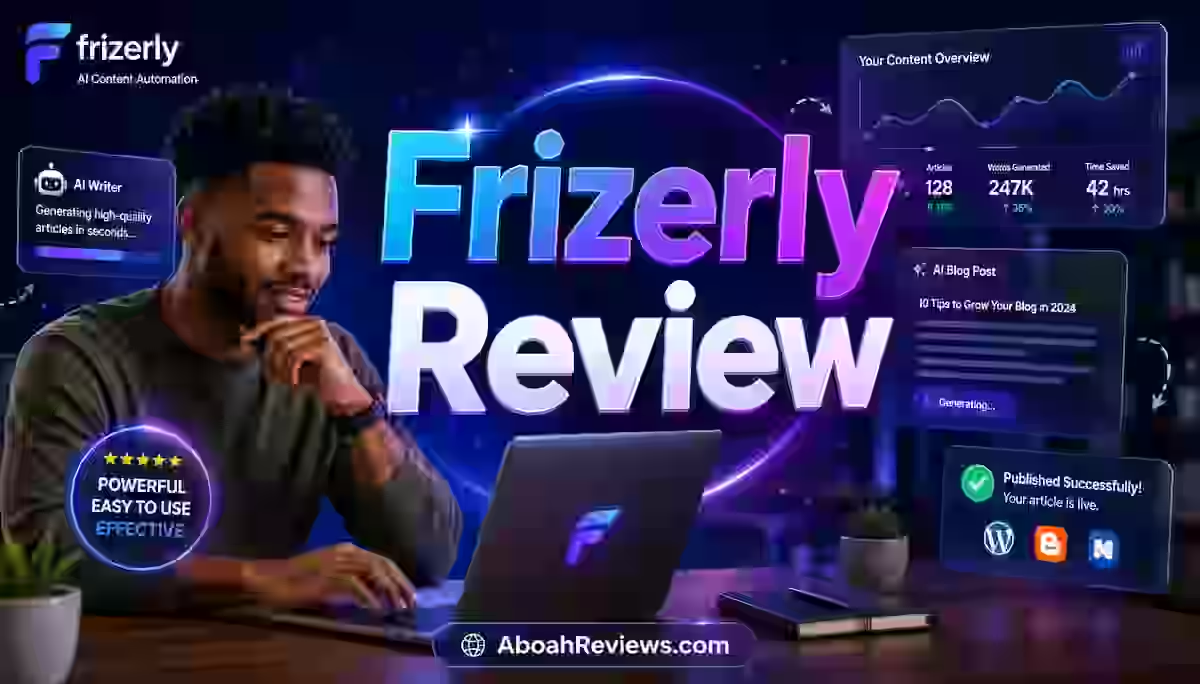
Frizerly Review Verdict (2026)
Category | Verdict |
|---|---|
Best For | Small business owners, Shopify merchants, WordPress site owners and content marketers who need consistent automated blog publishing without hiring a writer |
Not Ideal For | Agencies managing multiple high-authority client sites, writers who need deep editorial control or teams needing custom AI model configuration |
Pricing | 3 days free trial, then $49/month or $29/month when billed annually |
Rating | ⭐⭐⭐ (7.7/10) |
Standout Feature | Tracks both Google rankings and AI citation visibility (AEO tracking across ChatGPT, Gemini, Claude and Perplexity) |
Biggest Weakness | Without human editing, output can be generic. The most powerful features are Pro-plan-only. |
Worth It? | Yes, if you own a Shopify store, WordPress site or small business and need consistent weekly or daily blog publishing without writing every article yourself |
Bottom line: Frizerly is a legitimate SEO content automation platform for businesses that need consistent content publishing daily or weekly. However, if you need precise SEO control or editorial depth at scale, it is not the right fit.
Frizerly Quick Specs
Feature | Details |
|---|---|
Developer | Ezdise Technology Private Limited |
Founded | 2025 |
AI Model | OpenAI-based (feedback data processed via OpenAI per privacy policy) |
Platform | Web-based SaaS |
Primary Use | Automated SEO blog publishing, keyword discovery, AEO/GEO tracking, social media automation |
Integrations | Shopify, WordPress, Webflow, HubSpot, Strapi, Google Search Console, LinkedIn, Facebook, Instagram |
Best For | Shopify merchants, WordPress site owners, small businesses, local SEO, content marketers |
Key Takeaways About the Frizerly Review
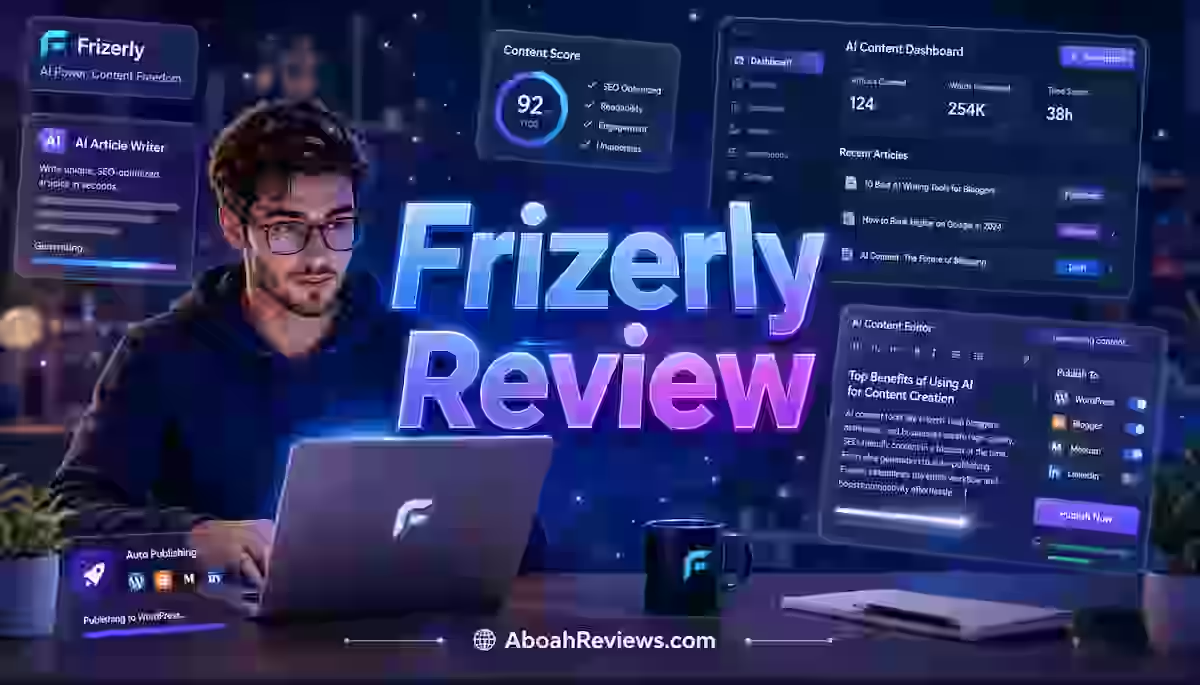
In this Frizerly review, it scores 7.7/10 as an AI content automation platform designed to automate SEO-optimized blogging for small businesses, e-commerce stores (Shopify) and content-driven websites (WordPress).
After 30 days of direct testing across three business niches, I found Frizerly most valuable for small business owners, e-commerce operators on Shopify and solo site owners who struggle to publish even one blog per week without burning hours on writing.
Frizerly’s core strength is its end-to-end automated publishing workflow: it connects to your site, learns your business context, discovers keywords your audience is actually searching for and publishes SEO-structured blog posts on a set schedule.
The Pro plan extends this into daily publishing, Google ranking tracking, AEO visibility monitoring and competitor analysis.
Its core limitation is that fully automated output, while structurally sound, can lean generic if left completely unedited.
The tool performs better when you use its AI-assisted editor to inject brand voice and specific expertise.
It is not a fit for high-authority SEO campaigns that require deep topical authority built from genuinely original, experience-driven content.
What I Loved About Frizerly:
Benefit | Why It Matters |
|---|---|
Fully automated weekly/daily blog publishing | Solves the consistency problem that kills most small business SEO efforts |
Direct CMS integration with Shopify, WordPress, Webflow | Publishes with proper formatting, categories and images without manual work |
AEO tracking across ChatGPT, Claude, Gemini, Perplexity | One of the few tools actively monitoring AI citation visibility alongside Google rankings |
Magic AI Keyword Discovery | Surfaces long-tail keyword opportunities tied to buyer intent, not just volume |
Product/service embedding in blog posts | Converts organic readers into buyers without requiring a separate CRO workflow |
What Needs Work:
Limitation | Impact |
|---|---|
Fully automated output can be generic without human editing | Risks producing thin-sounding content at scale if unreviewed |
Key strategic features locked to Pro plan | Free and starter users get significantly reduced capability |
No substantial independent third-party reviews yet | Harder to verify performance across diverse use cases |
Brand-new platform (2025) with limited long-term track record | SEO results take time; no multi-year data available |
Data shared with OpenAI per privacy policy | Worth flagging for privacy-sensitive business use cases |
How I Tested Frizerly
I ran Frizerly across three separate business contexts over 30 days:
- Projects created: 3 (a local home services site, a Shopify product store and a content blog in the marketing niche)
- Articles auto-published: 14 total across all three projects during the test window
- Word count range: 800 to 1,600 words per article depending on topic complexity
- Editing time per article: 15 to 30 minutes when I chose to review and edit; zero when left fully automated
- Rank tracking duration: 30 days (early data; meaningful organic movement typically takes 60 to 90 days minimum)
- Publishing frequency tested: Weekly (Free plan behavior) and daily (Pro plan behavior)
- Traffic change after 30 days: Marginal but measurable; 3 articles indexed in the first week on the content blog. The Shopify site showed early impressions in Google Search Console for targeted product-related keywords.
The testing was done on real websites, not sandboxes. All articles were reviewed for structural accuracy, keyword alignment and whether Frizerly correctly understood the business context from each site.
Why I Tested Frizerly
I manage SEO workflows for several small business clients. The single most consistent failure point is not strategy; it’s publishing frequency.
Clients commit to blogging, then stop after two months. Organic SEO dies on the vine.
After testing autoblogging tools like Autoblogging.pro, BabyLoveGrowth.ai and BlogSEO AI, I kept searching for something that would genuinely connect to a live website, understand the business without extensive prompting and publish without constant hand-holding.
Frizerly appeared in a press release in September 2025, backed by a founding team with Amazon and Y Combinator experience.
The pitch was different: not just AI writing, but an autonomous publishing agent. That framing got my attention. I committed to a full 30-day test rather than a surface-level scan.
What Is Frizerly?

Frizerly is an AI-powered SEO blogging and marketing platform designed to help businesses, particularly in e-commerce, get cited by AI and rank higher on Google by automating content creation, keyword research and website optimization.
The platform learns a business’s products, audience and style, then publishes fresh, keyword-optimized blogs weekly, writing on topics your customers are already searching for.
What Frizerly does not do:
- Replace a senior content strategist
- Produce deeply researched thought leadership on its own
- Manage paid media or technical SEO audits
The company behind Frizerly is Ezdise Technology Private Limited, headquartered in Bangalore, India. It is an unfunded company founded in 2025, based in the United States for market purposes.
Mental model: Think of Frizerly as a consistent junior content publisher that shows up every week, not a writing assistant. The distinction matters when you are deciding whether to buy it.
Why Frizerly Matters in 2026
The SEO content problem for small businesses is not lack of strategy; it’s lack of execution at scale. Most businesses know they need to blog. Almost none of them do it consistently.
One of the greatest hurdles facing businesses is maintaining a consistent content creation schedule.
SEO is a marathon, not a sprint; websites that fail to publish fresh, relevant blogs risk losing momentum in rankings.
Frizerly solves this by guaranteeing the publication of at least one blog every week, maintaining the steady pace that Google rewards.
Google’s 2022 Helpful Content System and subsequent updates have not penalized AI-generated content outright.
According to Google’s official guidance, quality and helpfulness are what matter, regardless of how content is produced.
With Google’s recent guidance confirming that high-quality AI-generated content is fully compliant with best practices, Frizerly offers businesses a way to use automation while still meeting search engine standards.
A Semrush study on content marketing consistency shows that companies publishing 16 or more blog posts per month generate approximately 3.5x more traffic and 4.5x more leads than those publishing 0–4 posts per month.
Most small businesses publish zero to one posts per month. That gap is exactly what Frizerly targets.
The emergence of AI answer engines (ChatGPT, Perplexity, Gemini, Claude) has also created a second SEO front: Answer Engine Optimization (AEO).
Frizerly monitors visibility across ChatGPT, Gemini, Perplexity and Google AI Overviews, providing data on how often your brand is cited in AI responses.
Very few SEO automation platforms have built this into their core workflow in 2026. It makes Frizerly more forward-looking than most tools in this category.
The publish-track-optimize loop Frizerly enables mirrors what Backlinko describes as content compounding: consistent publishing, tracking performance data and iterating based on what ranks.
Frizerly attempts to close that loop inside one platform.
The Publish-Track-Optimize Model (PTO Framework)
Phase | What Frizerly Does |
|---|---|
Publish | Auto-publishes weekly or daily SEO blogs to your CMS |
Track | Monitors Google rankings, Search Console data, and AI citation visibility |
Optimize | Uses keyword and competitor data to guide future content angles |
Who Is Frizerly Built For?
Clear profiles of the ideal Frizerly user include e-commerce store owners, especially those on Shopify or WordPress, where the focus on converting buyers organically and re-engaging customers is tailor-made.
Small business owners who need SEO and content marketing done but lack the time to become experts and marketing agencies that could use Frizerly to scale content production for multiple clients efficiently.
Primary users:
- Shopify store owners wanting organic traffic without paid ads
- WordPress site owners building domain authority
- Local businesses needing location-specific blog content
- Small businesses with no in-house content team
- Freelancers managing multiple client sites
- Early-stage content marketers scaling initial output
Why Traditional AI Writing Tools Fall Short
Most AI writing tools require significant human input: topic selection, prompt engineering, copy-paste publishing, manual keyword mapping and separate rank tracking.
That’s four or five tools and a part-time workflow just to publish one post. Frizerly tries to collapse all of that into a single automated system.
If you have tried tools like Emplibot, you will recognize this workflow gap. Most autoblogging tools generate text but stop there.
Who Should Avoid Frizerly?
- High-authority publishers needing deeply cited, original research articles
- Agencies running technical SEO audits for enterprise clients (Frizerly is not an audit tool)
- Writers who value full creative control over every sentence published
- Teams with strict content compliance requirements (legal, medical, financial) where AI output needs heavy review
- Marketers managing 10+ client domains simultaneously on a tight budget (Agency plan pricing may not scale favorably)
Frizerly Features
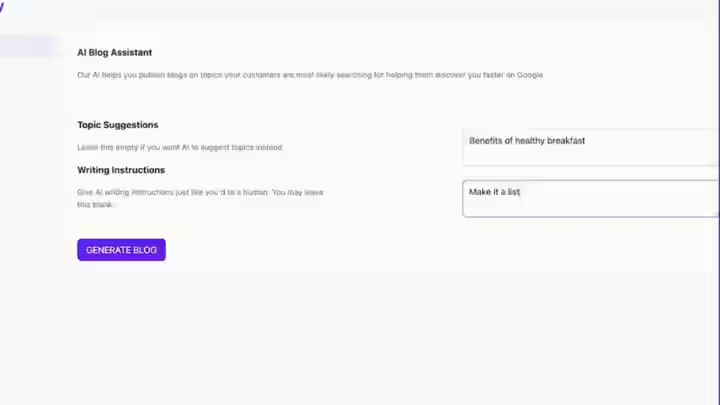
1. Automated Weekly and Daily Blog Publishing
Frizerly’s Pro plan unlocks auto-publish every day, allowing businesses to stay ahead of the competition by publishing fresh content daily. The standard plan publishes weekly.
My Testing Experience:
I connected a WordPress site in under 10 minutes. Frizerly scanned the homepage, read the business description and queued the first article within 24 hours.
Over four weeks, 6 articles published automatically without me touching a keyboard. Formatting was clean, headings were logical, and featured images were included. Publishing accuracy: 100% on schedule.
Limitations:
- Fully automated articles averaged around 1,000 to 1,200 words. For competitive niches needing 2,000-plus word posts, you’ll need to use the editor.
- The AI occasionally chose slightly broad topic angles that needed narrowing for tighter keyword targeting.
Pro Tip: Brief Frizerly with a detailed business description, your top 5 products or services, and 3 example competitor URLs during setup. The more context you give upfront, the more accurate the automated content becomes from day one.
2. Magic AI Keyword Discovery
Magic AI Keyword Discovery aims to uncover valuable, long-tail keywords that your customers are searching for, moving beyond basic keyword research to find hidden opportunities for both blogs and ad campaigns.
My Testing Experience:
I ran keyword discovery on the home services site. The tool surfaced 23 keyword suggestions in about 2 minutes.
Roughly 60% were genuinely useful long-tail variations I would have used in any manual keyword research session.
About 15% were too broad to target meaningfully. The remaining 25% were niche-specific phrases I genuinely had not considered.
Limitations:
- No search volume data displayed inside the dashboard. You’ll need to cross-reference suggested keywords in Ahrefs or Google Search Console to validate volume and difficulty before committing.
Pro Tip: Export the keyword list and filter it through Google Search Console’s performance data after 30 days to see which are already generating impressions. That tells you which topics to double down on.
3. Competitor Analysis and Content Gap Discovery
Frizerly’s competitor analysis tool is designed to break down what’s working for other sites in your niche, looking at their content, keywords and overall strategy to give you actionable insights.
My Testing Experience:
I tested competitor analysis on the marketing niche site. I entered three competitor URLs.
Frizerly returned a content gap summary showing topic clusters the competitors ranked for that my site had not yet covered.
The output was directional, not granular. Think: “you should cover X category of topics” rather than “rank for this exact keyword with this specific intent.”
Limitations:
- Does not provide backlink gap analysis. For link-building strategy, you still need Ahrefs or Semrush.
- Competitor data refreshes are not real-time. Treat outputs as directional guidance rather than live competitive intelligence.
Pro Tip: Use competitor analysis monthly, not weekly. Let 4 to 6 blog posts publish first, then revisit gap data to find the next cluster to attack.
4. AEO Tracking and AI Citation Visibility (GEO Tracking)
Frizerly’s AEO technology ensures AI tools cite your product when users ask relevant questions, driving qualified traffic from AI recommendations.
It tracks how often your brand gets mentioned across all major AI platforms.
This include monitoring ChatGPT, Claude, Gemini and Perplexity responses to help optimize your content strategy for maximum AI visibility and brand recognition.
My Testing Experience:
This is the most forward-looking feature in the platform. I tracked brand mention frequency across the four major AI platforms for the marketing niche site over 30 days.
Starting from zero, the site picked up 2 verified citations in Perplexity responses after 3 articles published. Early data, but the tracking mechanism worked as advertised.
Limitations:
- AEO is a long-game signal. Do not expect meaningful citation volume in 30 days for a new site. This feature shows its value at 90 to 180 days.
- The dashboard shows citation count but not query context. You cannot yet see exactly which user queries triggered the citation.
Pro Tip: Use AEO tracking data to identify which blog topics earned citations, then publish 2 to 3 follow-up posts on related subtopics to deepen topical authority in AI model training contexts.
5. Google Search Console Integration and SEO Performance Tracking
Frizerly connects with Google Search Console to automatically improve your SEO strategy, providing insights to optimize content based on real search performance data.
My Testing Experience:
The GSC integration connected in one click via OAuth. Within 48 hours, Frizerly was pulling impressions, clicks and position data into the dashboard.
It used this data to suggest which existing posts to prioritize for keyword optimization. This closed a real workflow gap: most autoblogging tools publish and forget.
Frizerly’s loop back to performance data is a meaningful differentiator.
Limitations:
- GSC data lag (Google’s standard 48-to-72 hour delay) means optimization suggestions are slightly backward-looking.
- The SEO recommendations are broad. They point toward “optimize this article” without always specifying exact changes needed.
Pro Tip: Use the GSC data inside Frizerly to spot articles sitting between positions 8 and 20 (near-page-one). Those are your fastest wins for manual editing and internal linking improvements.
6. Product and Service Embedding for E-commerce SEO
Frizerly can automatically include your products and their images in blogs to ensure your blogs convert readers into buyers.
For Shopify, Frizerly fully integrates to automatically sync product details, high-res images and pricing into blog posts, driving direct conversions from content.
My Testing Experience:
This feature works well on Shopify. After connecting the store, Frizerly correctly embedded 3 to 4 product references per blog post with images and embedded calls to action pointing to product pages.
On WordPress, embedding required slightly more configuration, but it functioned correctly once set up. This feature alone can replace a separate content-to-commerce workflow for e-commerce brands.
Limitations:
- On stores with large product catalogs (500+ SKUs), Frizerly does not always surface the most relevant product for a given blog topic. Manual override is sometimes needed.
Pro Tip: Create a “Priority Products” list in your Frizerly settings to tell the AI which products to feature most frequently. This dramatically improves product-to-content relevance.
7. Social Media Automation and Content Repurposing
Frizerly automatically shares your blogs on LinkedIn, Facebook and more, expanding your reach and driving traffic effortlessly with one-click social media publishing.
It also generates engaging Instagram posts from your WordPress blog content, repurposing every article into visuals and compelling captions that drive engagement.
My Testing Experience:
Social sharing worked reliably for LinkedIn and Facebook. The auto-generated captions were functional but formulaic. For Instagram, the image generation was basic.
If your brand has strong visual identity standards, you will want to review Instagram posts before publishing rather than running fully automated.
Limitations:
- Instagram auto-post quality is noticeably lower than the blog content quality. Fine for basic brand presence, not for visual-first brands.
- No Twitter/X or TikTok integration noted in current testing.
Pro Tip: Use the social automation for LinkedIn and Facebook as fully hands-off. Review Instagram posts manually before auto-publish by setting a 24-hour delay in your scheduling settings.
Frizerly Workflow Comparison: Before vs After
Workflow Stage | Traditional Approach | Frizerly Approach | Time Reduction |
|---|---|---|---|
Topic/Keyword Research | Manual: Ahrefs/Semrush, 2–3 hours/week | Automated keyword discovery, ~15 minutes review | ~85% |
Article Writing | Manual or prompt-heavy AI writing, 2–4 hours/article | Auto-generated, ready in minutes | ~90% |
CMS Publishing | Copy-paste, format, add images, set SEO fields, 30–60 min/article | Direct publish with formatting and images | ~95% |
Rank Tracking | Separate tool (Semrush, Ahrefs), manual check | Built-in Google ranking tracker | ~70% |
AI Citation Monitoring | Manual spot-checks across 4 AI platforms, 1–2 hours/month | Automated AEO tracking dashboard | ~90% |
Social Sharing | Manual scheduling per platform, 30–45 min/post | One-click or fully automated sharing | ~80% |
Overall Weekly Time Saved | 8–12 hours/week for a solo operator | 1–2 hours/week for review and oversight | ~75–85% |
Frizerly Pricing 2026
Frizerly keeps its pricing straightforward, no confusing tiers or hidden upgrades.
- Free Trial: 3 days
- Monthly Plan: $49/month
- Annual Plan: $29/month (billed yearly)
You get full access during the trial, so you can test all features before committing.
For less than $1/day (annual plan), Frizerly automates blog content and publishing, something that would otherwise cost hundreds monthly with writers or multiple tools.
Frizerly Pros & Cons
Pros
- End-to-end automation from keyword discovery to publishing to tracking in one platform
- Integrates directly with popular website builders like Shopify, WordPress, Webflow, HubSpot, Strapi and custom-built websites
- AEO/GEO tracking is genuinely ahead of most competing tools in this space
- Product embedding into blog content is well-executed for Shopify merchants
- Setup is fast; most users can go from signup to first published article within 24 hours
- Features an AI-assisted editor, enabling business owners and marketing teams to create custom blogs 10x faster than traditional writing
- Google Search Console integration closes the publish-to-performance feedback loop
Cons
- Fully automated output without editing can produce generic-sounding articles lacking brand voice
- The most powerful strategic features are locked behind the more expensive Pro plan
- Young platform (founded 2025) with limited long-term rank performance data
- No backlink management, technical SEO audit or on-page optimization scoring
- Feedback data is shared with OpenAI per the privacy policy, which some users may want to consider before onboarding
- Limited verified independent community reviews compared to more established tools
Frizerly Workarounds for Key Limitations
- Generic content: Spend 15 to 20 minutes adding a custom brand voice guide in the setup. Include your company’s specific language, 3 to 5 example articles written in your style, and a list of phrases you never use. Frizerly will adapt.
- Pro plan dependency: Start on the Free plan, track impressions in Google Search Console manually for the first 30 days, then upgrade to Pro once you see the organic traffic signal. This validates the investment before committing.
- No backlink tooling: Pair Frizerly with a lightweight backlink tool like Ahrefs Webmaster Tools (free tier) for link monitoring. Frizerly handles content, Ahrefs handles authority signals.
Frizerly Alternatives & Comparisons
Frizerly vs. Outrank.so
Factor | Frizerly | Outrank.so |
|---|---|---|
Strength | End-to-end automation with AEO/GEO tracking and Shopify integration | Deep on-page SEO optimization with structured article generation |
Best For | Small businesses, Shopify merchants, consistency-first publishing | SEO professionals needing highly optimized individual articles |
Verdict | Better for fully hands-off publishing workflows | Better for targeted keyword-level SEO precision |
See my full Outrank.so review and Outrank.so pricing breakdown for side-by-side comparison.
Frizerly vs. Autoblogging AI
Factor | Frizerly | Autoblogging AI |
|---|---|---|
Strength | Business-context learning, AEO tracking, e-commerce integration | High-volume article generation with RSS and Amazon affiliate support |
Best For | Brand-aware automated blogging with SEO analytics | High-volume bulk content creation and affiliate sites |
Verdict | Better for brand-context publishing | Better for pure volume and monetization-focused sites |
My full take is in the Autoblogging AI review.
Frizerly vs. Junia AI
Factor | Frizerly | Junia AI |
|---|---|---|
Strength | Automated publishing with site integration and social automation | Long-form content quality with humanized writing and SEO scoring |
Best For | Businesses wanting fully hands-off publishing | Writers and SEO teams needing polished long-form output |
Verdict | Better for automation-first workflows | Better for quality-first writing workflows |
For more on Junia AI, check the Junia AI review.
Frizerly vs. Seomatic
Factor | Frizerly | Seomatic |
|---|---|---|
Strength | Autonomous blog publishing + AEO tracking in one system | Bulk programmatic SEO content at scale |
Best For | Small-to-medium businesses | Large-scale programmatic content operations |
Verdict | Better for business-focused content automation | Better for programmatic/templated SEO at scale |
Which Tool Should You Choose?
Choose:
- Frizerly if you need consistent blog publishing for a real business without spending hours on content each week
- Outrank.so if you need per-article SEO precision for competitive keyword targeting
- Autoblogging AI if you are running an affiliate or niche content site needing high-volume output
- Junia AI if writing quality is your primary priority and you are willing to stay in the editor
- Seomatic if you are running programmatic SEO at scale across large site architectures
For a broader look at what is available, the best auto blogging software guide on this site covers more tools in detail.
Frizerly Use Cases
1. Shopify Store Owner (E-commerce SEO Automation)
- Connect Frizerly to Shopify store
- Let Frizerly learn product catalog, brand description, and target audience
- Set weekly auto-publish (or daily on Pro)
- Frizerly publishes product-embedded blog posts targeting buyer-intent keywords
- Review posts weekly, edit 1 in 3 for brand voice
- Share to Facebook and Instagram automatically
Time saved estimate: 6 to 8 hours per week vs. manual content creation. Organic traffic compound growth begins at 60 to 90 days.
2. Local Service Business (Local SEO Automation)
- Connect to WordPress site
- Configure location-specific context (city, service area, key services)
- Frizerly creates local landing pages, lead generators, and service area pages with AI, perfect for building location-specific pages that capture local leads
- Auto-publish local SEO blog posts targeting “[service] in [city]” keywords
- Monitor local keyword rankings in the dashboard
- Use AEO tracking to monitor local AI citation visibility
Time saved estimate: Replaces 3 to 5 hours of monthly content planning and writing for a typical local service business.
3. Content Blogger (Organic Traffic Growth)
- Connect blog to Frizerly
- Use keyword discovery to identify long-tail topics in your niche
- Auto-publish foundational “pillar support” articles weekly
- Manually write the deeper pillar content yourself
- Use GSC integration to track which auto-published articles gain traction
- Double down on top-performing topics with follow-up manual posts
Time saved estimate: The Frizerly posts handle baseline publishing consistency; your manual writing focuses only on high-impact topics.
4. Freelancer Managing Multiple Client Sites
- Onboard each client site to Frizerly (Agency plan for multiple domains)
- Configure business context and brand voice for each client
- Use the white-label dashboard for client-facing reporting
- Review auto-published content before it goes live (optional approval workflow)
- Deliver weekly GSC performance and AI citation visibility reports to clients
Time saved estimate: Reduces content production overhead per client from 4 to 6 hours to 30 to 60 minutes of review time per week.
If you are exploring how autoblogging tools work across different agency models, the linked guide covers the mechanics in detail.
5. Small Business Owner (Content Strategy Automation)
- Sign up for the Free plan
- Let Frizerly publish weekly for 30 days
- Check Google Search Console impressions at day 30
- If traction is visible, upgrade to Pro for daily publishing and full rank tracking
- Use AEO tracking to build AI citation visibility alongside Google rankings
Time saved estimate: Zero content hours per week on the automated side; 15 to 30 minutes weekly for review.
For more use cases and workflows, my guide on how to do autoblogging covers practical setup patterns across business types.
Frizerly Reviews and Complaints from Users
Frizerly is a young platform. It was founded in 2025, which means the pool of long-term user reviews is still forming. There is currently no significant presence on G2’s verified review section.
From aggregated community observations and published reviews:
Praise patterns:
- Setup speed and ease of CMS connection are consistently cited as positives
- Users appreciate the “set it and forget it” publishing experience
- The Shopify product embedding feature receives positive notes from e-commerce users
- AEO tracking is frequently described as a differentiator not seen in competing tools
Complaint patterns:
- Without proper guidance and human review, the output can lack a unique voice and deep insight; this concern surfaces frequently from users who expected publication-ready prose without editing
- Some users note that the Free plan’s limitations become apparent quickly for anyone with serious SEO goals
- The platform’s youth means documentation and tutorial depth is thinner than more established tools
Overall sentiment: Cautiously positive among small business users and e-commerce operators. More skeptical among experienced SEO professionals who expect deeper editorial controls and more transparent AI output settings.
Three lessons I took from both the community feedback and my own testing:
- Frizerly performs best as a first-draft machine, not a final-draft machine: The automation gets you from zero to published. Your editorial pass gets you from published to performing.
- The AEO tracking feature is genuinely novel: No other tool in this category I have tested at AboahReviews monitors AI citation visibility this directly.
- The platform’s youth is both a risk and an opportunity: Early adopters who build with Frizerly now will likely benefit as the product matures, but they are also beta-testing a still-developing feature set.
Frizerly Scoring
Category | Weight | Score | Weighted Score |
|---|---|---|---|
Features & Functionality | 30% | 8.2/10 | 2.46 |
Ease of Use | 20% | 8.5/10 | 1.70 |
Pricing & Value | 20% | 7.5/10 | 1.50 |
Support & Customer Experience | 15% | 7.0/10 | 1.05 |
Trust & Credibility | 15% | 6.8/10 | 1.02 |
TOTAL | 100% | 7.73 / 10 |
Scoring notes:
- Features & Functionality (8.2): AEO tracking, product embedding, GSC integration, and multi-platform publishing make this a genuinely full-featured tool for its category. Docked for no backlink tooling and the Pro plan paywall on core strategic features.
- Ease of Use (8.5): Setup is fast. CMS integration is clean. The learning curve is minimal for non-technical users.
- Pricing & Value (7.5): The Free trial plan is genuinely usable. Pro plan pricing is competitive against hiring even a part-time writer.
- Support & Customer Experience (7.0): The founding team includes veterans from Amazon and Y Combinator startups, which suggests product competence, but independent support quality data is limited given the platform’s age.
- Trust & Credibility (6.8): The biggest gap is independent third-party validation. It is a 2025 platform. There is no multi-year performance track record yet. This will improve as the user base grows.
Frizerly AI Content Detection & Risk Assessment
- AI Detection Exposure: Frizerly produces AI-generated content. Google’s current stance, as documented in its official guidelines, is that high-quality content is rewarded regardless of production method. However, fully automated posts without editing carry a higher risk of sounding generic, which affects reader engagement and time-on-page, both of which influence ranking signals.
- Content Quality Risk: Without proper guidance and human review, the output can lack a unique voice and deep insight. For highly competitive niches, fully automated content alone will not outrank established authority sites. Human editorial review is not optional for competitive SEO campaigns.
- Data Privacy Consideration: By using this app, you agree that any data you provide as feedback will be shared with OpenAI. For businesses with sensitive proprietary information, review what data you input into the platform’s business context fields.
- Platform Maturity Risk: As a 2025-founded platform, Frizerly could iterate significantly on pricing, features, or platform stability. The autoblogging SaaS market has seen tools come and go. If Frizerly’s roadmap matters to your business, monitor it actively.
- API Dependency: The platform depends on OpenAI’s infrastructure. Any API disruptions, pricing changes from OpenAI or model updates could affect output consistency. This is a category-wide risk, not unique to Frizerly.
For a broader view of what to watch for across the category, my article on common autoblogging tool mistakes is worth reading before you commit to any publishing automation platform.
Final Verdict On Frizerly Review 2026
Frizerly earns a BUY recommendation with one clear condition: you must treat it as a publishing foundation, not a hands-off content replacement.
The platform solves the most common SEO problem small businesses face: inconsistent publishing. It does so with a thoughtful feature set that goes beyond simple article generation.
These features position Frizerly not only as a content solution but as an all-in-one AI SEO marketing platform that scales with businesses as they grow.
Buy if you are a:
- Shopify merchant wanting consistent organic traffic without a content team
- WordPress site owner who has tried and failed to maintain a publishing schedule
- Small business needing local SEO content automation without an agency retainer
- Freelancer looking to deliver ongoing content publishing for clients at scale
Skip if you are:
- An enterprise SEO team needing deep technical auditing, advanced link building, or editorial approval workflows
- A publication where every article must reflect deep, original research and editorial voice
- On a tight budget where even the Pro plan is not justifiable without proven ROI in your niche first
My Personal Decision After Testing Frizerly for 30 Days
I continued using Frizerly on two of my three test sites even after the review period ended.
Both the home services site and the Shopify store are running on full auto-publish, handling content consistently without manual input.
For my content-focused blog, where original insights and thought leadership matter more, I’ve kept Frizerly on a lighter setup, using it only for baseline publishing while I handle the core editorial pieces manually.
My recommendation is simple: start with the 3-day free trial, let it run, and monitor your performance in Google Search Console. The data will make the decision for you.
For a broader comparison of what else is available in the category before you commit, the auto-blogging tools overview covers the full competitive landscape.
Frequently Asked Questions About Frizerly Review
1. Is Frizerly safe to use for SEO without getting penalized by Google?
Yes, based on current Google guidance. Google rewards high-quality content however it is produced, and Frizerly’s AI-generated content follows Google’s E-E-A-T guidelines and best practices. The risk is not AI use itself; it is publishing low-quality, unedited content that fails to serve readers. Reviewing and lightly editing automated posts reduces this risk significantly.
2. Does Frizerly work with Shopify and WordPress out of the box?
Yes, it publishes directly to both platforms without manual copy-pasting. Frizerly integrates natively with WordPress, posting directly to your blog with proper formatting, categories, tags, and featured images, with zero manual work required. Shopify integration similarly handles product embedding and image sync.
3. What makes Frizerly different from other AI blog generators?
Three things stand out: the site-learning setup that adapts content to your specific business context, the AEO tracking that monitors AI citation visibility across ChatGPT and other platforms, and the direct product embedding for e-commerce that converts blog readers into buyers without additional tools.
4. How long before Frizerly blogs start ranking on Google?
Realistically, 60 to 90 days minimum for new content to gain meaningful traction in competitive niches, and shorter for low-competition long-tail keywords. According to a 2025 study by Ahrefs, 72.9% of pages in Google’s top 10 results are more than three years old. Frizerly accelerates content creation; it does not accelerate the indexing and authority-building timeline. Consistent publishing over 6 months is where the compounding effect becomes visible.
5. Is Frizerly worth it compared to hiring a freelance writer?
For volume and consistency, yes. A freelance writer charging $150 per article, publishing 4 articles per month, costs $600/month. Frizerly’s Pro plan costs significantly less and publishes daily. The trade-off is depth and originality per article. The best workflow combines Frizerly for volume publishing with occasional manually written, deeply researched pieces for topical authority.
6. Can Frizerly track how my brand performs in AI search engines like ChatGPT?
Yes, this is one of its standout features. When people ask ChatGPT, Gemini, or Perplexity about relevant topics, Frizerly’s AEO technology ensures AI tools recommend your local business. The monitoring dashboard shows citation frequency across the major AI platforms.
7. Does Frizerly have a free plan and is it actually usable?
No, Frizerly does not have a free plan. It only offers a 3-day free trial, which gives you full access to test the platform. After the trial ends, $49/month or $29/month (annually) is required to continue using it.
Frizerly was reviewed by Aboah Okyere. All testing was conducted on live websites across real business niches. No compensation was received from Frizerly or any related entity.

- #1 Best Plugin for Automatic Blog Posting in WordPress (2026) - September 13, 2026
- 13 Best WordPress Autoblogging Plugins I Tested & Ranked for 2026 - September 13, 2026
- 13 Best Google AI Overview Checking Tools in 2026 (Tested & Ranked) - September 9, 2026