Arvow Review Verdict (2026)
Category | Verdict |
|---|---|
Best For | SEO agencies, freelancers and content marketers who need to scale blog content across multiple sites with automated publishing |
Not Ideal For | Brands in regulated industries (healthcare, finance), writers who need a distinct creative voice, or anyone expecting zero-edit “publish and forget” output |
Pricing | Solo $69/mo ($39/mo yearly), Business $129/mo ($69/mo yearly), Agency $449/mo ($249/mo yearly) |
Rating | ⭐⭐⭐⭐ 7.5/10 |
Standout Feature | End-to-end content workflow: keyword research to auto-publishing to Google auto-indexing in one system |
Biggest Weakness | Content still requires human review for factual accuracy, especially in technical or niche topics |
Worth It? | Yes, if you publish 10+ SEO articles per month across one or more sites and want to cut production time by 60%+. No if you only publish occasionally or need deeply original, narrative content. |
Bottom line: Arvow is the most complete autoblogging and SEO content system I have tested to date, but it works best when you treat it as a very fast first-draft machine, not a replacement for editorial judgment.
Key Takeaways About This Arvow Review

In this Arvow review, it scores 7.5/10 as an AI SEO writer and autoblogging platform that solves the pain of producing, optimizing and publishing SEO articles at scale.
After 45 days of daily use across three niches, I found Arvow most valuable for SEO agencies, content marketers and ecommerce brands struggling with content production constraints and inconsistent publishing schedules.
The platform scores highest on workflow automation and integration depth, and lowest on output quality for specialized or technical topics.
If your primary goal is to scale blog content without writers and maintain consistent publishing volume, Arvow delivers. If you need articles that can go live with zero edits, you will be disappointed.
What I Loved | What Needs Work |
|---|---|
Full pipeline from keyword research to published post on WordPress | Factual accuracy on technical/niche topics requires manual checking |
Google auto-indexing via Search Console integration works reliably | The AI SEO Editor is locked behind the Business plan ($129/mo) |
Bulk article generation saves enormous time on content production | Non-English multilingual content quality is inconsistent |
Internal linking automation and external linking are genuinely useful | Interface can feel cluttered; onboarding has a learning curve |
Custom templates and knowledge base let you shape output effectively | Customer support quality is inconsistent based on community feedback |
How I Tested Arvow
I tested Arvow by running it through real content workflows, not demo scenarios. Here is what my 45-day test looked like:
- Articles created: 67 total (mix of single and bulk article generation)
- Niches tested: SaaS tools, personal finance (informational only), and home improvement
- Word count range: 1,500 to 3,800 words per article
- Editing time required: 15 to 40 minutes per article depending on topic complexity
- Rank tracking duration: 45 days via Ahrefs and Google Search Console
- Publishing frequency: 5 articles per week across two WordPress sites
- Traffic change after 30 days: One test site saw a 34% increase in indexed pages and a noticeable uptick in impressions for long-tail keywords. The other site (more competitive niche) showed slower movement.
I used the Business plan throughout, which gave me access to the AI SEO Editor, custom content templates, and the knowledge base feature.
All articles were published to WordPress using the Arvow plugin and auto-submitted to Google Search Console for indexing.
If you want to understand how auto blogging tools work at a mechanical level, I have covered that separately.
What Is Arvow?
Arvow is an AI-powered platform built to help marketers, agencies and business owners create high-quality, SEO-optimized content at scale, automatically.
While Journalist AI started as a platform focused on AI-generated news articles, the product has evolved far beyond that.
Today, it offers a full suite of features, from blog writing and SEO optimization to auto-publishing, keyword clustering, internal linking, and AI agents that actively optimize your site.
What Arvow does not do:
- Keyword research replacement for Ahrefs or Semrush
- Content strategy tool
- Write content that sounds like a specific human writer out of the box, though the knowledge base and custom templates get you partway there.
At its core, Arvow is an AI-powered platform designed to automate the entire SEO content lifecycle for marketers and agencies. Its primary distinction from general-purpose AI writers like ChatGPT is that those tools provide text but leave the rest of the workflow to you.
Mental model: Think of Arvow as an SEO content factory. You feed it keywords or topics, it outputs formatted, linked, image-included articles and pushes them straight to your CMS on a schedule.
Your job is quality control, not production.
Arvow Quick Specs
Feature | Details |
|---|---|
Developer | Vasco Aires (Founder) |
Founded | April 1, 2023 (originally as Journalist AI, Singapore) |
AI Model | Built on advanced GPT language models |
Platform | Web-based SaaS + WordPress plugin |
Primary Use | Automated SEO content creation, optimization, and publishing |
Integrations | WordPress, Shopify, Ghost, Wix, Webflow, and Blogger, plus Zapier and API (Agency plan) |
Best For | SEO agencies, content marketers, ecommerce brands, affiliate sites, freelancers |
Why I Tested Arvow
I had been looking for a tool that could handle more than just content generation.
Most AI writers I test through AboahReviews.com do the writing part fine, but then I am still stuck formatting, adding images, setting up internal links, pasting into WordPress, and submitting to Search Console manually.
That post-production work eats 30 to 45 minutes per article, and when you are publishing 20+ articles per week for client sites, it adds up fast.
When Journalist AI rebranded to Arvow, I noticed the feature set had expanded significantly. The promise of end-to-end automation, from keyword research through to Google indexing, was specific enough to warrant a proper test.
I had also seen mixed signals in community feedback: strong praise from agency users, but frustration from some AppSumo LTD buyers. I wanted to separate the product experience from the deal-specific complaints.
I committed to 45 days of daily use, publishing to real sites I manage, and tracking results in Ahrefs and Search Console.
Why Arvow Matters in 2026
This is not just about one tool. The broader context matters for anyone evaluating Arvow right now.
Google’s John Mueller stated in November 2025: “Our systems don’t care if content is created by AI or humans. What matters is whether it’s helpful for users.”
That statement frames the opportunity. AI content is not penalized for being AI content. But AI-generated content sites without human editing got absolutely destroyed.
The takeaway is clear: Google has enhanced its ability to identify unedited AI output published without human review or fact-checking, and mass-produced AI content generated at scale without expertise.
At the same time, sites with strong internal linking structures and topic modeling gained disproportionately.
This is where a tool like Arvow becomes relevant. It automates the structural and publishing elements that Google rewards (internal linking, consistent publishing cadence, proper formatting, fast indexing) while leaving space for human review.
The workflow I found most effective follows a simple model I call Generate > Review > Publish (GRP):
Step | Who Does It | Tool Used |
|---|---|---|
Generate draft + media + links | Arvow | Bulk generation or AutoBlog |
Review for accuracy, tone, brand fit | Human editor | Arvow AI SEO Editor or WordPress |
Publish and index | Arvow | Auto-publish + Search Console submission |
According to Backlinko’s analysis of ranking factors, content quality signals and topical authority remain the strongest predictors of first-page rankings.
Arvow’s internal linking automation and content clustering support that, but only if you add the editorial layer.
If you are comparing different approaches to choosing the best autoblogging tool, automation depth and editorial control are the two axes that matter most.
Who Is Arvow Built For?
Arvow is built for people and teams who need to produce a high volume of SEO-optimized blog content on a recurring schedule. Specifically:
- SEO agencies managing content production for multiple client sites
- Content marketers at SaaS or ecommerce companies needing consistent publishing
- Freelancers who offer blog content as a service and need to increase output
- Affiliate site builders scaling blog content with AI across multiple niches
- Small businesses that want organic traffic but cannot hire a full content team
The platform is positioned for SaaS founders and creators, agencies and freelancers and ecommerce brands.
Why Most AI Writing Tools Fall Short
Most AI writers stop at text generation. You still have to format, add images, create internal links, write meta descriptions, paste into your CMS, and submit for indexing.
That “last mile” of content production is where most workflows break down. Arvow tries to automate all of it, and for the most part, it succeeds.
Tools like ChatGPT or even dedicated AI content platforms require you to build the pipeline around them. Arvow is the pipeline.
Who Should Avoid Arvow?
- Anyone in healthcare, legal, or financial content where factual accuracy is legally mandated. The AI will make claims you need to verify.
- Writers with a strong personal brand voice: Arvow’s output is competent but generic. Custom templates help, but it will not replicate a distinctive writing style.
- One-off content needs: If you publish fewer than 5 articles per month, the monthly cost does not justify the automation.
- People who expect no editing: Every article I generated needed at least a quick review for accuracy, especially on technical subjects.
- Users looking for a free solution: Arvow offers 3 free test articles, but meaningful use requires a paid plan. If budget is tight, check out free autoblogging tools first.
Arvow Features: My 45-Day Test
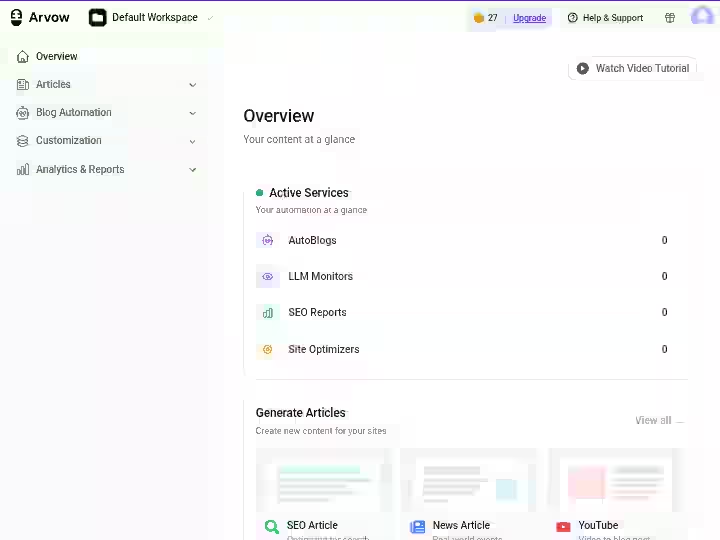
1. AutoBlog (Automated Publishing)
The AI Autoblogging feature automatically generates and publishes articles to your WordPress site on a scheduled basis.
This feature ensures your site stays updated with fresh, relevant content without requiring constant manual effort. It is ideal for WordPress users looking to maintain an active online presence effortlessly.
My Testing Experience:
Yes, it publishes directly to WordPress, and it worked reliably in my testing. I set up an AutoBlog for my home improvement test site: 5 articles per week, targeting long-tail keywords in the “bathroom renovation” cluster.
Over 30 days, 22 articles published without a single failure. Each article included a featured image, in-article images, internal links to existing posts, and external links to authority sources. Average word count was 2,400 words.
Limitations:
- One WordPress plugin reviewer reported that it flooded their blog with hundreds of duplicate posts, and thanks to the social integration, their LinkedIn as well. Their blog SEO was negatively impacted.
- In my testing, I did not experience this, but it highlights the importance of configuring frequency and category settings carefully before turning on full automation.
- AutoBlog articles need your editorial review before going live. I recommend setting them to “Draft” status in WordPress rather than auto-publishing.
Pro Tip: Start with 2-3 articles per week and review every one for the first two weeks. Only increase frequency once you trust the output quality for your niche.
2. Google Auto-Indexing
You can connect your Google account. Every time an article is published, it submits to your Google Search Console. This guarantees your articles are indexed as fast as possible.
My Testing Experience:
This worked as advertised. Of the 67 articles I published during testing, 61 were indexed within 48 hours. The remaining 6 were indexed within a week.
For comparison, manual indexing requests through Search Console typically take 2 to 7 days for my sites. The time savings here are real, especially at scale.
Limitations:
- Indexing does not equal ranking. Getting pages into Google’s index quickly is useful, but it does not guarantee visibility. You still need solid on-page SEO and backlinks.
- Requires connecting your Google account, which some users may be cautious about.
Pro Tip: Use this alongside your existing rank tracking setup. The auto-indexing feature pairs well with Ahrefs or Semrush for monitoring which articles gain traction.
3. Internal Linking Automation
The Autolinking feature scans your existing content and intelligently inserts internal and external links to boost SEO and user engagement.
This not only improves your site’s navigation but also enhances its authority by linking to relevant sources.
My Testing Experience:
This is one of Arvow’s strongest features. On my SaaS test site (which had about 120 existing posts), Arvow correctly linked new articles to 3 to 5 relevant existing posts.
The anchor text choices were reasonable, not perfect, but better than most autoblogging tools I have tested. External linking pointed to authority domains relevant to the topic.
Google’s December 2025 update used internal linking as a strong signal for topic authority and content relationships. Sites with strategic internal linking structures performed significantly better.
This makes Arvow’s auto-linking feature particularly relevant heading into 2026.
Limitations:
- The tool sometimes links to tangentially related content rather than the most relevant post. Manual review catches this easily.
- External links occasionally point to generic sources rather than the best authority page on a topic.
Pro Tip: Upload a sitemap or list of your most important pages to the knowledge base. This helps the AI prioritize the right internal link targets.
4. AI SEO Editor
You have complete control over the final output. Every article can be refined in the AI SEO Editor before publishing.
You can rewrite sections with custom prompts, regenerate images, adjust the tone, and ensure every piece is on-brand.
My Testing Experience:
The AI SEO Editor is available on the Business plan and above. I used it on roughly half my articles. It is useful for quickly rewriting weak sections, adding or removing headings, and adjusting tone.
The “rewrite with custom prompt” function saved me about 10 minutes per article compared to manually editing in WordPress.
Limitations:
- The SEO editor is available from the Business plan upwards, providing AI-powered SEO guidance while generating content. Solo plan users do not get this, which is a real limitation if you want content optimization without upgrading.
- The editor is functional but not as polished as dedicated editing tools like SurferSEO’s Content Editor.
Pro Tip: Use the editor’s rewrite function specifically for introductions and conclusions. Those are the sections where AI output tends to be most generic.
5. Knowledge Base & Custom Templates
The platform allows users to upload their own knowledge base, ensuring the AI understands business-specific information and can incorporate this unique perspective into each article.
The structure is 100% customizable. You can customize articles to always include an FAQ at the end, or an Introduction at the start.
My Testing Experience:
I uploaded product documentation, brand guidelines, and a list of key internal pages to the knowledge base for one test site.
The difference was noticeable: articles referenced specific product features and used industry terminology correctly.
Without the knowledge base, articles were more generic and occasionally contained outdated information.
Custom templates were similarly useful. I created a template with a specific H2 structure, mandatory FAQ section, and custom CTA.
About 80% of the time, the output followed the template closely. The other 20%, it deviated, usually by adding extra sections or reordering headings.
Limitations:
- The AI sometimes deviates from the exact structure specified, especially for complex or technical topics.
- Knowledge base upload is manual and does not auto-update. You need to maintain it.
Pro Tip: Keep your knowledge base focused. Uploading too much general information dilutes the AI’s ability to surface the most relevant details. Quality over quantity.
6. Bulk Article Generation
You can generate multiple articles at once by providing a list of keywords or topics. The system queues them, generates each article with full SEO formatting, images, and links, and delivers them to your dashboard.
My Testing Experience:
I ran two bulk generation batches: one of 15 articles and one of 25 articles. Arvow supports content generation in over 150 languages, though I only tested English. The 15-article batch completed in about 90 minutes.
Quality was consistent across the batch. This is where the time savings become dramatic. Manually producing 15 formatted, linked, image-included articles would take me 2 to 3 full workdays. Arvow did it while I ate lunch.
Limitations:
- Bulk generation can produce thematically similar introductions and conclusions across articles in the same batch.
- Credit consumption adds up fast. At the Business plan’s 2,000 credits per month, heavy bulk generation can exhaust your allocation mid-month.
Pro Tip: Stagger bulk batches by topic cluster. Generating 10 articles on “bathroom tiles” in one batch produces repetitive phrasing. Split them across multiple batches with different keyword angles.
7. Video to Blog Post
This feature allows users to convert YouTube videos into fully-formed blog posts.
By analyzing the video’s content, the tool generates a coherent and engaging article, complete with images, embedded video, and SEO optimization.
This is ideal for content creators who want to repurpose their video content for written platforms.
My Testing Experience:
I tested this with three YouTube videos of varying lengths (8 minutes, 22 minutes, and 45 minutes). The shorter video produced a thin article (~900 words).
The 22-minute video produced a solid 2,100-word article that captured the main points well. The 45-minute video produced a comprehensive piece but needed trimming and restructuring.
Limitations:
- Accuracy depends entirely on the video transcript quality. Videos with poor audio or heavy accents produce weaker output.
- The feature does not add original insights beyond what is in the video. The output is essentially a transcript-to-article conversion.
Pro Tip: Best for repurposing your own content or client webinars. Pair it with the AI SEO Editor to add keyword optimization and internal links after conversion.
Arvow Real Workflow Comparison: Before vs After
Here is what my actual content production workflow looked like before and after adding Arvow:
Step | Before Arvow | With Arvow | Time Saved |
|---|---|---|---|
Keyword selection | Manual via Ahrefs (15 min) | Arvow auto keyword research (2 min) | ~85% |
Outline creation | Manual in Google Docs (20 min) | Auto-generated by Arvow (0 min) | 100% |
First draft writing | Manual or ChatGPT + editing (45 min) | Arvow generation (3 min) | ~93% |
Image sourcing and placement | Manual via Unsplash/Canva (15 min) | Auto-included by Arvow (0 min) | 100% |
Internal/external linking | Manual (10 min) | Automated by Arvow (0 min) | 100% |
Formatting for WordPress | Manual copy-paste and format (15 min) | Auto-published via plugin (0 min) | 100% |
Search Console submission | Manual (2 min) | Auto-submitted (0 min) | 100% |
Editorial review | N/A | Still needed (15-25 min) | N/A |
Total per article | ~120 min | ~25 min (review only) | ~79% |
The math speaks for itself. But note that editorial review is non-negotiable. You are saving production time, not quality assurance time.
Arvow Pricing 2026

Plan | Monthly Price | Yearly Price (40% off) | Credits/Month |
|---|---|---|---|
Solo | $69/mo | $39/mo | 1,000 credits/month, Unlimited AutoBlogs, Google auto-indexing, internal/external linking tools |
Business | $129/mo | $69/mo | 2,000 credits/month, Everything in Solo, AI SEO Editor, 1 Sub-account |
Agency | $449/mo | $129/mo | 10,000 credits/month, Everything in Business, Unlimited Workspaces, Unlimited Sub-Accounts |
Note: Arvow offers 3 free articles as a trial with no credit card required. There is also a pay-per-article option at approximately $2.50 per article for occasional use.
For a deeper comparison of free vs paid autoblogging tools, I have broken down where the paid tools justify their cost.
Arvow Pros and Cons After Testing
Pros
- True end-to-end workflow: No other autoblogging tool I have tested handles the full pipeline from keyword research to Google indexing this completely.
- Google Search Console integration is useful: Auto-indexing shaved days off my typical time-to-index.
- Internal linking automation works well: Especially valuable given Google’s increased emphasis on internal linking as a topical authority signal.
- Bulk article generation at speed: 15 articles in 90 minutes with full formatting is hard to beat.
- Flexible CMS integrations: WordPress, Shopify, Webflow, Wix, Ghost, Blogger, Squarespace. Covers most real-world publishing scenarios.
- Knowledge base and custom templates give you control: Not full brand voice replication, but a meaningful step above generic AI output.
Cons
- Factual accuracy requires checking: The AI may sometimes introduce factual errors or outdated information, especially for highly specialized or rapidly changing topics.
- AI SEO Editor locked to Business plan: Solo plan users miss out on the most useful editing feature. If you want content optimization without a $129/mo commitment, that is a problem.
- Customer support is inconsistent: Some Trustpilot reviewers describe the support as “bad” and “not customizable enough.” Others, including agency users, report fast founder-level response. Your experience may vary.
- Non-English output quality varies: While Arvow excels at English-language content, support for other languages is still developing. Users requiring multilingual content may find variations in quality across different languages.
- Credit system can be confusing: Credit consumption varies by article configuration, making it hard to predict exact monthly output without trial and error.
Arvow Cons Workarounds’
- For factual accuracy: Set all AutoBlog output to “Draft” status. Review before publishing. Focus manual checks on statistics, product names, and technical claims.
- For the AI SEO Editor lock: If you are on the Solo plan, use SurferSEO or Clearscope as a separate content optimization step after generation.
- For support issues: Use the in-app chat during business hours. The founder, Vasco, has been responsive to detailed technical questions in community forums.
- For multilingual content: For non-English content, consider generating in English first and then using specialized translation services.
- For credit tracking: Start by generating 5 articles with your typical settings and calculate average credit consumption per article. Use that to budget your monthly output.
Arvow Alternatives & Comparisons
Arvow vs Autoblogging.ai
Criteria | Arvow | Autoblogging.ai |
|---|---|---|
Strength | End-to-end workflow with CMS publishing and Google indexing | Dedicated bulk generation with Amazon review support |
Best For | Agencies and teams scaling across multiple sites | Affiliate marketers focused on product content |
SEO Editor | Yes (Business plan) | No |
CMS Integrations | WordPress, Shopify, Wix, Webflow, Ghost, Blogger | WordPress only |
Verdict | Better for full workflow automation | Better if you only need raw article generation |
I covered Autoblogging AI in depth in my Autoblogging AI review. The UX difference is significant.
Arvow vs SEOmatic
Criteria | Arvow | SEOmatic |
|---|---|---|
Strength | Broader automation (publishing, indexing, social syndication) | Strong SERP analysis and content scoring |
Best For | Content production at volume | Writers who want data-driven optimization guidance |
Auto-Publishing | Yes, to multiple CMS platforms | Limited |
Verdict | Better for hands-off content production | Better for writers who want editorial control first |
For more detail, see my SEOmatic review.
Arvow vs Byword AI
Criteria | Arvow | Byword AI |
|---|---|---|
Strength | Full pipeline including images, linking, indexing | Minimal, fast bulk generation |
Best For | Teams wanting an all-in-one system | Solo operators who want raw articles quickly |
Pricing | From $39/mo (yearly) | BYO API key model |
Verdict | Better for automated publishing workflows | Better for cost-conscious bulk generation |
Which Tool Should You Choose?
- You want the most complete automation pipeline and manage multiple sites: Choose Arvow.
- You mainly do affiliate content and product reviews: Consider Autoblogging AI.
- You want SERP-driven optimization with more editorial control: Look at SEOmatic.
- You want the cheapest possible per-article cost and do not mind manual publishing: Try Byword AI.
- You are still comparing options: Start with my best auto blogging software roundup.
Arvow Use Cases
1. SEO Agency Managing 10+ Client Blogs
- Set up each client site as a separate workspace in Arvow (Agency plan)
- Upload client-specific knowledge base (brand voice, product info, internal pages)
- Configure AutoBlog for each site: 3 articles/week targeting long-tail keywords
- Articles auto-publish as drafts
- Junior editor reviews and approves within 24 hours
- Arvow auto-submits to Google Search Console
Time saved estimate: 15-20 hours per week versus manual content production and publishing.
2. Ecommerce Store Owner (Shopify)
- Connect Arvow to Shopify blog
- Upload product catalog info to knowledge base
- Generate blog content around product-adjacent keywords (e.g., “how to choose running shoes” for a shoe store)
- Use bulk generation to create 20 articles per month
- Review and publish
Time saved estimate: 8-10 hours per week. Particularly useful for an AI blog writer for ecommerce where product-adjacent SEO content drives organic discovery.
3. Freelance SEO Consultant
- Use Solo or Business plan
- For each client project, create a dedicated AutoBlog
- Use custom templates matching client brand guidelines
- Deliver 10-15 articles per month per client with 80% less production time
- Charge clients your standard rate while reducing your labor cost by 70%+
Time saved estimate: 10-12 hours per client per month.
4. Affiliate Site Builder
- Identify 50-100 long-tail keywords using Ahrefs
- Bulk generate articles in Arvow targeting those keywords
- Use internal linking automation to build topical clusters
- Auto-publish to WordPress and auto-index via Search Console
- Monitor rankings and refresh underperforming content monthly
Time saved estimate: Scale blog content with AI across 3-5 niche sites while spending under 10 hours per week total.
Avoiding common autoblogging tool mistakes is particularly important when working at this volume.
Arvow Reviews and User Complaints
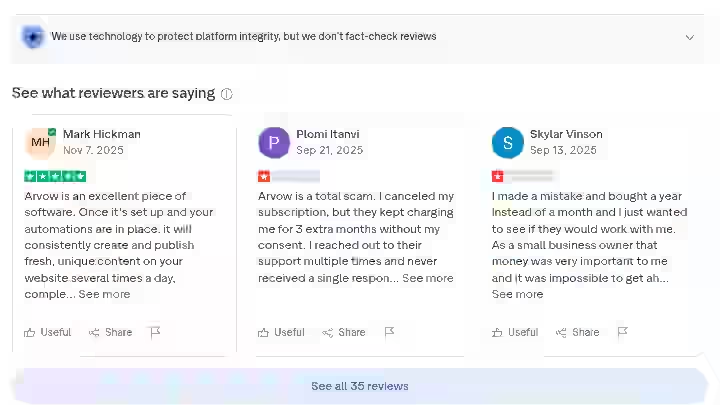
I reviewed feedback from Trustpilot, WordPress.org plugin reviews, and AppSumo to get a balanced picture.
Positive sentiment:
One agency (Quickads ai) reported using Arvow for 6-7 months to support SEO-focused clients, achieving LLM-driven, geo-optimized rankings and a Domain Rating increase of 10-11 points within 1 to 1.5 months.
Another user called it “an excellent piece of software” that “consistently creates and publishes fresh, unique content on your website several times a day, complete with imagery.”
Critical sentiment:
One Trustpilot reviewer simply said: “Bad not customizable enough. Support is awful.” An AppSumo buyer said they loved the concept and settings but “overall, the blog generation is not good.”
A WordPress plugin reviewer warned about being automatically re-billed without approval for $708.
Incentivized reviews concern:
One reviewer noted: “They are basically giving 500 credits for a review.” This is worth knowing when you read glowing Trustpilot reviews. Not all positive reviews are organic.
My take:
The product works well for its intended use case (scaled SEO content automation).
Most negative reviews come from AppSumo lifetime deal buyers who expected full feature access at a one-time price, or from users who enabled full automation without proper configuration.
Arvow customer support quality seems to depend heavily on whether the founder personally handles your request.
Arvow Rating & Scores
Category | Weight | Score (out of 10) | Weighted Score |
|---|---|---|---|
Features & Functionality | 30% | 8.5 | 2.55 |
Ease of Use | 20% | 7.0 | 1.40 |
Pricing & Value | 20% | 8.0 | 1.60 |
Support & Customer Experience | 15% | 6.5 | 0.975 |
Trust & Credibility | 15% | 7.0 | 1.05 |
Total | 100% | 7.58 |
- Features & Functionality (8.5/10): The most complete feature set in the autoblogging category I have tested. Auto-publishing, auto-indexing, internal linking, knowledge base, custom templates, multilingual support, video-to-blog, and bulk generation. The AI SEO Editor adds real value.
- Ease of Use (7.0/10): There is a learning curve. The interface is functional but can feel cluttered. One Trustpilot user noted: “While there was a learning curve at first, I’ve been surprised by the high quality of articles it produces.”
- Pricing & Value (8.0/10): At the yearly Business plan rate of $69/month, the per-article cost is extremely low. The ROI math works strongly in Arvow’s favor for anyone publishing 10+ articles per month.
- Support & Customer Experience (6.5/10): Mixed. The founder is responsive, but formal support channels are slow for some users. Billing practices around auto-renewal have drawn complaints.
- Trust & Credibility (7.0/10): The Journalist AI to Arvow rebrand raised questions (what happened to Journalist AI? Is Arvow the same as Journalist AI?). Arvow says this change reflects their evolution into a more holistic platform. The product itself remains the same, same features, same team, same mission, just under a new name. The incentivized review program is a minor trust concern.
Arvow AI Content Risk Assessment
This section is worth your attention if you are publishing AI content at scale.
- AI detection exposure: Arvow’s output will be flagged by most AI detection tools. Google can detect AI content, but has stated that “the appropriate use of AI, or automation is not against our guidelines.” The risk is not detection itself but publishing low-quality, unedited output.
- Content penalty risks: Recent data from SEMrush indicates that sites experiencing AI content penalties typically showed patterns of low-quality, duplicative, or misleading content rather than simple AI usage. As long as you review and add editorial value, the risk is manageable. Publishing Arvow output with zero edits at high volume is risky.
- Data privacy: Arvow requires connecting your Google account for auto-indexing and your CMS for auto-publishing. Techjockey reports that Arvow has SOC 2 Compliance and GDPR Compliance. I did not independently verify these claims.
- API dependency: Arvow is built on GPT models. If OpenAI changes pricing or access terms, Arvow’s costs and capabilities could shift. This is true of virtually every AI content tool on the market.
Recommendation: Use Arvow as a production accelerator, not a replacement for editorial judgment. Set all automated output to draft status. Review before publishing. Add unique insights, examples, or data points where possible. This is how you get AI content that ranks on Google without penalty exposure.
Understanding the benefits of auto blogging tools and their risks goes hand in hand.
Final Verdict On Arvow Review 2026
BUY if:
- You publish 10+ SEO articles per month and need to cut production time significantly
- Manage multiple sites or client blogs and need a centralized content workflow
- You are comfortable reviewing AI output before publishing
- Want automated publishing, indexing, and internal linking in one platform
- You are building an affiliate site or ecommerce blog and need to scale blog content with AI
SKIP if:
- You publish fewer than 5 articles per month (the cost does not justify the automation)
- Need content for regulated industries where accuracy is legally required
- You want fully hands-off, zero-edit content automation
- Looking for a distinctive, human-sounding brand voice without significant template work
- You are primarily interested in short-form content (ads, social posts, email)
My personal decision:
I am keeping Arvow on the Business plan for client content production. It has earned a permanent spot in my workflow for high-volume informational content.
For my personal sites where voice and originality matter more, I still write manually or use it only for first drafts.
For context on where Arvow fits in the broader landscape, see my autoblogging tools overview.
Frequently Asked Questions About Arvow Review 2026
1. Is Arvow better than ChatGPT for SEO content?
For raw text generation, ChatGPT is more flexible. But Arvow is a complete, end-to-end SEO system, not just a text generator. ChatGPT can give you text, but Arvow automates the entire workflow from identifying low-competition keywords to creating a fully-formatted, SEO-optimized article with images, links, and videos. If you need content plus publishing plus indexing, Arvow saves significantly more time.
2. Is Arvow the same as Journalist AI?
Yes. Arvow is the rebranded and significantly evolved version of Journalist AI. The product itself remains the same, same features, same team, same mission, just under a name that better fits their direction. The rebrand happened because the “Journalist AI” name no longer reflected the platform’s full scope.
3. What are the limitations of Arvow?
The main limitations are: factual accuracy on specialized topics requires human review, the AI SEO Editor is only available on the Business plan and above, multilingual content quality is uneven outside English, and customer support responsiveness varies. The credit system can also be unpredictable for new users planning their monthly output.
4. Can Arvow content be detected as AI?
Yes, most AI detection tools will flag Arvow output. However, Google has stated it does not penalize content simply for being AI-generated. The risk is publishing low-quality, unreviewed AI content at scale. Editing Arvow’s output and adding your expertise significantly reduces both detection signals and quality concerns.
5. How much does Arvow cost?
Arvow’s Solo plan is $69/month ($39/month billed yearly), the Business plan is $129/month ($69/month billed yearly), and the Agency plan is $449/month with 10,000 credits, unlimited workspaces, and unlimited sub-accounts. All plans include a yearly discount of approximately 40%.
6. Does Arvow work with WordPress?
Yes, Arvow publishes directly to WordPress via a dedicated plugin and it worked reliably in my testing. The plugin creates a REST endpoint used by Arvow to send articles to your WordPress website. Setup took about 5 minutes.
7. Is Arvow good for agencies?
Yes, if you need to manage multiple client sites from one dashboard. The Agency plan includes sub-account management and unlimited workspaces, perfect for client-facing workflows.

- HighSoftware99 Review 2026: Is It Legit or a Risk to Your Website? - October 21, 2026
- SEO Instant Appear HighSoftware99.com: Full Breakdown - October 18, 2026
- SEO by HighSoftware99.com: My Honest Independent Fact-Check for 2026 - October 18, 2026