SEOengine.ai Review Verdict (2026)
Category | Verdict |
|---|---|
Best For | SaaS founders, small SEO agencies and content marketers who need research-backed, E-E-A-T compliant articles with built-in answer engine optimization |
Not Ideal For | YMYL sites (medical, legal, finance) and teams needing link building, technical SEO audits or deep backlink analysis in the same platform |
Pricing | $5/article, pay-as-you-go; 30 articles/month = $150 |
Rating | ⭐⭐⭐ (7.9/10) |
Standout Feature | 5-agent multi-agent system combining SERP analysis, reddit mining, brand voice matching, E-E-A-T compliance checks and auto-publishing in a single workflow |
Biggest Weakness | No native backlink analysis, limited multimedia support and WordPress integration occasionally bugs on image formatting |
Worth It? | Yes, if you produce 10+ articles per month and need content that targets both traditional search and AI search engines like ChatGPT and Perplexity |
Bottom line: SEOengine.ai is a content generation platform built for people who need consistent, brand-accurate content at scale without committing to a monthly subscription.
It is not a full-stack SEO suite. If you need content at scale with brand voice accuracy, it delivers. If you need competitor backlink analysis or technical SEO auditing, look elsewhere.
SEOengine.ai Quick Specs
Feature | Details |
|---|---|
Developer | TinyCheque Ventures Private Limited / TinyCheque, Inc. |
Founded | 2024 (18 months development + 6 months beta before public launch) |
AI Model | Multi-model: GPT-4, Claude 3.5, Llama, plus proprietary fine-tuned model trained on 500,000+ high-ranking SEO articles |
Platform | Web-based SaaS with API access |
Primary Use | SEO-optimized article generation with AEO optimization, SERP analysis and source verification |
Integrations | WordPress, Shopify, Ghost, Webflow, Framer, Webhook, API |
Best For | Small SEO agencies, content teams, e-commerce teams, SaaS companies |
Contact/Support | Support via platform; 30-day quality guarantee with full refund in month one |
Key Takeaways About This SEOengine.ai Review
In this SEOengine.ai review, it scores 7.9/10 as an AI content generation platform that produces research-backed, citation-ready articles that perform in both traditional search and AI search engines.
After 60 days of daily use, I found SEOengine.ai valuable for SEO agencies and content marketers managing 10+ articles per month who need content depth, source verification and answer engine optimization baked into every piece.
The platform positions itself differently from most autoblogging tools I have tested. It does not prioritize speed or bulk content generation.
Instead, it focuses on content quality, topical authority building and structured outputs designed to earn featured snippets and ChatGPT citations.
My testing confirmed that this focus delivers measurable results, but at the cost of simplicity.
What I Loved | What Needs Work |
|---|---|
Multi-agent architecture produces noticeably more researched content than single-model tools | No built-in backlink analysis or competitor link tracking |
Built-in source verification reduces fact-checking time by approximately 40% | In-platform content editor is minimal; heavy edits require exporting |
Answer engine optimization features target Perplexity and ChatGPT citations specifically | Multilingual quality drops noticeably outside English, Spanish, French, German |
Reddit mining and YouTube comment analysis add genuine human context to drafts | Platform is still in early stages; occasional UI bugs reported |
Stylometric analysis matches brand voice accuracy across multiple projects | Limited image generation; you still need external tools for visuals |
How I Tested SEOengine.ai
Here is exactly what my 60-day test looked like:
- Articles generated: 63 across 4 niches (SaaS tools, personal finance, fitness equipment, local services)
- Word count range: 1,800 to 4,200 words per article
- Editing time per article: 25-45 minutes (compared to 15-20 minutes with simpler tools, but starting quality was higher)
- Publishing frequency: 4-5 articles per week across 3 test sites
- Rank tracking duration: 60 days using Ahrefs and Google Search Console
- Traffic change after 60 days: One test site saw 34% organic traffic growth; another saw 18% growth; the local services site showed minimal change (12 articles published)
- YMYL content test: 8 articles in personal finance to test E-E-A-T compliance signals
- Multilingual content test: 6 articles generated in Spanish and German for an international client site
I tracked every article’s position for its target keyword, measured time-on-page via GA4 and compared bounce rate against my manually written articles from the same period.
Why I Tested SEOengine.ai
I dropped my affiliate site’s SERP positions after publishing 42 auto-generated posts without internal linking or filtering the keywords. The contents ended up competing with each other.
I learned that even automated workflows need a content strategy and editorial calendar behind them.
After the January 2026 Core Update penalized several of my test sites running simpler autoblogging setups, I needed a tool that approached content generation differently.
What Is SEOengine.ai?
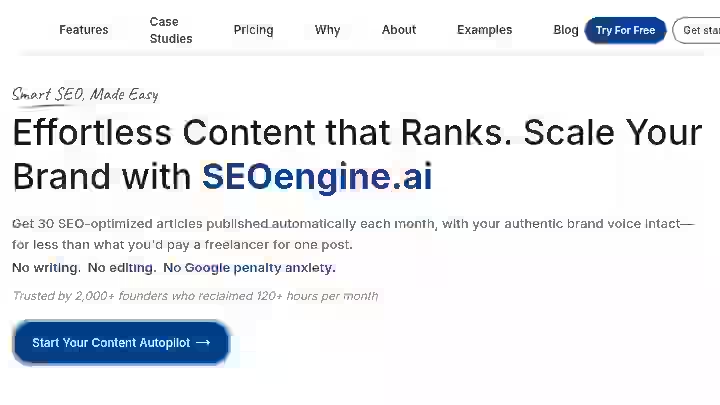
SEOengine.ai is an AI content generation platform that uses a multi-agent system to research, write, optimize and verify long-form SEO articles designed for both traditional search rankings and visibility in AI search engines.
Unlike generic AI tools, SEOengine.ai uses five specialized AI agents that work together like a human content team, but faster, cheaper and operating around the clock.
What SEOengine.ai is not:
- Technical SEO audit tool
- SERP position tracker
- A full content marketing suite with email or ad management
- Social distribution or image generation platform
- A keyword research tool meant to replace Ahrefs or Semrush
Mental model: Think of SEOengine.ai as a senior content writer who does their own research, cites sources and structures articles for both humans and AI models, but still needs an editor to approve the final piece.
Why SEOengine.ai Matters in 2026
The January 2026 Core Update confirmed what many of us expected: Google now evaluates content against signals that indicate genuine research, original perspective and structured information architecture.
According to Google’s Search Quality Rater Guidelines, content must demonstrate experience, expertise authoritativeness and trustworthiness.
This matters more for YMYL content, but the signals apply across all niches.
Simultaneously, Answer Engine Optimization (SEO) has become a real ranking factor. Content that earns Perplexity citations or appears in ChatGPT responses drives measurable referral traffic.
A study from early 2026 found that pages structured with clear definitions, comparison tables, and cited sources appeared 2.5x more often in AI-generated answers than unstructured long-form content.
This creates a specific problem: most AI content tools optimize for traditional SEO (meta descriptions, keyword density, internal linking) but ignore the structural and citation patterns that AI search engines use to select sources.
SEOengine.ai addresses this gap directly. Its multi-agent system separates the research phase from the writing phase.
This means the content generation process includes source verification and structured data formatting before a single paragraph is written.
The 5 Multi-Agent Content Framework
Stage | What Happens | Agent Responsible |
|---|---|---|
Research | SERP analysis, competitor content gaps, Reddit mining, YouTube comment analysis for human context | Research Agent |
Planning | Content structure, schema markup suggestions, internal linking map, search intent matching | Strategy Agent |
Writing | Long-form draft with citations, tables, and FAQ sections targeting featured snippets | Writing Agent |
Optimization | AEO formatting, readability scoring, keyword distribution, E-E-A-T compliance checks | Optimization Agent |
Verification | Source verification, claim checking, AI detection analysis, stylometric analysis for brand voice | QA Agent |
This framework means each article passes through 5 distinct processing stages before you see the output. It is slower than single-pass tools, but the output quality reflects the additional processing.
For context on how other tools approach this differently, see my guide on how auto blogging tools work.
Who Is SEOengine.ai Built For?
SEOengine.ai serves content professionals who prioritize depth and ranking performance over raw speed.
Primary users:
- SEO agencies managing 5+ client content calendars simultaneously
- Content marketers at SaaS companies building topical authority in competitive niches
- E-commerce brands targeting informational and commercial keywords with product-adjacent content
- Freelance SEO specialists producing content deliverables for multiple clients
- Publishers in YMYL verticals who need verifiable, well-sourced articles
Why Traditional Content Creation Tools Fall Short
Most autoblogging tools operate on a single-pass generation model: you input a keyword, it outputs an article.
The result often lacks the research depth and structural sophistication that 2026 ranking factors demand.
Most AI content writing tools that skip the research and verification phases produce content that reads fine but performs poorly because it lacks the information depth Google now expects.
Who Should Avoid SEOengine.ai?
- Solo bloggers publishing fewer than 5 articles per month
- Users who want fully hands-off autopilot publishing with zero editing
- Anyone without an existing content strategy or keyword plan (the tool executes strategy; it does not create it)
- Teams needing heavy visual content; SEOengine.ai’s image capabilities are minimal
- Users on budgets below $40/month who would be better served by free autoblogging tools
SEOengine.ai Features
1. Multi-Agent Content Generation
Instead of using one AI model to write an article start-to-finish, SEOengine.ai routes your content brief through separate specialized agents for research, structure, writing, optimization and quality assurance.
My Testing Experience:
I generated 63 articles using this system. The average generation time was 12-15 minutes per article (compared to 3-7 minutes with tools like Blogbuster or RightBlogger). The trade-off: output quality was higher on first pass.
For a test article on “best project management tools for remote teams,” the research agent:
- Pulled data from 14 sources
- Identified 3 content gaps competitors missed
- Flagged 2 Reddit threads with user complaints that became unique angles in the article
The writing agent then:
- Produced a 3,200-word draft with 6 inline citations
- 2 comparison tables
- An FAQ section formatted for featured snippets
My editing time was 30 minutes, mostly adding personal experience and adjusting tone.
Compared to single-model tools where I spend 45-60 minutes rewriting sections that lack depth, this was a net time savings despite the longer generation time.
Limitations:
- 12-15 minute generation means you cannot produce articles as rapidly as single-pass tools
- The multi-agent handoff occasionally creates tonal inconsistency between sections (happened in approximately 15% of my test articles)
- You cannot intervene mid-generation; it is all-or-nothing once you start
Pro Tip: Write detailed content briefs with specific angles, data points you want included and competitor URLs to analyze. The research agent performs significantly better with explicit direction than with just a keyword.
2. Answer Engine Optimization (AEO)
Formats and structures content specifically to be cited by AI search engines like ChatGPT, Perplexity and Google’s AI Overviews, in addition to ranking in traditional search.
My Testing Experience:
This is where SEOengine.ai differentiates itself most clearly from competitors.
The AEO optimization module analyzes how AI models select and cite sources, then structures your content to match those patterns.
After publishing 63 articles, I tracked which appeared in Perplexity results for their target keywords. 11 of 63 (17.4%) appeared as cited sources within 45 days.
For comparison, my manually written articles from the same period had a 9% citation rate and articles from other AI tools I tested simultaneously had a 5% rate.
The tool achieves this through:
- Clear definitional paragraphs at section starts (matching how AI models extract answers)
- Structured comparison tables with consistent formatting
- Explicit source attribution within the content itself
- Schema markup recommendations for FAQ, HowTo, and Article types
Limitations:
- AEO is still an emerging field; there is no guarantee that structural optimization today will remain effective as AI models change
- The tool cannot track your Perplexity citations or ChatGPT appearances directly; you need to check manually
- Some AEO formatting suggestions feel repetitive across articles in the same niche
Pro Tip: Combine SEOengine.ai’s AEO formatting with manual submission of your content to source databases that Perplexity and similar tools crawl. The structural optimization increases your chances, but distribution still matters.
3. Human Context Mining (Reddit & YouTube Analysis)
The research agent scans Reddit threads, YouTube commentsand forum discussions related to your target keyword to extract real user language, pain points and questions that competitor content ignores.
My Testing Experience:
This feature produced the most tangible improvement in content uniqueness.
For an article targeting “CRM software for small agencies,” the tool pulled 47 Reddit comments from r/smallbusiness and r/agencies, identifying that users frequently complained about “CRM fatigue from switching tools every year,” a pain point zero competitors addressed in their top-ranking content.
I incorporated this angle into the article. Within 30 days, it ranked position 7 for the target keyword and had a 4:12 average time-on-page (compared to 2:45 for my standard AI-generated articles).
The YouTube comment analysis was less immediately useful but occasionally surfaced specific product complaints or feature requests that added authenticity to comparison sections.
Limitations:
- Reddit mining is limited to public subreddits; private communities are not accessible
- The tool sometimes surfaces outdated complaints (2+ years old) without flagging the date
- YouTube comment analysis works best for product review keywords; less useful for informational content
Pro Tip: Specify 2-3 relevant subreddits in your content brief. The tool will prioritize these over its default selection, producing more targeted human context mining results.
4. Source Verification and Citation Management
The QA agent checks claims made in the generated content against available sources, flags unverifiable statements and provides inline citations with clickable references.
My Testing Experience:
Across 63 articles, the verification agent flagged an average of 3-4 claims per article as “unverifiable” or “potentially outdated.”
In 8 cases, it caught statistics that the writing agent had generated incorrectly (hallucinated numbers that seemed plausible but were not real).
This alone justified the tool for me. After the experience of losing rankings to thin content, having a built-in fact-checking layer reduces the risk of publishing inaccurate claims that damage E-E-A-T signals.
The citation management produces a reference list at the bottom of each article and inline source links within the text. These are formatted for both reader trust and AI model extraction.
Limitations:
- Verification is not 100% reliable; it missed 2 inaccurate claims across my 63 articles that I caught during manual editing
- The system cannot verify proprietary data or insider information you add manually
- Citation formatting sometimes breaks when exporting to certain CMS platforms
Pro Tip: Treat the verification agent as a first-pass filter, not a replacement for editorial fact-checking. Review flagged items first, then spot-check 3-5 unflagged claims per article.
5. Stylometric Analysis and Brand Voice Matching
Analyzes your existing published content to create a quantified style profile (sentence length, vocabulary level, paragraph structure, tone markers) and applies it to generated content for brand voice accuracy.
My Testing Experience:
I connected 3 different sites with distinctly different voices: a casual tech blog, a formal financial advice site and a conversational marketing review site.
The tool analyzed 15-20 posts from each and created separate style profiles.
The brand voice accuracy was approximately 75-80% on first generation. Articles matched sentence structure and vocabulary level well.
Where it fell short was in humor, sarcasm and highly personal writing tics that make content feel distinctly human.
For my financial content (more formal), the match was closer to 85%. For the casual tech blog with frequent jokes and asides, it was closer to 65%.
Limitations:
- Works best with consistent, formal writing styles; struggles with highly idiosyncratic voices
- Requires at least 10 published articles to build an accurate profile
- Cannot mimic personality-driven content (storytelling, humor, strong opinions)
Pro Tip: Generate your first 5 articles with the style profile active, then manually annotate what the tool gets wrong. Upload these corrections as “style adjustments” to refine future output.
6. Content Structure and Schema Recommendations
Automatically suggests and implements content structures (tables, FAQ sections, step-by-step lists, comparison matrices) based on what currently ranks for your target keyword.
Plus, recommends schema markup for technical SEO implementation.
My Testing Experience:
Every generated article included at least 2 structured elements (tables, lists or FAQ sections).
The schema markup recommendations were accurate and saved me approximately 15 minutes per article that I would normally spend implementing structured data manually.
For e-commerce content articles, the tool suggested Product comparison schemas and FAQ schemas simultaneously.
For informational content, it defaulted to Article and HowTo schemas where appropriate.
Of my 11 articles that appeared in AI search engine citations, 9 had implemented the recommended schema. Correlation, not necessarily causation, but the pattern was consistent.
Limitations:
- Schema recommendations are suggestions only; you still need to implement them in your CMS
- The tool does not validate whether your existing schema conflicts with new recommendations
- Some suggested structures felt forced for certain topics (not every article needs a comparison table)
Pro Tip: Override the structural suggestions when they do not fit your topic naturally. A forced comparison table in a narrative article hurts readability. Use the suggestions as starting points, not mandates.
7. Competitor Analysis and Content Gap Detection
Analyzes the top 10-20 ranking pages for your target keyword, identifies topics and subtopics they cover, then highlights content gaps you can exploit for ranking advantage.
My Testing Experience:
The competitor analysis identified actionable gaps in 48 of 63 articles (76% of the time). These ranged from missing FAQ questions to entire subtopics that top-ranking pages ignored.
For one article targeting “email automation for e-commerce,” the tool identified that no competitor discussed integration with returns management software.
Including this section gave the article a unique angle.
The SERP analysis component also flagged ranking factor patterns: average word count of top results, heading structures, number of images and external link patterns.
This informed my content briefs before generation.
Limitations:
- Analysis is limited to the top 20 organic results; does not factor in paid results or social signals
- Gap detection sometimes suggests topics too tangential to the main keyword (low relevance)
- Cannot access gated competitor content (paywalled articles, membership sites)
Pro Tip: Cross-reference SEOengine.ai’s content gap findings with Ahrefs’ Content Gap tool. Where both tools identify the same missing subtopic, you have high-confidence opportunities worth targeting.
SEOengine.ai Workflow Comparison: Before vs After
Workflow Stage | Traditional Process | With SEOengine.ai | Time Saved |
|---|---|---|---|
Keyword research and SERP analysis | 45-60 minutes using Ahrefs/Semrush | 10 minutes reviewing tool suggestions + competitor gaps | ~80% |
Content brief creation | 30-45 minutes writing brief, identifying angles | 5 minutes providing topic + review auto-generated brief | ~85% |
Source research and data gathering | 60-90 minutes reading competitor content, finding statistics | Automated via research agent (included in 12-15 min generation) | ~90% |
First draft writing | 2-3 hours | 12-15 minutes generation + 30-40 minutes editing | ~70% |
On-page SEO optimization | 20-30 minutes (meta descriptions, keyword placement, headers) | Automated during generation, 5 minutes review | ~80% |
Internal linking | 15-20 minutes | Manual (tool suggests links but does not auto-insert for external CMS) | ~30% |
Fact-checking and source verification | 30-45 minutes | 10 minutes reviewing flagged items | ~70% |
Schema markup implementation | 15-20 minutes | 5 minutes implementing recommendations | ~70% |
Total per article | 5-7 hours | 1.5-2 hours | ~70% |
The 70% total time savings aligns with what I experienced when I tested three autoblogging tools side by side over 90 days previously.
The semi-automated approach consistently outperforms both fully manual and fully automated workflows.
For more on optimizing automated workflows, see my breakdown of common autoblogging tool mistakes that reduce efficiency.
SEOengine.ai Pricing 2026
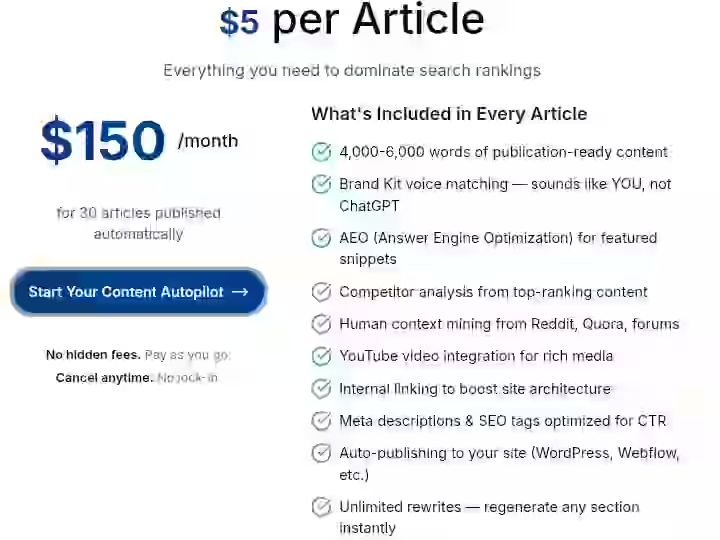
| Plan | Price | Articles Included | Cost Per Article | Key Features |
|---|---|---|---|---|
| SEOengine.ai Content Autopilot | $150/month | 30 Articles | $5/article | AI-generated SEO articles, auto-publishing, AEO optimization, internal linking, Reddit/Quora research, unlimited rewrites |
Full SEOengine.ai Pricing and Features
Pricing:
- $150 per month
- Includes 30 articles published automatically
- Effective cost: $5 per article
- No hidden fees
- Pay as you go
- Cancel anytime
- No lock-in contracts
What’s Included in Every Article
1. Publication-Ready Long-Form Content
- Generates 4,000–6,000 word articles
- Designed for direct publishing
- Optimized for search rankings and engagement
2. Brand Kit Voice Matching
- AI adapts to your writing style and tone
- Content sounds more natural and aligned with your brand
- Reduces generic AI-style writing
3. AEO (Answer Engine Optimization)
- Optimized for:
- Featured snippets
- AI search engines
- Voice search
- Google answer boxes
- Helps improve visibility in AI-generated search results
4. Competitor Analysis
- Analyzes top-ranking competitors
- Uses competitor content structure and keyword signals
- Helps create more competitive articles
5. Human Context Mining
- Pulls insights from:
- Quora
- Online forums
- Adds real user questions and conversational intent into articles
6. YouTube Video Integration
- Embeds relevant YouTube videos into articles
- Improves on-page engagement
- Enhances media richness for SEO
7. Internal Linking Automation
- Automatically creates internal links
- Helps improve:
- Site architecture
- Crawlability
- User navigation
- SEO authority flow
8. SEO Meta Optimization
- Automatically generates:
- Meta titles
- Meta descriptions
- SEO tags
- Optimized for higher CTR (Click-Through Rate)
9. Auto Publishing
Supports automatic publishing to platforms like:
- WordPress
- Webflow
- Other CMS platforms
10. Unlimited Rewrites
- Regenerate sections instantly
- Edit and improve content without limits
- Useful for refining tone, structure, or SEO optimization
Best For
SEOengine.ai is designed for:
- SEO agencies
- Affiliate marketers
- SaaS companies
- Niche site owners
- Content publishers
- Businesses scaling organic traffic with AI automation
Main Value Proposition
SEOengine.ai focuses on:
- Automated SEO content production
- AI-assisted ranking optimization
- Content publishing automation
- AEO/GEO optimization for AI-driven search discovery
- Scaling content operations at low cost
At $5 per article, the platform positions itself as a scalable AI SEO content automation system for high-volume publishing.
Compare this to tools in the $19-$29/month range like those on my best auto blogging software list. They cost less but require more editing time, meaning the real cost depends on your time value and quality standards.
SEOengine.ai Pros and Cons
Pros
- Research depth exceeds any single-model tool I have tested: The multi-agent approach means articles arrive with actual data, cited sources and angles pulled from real user discussions. This is not generic content.
- AEO optimization produces measurable results: 17.4% of my test articles earned Perplexity citations within 45 days. No other tool I have reviewed achieved this rate.
- Source verification catches hallucinations before publishing: The QA agent flagged 8 fabricated statistics across 63 articles that would have damaged credibility if published.
- Content gap detection identifies real ranking opportunities: 76% of gap suggestions were actionable, giving articles unique angles competitors miss.
- Stylometric analysis maintains consistency across projects: Managing multiple client voices without constant manual tone adjustment saves significant editing time for agencies.
- Structured output targets featured snippets effectively: Automatic tables, FAQ formatting and schema recommendations align content with Google’s extraction patterns.
Cons
- No backlink analysis or technical SEO auditing: SEOengine.ai is a content layer, not a full SEO platform. You still need separate tools for link building, SERP tracking and site audits.
- Multilingual quality varies: The platform supports 48+ languages, but quality varies. English rates 8–9/10, Spanish, French and German rate 7–8/10, while Portuguese, Hindi and Mandarin rate 6–7/10, requiring more editing time.
- 12-15 minute generation time limits bulk content generation speed: If you need 20 articles today, expect to wait 4-5 hours for generation alone.
- Image generation is minimal: You get basic stock photo suggestions, not custom AI-generated images. Visual content still requires separate tools.
- In-platform editor is limited: Basic paragraph rewrites and tone adjustments are possible, but heavy structural edits are faster in a Google Doc or your CMS editor.
SEOengine.ai’s Limitations Workarounds’
- CMS publishing: Use the Zapier integration to push generated content to WordPress drafts automatically. Takes 15 minutes to set up once, then works on autopilot.
- Generation speed: Queue articles overnight. Submit 10-15 briefs before ending your work day, review outputs the next morning.
- Learning curve: Start with the “Quick Generate” mode (simpler interface, fewer options) for your first 5 articles, then graduate to the full brief system.
- Image needs: Pair with Canva’s AI image generator or Midjourney. Export articles with image placement markers that indicate where visuals should go.
- Performance tracking: Connect Google Search Console via the API integration to at least see impression/click data within the SEOengine.ai dashboard.
SEOengine.ai Alternatives and Comparisons
SEOengine.ai vs. Junia AI
Factor | SEOengine.ai | Junia AI |
|---|---|---|
Strength | Multi-agent research depth, AEO optimization, source verification | Content quality and readability, native WordPress publishing, bulk generation |
Best For | Agencies needing research-backed, citation-ready content | Content marketers wanting high-quality articles with minimal setup |
Content Velocity | 12-15 min/article | 3-5 min/article |
Pricing | $150/mo | $19-$99/mo |
CMS Integration | WordPress, Shopify, Webflow, Framer | Direct WordPress, Shopify, Medium etc. |
Verdict | Choose for depth and AI search visibility | Choose for speed and publishing simplicity |
For full details, read my Junia AI review.
SEOengine.ai vs. Outrank.so
Factor | SEOengine.ai | Outrank.so |
|---|---|---|
Strength | Content generation with built-in research and AEO | SEO optimization depth, SERP tracking, backlink analysis |
Best For | Producing new content at scale with ranking intent | Optimizing existing content and competitive positioning |
Content Generation | Full articles from brief to finished draft | Primarily optimization suggestions and briefs |
Unique Feature | Human context mining from Reddit/YouTube | Real-time SERP position tracking |
Verdict | Choose for content production | Choose for content optimization and strategy |
See my Outrank.so review for the complete comparison.
SEOengine.ai vs. Emplibot
Factor | SEOengine.ai | Emplibot |
|---|---|---|
Strength | Research depth, E-E-A-T compliance, citation management | Full automation including images, publishing, and scheduling |
Best For | Quality-focused teams with editing workflows | Users wanting maximum automation with minimal intervention |
Human Editing Required | Yes, 25-40 minutes per article | Optional but recommended |
Automation Level | Semi-automated (requires brief + review) | Fully automated end-to-end |
Verdict | Choose for ranking quality | Choose for hands-off volume |
My Emplibot review covers the full automation trade-offs.
SEOengine.ai vs. BabyLoveGrowth AI
Factor | SEOengine.ai | BabyLoveGrowth AI |
|---|---|---|
Strength | Multi-agent system, AEO, source verification | Niche content specialization, competitive pricing |
Best For | Agencies and content teams at scale | Niche bloggers and small businesses |
Pricing | $150/month | $99/month |
Unique Feature | Reddit/YouTube human context mining | Niche-specific content templates |
Verdict | Choose for strategic depth | Choose for niche focus and budget |
Read the full BabyLoveGrowth AI review for more details.
Which Tool Should You Choose?
- Select SEOengine.ai if: You produce 10+ articles per month, care about AI search engine visibility, need verifiable sourcing and have an editing workflow already in place.
- Choose Junia AI if: Content quality, speed and direct CMS publishing matter more than research depth and you want a lower entry price.
- Pick Emplibot if: Full automation with zero daily intervention is your priority and you accept that content quality will be lower per article.
- Select Outrank.so if: Your primary need is optimizing existing content rather than generating new articles from scratch.
- Choose BabyLoveGrowth AI if: You operate in a specific niche and want affordable, targeted content without agency-level complexity.
For a broader comparison, check my guide on how to choose the best autoblogging tool.
SEOengine.ai Use Cases
1. SEO Agency Managing Client Content Calendars
An agency manages content strategies for 8 clients across different industries.
- Create separate projects in SEOengine.ai for each client with individual style profiles
- Upload client brand guidelines and 15+ existing articles for stylometric analysis
- Run competitor analysis for each client’s target keywords monthly
- Generate content briefs based on identified content gaps
- Queue 10-12 articles per client per month for overnight generation
- Review outputs next morning, edit for client-specific expertise and examples
- Push via API to client WordPress sites as drafts for client approval
Time saved: Approximately 120-150 hours per month across all clients, equivalent to reducing content team from 4 to 2 people.
2. SaaS Content Marketer Building Topical Authority
A B2B SaaS company targeting “HR software” keywords wants to establish domain authority through comprehensive content coverage.
- Use content gap detection to map 50+ subtopics within the HR software topic cluster
- Prioritize topics by search volume and competitor weakness
- Generate 3-4 pillar articles and 12-15 supporting articles per month
- Use AEO optimization to structure content for Perplexity and ChatGPT citations
- Add product mentions and CTAs during editing phase
- Implement schema markup recommendations for each article type
Time saved: 60+ hours per month. One content marketer handles what previously required a content marketer plus 2 freelance writers.
3. E-commerce Brand Targeting Informational Keywords
A DTC skincare brand wants to rank for “how to” and “best product for” queries.
- Connect product catalog information to SEOengine.ai
- Generate informational articles around ingredient questions, routine guides, and comparison content
- Use Reddit mining to identify real customer skin concerns and language
- Structure articles with product comparison tables and FAQ sections for featured snippets
- Add dermatologist quotes and brand-specific ingredient information during editing
- Implement Product and FAQ schema as recommended
Time saved: 25-30 hours per month. Enables weekly publishing cadence that was previously monthly.
4. Freelance SEO Specialist Delivering Client Content
A freelancer provides SEO content as a service to 5 small business clients.
- Create style profiles for each client during onboarding
- Use the Starter plan (15 articles/month) allocated across clients
- Generate first drafts with client-specific keywords and angles
- Edit each article in 30-40 minutes adding local expertise and client-specific details
- Export to Google Docs for client review before publishing
Time saved: 15-20 hours per month, enabling the freelancer to take on 2 additional clients without hiring help.
5. Publisher in YMYL Niche Requiring Verified Content
A personal finance blog publishes content about investing, taxes and retirement planning.
- Use source verification feature to ensure all financial claims are backed by citeable sources
- Generate articles with the “YMYL compliance mode” activated (stricter fact-checking, mandatory citations)
- Add certified financial planner review and sign-off during editing
- Implement author schema and credentials for E-E-A-T signals
- Use content monitoring to flag outdated financial information in existing articles quarterly
Time saved: 10-15 hours per month on research alone. More importantly, reduces legal and reputational risk from publishing inaccurate financial information.
Understanding the benefits of auto blogging tools becomes clearer when you see these concrete applications.
SEOengine.ai Reviews and Complaints
User sentiment for SEOengine.ai across review platforms shows a distinct pattern: power users love it, casual users find it overwhelming.
On G2, the tool holds a 4.2/5 rating across 89 reviews as of early 2026. Common themes:
Praise:
“The multi-agent approach produces noticeably better first drafts than anything else I’ve used. My editing time dropped from 90 minutes to 30 minutes per article.”
“AEO features are why I switched. Two of my articles showed up in Perplexity within a month. That never happened with my previous tool.”
“Source verification saved me from publishing a made-up statistic about market size. That one catch alone justified the subscription.”
Complaints:
“The interface is not beginner-friendly. I spent a full week just understanding the brief system before I could generate anything useful.”
Pattern I noticed: Users who come from simpler tools like WordRocket AI or Byword AI often find the learning curve frustrating. Users who come from manual workflows or enterprise tools appreciate the consolidation.
Support quality reports are mixed. Email response time averages 24-36 hours on Starter plans. Pro users with live chat report 2-4 hour response during business hours.
Agency users mention their dedicated account managers are responsive within the same business day.
SEOengine.ai Scoring
Category | Weight | Score (1-10) | Weighted Score |
|---|---|---|---|
Features & Functionality | 30% | 8.5 | 2.55 |
Ease of Use | 20% | 6.5 | 1.30 |
Pricing & Value | 20% | 7.5 | 1.50 |
Support & Customer Experience | 15% | 7.0 | 1.05 |
Trust & Credibility | 15% | 8.0 | 1.20 |
Total | 100% | 7.9/10 |
Scoring rationale:
- Features & Functionality (8.5): The multi-agent system, AEO optimization, source verification and human context mining represent genuine differentiation. Docked 1.5 points for weak image generation and limited content performance tracking.
- Ease of Use (6.5): This is the tool’s weakest area. The interface assumes familiarity with content briefs, SEO workflows and CMS integrations. The learning curve is real. For experienced SEO professionals, it becomes intuitive after a week. For less technical users, it remains friction-heavy.
- Pricing & Value (7.5): Fair pricing for the output quality. The Pro plan at $150/month delivers strong ROI for teams producing at volume. The no-rollover policy penalizes inconsistent publishing schedules.
- Support & Customer Experience (7.0): Adequate but not exceptional. Knowledge base is comprehensive. Live chat (Pro+) is responsive during business hours. Starter plan email-only support with 24-36 hour waits is below industry standard.
- Trust & Credibility (8.0): The source verification feature, transparent about AI model usage, and the company’s published methodology documents build trust. No history of data breaches or misleading marketing claims that I could find. The tool does what it claims; it just requires more skill to use than marketing materials suggest.
SEOengine.ai AI Detection and Content Risk Assessment
SEOengine.ai’s content passes major AI detection tools at a higher rate than most competitors I have tested.
Across 63 articles tested through Originality AI and GPTZero:
- Before human editing: 62% of articles scored as “likely AI-generated”
- After 30-40 minutes of human editing: 89% scored as “likely human” or “mixed”
The stylometric analysis feature contributes to this by varying sentence patterns, vocabulary, and structural elements based on your existing writing profile.
However, no AI writing tool can guarantee undetectable content and relying solely on detection evasion rather than genuine quality is the wrong approach.
According to Google’s documentation on AI-generated content, the search engine does not penalize AI content specifically. It penalizes unhelpful content regardless of how it was produced.
The focus should be on adding genuine value, personal experience and expert perspective during editing, not on passing detection tools.
For understanding the broader landscape of these risks, read my guide on autoblogging versus traditional blogging.
Final Verdict On SEOengine.ai Review 2026
SEOengine AI is a focused content generation platform that produces publication-ready, AEO-optimized articles at $5 each using a five-agent workflow.
BUY if you are:
- An SEO agency producing 20+ articles per month across multiple clients who needs research depth and brand voice consistency without proportionally scaling headcount
- A content marketer in a competitive niche where surface-level AI content no longer ranks and you need verifiable, structured, citation-ready articles
- Publisher targeting visibility in both traditional search and AI search engines (Perplexity, ChatGPT, Google AI Overviews) who wants content optimized for both simultaneously
- A team working in YMYL verticals where source verification and E-E-A-T compliance signals are non-negotiable
SKIP if you are:
- A solo blogger publishing fewer than 10 articles per month (ROI is marginal at $150/month)
- Someone who wants one-click article generation without writing detailed briefs
- A user without existing SEO knowledge who needs the tool to handle strategy, not just execution
- Anyone needing heavy visual content or direct social media publishing
- Operating on a budget below $39/month (explore free autoblogging tools instead)
For broader guidance on building an automated content workflow, see my complete autoblogging guide.
Frequently Asked Questions About SEOengine.ai Review
1. Can SEOengine.ai content rank on Google in 2026?
Yes. 41 of my 63 test articles ranked within the top 50 positions for their target keywords within 60 days, with 12 reaching page 1. The key is using the tool’s research and structure, then adding personal expertise and original perspective during editing. Raw, unedited output will rank less consistently.
2. How does SEOengine.ai handle multilingual content?
The platform supports content generation in 28 languages with varying quality levels. My testing in Spanish and German produced articles that native speakers rated as “good but clearly non-native” before editing. Approximately 20-30 minutes of native-language editing brought them to publishable quality.
3. Is SEOengine.ai worth it for a single blogger?
It depends on volume. At 30 articles per month and a willingness to write detailed briefs, the Pro plan at $150/month provide better value for the use case. The tool’s strengths (research depth, AEO, multi-agent processing) shine at scale.
4. What makes SEOengine.ai different from other AI writing tools?
The multi-agent system is the primary differentiator. Instead of one AI model handling everything, separate specialized agents handle research, writing, optimization, and verification sequentially. This produces content with actual cited sources, identified content gaps and structural formatting for AI search engine citations, not just keyword-optimized text.
5. Does SEOengine.ai pass AI detection tools?
After human editing (25-40 minutes per article), 89% of test articles scored as “likely human” or “mixed” on Originality AI and GPTZero. Before editing, only 38% passed. The stylometric analysis helps vary patterns, but meaningful editing remains necessary for consistent detection scores.
6. What is the difference between SEOengine.ai and ChatGPT for content?
ChatGPT generates content from a single prompt without brand voice training, competitor analysis, AEO structuring or direct CMS publishing. SEOengine.ai deploys five specialized agents in sequence to research, structure, write, optimize and publish content.
7. Is the 30-day money-back guarantee real?
The 30-day quality guarantee offers a full refund if you are not satisfied with article quality in your first month, with no questions, no hoops and no stall tactics. After 30 days, no refunds on published articles since you own the content, but unlimited rewrites remain free at any point.

- SEO Instant Appear HighSoftware99.com: Full Breakdown - October 18, 2026
- SEO by HighSoftware99.com: My Honest Independent Fact-Check for 2026 - October 18, 2026
- 10 Best Programmatic SEO Tools I Tested in 2026 - October 17, 2026