TL;DR: An autoblog (or automatic blog) is a website that publishes content automatically using AI writing tools, RSS feeds or automated scripts with minimal or zero manual writing. The software gathers data from various sources, processes it and schedules it to post directly to a Content Management System (CMS) like WordPress or Shopify.
How an Autoblog Works
An autoblog relies on a simple workflow that repeats on a set schedule:
- Trigger: The system is activated by a specific schedule (e.g., daily), a trending keyword list or an RSS feed.
- Generation: AI models generate unique text or scraping tools pull content from other publisher feeds.
- Publishing: The tool automatically creates the blog post, generates images and posts it to your website.
Types of Autoblogs
- AI-Generated: Software uses AI (like ChatGPT or custom writing algorithms) to research and write unique, SEO-optimized articles based on input keywords.
- Content Aggregation: Plugins scrape excerpts and content from other websites’ RSS feeds.
- Repurposing: Tools automatically turn existing content (like YouTube videos) into fully written blog posts.
Autoblog Common Use Cases
- Affiliate marketers managing multiple niche websites.
- Businesses trying to maintain a consistent online presence without the cost of hiring human writers.
- Agencies looking to scale content production across numerous client domains.
SEO & Best Practices for an Autoblog
While autoblogging saves time, relying entirely on hands-off content, especially scraping content from other sites, often results in Google penalties for duplicate or low-quality content.
To rank well, many bloggers use a semi-automated approach. They use AI tools to generate the first draft, but have a human editor review and polish the content before it goes live.
For a deeper look into the tools and workflows used to create modern autoblogs, you can explore my guide on autoblogging.
Introduction to What an Autoblog Is
I set up my first autoblog in early 2023 expecting passive income and zero effort.
What I got instead was a manual content audit, 40+ posts to rewrite and a lesson about Google’s thin content filters I won’t forget.
Unlike traditional blogs where you manually write and publish every post, autoblogs handle most of the publishing workflow automatically.
In this guide, I’ll explain what an autoblog is, how it works, which types exist and which tools actually perform in real-world SEO scenarios.
I’ll also share what went wrong in my tests and how semi-automation (hybrid autoblogging) outperformed full automation by roughly 3x in organic traffic after 6 months.
What Is an Autoblog?

An autoblog is a website that uses automation software to create, format and publish blog content with minimal manual intervention.
The goal is to scale content production beyond what one person can write manually.
Instead of writing 4 posts per month yourself, an autoblog might publish 20 to 100 posts per month using AI content generators, RSS feed aggregators or programmatic SEO workflows.
Most successful autoblogs in 2026 use AI writing tools to draft posts, then add human editing for fact-checking, tone adjustment, and SEO optimization.
How Autoblogs Have Evolved
Autoblogs looked very different 10 years ago.
1. RSS Autoblogs
Early autoblogs scraped RSS feeds from news sites and republished content automatically using WordPress plugins like WP RSS Aggregator or WP Automatic. These sites offered zero original value and often violated copyright laws.
Google cracked down on RSS scraper sites around 2015. Most disappeared after Panda and Penguin algorithm updates targeted thin content and duplicate content issues.
2. AI Autoblogs
Modern autoblogs use AI content creation tools like GPT-4, Claude, or specialized autoblogging software to generate original posts.
Tools like WordRocket AI, Emplibot and Junia AI build complete articles from keywords, add featured images and publish to WordPress automatically.
The output quality varies widely.
3. Programmatic SEO Autoblogs
These sites generate thousands of pages from databases or APIs. Think Zillow (real estate listings), Yelp (business directories), or Nomad List (city data). Each page follows a template but pulls unique data.
Programmatic SEO requires technical setup but scales to millions of pages. It’s not true autoblogging since you’re building page templates, not blog posts, but the automation principle is similar.
4. Affiliate Autoblogs
These autoblogs focus on product reviews, comparisons and affiliate marketing content. They use AI to draft review posts, insert affiliate links, and optimize for buyer-intent keywords like “best X for Y” or “X vs Y.”
I lost an affiliate site’s rankings after publishing 42 auto-generated posts without internal linking or keyword filtering. The content cannibalized itself. Google saw 42 near-duplicate posts targeting overlapping keywords and dropped the entire site from search engine results pages.
How Does an Autoblog Work?
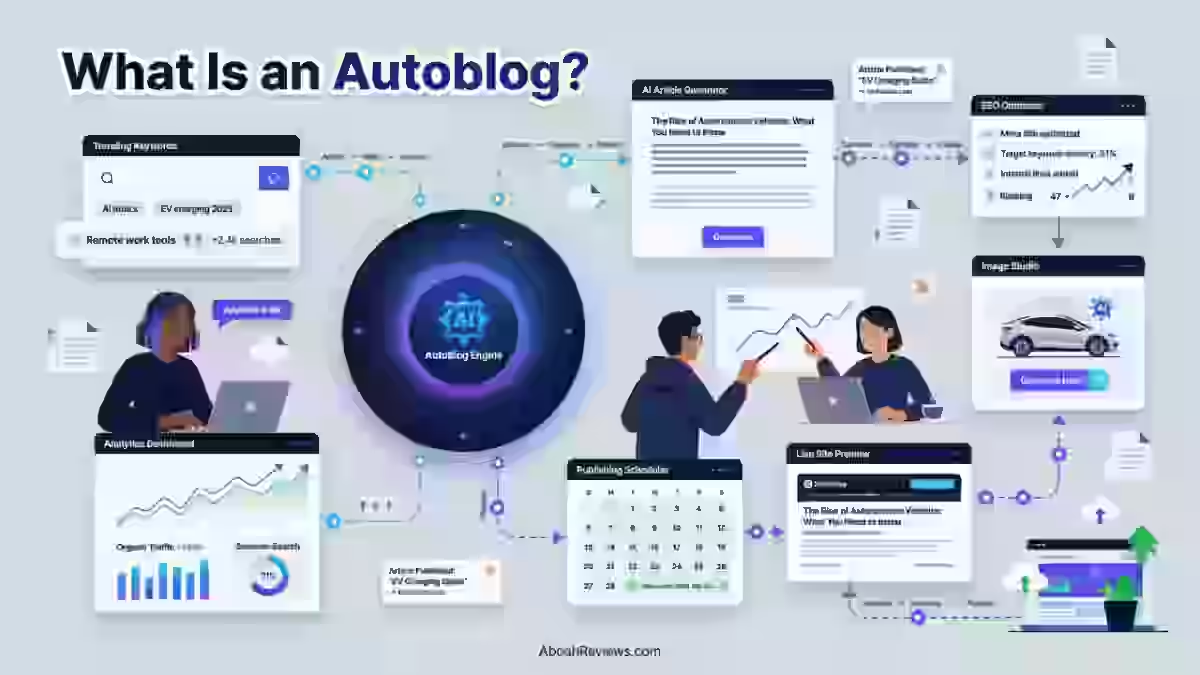
An autoblog uses a multi-step automated workflow to research, write, optimize and publish blog posts without manual writing.
The exact process depends on the tool, but most autoblogging platforms follow these steps.
1. Keyword Research
The autoblogging software starts with a seed keyword or topic list. Advanced tools pull related keywords from Google Suggest, competitor analysis or keyword databases.
For example, if you input “email marketing,” the tool might generate content ideas like “email marketing for small businesses,” “email marketing automation tools,” or “email marketing vs social media.”
Some tools require manual keyword input. Others scrape trending topics from RSS feeds or Google Trends automatically.
2. AI Content Generation
Once the tool has a keyword, it uses AI language models (usually GPT-4 or Claude) to draft the article. The AI writes the introduction, body sections and conclusion based on the keyword and any custom instructions you provide.
Quality varies. Fully automated tools often produce generic, shallow content that reads like a first draft. Semi-automated tools let you review and edit before publishing.
3. SEO Optimization
The autoblogging tool adds SEO elements automatically:
- Meta title and description
- H2 and H3 subheadings
- Internal links (if configured)
- Featured image (scraped from stock photo sites or generated with AI)
- Alt text for images
Most tools also optimize keyword density, add schema markup, and generate XML sitemaps.
According to Google’s Search Central documentation, helpful content should prioritize user value over search engine optimization tricks.
So, over-optimized autoblog posts often underperform.
4. Automatic Publishing
The tool publishes the finished post to your WordPress site or marketing platform using API connections. You can schedule posts in advance (e.g., 3 posts per week) or publish immediately.
Some tools also share posts to social media automatically and ping search engines to request indexing.
5. Performance Tracking
Better autoblogging platforms track post performance using Google Analytics integration or built-in dashboards. You’ll see metrics like organic traffic, keyword rankings and engagement rates.
This data helps you identify which topics perform best so you can generate more content in those areas.
Types of Autoblogs
Autoblogs vary by content type, traffic source and monetization strategy.
1. AI Autoblogs
These sites use AI writing tools to generate original blog posts from scratch. The content is unique (not scraped) but requires fact-checking since AI models sometimes hallucinate data or cite nonexistent sources.
Best for: Content marketers who want to scale production without hiring writers.
2. RSS Feed Autoblogs
These autoblogs pull content from RSS feeds using an RSS aggregator plugin, then republish it (sometimes with attribution, often without). This approach violates copyright laws if you don’t have permission from the original source.
Google penalizes sites that republish RSS feed content without adding original commentary or analysis.
Google rarely issues a direct manual penalty for duplicate content. Instead, it filters out duplicate pages and shows only the version it thinks is best. However, if you mass-produce scraped or spun pages just to trick search engines, you risk a severe ranking penalty.
Best for: Content curation websites that add editorial commentary and proper attribution.
3. News Autoblogs
News autoblogs aggregate breaking news from multiple sources and republish summaries with backlinks to the original articles. These sites monetize through display ads and ad revenue.
The challenge is speed. If you’re the 50th site to cover the same news story, you won’t rank.
Best for: High-frequency niches where fresh content matters more than depth.
4. Affiliate Autoblogs
These autoblogs generate product reviews, comparison posts, and buying guides optimized for affiliate sales.
The AI drafts the post, inserts affiliate links automatically and publishes to WordPress.
FTC guidelines require clear disclosure when using affiliate links. Make sure your autoblogging software adds disclosure statements automatically or manually review each post.
Best for: Affiliate marketers who want to scale product review content quickly.
5. Niche Autoblogs
Niche autoblogs focus on one narrow topic (e.g., drone photography, gluten-free recipes, mechanical keyboards). The narrow focus helps build topical authority and increases rankings.
I’ve seen niche autoblogs work well when the owner adds custom knowledge or personal testing results. Pure automation without niche expertise usually fails.
Best for: Subject matter experts who want to scale content in their specialty.
6. Product Review Autoblogs
These sites generate reviews for physical or digital products using product data from Amazon, ClickBank or other affiliate networks.
The AI pulls product specs, pricing and customer reviews, then writes a structured review post.
Quality is often low since the AI hasn’t tested the product.
Google’s Quality Rater Guidelines emphasize experience and expertise for review content, so auto-generated reviews rarely rank well without manual editing.
Best for: Supplementing manual reviews with AI-drafted comparison posts.
Autoblog vs Traditional Blog
Here’s how autoblogs compare to traditional blogs based on my testing:
Feature | Autoblog | Traditional Blog |
|---|---|---|
Content creation | AI/automation | Manual |
Publishing | Automated | Manual |
Scalability | High | Moderate |
Cost per post | $0.3-$5 | $30-$300 |
Human involvement | Low–Medium | High |
Time per post | 5–30 minutes | 2–8 hours |
Fact accuracy | Requires checking | High (if researched) |
Ranking speed | Slower | Faster (if high quality) |
Monetization potential | Medium | High |
The biggest difference is control. With traditional blogging, you write every sentence yourself. With autoblogging, you guide the AI and edit its output.
Neither approach is better universally. The right choice depends on your goals, budget and time availability.
Read my full breakdown on autoblogging vs traditional blogging.
What Can You Use an Autoblog For?
Autoblogs work best for content types that follow repeatable structures and don’t require deep expertise.
1. Affiliate Marketing
Generate product roundup posts, comparison articles and buying guides at scale. Insert affiliate links automatically and monetize through Amazon Associates, ShareASale or CJ Affiliate.
I tested this with an outdoor gear niche site. The AI drafted 30 product reviews in one weekend. After manual editing and adding personal testing notes, 8 of those posts ranked on page 1 within 6 months.
You can learn more about monetization in this guide on how to make money with autoblogs.
2. Local SEO
Autoblogs can generate location-specific content for service businesses. For example, “plumber in [city]” or “best HVAC repair in [zip code].”
The challenge is avoiding duplicate content. If 50 pages say the same thing with only the city name changed, Google flags it as thin content.
3. SaaS Blogs
SaaS companies use autoblogs to create comparison posts, feature explainers and FAQ content at scale.
The AI drafts the post, then the product team adds screenshots and accurate feature details.
This works well if you treat the AI output as a first draft, not a finished post.
4. News Websites
News autoblogs aggregate breaking stories from multiple sources, summarize them and link to the original articles.
Monetize through display ads or sponsored content.
Speed matters here. You need publishing automation that works in minutes, not hours.
5. E-commerce
E-commerce autoblogs generate category pages, product descriptions, and blog posts optimized for product-related keywords.
The AI pulls data from your product database and writes SEO-optimized descriptions automatically.
This saves hours compared to writing hundreds of product descriptions manually.
6. Lead Generation
Service businesses use autoblogs to rank for informational keywords, then convert visitors into leads with email signup forms or contact forms.
The autoblog brings in organic traffic and the lead magnet captures contact information.
I’ve seen this work well for B2B niches where content volume matters more than depth.
Pros and Cons of an Autoblog
Autoblogs offer real advantages, but they’re not risk-free.
Advantages
- Saves Significant Time: An autoblog can draft 20 posts in the time it takes you to write one manually. If you’re publishing 3 posts per week, automation cuts hours from your schedule. I used to spend 4 hours writing one blog post. With semi-automation, I spend 30 to 45 minutes editing an AI draft. That’s roughly an 80% time reduction.
- Lower Content Costs: Hiring freelance writers costs $30-$300 per post depending on word count and quality. Autoblogging tools cost $9-$99 per month for 10 to 100+ posts. The cost per post drops to $1-$10.
- Scales Content Production: You can publish 50 posts per month with one person and an autoblogging tool. Scaling that with manual writing would require hiring 5 to 10 writers and managing their workflow.
- Consistent Posting: Autoblogs eliminate writer’s block and scheduling gaps. The tool publishes on a regular schedule regardless of holidays, vacations or busy weeks.
- Passive Income Through Ads and Affiliate Marketing: Once the autoblog is running, it continues publishing and earning ad revenue or affiliate commissions with minimal ongoing effort. I’ve seen autoblogs generate $200-$2,000 per month in passive income after 12 to 18 months of consistent posting.
Disadvantages
- Requires Fact-Checking: AI models hallucinate data, cite nonexistent studies and make up statistics. Every post needs manual review to verify facts and correct errors. I published an AI-generated post about email marketing that claimed “83% of marketers use email automation.” The stat was fake. A reader called it out in the comments, which hurt trust.
- Risk of Low-Quality Content: Fully automated posts often feel generic and shallow. They lack the personal voice, specific examples and depth that readers (and Google) prefer.
- Google Quality Concerns: Google’s helpful content system prioritizes experience, expertise, and original insights. Auto-generated content often lacks all three unless you add manual editing. Data shows that pure, unedited AI content ranks much slower and rarely hits the top spot on search engines. Human-written content is 8× more likely to secure the number one ranking.
- May Need Manual Editing: Most autoblogs require human editing to add value, correct errors and improve readability. If you’re editing every post anyway, the time savings shrink.
Is Autoblogging Legal?
Yes, autoblogging is legal if you follow copyright laws and avoid content scraping without permission.
The legality of autoblogging depends on how you source and publish content.
Copyright Considerations
Scraping full articles from other websites and republishing them violates copyright infringement laws. Even if you use an RSS feed, you need permission to republish the full content.
Adding attribution doesn’t make it legal. You still need a license or explicit permission from the original source.
AI-Generated Content
AI-generated content is legal because the AI creates new text rather than copying existing content.
However, if the AI was trained on copyrighted material (which most models are), the legal landscape is still evolving.
Currently, no major lawsuits have successfully argued that AI-generated content violates copyright when the output is original and not a direct copy of training data.
Content Licensing
If you’re republishing content from RSS feeds or APIs, check the license terms. Some feeds allow republishing with attribution. Others prohibit it entirely.
Many WordPress autoblog plugins scrape content without checking licenses. You’re responsible for legal issues, not the plugin developer.
Google’s Position
Google’s official stance is that AI-generated content is acceptable as long as it’s helpful, accurate, and created for users (not just for ranking).
Google does penalize spammy auto-generated content that exists only to manipulate rankings or republish scraped content without adding value.
Does Google Penalize Autoblogs?
Google penalizes low-quality autoblogs but not automation itself.
The key factor is whether the content helps users or exists only to rank for keywords and display ads.
Google’s Focus on Helpful Content
Google’s helpful content system evaluates whether content provides value to readers.
If your autoblog publishes thin, generic or unhelpful posts, Google will suppress it in search rankings.
Spam vs Quality Automation
Google distinguishes between spammy automation and quality automation. Spammy autoblogs republish scraped content, stuff keywords unnaturally and exist only to generate ad revenue.
Quality autoblogs use AI to draft original content, then add human editing to improve accuracy and value.
If your autoblog follows white hat SEO practices and publishes genuinely helpful content, Google won’t penalize it just because you used automation.
E-E-A-T Considerations
Google’s Quality Rater Guidelines emphasize Experience, Expertise, Authoritativeness and Trustworthiness.
Autoblogs often struggle with these factors because AI can’t demonstrate real-world experience.
To improve E-E-A-T, add author bios with credentials, cite credible sources and include personal testing results or case studies.
Don’t rely on full automation without adding human expertise.
Best Practices for Running an Autoblog
The difference between a successful autoblog and a penalized one often comes down to these practices.
1. Add Human Editing
Never publish AI-generated content without reviewing it first. Check for factual errors, awkward phrasing, and missing context.
Add personal insights, examples, or testing results.
Hybrid autoblogging (AI draft + human editing) consistently outperforms full automation in my testing.
The editing step only takes 20 to 40 minutes per post but improves quality significantly.
2. Fact-Check AI Content
Verify every statistic, study citation and technical claim. AI models make up data when they lack information.
I use Google Scholar and brand websites to verify claims. If I can’t verify a stat, I delete it.
3. Create Original Images
Stock photos hurt engagement and make posts feel generic. Create custom graphics, screenshots or charts to improve visual appeal and perceived quality.
I use Canva and Figma to create simple custom images. It takes 10 to 15 minutes per post.
3. Build Topical Authority
Focus your autoblog on one niche instead of covering unrelated topics. Google rewards sites that demonstrate depth in a specific area.
My affiliate site that failed covered 12 unrelated product categories. My successful niche site covers one narrow topic (mechanical keyboards) and ranks far better.
4. Update Existing Posts
Autoblogs tend to publish new content constantly without updating older posts.
Google values fresh content, so update top-performing posts every 6 to 12 months with new data, examples and links.
I refresh my top 20 posts twice per year. Post date updates and new sections improve rankings noticeably.
5. Improve Internal Linking
AI tools often skip internal linking or link randomly. Manually add internal links between related posts to improve site structure and distribute link equity.
When I lost rankings on my affiliate site after 42 posts, poor internal linking was a major factor.
The posts didn’t connect to each other, so Google treated them as unrelated content instead of a cohesive site.
Best Autoblogging Tools for 2026
I’ve tested 10+ autoblogging platforms over the past 3 years. These are the tools that actually work in production.
1. WordRocket AI
WordRocket AI generates SEO-optimized blog posts and publishes them to WordPress automatically. It costs $10+ per month depending on post volume.
Best for: Agencies managing multiple client blogs. The bulk publishing and customization options make it efficient for high-volume workflows.
The tool generates 1,500 to 3,000-word posts with H2/H3 structure, internal links and meta descriptions. Quality is decent but requires editing for tone and accuracy.
2. Emplibot
Emplibot costs $49+ per month and publishes 10 to 50 posts per month automatically. It handles keyword research, content creation, image generation and WordPress publishing with zero manual input.
Best for: Site owners who want full automation and can accept moderate quality in exchange for volume.
I tested Emplibot for several days. The content quality was better than expected but lacked personal voice and depth.
It worked well for informational keywords but struggled with comparison or review posts.
3. RightBlogger
RightBlogger is a semi-automated tool that costs $59+ per month. It drafts blog posts but doesn’t auto-publish. You review, edit, and publish manually.
Best for: Bloggers who want AI drafts but prefer control over the final output.
I tested RightBlogger alongside Emplibot and Junia AI. The manual editing step slowed production but improved quality significantly.
Posts ranked faster and got more engagement than fully automated content.
4. Autoblogging AI
Autoblogging.ai costs $19+ per month and generates blog posts from keywords or RSS feeds. It includes an RSS aggregator and bulk feed import for automating news sites.
Best for: News websites or content curation sites that need fast publishing.
The user-friendly interface makes setup quick, but the AI content quality is weaker than competitors. Plan to edit heavily.
5. Byword AI
Byword AI costs $99+ per month and specializes in programmatic SEO and bulk content creation. It can generate 1,000+ posts from a CSV file in one batch.
Best for: Programmatic SEO projects where you need high volume and consistent structure.
Byword includes customization options for tone, length, and structure. The cost-effectiveness improves at higher volumes (1,000+ posts drops the cost per post under $0.30).
6. Junia AI
Junia AI costs $19+ per month and offers a balance of automation and customization. It generates blog posts, social media content, and product descriptions.
Best for: E-commerce sites and affiliate marketers who need variety in content types.
I tested Junia AI alongside Emplibot and RightBlogger. The tool performed well for listicles and product roundups but struggled with technical or nuanced topics.
7. SEOmatic
SEOmatic costs $29+ per month and focuses on programmatic SEO at scale. It integrates with Webflow, WordPress, and other publishing platforms.
Best for: Developers and agencies building large content sites with structured data.
The learning curve is steeper than competitors, but the automation and flexibility make it worth it for technical users.
For a detailed breakdown, check this guide on choosing the best autoblogging tool.
Conclusion
The best autoblogs combine automation with human oversight. Fully automated sites risk thin content penalties and low engagement.
Semi-automated sites that use AI drafts plus manual editing consistently outperform in search rankings and reader engagement.
If you’re considering autoblogging, start small. Test one tool for 90 days with 20 to 30 posts. Track organic traffic, rankings and engagement. Adjust based on what works for your niche and audience.
Autoblogs work best when you treat AI as a drafting assistant, not a replacement for expertise. Add your knowledge, test results, and personal voice to every post.
That’s the difference between a site that ranks and a site Google ignores.
Have you tried autoblogging? What tools or workflows worked (or failed) for you? I’d like to hear your experience.
Frequently Asked Questions About What an Autoblog Is
1. What is an autoblog?
An autoblog is a website that automates content creation and publishing using AI tools, RSS feeds or programmatic SEO techniques to scale production beyond manual writing limits. Modern autoblogs typically use AI writing tools to generate original posts, then publish them to WordPress or other platforms automatically. The level of automation ranges from full automation (zero human input) to semi-automation (AI draft + human review).
2. How does an autoblog work?
An autoblog works by using software to handle keyword research, AI content generation, SEO optimization and automatic publishing in a repeatable workflow. The tool drafts a blog post from a keyword, adds SEO elements like meta tags and internal links, then publishes to your site on a scheduled timeline. Some tools also generate featured images and share posts to social media automatically.
3. Is autoblogging legal?
Autoblogging is legal as long as you create original content or have permission to republish existing content. Using AI to generate new posts is legal, but scraping and republishing full articles from RSS feeds without permission violates copyright laws. Always verify you have proper licensing if you’re aggregating content from external sources.
4. Can autoblogs rank on Google?
Yes, autoblogs can rank on Google if the content is helpful, accurate and demonstrates expertise. Google doesn’t penalize automation itself but does penalize low-quality, spammy or thin content. Semi-automated autoblogs that combine AI drafts with human editing rank better than fully automated sites. In my testing, semi-automated posts outperformed fully automated posts by roughly 3x in organic traffic after 6 months.
5. Can you make money with an autoblog?
Yes, you can make money with an autoblog through display ads, affiliate marketing and sponsored content. Successful autoblogs typically generate $200-$2,000 per month after 12 to 18 months of consistent publishing. Monetization strategies include inserting affiliate links in product reviews, displaying ads through Google AdSense or Mediavine, and selling digital products or services to your audience.
6. What’s the difference between an autoblog and an AI blog?
An autoblog uses automation to publish content with minimal human input, while an AI blog uses AI to assist with content creation but typically includes more manual editing and curation. Both use AI content generation tools, but autoblogs prioritize speed and scale while AI blogs prioritize quality and human oversight. Many successful sites use a hybrid approach that combines automation with editorial control.
7. Do autoblogs require editing?
Yes, most successful autoblogs require human editing to verify facts, improve tone and add original insights. Fully automated posts often contain errors, generic phrasing and lack the depth needed to rank well. Editing typically takes 20 to 45 minutes per post but significantly improves quality and ranking performance. The editing step is where you add personal experience and expertise that AI can’t replicate.
8. What is the best autoblogging software?
The best autoblogging software depends on your goals and budget. WordRocket AI ($10+/month) works well for agencies, Emplibot ($49+/month) offers full automation, and RightBlogger ($59+/month) balances automation with manual control. For programmatic SEO at scale, Byword AI ($99+/month) handles bulk content creation efficiently. Test 2 to 3 tools to find which fits your workflow best.