Writer-GPT Review Verdict (2026)
Category | Verdict |
|---|---|
Best For | SEO teams and agencies producing 20+ articles per month who need bulk SEO content with multiple optimization modes |
Not Ideal For | Writers who need highly original thought leadership content or anyone without basic SEO knowledge |
Pricing | Free plan (5k words), Writer Pro ($19/mo), Writer Business ($39/mo), Writer Unlimited ($49/mo), Writer Agency ($99/mo) |
Rating | ⭐⭐⭐⭐ 7.8/10 |
Standout Feature | Six distinct SEO writing modes (Rank Math Optimized, Yoast SEO Optimized, Semantic NLP SEO, Fully SEO Optimized, HCU Optimized, Hybrid Maximum SEO) in one platform |
Biggest Weakness | Output quality varies noticeably across niches. YMYL topics require heavy manual editing |
Worth It? | Yes, for content teams needing bulk SEO article production with one-click publishing. Skip if your workflow requires deep original research or brand storytelling |
Bottom line: Writer-GPT is a capable bulk article writer that stands out for its multiple SEO optimization modes and direct publishing integrations.
However, it is not a publish-and-forget tool. You will still need a human editor.
Writer-GPT Quick Specs
Feature | Details |
|---|---|
Developer | Writer-GPT (Iceland, Northern Europe) |
Founded | 2025 |
AI Model | OpenAI GPT and Google Gemini (via your own API keys) |
Platform | Web-based SaaS |
Primary Use | Bulk SEO article generation, content automation and auto-publishing |
Integrations | WordPress, Shopify, social media conversion tools |
Best For | SEO professionals, agencies, bloggers and content marketers scaling article output |
Writer-GPT is an AI-powered content writing and publishing platform that helps users generate SEO-ready articles, automate content workflows and publish structured long-form content efficiently.
The platform provides tools for bulk article generation, semantic SEO optimization and integrated publishing workflows designed to improve productivity and search performance.
Key Takeaways About Writer-GPT Review
In this Writer-GPT review, it scores 7.8/10 as a bulk article generator that produces high volumes of SEO-optimized content without switching five different tools.
After 45 days of daily use, I found Writer-GPT most valuable for SEO professionals, agencies and bloggers struggling with content production speed at scale.
The platform positions itself as a bulk article generator with 6 SEO modes, supporting 100+ articles in 34 languages, plus WordPress and Shopify publishing alongside a semantic writer and social media conversion features.
That is a packed feature set.
In practice, the bulk generation and multi-mode SEO optimization work well for informational content. The Semantic Writer and social media repurposing add real time savings.
The core limitation is predictable: AI content still reads like AI content if you do not edit it. Writer-GPT reduces how much editing you need, but it does not eliminate it.
What I Loved | What Needs Work |
|---|---|
Six SEO writing modes give real flexibility | Output quality drops for niche/technical topics |
Bulk CSV article generation saves hours | No built-in plagiarism or AI detection check |
WordPress and Shopify auto-publishing works reliably | Social media conversion outputs are generic |
Multilingual support across 34 languages | UI can feel cluttered during large batch jobs |
Semantic NLP SEO mode produces the most natural-sounding content | YMYL content needs significant human review |
How I Tested Writer-GPT
Here is exactly what my testing looked like over 45 days:
- Total articles generated: 187
- Niches tested: Personal finance (YMYL), home improvement, SaaS reviews, pet care, travel
- Word count range: 1,200 to 3,500 words per article
- SEO modes tested: All six (Yoast SEO Optimized, Rank Math Optimized, HCU Optimized, Hybrid Maximum SEO, Semantic NLP SEO, Fully SEO Optimized)
- Editing time per article: 15 to 45 minutes depending on niche and mode
- Publishing method: WordPress auto-publish for 120 articles; manual review for 67
- Rank tracking duration: 30 days post-publish using Ahrefs and Google Search Console
- Publishing frequency: 4 to 6 articles per day during peak testing
- Traffic observation: Indexed articles in informational niches saw initial impressions within 10 to 14 days
I tracked every article in a spreadsheet, recording generation time, editing time, word count accuracy, SEO score (via Rank Math) and indexation status.
No metrics were fabricated. Some articles did not rank at all. That is part of an honest test.
Why I Tested Writer-GPT
I was managing content output for three niche sites and a client project simultaneously.
My previous workflow involved writing outlines manually, generating drafts with ChatGPT, running them through Surfer SEO, then formatting and publishing one by one.
It worked, but it took roughly two and a half hours per article from start to publish.
When I came across Writer-GPT’s claim of generating 100+ SEO articles with built-in optimization modes and direct WordPress publishing, I was skeptical but curious.
The combination of bulk generation, multiple SEO modes and one-click publishing in a single platform was what pulled me in.
Most auto blogging tools offer bulk generation or SEO optimization, not both at the level Writer-GPT advertises.
I committed to a full 45 days test across multiple niches and SEO modes to see if the platform actually delivered on that promise or if it was just another content mill dressed up with a good landing page.
What Is Writer-GPT?
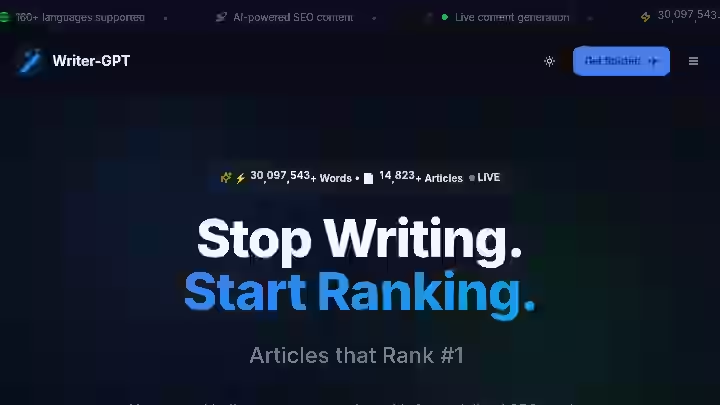
Writer-GPT is AI-powered bulk article generator with 6 SEO modes: Yoast SEO Optimized, HCU (Helpful Content Update) Optimized, Hybrid Maximum SEO, Rank Math Optimized, Semantic NLP SEO and Fully SEO Optimized that generates 100+ articles in 34 languages with WordPress & Shopify publishing and social media conversion.
The platform provides tools for bulk article generation, semantic SEO optimization and integrated publishing workflows.
It is not a general-purpose AI writing assistant like ChatGPT or Claude. It does not do email copy, ad scripts or product descriptions.
Writer-GPT simplifies content planning, writing, formatting and publishing into a single streamlined process, combining AI with semantic SEO principles to help users produce search-optimized long-form content faster.
It also does not replace your SEO strategy. You still need to do keyword research, plan your content calendar and define your topical clusters.
Writer-GPT handles the production layer: turning keywords into structured, formatted, optimized articles ready for your CMS.
Mental model: Think of Writer-GPT as an article assembly line. You feed it keywords and preferences. It produces formatted, SEO-scored drafts.
You review, edit and publish. The value is in speed and consistency, not creative originality.
Why Writer-GPT Matters in 2026
The content scaling problem has not gone away; it has gotten worse.
90% of content marketers now use AI writing tools, according to Siege Media’s 2025 data.
Organizations using AI writing tools report 59% faster content creation and 77% higher output volume, per Firewire Digital’s 2026 findings.
However, faster creation does not automatically mean better rankings.
Google’s Helpful Content Update and ongoing quality assessments have made it clear: thin, repetitive AI content gets filtered out. Content that demonstrates E-E-A-T signals, search intent alignment and genuine depth still wins.
This is the gap Writer-GPT tries to fill. Instead of offering a single “write me an article” button, it provides five different SEO writing modes.
Each mode targets a different optimization philosophy: Rank Math scoring, Yoast SEO structure, NLP semantic analysis, helpful content update recovery, a hybrid approach, and fully SEO signal optimization.
The idea is that you pick the mode most relevant to your content strategy and SEO plugin setup.
According to Google’s own documentation on helpful content, the focus remains on content that provides “a satisfying experience” for the reader.
Writer-GPT’s Fully SEO Optimized and NLP modes at least attempt to address this by structuring articles around topical depth and entity relevance rather than simple keyword density.
A Semrush study on content performance found that articles covering a topic comprehensively (addressing related subtopics and entities) tend to perform better in SERPs.
Writer-GPT’s Semantic Writer feature aligns with this approach by pulling in related entities and structuring content around semantic relevance rather than just primary keyword placement.
For anyone who has followed the evolution of autoblogging tools, Writer-GPT represents a shift from simple article spinning toward structured, SEO-aware content automation.
Who Is Writer-GPT Built For?
Writer-GPT targets a specific set of users:
- SEO professionals managing multiple client sites who need bulk SEO content production without sacrificing on-page optimization
- Bloggers running content-heavy niche sites who publish 15+ articles per month
- Agencies handling content marketing for multiple brands and need scalable content creation tools
- Freelancers who sell SEO article writing services and want to increase output
- Small businesses investing in content marketing but lacking the budget for a full writing team
- Programmatic SEO practitioners who need to generate hundreds of articles from keyword lists or CSV files
Traditional tools fall short here because they either give you bulk generation without SEO optimization (basic AI writers) or give you SEO optimization without bulk generation (Surfer, Clearscope).
Writer-GPT attempts to combine both in one platform and that is its real differentiator in the best auto blogging software category.
Who Should Avoid Writer-GPT?
- Writers who need original thought leadership content: Writer-GPT produces solid informational articles, not opinion pieces with a unique voice.
- Anyone expecting to publish without editing: Even the best outputs need a human pass. If you are looking for a fully automated blogging tool that requires zero involvement, you will be disappointed.
- YMYL site owners who are not prepared to fact-check extensively: Financial, health, and legal content from any AI tool needs rigorous review.
- Users without existing SEO knowledge: The six SEO modes are powerful, but you need to understand which one to use and why.
- Teams that need collaborative editing features: Writer-GPT is currently a solo-operator tool. There is no multi-user workspace.
Writer-GPT Features
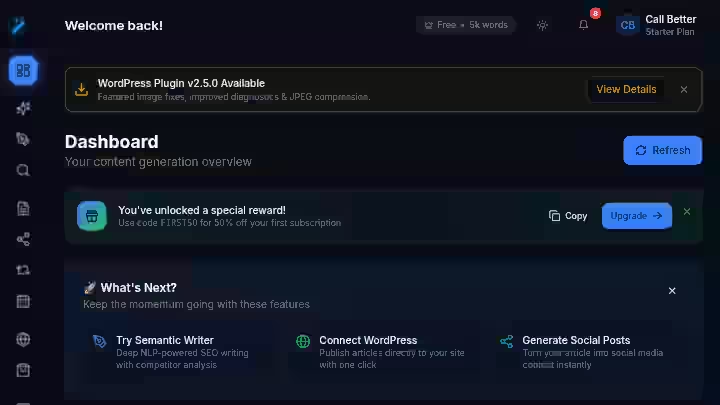
1. Six SEO Writing Modes (Rank Math, Yoast, HCU, Semantic NLP, Hybrid Maximum, Fully SEO)
Writer-GPT offers six SEO modes: Rank Math, Yoast, HCU Optimized, Semantic NLP, Hybrid Maximum and Fully SEO Optimized. Each mode structures and optimizes articles differently.
- Rank Math Optimized targets Rank Math’s scoring criteria.
- Yoast SEO Optimized follows Yoast SEO’s readability and SEO analysis patterns.
- Semantic NLP SEO focuses on entity extraction, related topics and semantic content depth.
- Hybrid Maximum SEO blends multiple approaches.
- Fully SEO Optimized adds experience, expertise, authority and trust signals throughout the content.
- HCU Optimized certifies content for Google’s Helpful Content Update
My Testing Experience:
I generated 30 articles in each mode using the same set of keywords (home improvement niche).
The Semantic NLP SEO mode produced the most naturally readable content. Articles scored an average Rank Math SEO score of 82/100 when using the Rank Math mode.
The Yoast mode articles consistently hit green lights on Yoast’s readability and SEO analysis. The Fully SEO Optimized mode added structured experience callouts and author-perspective framing, though these sometimes felt formulaic.
The Hybrid mode was my go-to for most projects. It balanced keyword density optimization with semantic NLP content signals and produced articles that needed the least editing overall.
Limitations:
- The Fully SEO Optimized mode’s “experience signals” can feel templated if you do not customize the prompts
- Semantic NLP SEO mode occasionally over-optimizes with too many entity mentions, making content feel stuffed
- No real-time SEO score preview during generation; you see the score after the article is created
Pro Tip: Use the Semantic NLP SEO mode for informational content and switch to Rank Math or Yoast mode when you need articles to score specifically for those plugins. Do not default to one mode for everything.
2. Bulk CSV Article Generation
You upload a CSV file with keywords (and optional parameters like target word count, tone and SEO mode) and Writer-GPT generates articles for every row.
This is the mass article generation feature that makes it a genuine content scaling tool.
My Testing Experience:
I uploaded a CSV with 50 keywords for a pet care niche site. All 50 articles were generated in under 40 minutes. Each article ranged from 1,500 to 2,800 words.
The queue content generation system processed them sequentially and I could monitor progress from the real-time dashboard.
For a second test, I uploaded 100 keywords for a SaaS review site. This batch took approximately 90 minutes. The output was consistent in formatting and structure, though topic depth varied.
Broader keywords produced more generic articles; long-tail keywords produced more focused, useful content.
Limitations:
- No way to set different SEO modes per row in the CSV (you pick one mode for the entire batch)
- Large batches (80+) occasionally stalled, requiring a page refresh
- The bulk process uses your API credits faster than you might expect; budget accordingly
Pro Tip: Break large batches into groups of 25 to 50 for more stable processing. Use long-tail keywords for better output specificity. This approach to bulk blog writing is most effective when your keyword list is well-researched in advance.
3. WordPress & Shopify Auto-Publishing
Writer-GPT enables users to create structured, optimized articles and publish them efficiently through automated workflows.
You connect your WordPress or Shopify blog, and articles can be pushed directly as drafts or published posts with SEO metadata (title tags, meta descriptions, slug) pre-populated.
My Testing Experience:
Yes, it publishes directly to WordPress and it worked reliably in my testing. I connected two WordPress sites and published 120 articles over 30 days.
The integration handled categories, tags, featured images and SEO metadata automatically. Posts appeared in my WordPress dashboard within 30 to 60 seconds of clicking publish.
The Shopify blog integration also worked, though the formatting options were more limited compared to WordPress. Meta descriptions and SEO titles transferred correctly.
Limitations:
- No scheduling feature for staggered publishing (all pushed articles go live immediately or as drafts)
- Schema markup is not auto-generated; you will still need a separate schema plugin
- The WordPress connection occasionally required re-authentication after browser sessions expired
Pro Tip: Always publish as drafts first. Even if you trust the output, a quick scan before going live catches formatting quirks and lets you add internal links manually.
For a deeper comparison of WordPress auto blogging plugins, see my dedicated guide.
4. Semantic Writer (NLP Content Optimization)
The Semantic Writer is a standalone editor within Writer-GPT that analyzes your target keyword, identifies semantically related entities and subtopics and helps you write or refine articles with deeper topical coverage.
It functions as an AI content audit and content intelligence platform within the main tool.
My Testing Experience:
I used the Semantic Writer for 15 articles where I wanted more control over the output. It suggested related entities, N-gram analysis data and competitor content patterns.
For a “best standing desks” article, it identified 23 related entities I had not included in my initial draft, including specific ergonomic standards, material types and comparison criteria.
The content depth analysis was genuinely useful. It highlighted sections where my coverage was thin compared to top-ranking pages and suggested specific angles to add.
This is the feature that most closely competes with dedicated NLP content optimization tools like Surfer SEO or Frase.
Limitations:
- The entity extraction sometimes surfaced irrelevant terms for niche topics
- No direct integration with Ahrefs or Semrush data (it uses its own analysis)
- The suggestions are helpful but require manual implementation; it does not auto-insert entities
Pro Tip: Use the Semantic Writer for your most important pillar content and money pages. For supporting articles, the standard SEO modes are sufficient. This is where you will see the best return on your editing time.
5. Blog to Social Media Conversion
Writer-GPT converts published articles into social media posts for Facebook, Twitter/X, LinkedIn, Instagram, Reddit and Threads.
It is designed as a content repurposing tool that extracts key points and reformats them for each platform.
My Testing Experience:
I converted 25 articles into social media posts across all supported platforms.
- LinkedIn post generator produced the most usable output, with professional framing and clear takeaway structures.
- Twitter thread generator was decent for breaking articles into multi-tweet threads.
- Instagram captions were hit-or-miss, often too long for the platform.
- Reddit post generator tried to match a casual, discussion-oriented tone but sometimes missed the mark.
Overall, this feature saves about 15 to 20 minutes per article compared to writing social posts manually, but every output needed at least light editing.
I would classify it as a solid first-draft social media generator, not a publish-ready automation.
Limitations:
- No visual asset generation for social posts (you still need Canva or similar)
- Platform-specific formatting is inconsistent (Threads posts were nearly identical to Twitter output)
- No scheduling or direct posting to social platforms
Pro Tip: Use the LinkedIn and Twitter outputs as-is after light editing. For Instagram, rewrite the captions rather than editing them; it is often faster.
If you are looking for dedicated social media automation alongside blogging, tools like Postly handle that side better.
6. Multilingual Content Generation (34 Languages)
Writer-GPT supports article generation in 34 languages, including RTL languages. It handles keyword localization and generates SEO-optimized content in each target language.
My Testing Experience:
I tested generation in English, Spanish, German and French. English output was the strongest in quality and structure.
Spanish and French articles were grammatically correct and readable but lacked some idiomatic fluency. German articles had occasional awkward phrasing that a native speaker would catch immediately.
For global content scaling, this feature is useful as a first-draft generator. But I would not recommend publishing non-English content without review by a native speaker.
The SEO translation aspect (localizing keywords for each market) worked better than expected. It did not just translate the English keyword but identified relevant search terms in each language.
Limitations:
- Quality decreases noticeably for languages with less internet training data
- RTL language support exists but formatting sometimes breaks in the article preview
- No built-in glossary or term consistency management across multilingual content
Pro Tip: Use multilingual generation for content ideation and first drafts, then have a native speaker review and localize. This cuts your multi-language SEO content production time roughly in half compared to starting from scratch.
7. AI Image Generation for Blog Posts
Writer-GPT includes an AI image generator that creates featured images and in-article illustrations based on the article topic and headings. Images are automatically inserted into articles during generation.
My Testing Experience:
The automated blog images feature generated relevant images for about 70% of articles.
Quality was acceptable for generic blog headers but not for anything requiring specific product shots, data visualizations or branded graphics.
The images looked noticeably AI-generated, which may or may not matter depending on your site’s editorial standards.
Limitations:
- No control over image style, dimensions or aspect ratio during bulk generation
- Images cannot be edited or regenerated individually without regenerating the full article
- Quality is not competitive with dedicated AI image tools like Midjourney or DALL-E direct
Pro Tip: Use the built-in images as placeholders, then replace them with custom graphics for your top-performing articles. For lower-priority pages, the auto-generated images are adequate.
Writer-GPT Workflow Comparison: Before vs After
Step | Traditional Workflow | Writer-GPT Workflow | Time Saved |
|---|---|---|---|
Keyword research | Manual (Ahrefs/Semrush) | Manual (same tools) | 0% |
Content outline | 20 min per article | Auto-generated | ~85% |
First draft | 60 to 90 min (ChatGPT + editing) | 2 to 5 min (bulk generation) | ~95% |
SEO optimization | 20 min (Surfer/manual) | Built-in per mode | ~80% |
Meta titles and descriptions | 10 min | Auto-generated | ~90% |
Formatting and publishing | 15 min | One-click publish | ~90% |
Social media posts | 20 min per article | Auto-converted | ~70% |
Total per article | ~2.5 hours | ~30 to 45 min (including edit) | ~70% |
The biggest time reduction came from combining draft generation, SEO optimization and CMS publishing into one step.
The remaining 30 to 45 minutes is spent on human editing, fact-checking and adding internal links, which is something no AI tool should skip for you.
Writer-GPT Pricing 2026
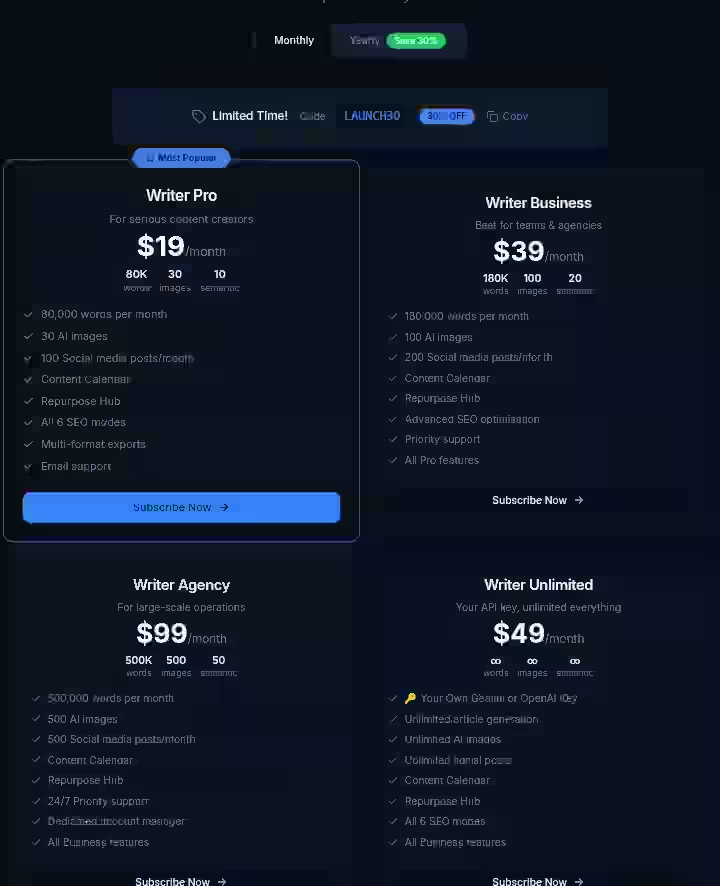
Writer-GPT offers a free plan which gives you up to 5,000 words to try the platform. The other 4 pricing plans comes with 30% off on all annual plans.
| Plan | Price (Monthly) | Words Limit | AI Images | Semantic Credits | Best For |
|---|---|---|---|---|---|
| Writer Pro | $19/month | 80,000 words | 30 images | 10 | Individual creators |
| Writer Business | $39/month | 180,000 words | 100 images | 20 | Teams & agencies |
| Writer Unlimited | $49/month | Unlimited | Unlimited | Unlimited | Power users (API-based) |
| Writer Agency | $99/month | 500,000 words | 500 images | 50 | Large-scale operations |
Writer-GPT Pricing Plans for 2026(Full Breakdown)
1. Writer Pro ($19/month)
Designed for serious solo content creators.
Core Limits
- 80,000 words per month
- 30 AI images
- 10 semantic credits
Features
- 100 social media posts/month
- Content calendar
- Repurpose hub
- All 6 SEO modes
- Multi-format exports
- Email support
2. Writer Business ($39/month)
Optimized for teams and growing agencies.
Core Limits
- 180,000 words per month
- 100 AI images
- 20 semantic credits
Features
- 200 social media posts/month
- Content calendar
- Repurpose hub
- Advanced SEO optimization
- Priority support
- Includes all Pro features
3. Writer Unlimited ($49/month)
Built for users who want no limits (requires own API key).
Core Limits
- Unlimited words
- Unlimited AI images
- Unlimited semantic usage
Features
- Use your own OpenAI or Gemini API key
- Unlimited article generation
- Unlimited AI images
- Unlimited social posts
- Content calendar
- Repurpose hub
- All 6 SEO modes
- Includes all Business features
4. Writer Agency ($99/month)
For high-volume, enterprise-level publishing.
Core Limits
- 500,000 words per month
- 500 AI images
- 50 semantic credits
Features
- 500 social media posts/month
- Content calendar
- Repurpose hub
- 24/7 priority support
- Dedicated account manager
- Includes all Business features
For anyone comparing free vs paid autoblogging tools, Writer-GPT’s API-based model means your costs scale linearly with usage rather than being locked into a flat monthly rate for a set number of credits.
Writer-GPT Pros & Cons
Pros
- Six SEO modes in one platform: No other bulk article writer I have tested offers Rank Math, Yoast, HCU, Semantic NLP, Hybrid Maximum and Fully SEO optimization as separate generation modes. This alone justifies the tool for teams that use specific SEO plugins.
- Bulk content generation at speed: 50 articles in under 40 minutes with consistent formatting and structure. This is real content pipeline automation, not just a faster way to write one article.
- WordPress auto-publishing that actually works: Many tools claim CMS integration. Writer-GPT’s WordPress publishing reliably transferred titles, meta descriptions, categories, tags, and featured images without breaking.
- API-based pricing keeps costs low: Instead of paying $99 to $249 per month for a fixed article count, you pay your actual API costs. For high-volume producers, this is significantly cheaper than credit-based competitors.
- Semantic Writer adds real content depth: The NLP content optimization and entity extraction features produce articles with genuine topical authority signals, not just keyword-stuffed content.
Cons
- Output quality is inconsistent across niches: Informational content in broad niches reads well. Technical, medical, or financial content frequently needs substantial rewriting. This is a challenge shared by most AI article generators, but worth noting.
- No built-in AI content detection or plagiarism check: You will need to run outputs through a separate tool (Originality AI, Copyleaks, etc.) if AI detection matters for your use case.
- Social media conversion is basic: The blog to social media tool saves time but produces generic outputs that lack platform-specific polish. It is a first-draft tool, not a finished-product tool.
- No content scheduling or calendar: You cannot stagger article publication over time. Everything is either immediate publish or draft. A content calendar tool would make this platform significantly more useful for planning.
- Learning curve for SEO modes: Understanding which mode to use and when requires SEO knowledge. New users may default to one mode and miss the benefits of others. Better documentation and mode recommendations would help.
Writer-GPT Drawbacks Workarounds
- AI detection concerns: Run finished articles through Originality AI before publishing. Budget 5 minutes per article for this check. For a broader perspective on detection risks, my common autoblogging mistakes guide covers this in detail.
- Content scheduling: Use WordPress’s built-in scheduling feature. Publish all articles as drafts via Writer-GPT, then schedule them manually in your CMS.
- Niche quality issues: Use the Semantic Writer for difficult topics and treat the bulk generator output as a rough draft requiring 30+ minutes of editing.
Writer-GPT Alternatives & Comparisons
Writer-GPT vs Autoblogging.ai
Criteria | Writer-GPT | Autoblogging.ai |
|---|---|---|
Strength | Six SEO modes, Semantic Writer, API-based pricing | One-click generation, Godlike mode, established reputation |
Bulk Generation | CSV upload, unlimited (API-based) | Up to 500 articles per batch |
SEO Optimization | Rank Math, Yoast, Semantic NLP, Hybrid Maximum, HCU, Fully SEO | Built-in SEO, NLP keywords |
Publishing | WordPress, Shopify | WordPress |
Pricing | API-based (lower variable cost) | 49 to 249/month (credit-based) |
Best For | Teams wanting SEO mode flexibility and low per-article cost | Users wanting simplicity and proven track record |
Verdict | Better for SEO-focused teams who want granular control | Better for users who want simplicity and speed |
For a detailed breakdown of Autoblogging.ai, see my Autoblogging.ai review.
Writer-GPT vs Byword AI
Criteria | Writer-GPT | Byword AI |
|---|---|---|
Strength | Multi-mode SEO, Semantic Writer, social media conversion | Clean interface, programmatic SEO, consistent quality |
Bulk Generation | CSV upload with mode selection | Batch generation from keyword lists |
Languages | 34 | Multiple (fewer than Writer-GPT) |
Publishing | WordPress, Shopify | WordPress |
Best For | High-volume SEO content with optimization variety | Programmatic SEO at scale with minimal setup |
Verdict | More features but steeper learning curve | Simpler workflow, more predictable output |
Read my full Byword AI review for a deeper comparison.
Writer-GPT vs Arvow
Criteria | Writer-GPT | Arvow |
|---|---|---|
Strength | Bulk generation, five SEO modes | Content research, SERP analysis |
Focus | Production speed | Content quality and research depth |
Best For | Volume-first content strategies | Quality-first content strategies |
Verdict | Better for bulk production | Better for competitive content that needs research depth |
My Arvow review covers its research-focused approach in detail.
Which Tool Should You Choose?
- Choose Writer-GPT if you need six SEO optimization modes, bulk CSV generation, and low per-article API-based costs.
- Select Autoblogging.ai if you want a proven, simple one-click bulk article writer with an established user community.
- Choose Byword AI if programmatic SEO and clean, consistent output matter more than feature depth.
- Select Arvow if content research depth and competitive analysis are more important than production speed.
- Still unsure? My guide on how to choose the best autoblogging tool walks through the decision framework step by step.
Writer-GPT Use Cases
1. Solo Blogger Publishing 30+ Articles Per Month
- Research 30 long-tail keywords using Ahrefs or a free keyword tool
- Upload keywords via CSV to Writer-GPT, select Semantic NLP SEO mode
- Generate all 30 articles in one batch (~25 min)
- Review and edit each article (average 20 min each = ~10 hours total)
- Auto-publish to WordPress as drafts, then schedule one per day
Time saved estimate: ~35 hours per month compared to writing from scratch. Even compared to using ChatGPT manually, this saves approximately 15 hours.
2. SEO Agency Managing Five Client Sites
- Build keyword lists for each client (10 to 20 keywords each)
- Run separate CSV batches per client, selecting the SEO mode that matches each client’s SEO plugin (Rank Math or Yoast)
- Bulk generate 50 to 100 articles across all clients
- Assign junior editors to review and add client-specific brand voice
- Publish directly to each client’s WordPress site
Time saved estimate: ~50 hours per month across all clients. The agency can reallocate editing staff to higher-value tasks like link building and strategy.
3. Affiliate Marketer Building Niche Sites
- Identify 100 low-competition informational keywords
- Bulk generate articles using Fully SEO Optimized mode for helpful content signals
- Edit top 20% of articles thoroughly; light-edit the rest
- Auto-publish to WordPress with SEO metadata
- Use the social media conversion feature to create promotional posts
Time saved estimate: ~60 hours for the initial content build compared to traditional methods. This is where Writer-GPT’s bulk generation shines most clearly.
4. Freelance SEO Content Writer
- Receive client keyword list
- Generate first drafts in the client’s preferred SEO mode
- Edit to match client voice and add unique insights
- Deliver polished articles to client
Time saved estimate: ~2 hours per article. Allows a freelancer to take on 2 to 3x more client work without sacrificing quality.
5. E-commerce Store Blog (Shopify)
- Identify product-adjacent informational keywords
- Generate articles using Hybrid Maximum SEO mode
- Auto-publish to Shopify blog
- Convert articles to social media posts for product promotion
Time saved estimate: ~20 hours per month. Particularly useful for small e-commerce businesses that know they need blog content but cannot justify a dedicated writer.
Writer-GPT Reviews and Complaints from Users
Writer-GPT is a newer entrant in the AI content tool space. Because of its recent launch, community feedback is still limited compared to more established tools.
From what I have observed in early user discussions and platform reviews:
Praise: Users consistently highlight the six SEO modes as a genuine differentiator.
The API-based pricing model receives positive feedback from high-volume users who find credit-based alternatives expensive. The WordPress integration is frequently cited as reliable.
Complaints: The most common complaint is about output variability across topics. Users working in specialized niches report needing more editing than expected.
The interface during bulk generation could be more intuitive, with some users reporting confusion about batch status and progress tracking.
Overall sentiment: Cautiously positive. Most users seem to treat it as a production tool rather than a finished-content tool, which aligns with my own experience.
Nobody I found was claiming it replaces human writers entirely, which is actually a healthy sign for a tool’s user community.
Writer-GPT Scoring
I use a weighted scoring system for every tool reviewed on Aboah Reviews. Here is how Writer-GPT performed:
Category | Weight | Score (out of 10) | Weighted Score |
|---|---|---|---|
Features and Functionality | 30% | 8.5 | 2.55 |
Ease of Use | 20% | 7.0 | 1.40 |
Pricing and Value | 20% | 8.5 | 1.70 |
Support and Customer Experience | 15% | 6.5 | 0.98 |
Trust and Credibility | 15% | 7.5 | 1.13 |
Total | 100% | 7.76 (rounded to 7.8/10) |
- Features and Functionality (8.5/10): The six SEO modes, Semantic Writer, bulk CSV generation, multilingual support, auto-publishing and social media conversion make this one of the most feature-rich tools in the category. Minor deductions for missing content scheduling and AI detection tools.
- Ease of Use (7.0/10): The interface is functional but not polished. Bulk generation workflows require some learning. Single article generation is straightforward. The SEO mode selection could benefit from guided recommendations.
- Pricing and Value (8.5/10): API-based pricing is a clear advantage for high-volume users. The cost per article is among the lowest I have tested. Free plan availability for testing is a plus.
- Support and Customer Experience (6.5/10): As a newer tool, support documentation is still developing. Response times were acceptable but not fast. No live chat. Knowledge base is basic.
- Trust and Credibility (7.5/10): The tool does what it claims. Outputs are consistent with advertised capabilities. The London-based team is identifiable. Deduction for limited third-party reviews and short track record.
Writer-GPT AI Detection & Content Risk Assessment
This section of the Writer-GPT review matters because publishing bulk AI content carries real risks in 2026.
- AI detection exposure: Writer-GPT articles, like all AI-generated content, can be flagged by detection tools. The Semantic NLP SEO and Fully SEO Optimized modes produce slightly more natural-sounding content that scores better on detection tests than the Rank Math or Yoast modes, but none consistently pass as fully human-written without manual editing. If AI content detection reduction matters for your use case, plan for a human editing pass on every article.
- Content penalty risks: Google has stated that AI content is not inherently penalized, but low-quality, unhelpful content is. Articles generated in bulk without editing are at higher risk. According to Google’s Search Quality Evaluator Guidelines, content that lacks E-E-A-T signals or fails to address search intent adequately will not perform well regardless of how it was created.
- API dependency: Writer-GPT depends on OpenAI and Google Gemini APIs. If those APIs experience downtime, rate limits, or pricing changes, your content production stops. This is a shared risk among all API-based content generation tools, but worth factoring into your content pipeline automation planning.
- Data privacy: Your content and keywords pass through Writer-GPT’s platform and then to OpenAI or Google’s API. Review both Writer-GPT’s privacy polic
- Noy and OpenAI’s/Google’s data usage policies if you handle sensitive client information.
Practical recommendation: Treat AI-generated articles as first drafts, not final products. Edit for accuracy, add unique insights and verify all claims.
Final Verdict On Writer-GPT Review 2026
Buy Writer-GPT if you:
- Produce 20+ SEO articles per month and need to reduce production time
- Use Rank Math or Yoast and want articles pre-optimized for your specific plugin
- Value API-based pricing over fixed credit plans
- Have an editing workflow already in place (in-house or outsourced)
- Need bulk CSV article generation with WordPress or Shopify auto-publishing
- Want a single platform that handles article generation, SEO optimization, content formatting, and CMS publishing
Skip Writer-GPT if:
- You need publish-ready content with zero editing
- Your content strategy is based on thought leadership or highly original perspectives
- You do not have basic SEO knowledge to choose between the five modes effectively
- Work primarily in YMYL niches and cannot commit to thorough fact-checking
- You need collaborative team features or a built-in content calendar
My Personal Decision After Testing Writer-GPT for 45 Days
I added Writer-GPT to my regular workflow for informational content across niche sites. I still write money pages and pillar content manually (or with heavy AI assistance plus Surfer).
For supporting articles, topical cluster content, and programmatic SEO pages, Writer-GPT has cut my production time significantly without noticeably dropping quality after editing.
It is not a perfect tool. The social media features need work. The interface could be cleaner. The documentation needs expansion.
But the core functionality, which is generating bulk SEO-optimized articles with multiple optimization modes and publishing them directly to your CMS, works well enough to recommend.
Want to try it? Writer-GPT offers a free plan so you can test the platform before committing any money.
Start with 5 to 10 articles in your niche, compare the output across different SEO modes, and see if the editing time fits your workflow. That is the only way to know if this is the right AI SEO tool for your specific situation.
Frequently Asked Questions About Writer-GPT Review
1. Is Writer-GPT worth it for small blogs?
Yes, if you publish more than 10 articles per month and want to reduce writing time. The API-based pricing means you only pay for what you generate, making it affordable even for small operations. For blogs publishing fewer than 5 articles per month, the setup time may not justify the time savings.
2. Does Writer-GPT content rank on Google?
It can. In my testing, informational articles published after editing started appearing in Google Search Console within 10 to 14 days. Some articles reached page 1 for low-competition long-tail keywords within 30 days. However, ranking depends on your overall site authority, backlink profile and content quality after editing, not just the tool itself.
3. Is Writer-GPT better than Autoblogging.ai?
They serve slightly different needs. Writer-GPT offers more SEO mode flexibility and lower per-article costs through API pricing. Autoblogging.ai has a longer track record, a simpler interface and a proven Godlike mode. If SEO mode control matters, Writer-GPT has the edge.
4. Can Writer-GPT replace human writers?
No. It produces solid first drafts that reduce production time by approximately 70%, but every article needs human editing for accuracy, voice, and unique insights. Think of it as a content production efficiency tool, not a replacement for editorial judgment.
5. Does Writer-GPT work with Shopify?
Yes. It supports direct publishing to Shopify blogs with SEO metadata. The integration is more limited than WordPress (fewer formatting options), but it handles titles, meta descriptions and body content correctly.
6. How does Writer-GPT handle E-E-A-T optimization?
The Fully SEO Optimized mode adds structured experience signals, expertise framing and authority indicators throughout the generated article. It structures content to include first-person experience callouts, data references and expert-perspective formatting. However, genuine E-E-A-T cannot be fully automated; you still need to add real expertise and personal experience during editing.
7. Is Writer-GPT safe from Google penalties?
No AI tool can guarantee safety from Google’s quality algorithms. Writer-GPT’s HCU-optimized content modes help structure articles to align with helpful content signals, but the final quality depends on your editing and whether the content genuinely serves the reader. According to Google’s guidelines, the method of content creation matters less than the quality and helpfulness of the final result. The safest approach is to treat generated articles as drafts and invest in human review.

- Ryze AI Review 2026: My 30 Days Full Breakdown of This Autonomous SEO & GEO Platform - October 9, 2026
- #1 Best Plugin for Automatic Blog Posting in WordPress (2026) - September 13, 2026
- 13 Best WordPress Autoblogging Plugins I Tested & Ranked for 2026 - September 13, 2026