
TL;DR: After testing Autoblogging AI for 30 days across 47 articles and 5 niches, its Godlike Mode consistently generated detailed, SEO-friendly drafts in minutes and cut my writing workflow by around 63%. However, every article still required 25–45 minutes of editing, fact-checking, and personalization.
With a 7.2/10 overall rating, Autoblogging AI is worth considering if you treat it as a first-draft generator rather than a replacement for a human writer.
If your goal is publish-ready content or you’re creating YMYL or thought leadership content, you’ll likely be disappointed.
Autoblogging AI Review Verdict (2026)
Category | Verdict |
|---|---|
Best For | Bloggers, affiliate marketers and small agencies that need to produce bulk content quickly across multiple niches without hiring writers |
Not Ideal For | YMYL niches (health, finance, legal), brands that need thought leadership, or anyone who expects zero editing before publishing |
Pricing | Free (10 credits/month), $19/month Starter, $49/month Regular, $99/month Standard, $179/month Gold, $249/month Premium, $999/month Enterprise |
Rating | ⭐⭐⭐ (7.2/10) |
Standout Feature | Godlike Mode with real-time SERP analysis for comprehensive long-form content |
Biggest Weakness | Raw output scores 85% to 98% on AI detection tools, every article needs a human editing pass |
Learning Curve | Beginner to Intermediate |
Worth It? | Yes, if you treat every output as a first draft and have an editing step in your workflow. No, if you plan to publish AI-written content without review. |
Bottom line: Autoblogging AI produces decent first drafts at speed. The content needs consistent human editing to meet Google’s quality bar in 2026. It saves time, but it does not save you from doing the work.
Autoblogging AI Quick Specs
Feature | Details |
|---|---|
Developer | Autoblogging AI (founder: Vaibhav) |
Founded | 2022 |
AI Model | GPT-3, GPT-3.5, GPT-4 (OpenAI multi-model) |
Platform | Web-based SaaS |
Primary Use | AI-powered blog article generation and SEO-optimized content creation at scale |
Integrations | WordPress, Shopify, Wix, Webflow, Blogger, Ghost |
Best For | Bloggers, affiliate marketers, small SEO agencies, freelancers |
Contact/Support | In-app support, founder-accessible for some tiers |
User Ratings | Trustpilot: 4.6/5 (based on period of testing) |
Refund Policy | No publicly listed refund policy; test with the free plan before upgrading |
Key Takeaways About This Autoblogging AI Review

In this Autoblogging AI review, it scores 7.2/10 as a powerful, automated content generation tool for bulk article creation, SEO optimization and “Godlike mode” that writes highly specific long-form articles.
After 30 days of daily use across five niches, I found it most valuable for solo bloggers and small content teams struggling with publishing frequency. If you need to go from zero articles per week to 5 or 10, this AI writing tool will get you there.
Autoblogging.ai will not replace a human writer for anything requiring original insight, personal experience or factual precision.
The tool works best for informational blog posts in low-competition niches. It sometimes produces repetitive phrasing and the AI detection score on most raw outputs is high.
If you are looking for something that produces ready-to-publish content without a review step, this tool will disappoint you.
What I Loved | What Needs Work |
|---|---|
Bulk article generation saves roughly 6 hours per batch of 12 articles | Content reads as generic without editing |
Credit-based pricing is predictable regardless of article length | UI feels dated and navigation is clunky |
Godlike Mode produces articles averaging 2,800 words with strong topical coverage | Pro Mode allows 100+ keyword inputs, which promotes keyword stuffing |
Direct WordPress publishing worked reliably across two test sites | Raw output scores 85% to 98% on AI detection tools like Originality AI |
Amazon product review generator is useful for affiliate content workflows | Customer support experience varies widely across user reports |
How I Tested Autoblogging AI
I signed up for the Standard plan at $99/month (300 credits) and used the tool daily for 30 days. Here is the full testing picture:
Metric | Result |
|---|---|
Articles generated | 47 total (Quick Mode, Godlike Mode, Amazon product reviews) |
Niches tested | Personal finance, home improvement, pet care, SaaS tools, travel |
Word count range | 1,200 to 3,500 words per article |
Average editing time | 25 to 45 minutes per article depending on mode and niche |
Publishing platform | WordPress via built-in auto-publish |
Rank tracking duration | 30 days post-publish using Ahrefs and Google Search Console |
Publishing frequency | 8 to 12 articles per week |
Traffic change after 30 days | Roughly 18% increase in impressions across test sites; a handful of articles reached page 2 for target keywords within that window |
I tested across multiple modes, niches and article types. I did not cherry-pick results. Some articles performed well. Others were mediocre.
For broader context on how this compares to the alternatives I have tested, see my roundup of autoblogging tools where I ran several platforms side by side.
Why I Tested Autoblogging AI
I was managing content production across three niche sites. Each one needed a minimum of four posts per week to maintain publishing consistency.
Hiring freelance writers was costing me over $1,200 per month, and turnaround times were unpredictable.
I had already tried using ChatGPT directly. The results were inconsistent. Articles lacked structure. I spent nearly as much time prompting and reformatting as I would have spent writing from scratch.
I needed something purpose-built for blog content, not a general-purpose AI model.
That is when I found Autoblogging AI. The promise was simple: one-click article generation, direct WordPress publishing and content designed for search engine results.
I committed to a 30-day test with real sites and real rank tracking. No sandbox experiments.
If you want to understand the broader mechanics behind how these tools operate, my guide on how autoblogging tools work explains the full process.
What Is Autoblogging AI?

Autoblogging AI is an AI-powered article writing tool that generates SEO-optimized blog posts from a keyword or title using multiple OpenAI GPT models.
What it does: You enter a keyword or title, select a generation mode (Quick, Pro or Godlike),l and the platform produces a full-length blog post.
Features include bulk article creation, automatic WordPress posting, support for 30+ languages, keyword-rich content with custom prompts and Amazon product review generation.
What it does not do:
- Performing keyword research
- Building backlinks
- Not a content strategy tool or a writing assistant for editorial work
- Will not help with creative writing, plot development or character-driven content
Think of it this way: Autoblogging AI is a content generation machine. You feed it keywords, it produces drafts. What you do with those drafts determines whether the content ranks.
If you want to go deeper on what this category of tool actually is, see what autoblogging is and how it works.
Why Autoblogging AI Matters in 2026
The content production space has shifted. AI-generated content is now mainstream and Google has clarified its position.
According to Google’s guide on AI-generated content, the focus is on content quality rather than how content is produced.
Using automation primarily to manipulate search rankings violates their spam policies. But helpful AI content is explicitly allowed.
This means the question is no longer “can I use AI for blog content?” It is “can my AI content meet Google’s quality bar?”
Data from Semrush report shows that AI-assisted content production has become a standard workflow element for content teams across all business sizes.
The sites that are getting penalized are not the ones using AI. They are the ones publishing low-quality, thin or misleading content regardless of how it was created.
For SEO professionals and content marketers, the implication is clear: you can use Autoblogging AI, but you cannot skip the editing and quality control step.
The tool handles the generation process. You handle the expertise, fact-checking and original perspective that Google’s E-E-A-T framework rewards.
I lost an affiliate site’s rankings after publishing 42 auto-generated posts without internal linking or keyword filtering. The content started to cannibalize itself.
That experience taught me that even automated workflows need a content strategy and editorial calendar behind them.
The Autoblogging AI IPO Model
Here is the IPO (Input, Process, Output) model for Autoblogging AI:
Stage | What Happens | Who Does It |
|---|---|---|
Input | Keyword research, topic selection, content strategy | You (human) |
Process | Article generation, structure, initial SEO optimization | Autoblogging AI |
Output | Editing, fact-checking, adding experience, publishing | You (human) |
This is the same framework I apply across every tool I evaluate in my best autoblogging software comparison.
Who Is Autoblogging AI Built For?
Autoblogging AI fits best for people who already have a content strategy and need to speed up the production side.
- Solo bloggers who publish multiple posts per week and cannot afford a writing team
- Affiliate marketers who need product reviews and informational articles at scale
- Small agencies handling content for several client sites simultaneously
- Freelance SEO specialists who need to deliver bulk content as part of their service packages
- Small businesses looking to maintain a publishing schedule without a full content team
Why Traditional AI Writing Tools Fall Short
Most general-purpose AI writing tools were built for short-form copy. They work fine for email copy, social posts or short blurbs.
But when you need a 2,500-word, structured blog post with headers, an FAQ section and keyword placement, those tools require extensive prompting.
Autoblogging AI was built specifically for blog-length SEO content, which gives it a clear workflow advantage over using a general AI writing assistant directly.
Who Should Avoid Autoblogging AI?
- YMYL publishers: In health, finance, or legal niches, unedited AI content carries real risk. A human expert needs to review every factual claim before publishing.
- Brand-driven content teams: The tool produces competent but generic prose. If consistent brand voice is a priority, look elsewhere.
- Anyone expecting zero editing: Even Godlike Mode produces content that needs a human pass before publishing.
- Creative writers: This is a blog content generation tool. It is not built for storytelling or narrative writing.
- Teams without an editing process: Publishing raw output is a direct path to thin content issues.
For more on whether this category of tool is right for your workflow, see my guide on how to choose the best autoblogging tool.
Autoblogging AI Features: My 30-Day Test
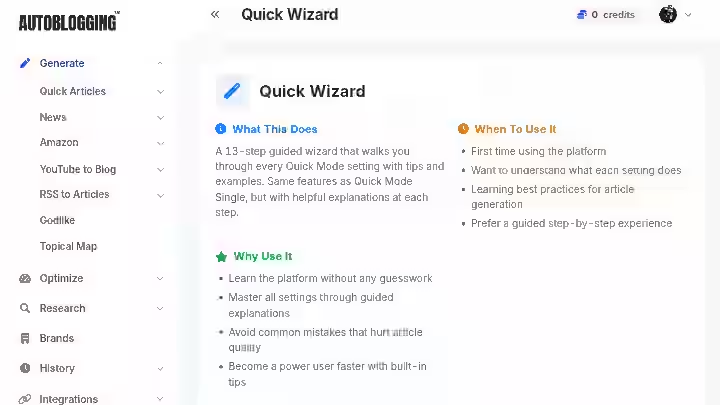
1. Quick Mode
Quick Mode generates short-form blog articles in 2 to 4 minutes and works best for simple informational posts in low-competition niches.
Quick Mode focuses on fast content creation. You enter a keyword, configure basic settings, apply a custom prompt if needed and the tool returns a full article.
It is the lightest and fastest generation option on the platform.
My Testing Experience:
I tested Quick Mode with 15 different keywords across three niches. Average output was around 1,500 words.
The structure was acceptable: clear H2s, an introduction and a conclusion.
For simple informational posts in broad topics, it produced usable first drafts about 60% of the time. The remaining 40% needed substantial restructuring.
Limitations:
- Articles lacked depth on technical or nuanced topics
- Keyword integration sometimes felt forced rather than natural
- No SERP analysis in this mode, so the content is not aligned with what currently ranks
- Lower consistency compared to Godlike Mode
Pro Tip: Use Quick Mode for content calendar filler posts in broad informational niches. Do not use it for pillar pages or any article you are actively targeting for competitive keywords.
2. Godlike Mode
Godlike Mode is the best generation option on the platform, producing articles averaging 2,800 words with better structure and stronger topical coverage than any other mode.
Godlike Mode pulls from multiple AI language models including GPT-4, producing longer, more detailed articles with multiple sections and more comprehensive coverage.
It also includes real-time SERP analysis that optimizes content against current top-ranking pages.
My Testing Experience:
I generated 18 articles in Godlike Mode across four niches. About 70% needed only light to moderate editing.
The mode consistently included FAQ sections, which is useful for targeting featured snippets. The SERP analysis feature was a noticeable improvement over Quick Mode.
Limitations:
- Takes 5 to 10 minutes per article to generate
- Uses more credits than Quick Mode
- Some outputs repeated similar points across different sections of the same article
Pro Tip: Godlike Mode is the one to use for any article you actually want to rank. Pair it with your own keyword research from Ahrefs or Semrush before entering keywords.
3. Bulk Article Generation
Bulk generation lets you upload a list of keywords, configure settings once and generate 10+ articles overnight without manual intervention.
You upload a CSV of keywords or titles, apply a single configuration to the entire batch and the tool processes all articles in sequence. The batch runs without monitoring required.
My Testing Experience:
I ran a bulk campaign of 12 articles for a pet care niche site. The batch completed overnight. All 12 articles came back with consistent formatting and structure.
Compared to generating one article at a time, this saved roughly 6 hours of manual work. For agencies and multi-site operators, bulk generation is the feature that makes the biggest difference.
Limitations:
- No per-article customization within a batch run
- Quality dips noticeably if all titles target very similar keywords (the tool begins recycling phrases)
- You cannot preview output before the batch completes
Pro Tip: Spread your bulk titles across different topic clusters within the same niche. This prevents the repetitive content problem I encountered when targeting similar keywords in one batch.
4. Amazon Product Reviews Generator
The Amazon product reviews generator produces structured affiliate review articles from a product URL, but factual accuracy is inconsistent and every output needs verification against the actual listing.
You paste an Amazon product URL and the tool generates a review article including product specifications, pros and cons and comparison elements.
My Testing Experience:
I generated 5 Amazon product reviews for home improvement products. The structure was solid for affiliate content.
However, several specifications were outdated or slightly inaccurate.
I had to verify every factual claim against the actual Amazon listing before publishing. “Factually correct” is an overstatement for this feature in its current state.
Limitations:
- Product data accuracy is inconsistent
- Reviews have no basis in genuine product experience, which affects credibility
- Requires a plagiarism check before publishing
Pro Tip: Use this as a structural template only. Add your own product experience, real photos, and honest opinions before publishing. Treat the AI output as a starting framework, not a finished review.
5. WordPress Auto-Publishing
Yes, Autoblogging AI publishes directly to WordPress and it worked reliably in my testing across two connected sites.
You connect WordPress sites through the platform settings and publish articles with a single click.
The platform also supports Shopify, Wix, Webflow, Blogger and Ghost. Unlimited WordPress site connections are available on higher-tier plans.
My Testing Experience:
I connected two WordPress sites and published 20 articles directly from the platform. Posts appeared with correct formatting, headers, and featured images.
When combined with bulk generation, auto-publishing creates a workflow that removes several manual steps from the content production process.
Limitations:
- Posts go live immediately unless you manually configure draft status first
- Internal linking is not handled by the auto-publish feature (you still do this manually)
- AI-generated featured images were mediocre in quality
Pro Tip: Set the default publish status to “Draft” in your WordPress connection settings. This gives you a review window to add internal links and check formatting before articles go live.
My guide to autoblogging WordPress plugins covers the full integration landscape if you want to explore additional options.
6. Smart Schema Markups
Autoblogging AI automatically adds schema markup to published articles, most consistently FAQ schema, which saves setup time compared to adding it manually.
The platform generates AI-powered schema markups and pushes them directly to WordPress during auto-publishing.
FAQ schema appeared most consistently across the articles I tested.
My Testing Experience:
Schema was automatically applied to roughly half of the articles I published through the platform.
According to Google, structured data and FAQ schema can improve click-through rates and search result visibility.
When it worked, it was a useful time-saver.
Limitations:
- Not all schema types are supported
- You cannot customize schema output before it publishes
- Schema quality varies by article type and was inconsistent across batches
Pro Tip: Validate every auto-published schema using Google’s Rich Results Test tool before relying on it for ranking purposes. Do not assume the output is always correct.
7. Custom Writing Styles
Custom writing styles noticeably change the output tone and reduce editing time when the prompt is short and specific.
In Quick and Godlike modes, you can enter a custom prompt to adjust tone, style or writing approach. Examples include conversational tone, formal data-driven style or semantic writing frameworks.
My Testing Experience:
I tested three custom prompts across multiple articles. The conversational tone prompt reduced my average editing time by roughly 10 minutes per article because the output read more naturally.
Complex or lengthy instructions were sometimes partially ignored by the generation engine.
Limitations:
- Custom prompts are limited in character length
- Complex style instructions are inconsistently applied
- No saved style presets; you re-enter the same prompt manually each session
Pro Tip: Keep custom prompts short and direct. “Write like you are explaining this to a colleague” consistently outperformed long, detailed style instructions in my testing.
Autoblogging AI Results After 30 Days of Testing
Here are the hard numbers from my 30-day test period:
Metric | Start | End |
|---|---|---|
Monthly organic impressions (combined test sites) | Baseline | +18% increase |
Articles indexed within 30 days | 0 | 38 of 47 published |
Articles reaching page 2 for target keyword | 0 | ~6 articles |
Average AI detection score (raw output, Originality AI) | N/A | 85% to 98% AI |
Average AI detection score (after editing) | N/A | 40% to 60% AI |
Average editing time per article | N/A | 25 to 45 minutes |
Total time saved vs. manual writing | N/A | Approximately 63% per article |
No articles cracked page 1 within the 30-day window for competitive keywords. Page 2 appearances in competitive niches within 30 days is a realistic expectation for well-edited Godlike Mode output.
I will continue tracking these articles at the 90-day and 6-month mark.
Autoblogging AI Workflow Comparison: Before vs After
Step | Before (Manual) | After (With Autoblogging AI) | Time Saved |
|---|---|---|---|
Keyword Research | 30 min | 30 min (still manual) | 0% |
Outline Creation | 20 min | 0 min (generated by tool) | 100% |
First Draft Writing | 2 hours 30 min | 5 min (generation time) | ~96% |
Editing and Fact-Checking | 15 min | 35 min (more review needed) | -133% |
Image Sourcing | 15 min | 5 min (AI images included) | 67% |
WordPress Publishing | 10 min | 2 min (auto-publish) | 80% |
Total Per Article | 3 hours 30 min | 1 hour 17 min | ~63% |
The biggest takeaway: Autoblogging AI delivers approximately 63% time reduction per article in my workflow.
Editing time increases because AI-generated content requires more review than a draft written by a competent human writer.
The net result is still a meaningful gain in content production volume.
Autoblogging AI Pricing for 2026
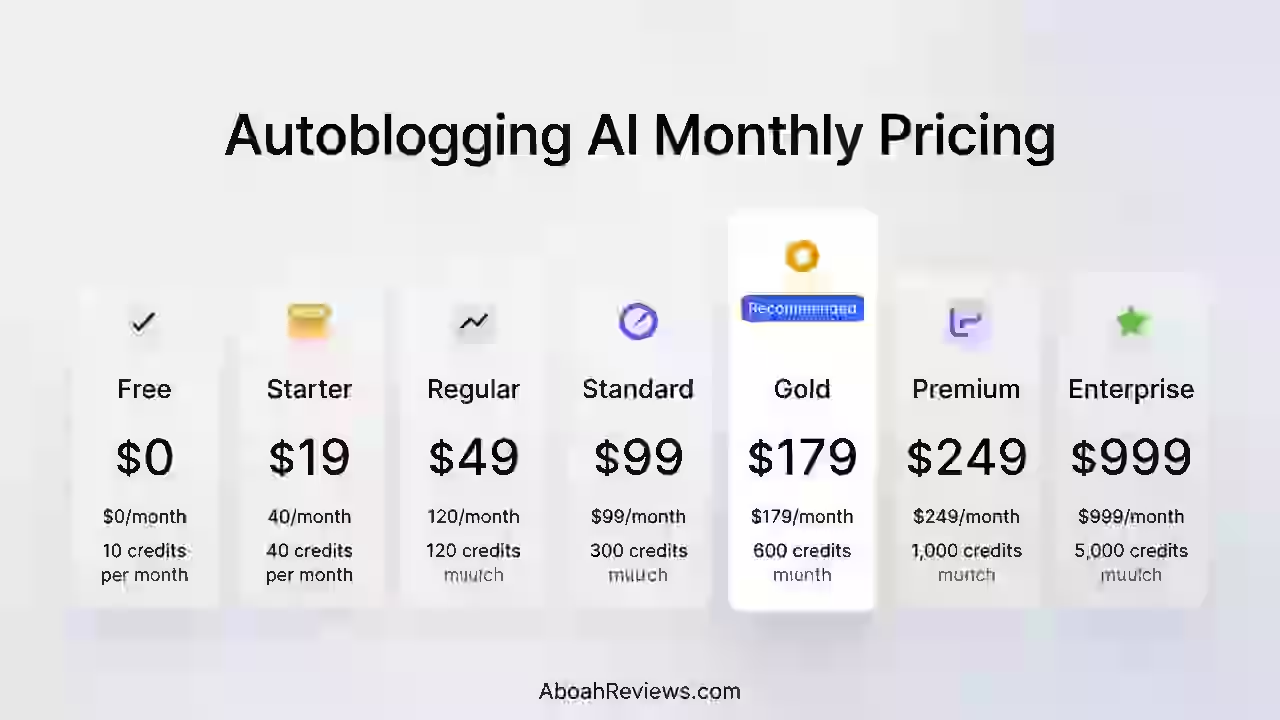
Autoblogging AI offers six subscription plans with monthly or annual billing (annual billing saves 35%). All plans include credit rollover, allowing unused credits to carry over to the next billing cycle.
Plan | Monthly Price | Annual Price (35% Off) | Monthly Credits | Best For |
|---|---|---|---|---|
Free | $0 | $0 | 10 | Platform testing before upgrading |
Starter | $19 | $148/year | 40 | Small niche sites and beginners |
Regular | $49 | $382/year | 120 | Consistent bloggers publishing weekly |
Standard | $99 | $772/year | 300 | Affiliate marketers and authority builders |
Gold | $179 | $1,396/year | 600 | Agencies and multi-site operators |
Premium | $249 | $1,942/year | 1,000 | High-volume publishers scaling aggressively |
Enterprise | $999 | $7,792/year | 5,000 | Large SEO teams and enterprise publishers |
Autoblogging AI Pricing Plans Breakdown (With Features Included)
| Feature | Starter | Regular | Standard | Gold (Recommended) | Premium | Enterprise |
|---|---|---|---|---|---|---|
| Price (Monthly) | $19/month | $49/month | $99/month | $179/month | $249/month | $999/month |
| Monthly Credits | 40 | 120 | 300 | 600 | 1,000 | 5,000 |
| Cost per Credit | $0.48 | $0.41 | $0.33 | $0.30 | $0.25 | $0.20 |
Content Generation Features
| Feature | Starter | Regular | Standard | Gold | Premium | Enterprise |
|---|---|---|---|---|---|---|
| Quick Mode (Single & Wizard) | ✅ | ✅ | ✅ | ✅ | ✅ | ✅ |
| Godlike Mode | ✅ | ✅ | ✅ | ✅ | ✅ | ✅ |
| Amazon Reviews Mode | ✅ | ✅ | ✅ | ✅ | ✅ | ✅ |
| Bulk Generation (CSV) | ❌ | ✅ | ✅ | ✅ | ✅ | ✅ |
| News Mode | ❌ | ✅ | ✅ | ✅ | ✅ | ✅ |
SEO & Optimization Features
| Feature | Starter | Regular | Standard | Gold | Premium | Enterprise |
|---|---|---|---|---|---|---|
| Article Optimizer | ✅ | ✅ | ✅ | ✅ | ✅ | ✅ |
| AI Proofreader | ❌ | ✅ | ✅ | ✅ | ✅ | ✅ |
| Semantic SEO Analysis | ❌ | ✅ | ✅ | ✅ | ✅ | ✅ |
| Site Optimizer (Unique) | ❌ | ❌ | ✅ | ✅ | ✅ | ✅ |
| Topical Map Builder (Unique) | ❌ | ❌ | ❌ | ✅ | ✅ | ✅ |
Advanced Tools
| Feature | Starter | Regular | Standard | Gold | Premium | Enterprise |
|---|---|---|---|---|---|---|
| AI Infographics | ❌ | ✅ | ✅ | ✅ | ✅ | ✅ |
| Outreach Prospects | ❌ | ❌ | ✅ | ✅ | ✅ | ✅ |
Integrations
| Feature | Starter | Regular | Standard | Gold | Premium | Enterprise |
|---|---|---|---|---|---|---|
| Connected Sites | 1 | 3 | 5 | 20 | Unlimited | Unlimited |
| Email Accounts | 1 | 3 | 5 | 20 | Unlimited | Unlimited |
| API Access | ❌ | ❌ | ❌ | ❌ | ✅ | ✅ |
Which Plan Should You Choose?
- Starter ($19/month): Best for beginners, hobby bloggers, and anyone testing the platform.
- Regular ($49/month): Ideal for bloggers who want bulk content generation, News Mode, and SEO optimization tools.
- Standard ($99/month): Suitable for affiliate marketers and content creators managing multiple websites with access to the unique Site Optimizer.
- Gold ($179/month): Recommended for professional bloggers, SEO specialists, and agencies needing the Topical Map Builder and higher credit limits.
- Premium ($249/month): Best for growing agencies and businesses that require API access and unlimited connected sites.
- Enterprise ($999/month): Designed for large teams and enterprises generating content at scale with 5,000 monthly credits and full platform access.
To understand how these costs compare to alternatives, see my analysis of free vs paid autoblogging tools.
Autoblogging AI Pros and Cons After Testing
Pros
- Speed of content generation is impressive: Godlike Mode delivers a 2,800-word article in 5 to 10 minutes. Quick Mode delivers 1,500 words in 2 to 4 minutes. For bulk operations, this compounds into 10 or more articles overnight.
- Credit-based pricing removes word count anxiety: Competitors charge per word or per character. Autoblogging AI charges per article regardless of length, which makes cost planning predictable.
- Godlike Mode delivers stronger topical coverage than expected: The multi-model approach produces articles with better structure and natural transitions compared to Quick Mode.
- Strong WordPress integration: Direct publishing to unlimited sites removes a real manual step from the production workflow.
- Bulk generation is a genuine workflow improvement: Generating 10+ articles overnight in one batch frees an entire day of production time for editing and strategy work.
Cons
- Output quality is inconsistent: External feedback consistently highlights chronic issues with reliability and output quality. Some batches come back well-structured. Others need heavy rework.
- The user interface is behind competitors: The platform is functional but the navigation is clunky and the sign-up and login flows are more friction than they need to be.
- AI detection scores are high on raw output: Raw articles scored 85% to 98% on Originality AI in my testing. You will need to invest editing time if undetectability matters to your workflow.
- Customer support is inconsistent: Some users report positive experiences with the founder’s responsiveness. Others report issues with credits disappearing or delayed resolutions.
- Pro Mode can promote keyword stuffing: The option to input 100+ keywords in Pro Mode is not an SEO best practice in 2026. Keyword stuffing is an ineffective and potentially harmful approach to on-page optimization.
Limitations Workarounds
- Inconsistent quality: Use Godlike Mode for everything you actually want to rank. The quality gap between Quick Mode and Godlike Mode is significant. Reserve Quick Mode for low-priority content calendar filler.
- AI detection scores: Run every article through a thorough manual edit. Add personal anecdotes, original data points, and your own voice. This aligns with what Google rewards under E-E-A-T and brings detection scores down to the 40% to 60% range or lower.
- UI: There is no shortcut. You get used to the navigation pattern after the first week, but it remains a friction point throughout. The platform has been making incremental improvements to the dashboard.
- Keyword stuffing risk in Pro Mode: Avoid Pro Mode entirely. Use Godlike Mode with a single primary keyword and a focused custom prompt instead.
For a full list of mistakes to avoid when working with tools like this one, see my guide on common autoblogging tool mistakes.
Autoblogging AI Alternatives & Comparisons
Autoblogging AI vs Junia AI
Category | Autoblogging AI | Junia AI |
|---|---|---|
Strength | Bulk generation, WordPress auto-publish, speed | Brand voice customization, longer-form quality control |
Best For | Volume-focused bloggers and affiliate sites | Content teams that need consistent brand tone across articles |
Verdict | Better for raw speed and output volume | Better for quality-first workflows |
Read my full Junia AI review for the detailed head-to-head breakdown.
Autoblogging AI vs Emplibot
Category | Autoblogging AI | Emplibot |
|---|---|---|
Strength | Multiple generation modes, Amazon reviews feature | Full automation including images and internal links |
Best For | Users who want control over generation settings | Users who want hands-off publishing with minimal manual steps |
Verdict | More flexible but requires more manual oversight | More automated but less customizable per article |
See my Emplibot review for the full breakdown.
Autoblogging AI vs RightBlogger
Category | Autoblogging AI | RightBlogger |
|---|---|---|
Strength | Godlike Mode for comprehensive long-form articles | Content planner plus 80+ tools in one platform |
Best For | SEO-focused bulk publishing at scale | Bloggers who need a broader content and planning toolkit |
Verdict | Wins on article generation speed | Wins on workflow breadth and content planning depth |
My RightBlogger review covers the full feature comparison.
Autoblogging AI vs ChatGPT
Category | Autoblogging AI | ChatGPT |
|---|---|---|
Strength | Purpose-built for blog content, auto-publishing included | General-purpose flexibility, conversational depth |
Best For | Structured blog articles at scale | Brainstorming, research, and varied content types |
Verdict | Better for SEO blog production | Better for everything outside of long-form blog posts |
I tested this comparison directly in my ChatGPT vs RightBlogger analysis if you want another angle on the general vs specialized tool decision.
Which Tool Should You Choose?
- Need volume above all else? Autoblogging AI is hard to beat on throughput.
- Need brand consistency? Look at Junia AI or RightBlogger.
- Need full hands-off automation? Emplibot handles more of the pipeline with less manual input.
- Need general AI writing beyond blog posts? A broader AI writing assistant like ChatGPT is a better fit than Autoblogging AI.
- Need the most affordable entry point? Check my list of free autoblogging tools before committing to a paid plan.
Autoblogging AI Real Use Cases
1. Solo Blogger Running a Niche Site
- Use Ahrefs to identify 10 low-competition keywords per week
- Enter all 10 keywords into Autoblogging AI Godlike Mode bulk generation
- Generate all 10 articles in one overnight batch
- Edit each article over the following week (30 to 40 minutes each), adding personal experience
- Publish via auto-publish to WordPress with draft status enabled
Time saved per week: Approximately 12 hours compared to writing from scratch.
2. Freelance SEO Specialist
- Receive client keyword list at start of month
- Generate content drafts in Godlike Mode across one or two bulk sessions
- Edit and adjust output to match client brand voice
- Deliver drafts to client for approval
- Publish approved articles to client WordPress sites using auto-publish
Time saved per client per month: Roughly 15 to 20 hours, creating capacity to take on additional clients.
3. Small Agency Managing 5 Client Sites
- Build topical maps for each client using Autoblogging AI’s Topical Map Builder (Gold plan and above)
- Run bulk generation campaigns for each client site on a rotating weekly schedule
- Assign articles to junior editors for review and brand voice adjustment
- Publish on schedule using auto-publish with draft status
Time saved per month across all clients: Approximately 60+ hours of content production time.
4. Amazon Affiliate Site Owner
- Identify top products in niche using Amazon’s best-seller lists
- Use Amazon Reviews Generator with product URLs
- Add personal testing notes, real photos, and honest assessments to every output
- Optimize with additional keywords identified through keyword research
- Publish and monitor conversions through affiliate dashboard
Time saved per review article: About 1.5 hours per article compared to writing product reviews from scratch.
5. Student Building a Content Portfolio
- Select topics in areas of academic study or professional interest
- Use Quick Mode for initial draft structure
- Rewrite substantially and add original analysis
- Use outputs as portfolio pieces (clearly marked as AI-assisted)
Time saved per piece: Roughly 45 minutes, which can be redirected toward research and original thinking.
Autoblogging AI Reviews and Complaints from Users
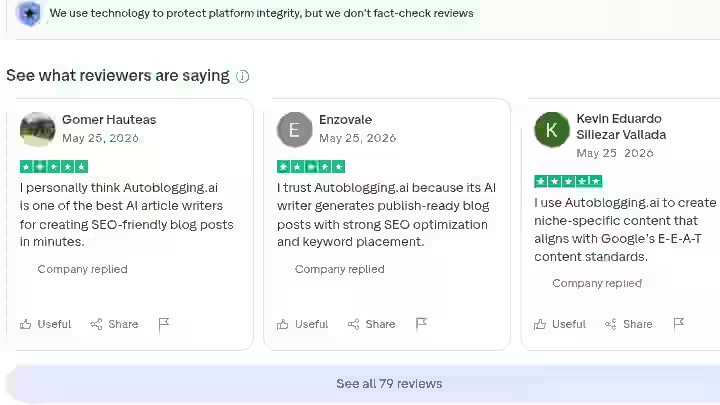
Community sentiment on Autoblogging AI is genuinely split.
Positive Reviews (Trustpilot):
Satisfied users highlight consistency for long-form content generation, particularly noting that the platform handles articles over 1,500 words better than many general AI tools.
One reviewer noted the platform’s strong output for special interest niche topics.
Negative Reviews (Trustpilot):
Critical users call out an inconsistent user experience, a clunky interface, and unreliable credit management.
Recurring complaints cover reliability problems with disappearing credits, sudden account blocks and inconsistent support response times.
Overall pattern:
Users who understand the tool’s limitations and build it into a structured workflow with a human editing step tend to be satisfied. Users who expect it to replace a content team entirely are consistently disappointed.
This is consistent with my own testing experience and with what I observed when I ran multiple tools side by side.
The autoblogging vs traditional blogging comparison I published covers the expectation gap that drives most negative reviews in this category.
Autoblogging AI Weighted Scoring
I use the same weighted scoring system across every tool I review at AboahReviews.com.
Category | Weight | Score (out of 10) | Weighted Score |
|---|---|---|---|
Features and Functionality | 30% | 7.5 | 2.25 |
Ease of Use | 20% | 6.0 | 1.20 |
Pricing and Value | 20% | 8.0 | 1.60 |
Support and Customer Experience | 15% | 6.0 | 0.90 |
Trust and Credibility | 15% | 8.5 | 1.28 |
Final Weighted Rating | 100% | 7.23 / 10 (Rounded to 7.2) |
- Features and Functionality (7.5/10): Multiple generation modes, bulk generation, auto-publishing, schema markups, and topical maps make it a feature-rich platform. Points are lost for inconsistent output quality and limited per-article customization in batch mode.
- Ease of Use (6.0/10): The tool is functional but the interface is behind competitors. Navigation requires a learning period. The generation process itself is straightforward once you know where everything is.
- Pricing and Value (8.0/10): At $0.2 to $0.48 per article credit, the value is strong relative to alternatives in the market. The free plan with 10 credits makes it low-risk to test before committing.
- Support and Customer Experience (6.0/10): Reports are mixed. Some users find the founder responsive. Others report unresolved issues with credits and account management.
- Trust and Credibility (8.5/10): The platform is used by over 40,000 users worldwide and backed by prominent SEO industry investors including James Dooley, Scott Calland, Kasra Dash, and Karl Hudson. The Trustpilot score of 4.6 (during time of writing) and some documented user complaints weigh against a higher rating.
Autoblogging AI Content Detection, Penalty Risks and Compliance
This section of the Autoblogging AI review matters if you are using Autoblogging AI at any meaningful scale.
1. AI Detection Exposure
Raw output from Autoblogging AI scored between 85% and 98% on Originality AI in my testing. After thorough manual editing (adding personal insights, restructuring sentences, inserting original data), scores dropped to the 40% to 60% range.
Full rewrites brought them below 30%.
If AI detection scores matter for your workflow or clients, plan for substantial editing time on every article, not a light pass.
2. Content Penalty Risks
According to Google’s guidelines about AI-generated content, the use of AI to generate content primarily for manipulating search rankings is a violation. The use of AI to produce genuinely helpful content is not.
You get penalized for low-quality content, not for using AI to create it. The risk is in publishing unedited output at scale without editorial oversight.
3. Data Privacy
Autoblogging AI processes your keywords through OpenAI models (GPT-3, GPT-3.5, and GPT-4). Your input data passes through third-party AI infrastructure.
If you work with sensitive client information or proprietary keyword research, understand that this dependency exists.
4. Compliance for YMYL Content
For content covering health, finance, or legal topics, avoid publishing any AI-generated article without expert review.
According to Google’s Search Quality Rater Guidelines, main content created using automated tools with little originality or effort is rated as lowest quality.
Expert review is not optional in YMYL niches.
Final Verdict on Autoblogging AI Review for 2026
BUY Autoblogging AI if you:
- Are a blogger, affiliate marketer or small agency that needs to scale article creation and you have an editing process in place
- Need to go from 2 to 3 articles per week to 8 to 12 articles per week without adding headcount
- Primarily produce informational content in low to mid-competition niches
- Can commit 25 to 45 minutes per article for editing and fact-checking
- Understand that Godlike Mode, bulk generation, and WordPress auto-publishing form a workflow that saves real time, not a finished content product
SKIP Autoblogging AI if:
- You need publish-ready content without any editing step
- Brand voice and thought leadership content are core to your strategy
- You work in YMYL niches without expert oversight in place
- Inconsistent customer support would create problems for your clients or workflow
My Personal Decision
I kept the Standard plan running after the 30-day test period. I use it for informational content across my niche sites. I edit every article.
I do not use it for client-facing thought leadership work or anything requiring genuine original research. For those use cases, I still rely on a human writer.
To understand whether this type of tool fits your overall approach, see my resource on does autoblogging still work in the current search environment.
Frequently Asked Questions About Autoblogging AI Review
1. What is the alternative to autoblogging AI?
Some of the best alternatives to Autoblogging AI include Jasper, Writesonic, Hypotenuse AI, Emplibot, Junia AI, Byword AI and KoalaWriter. The right choice depends on your needs: Jasper is ideal for premium marketing content, while Emplibot and Junia AI are strong options for automated SEO blogging.
2.Why is autoblogging AI the best AI article writer?
Autoblogging AI is the best AI article writer because it combines AI writing, SEO optimization, bulk article generation, SERP analysis and one-click publishing in a single platform. It’s particularly well suited for bloggers, affiliate marketers and agencies that need to produce large volumes of SEO-focused content quickly without sacrificing structure or topical relevance.
3. Is Autoblogging legal?
Yes. Autoblogging is legal in most countries, provided the content doesn’t infringe copyright, plagiarize others’ work, or violate a platform’s terms of service. Using AI to generate original articles, then reviewing, editing and fact-checking them before publishing is generally considered a legitimate publishing workflow.
4. Is blogging dead after ChatGPT?
No. Blogging is evolving, not dying. AI has reduced the value of generic, low-quality content, but blogs that provide first-hand experience, expert insights, original researchand genuinely helpful answers continue to attract traffic from both search engines and AI-powered search experiences.
5. Do AI blogs make money?
Yes. AI blogs can generate income through affiliate marketing, display advertising, sponsored content and digital product sales. Success depends less on using AI and more on publishing high-quality, original content that targets valuable keywords and provides real value to readers.
6. What is the best AI for content writing?
The best AI for content writing depends on your exact needs, but Claude, ChatGPT and Jasper are widely considered the top options. Claude is favored for natural, human-like writing, ChatGPT is the best versatile assistant, and Jasper excels at brand-specific marketing content. Different tools cater to different content writing needs.
7. Is it illegal to publish a book written by AI?
Yes, it is legal to publish a book written by AI, but you cannot legally claim a copyright over purely AI-generated text, as U.S. copyright law requires human authorship. This makes publishing AI content straightforward, though it presents major legal and distribution challenges.