TL;DR: Content automation tools can save you a significant amount of time, but not every tool on the market does what it claims.
This roundup covers 10 tools across different categories:
- AI content generation
- Semantic SEO optimization
- AI content optimization
- Local SEO automation
- Keywords rank tracking
- AI search visibility monitoring
- Advertising campaign automation
- WordPress content automation
If you want an end-to-end SEO content automation platform, Distribb is the strongest overall pick. If you need something more specialized, the right tool depends on your specific workflow gap.
What Are Content Automation Tools?
Content automation tools are software platforms that handle repetitive, time-consuming tasks in a content production or SEO workflow without you having to do every step manually.
The category is broader than most people realize. It includes:
- AI writing tools that generate article drafts from keywords or briefs
- SEO content automation platforms that handle keyword research, content planning, optimization, and publishing in one place
- Content optimization software that scores your existing content against SERP data and gives you recommendations
- AI visibility monitoring tools that track how your brand appears in AI-generated search results
These are different things, and conflating them leads to buying the wrong tool for the job.
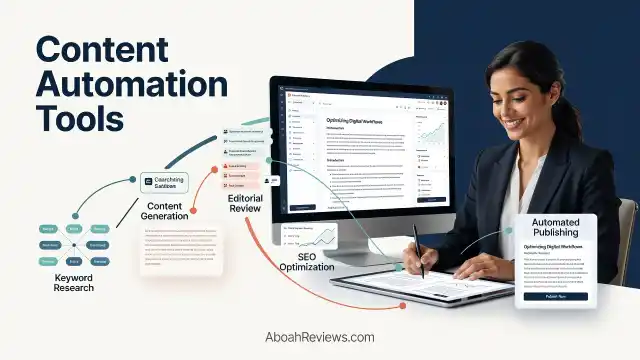
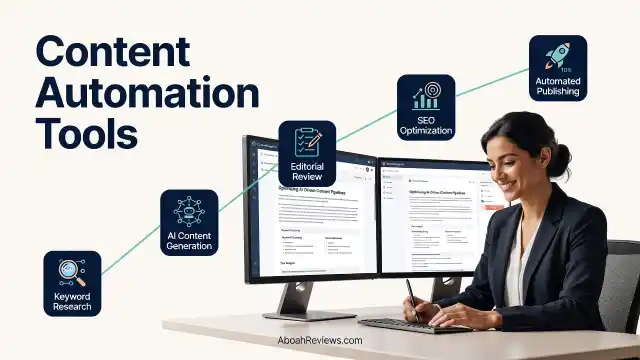
The parts of a content workflow that automation handles most effectively include:
- Keyword data collection and clustering
- Content brief and outline creation
- First-draft AI article generation
- On-page SEO element population (title tags, meta descriptions, headings)
- Scheduled publishing to your CMS
- Internal link suggestions
- Rank tracking and performance reporting
- Brand monitoring in AI search results
The parts that still require human judgment include:
- Search intent analysis
- Fact-checking
- Editorial decisions
- E-E-A-T signals like first-hand experience and genuine expertise
- Anything requiring your brand’s specific voice and perspective
I ran into this repeatedly during my testing. Automation removes the repetitive steps, but it does not replace the thinking behind good content.
Best Content Automation Tools Compared
| Tool | Best for | Primary category | Starting price |
|---|---|---|---|
| Distribb | End-to-end SEO content automation | SEO content automation | $97/mo |
| Otterly AI | AI search visibility monitoring | GEO / AEO | $29/mo |
| BabyLoveGrowth AI | Content and backlink automation | SEO automation | $99/mo |
| Localo | Local SEO and Google Business Profile | Local SEO | $39/mo |
| WordRocket AI | Scalable AI content generation (BYOK) | AI writing automation | Free (BYOK) |
| NeuronWriter | Semantic SEO content optimization | Content optimization | $23/mo |
| RightBlogger | All-in-one blogging automation toolkit | Blogging automation | $59/mo |
| Nightwatch | SEO rank tracking with AI visibility | Rank tracking | €79/mo |
| Clearpost AI | Automated WordPress content publishing | WordPress automation | Free (BYOK) / $99/mo |
| Ryze AI | Automated advertising campaign optimization | Marketing automation | $89/mo |
Important note: Not all ten tools automate content creation. Otterly AI monitors AI search visibility. Nightwatch tracks keyword rankings. Localo manages Google Business Profiles. Ryze AI optimizes paid ads.
I am listing them together because they all automate a meaningful part of a digital marketing workflow, but they solve different problems.
1. Distribb: Overall Best Content Automation Tool
Distribb is an end-to-end SEO content automation platform that handles keyword research, content calendar creation, AI article generation, publishing, backlink exchange, social repurposing and AI search visibility monitoring in a single dashboard.
What Distribb Does
Distribb connects to Google Search Console and uses your existing site data to identify content opportunities.
From there, it builds a content calendar, generates SEO-focused articles, and publishes them to your CMS. It also includes a backlink exchange network that lets you trade links with other publishers on the platform.
The AI visibility component tracks how your content performs in AI-generated search results, which is increasingly relevant as a portion of search traffic shifts to AI platforms.
For a tool at this price point, the scope of what Distribb attempts is unusually wide. That is both its strength and its main limitation: a tool trying to do everything has to make compromises somewhere.
Key Features
- Google Search Console integration for content gap analysis
- Automated keyword research and content calendar
- AI article generation with direct CMS publishing
- Backlink exchange and link-building network
- AI search visibility tracking
- Supports WordPress and other major CMS platforms
Pricing
Distribb offers two paid plans: Pro at $97/month and Accelerator at $495/month. There is a 7-day free trial. No free plan exists.
Distribb’s Pro plan costs $97/month, which is above the median for SEO automation tools.
Pros
- Covers the full content workflow from keyword discovery to publishing
- Backlink exchange built into the platform
- AI visibility tracking included
- Google Search Console integration
Cons
- 7-day trial is very short for evaluating a complex platform
- $97/month starting price is a significant commitment
- No free plan
- Accelerator plan at $495/month is expensive for small publishers
Who Should Use Distribb?
Distribb is a reasonable fit for content-focused businesses that need a single platform to manage keyword research, content production, publishing, and monitoring.
It makes less sense for teams that already have dedicated tools for each of these functions and would not benefit from an all-in-one workflow.
For more context on what end-to-end SEO automation involves, read my complete breakdown of Distribb.
2. Otterly AI: Best for AI Search Visibility Monitoring
Otterly AI tracks how your brand appears in responses generated by AI search platforms, including Google AI Overviews, ChatGPT, Gemini, Perplexity, and Microsoft Copilot.
What Otterly AI Does
You set up prompts, and Otterly monitors those prompts across the AI platforms you care about, tracking whether your brand appears, where it appears, whether competitors are mentioned, and what sources the AI systems cite.
It also includes an AI accessibility audit to check whether AI crawlers can read your key pages.
I spent 30 days monitoring AI search visibility across 50+ search prompts while evaluating GEO tracking tools, and what stood out was how inconsistent AI visibility can be.
A brand might appear prominently for one commercial query and receive no visibility for a closely related query. Tools like Otterly help you understand this pattern rather than guessing at it.
Key Features
- Brand monitoring across ChatGPT, Perplexity, Google AI Overviews, Gemini, and Copilot
- Citation intelligence showing which sources AI systems use
- Competitor visibility tracking
- AI accessibility audit
- AI content scoring
- Multi-brand management on higher tiers
- GEO recommendations
Pricing
Otterly AI has four pricing tiers. Lite is $29/month. Standard is $189/month. Premium is $489/month. Enterprise is custom. A 14-day free trial is available.
The Lite plan includes 15 search prompts, which is a tight limit if you are monitoring more than a couple of brands or query sets.
Pros
- Monitors the widest range of AI platforms in this category
- Clear citation data shows which sources AI systems cite
- Competitive monitoring helps you benchmark against peers
- 14-day free trial gives adequate evaluation time
- 40,000+ users as of August 2026 (company-reported)
Cons
- Prompt volume is capped and add-ons carry an extra cost ($99/month per additional prompt pack)
- Some AI engines, including Google AI Mode and Gemini, sit behind paid add-ons on lower tiers
- $189/month jump from the Lite plan is steep for mid-tier users
- Tracking visibility is not the same as guaranteeing it; AI search results change dynamically
Who Should Use Otterly AI?
Otterly AI is the right choice for brand managers, SEO teams, and agencies that need to understand how their brand appears in AI search results.
It is not a content creation tool. If you are tracking one or two brands and do not need high prompt volume, the Lite plan at $29/month is a low-risk entry point.
See the AboahReviews Otterly AI review for a deeper look.
3. BabyLoveGrowth AI: Best for Content and Backlink Automation
BabyLoveGrowth AI bundles automated article publishing, backlink building, AI visibility tracking, and social content (Reddit and Quora agents) into a service built around a single website per plan.
What BabyLoveGrowth AI Does
The platform takes a managed service approach rather than a DIY tool. You connect your site, set preferences, and the platform handles content production and distribution.
Articles are generated and published on a schedule, links are built through the platform’s network, and AI visibility tracking monitors how your brand appears in AI-generated results.
The backlink component is one of the more unusual features in this category. Rather than a manual outreach tool or an exchange network, BabyLoveGrowth AI integrates link building directly into the content service.
Key Features
- Automated SEO content planning and article generation
- Brand voice learning from existing content
- Automatic publishing to supported CMS platforms
- Backlink exchange and link building network
- AI search tracking and monitoring
- Reddit and Quora agents for social content
- 50+ languages supported
Pricing
BabyLoveGrowth AI has two plans. Grow is $99/month. Scale is $299/month. A 90-day money-back guarantee is offered. A 3-day free trial is available on both plans, with no credit card needed.
Pros
- Backlinks, content, and AI visibility tracking in one service
- 90-day money-back guarantee reduces purchase risk
- Brand voice learning from your existing content
- Reddit and Quora agents add social content distribution
Cons
- $99/month starting price is high for a single-site service
- Less control over individual articles than a DIY platform
- Not suited for teams that want granular editorial oversight
- Scale plan adds multi-market support but costs $299/month
Who Should Use BabyLoveGrowth AI?
BabyLoveGrowth AI suits business owners who want an automated SEO service rather than a tool they manage themselves, and who value the backlink component.
It is not the right fit for content teams that need to approve every article before it goes live or that run more than one website without significant budget.
Read the BabyLoveGrowth AI review for a detailed breakdown.
4. Localo: Best for Local SEO Automation
Localo is a local SEO platform for businesses managing one or more Google Business Profiles, covering rank tracking, review management, and AI-powered task recommendations.
What Localo Does
Localo automates the operational parts of local SEO: monitoring local search rankings, managing review responses, tracking competitor activity, and generating a prioritized list of recommended profile optimizations.
Its Smart Tasks feature uses AI to audit your Google Business Profile and turn the findings into specific, ranked action items.
The Localo AI Agent, added in October 2024 and included with every paid plan, helps execute those tasks without requiring you to manually work through a checklist.
Key Features
- Local keyword rank tracking at city and location level
- Google Business Profile optimization and management
- Smart Tasks AI-generated action checklist
- Review management and AI-suggested responses
- Competitor activity tracking
- Citations manager
- Local SEO performance reporting
- Content Publisher for GBP posts
Pricing
Localo has three tiers: Single Business at $39/month, Pro, and Enterprise. The Single Business plan is verified as of November 2026.
A 14-day free trial is available. The platform also offers a free Local Rank Checker tool that does not require a subscription.
Pros
- Clear guided workflow makes local SEO manageable for non-specialists
- Smart Tasks converts an audit into specific, ranked actions
- Localo AI Agent included on every paid plan
- 14-day free trial
- Free Local Rank Checker available without signing up
Cons
- Primarily covers Google Business Profile; limited cross-channel reporting
- Not suited for agencies needing standardized multi-client reporting at scale
- Rank tracking depth is narrower than a full-scale SEO platform
Who Should Use Localo?
Localo works well for small businesses and agencies managing a modest number of Google Business Profiles. If you need local SEO automation with GBP management built in, it is one of the cleaner tools in the category.
For broader SEO data, you would need to combine it with another platform.
For my complete test results, read the Localo review.
5. WordRocket AI: Best for Scalable AI Content Generation
WordRocket AI is a bring-your-own-key (BYOK) content generation platform that connects to OpenRouter for AI model access and lets you generate, schedule, and publish SEO-focused articles at scale without paying per-word subscription fees.
What WordRocket AI Does
The core concept behind WordRocket is that you pay a platform fee to access the content workflow, and you separately pay OpenRouter for the actual AI model usage at API rates.
There is no markup on the AI calls. This means your content generation cost scales with volume but stays transparent, which is different from most AI writing tools that charge flat subscriptions regardless of how much you produce.
The platform supports bulk article generation via CSV, brand voice training from your own writing samples, sitemap-based internal link injection, AI image generation, and one-click publishing to WordPress and Ghost.
Key Features
- BYOK model: connect OpenRouter API and pay only for what you generate
- Access to GPT-4, Claude, and Gemini models via OpenRouter
- Bulk generation via CSV upload
- Brand voice training from writing samples
- Auto-injected internal links via sitemap
- AI image generation
- One-click WordPress and Ghost publishing
- Competitor analysis and keyword research tools
Pricing
WordRocket AI has a free plan and paid plans from approximately $10/month for the Starter tier up to $20/month for Pro plan and $49.99/month for Premium.
A lifetime deal has also been available through third-party platforms.
The BYOK model means your total cost depends on both the platform fee and your OpenRouter usage.
Pros
- Transparent BYOK pricing with no markup on AI calls
- Access to multiple frontier AI models
- Bulk generation is genuinely useful for high-volume content workflows
- Sitemap-based internal linking saves meaningful manual effort
- Supports WordPress and Ghost publishing
Cons
- BYOK requires you to manage API keys, which adds friction for non-technical users
- Content quality depends heavily on which model you use and how you configure the tool
- Less suitable for teams that want an all-in-one platform with its own AI included
Who Should Use WordRocket AI?
WordRocket AI suits content producers who need high-volume output at a predictable per-article cost and are comfortable managing API keys.
It is not the right fit for users who want a fully managed tool with AI included at a flat rate.
For complete details, check out the WordRocket AI review.
6. NeuronWriter: Best for Semantic SEO Content Optimization
NeuronWriter is a semantic SEO content editor that scores your content against SERP analysis, gives NLP-based keyword recommendations, and provides tools for content planning, internal linking, and competitive analysis.
What NeuronWriter Does
NeuronWriter pulls SERP data for your target keyword, analyzes the top-ranking pages, and generates a list of semantically related terms and entities your content should cover.
You write or import content into the editor, and it shows a score based on how well your content covers the topic compared to what is ranking. The closer you get to full topic coverage, the higher the score.
This approach is particularly useful when you have thin content or pages that rank on page two and need a targeted optimization push.
Key Features
- SERP-based content analysis and competitor research
- NLP and semantic keyword recommendations
- Content scoring with optimization guidance
- Internal linking tool
- AI content generation (using your own AI credits on higher plans)
- Content planning and project management
- Multi-language support
- BYOK (Bring Your Own Key) for unlimited content generation on higher plans
Pricing
NeuronWriter has five plans. Bronze is $23/month. Silver is $45/month. Gold is $69/month. Platinum is $93/month. Diamond is $117/month. Annual billing saves approximately 17-20%. A 7-day free trial is available.
| Plan | Monthly price | Projects | Content analyses |
|---|---|---|---|
| Bronze | $23 | 2 | 25/month |
| Silver | $45 | 5 | 50/month |
| Gold | $69 | 15 | 75/month |
| Platinum | $93 | 30 | 100/month |
| Diamond | $117 | Unlimited | 150/month |
Pros
- Content scoring based on real SERP data, not generic readability metrics
- Semantic keyword recommendations grounded in what already ranks
- Clear project-based structure works well for agencies and content teams
- BYOK on higher plans removes AI generation limits
- Entry price at $23/month is accessible
Cons
- 25 content analyses per month on the Bronze plan is a real limit for high-volume producers
- Not a publishing tool; you export and publish manually
- The content score is a guide, not a ranking guarantee
Who Should Use NeuronWriter?
NeuronWriter is the right choice if content optimization is your primary need: you have existing pages that underperform, or you want to write new content that is properly optimized from the start.
It works well alongside a CMS or publishing workflow. If you need a full end-to-end automation platform, you would combine NeuronWriter with something else.
7. RightBlogger: Best All-in-One Blogging Automation Toolkit
RightBlogger is a blogging automation platform that combines AI article writing, keyword research, automated publishing, site auditing, AI brand monitoring, and social media distribution in one subscription.
What RightBlogger Does
RightBlogger generates full articles, runs automated publishing schedules, connects directly to WordPress and over a dozen other platforms.
It includes a Site Agent that reviews your site every few days (or daily on Agency), reads your Search Console data, and proposes specific fixes such as internal links to add, low-CTR meta descriptions to rewrite, and thin content to update.
The AI Brand Monitor checks how your brand appears across AI platforms including ChatGPT, Google AI Overviews, Gemini, Perplexity, and others. This is included on every paid plan.
The platform was built by Ryan Robinson and Andy Feliciotti and reports over 51,000 users as of late 2026, with a Trustpilot TrustScore of 4.8.
Key Features
- AI article generator with keyword research built in
- Automated publishing schedules (1 post/day on Solo, 3 on Pro, 10 on Agency)
- Site Agent auditing and fix proposals
- AI Brand Monitor across ChatGPT, Gemini, Perplexity, and more
- Google Search Console integration
- Social media distribution across LinkedIn, X, Facebook, Threads, Instagram, and Pinterest (varies by plan)
- 139 language support
- WordPress, Shopify, Webflow, Ghost, Wix, Framer, Notion, and more
- 90+ AI blogging tools included
Pricing
RightBlogger has three paid plans:
| Plan | Monthly billing | Annual billing | Sites |
|---|---|---|---|
| Solo | $59/mo | $49/mo ($588/yr) | 1 |
| Pro | $89/mo | $69/mo ($828/yr) | 3 |
| Agency | $299/mo | $199/mo ($2,388/yr) | 10 |
A free plan is available with 2,000 AI words per month. A 7-day free trial is available on paid plans. A 30-day money-back guarantee applies.
Pros
- Site Agent goes beyond content generation to audit and propose specific site improvements
- AI Brand Monitor included on every paid plan
- Broad CMS and social platform support
- Free plan available; 7-day trial with no payment required
- 139 languages supported
Cons
- Solo plan includes only LinkedIn for social sharing; other networks require Pro
- Site Agent can apply live fixes only on certain platforms (mostly WordPress)
- Rankings and AI inclusion are not guaranteed, per the company’s own disclosure
- Entry price of $49/month (annual) is higher than a basic AI writer
Who Should Use RightBlogger?
RightBlogger is a solid fit for bloggers, content creators, and small agencies that want an all-in-one platform covering content generation, automated publishing, site monitoring, and AI brand visibility.
The Agency plan at $199/month (annual) for 10 sites is competitive for agencies managing multiple client blogs.
Read my RightBlogger review for a full walkthrough.
8. Nightwatch: Best for Automated SEO Rank Tracking
Nightwatch is a rank tracking and SEO monitoring platform with granular local tracking capability and, as of recent updates, AI search visibility monitoring built in.
What Nightwatch Does
Nightwatch tracks keyword rankings across Google, Bing, YouTube, DuckDuckGo, and Yahoo.
Its strongest capability is local rank tracking: it tracks positions at city and zip code level across 107,000+ locations, which makes it one of the more precise tools in the category for local and multi-location businesses.
The AI visibility component tracks your brand across ChatGPT, Claude, Gemini, and Perplexity with prompt monitoring and historical tracking. This is a newer addition that positions Nightwatch beyond traditional rank tracking.
Key Features
- Daily keyword rank tracking across search engines
- City and zip code level local rank tracking
- Competitor ranking analysis
- AI search visibility tracking (ChatGPT, Claude, Gemini, Perplexity)
- Customizable performance reports
- Scheduled automated reports
- Google Analytics integration
- Backlink monitoring
- SEO audit tools (limited on lower plans)
- White-label reports on every plan
Pricing
Nightwatch prices in euros. Plans verified November 2026:
| Plan | Monthly price | Websites | Keywords | AI prompts |
|---|---|---|---|---|
| Starter | €79/mo | 5 | 500 | 50 |
| Professional | €159/mo | 25 | 2,500 | 150 |
| Agency | €399/mo | 100 | — | 500 |
| Enterprise | Custom | — | — | — |
Annual billing is available at a discount.
Pros
- One of the most granular local rank trackers available
- AI visibility monitoring built into the same platform
- White-label reports on every plan, useful for agencies
- Tracks across multiple search engines, not just Google
Cons
- Site audits cap at 25 pages on Starter and Professional plans
- Starting at €79/month is higher than entry-level rank trackers
- AI prompts are capped per plan; not ideal for high-volume monitoring
- Primarily a monitoring tool; no content generation
Who Should Use Nightwatch?
Nightwatch is best for SEO agencies and in-house teams that need accurate rank tracking at a granular local level.
The addition of AI visibility monitoring makes it a reasonable choice for teams that already track rankings and want to bring AI search data into the same workflow.
If you only need AI visibility monitoring without rank tracking, Otterly AI is a more focused option.
9. Clearpost AI: Best for WordPress Content Automation
Clearpost AI is a WordPress plugin that automates the full content pipeline from inside your dashboard: keyword research, content calendar creation, AI article generation, SEO element population, and direct publishing.
What Clearpost AI Does
Unlike standalone content tools that require you to copy and paste between platforms, Clearpost AI lives inside your WordPress admin and handles the workflow there.
It populates Yoast, Rank Math, and AIOSEO fields automatically. It also includes an MCP (Model Context Protocol) server, which means AI agents using Claude Desktop, Claude Code, ChatGPT, or Cursor can interact directly with your site’s content.
Clearpost’s GEO (Generative Engine Optimization) focus is built into the plugin’s architecture: it structures content so that AI systems can read and cite it, not just traditional search crawlers.
Key Features
- Automated SEO keyword research and content calendar
- AI article generation using OpenAI, Claude, or Gemini (your own API keys)
- Auto-population of Yoast, Rank Math, and AIOSEO fields
- Direct WordPress publishing with categories, tags, internal links, and featured images
- MCP server for AI agent integration
- GEO-ready content structuring
- 150+ language support
Pricing
The core plugin is free when you use your own AI provider API keys.
A premium plan is available at $99/month.
The free version includes core features with API key access; the premium service adds a managed content analysis agent and handles AI provider API access on your behalf.
Pros
- Lives inside WordPress with no separate dashboard to manage
- Fills SEO plugin fields automatically
- MCP server is an unusually advanced feature for a WordPress plugin
- Free core version with your own API keys keeps costs low
- GEO-focused architecture
Cons
- Very new platform with limited independent reviews as of late 2026
- Requires bringing your own API keys on the free version; adds operational complexity
- Premium pricing at $99/month is on the higher end for a WordPress plugin
- Small installed base means less community knowledge and fewer tutorials
Who Should Use Clearpost AI?
Clearpost AI is a good fit for WordPress site owners who want automated content production without leaving their dashboard.
The free BYOK version is worth trying if you are already using the OpenAI, Claude, or Gemini API for other work.
Agencies managing 10 to 30+ WordPress sites are an explicitly supported use case.
For a detailed review, see the Clearpost AI review.
10. Ryze AI: Best for Automated Advertising Campaign Optimization
Ryze AI is an advertising management platform that uses AI agents to optimize paid ad campaigns across Google Ads, Meta Ads, TikTok, LinkedIn, Microsoft Ads, and other channels, with a human approval step on each proposed change.
What Ryze AI Does
Ryze AI connects to your ad accounts, reviews performance daily, and proposes bid, budget, keyword, and creative changes.
Each change requires owner approval before it is applied, which keeps a human in the loop.
The platform also includes SEO audit features and brand citation tracking across ChatGPT, Claude, Gemini, and Perplexity.
As of February to March 2026, Ryze added a live dashboard with approval cards and an MCP connector that lets Claude and other AI assistants run Google, Meta, and LinkedIn ads through the same interface.
The company reports over 2,000 marketers managing more than $500 million in ad spend on the platform.
Key Features
- Daily bid, budget, and negative keyword proposals for Google Ads and Meta Ads
- AI-generated ad creatives from a brief
- Campaign building from chat
- MCP connector for Claude, Cursor, and other AI tools
- Cross-platform coverage: Google, Meta, TikTok, LinkedIn, Snapchat, Reddit, Microsoft
- Competitor analysis via Meta Ads Library
- SEO audit and on-page fixes
- Brand citation tracking in ChatGPT, Claude, Gemini, and Perplexity
- Approval workflow on every proposed change
Pricing
Ryze AI’s core plan is Paid Ads Autopilot at $89/month flat, with a 7-day free trial.
The flat fee covers all ad spend levels without a percentage-of-spend charge, which differentiates it from competitors like Madgicx that tier by spend.
Higher plans exist for agencies and larger operations, up to $1,499/month for Ecom Autopilot.
Pros
- Flat monthly fee regardless of ad spend is predictable for scaling businesses
- Human approval step on every change prevents autonomous errors
- MCP connector is a genuinely useful integration for AI-powered workflows
- Covers more ad platforms than most comparable tools
- Includes SEO and AI visibility tracking alongside ad management
Cons
- Advertising automation is a different category from content automation; not a content tool
- The approval workflow requires active attention; it is not fully autonomous
- Credit system caps agent usage; higher volumes may hit limits
- Primarily useful if you are already running paid ads; no value if you are not
Who Should Use Ryze AI?
Ryze AI makes sense for small to midsize businesses and agencies running paid ad campaigns on Google or Meta who want daily optimization without hiring a dedicated PPC manager.
The flat fee is competitive for businesses spending more than $5,000/month on ads, where a percentage-based tool would cost more.
I highly recommend checking out my full takeaway of Ryze AI.
Feature Comparison: What Each Tool Actually Automates
| Feature | Tools |
|---|---|
| Automated article writing | Distribb, BabyLoveGrowth AI, WordRocket AI, RightBlogger, Clearpost AI |
| Keyword research | Distribb, RightBlogger, NeuronWriter, Clearpost AI |
| Content optimization / scoring | NeuronWriter, Distribb, RightBlogger |
| Automatic CMS publishing | Distribb, BabyLoveGrowth AI, Clearpost AI, WordRocket AI, RightBlogger |
| Backlink automation | Distribb, BabyLoveGrowth AI |
| AI visibility tracking | Otterly AI, Nightwatch, Distribb, BabyLoveGrowth AI, RightBlogger, Ryze AI |
| Local SEO automation | Localo, Distribb |
| Rank tracking | Nightwatch, Localo |
| Advertising automation | Ryze AI |
Benefits of Using Content Automation Software
- Removes repetitive tasks from your workflow: Keyword data collection, brief creation, content calendars, and reporting are the tasks that benefit most from automation. These are time-consuming but do not require creative judgment, which makes them good candidates for software to handle.
- Speeds up content production: A 21-day comparison I ran across 25 optimization tasks showed that the manual workflow required moving between multiple tools and completing many repetitive steps. Automation reduced the time required, particularly on data collection and reporting.
- Makes publishing more consistent: A scheduled automated workflow keeps content going out on a predictable cadence, which matters for topical authority and site freshness.
- Helps manage multiple websites: Platforms like RightBlogger and Distribb are built to handle multi-site workflows. Managing content across three to ten sites manually becomes impractical at a point where automation genuinely earns its cost.
- Simplifies SEO monitoring: Rank tracking, AI visibility monitoring, and site auditing at scale require software. Doing this manually across dozens of keywords and multiple AI platforms would take more time than it saves.
Disadvantages of Content Automation Tools
- AI-generated drafts need editing: I found issues in automated workflows including irrelevant keyword suggestions, pages targeting overlapping search intent, and recommendations that looked correct on paper but did not make sense for the page. Automation does not eliminate the need to review what it produces.
- Publishing mistakes cost you: I lost rankings on an affiliate site after publishing 42 auto-generated posts without adequate internal linking or keyword filtering. Automated publishing without editorial control is a risk, not a benefit.
- Multiple subscriptions add up fast: If you need a content automation tool, a rank tracker, an AI visibility monitor, and a local SEO platform, you could easily spend $300 to $500 per month before anything else. Budget planning matters.
- Some platforms automate one step, not the whole workflow: A tool that generates articles but does not optimize them, or one that optimizes but does not publish, leaves you stitching together the rest of the workflow manually.
- Automated recommendations are not guarantees: No SEO automation tool can guarantee rankings. Distribb does not guarantee them. RightBlogger explicitly states this. Any platform that implies otherwise is making a claim it cannot support.
How to Choose the Best Content Automation Tool
Content generation capabilities
Check whether the tool generates original research-grounded content or just remixes existing sources. Look at the editing controls: can you adjust tone, brand voice, and format before publishing? Find out whether a human review step is built into the workflow or whether articles go live automatically.
SEO automation
A good SEO automation tool should cover keyword research, semantic optimization against SERP data, internal linking, and technical SEO support.
Tools like NeuronWriter focus on optimization after the fact, while Distribb and RightBlogger build SEO into the generation process.
Publishing integrations
Check whether the tool connects to your actual CMS. WordPress is universally supported. Shopify, Webflow, Ghost, and Framer have varying levels of support depending on the platform.
AI search visibility
If tracking your brand in AI-generated search results matters to your business, check which AI platforms a tool covers. Otterly AI covers the widest range. RightBlogger and Nightwatch include this alongside their other features. For more on this topic, see how to optimize for AI search.
Pricing and scalability
Consider the total cost across the tools you would need, not just one subscription. A platform at $97/month that covers five workflow steps might cost less than three separate tools at $30 to $50 each.
Human editorial control
Determine whether you can review, edit, and approve content before it publishes. The most effective automated workflows I have tested are ones that give me control over the final output rather than publishing autonomously.
The time savings are real; the cleanup cost when something goes wrong can be significant.
How to Build a Content Automation Workflow
A practical workflow using the tools in this guide:
- Discover keywords and content opportunities: Use Distribb, RightBlogger, or NeuronWriter’s keyword research. Connect Google Search Console for existing site data.
- Build a content calendar: Distribb and RightBlogger build calendars automatically from keyword data. ClearPost does this inside WordPress.
- Generate article briefs and outlines: NeuronWriter creates SERP-based content briefs. RightBlogger and Distribb generate outlines alongside the article.
- Produce SEO-focused content: Distribb, WordRocket AI, BabyLoveGrowth AI, RightBlogger, or Clearpost AI generate the draft. WordRocket AI gives you model flexibility via BYOK.
- Optimize for search intent and semantic coverage: Run the draft through NeuronWriter’s editor to check topic coverage against SERP data.
- Review and fact-check: This step stays human. AI-generated content requires editorial review before it represents your brand.
- Publish to your CMS: Distribb, WordRocket AI, BabyLoveGrowth AI, RightBlogger, and Clearpost AI all publish directly. Clearpost AI stays inside WordPress.
- Monitor rankings and AI search citations: Use Nightwatch for rank tracking. Use Otterly AI for AI search visibility. Use Localo if you manage local SEO.
- Update underperforming content: RightBlogger’s Site Agent reviews your existing content and proposes specific improvements. NeuronWriter can re-score an underperforming page.
The key point from my testing: the best automated workflows are ones where automation removes the repetitive steps without creating another layer of cleanup.
If you are spending as much time fixing automation errors as you would have spent doing the work manually, the tool is not saving you time.
Final Takeaway: Which Content Automation Tool Should You Choose?
Distribb is the strongest overall choice for end-to-end SEO content automation: keyword research, content calendar, AI generation, publishing, backlinks, and AI visibility monitoring in one platform. The $97/month starting price is a real commitment, but if you need the full workflow covered, it is the most complete option in this category.
Otterly AI is the right choice if AI search visibility monitoring is your specific need. It covers more AI platforms than any other standalone tool in this list and gives you citation-level data, not just mention counts.
BabyLoveGrowth AI suits businesses that want a managed service approach with backlinks included, rather than a DIY tool.
Localo is the clearest choice for local SEO: it focuses specifically on Google Business Profile management and local rank tracking in a way that generalist platforms do not match.
WordRocket AI is best for high-volume content producers who want transparency on AI costs and flexibility in model selection.
NeuronWriter is the right tool if content optimization rather than content generation is your primary need. It works alongside your existing workflow rather than replacing it.
RightBlogger is the strongest all-in-one option for bloggers and content teams that want automated publishing, site auditing, and AI brand monitoring without piecing together separate tools.
Nightwatch is the right rank tracker for teams that need granular local tracking. The addition of AI visibility monitoring adds value for teams already tracking rankings.
Clearpost AI is worth considering if you manage WordPress sites and want an automation tool that lives inside your dashboard rather than requiring a separate login.
Ryze AI is not a content tool. It is an advertising automation platform that earns its place on this list because paid ad management is part of many digital marketing workflows. If you run Google or Meta ads and want daily automated optimization at a flat monthly fee, it is a reasonable choice.
The consistent theme from testing across all of these tools: automation works best when it handles the repetitive, predictable parts of a workflow and leaves the judgment calls to you.
Every tool on this list that publishes content automatically needs a human review step to catch errors before they affect your site. That is not a limitation of the tools; it is how good content workflows are designed.
Frequently Asked Questions About Content Automation Tools
What are the best content automation tools in 2026?
The best content automation tools in 2026 depend on what you are trying to automate. Distribb is the strongest end-to-end option for SEO content automation. RightBlogger is the best all-in-one platform for bloggers. NeuronWriter is the top choice for content optimization. Otterly AI leads for AI search visibility monitoring. Localo is the best tool for local SEO automation.
What is the best AI tool for automating blog content?
RightBlogger and Distribb are the most complete options for automating the full blog content workflow, covering keyword research, article generation, and publishing. If you are WordPress-based and want everything inside your dashboard, Clearpost AI is a focused alternative. WordRocket AI is the strongest option if you want model flexibility and transparent per-article AI costs via BYOK.
Are content automation tools worth paying for?
They are worth paying for when they remove enough manual work to justify the subscription cost. If you are publishing one article a week, automation probably does not pay for itself. If you are managing multiple sites or publishing daily, the math changes.
What is the difference between content automation and AI content generation?
AI content generation is one component of content automation. Content automation covers the broader workflow: keyword research, planning, generation, optimization, publishing, monitoring, and reporting. An AI writing tool generates a draft. A content automation platform manages the whole pipeline.
What is the best content automation software for agencies?
For agencies managing multiple clients, the most useful platforms are RightBlogger Agency at $199/month (annual) for 10 sites, Distribb for end-to-end content automation, and Nightwatch at €399/month for 100 sites with rank tracking and AI visibility monitoring. Localo works for agencies with local SEO clients. The right combination depends on whether your agency needs content production, SEO monitoring, or both.
How accurate are automated SEO recommendations?
Automated SEO recommendations vary considerably in accuracy. During my testing I found irrelevant keyword suggestions, overlapping search intent across pages, and technically correct recommendations that did not make sense for the specific page or audience. Automation can miss context. The best approach is to treat automated recommendations as a starting point and apply judgment before implementing them.
Can content automation tools guarantee AI search rankings or citations?
No. AI search results change dynamically, and no tool can guarantee a citation in Google AI Overviews, ChatGPT, or any other AI platform. Otterly AI, Nightwatch, RightBlogger, and others can track your visibility in AI search results and help you optimize for it, but that is different from guaranteeing a specific outcome. Any vendor claiming to guarantee AI citations is making a claim that is not supportable.
Disclaimer: This article reflects research conducted through November 2026 and direct testing experience across automated SEO workflows. Pricing was verified from official vendor pages, not third-party sources. Some links in this article are affiliate links, which means AboahReviews.com may earn a commission if you sign up through them, at no extra cost to you. This does not influence the recommendations or evaluations in this review.

- 10 Best Content Automation Tools I Personally Tested in 2026 - November 28, 2026
- Vectoron vs Conductor.com: Which Is Better for Enterprise SEO and AI Visibility Tracking in 2026? - November 25, 2026
- Google Ads for Doctors SEO Outline: Complete Breakdown for 2026 - November 24, 2026