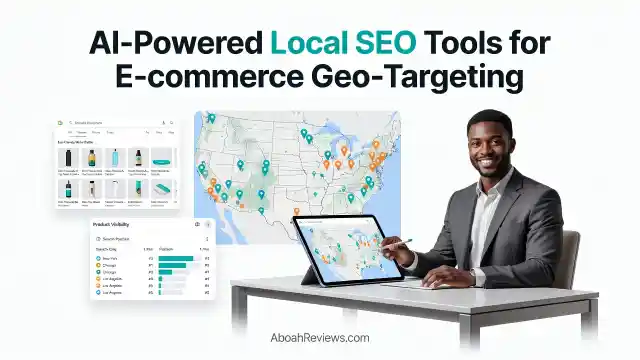
TL;DR: This article reviews 7 AI-powered local SEO tools for e-commerce geo-targeting businesses that need to rank in specific cities, states or regions.
If you run an online store and need to know which tools actually support geographic targeting, this is the breakdown you need.
The Problem With E-commerce Local SEO Sites
If you sell products online but only rank in one city, you are leaving sales on the table. That is the core problem local SEO solves for e-commerce.
A customer in Atlanta searching for “custom phone cases near me” or “buy handmade candles in Atlanta” gets different results than someone searching the same terms in Chicago.
If your store does not show up for the right geography, you do not get the sale.
I spent time researching and testing AI-powered local SEO tools for e-commerce geo-targeting, comparing their actual capabilities against what vendors claim.
The tools in this article range from dedicated local SEO software focused on Google Business Profiles to broader SEO platforms that help you produce location-specific content at scale.
Some of these tools are built for businesses with physical stores. Others work for online-only retailers. I explain the difference throughout.
What Are AI-Powered Local SEO Tools for E-commerce Geo-targeting?
AI-powered local SEO tools help e-commerce businesses rank in specific geographic markets by automating tasks like location-based keyword research, local rank tracking, geographic content creation, and business listing management.
Traditional e-commerce SEO focuses on ranking nationally or globally for product keywords. Local SEO for e-commerce works differently. It targets location-specific search queries: people searching for products in a particular city, state, or region.
Those searches carry strong purchase intent, and the competition is often lower than broad national keywords.
Local SEO vs. Traditional E-commerce SEO
Traditional e-commerce SEO targets keywords like “buy running shoes online” or “best wireless headphones.” Local e-commerce SEO targets keywords like “running shoes store in Denver” or “buy wireless headphones Atlanta.”
The search intent is similar, but the geographic qualifier changes who shows up.
Google surfaces results differently depending on the searcher’s location. A product that ranks well nationally may not appear in local map packs or geographically filtered results.
That gap is what local SEO tools address.
Where Geo-Targeting Applies in E-commerce
Local SEO for e-commerce applies in several situations:
- Physical stores with online presence: Retailers with storefronts benefit directly from Google Maps rankings, Google Business Profiles, and local organic search.
- Multi-city delivery businesses: A bakery or florist that delivers within a 50-mile radius needs to rank in specific zip codes and cities.
- Regional marketplaces: An e-commerce store that only ships within a country, state, or set of cities benefits from geo-targeted organic content.
- Online stores targeting underserved local markets: A national store can capture search demand by creating location-specific landing pages for high-intent regional searches.
How AI Fits Into Local SEO for E-commerce
AI tools help with local SEO in three main ways.
- First, they automate the research side: identifying which geographic markets have search demand, which competitors dominate local results, and which keywords are worth targeting per location.
- Second, they assist with content production: generating location-specific product pages, category descriptions, and landing pages faster than a purely manual process.
- Third, they handle monitoring: tracking rankings across different geographic locations over time, flagging ranking changes, and surfacing local visibility data.
The limitation is that AI tools in this category are not equal. Some focus on Google Business Profiles and local map rankings, which matters most for businesses with physical stores.
Others focus on content generation and keyword research, which matters more for online-only stores. Few tools do both well.
How AI-Powered Local SEO Tools Help E-commerce Businesses Target Geographic Markets
The best local SEO tools reduce the manual work of researching, creating, and monitoring location-specific SEO, while still giving you enough control to avoid the errors that come with fully automated workflows.
Identify Location-Specific Product Keywords
Location-specific product keywords are search queries that combine a product or category with a geographic modifier. Examples: “buy leather boots in Nashville,” “custom dog tags Chicago,” or “organic skincare Los Angeles.”
These keywords often have lower competition than broad national terms and attract buyers with strong local intent.
AI tools automate the discovery of these keywords by pulling search volume data, ranking difficulty, and competitor rankings across geographic segments.
The manual version of this involves running individual keyword searches for each city, which is slow and inconsistent.
Tools like SE Ranking and NeuronWriter speed this up by identifying keyword clusters and location-specific variations at scale.
Track Rankings Across Different Geographic Locations
Local rank tracking is different from standard keyword tracking. A single keyword can produce different ranking positions depending on where the searcher is located.
A product page ranking number 3 in Dallas may rank number 14 in Houston for the same keyword.
Geo-grid tracking tools show you exactly where your rankings are strong and where they drop off on a geographic grid, often overlaid on a map.
Local Dominator and Synup offer this type of grid-based tracking. For e-commerce businesses with physical stores or service areas, this data shows you which zip codes or neighborhoods you are winning in, and which you are losing to competitors.
Optimize Product and Category Pages for Local Search Intent
Product and category page optimization for local search means adjusting your page content to signal relevance for geographically specific queries.
That includes adding location-specific text to product descriptions, creating location-based category pages, and structuring content to match the search intent of buyers in a particular city or region.
NeuronWriter handles this well for content optimization. It identifies NLP-based keyword recommendations and competitor content patterns, which you can apply to create location-relevant pages.
The limitation is that it does not track local map rankings, so it covers the organic content side rather than the Google Maps side.
Manage Business Listings and Location Information
For e-commerce businesses with physical locations, accurate business listing data is a ranking factor.
Inconsistent name, address, and phone number (NAP) information across directories like Google Business Profile, Yelp, and Bing Places can suppress local rankings.
Synup and Localo both handle listing management. They sync your business information across multiple directories, flag inconsistencies, and help maintain accurate location data at scale.
This matters most for multi-location retailers or brands with both online and physical presence.
Generate Geographically Relevant Content
Geographically relevant content is content that is specifically written for or adjusted to reflect a particular location.
For e-commerce, this includes city-specific product landing pages, regional buying guides, and location-tailored category descriptions.
Distribbb automates a large part of this. It generates SEO content including location-specific articles at scale, with keyword research and publishing automation built in.
The risk here, which I cover in the limitations section, is that fully automated location content can become thin and repetitive if the pages do not contain genuinely location-specific information.
Monitor Competitors in Individual Markets
Competitor monitoring in local SEO tells you who is outranking you in a specific city or region, what keywords they are ranking for, and what content or listings they are using to do it. Without this data, you are optimizing blind.
SE Ranking provides competitor research at the keyword and market level. Localo and Local Dominator surface competitor visibility within geo-grids.
Knowing which competitor dominates your target geography is the first step to building a strategy to displace them.
Improve Visibility in Google AI Overviews and AI Search
AI search results from Google, Perplexity, and ChatGPT increasingly appear for location-based product queries.
A search like “best running shoe stores in Austin” may now surface an AI-generated response before the standard organic results. If your business or content is not being cited by AI search systems, you are missing this new visibility channel.
Tracking AI visibility for local queries requires different tools than traditional rank tracking. I cover AI search visibility in more depth in the generative engine optimization tools resources on this site.
7 Best AI-Powered Local SEO Tools for E-commerce Geo-Targeting
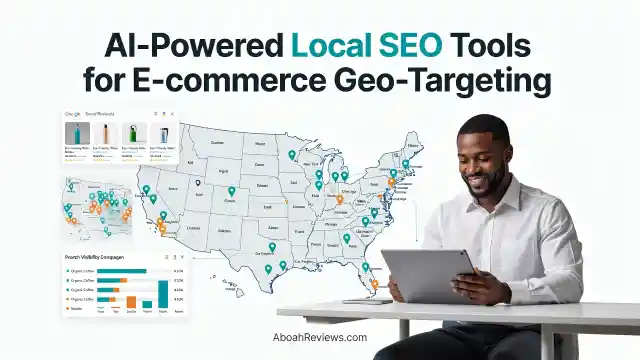
I evaluated these platforms based on the following criteria: geographic keyword and rank tracking, AI content generation and optimization, local listing management, multi-location SEO support, competitor analysis, e-commerce compatibility, and pricing.
I looked for tools that deliver genuine geo-targeting capabilities, not just generic SEO features that happen to include a “local” label.
1. Localo: Best for Local Search Optimization
Localo is built around Google Business Profile management and local search visibility. It is the clearest fit for e-commerce businesses with physical retail locations.
What it does: Localo monitors and optimizes your Google Business Profile, tracks local keyword rankings using a geo-grid, monitors competitor visibility in your local area, manages review responses, and automates Google Posts.
It includes AI-powered recommendations for profile improvements and content suggestions.
Key features:
- Google Business Profile optimization and health scoring
- Local keyword rank tracking with geo-grid visualization
- Competitor visibility analysis in local maps
- Review management and AI-assisted response drafting
- Local citation and directory management
- Google Posts automation
Where it works for e-commerce: If you run a Shopify or WooCommerce store that also has a physical storefront, Localo is a strong choice.
It surfaces the specific actions that improve your Google Maps ranking: completing your profile, responding to reviews, posting regularly, and building local citations.
The geo-grid tracking shows you exactly where your visibility drops off around your store location.
Where it falls short: Localo is not designed for online-only retailers. Without a verified Google Business Profile (which requires a physical address), you cannot use most of its core features.
It is also not an SEO content tool, so it does not help you create location-specific product pages or optimize your website for local organic search.
Pricing: Localo offers a free plan with limited features. Paid plans start at around $29/month. Exact pricing varies by plan and feature set, so verify current plans on their website.
Best for: E-commerce stores with physical locations that want to improve Google Maps visibility and automate Google Business Profile management.
Avoid if: You run an online-only store without a physical address or you need website content optimization alongside listing management.
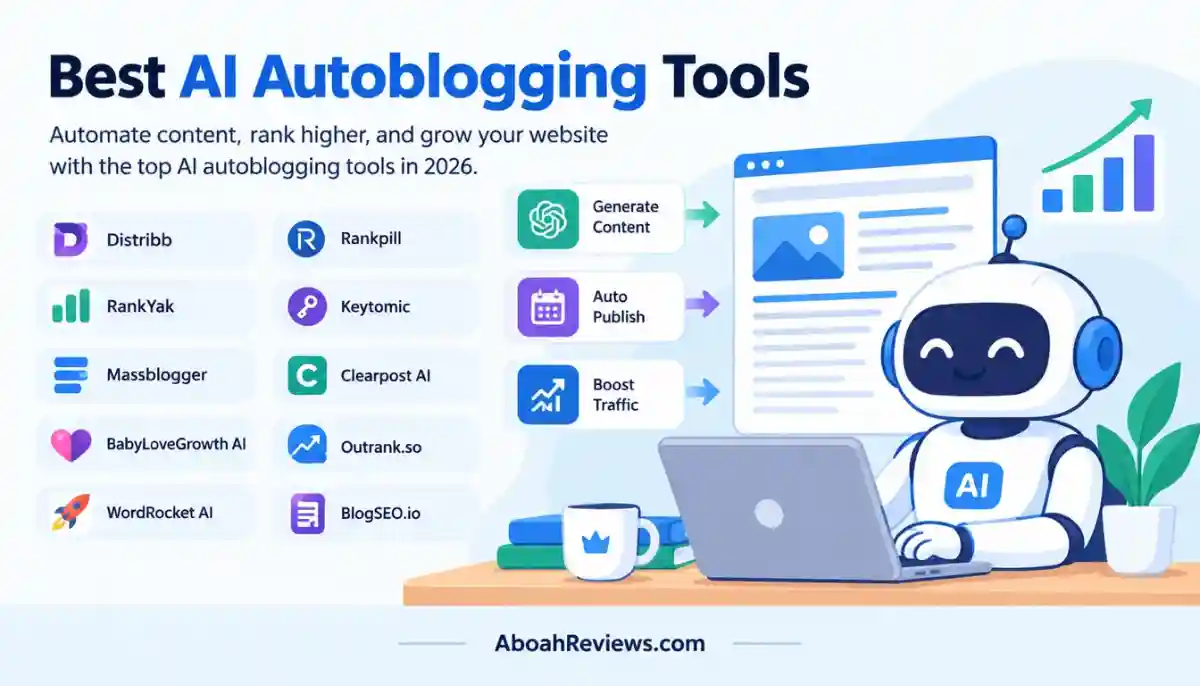
2. Distribb: Best for Automated SEO Content and Geographic Landing Pages
Distribb is an SEO content automation platform that can support geographic targeting through its keyword research and AI content generation workflows.
It is a different kind of tool from Localo: focused on content and organic search rather than local map rankings.
What it does: Distribbb automates keyword research, generates AI SEO articles, manages a content calendar, integrates with Google Search Console, and publishes content to your website.
It can generate geographically targeted content by identifying location-specific keyword opportunities and writing articles that target those searches.
Key features:
- Automated keyword research and content planning
- Google Business Profile management
- AI-generated SEO articles with direct publishing
- Google Search Console integration for performance data
- Content calendar and scheduling
- Location-specific content generation based on keyword data
Where it works for e-commerce: If you need to produce location-specific landing pages or blog content at scale, Distribbb reduces the manual workload.
An e-commerce store targeting buyers in multiple cities can use it to build out a library of location-targeted content faster than a purely manual process. The Google Search Console integration helps you track which geographic content is driving traffic.
Where it falls short: Distribbb does not offer dedicated geo-grid rank tracking or local listing synchronization.
Its geo-targeting is indirect: it helps you produce content that targets location-specific keywords, but it does not track your ranking in a local map pack or visualize geographic ranking performance.
Best for: E-commerce content teams that want to scale geographically targeted blog or landing page content without hiring a large writing team.
Avoid if: You need local map tracking, or multi-location listing synchronization.
3. SE Ranking: Best for Multi-Location SEO Tracking
SE Ranking is a full-service SEO platform with dedicated local SEO features that make it one of the most practical choices for e-commerce businesses targeting multiple geographic markets.
What it does: SE Ranking provides location-based keyword rank tracking, Google Business Profile management, competitor research, website audits, local listing management, and AI-assisted content workflows.
Its local marketing module supports multi-location businesses with reporting, GBP management, and local citation tracking.
Key features:
- Location-based keyword rank tracking (down to city and zip code level)
- Google Business Profile management and monitoring
- Local listing management and NAP consistency tracking
- Competitor research with keyword gap analysis
- Website audit with technical SEO recommendations
- AI content tools for optimization and drafting
- Customizable reporting for agency and multi-client use
Where it works for e-commerce: SE Ranking is the most complete option in this list for e-commerce businesses that need to track rankings across multiple geographic markets simultaneously.
You can set up rank tracking for the same keywords across different cities and monitor how your position changes by location. This is useful for a retailer expanding into new markets who wants to know which locations are winning and which need more work.
Where it falls short: SE Ranking covers a lot of ground, which means the local SEO features are not as deep as a dedicated tool like Localo or Local Dominator.
The geo-grid visualization is not as detailed as specialized local tracking tools. The price also increases significantly as you add more tracked keywords or projects.
Pricing: SE Ranking plans start at around $65/month on annual billing. Local SEO features are included in higher tiers.
Best for: E-commerce businesses and agencies that need a single platform covering keyword tracking, local SEO, website audits, and reporting across multiple locations.
Avoid if: You only need local map ranking data or GBP automation and do not need a full SEO platform.
4. NeuronWriter: Best for Location-Specific Content Optimization
NeuronWriter is a content optimization platform that uses NLP (natural language processing) analysis to help you write content that ranks.
It is not a local SEO platform in the traditional sense, but it has real value for optimizing location-specific landing pages and product content.
What it does: NeuronWriter analyzes top-ranking content for a given keyword and provides NLP-based recommendations for terms, entities, and content structure that your page should include.
It offers AI writing assistance, competitor content analysis, and content scoring. For location-specific content, it identifies the semantic elements that top-ranking local pages include.
Key features:
- NLP-based content analysis and optimization recommendations
- Competitor content comparison
- AI writing assistant with content outlines
- Content scoring against competitor benchmarks
- Product and category page optimization
- Keyword research and clustering
Where it works for e-commerce: If your e-commerce site is producing city-specific landing pages, NeuronWriter helps you optimize each page’s content to match what is actually ranking for that location query.
Rather than guessing which terms to include in a “buy handmade candles in Denver” page, you can see which terms and entities the top-ranking competitors are using and structure your content accordingly.
Where it falls short: NeuronWriter is a content tool, not a local SEO platform. It does not track local map rankings, manage Google Business Profiles, or provide geo-grid tracking.
If you need location-specific rank tracking or listing management, you need a separate tool. Its geo-targeting support is entirely on the content optimization side.
Pricing: NeuronWriter plans start at around $23/month. Verify current pricing on their website before subscribing.
Best for: E-commerce content teams optimizing location-specific landing pages and product category pages for organic local search.
Avoid if: You need map ranking data, GBP management, or any local listing management functionality.
5. Local Dominator: Best for Geographic Rank Tracking
Local Dominator is built specifically for geo-grid rank tracking. It is the most focused tool in this list for understanding exactly where your business ranks on a geographic map.
What it does: Local Dominator tracks your Google Maps rankings using a geo-grid overlay. You enter a business location and target keywords, and it shows you your ranking position at multiple points on a geographic grid.
This gives you a visual map of where you rank well and where you drop off. It also surfaces competitor visibility within the same grid.
Key features:
- Google Maps geo-grid rank tracking
- Geographic ranking heatmaps
- Competitor visibility mapping
- Local keyword position monitoring by location
- Identifying underserved geographic areas with ranking opportunities
Where it works for e-commerce: For e-commerce businesses with physical stores, Local Dominator answers a question that standard rank trackers cannot: “Do I rank number 1 in Google Maps for a customer standing five blocks from my store?”
The answer changes by location, and Local Dominator makes those differences visible. It is useful for multi-location retailers who want to compare geographic performance across different store catchment areas.
Where it falls short: Local Dominator is a tracking tool, not an optimization tool. It tells you where you rank but does not generate content, optimize your GBP, or manage listings.
It also requires a verified Google Business Profile, which limits its value for online-only stores. The feature set is narrow compared to SE Ranking or Synup.
Pricing: Local Dominator offers a free tier with limited reports. Paid plans are priced per report or by subscription.
Best for: E-commerce businesses with physical stores that need precise geographic rank tracking to identify which areas they are winning and losing in Google Maps.
Avoid if: You run an online-only store, or you need a full local SEO platform rather than a dedicated tracking tool.
6. Synup: Best for Multi-Location Listing Management
Synup is a local marketing platform built for businesses that need to manage multiple locations and keep their listing data accurate and consistent across directories.
What it does: Synup synchronizes your business information across search engines, directories, and social platforms. It offers local SEO rank tracking, geographic grid monitoring, review management, AI-assisted content tools, and multi-location reporting.
Its primary strength is ensuring your business data is accurate and consistent everywhere it appears online.
Key features:
- Business listing synchronization across 100+ directories
- NAP consistency monitoring and correction
- Local SEO rank tracking with geographic grid data
- Review management and AI-assisted response drafting
- Competitor comparisons at the local level
- Multi-location reporting and dashboards
- AI tools for local content and GBP posts
Where it works for e-commerce: Synup is the right choice for e-commerce brands that have multiple physical store locations and need to keep listing information consistent across all of them.
A retailer with 10 stores in different cities gets practical value from Synup’s automated listing sync and multi-location reporting. The geographic grid tracking helps identify ranking weaknesses at individual locations.
Where it falls short: Synup is enterprise-oriented, which means it is priced for businesses with multiple locations rather than individual e-commerce stores.
For online-only e-commerce businesses without Google Business Profiles, Synup’s core listing management features do not apply.
Pricing: Synup is priced per location per month and tailored to business size.
Best for: Multi-location e-commerce retailers and agencies managing local SEO across many physical locations.
Avoid if: You run a single-location or online-only store, or you need a tool with public, budget-friendly pricing.
7. Paige by Merchynt: Best for Automated Local Business Marketing
Paige, built by Merchynt, is an AI tool designed to automate Google Business Profile management and local marketing for small businesses. It is focused on making local SEO accessible without requiring deep SEO knowledge.
What it does: Paige automates Google Business Profile optimization, generates Google Posts, drafts review responses, provides local ranking reports, produces Google Maps heatmaps, monitors AI search visibility, and offers local website optimization recommendations.
It is designed as an AI assistant that runs many local marketing tasks on autopilot.
Key features:
- Automated Google Business Profile optimization
- AI-generated Google Posts on a schedule
- Review response drafting and reputation monitoring
- Local ranking reports and progress tracking
- Google Maps heatmaps for geographic visibility
- AI search visibility monitoring for local queries
- Local website optimization guidance
Where it works for e-commerce: Paige is a good fit for e-commerce businesses with physical retail locations that want automated local marketing without managing each task manually.
The AI search visibility monitoring is a differentiator: it surfaces when and where your business appears in AI-generated answers for local queries, which is a capability most traditional local SEO tools do not offer.
Where it falls short: Like Localo, Paige requires a verified Google Business Profile. Online-only retailers without a physical address cannot access its core features.
The tool is designed for small to medium local businesses, so agencies with large multi-location portfolios may find it limited compared to Synup or SE Ranking.
Pricing: Paige by Merchynt offers plans starting at around $49/month.
Best for: Small to medium e-commerce businesses with physical stores that want to automate local marketing and monitor AI search visibility without managing each task manually.
Avoid if: You run an online-only store without a Google Business Profile, or you manage dozens of locations and need enterprise-grade reporting.
AI-Powered Local SEO Tools Compared: Features and Capabilities
The table below summarizes each platform’s primary strength and key capabilities. “Geo-tracking” refers to dedicated geographic rank tracking (geo-grids or location-based position data).
“AI content” means the platform includes AI content generation or optimization. “Local listings” means the platform manages and syncs business listings across directories.
| Platform | Primary strength | Starting price | Geo-tracking | AI content | Local listings | Best for |
|---|---|---|---|---|---|---|
| Localo | Local search optimization | ~$29/mo | Yes (geo-grid) | Yes (recommendations) | Yes | Physical stores |
| Distribbb | SEO content automation | Varies | Indirect | Yes | No | Content scaling |
| SE Ranking | Multi-location SEO tracking | ~$65/mo | Yes (city/zip) | Yes | Yes | Agencies, multi-market |
| NeuronWriter | Content optimization | ~$23/mo | Indirect | Yes | No | Content teams |
| Local Dominator | Geo-grid rank tracking | Varies | Yes (geo-grid) | No | No | Physical stores |
| Synup | Multi-location listing management | Quote only | Yes (geo-grid) | Yes | Yes | Multi-location retailers |
| Paige by Merchynt | Local marketing automation | ~$49/mo | Yes (heatmaps) | Yes | Yes | Small local businesses |
Notes on “Indirect” geo-tracking: Distribbb and NeuronWriter support geographically targeted SEO through keyword research and content optimization, but they do not provide local map rank tracking or geographic grid visualization.
You can use them to build location-specific content, but you would need a separate tool to track how that content ranks in Google Maps or local search results for different geographic positions.
All pricing should be verified directly with the vendor before purchasing. Plans and feature availability change.
Which Local SEO Tool Is Best for Different E-commerce Business Models?
The right tool depends on your business model, geographic coverage, and whether you have a physical location. Here is how each scenario maps to the tools reviewed above.
Best for Shopify Stores Targeting Multiple Cities
SE Ranking is the most practical choice for Shopify stores targeting multiple cities. It tracks keyword rankings across specific locations, integrates with Google Search Console, and provides website audit data that applies directly to your Shopify store structure.
NeuronWriter is a useful companion for optimizing the city-specific landing pages your Shopify store creates. For local SEO automation tools that connect with Shopify’s ecosystem, SE Ranking is currently the most capable standalone option.
Best for WooCommerce Stores Targeting Regional Markets
SE Ranking works well for WooCommerce too.
If your WooCommerce store produces a lot of content alongside its product catalog, Distribbb can support the geographic content side by automating region-specific articles and landing pages.
Pair it with SE Ranking for rank tracking across your target regional markets.
Best for E-commerce Businesses with Physical Stores
Localo is the clearest choice here. It is built around Google Business Profile management and geo-grid rank tracking for physical locations.
If your e-commerce brand has a retail presence, Localo covers the local map visibility side while SE Ranking or NeuronWriter handles your organic website content.
For a broader view of automated local SEO tools that handle both listings and content, SE Ranking covers the most ground in a single platform.
Best for Retailers with Multiple Branches
Synup is built for this use case. If you manage five or more locations, the manual overhead of keeping listing data consistent across all of them is significant.
Synup automates that across 100+ directories and provides multi-location reporting.
For smaller multi-location setups (two to four locations), SE Ranking’s local marketing module handles the same needs at a more transparent price point.
Best for International E-commerce SEO
None of the tools reviewed here specialize in international SEO with hreflang management, international keyword research across different languages, or multi-country rank tracking at scale.
SE Ranking is the most flexible for multi-country rank tracking since you can configure location-specific tracking in different countries.
For dedicated international SEO automation, you would likely need a larger platform like Semrush or Ahrefs alongside these tools.
Best for Agencies Managing Multiple E-commerce Clients
SE Ranking is the strongest agency option in this list. It supports multiple projects, generates white-label reports, tracks keywords by location for each client, and includes local SEO features for clients with physical locations.
Synup is an alternative for agencies with large multi-location clients, but its pricing model (per location) makes it more expensive at scale.
How to Choose an AI-Powered Local SEO Tool for E-commerce
The right tool depends on what you actually need. These are the questions worth answering before you sign up for anything.
Check Geographic Keyword Tracking Capabilities
If your primary goal is to know how you rank in specific cities or neighborhoods, you need a tool with geographic rank tracking.
Standard rank tracking tools give you a national or regional rank, which does not tell you how you appear to a customer in a specific zip code.
Local Dominator, Synup, SE Ranking’s local module, and Paige’s heatmap feature all provide geographic rank data. Distribbb and NeuronWriter do not.
Evaluate Support for Shopify and WooCommerce
Most local SEO tools are platform-agnostic: they track your website’s rankings and audit your pages regardless of your CMS.
However, some tools have tighter integrations with Google Search Console, which Shopify and WooCommerce both support.
SE Ranking’s Google Search Console integration is particularly useful for e-commerce sites with large product catalogs, since it surfaces which pages are getting geographic search impressions.
Look for Location-Based Content Optimization
If you plan to build location-specific landing pages or product category pages, you need a tool that helps you optimize that content.
NeuronWriter is the strongest in this area. It analyzes what top-ranking pages include for a given local keyword and shows you the gaps in your content.
Distribbb generates the content automatically, which is faster but requires more editorial review.
Compare Automation and AI Capabilities
Automation in local SEO covers several different tasks: generating Google Posts, drafting review responses, syncing listing data, generating content briefs, and producing reports.
Paige automates the GBP management side. Distribbb automates content generation. SE Ranking and Synup automate reporting. No single tool automates all of these well.
Consider Multi-Location Scalability
If you have one location today but plan to expand, factor in pricing per location. Synup charges per location, which scales up quickly.
SE Ranking and Localo price by plan tier rather than per location, which is more predictable for growing businesses.
Compare Pricing Against Actual Business Requirements
Local SEO tools range from $23/month (NeuronWriter) to quote-only enterprise pricing (Synup).
Before paying for any tool, map your actual needs: do you need GBP management, geo-grid tracking, content optimization, listing sync, or some combination?
Paying for a tool like Synup when you only need NeuronWriter’s content optimization wastes budget. Paying for NeuronWriter when you actually need geo-grid tracking leaves a capability gap.
Benefits and Limitations of AI-Powered Local SEO for E-commerce
AI-assisted local SEO delivers real time savings on repetitive tasks but introduces new problems if you treat automation as a substitute for strategy. Here is an honest look at both sides.
Advantages
- Better targeting of geographically relevant searches: Location-specific keywords often convert better than broad product terms because the searcher is signaling where they want to buy, not just what they want to buy. Tools that identify these local keyword opportunities give you an edge over competitors who only optimize for national terms.
- More efficient production of location-specific content: Building out pages for 20 target cities manually takes weeks. AI content tools shorten that timeline. When I ran 21-day comparisons of manual vs. automated SEO workflows across 25 tasks, content production was consistently one of the areas where automation delivered the clearest time savings, as long as I still reviewed the output before publishing.
- Improved visibility across regional markets: Geo-grid tracking shows you ranking gaps you would not catch with standard rank tracking. Knowing you rank number 2 nationally but number 12 in your top target city tells you exactly where to focus next.
- Easier monitoring of local competitors: Tools like SE Ranking, Localo, and Synup surface which competitors dominate specific local markets, what keywords they own, and how their visibility changes over time. That intelligence would take hours to gather manually.
- Reduced manual SEO workload: Listing synchronization, review response drafting, Google Posts scheduling, and local report generation are all tasks that benefit from automation. These are repetitive enough that the time savings are consistent and meaningful.
Limitations
- AI-generated content may require human editing: Fully automated location pages tend to be thin. A page generated for “buy handmade candles in Denver” that simply swaps a city name into a template does not answer the reader’s actual question any better than a generic page. I lost rankings on an affiliate site after publishing 42 auto-generated posts without proper content strategy behind them. The lesson applied here too: location pages need genuine local relevance, not just a geographic keyword inserted into boilerplate.
- Local ranking tools may prioritize Google Business Profiles over product search visibility: Most geo-grid tools track your Google Maps ranking, not your organic product page ranking. These are different. A product page can rank well in organic search for a local query without appearing in the Google Maps pack. If you conflate the two, you will optimize for the wrong thing.
- Not every e-commerce business is eligible for a Google Business Profile: Google requires businesses to have in-person contact with customers during their stated hours, but customers don’t necessarily have to visit the business’s premises. Eligible service-area businesses including some home-based businesses can qualify while keeping their address hidden. Online-only retailers and dropshippers with no in-person customer contact aren’t eligible.
- Geographic ranking data does not automatically translate into sales: Ranking number 1 in a local map pack for a relevant keyword does not guarantee conversions. If your store page does not handle local shipping, local inventory, or local pricing, the customer who finds you may not buy from you. Local SEO drives discovery; your store experience converts it.
- Location pages can become repetitive or thin without meaningful regional differences: Scaling to 50 city pages is straightforward with AI content tools. Making each of those pages genuinely useful to someone in that city is harder. If the pages are nearly identical with just the city name swapped, Google may treat them as thin content.
How to Implement Geo-Targeted SEO for an E-commerce Website
This is the practical workflow. These steps apply whether you are using one of the tools above or starting with a manual process before adding automation.
Step 1: Identify Profitable Geographic Markets
Start with data, not assumptions. Look at your existing analytics to find which cities or regions already send you traffic or orders without any deliberate local optimization.
Those are your highest-probability targets.
Then look at keyword data for your top product categories filtered by location to find markets with search demand where you do not yet rank. Tools like SE Ranking’s location-based keyword research or Google Search Console’s geographic performance data are useful here.
Step 2: Research Location-Specific Product Keywords
For each target market, build a list of location-qualified keywords. These are product queries that include city names, regional descriptors, or proximity modifiers.
Focus on keywords that have clear commercial intent: “buy,” “shop,” “best,” “near me” combined with your product categories. Filter for keywords where the competition is realistic based on your site’s current authority.
Step 3: Create Dedicated Regional Landing Pages
Build a separate page for each significant target market.
Each page should address that location specifically: mention local shipping availability, regional delivery timelines, local events or context where relevant, and any location-specific product variations.
A page for “leather bags Austin” should feel like it was written for someone in Austin, not like a national product page with “Austin” appended to the title. Thin location pages that just swap city names are a shortcut that tends to hurt more than it helps.
Step 4: Optimize Product Descriptions and Category Pages
For your core product and category pages, add geographic signals where they fit naturally. If you serve specific states or regions, say so explicitly.
Add structured data where appropriate: LocalBusiness schema for businesses with physical locations, Product schema for product pages, and OfferShippingDetails for shipping coverage information.
These signals help search engines understand the geographic relevance of your pages. Google Search Central’s structured data documentation covers current implementation guidance.
Step 5: Implement Localized Structured Data Where Appropriate
If your store has a physical location, implement LocalBusiness schema on your contact and location pages. For multi-location retailers, each location should have its own schema markup with accurate NAP data.
For online-only stores, Organization schema is the right type. Avoid adding a fake local address to your schema to target a city where you have no physical presence. Google detects this and it can result in penalties or manual actions.
Step 6: Configure Geographic Rank Tracking
Set up rank tracking for your target keywords across each priority market. If you are using SE Ranking, configure location-based tracking at the city or zip code level.
If you need geo-grid data for Google Maps, add Local Dominator or Localo for that layer. Check rankings weekly rather than daily: local rankings fluctuate enough that daily data can mislead you into reacting to noise rather than trends.
Step 7: Monitor Organic Traffic, Conversions, and Revenue by Location
Rankings are not the end goal. Set up geographic segments in Google Analytics or your analytics platform to track which cities send traffic, which convert, and what the revenue per city looks like.
A city where you rank number 2 and convert at 4% is more valuable than a city where you rank number 1 and convert at 0.5%. Local SEO should be evaluated on revenue contribution, not just position.
Common Mistakes to Avoid When Using AI for E-commerce Geo-Targeting
Creating hundreds of nearly identical city landing pages
Scaling location pages is easy with AI tools. Making them worth reading is harder. If your 100 city pages use the same template with the city name swapped in, they are not providing genuine geographic value.
Google’s helpful content guidance applies to location pages just as it does to any other content. Build fewer pages that are genuinely useful rather than many pages that are technically distinct but practically identical.
Using fake business addresses to target additional locations
This violates Google’s guidelines and can result in your Google Business Profile being suspended. Some businesses try to list a UPS store address or a coworking space address to target a new city.
Google has tightened verification requirements precisely because this practice became widespread. If you do not have a real presence in a city, build organic content targeting that city rather than creating a fake GBP listing.
Adding geographic keywords without genuine local relevance
Inserting city names into page titles and meta descriptions without supporting content is a tactic that worked years ago and does not work now.
If a page mentions Atlanta 12 times but contains no information actually relevant to someone in Atlanta, it is not a local page. It is a keyword-stuffed page.
Publishing unedited AI-generated product descriptions
AI tools generate product descriptions quickly. They also introduce errors, generic phrasing, and inaccurate claims.
For e-commerce, an inaccurate product description is not just an SEO problem: it is a customer experience problem that affects returns and trust. Review AI-generated product content before it goes live.
Confusing Google Maps rankings with organic product rankings
A geo-grid tool that shows you ranking number 1 in Google Maps for a keyword is showing you your map pack position.
That is separate from where your product pages rank in organic search for the same keyword. Both matter, but they require different strategies and different tools to track.
Ignoring localized inventory, shipping costs and delivery availability
Ranking well for “buy furniture in Phoenix” but not shipping to Phoenix, or charging $200 shipping to Phoenix, creates a mismatch between the search intent you are targeting and the experience you are delivering.
Local SEO brings people to your door. If the door does not open where they are, the traffic is wasted.
Measuring rankings without tracking conversions
Rankings are a leading indicator. Revenue is the outcome.
If you are spending time and money on local SEO but not tracking which geographic markets convert and generate revenue, you cannot make good decisions about where to invest next.
Set up location-based conversion tracking before you start building out local content.
Final Verdict: Which AI-Powered Local SEO Tool Should You Choose?
The right choice depends more on your business model than on feature lists. Here is how to match the tool to your situation.
Localo is the clearest choice if you have a physical store and want to improve your Google Maps visibility. It handles GBP management, geo-grid tracking, and local citation management well and is priced accessibly for small and medium retailers.
Distribbb fits e-commerce businesses that need to scale geographically targeted content. It is a content and automation tool, not a local map tool. Use it for organic content production and GBP post and reviews management not geo-grid tracking.
SE Ranking is the most versatile option for e-commerce businesses that need location-based rank tracking across multiple markets, website auditing, and local SEO features in a single platform. It is the best starting point for agencies and stores expanding across multiple cities simultaneously.
NeuronWriter is for content-first e-commerce teams. If you are building location-specific landing pages and want to optimize each one against competitor benchmarks, NeuronWriter gives you the NLP analysis to do it properly. It does not replace a local SEO tracking tool. It complements one.
Local Dominator is a specialist tool. Use it when you need precise geo-grid tracking for a physical location and want a dedicated map rank visualization without paying for a full platform. It answers one question very well and does little else.
Synup makes sense for multi-location retailers managing five or more physical stores. The automation of listing synchronization across 100+ directories is genuinely valuable at that scale. For one or two locations, SE Ranking or Localo covers the same ground at a more transparent price.
Paige by Merchynt suits small e-commerce businesses with physical locations that want automated GBP management without learning a complex platform. The AI search visibility monitoring is a useful addition if you want to track how your business appears in AI-generated answers for local queries.

- 10 Best Content Automation Tools I Personally Tested in 2026 - November 28, 2026
- Vectoron vs Conductor.com: Which Is Better for Enterprise SEO and AI Visibility Tracking in 2026? - November 25, 2026
- Google Ads for Doctors SEO Outline: Complete Breakdown for 2026 - November 24, 2026