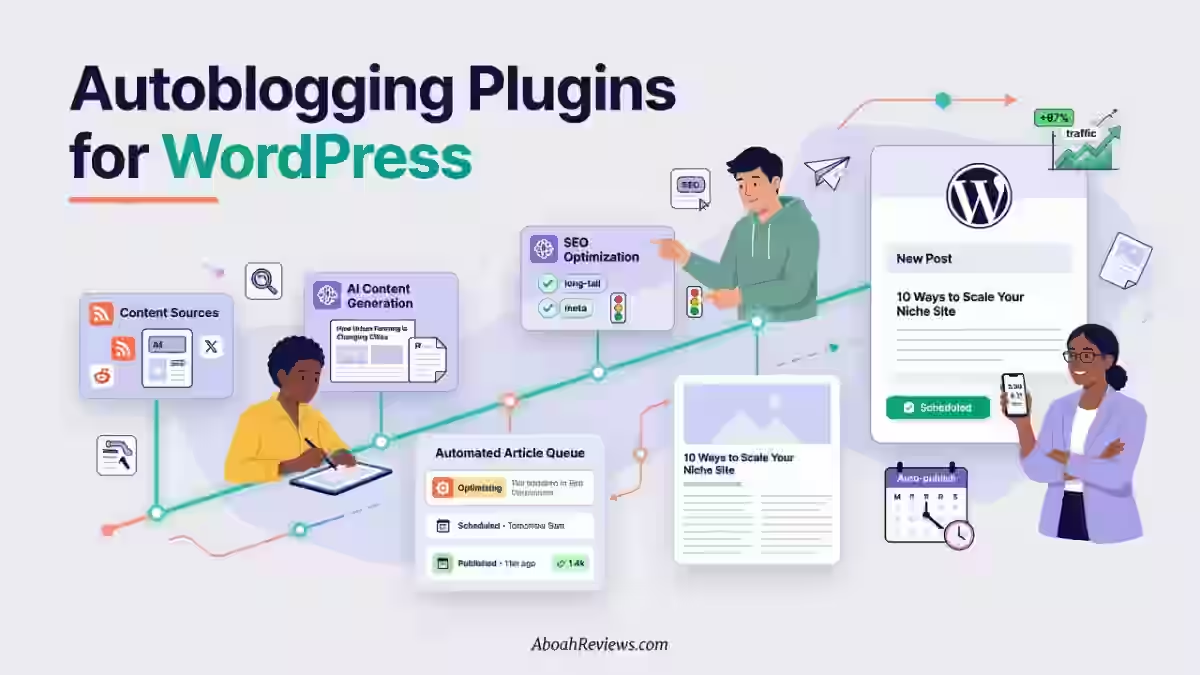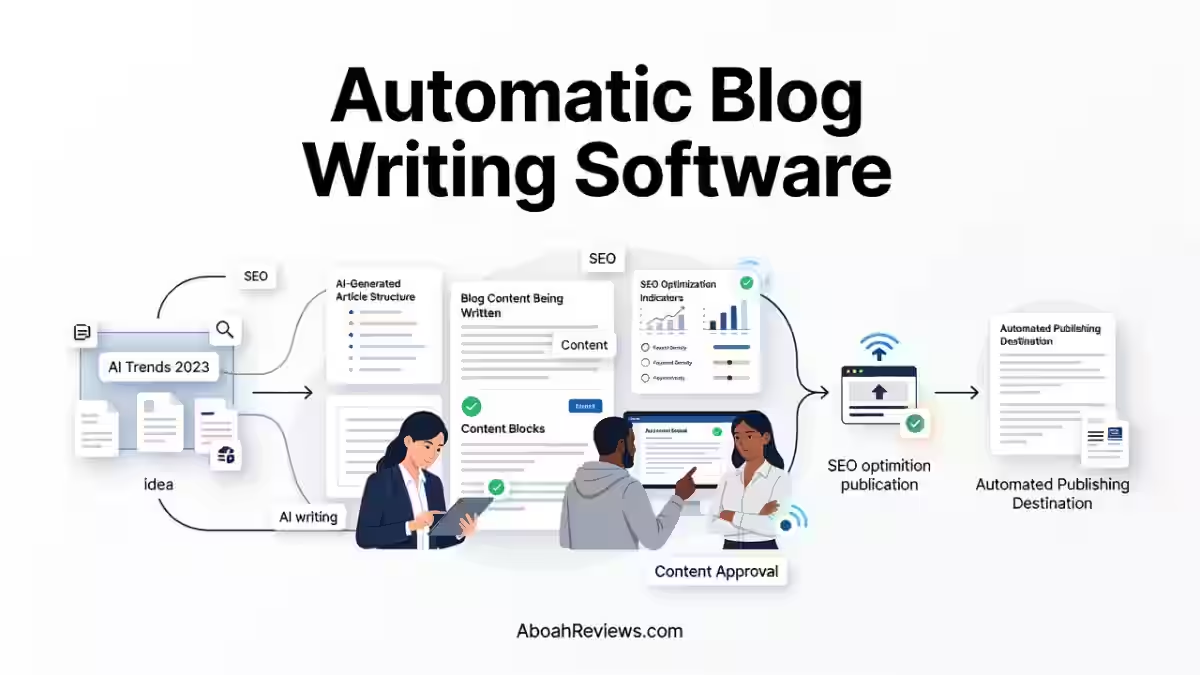
TL;DR: Automatic blog writing software handles some or all of the content workflow, from keyword research through publishing, using AI. This guide reviews 10 tools tested in 2026 for SEO professionals, bloggers, content marketers, and agencies who want honest, experience-based tool comparisons, not marketing claims.
The main takeaway: automation saves time, but human oversight still determines whether content ranks.
What Is the Best Automatic Blog Writing Software in 2026?
Here’s where each tool stands based on use case, pricing, and what they actually do well:
Software | Best For | Starting Price | Post Volume | Human Editing Needed |
|---|---|---|---|---|
End-to-end automated blogging + AI SEO | ~$99/mo | 30+ posts/mo | 20–35 min/post | |
Automated content growth + backlinks | $99/mo | 30 posts/mo | Moderate | |
Automated local SEO blogging | $39/mo ($18/mo annual) | Daily posts | Yes | |
WordPress-native blog automation | 7 days free trial then $99/mo | Varies | Recommended | |
SEO-driven content with editorial review | $99+/mo | 30 posts/mo | Minimal (built-in review) | |
High-volume article generation at low cost | $10 + API cost | Varies | Yes | |
AI-assisted blogging and content creation | $59/mo | Unlimited (Pro) | Yes | |
Programmatic SEO at scale | $99/mo or $5/article | Bulk batches | Yes | |
WordPress blog automation + social sharing | $69/mo | Varies | Minimal | |
Automated blog post generation | $19/mo | Varies by credits | Yes |
Important: Verify every feature and price against current product pages before purchasing. Pricing and plan structures in this category change frequently.
Introduction
I’ve been testing automatic blog writing software since early 2023, and the honest answer most review sites skip is this: these tools range from genuinely useful to quietly dangerous for your SEO.
Some will help you publish 30 articles a month with reasonable quality. Others will flood your site with thin content that hurts your rankings within 90 days.
This guide breaks down 10 tools I’ve personally tested directly, explains how they actually work, and tells you exactly who each one is built for.
If you’re evaluating autoblogging platforms for your own site or a client’s, you’ll walk away with a clear decision framework, real pricing numbers, and honest trade-offs.
What Is Automatic Blog Writing Software?
Automatic blog writing software is a category of tools that automate some or all of the blog content workflow: finding topics, selecting keywords, building outlines, writing articles, optimizing for SEO, adding images, scheduling, and publishing to your CMS.
The term covers several different product types, and mixing them up leads to bad buying decisions. Here’s how they break down:
- AI writing tools (like Jasper or ChatGPT): Generate content when prompted. You still manage research, SEO, and publishing manually.
- Automated blogging platforms (like BabyLoveGrowth AI or Keytomic): Handle the full pipeline from keyword discovery to published post with minimal manual input.
- WordPress autoblogging plugins (like WPAutoBlog or Clearpost AI): Operate inside WordPress and trigger content creation and publishing directly from your dashboard.
- Bulk AI article generators (like Byword AI or WordRocket AI): Generate large batches of articles from keyword lists. Best for editorial review workflows, not direct publishing.
Understanding which category you’re buying into is the first decision. The category shapes the use case, and the use case determines whether the tool is worth it for you.
How Does Automatic Blog Writing Software Work?
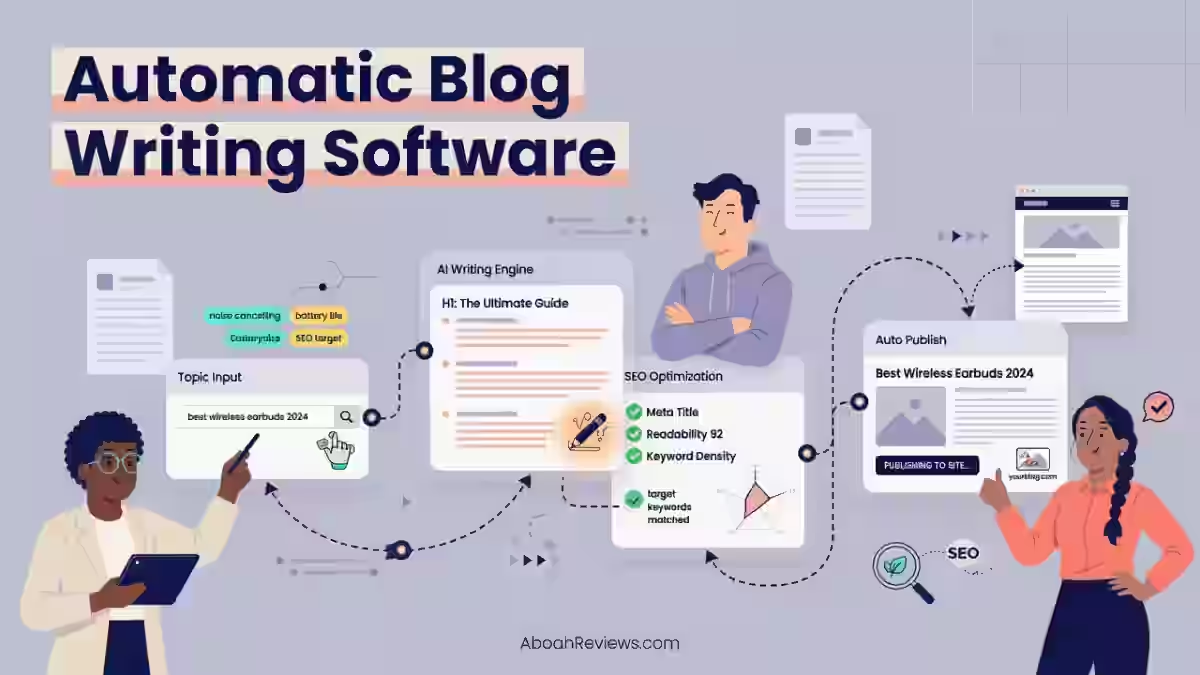
Most automated blogging platforms follow a shared workflow. The steps below reflect what the best tools in this category actually do from start to finish.
If you want a broader orientation before going further, my guide on how autoblogging works covers the mechanics in plain terms.
1. Finds Topics and Keywords
The software identifies what to write about. It pulls keyword data from your niche, competitor analysis, or a seed topic you provide.
Tools like Keytomic and BabyLoveGrowth AI do this automatically. Others, like Byword AI, require you to supply the keyword list yourself.
2. Builds an Article Outline
Once a keyword is selected, the tool maps a structure: headings, subheadings, word count targets, and sometimes competing page analysis.
Better platforms analyze top-ranking pages for search intent before building the outline, not just keyword density.
3. Generates the Blog Post
The AI writes the article based on the outline. Output quality varies significantly across tools.
The quality of AI drafts depends heavily on the model being used, the quality of the prompt, and whether the tool includes SERP data in its generation process. Generic prompts produce generic content.
4. Optimizes the Content for SEO
SEO optimization in autoblogging software typically includes meta descriptions, title tags, heading structure, schema markup, and keyword placement.
The best tools go beyond surface-level optimization. They analyze competing pages for search intent, suggest related semantic keywords, and score content before publishing.
5. Adds Images and Internal Links
Some platforms generate or source images automatically, add alt text, and insert internal links to related content on your site. This varies widely.
Keytomic generates on-brand images with alt text. Others insert stock images with no contextual relevance.
6. Publishes or Saves the Article
Full-autopilot tools push the article live to your CMS. Semi-automated platforms save drafts for review. Direct CMS publishing works across WordPress, Shopify, Webflow, and Wix on most major platforms.
7. Monitors Search Performance
The strongest platforms track what happens after publishing: keyword rankings, organic traffic, and increasingly, AI citation visibility.
BabyLoveGrowth AI includes a dashboard that monitors your brand’s visibility across ChatGPT, Perplexity and Gemini. You get prompt-level brand citation tracking and a GEO audit.
Automated Blogging Workflow (Simple Diagram)
Niche/Seed Topic
       ↓
Keyword Discovery
       ↓
Article Outline
       ↓
AI Article Generation
       ↓
SEO Optimization (on-page)
       ↓
Image + Internal Link Injection
       ↓
CMS Publishing (WordPress / Shopify / Webflow)
       ↓
Performance Monitoring (Rankings + AI Citations)
Types of Automatic Blog Writing Software
1. Full-Autopilot Blogging Platforms
These platforms handle the entire workflow without you touching anything between keyword input and published post. The best examples are Keytomic and BabyLoveGrowth AI.
These tools are best for teams or businesses that want consistent publishing without managing a content team. The tradeoff is editorial control; you hand a lot of the decision-making to the platform.
2. WordPress-Native Automation Tools
These tools are built to run directly inside WordPress, which removes CMS integration friction. Examples include Clearpost AI and Emplibot.
Emplibot is the closest thing to a hands-off autoblogging experience for WordPress. It handles the full pipeline from topic research through WordPress publishing, with social distribution built in.
Clearpost AI positions itself as an AI content platform focused on brand voice consistency and editorial quality. It connects to WordPress via API for publishing
The advantage of operating natively in WordPress is lower friction: your content, editorial workflows, and site settings all stay in one place. If you’re running a WordPress-first operation, these tools reduce the integration overhead.
See my full list of AI blog automation WordPress plugins for a deeper breakdown of the options in this category.
3. Bulk AI Article Generators
These tools are optimized for generating many articles fast from a keyword list. The output goes into an editorial queue rather than straight to publishing. Examples include Byword AI, WordRocket AI, and Autoblogging.ai.
These tools are not hands-off autopilot systems. They generate content efficiently, but someone still needs to review the output before it goes live, especially if you’re targeting competitive keywords.
10 Best Automatic Blog Writing Software for 2026: Full Reviews
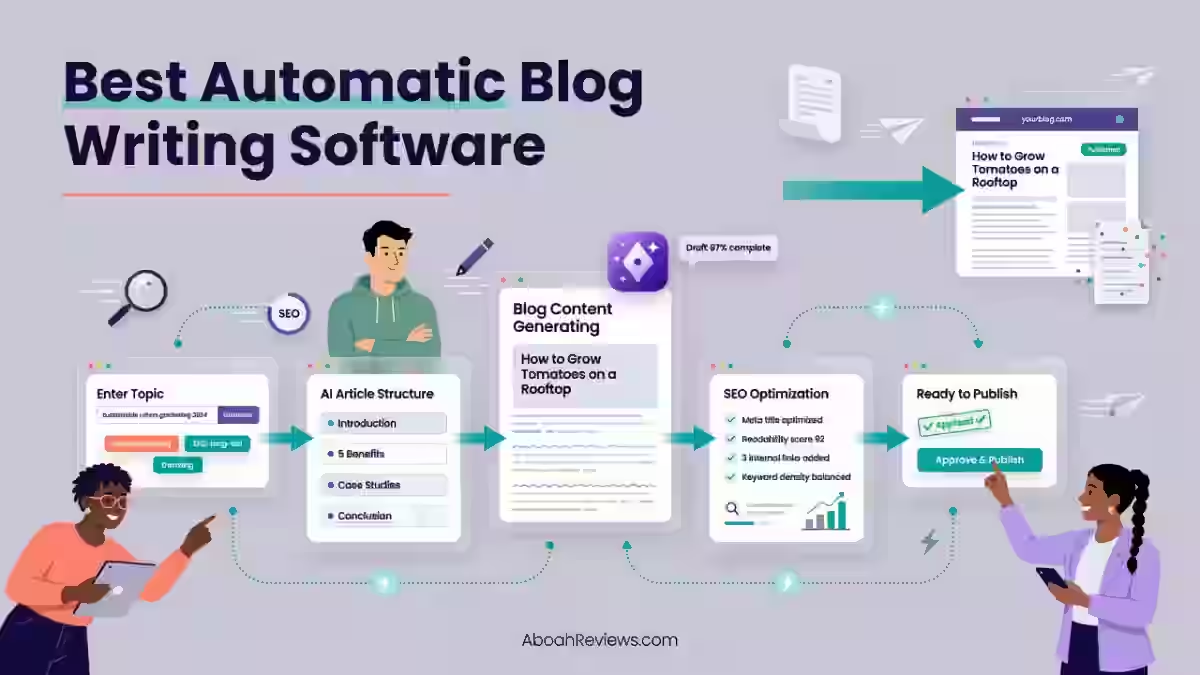
1. Keytomic – Best for End-to-end automated blogging + AI SEO
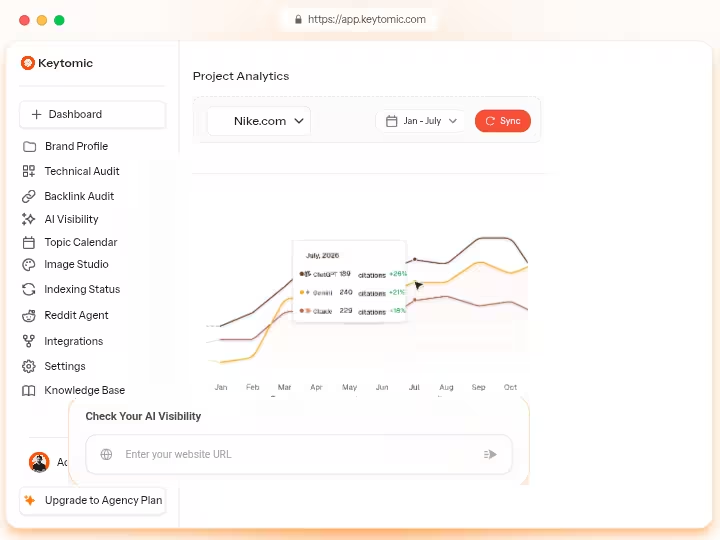
Keytomic combines schema markup automation, AI overview tracking, technical SEO audits, auto-indexing, SEO calendar management, CMS integrations, Reddit brand authority automation and multilingual content support in one subscription.
It’s one of the most complete automated blogging stacks I’ve tested. Keytomic also indexes every new page using its built-in indexing system for Google, Bing, ChatGPT, and other search engines to ensure faster discovery and improved visibility.
It consolidates keyword research, content creation, publishing, indexing and AI visibility tracking into one platform. Setup involves connecting your CMS, entering your niche, and letting the tool generate a rolling 30-day calendar.
From there, articles get written and published automatically. AI draft quality is consistently structured and editorial-ready with 20 to 35 minutes of human review.
Keytomic connects natively to Framer, HubSpot CRM, Sanity, Shopify, Webflow, Wix, and WordPress.
Pros
- True end-to-end automation: keyword research, writing, publishing, indexing, and AI citation tracking in one workflow
- Auto-indexing reduces time-to-visibility for new pages
- Rolling 30-day calendar removes content planning gaps
- No credit expiration on plans
Cons
- May still need Ahrefs or SEMrush for advanced backlink and rank tracking
- Higher learning curve for non-technical users
Pricing: $1 trial for 3 days then $99/month (Pro), $999/month (Agency DFY).
Best for: Teams and agencies that want genuine end-to-end SEO automation, including AI citation tracking, without managing 5+ separate tools.
Skip if: You need heavy multilingual output or granular rank tracking across thousands of keywords.
Read the full breakdown in my Keytomic test results.
2. BabyLoveGrowth AI – Best for Automated Content Growth
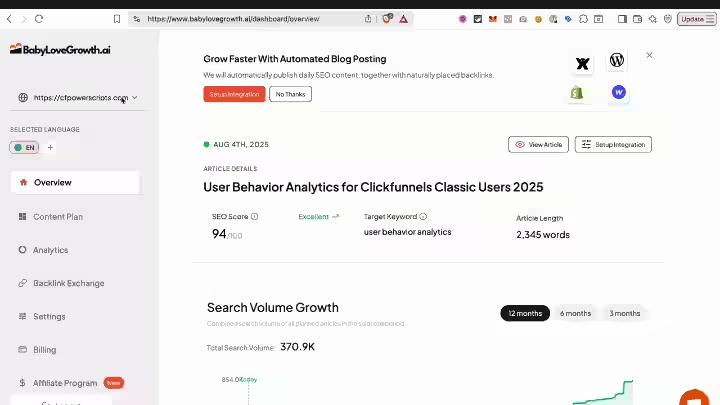
BabyLoveGrowth AI is a SaaS-based SEO automation platform founded in 2024 by Tilen Savnik that handles daily content publishing, automated backlink building and AI search visibility tracking in one subscription.
You get 30 SEO-optimized articles per month, published automatically to your site. Each article includes citations, internal linking, and branded infographics.
The effective per-article cost works out to roughly $3.30. That’s compared to $50–$200 per article for freelance writers doing similar work.
The backlink network is a real differentiator too. The backlink network spans over 4,000 websites and focuses on contextual, relevant placements rather than generic directory links.
One honest hindrance: the real risk is you pay upfront. If the content quality in your specific niche requires heavy editing, your true cost per article is higher than the sticker price. Factor in your editing time before calculating ROI.
The platform integrates with WordPress, Webflow, Shopify, Wix, Ghost, Duda, BigCommerce and also supports API and webhook connections.
Pros
- Automated end-to-end: content creation, publishing, backlink building, and AI citation tracking in one plan
- Native AI search visibility tracking (ChatGPT, Perplexity, Gemini)
- 30 SEO articles/month with internal linking and infographics included
- 20+ language support
Cons
- Limited editorial control over content calendar order without contacting support
- Content depth can be thin in technical or regulated niches
- Requires 60–90 days minimum to see meaningful organic results
Pricing: Grow ($99/month) and Scale ($299/month), plus a custom reseller plan for agencies. Both plans include a 3-day free trial, 25% off annual billing and a 90-day money-back guarantee.
Best for: Small to medium businesses that want hands-off content growth with backlink building and AI search monitoring included.
Skip if: You need daily editorial control or operate in a highly technical niche where thin content is a major risk.
3. Soro SEO – Best for Automated local SEO blogging

Soro SEO solves the time-cost problem of running a consistent, SEO-optimized content operation without a full writing team. It’s an automated blogging platform with daily publishing built in, geo-targeted keyword discovery, and direct CMS integration.
Soro’s daily automated publishing with geo-targeted keyword discovery makes it a reasonable fit for local service businesses building organic presence. It’s simpler to set up than most tools in this list, which matters for solo founders and small teams.
User feedback is mostly positive on automation, setup, and support, though some users say the content can feel generic and may need editing depending on the niche.
For full Soro SEO details, see my Soro SEO review.
Pros
- Daily automated publishing out of the box
- Geo-targeted keyword discovery for local SEO use cases
- Simple setup with minimal technical knowledge required
- Lower starting price than most full-autopilot alternatives
Cons
- Content can feel generic in competitive niches without editing
- Limited advanced SEO controls compared to Keytomic or Outrank.so
- No AI citation tracking (a gap vs BabyLoveGrowth AI and Keytomic)
Pricing: Soro SEO pricing starts at $39/month on a monthly plan, drops to $27/month on a quarterly plan and falls to $18/month when billed annually. Full breakdown at Soro SEO pricing.
Best for: Local service businesses and solo founders who want consistent daily publishing without a content team.
Skip if: You need deep SEO controls, AI citation tracking, or content quality above generic without heavy editing.
4. Clearpost AI – Best for WordPress-native blog automation
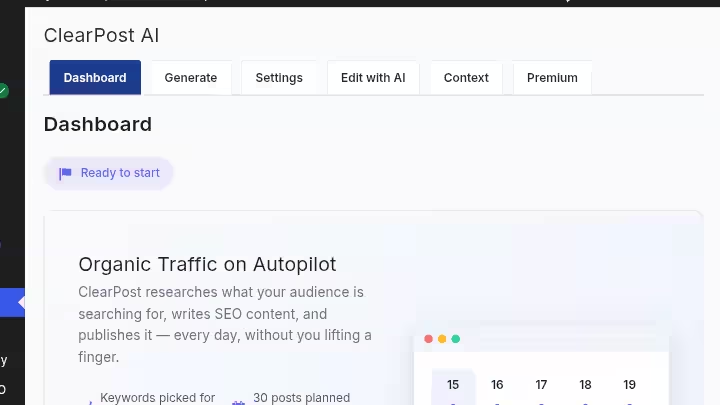
Clearpost AI is a WordPress-focused automated blogging tool that handles content creation and publishing directly inside your WordPress dashboard. It removes the need to export and import between platforms, which cuts a real constraint for WordPress-first teams.
The tool is designed to keep your publishing workflow inside one environment. This is useful for bloggers and small agencies who already manage everything in WordPress and don’t want another external platform to log into.
Check my Clearpost AI review for hands-on details on output quality and setup steps.
Pros
- WordPress-native operation means no CMS integration friction
- Reduces context-switching between platforms
- Suited for bloggers already running their workflow in WordPress
Cons
- Less useful if you manage multiple CMS platforms
- Fewer advanced SEO controls than standalone platforms like Soro SEO or Keytomic
- Limited data available on output quality vs. larger alternatives
Pricing: Free (bring-your-own API key); Premium ($99/month), Business ($199/month). All plans come with 7-day free trial, no credit card required
Best for: WordPress-only bloggers who want blog automation without leaving their existing dashboard.
Skip if: You manage non-WordPress CMS platforms or need multi-site agency controls.
5. Outrank.so – Best for SEO-driven content with editorial review

Outrank.so is an SEO content writing software that uses AI to help create optimized, high-quality content. The software analyzes top-ranking web pages and utilizes this data to generate content outlines, first drafts, and suggestions to improve content originality.
It personalizes content using the user’s brand voice and style guide. Outrank.so checks content quality with SEO metrics and optimizes content by adding keywords, internal links, and semantic terms.
What separates Outrank.so from full-autopilot tools is the built-in editorial review step before publishing. Outrank.so is best for high-quality, research-backed content with editorial review before publishing.
See a full breakdown in my Outrank.so review for more details.
Pros
- SERP analysis baked into the outline and generation process
- Editorial review workflow before content goes live
- Brand voice and style guide controls
- Strong content quality for competitive keywords
Cons
- Higher price point than simpler autopilot tools
- Requires more user involvement than fully automated platforms
- Not ideal if your goal is hands-off publishing volume
Pricing: Outrank.so costs $99 per month for its standard all-in-one plan. You can test the platform using a $1 three-day trial that provides full access
Best for: SEO professionals and content marketers who want high-quality AI drafts with a pre-publishing review step.
Skip if: You want fully automated publishing with zero editorial involvement.
6. WordRocket AI – Best for High-volume article generation at low cost
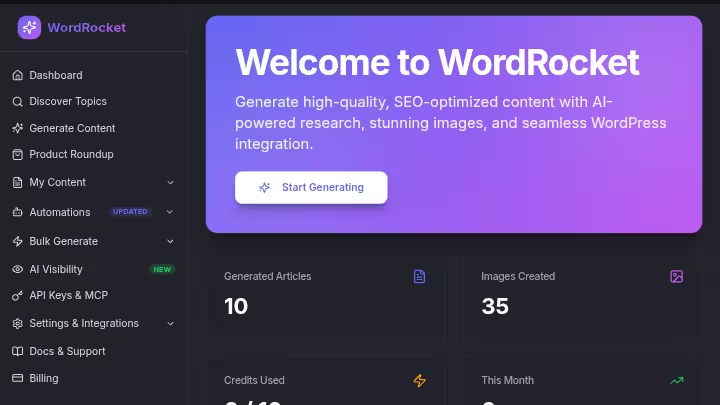
WordRocket AI is a bring-your-own-API-key (BYOK) content generation platform built for high-volume SEO content production at minimal cost per article. The BYOK model is what makes it unusual in this category.
I tested WordRocket AI across three affiliate sites for 45 days, generating 47 articles averaging 2,847 words each. The standout feature was the bring-your-own-API-key model. My total API cost was about $12.40 for all 47 articles, versus what would’ve been $79+/month on a subscription tool with word caps.
The cost efficiency at scale is real. The trade-off is that you need to supply your own OpenAI or Anthropic API key, which adds a small setup step.
Check WordRocket AI pricing and the lifetime deal for current options.
Pros
- Extremely low cost per article at scale using BYOK model
- Strong for bulk generation across affiliate and niche sites
- No monthly word caps tied to subscription tier
Cons
- Requires API key setup (minor friction for non-technical users)
- Less automated than full-autopilot platforms
- Editorial review strongly recommended before publishing
Pricing: Free plan ($0/month), Starter plan ($10/month), Pro ($20/month), Premium ($49.99/month).
Best for: Affiliate marketers and niche site operators producing 40–100+ articles per month who want minimal cost per word.
Skip if: You want a fully automated pipeline with no technical setup.
7. RightBlogger – Best for AI-assisted blogging and content creation
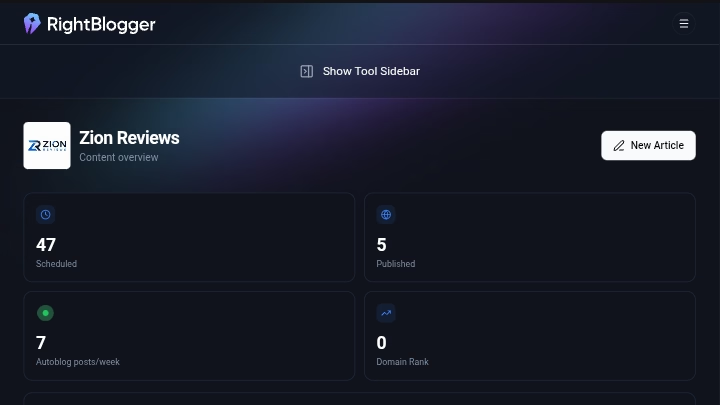
RightBlogger is an AI content platform built specifically for bloggers and content marketers who want to rank in Google. It bundles over 90 tools for keyword research, content generation, SEO optimization, and publishing into one interface.
Unlike general-purpose AI writing tools, it’s designed around search visibility, including newer AI platforms like ChatGPT and Perplexity that pull from well-optimized content.
One of its most practical features for brand consistency: one notable feature is “MyTone,” which lets you train the AI on your writing style by feeding it examples of your past work.
For a detailed comparison, see the RightBlogger review.
Pros
- 90+ tools in one platform with no credit system on paid plans
- “MyTone” voice training improves brand consistency over time
- Unlimited articles on Pro plan ($5o/month)
- Publishes to WordPress, Webflow, Ghost, Wix, and Duda
Cons
- Still requires human editing for competitive content
- Backlink exchange network requires domains with DR 15 and above
- Not a full autopilot platform
Pricing: Free plan (up to 2 or 3 articles per month), Solo at $59/month (1 site), Pro at $89/month (3 sites) and Agency at $299/month (10+ sites), all with unlimited AI words and a current 50% off annual plan promotion. All plans include 7 days free trial.
Best for: Bloggers, content marketers, and freelancers who want an all-in-one writing and publishing workflow with brand voice controls.
Skip if: You want fully automated, no-touch publishing.
8. Byword AI – Best for Programmatic SEO at scale
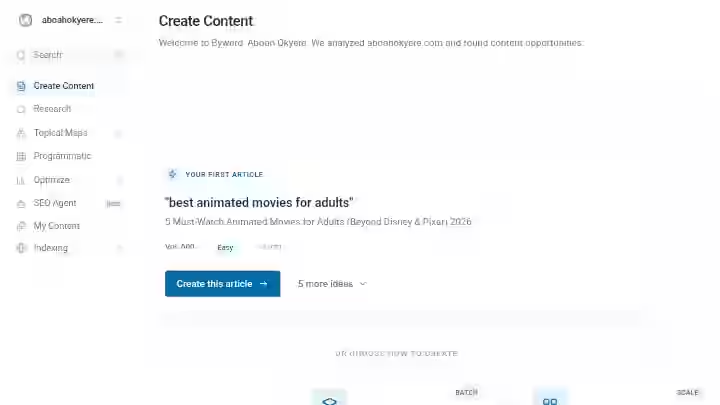
Byword AI is built for one specific use case: generating large batches of articles from keyword lists, particularly for programmatic SEO. It is the best autoblogging software for programmatic SEO, ‘best plumber in [city]’ across 200 cities, generated and published in hours. The templated generation is genuinely useful.
The platform is purpose-built for generating many similar articles across keyword variations at speed.
Strong fit: Multi-location businesses, directory sites, and teams running programmatic SEO that need hundreds of similar articles across keyword variations. The templated generation is purpose-built for this workflow.
What it’s missing: for standard blog content, quality is functional but not distinctive. No keyword research built in; you bring the keywords. No content strategy layer or editorial planning. Check my Byword AI review for a complete breakdown.
Pros
- Best-in-class for programmatic SEO bulk generation
- Templated generation handles city/service page variations well
- Fast output at scale for large keyword batches
Cons
- No built-in keyword research (you supply all keywords)
- Content quality is functional, not distinctive, on complex topics
- Article quality tends toward generic on complex topics. No GBP, no social media, no backlink features.
Pricing: Free trial (5 articles), Starter ($99/month), Standard ($299/month), Scale ($999/month), Unlimited ($1,999/month) or $5/article
Best for: Agencies and multi-location businesses running programmatic SEO across hundreds of keyword variations.
Skip if: You want strategic content planning, keyword research, or editorial quality for competitive blog topics.
9. Emplibot – Best for WordPress blog automation + social sharing
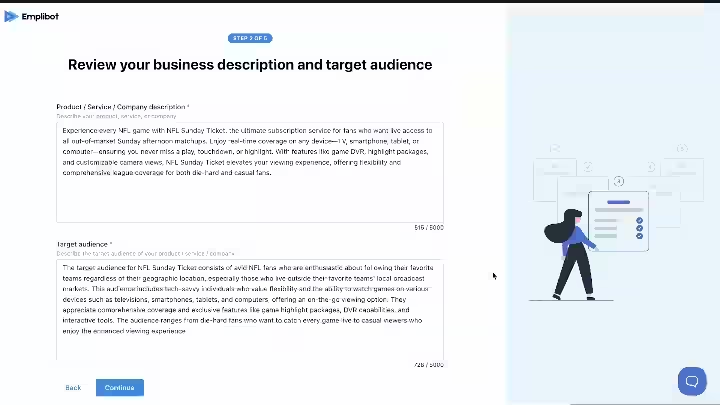
Emplibot is best for WordPress users who want fully automated blogging and social media distribution.
It handles the complete pipeline within WordPress and pushes content to social channels automatically, which is useful for teams that want one tool to replace both a scheduler and a content generator.
For agency use with multiple WordPress clients, Emplibot’s multi-site management and white-label option are real advantages. Check my full Emplibot review for hands-on output samples.
Pros
- WordPress-native with social distribution included
- Multi-site dashboard for agency use
- Handles the full pipeline from topic to published post
- White-label capabilities
Cons
- Less useful outside of WordPress environments
- Content still benefits from light editorial review
- Social automation quality varies by platform
Pricing: $69/month for Starter, $99/month for Standard and $149/month for Pro (Free trial for each plan)
Best for: Agencies managing multiple WordPress client blogs who want blogging and social distribution in one tool.
Skip if: You run a non-WordPress CMS or need heavy editorial control over each piece.
10. Autoblogging AI – Best for Automated blog post generation

Autoblogging.ai is an advanced AI content writer that helps users generate high-quality articles, blog posts, Amazon reviews, and other content with minimal effort. It aims to make content creation easy, fast, and affordable for everyone.
It can cover a wide range of topics like technology, marketing, lifestyle, products, news, and more to suit the user’s content needs. The platform offers customized article creation with options to specify tone, length, keywords, headings, formats, and more.
Where it stands out is bulk generation in multiple languages. With features like bulk content generation, multilingual support, plagiarism-free content, and flexible plans, it aims to be the go-to AI assistant for all content needs.
Pros
- Bulk article creation across 30+ languages
- One-click article generation optimized for rankings
- Automatic WordPress posting included
- Flexible credit-based plans
Cons
- Content can require fact-checking and editorial review
- Credit-based pricing limits predictability for high-volume users
- Less strategic automation compared to full-autopilot platforms
Pricing: Free (10 credits/month), $19/month Starter, $49/month Regular, $99/month Standard, $179/month Gold, $249/month Premium, $999/month Enterprise
Best for: Content teams generating bulk articles in multiple languages with direct WordPress publishing.
Skip if: You need strategic keyword planning, backlink building, or AI citation tracking included.
Key Features to Look For in Automatic Blog Writing Software
1. Automated Keyword Research
The tool should find topics without you manually supplying a keyword list every week.
Platforms that automate keyword discovery save 3–5 hours per month in planning time alone. Check whether the tool pulls from SERP data or just a static database.
2. AI Article Generation
Output quality varies more than any vendor will tell you. The model matters, but so does whether the tool includes competitor page analysis in the prompt.
Test output on your hardest target keyword before committing to a paid plan.
3. SEO Optimization
Tools that only insert keywords mechanically without addressing search intent create content that looks optimized but does not rank well.
I check for actual on-page SEO scoring, not just keyword insertion, when reviewing platforms.
4. Direct CMS Publishing
Publishing should push cleanly to your CMS with correct formatting, categories, tags, and images. Test this before committing. Formatting failures in the live WordPress editor waste more time than they save.
5. Content Scheduling
A publishing calendar you can see and modify reduces the risk of content gaps and duplicate topics. The best tools generate a 30-day rolling calendar automatically.
6. Internal Linking
Automated internal linking prevents the content cannibalization problem.
I lost an affiliate site’s rankings after publishing 42 auto-generated posts without internal linking or keyword filtering. The content cannibalized itself. That mistake is avoidable if you choose a tool that handles this at the generation stage.
7. AI Image Generation
On-brand images with correct alt text improve both user experience and SEO. Generic stock images add no value. Ask specifically whether images are generated contextually or pulled from a stock library.
8. Brand Voice Controls
Tools like RightBlogger’s “MyTone” and Keytomic’s brand guidelines input reduce the editing time needed per article. This matters more at high volume.
9. Performance Tracking
At minimum, connect your tool to Google Search Console. Better platforms include built-in rank tracking or AI citation monitoring.
Keytomic indexes every new page using its built-in indexing system for Google, Bing, ChatGPT, and other search engines to ensure faster discovery and improved visibility.
Automatic Blog Writing Software vs. AI Writing Tools
People regularly confuse these two categories. Here’s a direct comparison of what each handles:
Capability | AI Writing Tool (e.g., ChatGPT, Jasper Al) | Automated Blogging Platform (e.g., Keytomic, BabyLoveGrowth AI) |
|---|---|---|
Topic/keyword research | Manual (you do it) | Automated |
Keyword selection | Manual | Automated |
Article outlining | Manual or prompted | Automated |
Article generation | On demand (prompted) | Scheduled/automated |
SEO optimization | Limited (manual) | Built-in |
Internal linking | Manual | Automated (on best tools) |
Image sourcing/generation | Usually manual | Automated (on some tools) |
CMS publishing | Manual copy-paste | Direct integration |
Content scheduling | None | Built-in calendar |
Analytics/tracking | None | Built-in (on some tools) |
AI citation monitoring | None | Available on Keytomic, BabyLoveGrowth AI |
The key distinction: an AI writing tool helps you create content faster when you prompt it. An automated blogging platform owns the publishing workflow from topic discovery through live article, with or without your daily involvement.
Neither replaces editorial judgment. The platforms just remove the mechanical steps.
Pros and Cons of Automatic Blog Writing Software
Pros
- Faster content production: Tools like Byword AI and WordRocket AI generate 2,000–3,000-word articles in under 2 minutes.
- Reduced repetitive work: Keyword research, outline building, meta description writing, and CMS formatting can all be automated.
- Publishing at scale: Full-autopilot platforms publish 30–100+ articles per month without daily input.
- Automated SEO tasks: On-page optimization, schema markup, and internal linking happen at generation, not post-production.
- Consistent publishing schedule: Automated calendars prevent the content gaps that hurt crawl frequency and topical authority.
- Less manual CMS work: Direct WordPress, Shopify, and Webflow integrations eliminate copy-paste publishing.
Cons
- Content require fact-checking: AI generation makes confident-sounding factual errors. Always verify statistics, product specs, and claims.
- Automated articles can become repetitive: Without brand voice controls and topic filtering, articles start sounding identical.
- Poor inputs produce poor topics: Garbage-in, garbage-out applies here. Weak niche targeting produces off-target content.
- Limited editorial control on full-autopilot tools: You often can’t reorder topics or block specific articles without contacting support.
- Publishing AI content without human review: Unchecked AI outputs frequently contain hallucinations, generic surface-level logic, and fabricated data that destroy author credibility and risks search engine penalty.
Is Automatic Blog Writing Software Good for SEO?
It can be, but automation itself does not guarantee rankings. Google’s quality systems evaluate content on multiple signals that automation alone cannot satisfy.
According to Google’s helpful content guidance, what matters is whether content is created primarily for people and demonstrates first-hand experience with the topic.
Here’s what actually determines whether automated content ranks:
- Search intent match: Does the article format and angle match what searchers expect for that keyword? A tool that ignores search intent produces content that won’t rank regardless of keyword density.
- Originality: Regurgitated content from competing pages without added perspective or data is thin by definition.
- First-hand experience: AI cannot manufacture genuine experience. Content that references real use cases, test results, or specific outcomes consistently outperforms generic AI prose.
- Topical depth: One article on a topic doesn’t build authority. A structured cluster of interlinked articles does. Tools with topical clustering built in (like BabyLoveGrowth) address this automatically.
- Factual accuracy: Errors in factual content create trust problems with both readers and quality raters.
- Internal linking: A well-linked site helps Google understand your content structure. Missing this is one of the most common autoblogging mistakes.
- Technical SEO: Page speed, clean HTML, proper schema, and indexability all affect whether your content gets seen at all.
- Backlinks and authority: Automated content on a brand-new domain with zero backlinks will struggle to rank for competitive terms, but it can sometimes rank for hyper-specific, zero-competition long-tail keywords if the data is genuinely useful.
- Human editorial review: The single highest-ROI step you can add to any automated content workflow. Even 20 minutes of review per article materially improves quality and reduces the risk of publishing something that harms your site.
For a broader look at how automation fits into SEO strategy, my AI SEO automation guide covers this in more depth.
How to Choose the Best Automatic Blog Writing Software
Use this evaluation framework before signing up for anything:
- Define your publishing volume: Do you need 5 articles a month or 50? Volume determines which category of tool you actually need. Bulk generators suit high-volume workflows. Autopilot platforms suit consistent mid-volume publishing.
- Decide how much automation you actually need: Full autopilot saves the most time but gives you the least control. Semi-automated tools (AI draft + human review) reduce risk significantly. Be honest about whether you’ll actually review content before it goes live.
- Check keyword research capabilities: Does the tool find and select keywords for you, or do you supply them? Tools that automate discovery save planning time. Tools that require manual input need to pair with a separate keyword research workflow.
- Evaluate SEO controls: Look for on-page scoring, semantic keyword suggestions, and schema markup, not just keyword insertion. Thin SEO tooling produces thin rankings.
- Test content quality before committing: Run the trial. Generate 3–5 articles on your actual target keywords. Read them. Would you publish them? Would you be proud of them representing your brand?
- Verify CMS integrations: Confirm the tool publishes cleanly to your CMS, not just that it claims to. A failed WordPress integration discovered after payment is a bad day.
- Check image capabilities: Are images generated contextually with proper alt text, or is it a stock photo grab? This matters for both SEO and user experience.
- Compare pricing per published article: Divide the monthly cost by the number of articles you’ll realistically publish. A $99/month plan generating 30 articles costs $3.30/article. A $29/month plan you use for 3 articles costs $9.67/article.
- Review editing and approval controls. Can you review drafts before they go live? Can you block specific topics? Can you adjust the content calendar? The more editorial control you need, the more these features matter.
For a deeper guide on this decision process, my article on how to choose the best autoblogging tool walks through a complete evaluation framework.
Final Verdict
There’s no single best automatic blog writing software for every situation. The right tool depends on your volume, team size, CMS, and how much editorial involvement you’re willing to maintain.
Here’s how I’d break it down based on real use cases:
- Best for full automation with AI SEO tracking: Keytomic. It handles keyword research, content, publishing, indexing, and AI citation monitoring in one subscription without needing external tools for most workflows.
- Best for automated content growth with backlinks included: BabyLoveGrowth AI. At $99/month, you get 30 articles, automated backlinks, and AI search visibility tracking in one plan. No other tool at this price point matches that bundle.
- Best for WordPress users: Emplibot. Native WordPress operation with social distribution and multi-site management makes it the strongest choice for WordPress-first teams and agencies.
- Best for bulk content at low cost: WordRocket AI. The BYOK model makes it the most cost-efficient option for high-volume affiliate and niche site operators.
- Best for SEO-focused publishing with editorial control: Outrank.so. SERP analysis, brand voice controls, and a review step before publishing make it the right call for competitive niches where quality matters more than volume.
- Best for agencies managing multiple sites: BabyLoveGrowth AI or Abun, depending on CMS mix and reporting needs.
- Best for local SEO blogging: Soro SEO. Geo-targeted keyword discovery and daily publishing at 18–39/month is a reasonable fit for local service businesses.
Whatever tool you choose, build in at least one human review step before content goes live. The tools in this list are genuinely useful. None of them replace the judgment call that comes from actually knowing your audience, your niche, and what your readers need to find.
Frequently Asked Questions About Automatic Blogging
What is the 80/20 rule for blogging?
The 80/20 rule means spending about 20% of your time creating content and 80% promoting, distributing, and optimizing it. The goal is to maximize traffic and engagement from each piece of content rather than simply publishing more.
How long does it take to make $500 per month blogging?
For most new bloggers, reaching $500 per month can take 6–18 months, depending on the niche, traffic, monetization strategy, and publishing consistency. Some achieve it faster, while competitive niches may take longer.
Are blogs still a thing in 2026?
Yes, blogs are still relevant in 2026, particularly for businesses, publishers, and websites targeting search traffic and building topical authority. However, successful blogging increasingly requires original expertise, strong SEO, multimedia content, and optimization for AI search.
How much money per 1,000 views on a blog?
A blog can typically earn anywhere from $2 to $30+ per 1,000 pageviews from display advertising, depending on the niche, audience location, ad network, and season. High-value niches such as finance, insurance, and software can generate substantially higher RPMs.
How many YouTube views do I need to make $2,000 a month?
The number varies by niche and RPM, but at a $5 RPM, you would need roughly 400,000 monetized views per month to earn $2,000. Channels with higher RPMs may reach that amount with fewer views, while lower-RPM channels need considerably more.
Is blogging still profitable?
Yes, blogging can still be profitable when it targets valuable search demand and uses multiple revenue streams such as affiliate marketing, advertising, digital products, and services. The biggest challenge in 2026 is producing genuinely useful content that stands out from mass-produced AI content.
What is replacing blogging?
Blogging is not being completely replaced, but traditional text-only blogging is increasingly supplemented by video, podcasts, social media, newsletters, and AI-powered search experiences. The modern approach is to turn expertise into multiple content formats rather than relying solely on written articles.

- EverBee Review 2026: My 30 Days Unbiased Testing Results - September 5, 2026
- 11 Best AI Overviews Rank Tracking Tools in 2026 (Honest Breakdown) - September 5, 2026
- 11 Best Automated Local SEO Tools for 2026: Full Breakdown - September 5, 2026