TL;DR: This article covers the 11 best AI autoblogging tools available in 2026, ranked by practical SEO value rather than feature volume. It is written for bloggers, content marketers, SEO professionals, and agencies evaluating automated content platforms. The overall recommendation is Distribb for most users, with strong alternatives depending on budget, publishing volume and whether backlinks or AI search visibility matter to your workflow.
If you are searching for the best AI autoblogging tools, you are probably trying to solve one of two problems: you don’t have time to write and publish consistently or you manage too many sites to do it manually.
The question is no longer whether AI can write a blog post; it can. The real question is which tools actually move the needle for search visibility, which ones create more cleanup work than they save and which ones are worth the monthly cost when you factor in editing time, link quality, and actual traffic outcomes.
If you are also researching the broader landscape of SEO automation before committing to an autoblogging tool, that context will help frame what these platforms actually automate and where human oversight still belongs.
Quick Answer: What Are the Best AI Autoblogging Tools in 2026?
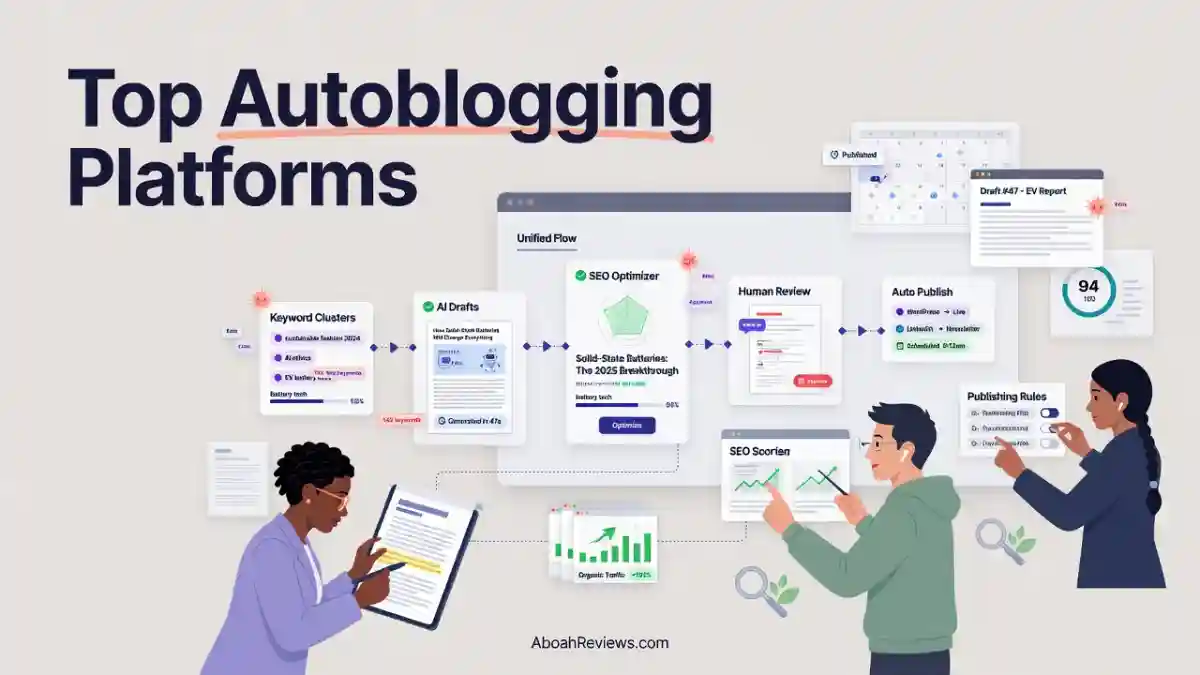
The best AI autoblogging tool depends on whether your priority is content volume, backlink acquisition, programmatic SEO at scale or AI search visibility tracking, because no single platform does all four equally well.
Here is the short version before the full breakdown:
- Best overall: Distribb combines article generation, a credit-based backlink exchange, and multi-channel distribution, making it the most complete option for sites that need content plus off-page SEO in one subscription.
- RankYak is built for hands-off daily publishing with a unique maintenance layer (Site Guard) that audits existing pages instead of only generating new ones.
- Massblogger is the strongest option for agencies and site operators running programmatic SEO across 5 or more WordPress sites.
- BabyLoveGrowth AI combines content, a 4,000+ site backlink network, and AI search visibility tracking.
- WordRocket AI is the best budget-friendly option for bulk and high volume publishing using your own API key.
- Rankpill publishes long-form daily content with backlink credits included.
- Keytomic adds auto-indexing and Reddit marketing automation to a standard autoblogging workflow.
- Clearpost AI handles hands-off WordPress publishing with editorial simplicity.
- Outrank.so focuses on research-backed content and an automated backlink exchange.
- BlogSEO.io focuses on semantic SEO, schema, and structured content workflows.
- Rightblogger gives solo bloggers and beginners a broader all-in-one toolkit at a lower price point.
None of these tools replace editorial judgment. All of them require at minimum a review step before content goes live at scale.
What Are AI Autoblogging Tools?

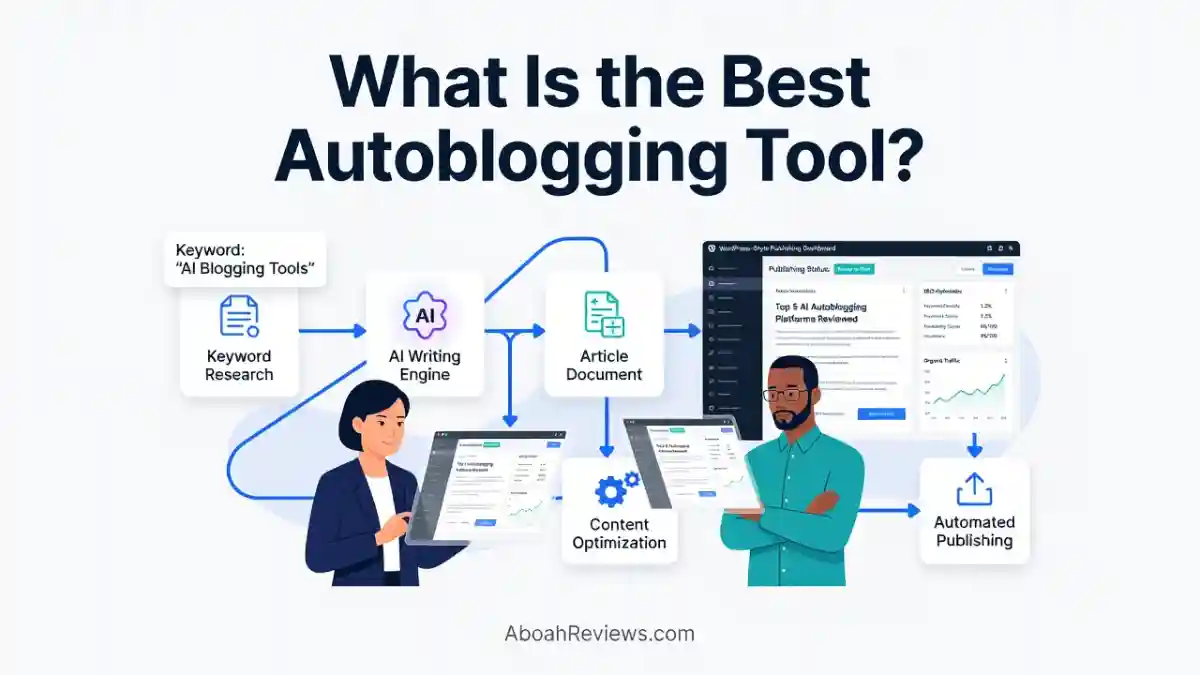
AI autoblogging tools are software platforms that automate some or all stages of the blog content workflow: keyword research, content planning, article generation, on-page optimization, internal linking, CMS publishing and in some cases, link-building and AI search visibility tracking.
The automation depth varies significantly. Some tools generate content and stop there. Others run a full loop from keyword discovery through to published article, backlink acquisition, and performance monitoring.
Understanding which parts of the workflow a tool actually automates versus which parts still require human input is the most important thing to evaluate before choosing one.
For a broader look at how autoblogging works before evaluating specific platforms, that context helps clarify what “automated” actually means in practice.
Comparison Table: Best AI Autoblogging Tools in 2026
| Tool | Best For | Starting Price | Articles/Month | Auto-Publish | Backlinks | AI Visibility | Free Trial |
|---|---|---|---|---|---|---|---|
| Distribb | Content + links + distribution | $97/mo | 30 | Yes | Yes (exchange) | Yes | 3 days |
| RankYak | Hands-off daily publishing | $99/mo | 30 (1/day) | Yes | Yes (exchange) | No | 3 days |
| Massblogger | Programmatic SEO, multi-site | $59/mo | Unlimited (plan-based) | Yes | No | No | Flex free plan |
| BabyLoveGrowth AI | Content + backlinks + AI tracking | $99/mo | 30+ | Yes | Yes (4,000+ sites) | Yes (ChatGPT, Claude, Perplexity, Gemini) | 3 days |
| WordRocket AI | Budget bulk publishing | $10/mo + API | 15–50+ | Yes | No | No | No public trial listed |
| Rankpill | Long-form daily publishing | $99/mo | 30 | Yes | Yes (30 credits/mo) | Claimed, method not publicly verified | 3-day $1 trial |
| Keytomic | Auto-indexing + Reddit marketing | $99/mo | 30 | Yes | Yes (community) | Yes | $1 for 3 days |
| Clearpost AI | Hands-off WordPress publishing | Not publicly listed | 30+ | Yes | No | No | 7 days |
| Outrank.so | Research-backed content + backlinks | $99/mo | 30 | Yes | Yes (exchange) | No | $1 trial |
| BlogSEO.io | Semantic SEO automation | $97/mo | Varies by plan | Yes | Yes | Partial | Yes |
| Rightblogger | Beginners and solo bloggers | $59/mo | Unlimited | Yes | Yes (new feature) | No | No |
Pricing sourced from vendor pages and third-party review data as of October 2026. Verify current plans before purchasing.
How I Chose the Best AI Autoblogging Tools for 2026
Before covering individual tools, it is worth explaining what actually went into these rankings. I did not score tools based on how long their feature lists are. I evaluated them based on what a working SEO professional would actually need from an automated content workflow.
My 30-day test of automated SEO workflows across 3 websites showed that the biggest time savings came from repetitive tasks such as keyword data collection, content brief creation, and report generation.
But those time savings disappeared when I had to fix problems created by automation I had not reviewed carefully enough. That experience shapes every evaluation here.
Content Generation and Quality
Content quality means more than grammatical correctness. It includes whether the article covers the search intent accurately, whether it produces factually defensible claims, and whether it would require significant editing before publishing.
I look at whether:
- the tool does SERP-level research before writing or simply generates from a keyword
- articles require light editing or substantial rewrites
- brand voice can be configured
- factual accuracy is a stated concern in the tool’s workflow
SEO Automation Capabilities
Automation value varies by task. Automated keyword research that ignores your existing rankings can cause keyword cannibalization. Internal linking automation that inserts irrelevant anchors can hurt more than help.
I look at whether the tool integrates Search Console data, whether it runs cannibalization checks and whether on-page optimization reflects actual SERP analysis.
Publishing and Workflow Automation
The best publishing workflows give you control without requiring you to touch every article manually. That means approval gates, scheduling controls, draft options, and clear CMS integration that actually works without custom configuration.
Key questions:
- Does the tool publish live automatically by default, or does it allow draft review?
- Can you control publishing frequency?
- How many CMS platforms does it actually support versus list on a feature page?
Backlink Building and AI Search Visibility
Several tools in this list include backlink exchange networks. These are not the same as earning editorial backlinks.
Exchange networks carry risk under Google’s link policies if reciprocal link patterns are detected. I note this for each relevant tool without dismissing the feature entirely. Contextual link exchange within a vetted network is different from bulk link farming, but independent verification of link quality is difficult.
AI search visibility tracking is a separate capability. My 30-day test monitoring AI visibility across 50+ search prompts showed how inconsistent AI appearances can be.
Tools that reduce AI visibility to a single score are less useful than those that track query-level data, competitor appearances, and citation sources over time. For a deeper look at that topic, the AI search visibility guide covers the evaluation framework.
Pricing, Ease of Use and Scalability
I compare total cost rather than headline price. That means factoring in API key costs where the tool uses a bring-your-own-key model, per-site pricing for agencies managing multiple domains, and whether the free trial gives you enough access to evaluate content quality before committing.
1. Distribb: Best Overall AI Autoblogging Tool
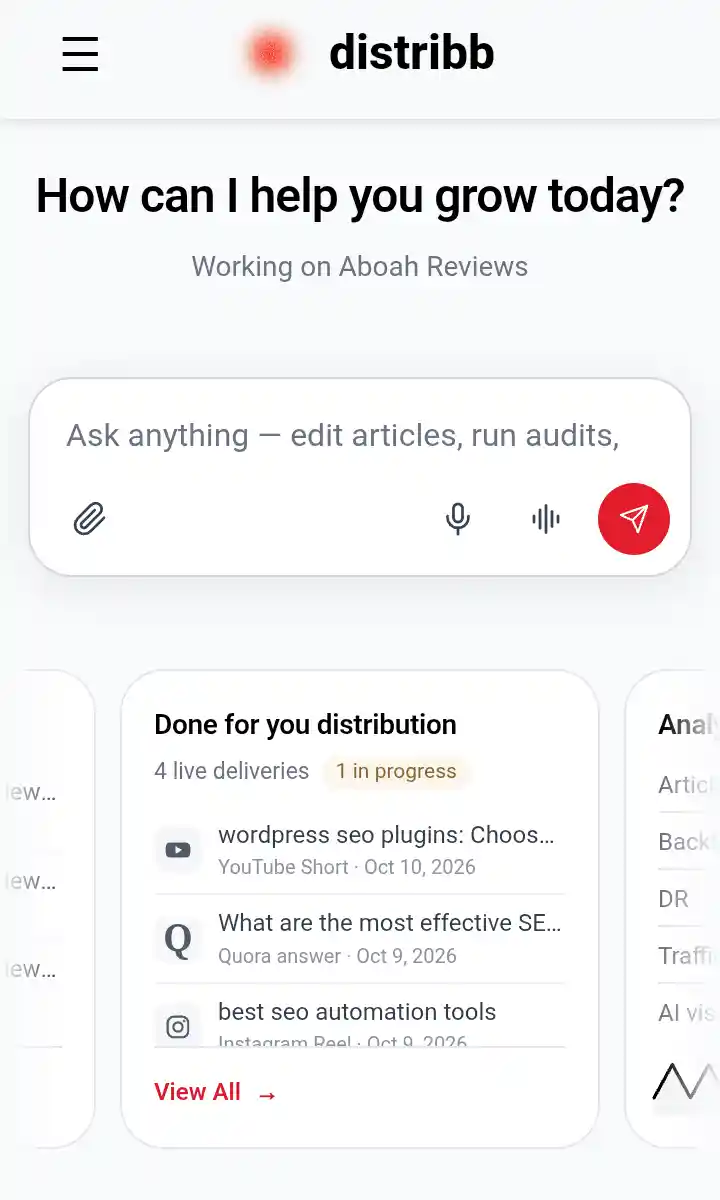
Distribb is the overall best AI autoblogging tool when you want article generation, publishing, backlink building, AI visibility tracking, flagging underperforming pages, social repurposing and distribution handled from a single subscription rather than stacking separate tools.
Distribb analyzes your niche and competitors, finds buyer-intent keywords, and keeps your content calendar full automatically, with articles written, scheduled, and published with SEO and AI visibility in mind.
Key Features
Distribb analyzes your domain, identifies competitor content gaps, and auto-populates a 30-day editorial queue with buyer-intent keyword targets. The queue refills automatically as articles publish.
Distribb produces 4,000 to 5,000 word articles with clean heading structure, AI-generated images, automatic internal linking, and conversion-focused keyword targeting.
Publishing goes straight into your CMS: WordPress, Webflow, Shopify, Wix, Ghost, or Notion. More than 150 languages are supported.
The semantic cocoon content architecture is also worth noting: it structures articles around topical clusters rather than isolated posts, which helps build domain authority faster.
For technical users, Distribb exposes a full REST API and an MCP server, with an official skill for Claude and AI agents. You can drive GSC audits, writing, and publishing from your own scripts, bringing your own AI model. For technical profiles running site portfolios, it is a genuine plus.
On keyword targeting accuracy: the keyword targeting was directionally solid. Topics selected were genuinely relevant and showed search intent alignment in about 80% of cases.
Pricing
Distribb’s pricing breaks down as follows:
- Trial (free for 7 days, full access, credit card required),
- Agentic ($49/month for API and AI agent skill access)
- Pro ($97/month for 30 articles per month, backlinks, drafted outreach, CMS integrations, AI images, and 150+ languages)
- Accelerator ($495/month for 90 articles per month, 8 videos, 8 Medium syndications, 8 carousels, managed outreach campaigns, and priority link placements).
30 articles per month at 4,000 to 5,000 words each is enough for one active niche site publishing 6 to 8 articles per week or three to four smaller sites at lower frequency.
Pros
- Full workflow from keyword research to content to backlinks to distribution
- Semantic cocoon architecture for topical authority building
- MCP server and REST API for technical users managing portfolios
- 150+ language support
- Verifiable MRR and active subscriber base
- 7-day free trial
Cons
- Social auto-posting is not yet live
- The price point is higher compared to other tools
- The Accelerator tier at $495/month is only justified for high-volume operators running off-site distribution campaigns.
Best For
Content publishers, affiliate sites, and small agencies that want automated content production, a passive backlink layer, optimization, distribution and AI visibility tracking in a single monthly fee without managing separate tools.
Who Should Consider a Distribb Alternative?
Users who need white-label reporting, multi-client dashboards, granular brand voice configuration, or deep technical SEO auditing will find Distribb’s feature set insufficient. For those users, BabyLoveGrowth AI offers more in those specific areas.
Read my full Distribb review for the complete 90-day test breakdown.
2. RankYak: Best for Hands-Off Daily Publishing
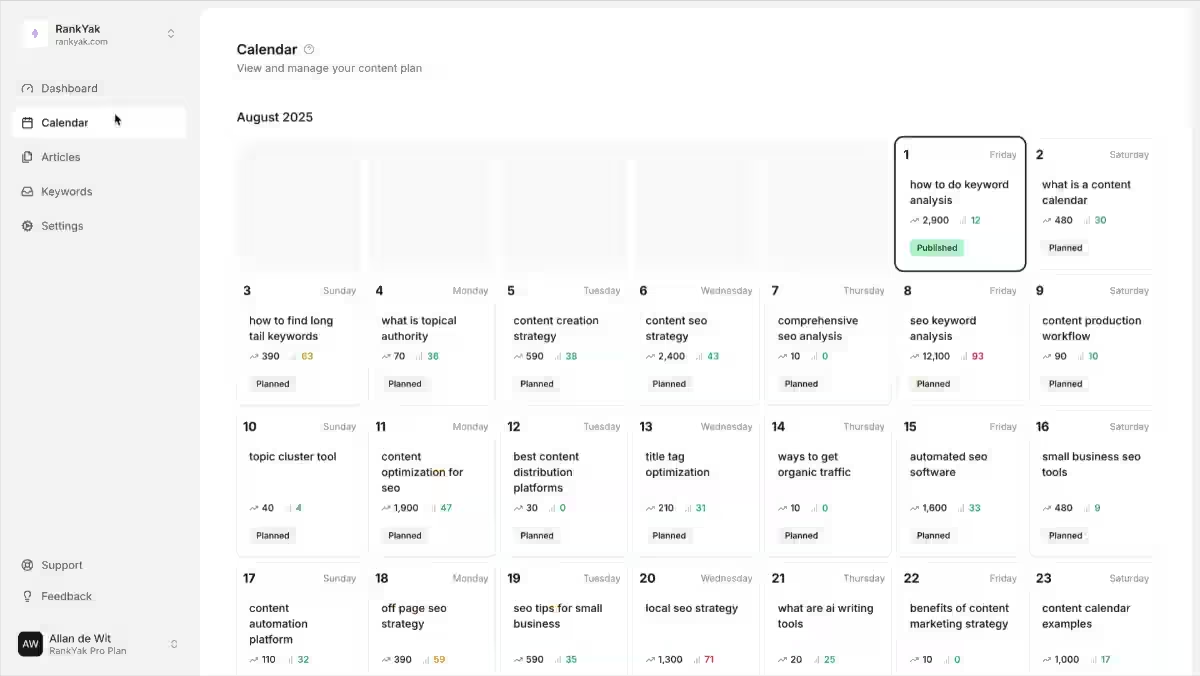
RankYak is an SEO automation platform that runs the whole loop: it finds the keywords your future customers search for, plans the calendar, writes and publishes the articles, builds the backlinks, and watches over the pages you already have. It works at your pace, with you approving each step, or on full autopilot.
RankYak, built by two-person Dutch company Height Labs, automates the full monthly loop: it generates a keyword plan with topic clustering, writes and publishes one article a day, embeds YouTube videos and infographics, and builds backlinks through a private exchange network.
The daily cadence is what makes it distinct. Most autoblogging tools give you a monthly quota you can use however you want. RankYak enforces a daily publishing rhythm, which sends strong consistency signals to search engines.
Key Features
Its smartest feature is how it uses Google Search Console: RankYak reads your GSC data when planning keywords, explicitly to avoid cannibalizing terms you already rank for. That is a meaningful technical differentiator compared to tools that do keyword research without awareness of your existing rankings.
Site Guard provides a daily audit of your existing pages against your real Search Console data, flagging weak titles, lost clicks and keyword cannibalization, with each fix written for you to approve.
Publishing goes directly to WordPress, Webflow, Shopify, Wix, and Duda, or through Zapier, webhooks, and the API.
The recently added backlink exchange network adds a link-building layer where RankYak users automatically exchange contextual backlinks.
Pricing
The official RankYak pricing page lists the Pro plan at $99 per site per month. Automatic volume discounts step the per-site price from $99 down to $79 at 20+ sites, with per-client projects and consolidated billing. A 3-day free trial is available.
Note: software costs add up across a portfolio of websites because RankYak prices each site separately. Factor this into agency budget planning before committing.
Pros
- GSC-integrated keyword planning that avoids cannibalization
- Daily publishing cadence rather than a monthly quota to manage manually
- Site Guard for ongoing improvement of existing pages
- Automated backlink exchange included
- Broad CMS and integration support (Zapier, Make, webhooks, API)
- Agency volume pricing ladder
Cons
- Automation removes the friction of daily publishing, although it does not replace the need for editorial oversight.
- Per-site pricing makes it expensive for agencies managing many client domains
- Its 2025 launch means limited public review history and a small team handling support, which is worth considering for businesses that need guaranteed response SLAs
Best For
Solo founders, e-commerce operators, and small agencies that want consistent daily output without managing a content calendar.
Also worth evaluating if your main SEO concern is publishing frequency and fresh crawl signals rather than large monthly batch volumes.
Who Should Consider a RankYak Alternative?
If you need to publish more than 30 articles per month per site, or if your budget does not allow for per-site pricing across a portfolio, Massblogger or WordRocket AI will be more economical.
3. Massblogger: Best for Programmatic SEO and Multi-Site Operations
Massblogger is the strongest choice when you manage multiple WordPress sites and need programmatic SEO page generation rather than only single-article writing. Choose Massblogger if you manage 5+ sites and want programmatic SEO features.
Its standout feature is pSEO enrichment that adds unique AI content to existing programmatic pages to prevent thin content penalties, plus an MCP server for Claude integration and GSC-powered A/B SEO testing.
The developer is Emil Klitmose, a former agency owner who managed 100+ SaaS and affiliate sites. That background is visible in the product design, which addresses multi-site management problems that most autoblogging tools ignore.
Key Features
What makes Massblogger different from every other tool in this list is the programmatic SEO layer. Most autoblogging tools generate fresh articles.
Massblogger can enrich existing programmatic pages with AI-generated content, which addresses one of the core problems in pSEO: pages that have structure and data but lack the depth that prevents them from being classified as thin content.
Key integrations include WordPress, Next.js, REST API, Webhooks, Claude/Cursor via MCP, Google Search Console, and Advanced Custom Fields (ACF).
The GSC-powered A/B SEO testing capability is not something you will find in most tools at this price point. Testing title and meta variations against real Search Console performance data before rolling changes out at scale is a genuine workflow advantage for multi-site operators.
Pricing
- Massblogger offers a Flex plan at $0/month, Discovery plan at $59/month and a Pro plan at $99/month.
- A refund is available after the first article if you are unsatisfied. This is a reasonable evaluation policy that lowers the commitment risk.
Pros
- Dedicated programmatic SEO enrichment layer
- Multi-site management without per-site pricing penalties
- IndexNow integration supports faster indexation for newly generated pages
- GSC integration for data-driven publishing decisions
- MCP server for Claude and Cursor integration
- Anti-cannibalization tracking directly addresses one of the most common programmatic SEO failure modes
- Built by a practitioner with real multi-site management experience
Cons
- Limited brand voice customization compared to tools like RightBlogger.
- Not suitable for single-site bloggers who do not need programmatic SEO capabilities
- The interface complexity reflects the tool’s depth, meaning the learning curve is steeper than simpler autobloggers
Best For
SEO professionals and agencies managing 5+ WordPress sites who need programmatic SEO, multi-site content automation, and GSC-powered optimization.
Who Should Consider a Massblogger Alternative?
Yes, if you manage multiple sites and want programmatic SEO capabilities most competitors don’t offer. Skip if you need one site with deep brand voice control.
For deeper context on how programmatic SEO and autoblogging differ in practice, the autoblogging vs programmatic SEO comparison explains the distinction clearly.
4. BabyLoveGrowth AI: Best for Automated Backlink Exchange and AI Visibility Tracking
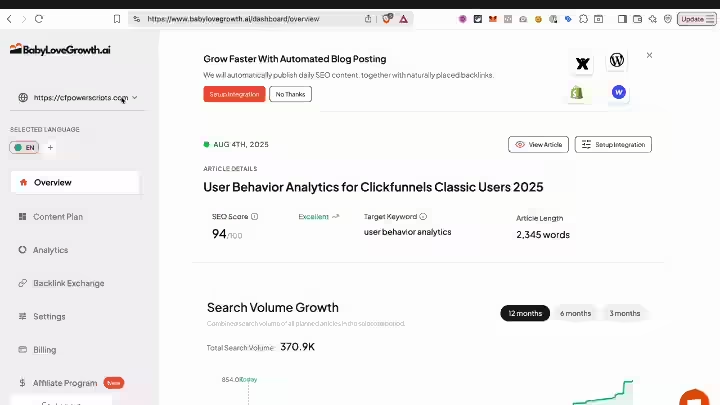
BabyLoveGrowth AI is the best AI SEO and GEO automation platform in this list. BabyLoveGrowth AI continues through a backlink exchange network of 4,000+ sites, AI search citation tracking, a Reddit brand authority module, and a technical GEO audit. That is a wide stack for $99/month.
The AI visibility tracking capability is what separates it from most tools at this price point. My 30-day test of AI search visibility monitoring showed how much query-level data matters compared to aggregate visibility scores.
BabyLoveGrowth AI tracks mentions across ChatGPT, Claude, Perplexity, and Gemini, which covers the four AI systems where brand citations currently matter most.
Key Features
BabyLoveGrowth AI includes: 30 articles per month with daily publishing, a built-in vetted backlink exchange network, LLM visibility tracking across ChatGPT, Claude, Perplexity, and Gemini, CMS integrations with WordPress, Shopify, Webflow, Wix, Ghost, and API access, multiple language support, and GEO audits.
The Reddit brand authority module is worth noting separately. Reddit content now appears frequently in search results and is cited in AI answers.
Having a module that supports Reddit presence building inside an autoblogging platform is unusual and reflects awareness of how modern search ecosystems work.
Pricing
BabyLoveGrowth AI offers two paid plans: Grow ($99/month) and Scale ($299/month), plus a custom reseller plan for agencies. Both plans include a 3-day free trial, 25% off annual billing, and a 90-day money-back guarantee.
See the full BabyLoveGrowth AI pricing breakdown before deciding between the Grow and Scale plans.
Pros
- AI citation tracking across four major LLMs (not independently verified as to tracking methodology)
- 4,000+ site backlink network
- Reddit brand authority module
- Technical GEO audit included
- 90-day money-back guarantee is the longest refund window in this category
- Broad CMS support
Cons
- BabyLoveGrowth AI’s pricing at higher levels is opaque, which makes budgeting harder.
- The LLM tracking methodology is not publicly detailed, so the accuracy and frequency of citation monitoring cannot be independently verified
- Scale tier at $299/month is a significant step-up from the base plan
Best For
Founders, boutique agencies, and e-commerce brands that need content production, passive link building, and AI search citation monitoring in one platform without paying separately for each capability.
Who Should Consider a BabyLoveGrowth AI Alternative?
If AI search visibility tracking is not a priority, Outrank.so offers similar content and backlink features at the same price point with a more established public review history. The BabyLoveGrowth AI vs Outrank.so comparison breaks down the practical differences.
For a deeper evaluation, read the full BabyLoveGrowth AI review.
5. WordRocket AI: Best Budget-Friendly Tool for Bulk Content Production
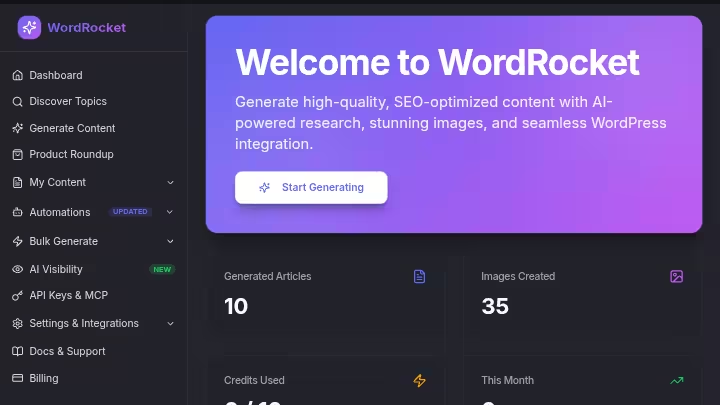
WordRocket AI is the best option if you want to control your exact content cost rather than pay a flat subscription markup on AI usage. It is a bring-your-own-API platform that connects to OpenRouter and Gemini to generate long-form SEO articles.
The BYOK (bring-your-own-key) model is the defining characteristic here. WordRocket AI starts at $10/month and offers unlimited articles on a BYOK basis, with WordPress auto-publish included.
The trade-off is that you pay your own OpenAI or Anthropic API costs on top of the subscription fee, which makes the total cost variable based on usage volume.
Key Features
- WordPress auto-publishing
- Unlimited article volume (subject to API costs you control)
- SEO briefs with keyword input
- Simple content scheduling
Pricing
WordRocket AI starts at $10/month, with API costs added on top based on the AI model you use and the volume of content generated.
For users already paying for OpenAI or Anthropic API access, this can be an economical option if publishing volume is high. For lower volumes, the economics are less clear.
Verify current pricing at the WordRocket AI pricing page before calculating total costs.
Pros
- Lowest monthly entry cost in this list at $10/month
- Unlimited article volume (API-cost dependent)
- WordPress publishing included
- Suitable for high-volume bulk content strategies
Cons
- No backlink features
- No AI visibility tracking
- Total cost unpredictable at high volume if API pricing changes
Best For
High-volume content operators who pay for their own AI API access, and want a low-overhead publishing layer on top.
Who Should Consider a WordRocket AI Alternative?
Anyone who needs on-page SEO or backlinks built into the same workflow should consider Distribb or BabyLoveGrowth AI instead.
Read the full WordRocket AI review for a deeper breakdown of the BYOK model.
6. Rankpill: Best for Daily Automated SEO Content Publishing and Backlinks
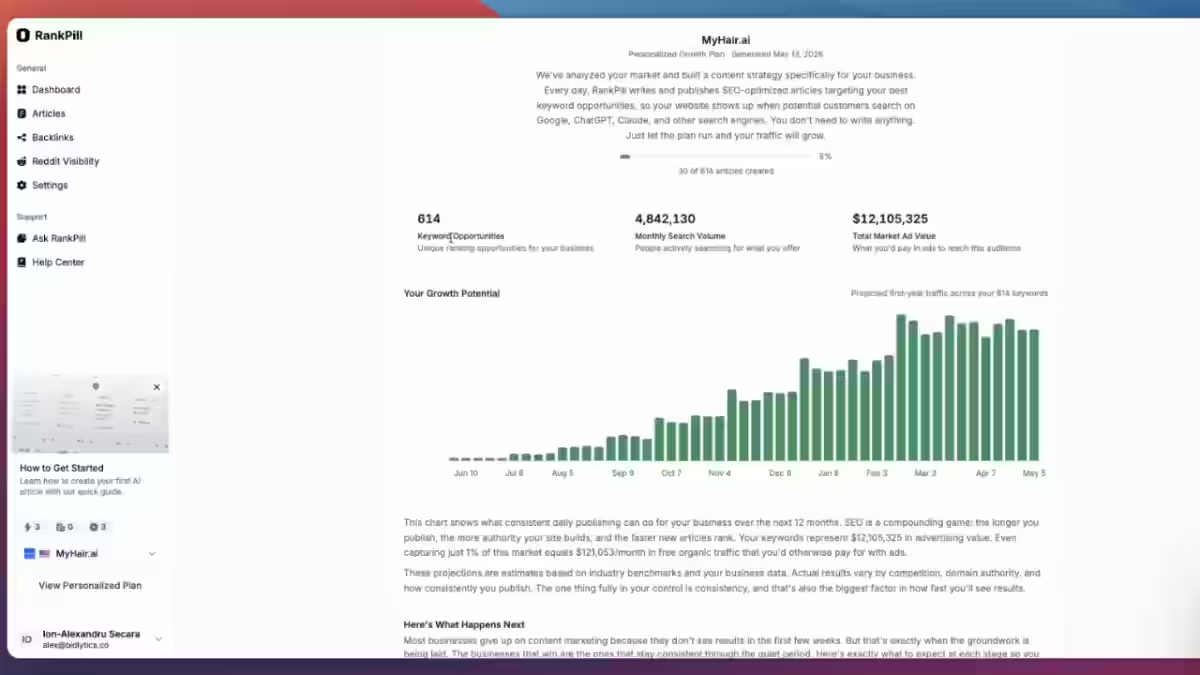
Rankpill is a comprehensive AI SEO platform designed to deliver end-to-end automation including AI-powered content generation, publishing, keyword research, competitor analysis, and real-time SEO scoring.
Automated content consists of long-form articles (3,000+ words advertised) with images, internal links, and citations, generated and published daily to WordPress, Shopify, Webflow, Wix, Framer or via webhooks, in 100+ languages.
Key Features
Features include fully automated SEO content creation tailored to your niche, personalized keyword research and daily 3,000-word blog posts, auto-generated images, videos, and internal/external linking, real-time SEO scoring to ensure every piece hits performance targets, multi-language support and auto-publishing to your website, and multi-platform integration with built-in promotion capabilities.
The backlink exchange provides contextual links between verified sites in your niche to grow domain authority, with 30 credits per month.
Pricing
The platform charges $99/month after a $49.5 for first month and $89/month. Verify current pricing directly before purchasing.
One concern worth flagging: before you see a detailed plan, an article, or a single actionable recommendation, you must pay the $49.5 for the first month. That means you cannot evaluate actual content quality on your own site before committing, which is a meaningful limitation compared to tools that offer a fuller trial experience.
Pros
- Long-form output at 3,000+ words per article
- Multi-CMS publishing (WordPress, Shopify, Webflow, Wix, Framer, webhooks)
- 100+ language support
- Backlink credits included
- Real-time SEO scoring
Cons
- Paywall activates before you can evaluate content quality on your own data
- Backlink credits are not the same as 30 delivered links. Verify what “credit” means in practice
Best For
Content publishers who want long-form daily output across multiple CMS platforms and do not need to see sample output before subscribing.
Who Should Consider a Rankpill Alternative?
If you want to evaluate actual article quality before paying, RankYak or Distribb both offer more transparent trial access. Read the full Rankpill review for a complete breakdown.
7. Keytomic: Best for Auto-Indexing and Reddit Marketing Automation
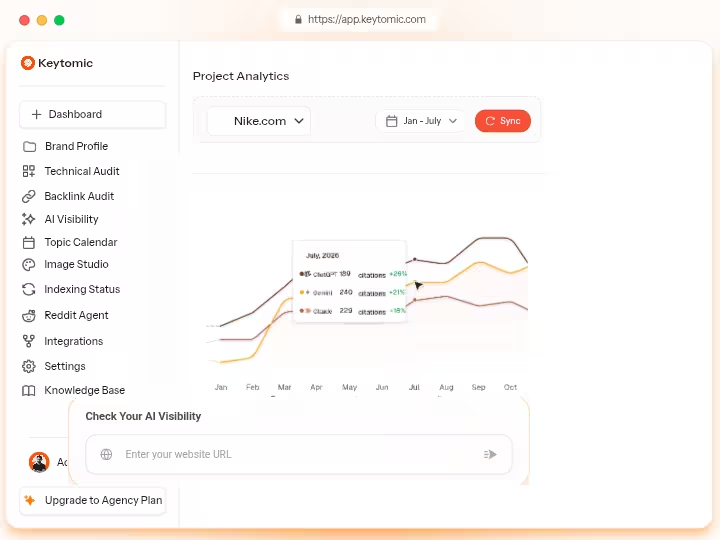
Keytomic combines keyword research, content planning, AI writing, publishing, auto-indexing, and AI visibility tracking in one $99/month platform.
The auto-indexing feature is what makes Keytomic stand out from other tools at this price point. Getting content indexed promptly is a consistent challenge for new sites and growing blogs.
Having indexing automation built into the same platform that generates and publishes content removes a step that many publishers handle manually through Google Search Console or third-party indexing tools.
Key Features
Keytomic supports auto-publishing to WordPress, Shopify, Webflow, Framer, and GoHighLevel, with features including keyword research, schema automation, internal links, AI visibility tracking, and auto-indexing.
The Reddit marketing automation module complements the indexing capability. Reddit threads frequently appear in search results and are cited in AI answers.
Having a structured way to build Reddit presence as part of the same content workflow addresses a distribution gap that most autoblogging tools ignore.
Pricing
Keytomic starts at $1 trial (3 days), $99/month (Pro), $999/month (Agency DFY).
Pros
- Auto-indexing built into the publishing workflow
- Reddit marketing automation for distribution beyond Google
- AI visibility tracking included
- $1 trial for 3 days reduces commitment risk
- Broad CMS support including GoHighLevel (useful for agencies)
- Agency DFY tier for done-for-you operations
Cons
- Manual keyword research tool is less developed than standalone platforms like Semrush or Ahrefs.
- Not the right fit if you need white-label reporting for client delivery.
- Agency DFY at $999/month is expensive and lacks transparent pricing details beyond the listed tier
Best For
Agencies, SaaS companies, affiliate marketers, and founders who want a full publishing workflow with indexing automation and Reddit distribution included.
Who Should Consider a Keytomic Alternative?
If backlink quantity and quality are your primary concern, BabyLoveGrowth AI with its 4,000+ site network offers more in that area.
Read the full Keytomic review for hands-on evaluation details.
8. Clearpost AI: Best for Hands-Off WordPress Publishing
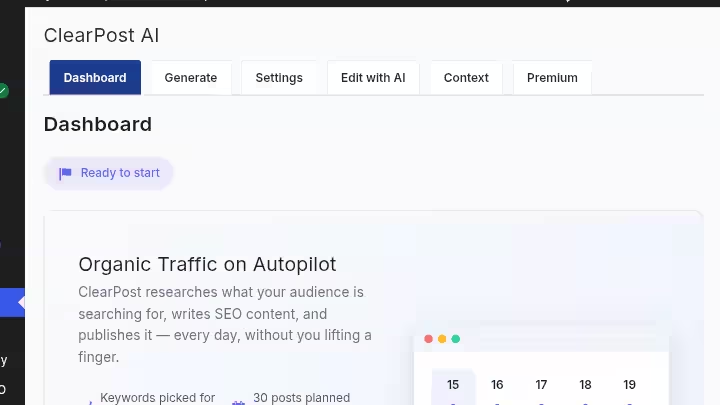
Clearpost AI is a WordPress-focused autoblogging platform designed for hands-off publishing with minimal configuration. Clearpost delivers 30+ posts per month at a fraction of agency content costs, with the same on-page SEO fundamentals that Yoast and Rank Math check for.
The positioning is explicit: AI does the heavy lifting including keyword research, drafting, on-page SEO, and WordPress publishing. This is a tool built for operators who want to set up a publishing workflow and step back, rather than those who want granular control over each content decision.
Key Features
- Automated keyword research
- On-page SEO optimization
- Direct WordPress publishing
- Hands-off content scheduling
- 7-day free trial
The strength is simplicity: the setup is straightforward and the workflow is genuinely low-maintenance once configured.
Pricing
Free (bring-your-own API key); Premium ($99/month), Business ($199/month). All plans come with 7-day free trial, no credit card required. Check the Clearpost AI review for current plan details.
Pros
- Simple WordPress-only workflow with minimal setup
- Genuine hands-off operation once configured
- 7-day free trial (the longest in this list)
- On-page SEO included in the publishing workflow
Cons
- WordPress-only (no Shopify, Webflow, or other CMS support)
- No AI visibility tracking
- Narrower feature set than most tools at the same general price bracket
Best For
WordPress site owners who want simple hands-off publishing without paying for features they will not use. Suitable for bloggers and small publishers who do not need backlinks or AI tracking.
Who Should Consider a Clearpost AI Alternative?
If you publish on multiple CMS platforms, or if you need backlinks included, Distribb or RankYak cover both the WordPress use case and a broader feature set.
9. Outrank.so: Best for Research-Backed Content and Backlinks

Outrank.so offers automated reciprocal backlink exchanges, automated article generation, and a $99/month starting price. It lacks deep analytics, keyword gap tracking, and broader local or social SEO distribution, meaning it must be paired with traditional SEO tools like Ahrefs or Semrush.
Where Outrank.so positions itself well is in content research quality. Articles are built from SERP analysis and competitor research rather than simple keyword input, which generally produces better search intent alignment.
Key Features
- Research-backed content generation from SERP analysis
- Automated backlink exchange network
- 150+ languages
- CMS integrations: WordPress, Shopify, Webflow, Wix, Framer, Notion, Webhook
- 30 articles per month at base plan
Pricing
Outrank.so is priced at $99/month. A $1 trial is available. For full plan details, see the Outrank.so pricing page.
Pros
- Research-first content workflow produces better intent alignment than keyword-only tools
- 150+ language support
- Backlink exchange included
- Broad CMS support including Notion and Framer
- Simple interface with a low learning curve
Cons
- Automated, reciprocal backlink exchanges carry real risk under Google’s link spam policies
- Articles occasionally miss precise search intent or formatting
- It lacks deep analytics, keyword gap tracking, and broader local or social SEO distribution
- No LLM visibility tracking (unlike BabyLoveGrowth AI)
- No Reddit distribution module
Best For
SEO teams and content publishers who want BabyLoveGrowth AI’s content plus backlinks bundle but need faster output, more languages, or prefer to skip the strategic planning phase.
Who Should Consider an Alternative?
If AI citation tracking is important to your strategy, BabyLoveGrowth AI is the better fit at the same price point.
Read the full Outrank.so review for a complete breakdown.
10. BlogSEO.io: Best for Semantic SEO Automation and Backlinks
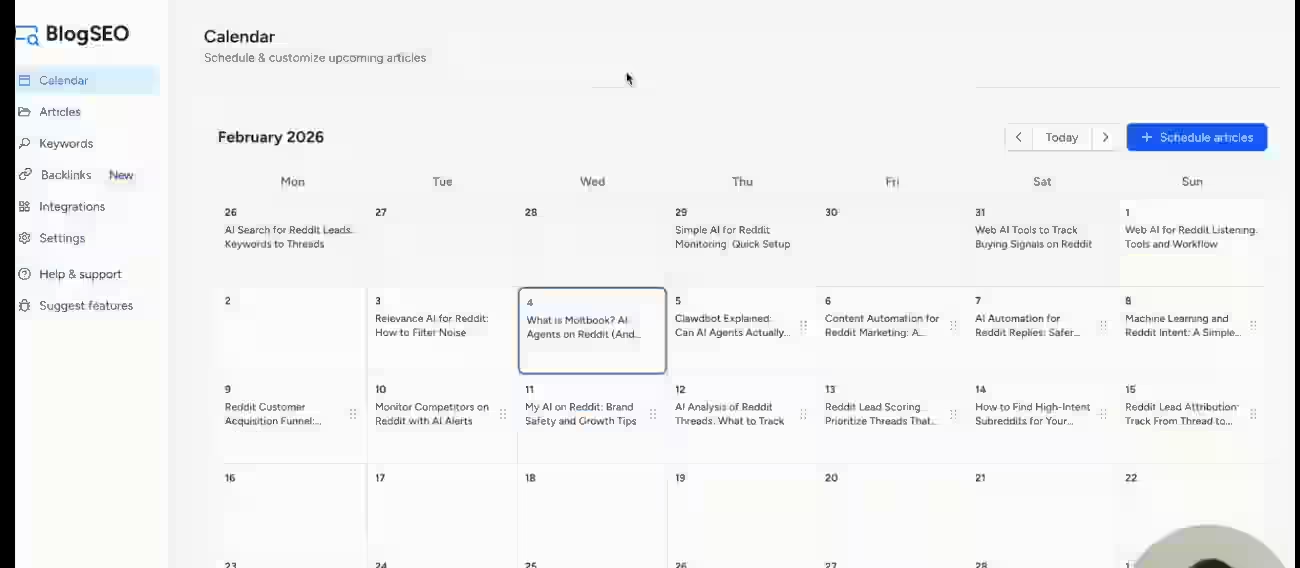
BlogSEO.io focuses on semantic SEO automation: generating content that is structured around topic clusters, schema markup, and internal linking rather than individual keyword targeting. Its research-to-publish blog workflow includes internal linking, scheduling, and draft or live WordPress delivery.
BlogSEO.io is rated as the best option for semantic SEO publishing within comparison sets that prioritize structured data and topical depth over raw publishing volume.
Key Features
- Semantically focused content generation
- Smart schema generator
- Internal link picker
- Content scheduling with draft or live delivery
- AI web visibility features
- Backlink exchange features
- WordPress and Shopify publishing
Pricing
BlogSEO.io offers a 7-day free trial for testing the platform, $59/month (Starter plan) and $97/month (Ambition plan).
Pros
- Semantic content structure rather than individual keyword targeting
- Smart schema generator for structured data
- Internal link picker included
- Draft mode for editorial review before publishing
- WordPress and Shopify support
Cons
- AI citation monitoring is claimed, but the method should be tested and verified independently before relying on it for reporting.
- Publishing volume at base tier is lower than some tools in this list
- Backlink features should be verified for link quality before scaling
Best For
Content teams and bloggers who want semantically structured, schema-rich content rather than high-volume generic articles. Suitable for sites where topical authority and structured data matter more than raw publishing frequency.
Who Should Consider an Alternative?
For raw publishing volume and backlink quantity, RankYak or BabyLoveGrowth AI are better fits. Read the full BlogSEO.io review for a complete feature evaluation.
11. Rightblogger: Best All-in-One Toolkit for Beginners and Solo Bloggers
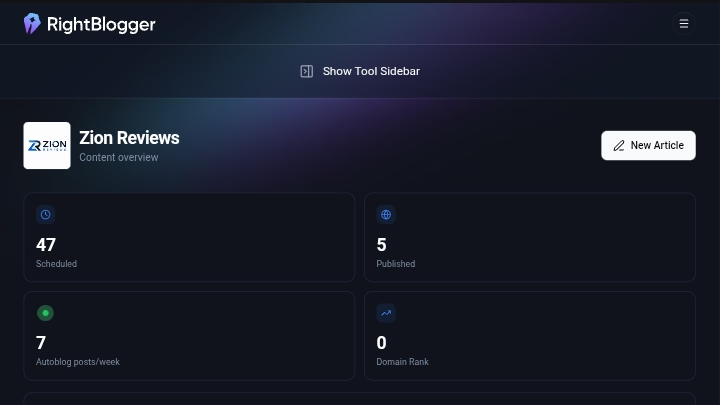
RightBlogger offers unlimited articles on all plans starting at $59/month. The Site Agent runs recurring scans on connected WordPress sites, queues internal-link additions, meta-description rewrites for low-CTR pages, and broken outbound-link cleanups.
It includes 90+ AI-powered blogging tools covering ideation through publishing, with direct WordPress integration and scheduled publishing.
Rightblogger is positioned differently from every other tool in this list. Rather than providing a narrow automated workflow, it gives you a broad toolkit of individual AI-assisted content tools.
Key Features
- 90+ AI-powered blogging tools
- Unlimited article generation on all paid plans
- Site Agent for ongoing WordPress site improvement
- WordPress auto-publish and scheduling
- Backlink exchange feature (recently added)
- SEO articles with keyword guidance
Pricing
Monthly plans start at $59/month. A lifetime deal option is available at around $69. See the RightBlogger pricing page for current plan details.
The unlimited article volume at $59/month is a meaningful value advantage for bloggers who want to produce content at their own pace without credit limits. The trade-off is that you are doing more of the workflow manually than with fully automated platforms.
Pros
- Unlimited articles on all plans
- 90+ individual content tools for ideation through publishing
- Site Agent for ongoing WordPress optimization
- $59/month is the lowest price for a tool with genuine SEO features in this list
- Lifetime deal option available
- Accessible for beginners without technical SEO experience
Cons
- Limited advanced SEO features compared to tools like Outrank.so or BabyLoveGrowth AI.
- Less end-to-end automation than most tools in this list
- No backlink network of comparable scale to BabyLoveGrowth AI or Outrank.so
- No AI citation tracking
- No programmatic SEO capabilities
Best For
Solo bloggers and small content teams who want a Swiss Army knife for content creation with ongoing site optimization built in.
Who Should Consider a Rightblogger Alternative?
If you need automated end-to-end publishing without manual tool-switching, Distribb or RankYak will serve you better.
Read the full RightBlogger review for a complete evaluation.
Are AI Autoblogging Tools Good for SEO in 2026?
AI autoblogging tools can support SEO when they produce useful, accurate, original content that satisfies search intent. Automation alone does not guarantee rankings.
The clearest framework for evaluating this comes from Google’s own guidance, which focuses on whether content is helpful, reliable, and created primarily for people rather than for search engines. The question of whether AI was involved in production is secondary to whether the content is actually useful.
Google’s Search Quality documentation does not prohibit AI content. It penalizes low-quality content regardless of how it was produced.
From my 21-day comparison of manual and automated SEO workflows, I found that simple data collection and reporting were much easier to automate than decisions involving search intent, content quality, or page targeting. That distinction is directly relevant to evaluating autoblogging tools.
Here is what the evidence from working with these tools actually shows:
- Content usefulness and originality: The best tools in this list do SERP research before generating content. That research step is the difference between articles that accurately address a search query and articles that cover a keyword without understanding what the searcher actually needs.
- Human editorial oversight: Every tool in this list benefits from at least a light editorial review before publishing at scale. My experience with automated workflows confirmed that automation can create additional work when recommendations or outputs are accepted without review. A wrong factual claim, a page that cannibalizes an existing ranking, or an article that misreads search intent all create cleanup work that costs more time than the automation saved.
- Firsthand experience and evidence: Google’s quality guidance explicitly values content that demonstrates firsthand knowledge, original analysis, and direct experience with the topic. A fully automated article cannot do this by definition. The solution is not to avoid automation but to add original observations, data, or examples where the topic requires them.
- Backlink exchange risks: Several tools in this list include automated backlink exchange networks. Google’s link spam policies apply to link schemes regardless of whether they are manual or automated. Contextual link exchange within a vetted network is a different risk profile from bulk link farming, but independent verification of link quality is difficult. Treat backlink exchange features as a supplementary layer rather than a primary link-building strategy.
- Indexing and performance monitoring: Publishing content is not the same as ranking for it. Monitor Search Console data after publishing to understand which articles are being indexed, which queries they appear for, and whether traffic is materializing. For a broader look at AI search visibility alongside traditional ranking, the AI Overview tracking guide explains what to monitor and how.
- Risks of volume without quality control: Publishing large volumes of low-value pages is one of the fastest ways to trigger a Google quality review. A smaller number of well-reviewed, genuinely useful articles will consistently outperform large volumes of thin automated content. This is not a theoretical concern. It reflects the actual pattern in how Google quality updates have affected autoblogging sites.
How to Choose the Best AI Autoblogging Tool
Define Your Primary Objective
The right tool depends on what you actually need: content generation volume, daily publishing consistency, programmatic SEO at scale, passive link acquisition, AI search visibility monitoring, or some combination of these.
Tools that try to do everything at $99/month will inevitably do some things better than others. Be clear about which capabilities are non-negotiable before evaluating pricing.
Check CMS Compatibility
Most tools support WordPress. Shopify, Webflow, Wix, and Framer support varies significantly.
If you publish on a non-WordPress CMS, verify integration depth rather than just checking whether the CMS appears on the feature list. Zapier or webhook-based integrations are more fragile than native connections.
Evaluate Content Quality Before Committing
Every tool in this list offers either a free trial, a $1 trial, or a short money-back guarantee window. Use that window to generate articles on your actual topic and compare them against the content currently ranking for those search queries.
If the output would require more than 15 to 20 minutes of editing per article to make publishable, factor that time into the total cost calculation.
Compare Total Costs
Headline subscription prices do not tell the full story:
- BYOK tools (WordRocket AI): Add API costs based on your volume
- Per-site pricing (RankYak): Multiply by the number of sites in your portfolio
- Accelerator or Scale tiers: Evaluate whether the additional features justify the step-up cost
- Editing time: If you spend 2 hours per article reviewing automated output, factor that into the ROI calculation
Review Automation Controls
Fully autonomous publishing carries the highest risk. Approval gates, draft modes, and scheduling controls give you a checkpoint before content goes live. Verify whether these controls exist and whether they are on by default or require manual configuration.
Assess SEO and Reporting Features
The tools that connect to Search Console data for keyword planning (RankYak, Massblogger) have a meaningful advantage over those that do keyword research in isolation.
Search Console data shows you what you already rank for, which prevents cannibalization and helps focus new content on gaps rather than competing with your existing pages.
For automated SEO reporting alongside content automation, understanding how to track performance after publishing is as important as the publishing workflow itself.
Start With a Controlled Pilot
Publish 10 to 15 carefully reviewed articles and monitor their performance for 60 to 90 days before scaling.
Index rate, impressions, clicks, and keyword positions for those articles will tell you more about a tool’s actual SEO impact than any vendor claim or review article can. That data gives you a defensible basis for either scaling the workflow or switching tools.
Takeaway: Which AI Autoblogging Tool Should You Choose?
Distribb is the strongest overall recommendation in this comparison for users who want keyword research, competitor analysis, content generation, backlink building, AI visibility tracking, social repurposing and content distribution without managing multiple platforms.
The workflow is genuinely automated, the backlink exchange layer adds post-publish value, and the 7-day trial gives you enough time to evaluate content quality on your own site before committing to $97/month.
For specific use cases, here is where the alternatives make more sense:
| Goal | Best Tool | Why |
|---|---|---|
| Hands-off daily publishing | RankYak | GSC-integrated keyword planning, daily cadence, cannibalization checks |
| Multi-site programmatic SEO | Massblogger | Built for 10+ site portfolios, pSEO enrichment, GSC A/B testing |
| Content + backlinks + AI citation tracking | BabyLoveGrowth AI | 4,000+ site network, LLM tracking across 4 AI systems |
| Budget bulk publishing | WordRocket AI | $10/month + BYOK, unlimited volume |
| Beginners and solo bloggers | Rightblogger | 90+ tools, unlimited articles, $59/month, Site Agent |
| Research-backed content | Outrank.so | SERP-research-first workflow, 97 G2 reviews, 150+ languages |
| Semantic SEO and schema | BlogSEO.io | Topical clusters, smart schema, internal link picker |
| Auto-indexing and Reddit distribution | Keytomic | Indexing automation, Reddit marketing module |
Before automating a full website, publish a small controlled batch, review every article before it goes live, and monitor Search Console data for 60 days. The best AI autoblogging tool is not the one that publishes the most articles. It is the one that removes repetitive work while helping you produce content that deserves to be discovered.
Frequently Asked Questions
What are the top 5 automation tools for autoblogging in 2026?
The five strongest options based on workflow completeness, pricing, and feature depth are Distribb, RankYak, BabyLoveGrowth AI, Keytomic, and Massblogger. Distribb leads for most general use cases. RankYak is the best for daily publishing consistency. BabyLoveGrowth AI is the best if AI citation tracking matters. Keytomic stands out for auto-indexing. Massblogger is built specifically for multi-site programmatic SEO operations.
What is replacing traditional blogging?
AI-assisted content workflows are replacing the purely manual blogging model, but editorial judgment remains necessary. What is changing is that keyword research, content briefs, first drafts, internal linking, and SEO optimization no longer require full manual execution. What has not changed is the need for accurate information, genuine expertise, and content that satisfies what the reader actually needs.
What is the best free autoblogging plugin for WordPress?
There is no free tier among the tools reviewed here that provides full autoblogging automation. WordRocket AI and Massblogger offer a free plan at $0/month, which covers limited functionality. For a broader look at free and lower-cost options, the free autoblogging tools guide covers what is available at no cost and what the trade-offs are.
Is automated backlink exchange safe for SEO?
Backlink exchange networks carry risk under Google’s link spam policies. The risk level depends on the quality, relevance, and DR of exchanged links, and whether the exchange pattern is detectable at scale. No tool in this list can guarantee that its exchange network will not be identified as a link scheme. Treat backlink exchange features as supplementary to a broader link-building strategy rather than a primary tactic.
Can AI autoblogging tools improve visibility in AI search results?
Some tools in this list include AI visibility tracking (BabyLoveGrowth AI, Distribb). Tracking mentions is different from guaranteeing citations. AI search results from ChatGPT, Perplexity, and Google AI Overviews are dynamic and change frequently. Content quality, source authority, entity clarity, and structured information all influence AI citation likelihood, but no tool can guarantee inclusion.
What is the best AI autoblogging tool for agencies managing multiple client sites?
For agencies, the evaluation depends on whether you need white-label reporting, multi-client billing, or volume pricing. RankYak’s automatic discount ladder down to $79/site at 20+ sites is the most transparent agency pricing in this comparison. Massblogger handles multi-site portfolio management without per-site pricing, making it more economical at scale.

- LiteScroll com Free SEO Tools: Features, Benefits and Honest Review (2026) - November 20, 2026
- SEO Agency Interamplify: Services, Pricing and Alternatives for 2026 - November 19, 2026
- Otterly AI Review 2026: Is It Worth $29/Month for AI Search Visibility? - November 18, 2026