“Affiliate Disclosure: Some of the links in this article are affiliate links. If you click through and make a purchase, I earn a small commission at no extra cost to you. This does not influence my ratings.”
Quick Answer: What Are the Best Autoblogging Tools for 2026?
The best autoblogging tool in 2026 is Keytomic for users who want a complete hands-off SEO workflow covering keyword research, AI content generation, publishing, indexing, technical SEO, backlinks and AI search visibility.
BabyLoveGrowth AI is the better choice if automated backlink building and SEO content are a priority.
Soro SEO is particularly well suited to local businesses that want daily, geo-targeted publishing.
For high-volume content at a lower software cost, WordRocket AI is a strong alternative because its BYOK model lets you control your AI API costs.
What Are Autoblogging Tools?
Autoblogging tools are software platforms that automate part or all of the blog content workflow: keyword research, article generation, on-page SEO and CMS publishing.
The old model of autoblogging meant scraping RSS feeds and republishing other people’s content with minor edits. That approach is effectively dead for anyone who cares about organic search.
Modern autoblogging uses AI to generate original content, publish it automatically to your CMS and optimize it for SEO, all on autopilot.
Some go further and handle backlink building, schema markup, internal linking, auto-indexing, distribution to social media and AI search visibility tracking.
If you want a broader picture of how the mechanics work, my guide on how autoblogging works is a solid starting point
Best Autoblogging Tools at a Glance

I ranked these tools based on SEO automation, content quality, publishing automation, pricing and value, ease of use and scalability, combining hands-on testing where available with product and pricing research.
| Rank | Tool | Best For | Automation Level | Starting Price | My Score |
|---|---|---|---|---|---|
| 1 | Keytomic | Best hands-off SEO automation | Full | $99/mo | 9.0/10 |
| 2 | BabyLoveGrowth AI | Automated SEO content + backlinks | Full | $99/mo | 8.8/10 |
| 3 | Soro SEO | Local SEO autoblogging | Full | $39/mo | 8.5/10 |
| 4 | WordRocket AI | High-volume, low-cost content scaling | High | $10/mo + API | 8.3/10 |
| 5 | Distribb | Backlinks + Content distribution at scale | Full | $97/mo | 8.1/10 |
| 6 | Outrank.so | Research-backed SEO content | High | $99/mo | 8.0/10 |
| 7 | BlogSEO.io | Automated blog publishing | High | ~$97/mo | 7.8/10 |
| 8 | RightBlogger | Bloggers and small teams | Moderate | $59/mo | 7.7/10 |
| 9 | Byword AI | Programmatic SEO and affiliate content | High | $5/article or $99/mo | 7.6/10 |
| 10 | RankPill | Automated SEO workflows | Full | $49.50/mo (first month) then $99/mo | 7.4/10 |
| 11 | Frizerly | Automated business blogging | High | $49/mo | 7.2/10 |
Before scaling any autoblogging tool, map your keyword clusters. Assign a primary keyword to each article, define the intent and make sure no two posts are targeting the same head term.
Autoblogging Tools Scoring Breakdown
Rank | Tool | SEO Automation (25%) | Content Quality (20%) | Publishing Automation (20%) | Price & Value (15%) | Ease of Use (10%) | Scalability (10%) | Overall Score |
|---|---|---|---|---|---|---|---|---|
1 | Keytomic | 9.5 | 8.5 | 9.5 | 9.0 | 8.5 | 8.3 | 9.0/10 |
2 | BabyLoveGrowth AI | 9.3 | 8.0 | 9.2 | 9.0 | 8.3 | 8.6 | 8.8/10 |
3 | Soro SEO | 7.8 | 8.1 | 9.5 | 9.5 | 9.5 | 6.5 | 8.5/10 |
4 | WordRocket AI | 7.5 | 8.7 | 8.5 | 9.5 | 7.5 | 8.1 | 8.3/10 |
5 | Distribb | 8.3 | 7.8 | 8.5 | 7.5 | 7.8 | 8.6 | 8.1/10 |
6 | Outrank.so | 8.3 | 9.2 | 7.0 | 7.8 | 7.0 | 8.2 | 8.0/10 |
7 | BlogSEO.io | 7.6 | 7.4 | 8.5 | 7.2 | 8.5 | 7.9 | 7.8/10 |
8 | RightBlogger | 6.8 | 7.8 | 6.5 | 9.3 | 8.7 | 8.8 | 7.7/10 |
9 | Byword AI | 6.3 | 6.6 | 8.8 | 8.5 | 8.5 | 8.5 | 7.6/10 |
10 | RankPill | 7.5 | 6.5 | 8.3 | 7.8 | 7.0 | 7.0 | 7.4/10 |
11 | Frizerly | 6.0 | 6.3 | 8.0 | 8.5 | 9.0 | 6.7 | 7.2/10 |
1. Keytomic for Hands-off SEO Publishing
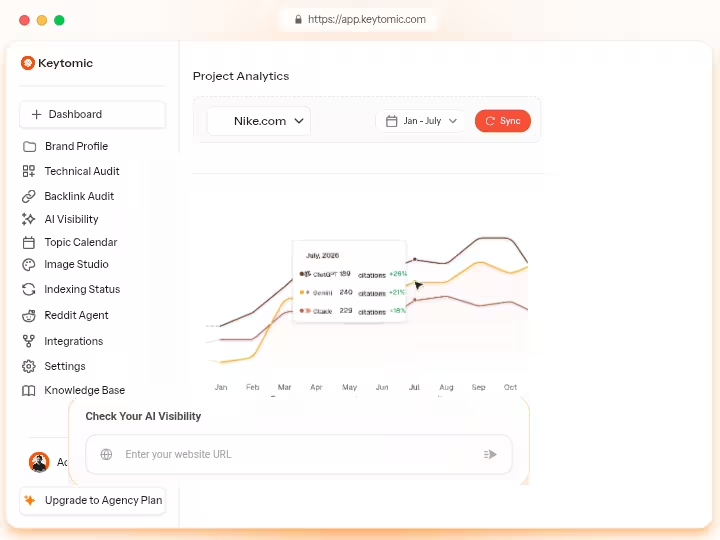
Keytomic is the strongest hands-off SEO automation platform I tested in 2026 because it covers more of the real SEO workflow in a single subscription than anything else at this price.
It handles keyword research, content creation, CMS publishing, auto-indexing, schema markup, backlink building, daily Reddit AI brand authority automation and AI search visibility tracking, all from one dashboard. Most competing tools cover two or three of those layers. Keytomic covers six or seven simultaneously.
The platform is built around a rolling 30-day content calendar. You approve the plan, and the tool executes it. The auto-indexing layer is genuinely useful for content operations because it reduces the lag between publishing and first Google discovery without manual submission.
The AI visibility tracking covers ChatGPT, Perplexity, and Gemini, which matters if you’re thinking ahead about how generative engine optimization fits into your content strategy.
Pros
- True end-to-end automation from keyword research to published and indexed content
- AI citation tracking in one workflow
- Auto-indexing reduces the time between publishing and first search appearance
- Strong AI search visibility tracking built in at no extra cost
Cons
- Backlink community is limited
- Rank tracking and manual keyword research tools are less developed than standalone platforms like Semrush or Ahrefs
- Not the right fit if you need white-label reporting for client delivery
Pricing: Keytomic starts at $1 trial (3 days), $99/month (Pro), $999/month (Agency DFY).
Best for: Small to mid-sized teams, SaaS businesses and boutique SEO agencies that want a single platform to run a full content operation without managing multiple subscriptions.
Not ideal for: White-label agency reporting or teams that need deep standalone rank tracking.
Read the Keytomic review for a full feature walkthrough.
2. BabyLoveGrowth AI for Automated SEO Content + Backlinks
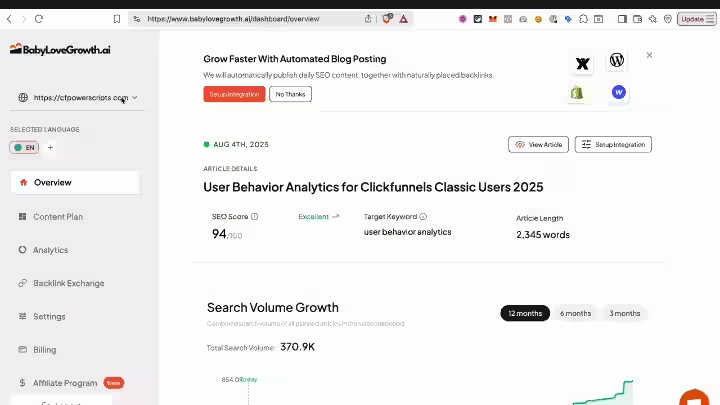
BabyLoveGrowth AI is the best option when you want automated backlink building included in the same subscription as your content workflow.
Most autoblogging tools stop at publishing. BabyLoveGrowth AI continues through a backlink exchange network of 4,000+ sites, AI search citation tracking, a Reddit brand authority module, and a technical GEO audit. That’s a wide stack for $99/month.
The content output covers 30 articles per month with internal links, citations, infographics, and YouTube video embeds included. The multilingual support across 20+ languages also makes it one of the stronger options for international content operations.
One honest caveat: content quality in highly technical or regulated niches sometimes needs a review pass before publishing. The 90-day money-back guarantee reduces the risk of discovering this too late.
Pros
- The breadth of the automation, including content generation, CMS publishing, backlink exchange, schema generation, GEO audit, LLM tracking and Reddit agent, is genuinely wider
- AI search visibility feature is genuinely unusual at this price point. Most competing SEO automation platforms either don’t offer AI visibility tracking at all or charge separately for it
- 90-day money-back guarantee reduces subscription risk
- Strong value for volume: 30 articles per month plus backlinks at $99/month
Cons
- Content quality in highly technical or regulated niches may require editing before publishing
- The real risk is paying upfront. If the content quality in your specific niche requires heavy editing, your true cost per article is higher than the sticker price.
- Expect 3+ months of consistent publishing before compounding SEO results become visible
- Not suitable for editorial-heavy brands requiring full creative control
Pricing: BabyLoveGrowth AI offers two paid plans: Grow ($99/month) and Scale ($299/month), plus a custom reseller plan for agencies.
Both plans include a 3-day free trial, 25% off annual billing and a 90-day money-back guarantee.
For the full plan breakdown, see the BabyLoveGrowth AI pricing guide.
Best for: Small businesses, affiliate site operators, and agencies that want hands-off SEO content plus automatic backlink building.
Not ideal for: Editorial-heavy brands that require full creative control over voice and tone.
Read the full BabyLoveGrowth AI review for my 45-day test results.
3. Soro SEO for Local SEO Autoblogging

Soro SEO is the best-fit tool for local service businesses and small site operators that need geo-targeted content published daily without managing a content calendar themselves.
The tool researches keywords with local and geographic targeting built in, generates SEO articles aligned to local intent queries, and publishes them automatically on a pre-filled daily schedule. That setup removes the biggest operational burden for small businesses: consistency.
At $39/month for 30 articles, the per-article cost works out to roughly $1.30. That’s well below what a freelance writer charges for an SEO-optimized article, which typically runs between 50 and 200 depending on length and niche.
Local businesses need blog content that answers location-specific and service-specific questions, so the tool matters less than the topic and entity strategy behind it. A generic autoblogger producing national-scope articles rarely wins local intent. Soro’s geo-targeted keyword discovery addresses that directly.
Pros
- Simple setup, fast onboarding, and a clean dashboard
- Daily auto-publishing without requiring manual scheduling
- Low per-article cost at the entry tier
- Solid fit for local businesses running niche content sites
Cons
- Fewer advanced SEO features than Keytomic or BabyLoveGrowth AI
- No built-in backlink building
- Content depth may fall short for competitive or technical niches
- Less useful for agencies managing multiple client sites simultaneously
Pricing: At $39/month for 30 articles, the per-article cost works out to be $1.30 per post at the entry tier. See the Soro SEO pricing guide for current plan details.
Best for: Local service businesses, niche bloggers, and small site owners wanting consistent daily publishing.
Not ideal for: Agencies managing multiple client sites or users who need advanced technical SEO features.
Read the Soro SEO review for a feature-level breakdown.
4. WordRocket AI for High-Volume, Low-Cost Content Scaling
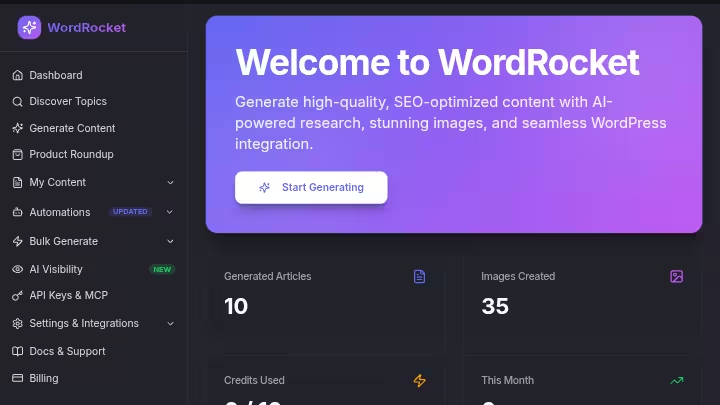
WordRocket AI is the best option for high-volume content production when you want to control AI API costs directly through a bring-your-own-key (BYOK) model.
The BYOK setup means you’re not paying a fixed per-article fee that gets expensive at scale. You connect your own OpenRouter API key and choose which AI model runs your content, whether that’s GPT-4, Claude or Gemini.
Your cost per article drops significantly as volume increases.
I tested WordRocket over 45 days and found it particularly strong for affiliate marketers who need to generate product comparison and review content across dozens of long-tail keywords at once.
The long-form coherence past 3,000 words is noticeably better than most subscription-based tools at this price.
The BYOK setup does have a learning curve, though. If you’re not comfortable with API keys and model configuration, this tool will take some setup time before it’s running smoothly.
Pros
- WordRocket’s BYOK model offers more flexibility for high-volume users. Cost predictability with the BYOK model means no surprise overages or artificial word limits.
- Template quality reduces prompting time significantly for recurring content types
- Lifetime deal eliminates ongoing monthly costs
- Strong long-form coherence compared to many subscription-based generators
Cons
- Built-in keyword research is limited
- API setup has a learning curve and is not beginner-friendly
- Image generation quality is basic, usable but not professional
- No collaboration tools or workflow management for teams
- No automated backlink building
Pricing: Free plan ($0/month), Starter plan ($10/month), Pro ($20/month), Premium ($49.99/month).
A lifetime deal starts at $199 + API usage. See the WordRocket pricing page for the full breakdown.
Best for: Solo bloggers, affiliate marketers, and small agencies comfortable managing their own API costs.
Not ideal for: Beginners who need an all-in-one system or teams needing collaboration tools.
Read the full WordRocket AI review.
5. Distribb for Content Distribution at Scale + Backlinks

Distribb is the best option when you want automated content publishing paired with backlink distribution and AI search visibility, not just article generation.
Where most autoblogging tools stop at the publish button, Distribb continues through a credit-based backlink exchange and multi-channel distribution layer.
The semantic cocoon content architecture is also worth noting: it structures articles around topical clusters rather than isolated posts, which helps build domain authority faster.
The 3-day free trial (credit card required) lowers the risk of testing it.
The $97/month price point is on the higher end for solo operators, but the post-publish distribution layer justifies it for users who need both content, distribution and link-building.
Pros
- Combines content generation, publishing, backlinks, and distribution in one tool
- Semantic cocoon architecture helps build topical authority faster than isolated articles
- Distribb’s backlink network operates on a credit model. Both Distribb and competing tools eliminate cold outreach, which typically costs 5 to 10 hours per quality backlink when done manually.
- 3-day trial lowers entry risk
Cons
- $97/month base price is at the higher end for solo operators
- Distribution features are most valuable on higher tiers
- Content quality in niche technical areas may still need review
- Trial period of 3 days is short for evaluating content strategy fit
Pricing: $97/month (Pro plan) after a 3-day free trial and is designed as a full AI SEO automation platform, not just a content distribution tool.
Annual billing reduces the effective monthly rate. Review the Distribb review for full plan details.
Best for: Content publishers and affiliate marketers who want automated publishing paired with backlink distribution.
Not ideal for: Users whose primary need is content generation alone, where lower-cost tools make more sense.
6. Outrank.so for Research-Backed SEO Content

Outrank.so produces the most research-backed, editorially defensible content of any tool in this comparison, which is why it scores highest for content quality despite ranking 6th overall.
The platform pulls SERP analysis, competitor content gaps and source citations into each article before generating. That workflow produces content you can actually defend, which matters for competitive informational queries where thin AI content gets filtered out quickly.
The tradeoff is that Outrank.so requires more human involvement per article than tools like Keytomic or BabyLoveGrowth AI.
It is not a set-and-walk-away platform. However, it’s better suited to SEO teams that want a strong AI-assisted drafting process rather than full publishing automation.
Pros
- Research-first approach produces more defensible, citation-ready content
- Strong SERP analysis, citations, and editorial-quality drafts make it a solid choice for SEO professionals
- High authority backlinks that boost your domain authority
- Solid option for teams that need to defend content quality to clients
Cons
- Requires more manual setup and review than pure autopilot tools
- Less suitable for bulk publishing workflows
- Higher involvement per article than Keytomic or BabyLoveGrowth AI
Pricing: $1 for a 3-day trial, then $99/month for 30 auto-published articles ($3.30/article). See the Outrank.so pricing plans for 2026 for current tier details.
Best for: SEO professionals and content teams who prioritize article quality and SERP-defensible content.
Not ideal for: Users who want maximum hands-off automation or bulk publishing.
Read the Outrank.so review for a hands-on breakdown.
7. BlogSEO.io for Automated Blog Publishing

BlogSEO.io is built for website owners who want consistent, SEO-optimized content published automatically without managing every step manually.
It handles keyword discovery, article generation, on-page SEO formatting, schema markup, and direct CMS publishing with scheduling controls.
The automated backlink exchange on autopilot is a bonus for a tool at this price point, though the cap of up to 15 backlinks per month limits its impact compared to BabyLoveGrowth AI’s broader network.
The Google Search Console integration is useful for tracking what’s working without leaving the platform. The clean interface keeps the onboarding manageable even for non-technical users.
Pros
- Clean, accessible interface with a manageable learning curve
- Solid schema and meta tag automation baked into output
- Good fit for bloggers and small business owners who want scheduled publishing without deep technical setup
- Competitive entry pricing for the publishing automation it provides
Cons
- Up to only 15 backlinks per month
- Content depth may not satisfy competitive, high-authority niches
- Less suitable for agencies managing multiple client sites
- Fewer workflow features than competitors
Pricing: Approximately $97/month after a 3-day free trial. Higher tiers support greater article volume and additional sites. See the BlogSEO.io review for current pricing.
Best for: Bloggers, small business owners, and content marketers who want reliable automated publishing with solid on-page SEO.
Not ideal for: Agencies managing multiple client sites or SEO professionals who need deep SERP analysis.
8. RightBlogger for Bloggers and Small Teams
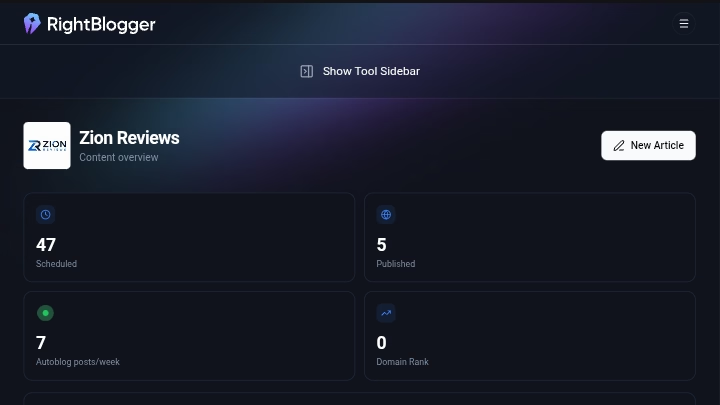
RightBlogger is the best-value option for solo bloggers who want unlimited AI content tools, a built-in keyword research workflow, and a brand voice configuration all in one $59/month subscription.
It’s not primarily an autoblogging platform in the traditional sense. It’s a comprehensive blogging toolkit that includes autoblogging capabilities alongside 90+ writing tools, keyword research, social media automation, and a Site Agent that surfaces ongoing SEO maintenance suggestions.
RightBlogger fits beginners and solo creators who want simple automation. It offers a broad set of blog-focused content tools with a fast learning curve and less setup friction. The appeal is practical utilities without enterprise complexity.
Publishing still requires user initiation per batch, which is a real limitation for users who want a fully automated workflow.
Pros
- For individual affiliate sites with lower volume needs, RightBlogger’s toolkit covers product review templates, comparison formats, and SEO scoring in one subscription
- Unlimited article generation removes per-article cost anxiety for active bloggers
- MyTone brand voice configuration reduces editing time significantly
- Site Agent provides ongoing SEO maintenance without manual audits
Cons
- Not a true hands-off autopilot system; publishing still requires user initiation per batch
- Less suitable for agencies managing multiple client sites at scale
- Backlink exchange is newer and less proven than BabyLoveGrowth AI’s network
- Not built for bulk programmatic content at the scale of Byword AI or WordRocket AI
Pricing: Solo at $59/month (1 site), Pro at $89/month (3 sites) and Agency at $299/month (10+ sites), all with unlimited AI words and a current 50% off annual plan promotion.
Best for: Individual bloggers, freelancers, and small teams who want a broad content toolkit rather than hands-off autopilot.
Not ideal for: Agencies or bulk programmatic content operations.
If you want a comparison, read RightBlogger review for a feature-level contrast.
9. Byword AI for Programmatic SEO & Affiliate Content at Scale
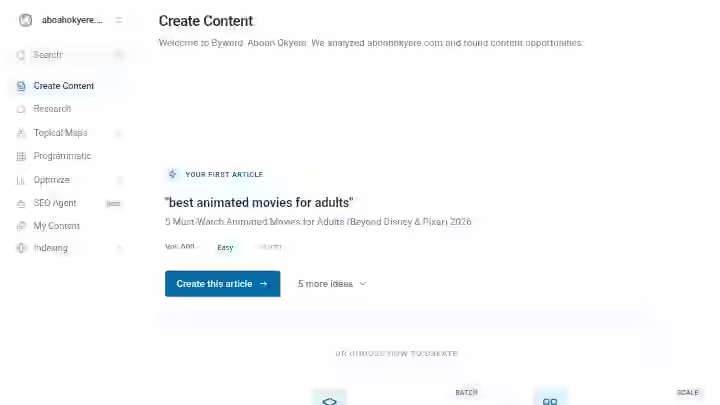
Byword AI is built specifically for affiliate marketers and programmatic SEO operators who need to generate high volumes of topically relevant content from keyword lists at a low per-article cost.
The $5/article pay-as-you-go model makes the cost calculation simple for high-volume campaigns. CSV keyword upload lets you queue 50 to 200+ articles at once, which removes the need for manual topic entry at scale.
The internal linking and meta tag generation runs automatically as part of each article job.
The tradeoff is content depth. Bulk generation is exactly where quality risk rises. Without strong review, templated or repetitive content can become a liability. Treat volume as a starting point, not a finished product.
Pros
- Low per-article cost at $5/article on pay-as-you-go
- Efficient bulk generation workflow for programmatic content operations
- Bulk generation across hundreds of affiliate-intent keywords is where Byword is specifically built to work
- Simple, fast setup with no complex onboarding
Cons
- Content quality at high volumes requires spot-checking before bulk publishing
- Less suitable for brand-led, thought leadership, or YMYL content
- No built-in backlink building or AI search visibility tracking
- Research depth does not match Outrank.so for competitive informational queries
Pricing: Byword AI offers three plans: Starter at $99/month (25 articles), Standard at $299/month (80 articles), and Scale at $999/month (300 articles), with 17% savings on annual billing and 5 free articles to start.
Best for: Affiliate marketers and programmatic SEO operators running long-tail keyword campaigns.
Not ideal for: Brands needing editorial control, YMYL content or AI search visibility features.
Read the Byword AI review for the full breakdown.
10. RankPill for Automated SEO Workflows
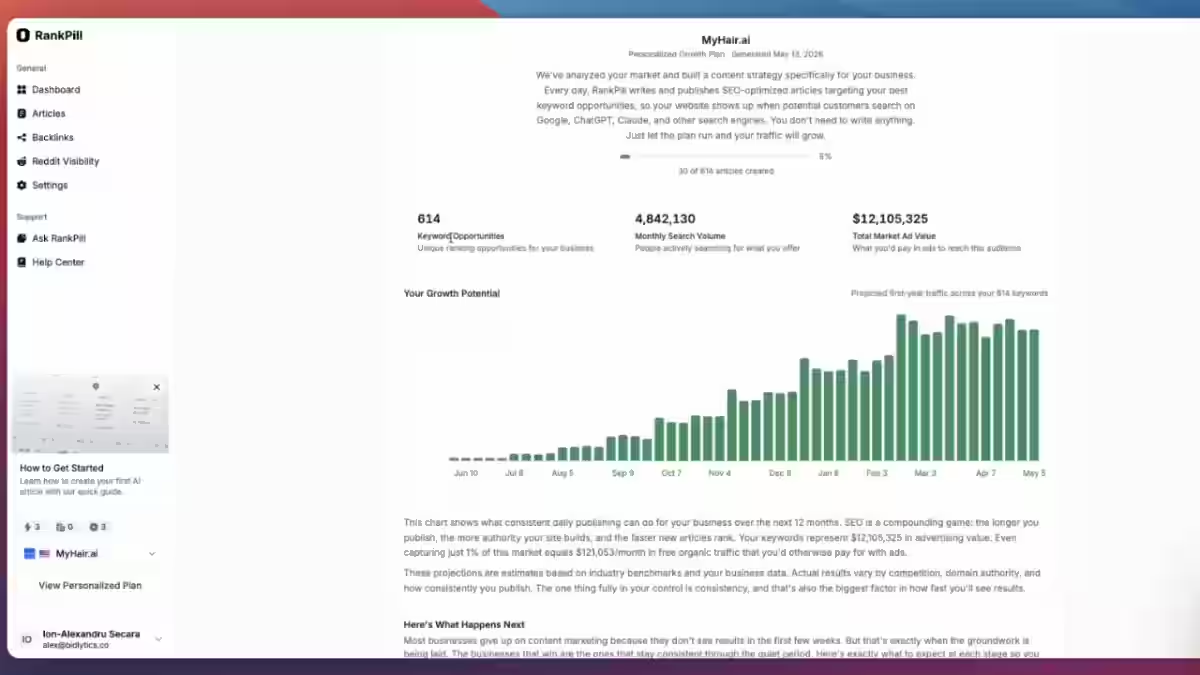
RankPill is best for small businesses and content teams that want automated SEO workflow management with backlink credits included at the base plan, and can commit to a 15-minute human review per article.
The platform identifies ranking opportunities through automated website analysis, then generates content and publishes it daily across your connected CMS platforms.
The 30 backlink credits per month included at the base plan is genuinely unusual at this price point and adds link-building value without a separate subscription.
Content quality can be inconsistent across technical niches, which means treating RankPill as a draft engine with a mandatory review step rather than a fully hands-off publisher.
Pros
- Backlink credits included at the base plan, which is unusual at $99/month
- Solid on-page SEO automation for teams that do not want to manually optimize every post
- Daily publishing keeps content cadence consistent without manual scheduling
- Solid choice if you need daily publishing across multiple CMS platforms in a single subscription
Cons
- Content quality can be inconsistent across technical niches, requiring a review layer
- Best used on a test site as a draft engine with a mandatory human review step
- No white-label reporting for agencies
- Mixed user feedback on content quality consistency
Pricing: RankPill is priced at $49.5/month for first month then $99/month or $990/year, which works out to $82.50/month.
Best for: Small businesses wanting daily automated publishing with included backlink credits.
Not ideal for: Fully hands-off workflows or agencies needing multi-site management and client reporting.
11. Frizerly for Automated Business Blogging
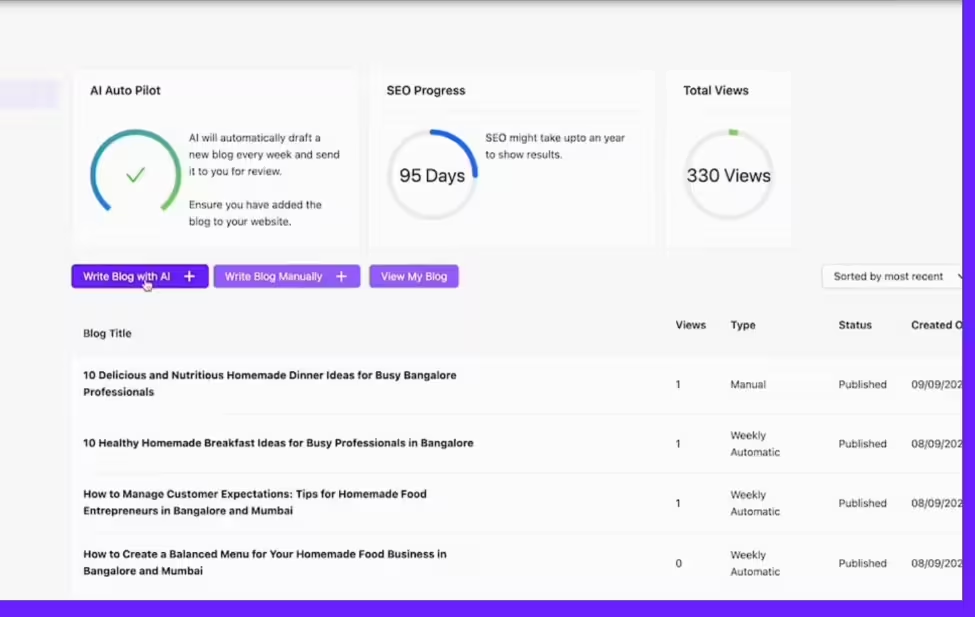
Frizerly is the simplest setup on this list and the best entry point for small business owners who want automated blogging without a technical learning curve.
It connects to your website, researches content opportunities, generates SEO-optimized articles, and publishes them automatically to WordPress, Shopify, Webflow, and other major platforms.
The Google Search Console OAuth integration pulls impressions, clicks, and position data into the dashboard within 48 hours of connecting.
Frizerly ranks 11th not because it’s a poor product, but because its feature set is deliberately lightweight. It doesn’t include backlink building, advanced technical SEO audits, or the kind of scalability that agencies need.
For a small business owner running one site, those missing features probably don’t matter.
Pros
- Fast, low-friction setup suited to non-technical users
- Daily auto-publishing on Pro plan keeps content cadence consistent
- Google Search Console integration provides basic performance tracking
- Good value for small businesses that do not need advanced workflow features
Cons
- Not suited for high-authority publishers needing deeply cited, original research articles or for agencies running technical SEO audits for enterprise clients
- No built-in backlink building
- Content depth may not hold up in highly competitive niches
- Less scalable for agencies managing multiple domains simultaneously
Pricing: Standard at $49/month ($29/month billed annually). Pro at $149/month ($99/month billed annually). Pro SEO + Social at $199/month ($149/month billed annually).
Best for: Small business owners and niche bloggers who want consistent blogging without setup complexity.
Not ideal for: Competitive niches needing deep citation-backed content or agencies managing multiple domains.
Read the full Frizerly review for all features and plan details.
How I Tested and Ranked These Autoblogging Tools
I did not rank these platforms simply by the number of features they advertise.
Each tool was evaluated according to how effectively it can automate a real-world blogging workflow while maintaining SEO quality, publishing control, usability, and value.
Here is how I separated hands-on testing from research:
- Hands-on testing: Keytomic, BabyLoveGrowth AI, WordRocket AI, RightBlogger, Outrank.so, Byword AI, Soro SEO and the rest were all tested in active publishing workflows.
- Product research: They were assessed through official documentation, third-party reviews, and verified user feedback on G2 and Trustpilot.
- Pricing research: All pricing data was verified against current public documentation as of 2026.
- SEO workflow performance: Where available, I tracked organic traffic changes using Ahrefs and Google Search Console over 30 to 90-day periods.
The scoring framework weighted the following criteria:
Criterion | Weight |
|---|---|
SEO Automation | 25% |
Content Quality | 20% |
Publishing Automation | 20% |
Pricing and Value | 15% |
Ease of Use | 10% |
Scalability | 10% |
How to Choose the Best Autoblogging Tool
1. Define How Much You Want to Automate
The answer to this question determines your shortlist before you even look at pricing. The autoblogging tools in this guide cover different levels of automation:
- AI writing only (RightBlogger, WordRocket AI): You provide the keyword strategy; the tool drafts the content.
- SEO automation + content (Outrank.so, BlogSEO.io): Keyword discovery and generation are handled, but publishing requires your input.
- Full content workflow (Keytomic, BabyLoveGrowth AI, Soro SEO, Frizerly): Research, generation, optimization, and publishing run automatically after setup.
- Content + backlinks + AI visibility (Keytomic, BabyLoveGrowth AI, Distribb): The full post-publish layer is also automated.
If you want to understand the full range of options before committing, see the autoblogging vs. hybrid blogging comparison.
2. Consider Your Content Volume
Volume needs and tool design are not always aligned:
- 1 to 5 articles/month: Any tool works, but you are overpaying for high-volume platforms.
- 10 to 30 articles/month: The sweet spot for most subscription tools (BabyLoveGrowth AI, Keytomic, RankPill, Soro SEO).
- 50 to 200+ articles/month: Bulk tools like Byword AI or WordRocket AI with BYOK pricing make more financial sense.
- 500+ articles/month (programmatic): Byword AI’s CSV bulk generation or Autoblogging.ai’s batch mode are specifically designed for this level.
3. Evaluate SEO Automation Capabilities
Before committing, check whether the platform handles:
- Keyword targeting and search intent matching
- SERP analysis and competitor gap identification
- Internal linking automation
- Schema markup generation
- Meta description and title tag optimization
- Content update and refresh workflows
Not all autoblogging tools cover all of these. Keytomic covers the most in one platform. Outrank.so covers SERP analysis most thoroughly.
4. Check CMS and Publishing Integrations
Always verify CMS compatibility before subscribing. The platforms in this list have varying CMS support:
- WordPress: Supported by all 11 tools
- Webflow: Supported by Keytomic, BabyLoveGrowth AI, Outrank.so, Distribb, Frizerly, Byword AI
- Shopify: Supported by Keytomic, BabyLoveGrowth AI, Soro SEO, Frizerly
- Wix: Supported by Keytomic, BabyLoveGrowth AI
- HubSpot CMS: Supported by Keytomic
Confirm CMS compatibility before committing. If you are on Webflow or Shopify, most WordPress-first tools will not serve you.
For more technical integration context, see the guide on AI blog automation WordPress plugins.
5. Consider How Much Human Editing You Need
This is where most buyers underestimate the real cost of automation. The sticker price of $99/month becomes $140/month in effective cost if each article requires 30 minutes of editing from a $40/hour editor.
Before scaling any autoblogging tool, evaluate:
- Accuracy: Does the generated content make factual claims you can verify?
- Brand voice: Does it read like your business, or like generic AI output?
- Research quality: Does it cite sources? Can you defend the claims?
- Editing time: How long does each article take to review and approve?
I run a mandatory 10-minute spot-check on every auto-generated article before it goes live, regardless of the tool.
6. Evaluate Scalability
Ask whether the platform can support:
- Multiple websites in one subscription
- Larger content volumes without a proportional price jump
- Team seats and workflow collaboration
- White-label reporting for client delivery
- International content in multiple languages
- Automated content maintenance for existing articles
BabyLoveGrowth AI has the clearest agency tier. Keytomic offers per-project pricing with a 10% discount for multiple sites. RightBlogger covers team use on its Business plan.
7. Test Content Quality Before Scaling
The single most important step before activating large-scale automation: publish 5 to 10 test articles, monitor performance in Google Search Console for 4 to 6 weeks, and evaluate quality against your editorial standards.
Scale only after the quality floor meets your threshold. This is not optional.
Google emphasizes creating helpful, reliable, people-first content and uses E-E-A-T, particularly experience, expertise, authoritativeness and trustworthiness, as part of its guidance for evaluating content quality.
Automated content that does not meet that bar, regardless of publishing volume, will not perform consistently.
Autoblogging Tools and AI Search Visibility: Why This Now Matters
Something that didn’t exist as a consideration 3 years ago now affects how you evaluate autoblogging tools: AI search visibility.
Google AI Overviews, ChatGPT search and Perplexity are increasingly the first place users encounter answers to their questions. If your content isn’t structured to be cited by AI engines, you’re missing a growing portion of organic discovery.
The most effective platforms for automated blogging combine deep integration with your website, advanced SEO practices, and unique features such as AI citation optimization.
As brands increasingly compete to be recognized by AI answer engines like ChatGPT, Gemini, and Perplexity, using tools with built-in visibility enhancements is vital.
Keytomic and BabyLoveGrowth AI both include AI citation tracking in their base plans. Soro SEO structures content to improve visibility across AI search platforms. Frizerly includes an AEO/GEO dashboard on its Pro plan.
How to Build a Safe Autoblogging Workflow for SEO
Here’s the practical workflow I use and recommend:
Before You Start Publishing
- Map your keyword clusters: Group related topics by intent (informational, commercial, transactional) and assign one primary keyword per article to prevent cannibalization
- Set up internal linking rules: Decide which posts link to which before publishing starts, not after
- Connect your CMS properly: Verify the integration works on a test post before scheduling bulk publishing
- Define your review checklist: What does every article need before it goes live? Minimum: factual accuracy check, brand voice review, internal link verification
During Publishing
- Review every article before it goes live: Even a 10-minute review catches factual errors, removes generic AI transitions, and lets you add one original insight per post
- Publish at a pace Google can index comfortably: Start with a manageable publishing cadence, review the output, monitor indexing and organic performance, and increase volume only when the workflow consistently produces useful content.
- Monitor crawl coverage in Google Search Console: Watch for indexing anomalies early, not six months in
After Publishing
- Track performance in Google Search Console at 60 and 90 days: Identify which posts are gaining impressions and which are getting zero clicks
- Update or consolidate low-performing articles at 6 months: Content that doesn’t gain traction in six months is either targeting the wrong keyword or missing depth
- Run a content audit before scaling further: Don’t add 20 more articles to a site that has indexing problems with the first 20
If you’re using RSS feeds as a content source for autoblogging, the guide on RSS feeds for autoblogging covers how to use them without creating duplicate content issues.
Autoblogging vs. AI Writing vs. SEO Automation
Although AI writing, autoblogging and SEO automation are often used interchangeably, they solve different problems.
AI writing focuses primarily on generating content, autoblogging extends that process into automated publishing, while SEO automation covers a much broader set of search optimization tasks.
Understanding the difference matters because choosing a tool based only on its AI writing capabilities can leave important parts of your content workflow manual.
| Approach | Primary purpose | Typical automation | Best for |
|---|---|---|---|
| AI writing | Generate articles and other content | Content drafting | Bloggers, writers and content teams |
| Autoblogging | Research, generate and publish content | Content workflow + publishing | Site owners scaling regular publishing |
| SEO automation | Automate broader SEO processes | Research, optimization, monitoring and maintenance | SEO professionals, agencies and businesses |
AI Writing
AI writing tools primarily help you create content faster. You provide a topic, keyword, prompt or content brief, and the software generates a draft.
Depending on the platform, AI writing can include features such as:
- Article and blog post generation
- Product reviews and comparisons
- Content rewriting
- Outlines and content briefs
- Meta titles and descriptions
- Social media content
- Brand voice customization
The main limitation is that AI writing does not necessarily automate the entire publishing workflow.
You may still need to perform keyword research, evaluate search intent, edit the article, add internal links, optimize the page and publish it yourself.
Tools such as RightBlogger and WordRocket AI are closer to this model, although both offer additional automation beyond basic writing.
Autoblogging
Autoblogging takes AI content generation a step further by automating the process of getting content onto your website.
A modern autoblogging workflow can include:
- Keyword or topic discovery
- Search intent analysis
- Content generation
- On-page SEO optimization
- Internal linking
- Image generation or selection
- Schema and metadata
- CMS publishing
- Content scheduling
- Performance monitoring
The defining characteristic is workflow automation.
Instead of using AI simply to write an article, an autoblogging platform can move that article through multiple stages of the publishing process with limited manual intervention.
However, more automation does not automatically mean better SEO. You still need to verify factual accuracy, search intent, originality, usefulness and editorial quality before scaling production.
SEO Automation
SEO automation is broader than autoblogging. It can include content creation, but its purpose is to automate repetitive SEO operations across the entire website.
An SEO automation platform may handle:
- Keyword research
- Competitor and SERP analysis
- Content planning
- On-page optimization
- Internal linking
- Technical SEO monitoring
- Schema implementation
- Rank tracking
- Search Console analysis
- Content updates
- Backlink monitoring
- AI search visibility tracking
This makes SEO automation particularly useful for businesses, agencies and publishers managing larger websites.
A platform can therefore be an effective SEO automation tool without being a traditional autoblogging platform, just as an autoblogging tool can automate publishing without providing the depth of technical SEO functionality found in dedicated SEO platforms.
Which One Should You Use?
The right choice depends on what you actually want to automate.
Choose AI writing if you mainly need help producing drafts and want to retain control over research, editing and publishing.
Select autoblogging if your primary goal is to scale a repeatable content workflow from topic discovery through CMS publishing.
Pick SEO automation if you want to automate broader search optimization tasks beyond content production, such as technical SEO, internal linking, performance monitoring and content maintenance.
For many publishers, the most effective approach is not choosing one category exclusively. A hybrid workflow can use AI to accelerate content production, automation to handle repetitive publishing tasks, and human oversight for strategy, fact-checking and editorial quality.
The key distinction is simple: AI writing automates the writing, autoblogging automates the publishing workflow, and SEO automation automates a broader portion of the SEO operation.
Frequently Asked Questions About Autoblogging Tools
What are the best autoblogging tools?
The best autoblogging tools in 2026 are Keytomic (best overall SEO automation), BabyLoveGrowth AI (best for content + backlinks), and WordRocket AI (best for high-volume, low-cost scaling). The right tool depends on your publishing volume, automation preference, and budget.
What is the best autoblogging tool?
Keytomic is the best autoblogging tool overall based on its end-to-end SEO automation, which covers keyword research, content generation, auto-publishing, auto-indexing, schema markup, and AI search visibility tracking in one $99/month subscription.
Are autoblogging tools good for SEO?
Autoblogging tools are good for SEO when used within a structured content strategy with human editorial oversight. They accelerate content production, maintain publishing consistency, and can improve crawl frequency signals. Autoblogging is effective in 2026 when it is paired with a content strategy, editorial review, and proper SEO setup.
Can autoblogging tools create original content?
Autoblogging tools generate text that is not plagiarized, but it is not genuinely original in the sense of first-hand experience, primary research, or expert insight. The content is synthesized from patterns in training data and, in some tools, live web sources. Originality in a competitive SEO context requires adding information the reader cannot find in the top 10 results and that still requires human input for most topics.
Are autoblogging tools safe to use?
Autoblogging tools can be used safely, but automation itself doesn’t guarantee SEO compliance or content quality. The main risks come from publishing inaccurate, unhelpful, repetitive or scaled content without appropriate review.
Can autoblogging tools replace human writers?
Autoblogging tools replace repetitive drafting tasks, not human editorial judgment. They can produce a usable first draft in minutes, but accuracy checking, brand voice alignment, original perspective, and quality control still require human involvement.
Can autoblogging tools update old articles automatically?
Some autoblogging platforms include automated content maintenance. Frizerly uses Google Search Console data to flag underperforming articles and suggest updates. Keytomic’s content calendar can be configured to revisit existing content. BabyLoveGrowth AI focuses on new content production rather than updates. For a systematic content refresh workflow, most tools still require manual initiation of the update process, though the draft-and-optimize step can be automated.
What is the best autoblogging tool for beginners?
For beginners, RightBlogger at $59/month is the most accessible starting point. It includes 90+ blogging tools, an intuitive interface, unlimited article generation, and a Site Agent for ongoing SEO guidance.
What is the best autoblogging tool for agencies?
BabyLoveGrowth AI’s agency tier is the strongest options for agencies managing multiple client sites. BabyLoveGrowth AI includes backlink building and AI visibility tracking at the base price, which makes the value case for clients easier to demonstrate.

- Clearpost AI Review 2026: I Tested It for 30 Days & Found Some Limitations - August 19, 2026
- ProfitTree Review 2026: My 30-Day Test Results, Flaws & Verdict - August 18, 2026
- 7 Best Autoblogging Tools for End-to-End Publishing (Tested & Ranked) - August 17, 2026